We’ve tested and compared the top online brokers available in Europe, so you don’t have to.
In this guide, we break down fees, platforms, regulation, and product range across nine brokers, whether you’re a first-time investor looking for simplicity or an experienced trader after tight spreads and advanced tools.
From commission-free ETF investing to advanced forex platforms, each broker on this list stands out for a different reason. Here’s what we found.
Best brokers in Europe
- eToro: Best broker for commission-free ETF investing and social trading. Offers a welcome bonus up to $500 for new users (T&Cs apply).
- Interactive Brokers: Best EU broker overall
- XTB: Best broker for low forex spreads
- Lightyear: Best for beginners and ETFs. New users earn a free share worth up to €100 with the promo code INVESTINGINTHEWEB
- Pepperstone: Best app for CFDs
- Freedom24: Best for ETF Investment plans and US stock options. New clients can get up to 20 gift shares (T&Cs apply).
- DEGIRO: Best broker in Europe for long-term investors
- Saxo Markets: Best European broker for professionals
- Trading 212: Best broker for beginners and auto-invest
Disclaimer: Investing involves risk of loss.

55% of retail CFD accounts lose money.


69-80% of retail CFD accounts lose money.

Terms apply, seek guidance if necessary. When you invest, your capital is at risk.

74-89% of retail CFD accounts lose money.

Investing involves risk of loss.

Investing involves risk of loss.

62% of retail CFD accounts lose money.

Capital at Risk. Sponsored Link. To get free fractional shares worth up to 100 EUR/GBP, you can open an account with Trading 212 through this link. Terms apply.
Best brokers in Europe – Comparison table




Other resources
- Check our Youtube channel! You will find step-by-step guides of how to invest in the S&P 500 on different apps, as well as other educational videos about investing and investment platforms.
- Explore our tools: Check our comparison tool, reviews, broker bonuses, broker interest rates, BrokerMatch, and others.
Broker reviews
#1 Interactive Brokers: Best online broker in Europe overall
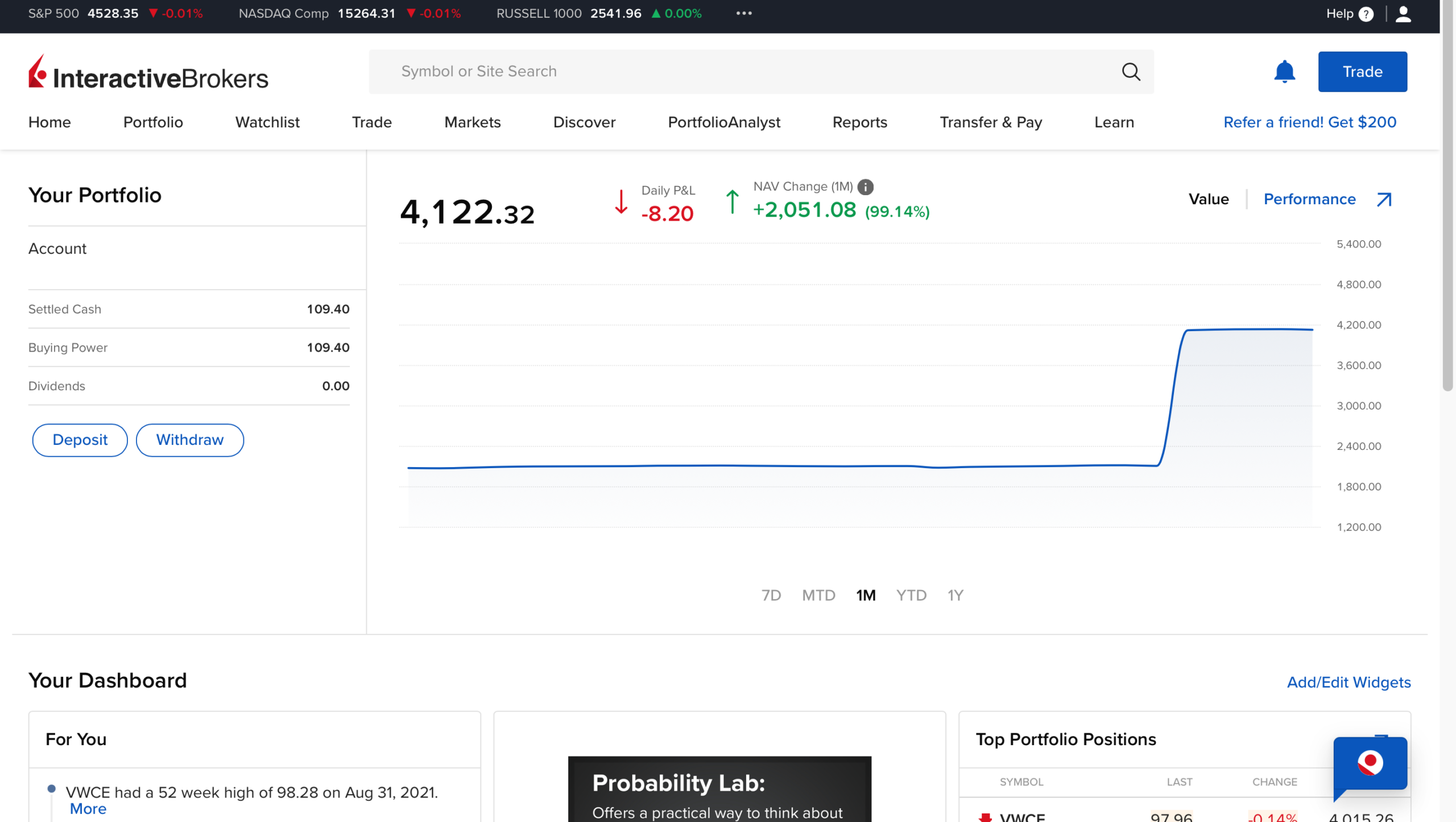
Interactive Brokers leads the list as the best online broker in Europe. Founded in 1978, Interactive Brokers is one of the largest international brokers, listed on NASDAQ (ticker: IBKR) and a constituent of the S&P 500 since August 2025. It is regulated by multiple top-tier authorities including the FCA (UK), Central Bank of Ireland (CBI), ASIC (Australia), and SEC and FINRA (US), with no minimum deposit requirement. The broker serves around 4.7 million client accounts (March 2026) across 170+ markets.
Interactive Brokers supports more than 20 account base currencies including GBP, USD, EUR, CHF, and other major currencies. Funding is primarily via bank transfers (SEPA, Faster Payments, wire), though debit card deposits are available in some jurisdictions. They offer one of the tightest spreads in the market alongside best-execution routing through IB SmartRouting. Commissions are tier-based, varying with monthly trading volume:
- US stocks (IBKR Pro): $0.0035 per share, $0.35 minimum per order, capped at 1% of trade value.
- European stocks/ETFs: 0.05% of order value (€1.25 minimum, €29 maximum).
- US options: $0.65 per contract ($1 minimum per order).
- FX conversion: 0.002% of the trade value with a $2 minimum, one of the lowest in the industry.
For investors who prefer trading on the go, Interactive Brokers offers several mobile applications:
- IBKR Mobile: the full-featured app with advanced order types, options chains, real-time data, and multi-currency portfolio views.
- IBKR GlobalTrader: a streamlined app for beginners with fractional shares from $1, automatic currency conversion, and a $10,000 virtual demo account to practise before going live.
- Impact: a values-aligned investing app for ESG-focused retail investors.
- Trader Workstation (TWS): the professional desktop platform with advanced charting, algorithmic order types, and customisable workspaces.
IBKR also offers interest on uninvested cash (paid at the full rate on accounts above $100,000 NAV, with rates linked to central bank policy) and the Stock Yield Enhancement Program (SYEP) for clients willing to lend out eligible securities for additional income.
On the downside, the platform’s depth can feel overwhelming for newcomers, with a steeper learning curve than simpler apps like Trading 212 or eToro. Fortunately, Interactive Brokers offers extensive educational resources through IBKR Campus (formerly Traders’ Academy), including video tutorials, courses, and webinars covering platforms, strategies, and asset classes.
Want to know more? Check out our comprehensive Interactive Brokers review and visit IBKR’s website.
Pros
- Low commissions on US stock trading
- No monthly inactivity fee
- The broadest product and markets range in the brokerage industry
- Demo account
- Excellent reputation (founded in 1978)
- Extensive research and Education tools
- Has a modern mobile trading app to trade Stocks, Options and ETFs, ideal for novice investors, IBKR GlobalTrader.
- Offers interest on uninvested cash balances
Cons
- Complicated and lengthy account opening process (but fully online)
- Steeper learning curve for beginners
- Website is difficult to navigate
- Interactive Advisors (Robo-advisor feature) is only available for US customers
#2 eToro: Best for commission-free ETF investing and social trading
55% of retail CFD accounts lose money.
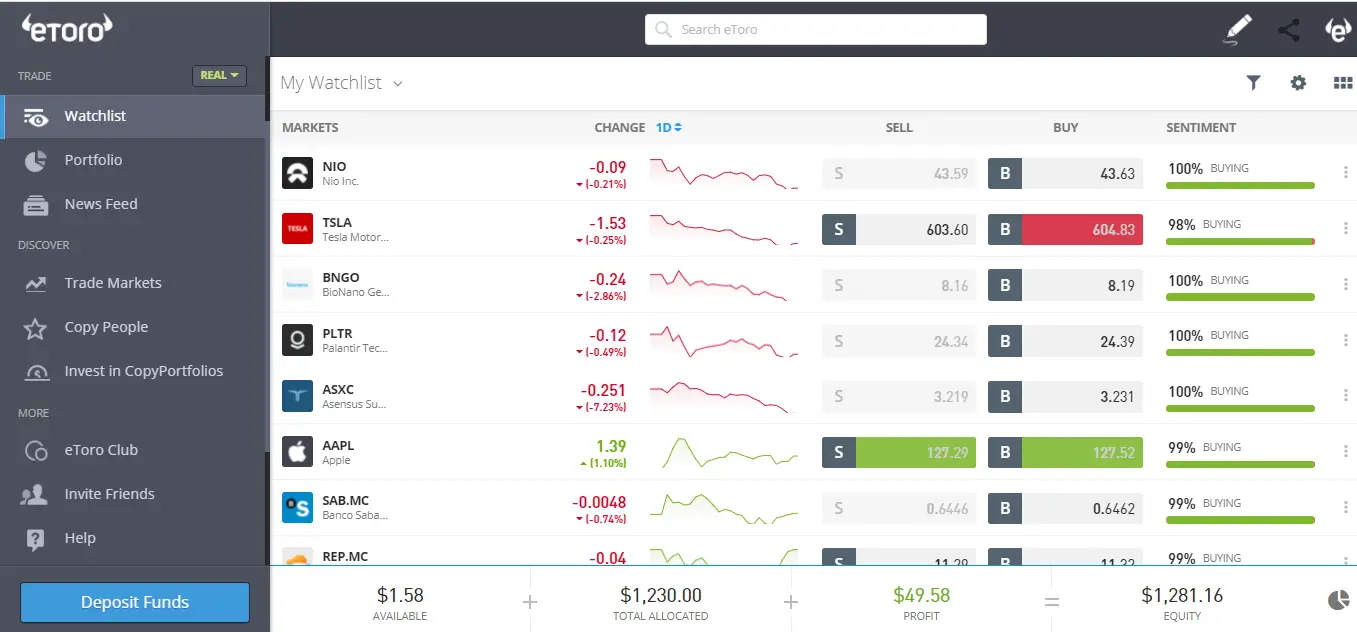
Another exceptional trading platform in Europe is eToro, a publicly traded social investing platform with over 40 million registered users across 140+ countries. The company listed on NASDAQ in May 2025 (ticker: ETOR), reinforcing its credibility and transparency. eToro is best known for its social trading feature, which allows users to copy the trades of experienced investors. There are thousands of verified Popular Investors on eToro, and you can select traders to follow based on past return on investment (ROI), risk score, asset allocation, or other criteria.
The eToro platform provides access to over 3,000 financial instruments, including real stocks (not CFDs), ETFs, cryptocurrencies, commodities, and indices. Additionally, users can invest in ready-made thematic portfolios called Smart Portfolios, which group together assets or traders around themes such as artificial intelligence, renewable energy, dividend-paying stocks, or sector-specific opportunities. New users can also benefit from a sign-up bonus: eToro offers a free asset for new users meeting deposit thresholds.
eToro offers commission-free ETF investing in Europe, while real stock trades carry a flat commission of $1 to $2 per trade depending on the exchange (other fees apply). European investors can also earn interest on uninvested USD cash, with the rate depending on their eToro Club tier and linked to US Federal Reserve policy. Account opening and funding are quick and straightforward, and you can practise with a $100,000 virtual demo account before committing real capital.
On the downside, spreads can be relatively high for some products (particularly forex and crypto), withdrawals from the USD account cost $5, and a $10 monthly inactivity fee applies after 12 months without logging in. eToro is regulated by top-tier authorities globally, including the FCA (UK), CySEC (Cyprus), ASIC (Australia), and SEC and FINRA (US). European clients are typically served by eToro (Europe) Ltd, authorised and regulated by CySEC and passported across the EEA under MiFID II, with client funds protected up to €20,000 under the Cyprus Investor Compensation Fund (ICF).
If you want to learn more, check out our eToro review.
Pros
- Low stock trading fees (from $0 per trade)
- Commission-free ETFs (other fees apply)
- Social trading and other innovative products
- Wide variety of financial products
- Slick, modern, and easy for anyone to use
- European users have access to three account currencies: EUR, USD and GBP
- Top tier regulators
Cons
- Limited disclosed financial information
- Withdraw and inactivity fees
- Spread, overnight, inactivity, and currency conversion fees higher than average
- Doesn’t offer bonds, futures, or options
#3 XTB: Best broker for low forex spreads
69-80% of retail CFD accounts lose money.
Founded in 2002, XTB is a major player in the European brokerage industry serving more than 2 million clients at the end of 2025. The company is publicly listed on the Warsaw Stock Exchange (ticker: XTB) and regulated by multiple top-tier authorities including the FCA (UK), KNF (Poland), CySEC (Cyprus) and DFSA (Dubai).
The platform offers 0% commissions on real stocks and ETFs up to €100,000 monthly trading volume (0.2% commission applies above that threshold, with a €10 minimum per order). While XTB’s xStation 5 platform supports a wide range of asset classes, it is particularly well-suited to active CFD and forex traders, offering competitive spreads and advanced tools across all asset classes.
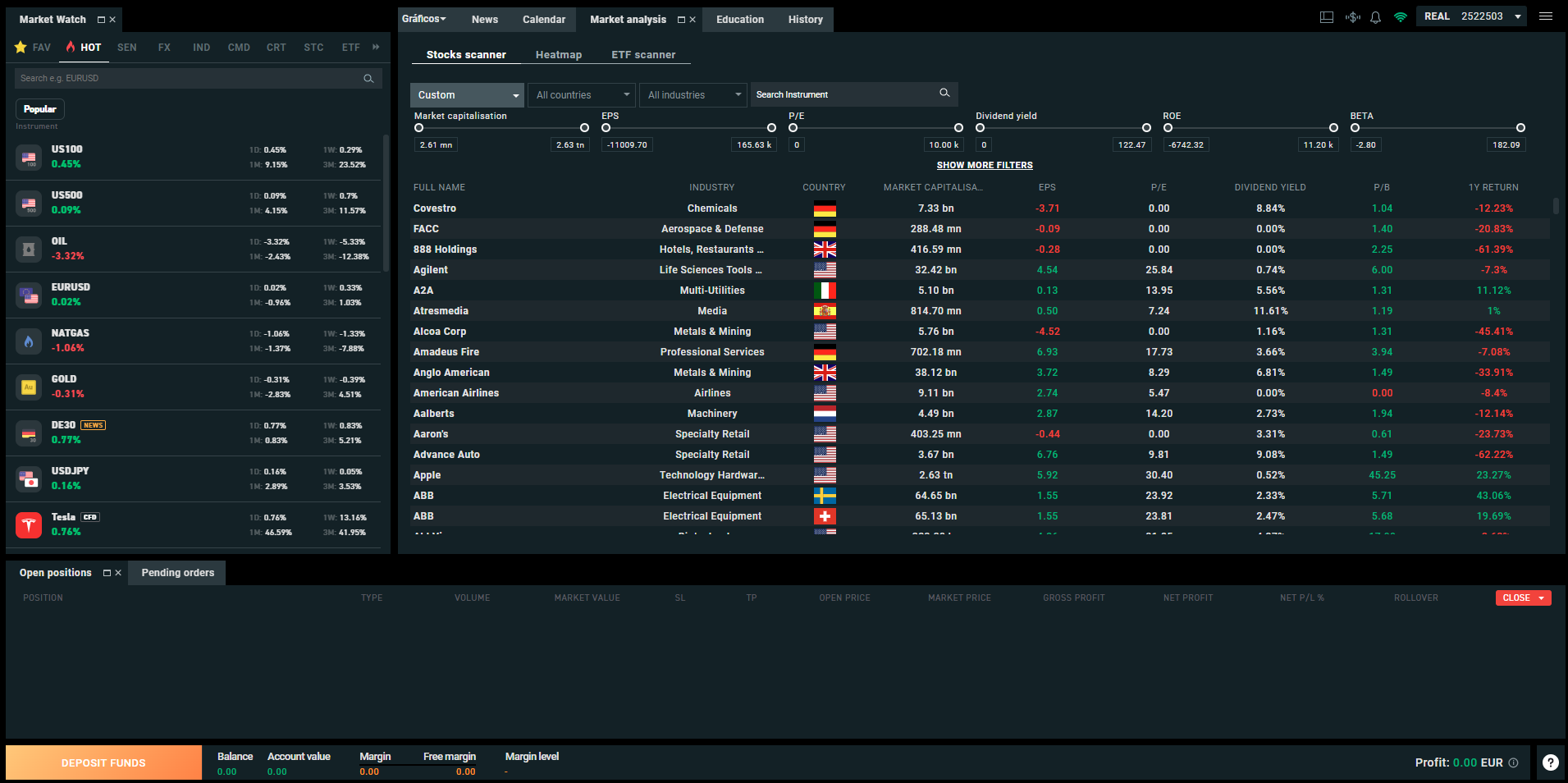
Opening an account and transferring funds is a quick and hassle-free process. For beginners, XTB provides a demo account where you can trade with virtual money to test the platform firsthand, plus comprehensive educational tools through the XTB Trading Academy (video courses, webinars, and market analysis). For intermediate and advanced investors, the platform offers extensive technical and fundamental analysis tools to support trading decisions.
XTB’s product range includes 5,300+ real stocks, 1,300+ ETFs, 70+ forex pairs, commodities, indices, and cryptocurrency CFDs. Additional features include Investment Plans for automated ETF investing, interest on uninvested cash in eligible countries, and vanilla options on US stocks (launched in January 2026, covering 110 US stocks and ETFs, with no per-contract commission and a 0.25% markup built into the premium). These options are buy-only and are not available in every country.
On the downside, XTB charges relatively high spreads on cryptocurrency CFDs (although forex spreads are competitive), and an inactivity fee of €10/month applies when there has been no trading for 365 days and no deposit in the previous 90 days. There is also a 0.5% currency conversion fee on trades in non-base currencies.
Still have doubts? Go through our XTB review.
Pros
- Free stocks trading (only applicable to some countries)
- Customizable trading platform (charts and workspace)
- Low Forex Spreads
- Demo account
- No minimum account deposit
- Valuable education materials
- Top-tier Regulators
Cons
- Complex trading platform for a beginner
- High Stock CFD spreads
- Limited product portfolio
- Withdrawal fees for transfers below $100
- Inactivity fee (€10/monthly after 1+ year with no activity plus no deposit in the last 90 days)
#4 Lightyear: Best for beginners and ETFs
Terms apply, seek guidance if necessary. When you invest, your capital is at risk.
Lightyear is a European investment platform operating via two regulated entities: Lightyear Europe AS, authorised and regulated by the Estonian Financial Supervision and Resolution Authority (EFSA, licence number 4.1-1/31), and Lightyear UK Ltd, authorised and regulated by the Financial Conduct Authority (FCA). EU clients benefit from up to €20,000 protection under the Estonian Investor Protection Sectoral Fund, while UK clients are covered by the FSCS up to £85,000.
Lightyear offers a competitive fee structure:
- ETFs: no Lightyear execution fees (fund manager fees still apply).
- Stocks: commissions capped at €/$/£1 per order (0.1% on US stocks, with a $0.10 minimum).
- FX conversion: 0.35%, minimised through Lightyear’s multi-currency account in EUR, GBP, and USD.
- Interest through Money Market Funds managed by BlackRock or J.P. Morgan, depending on the country: EUR 2.22% or 2.24%, GBP 3.82% or 3.84%, USD 3.70% or 3.67% (AER/APY, net, variable, as of 25 August 2026). Money market funds are investments, not bank deposits.
- Crypto-assets: 0.45% per trade for EU clients.
The investment platform is well-suited to beginners and intermediate investors who want to build long-term diversified portfolios through fractional shares. With an easy-to-use mobile and desktop app and access to 6,000+ stocks and ETFs across 16 stock exchanges (US, UK, European, and Asian markets), ETFs from leading providers (iShares, Vanguard, Invesco, HSBC, Amundi, Xtrackers), and EU and UK government bonds, Lightyear provides solid exposure to global capital markets.
Lightyear also offers a free share worth up to €100 with our promo code INVESTINGINTHEWEB.
UK investors can also benefit from Lightyear’s Stocks and Shares ISA and Cash ISA. Plans enable automated goal-based investing across customisable stock and ETF portfolios, and Lightyear AI provides contextual portfolio insights.
There are, however, some product gaps to be aware of: the platform does not offer options, futures, forex, CFDs, mutual funds, or SIPP accounts, and there is no demo account for paper trading. GBP-denominated UK stocks are not available as fractional shares (only whole-share purchases on these), which is a notable limitation for UK investors wanting to access expensive London-listed names with small amounts.
To know more about the platform, check out our Lightyear review.
Pros
- 0% Lightyear execution commission on ETF trading (other fees, like fund manager and FX fees, may apply)
- No account opening, inactivity, or withdrawal fees
- High interest on EUR, USD & GBP through MMFs
- Free multi-currency account
- Minimum deposit of €/£/$1
- Fractional Shares
- Account opening promotion with the promo code INVESTINGINTHEWEB
- You can automate your investments with "Plans"
Cons
- Limited financial instruments (no options or futures; commodities only via ETCs such as gold, silver and copper; bonds limited to a small Baltic selection)
- No demo account
- Only available in 25 european countries (not available internationally)
- 0.35% currency conversion fee (0.10% for UK GIA and ISA accounts)
Disclaimer: Capital at risk. The provider of investment services is Lightyear Financial Ltd for the UK and Lightyear Europe AS for the EU. Terms apply: lightyear.com/terms. Crypto-assets are high-risk and volatile. Seek qualified advice if necessary.
#5 Pepperstone: Best for CFDs
74-89% of retail CFD accounts lose money.
Established in 2010 in Melbourne, Pepperstone has become one of the world’s largest CFD and forex brokers, covering 1,350+ instruments (CFDs on forex, indices, commodities, shares, ETFs, and cryptocurrencies, plus spread betting for UK clients).
Pepperstone is regulated by multiple top-tier financial authorities, including FCA (UK), CySEC (Cyprus), ASIC (Australia), BaFin (Germany), DFSA (Dubai), CMA (Kenya), SCB (Bahamas), and SCA (UAE). In the UK and EEA, leverage is capped at 30:1 on major forex pairs and lower on other instruments under FCA and ESMA rules.
The broker is best known for its strong execution standards, tight spreads (raw spreads from 0.0 pips on the Razor account, with a commission from $3.50 per lot per side), and broad platform support: MT4, MT5, cTrader, and TradingView integration.
Pepperstone won the IITW Best MT4/MT5 Broker Award 2026 and is well rated by users on Trustpilot and on the App Store and Google Play.
On the downside, Pepperstone focuses exclusively on CFDs and spread betting (no real shares, ETFs, or direct cryptocurrency ownership) and offers no interest on uninvested balances, a feature available at several competing platforms.
Pepperstone is best for traders focused on CFDs and forex. It is endorsed by the r/Forex subreddit, the largest forex community on the internet, alongside Interactive Brokers, further attesting to its credibility in the forex and CFD community.
Check our in-depth Pepperstone review for more.

Pros
- Quick customer support response times
- No fees for deposits, withdrawals, or account inactivity
- Competitive spreads in the Razor account with active trader rebates
- Higher leverage options are available depending on region and client categorization
Cons
- Limited to CFD trading; no direct asset ownership
- Higher Forex spreads in the standard account
- Crypto CFDs offerings are limited compared to competitors
- Limited educational resources
#6 Freedom24: Best for ETF Investment plans and US stock options
Investing involves risk of loss.
Freedom24 is operated by Freedom Finance Europe Ltd, licensed by the Cyprus Securities and Exchange Commission (CySEC) since 2015 and passported across the EEA under MiFID II. It is part of Freedom Holding Corp. (NASDAQ: FRHC) and provides access to more than 1 million instruments on 15 exchanges in Europe, Asia and the US, including stocks, ETFs, bonds, and US stock options.
Providing access to more than 3,600 ETFs, Freedom24 offers not only the most popular ETFs from global issuers like Vanguard, iShares, and Invesco, but also a broad range of investment strategies, including dividend-focused, short-term bond, and ESG-themed ETFs, as well as niche options such as covered call ETFs. If a specific ETF isn’t listed, clients can request its addition directly, a level of flexibility rarely found among European brokerage platforms.
For long-term investors, Freedom24 offers ETF Investment plans: you can invest in selected ETFs regularly (weekly or monthly) with €0 commission. The €0 fee applies only to purchases made within the Freedom24 Recurring Investment function, and other fees apply according to the Freedom24 Fee Schedule.
In selected countries (the Netherlands, Germany, Lithuania, Spain, Greece and Italy), clients can also ask their personal manager for investment advice, a service most brokers in this list do not provide because they are execution-only. The only prerequisite is completing the suitability test.
The platform’s web and mobile interfaces are intuitive and well-designed, complemented by market analysis from the InvestIdeas tab. New users can also benefit from a signup promotion of up to 20 gift shares, depending on the size of their first deposit.
With no minimum deposit, Freedom24 offers two pricing plans:
- Smart in EUR: €0.02 per share + €2 per order on US and European stocks and ETFs, and $0.65 per US option contract. It suits investors with lower trading volumes.
- All Inclusive in EUR: 0.5% of the trade value + €0.012 per share + €1.20 per order, and $3 per US option contract + €10 per order. It includes a personal account manager.
On the downside, it charges a €7 withdrawal fee, does not offer fractional shares and does not support cryptocurrency trading.
In the unlikely event that segregated client assets cannot be returned, Freedom24 falls under the Cyprus Investor Compensation Fund (ICF), which compensates non-returned investments up to €20,000.
Want to learn more? Check out our Freedom24 review or visit Freedom24 directly.
Pros
- Low commissions on stock and ETF trading
- No minimum deposit for general trading
- Demo trading
- Slick, modern, and easy for anyone to use
- No custody fee
Cons
- €7 per withdrawal
- No cryptocurrencies
Disclaimer: Investments always involve the risk of loss. The WELCOME promotion is subject to Terms and Conditions. Gift Shares are allocated randomly from a selection of eligible stocks, with higher-value shares awarded less frequently. Commission-free investing applies exclusively to specific recurring investment plans. Other fees apply according to the Freedom24 Fee Schedule. Options are complex financial instruments with a high risk of loss and are not suitable for all investors. Access to a specific financial instrument may depend on the suitability assessment.
#7 DEGIRO: Best broker in Europe for long-term investors
Investing involves risk of loss.
Founded in 2013 and part of flatexDEGIRO since 2020, DEGIRO is a low-cost European brokerage that has become very popular thanks to its competitive pricing. The group has 3.5 million customer accounts across 16 European countries, and the platform has built a reputation around its “do-it-yourself” philosophy, giving investors everything they need to manage their own portfolios. DEGIRO offers a wide range of financial assets including stocks, ETFs, bonds, options, futures, warrants, investment funds, and leveraged products (which are similar to but not identical to CFDs, more details here).
Key cost considerations:
- Core Selection ETFs: €0 commission when executed on Tradegate (a €1.00 flat handling fee for external costs still applies).
- US stocks: €1.00 commission per trade, plus the €1.00 handling fee.
- European stocks: €3.90 + €1.00 handling fee on most major exchanges.
- Annual connectivity fee: €2.50 per exchange (charged once per year for each foreign exchange you actively use).
- Options: €0.75 per contract on European exchanges and $0.75 per contract on US exchanges, plus a €5 monthly connectivity fee for US derivatives markets.
The web and mobile platforms are intentionally minimalist, efficient and straightforward, with a short learning curve. On the downside, the absence of in-depth fundamental research, the lack of price alerts in the app, the limited charting tools and the lack of fractional shares may frustrate more advanced or smaller investors.

In terms of safety, DEGIRO services are provided by flatexDEGIRO Bank SE, a German credit institution supervised by BaFin and the Deutsche Bundesbank, with AFM and DNB oversight for Dutch clients. In the unlikely event that segregated client assets cannot be returned, DEGIRO falls under the EdW German Investor Compensation Scheme, which compensates non-returned securities up to 90% with a maximum of €20,000.
Cash deposited into a DEGIRO Cash Account with flatexDEGIRO Bank is additionally protected up to €100,000 under the German Deposit Guarantee Scheme.
Still have doubts? Go through our DEGIRO review.
Pros
- ETF Core Selection: full range of ETFs/ETCs/ETNs on Tradegate (1,000+ products) for only the €/£1 handling fee, with no connectivity fee (external fees apply)
- User-friendly web and mobile app
- Wide range of investment options
- Education material: Investor’s Academy and Investing with DEGIRO
- Low overall commission structure
- No account opening, inactivity, or withdrawal fee
Cons
- 0.25% currency conversion fee (charged if you deposit or invest in a different currency than your base currency)
- €/£1 flat handling fee (charged in most transactions)
- €/£2.50 of connectivity fee (paid annually), per exchange where you’re invested
- Does not offer Forex or CFDs
- No ISA account (for UK residents)
- Low-quality customer support
- No interest paid on cash balances
#8 Saxo: Best broker in Europe for professional traders
62% of retail CFD accounts lose money.
Launched in 1992, Saxo (rebranded from Saxo Bank) is one of the most established names in the European brokerage industry, with a proven multi-decade track record. In March 2026, the Swiss private bank J. Safra Sarasin completed the acquisition of around 71% of Saxo Bank, and in July 2026 it agreed to buy the remaining stake (subject to regulatory approval). Saxo holds an A- credit rating from S&P and provides access to over 71,000 financial instruments through its proprietary platforms: SaxoTraderPRO (desktop) and SaxoTraderGO (web and mobile).
The product range includes stocks, ETFs, bonds, mutual funds, options, futures, CFDs, forex, and commodities, covering both cash and margin trading across global markets. Saxo also provides advanced research tools designed to support both long-term investing and active leveraged trading. Note that direct cryptocurrency trading is not offered, only crypto ETPs and CFDs.
Saxo’s account tiers are assigned according to your deposits or portfolio value, and the thresholds and names vary by country:
- Classic: no minimum deposit in most European markets, with access to tight spreads and 24/5 customer support.
- Platinum: from €/$200,000, with up to 30% lower trading fees and priority local-language support.
- VIP: from €/$1,000,000, with the best available pricing, access to trading experts, and exclusive event invitations.

Pricing varies by account tier and instrument. For example, a US stock order costs 0.08% of trade value (minimum $1) on Classic, dropping to 0.03% of trade value (minimum $1) on VIP. Accounts holding stocks, ETFs or bonds may also incur a custody or service fee, which differs by country, so check the pricing page for your market before opening an account.
Saxo Bank A/S is a fully licensed European bank supervised by the Danish Financial Supervisory Authority (Finanstilsynet). Saxo is a member of the Danish Guarantee Fund, which protects client cash deposits up to €100,000 and financial securities (stocks, ETFs, etc.) up to €20,000 per client. Saxo serves clients across 180+ countries through multiple regulated entities, including local branches in the Netherlands (the former BinckBank, with AFM oversight), the UK, Germany, Italy, France, and others.
Pros
- Excellent research materials
- Outstanding trading platforms (SaxoInvestor and SaxoTrader)
- Extensive range of investment products and commercial offers
- Long track record
- Supervised by worldwide top-tier regulators
Cons
- $0 in most countries; higher minimums in some regions (e.g. $5,000 in MENA)
- Fees higher than average
- Fee structure is complex
- Does not accept US residents
#9 Trading 212: Best broker for beginners and auto invest
Capital at Risk. Sponsored Link. To get free fractional shares worth up to 100 EUR/GBP, you can open an account with Trading 212 through this link. Terms apply.
Founded in 2004 in Sofia, Bulgaria, and now headquartered in London, Trading 212 is a fintech that has made retail investing more accessible through an intuitive mobile and web platform. The company serves more than 5 million clients, offering access to 10,000+ stocks and ETFs. Sponsored Code: to get free fractional shares worth up to €100, you can open an account with Trading 212 using the promo code “IITW”. Terms apply.
Trading 212 offers no commissions on stocks and ETFs (other fees may apply, see terms and fees), fractional shares from €1, and an automatic investing feature called Pies and AutoInvest. The platform also provides:
- Stocks and Shares ISA + Cash ISA: tax-wrapped accounts for UK residents.
- Interest on uninvested cash for clients who enable it. Terms apply, and rates change over time.
- Multi-currency accounts: hold balances in several currencies.
- Stock lending (opt-in).
- Customer support in multiple languages.
Account opening is quick and fully digital. A 0.15% FX fee applies when converting funds. Other fees may apply. On the downside, the product range has notable gaps, with no bonds, options, or futures.

Pies & AutoInvest is an execution-only service. Not investment advice or portfolio management. Automatic investing refers to executing scheduled deposits. You are responsible for all investment and rebalancing decisions.
When investing, your capital is at risk. If you enable interest, Trading 212 will hold your cash in qualifying money market funds and banks. Otherwise, your cash will be held only in banks. Interest applies on cash in an investment account. Terms apply.
Trading 212 operates through four regulated entities:
- Trading 212 UK Ltd, FCA-regulated (FRN 609146), with FSCS protection up to £85,000.
- Trading 212 EU GmbH, BaFin-regulated (licence 10109603), providing services across the EEA on a cross-border basis under MiFID II.
- Trading 212 Markets Ltd, CySEC-regulated (licence 398/21), with the Cypriot Investor Compensation Fund up to €20,000.
- Trading 212 AU PTY LTD, ASIC-regulated (AFSL 541122) for Australian clients.
If you want to learn more, check our Trading 212 review.
Pros
- Commission-free real stock, ETFs and crypto trading (other fees may apply. See terms and fees)
- AutoInvest & Pies feature (execution-only service, not financial advice)
- Fast and easy account opening process
- Demo account
- Top Tier Regulators
- Free fractional shares worth up to €100
- High interest on uninvested cash
Cons
- Limited product portfolio (no Options, Bonds, Mutual Funds or Futures)
- No relevant Fundamental tools
- 0.15% of Foreign exchange fees
Disclaimer: When investing, your capital is at risk and you may get back less than invested. Past performance doesn’t guarantee future results. Crypto-assets are high-risk and volatile. You could lose your invested capital, and these assets are not covered by protection schemes. Make sure you understand the risks before investing.
How to choose the best broker in Europe?
Choosing the right broker is one of the most consequential decisions for your long-term investment success. Here are the key factors to consider when evaluating European brokers:
- Regulation and investor protection: prioritise brokers regulated by top-tier European authorities like the FCA (UK), BaFin (Germany), CySEC (Cyprus), AFM (Netherlands), or CNMV (Spain). Verify the applicable investor compensation scheme: FSCS up to £85,000 in the UK or national schemes (typically €20,000 to €100,000) in the EU.
- Fees and total cost of ownership: compare not only headline commissions but also FX conversion fees, custody charges, inactivity fees, withdrawal costs, and platform fees. For investors trading US-listed stocks from EUR/GBP base accounts, FX fees can significantly affect long-term returns.
- Trading platforms: evaluate platform reliability, mobile app quality, order types supported, charting capabilities, and whether desktop and web versions are available. The best platform depends on your trading style (passive investing vs active trading).
- Product range: ensure the broker offers the asset classes you need, such as stocks, ETFs, bonds, options, futures, mutual funds, or specific markets (LSE, Euronext, Xetra, etc.). Some brokers excel at specific categories (e.g., Pepperstone for forex and CFDs, IBKR for global breadth, Saxo for premium service).
- Tax-efficient accounts: UK investors should consider whether the broker offers Stocks and Shares ISAs and SIPPs. EU investors may want brokers with local tax reporting support.
- Interest on uninvested balances: increasingly important given current interest rates, so look for brokers offering competitive rates on EUR, GBP, and USD cash.
- Customer support quality: test response times and language coverage before committing significant capital. Multi-language support and 24/5 (or 24/7) availability are important for international investors.
- Reputation and track record: review user feedback on Trustpilot, App Store, and Google Play, plus the broker’s history of platform outages, regulatory actions, and corporate stability.
By considering these factors carefully, you can choose the European broker that best matches your investment goals, risk tolerance, and financial situation.
Which platform should you choose?
The best online broker in your specific case will depend on your profile, preference, and objectives. Explore the websites above and decide for yourself!
For in-depth reviews of best brokers in individual European countries, please consult our articles listed below:
A reminder that the above should not be seen as investment advice and should be considered information only. Investors should do their own research and diligence about the best-suited services and opportunities for their risk, returns, and impact strategy.
Best European brokers: the bottom line
In conclusion, choosing the best online broker in Europe depends on individual preferences and trading goals. Our top picks include:
Interactive Brokers
Known for low commission and a wide range of financial products.eToro
Renowned for commission-free ETF investing and social trading.XTB
Ideal for commission-free ETF trading, and low forex spreads.Lightyear
Best for beginners and ETFsPepperstone
Best for CFDs and low spreads.Freedom24
Best for ETF Investment plans and US stock optionsDEGIRO
Best broker in Europe for long-term investorsSaxo
Suited for professional traders, offering an extensive range of investment products.Trading 212
Known for auto-investing and Pies feature.
Consider factors like regulation, fees, trading platforms, available financial instruments, and customer support when making your choice. Always conduct thorough research based on your risk tolerance and investment strategy.
FAQs
Is Charles Schwab available in Europe?
No, Charles Schwab is unavailable in most European countries like Germany, Italy, the Netherlands, France or Portugal. It is primarily a US broker. However, it accepts new accounts from a handful of other countries.
How to invest in stocks from Europe?
You can use one of the online brokers shown above: Interactive Brokers, eToro, XTB, Lightyear, Freedom24, DEGIRO, Saxo, and Trading 212.
What is a brokerage company?
It is an entity designed to be the middleman between you and the people you are trying to buy or sell a stock, ETF, crypto,… you name it!
Which broker is best in Europe?
There is no single answer. It depends on what you value most: fees, security, investment platform or any relevant feature.
What are the types of investments you can make with a brokerage account?
You can trade stocks, ETFs, Forex, Bonds, Futures and CFDs on stocks, ETFs, indices, cryptocurrencies, commodities.
Can I invest in US stocks from Europe?
Yes, you can invest in US stocks from Europe. To do so, you’ll need to open an international brokerage account that allows trading on US stock exchanges.