


Hello, fellow investor! We’ll give you our honest review of Trading 212 Invest.
We recommend Trading 212 if you’re looking for commission-free stocks and ETFs trading*, want competitive interest on uninvested EUR/GBP/USD cash balances, and/or want to use Trading 212’s automated investing feature, Pies and AutoInvest**.
New users get one free fractional share worth up to €100 by using our Trading 212 promo code: IITW.***
On the downside, the platform has a relatively limited product range (no bonds, options, mutual funds, or futures), lacks in-depth fundamental research tools, and applies a 0.15% currency conversion fee on trades in foreign currencies.
On the regulatory front, Trading 212 is authorised and regulated by tier-1 authorities across multiple jurisdictions:
- FCA (UK) – via Trading 212 UK Ltd (registration number 609146);
- BaFin (Germany) – via Trading 212 EU GmbH (licence number 10109603);
- CySEC (Cyprus) – via Trading 212 Markets Ltd (registration number 398/21);
- ASIC (Australia) – via Trading 212 AU PTY LTD (AFSL 541122, ABN 46 660 342 763).
That’s Trading 212 in a nutshell. Keep reading if you want to find out what our research team has to say after carefully analysing Trading 212.
* Other fees may apply. See terms and fees.
** Pies & Autoinvest is an execution only service, following your own investment decisions. Not investment advice or portfolio management.
*** Sponsored Link. To get a free fractional share worth up to €/£100, you can open an account with Trading 212 using the IITW promo code. Terms apply.
Overview
Founded in 2004 in Sofia, Bulgaria, Trading 212 is a London-headquartered fintech with a clear mission: democratise investment activity. Over the past two decades, the platform has become increasingly popular among both retail and professional investors thanks to its simple, mobile-first trading experience and competitive pricing. As of 2026, Trading 212 serves millions of clients across the UK, EU, and Australia, with one of the largest user bases of any commission-free European broker.
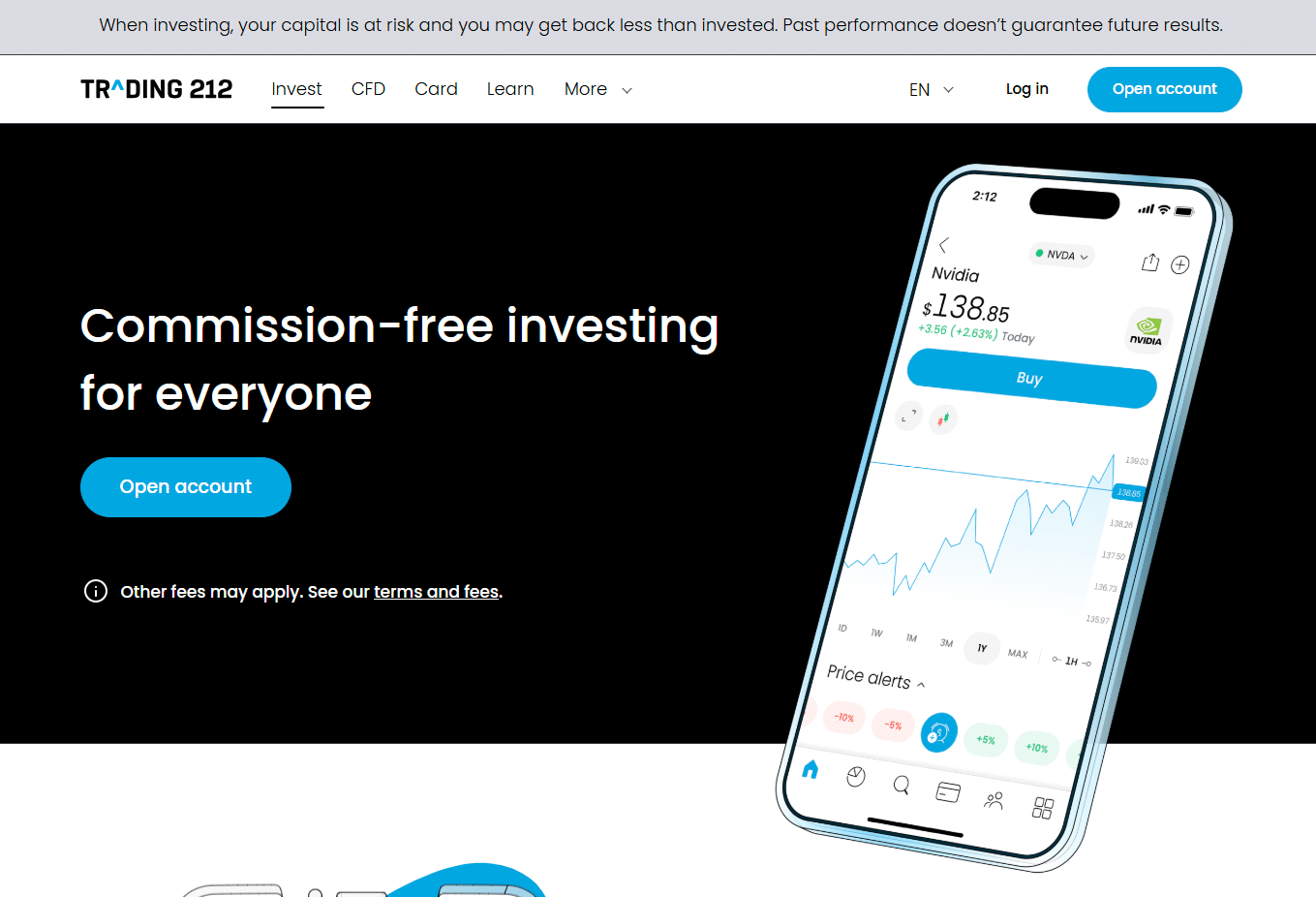
In Trading 212 Invest, you can trade commission-free stocks and ETFs from several major exchanges, including the NYSE, NASDAQ, LSE, Euronext, Deutsche Börse, and others.
The platform offers Pies and AutoInvest – an automated investing feature that lets you build a diversified, self-managed thematic portfolio and customise it to your financial goals. You also get access to Model Pies (curated by Trading 212) and Community Pies (created by other users), so you can pre-fill your portfolio with ready-made allocations rather than building from scratch. Bear in mind that you retain full control over your investments – your copy of a Pie is not linked to the original, so any changes the original Pie creator makes will not be reflected in your portfolio.
Trading 212 also offers portfolio transfers, meaning you can transfer your stocks or ETFs in to (or out of) Trading 212 if you decide to switch broker. No fees are charged for transfers in or out, and the whole process is typically completed within 30 calendar days.
One of the few fees Trading 212 applies is the 0.15% currency conversion fee. For example, if you’re based in a Eurozone country and want to invest in Apple (quoted in USD), the 0.15% will be applied on both buying and selling (0.30% round-trip in total). An investment of €1,000 would cost roughly €3 in conversion fees in total.
Trading 212 also gives you access to fractional shares: from as little as €/£1, you can invest in stocks like Amazon, Berkshire Hathaway, or NVIDIA without needing to buy a full share. This makes diversification accessible at any account size. On top of that, Trading 212 lets you earn interest on uninvested cash balances, with rates competitive with the best European brokers:
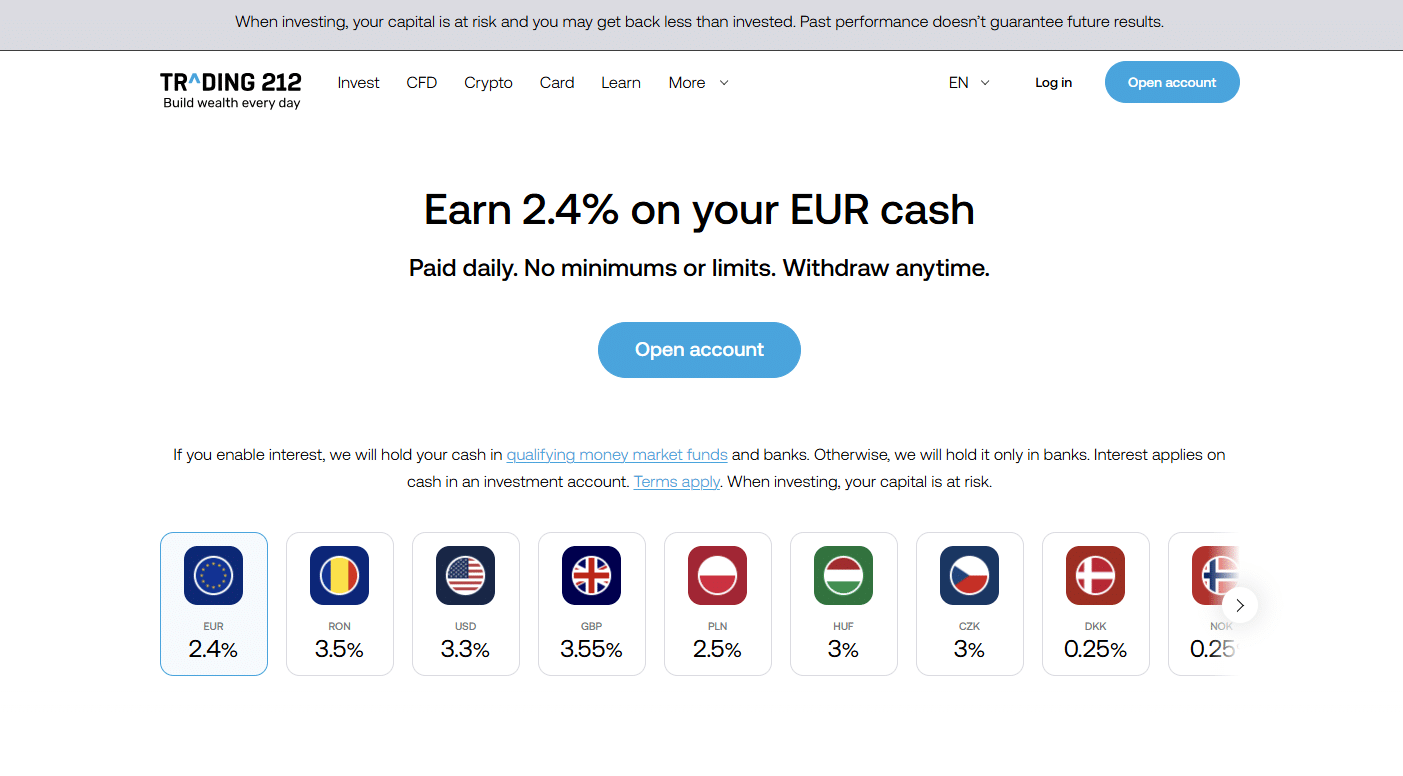
Users under Trading 212 EU GmbH* can earn competitive interest on EUR balances linked to ECB policy (currently up 3.50% p.a. as of June 2026), available to both new and existing users. This applies to residents of several European countries, namely Austria, Denmark, Finland, France, Germany, Iceland, Ireland, Liechtenstein, Luxembourg, Netherlands, Norway, Spain, Sweden and Switzerland. UK clients earn up to 3.55% p.a. on GBP balances, while USD balances earn up to 3.30% p.a. The exact rate depends on the QMMF yields and central bank policy at any given time.
Trading 212 also offers an opt-in stock lending program. By enabling this feature, you allow Trading 212 to lend out the financial instruments held in your account to other market participants. Lending generates daily interest, which is shared with you on a 50/50 split after costs. The loaned shares are fully collateralised by government treasuries, and you can sell at any time (lent shares are automatically recalled when you place a sell order). Stock lending is disabled by default – you must explicitly opt in. See our dedicated section below for the full mechanics and risk considerations.
The account opening process is fast, fully digital, and requires a minimum deposit of €/£10. Trading 212 offers multi-currency accounts, meaning you can hold several currencies in your portfolio (GBP, USD, EUR, CHF, DKK, NOK, PLN, SEK, CZK, RON, BGN, HUF) – useful for investors who trade across multiple markets without wanting to convert constantly. We did encounter some minor friction with ID verification during testing, but it was easily resolved by repeating the process (which took less than 2 minutes).
Customer support is responsive and effective. It’s available 24/7 via in-app chat and can handle enquiries in 16 languages, including English, German, French, Spanish, Italian, Polish, Portuguese, Dutch, and others – genuinely useful for non-English-speaking European investors.
Highlights
| 🗺️ Supported countries | Worldwide – exceptions include the US, Canada, and Belgium (~100+ countries supported) |
| 💰 Interest on uninvested cash (variable, ECB/BoE/Fed-linked) | EUR: 2.40% p.a. (3.50% in selected countries); GBP: up to 3.55% p.a.; USD: up to 3.30% p.a. (as of June 2026) |
| 💰 Stocks and ETFs commissions | Commission-free (other fees may apply – see terms) |
| 💰 Currency conversion fee | 0.15% per conversion |
| 💰 Inactivity fee | €/£0 (none) |
| 💰 Withdrawal fee | €/£0 (none) |
| 💵 Minimum deposit | €/£10 |
| 📍 Products offered | Real stocks, ETFs, and Cash ISA / Stocks & Shares ISA (UK only) |
| 🎮 Demo account | Yes (unlimited, no time restrictions) |
| 📜 Regulatory entities | FCA (UK), BaFin (Germany), CySEC (Cyprus), ASIC (Australia) |
| 🏦 Investor protection | FSCS £85,000 (UK), CySEC ICF €20,000 (EU), EdW €20,000 (Germany), EdB €100,000 cash (Germany) |
Pros and Cons
Pros
- Commission-free real stock, ETFs and crypto trading (other fees may apply. See terms and fees)
- AutoInvest & Pies feature (execution-only service, not financial advice)
- Fast and easy account opening process
- Demo account
- Top Tier Regulators
- Free fractional shares worth up to €100
- High interest on uninvested cash
Cons
- Limited product portfolio (no Options, Bonds, Mutual Funds or Futures)
- No relevant Fundamental tools
- 0.15% of Foreign exchange fees
Invest account type
In Trading 212 Invest, you may trade commission-free +10,000 real stocks and ETFs from several exchanges, including the NYSE, Nasdaq, LSE, Euronext, etc. You can build a diversified pie – with Pies & AutoInvest – and customize it to your unique financial goals. It gives total flexibility in the way you can divide your funds. Once you finalize your allocation, you can invest and reinvest dividends into your pie automatically.

Trading 212 Stocks & Shares ISA (UK only)
For UK residents, Trading 212 offers a Stocks & Shares ISA – one of the platform’s biggest differentiators in the UK market. The ISA wrapper allows UK investors to invest up to the annual ISA allowance (£20,000 for the 2026/27 tax year) with all capital gains, dividends, and interest sheltered from UK Income Tax and Capital Gains Tax.
Key features of the Trading 212 ISA
- Annual allowance: £20,000 per tax year, in line with HMRC rules;
- Commission-free trading: same fee structure as the standard Invest account – no commissions on real stocks and ETFs;
- Fractional shares: invest from £1 per stock or ETF;
- Pies and AutoInvest available: build automated thematic portfolios within the ISA wrapper;
- Cash interest: uninvested cash within the ISA earns the same competitive interest rate as the standard account (currently up to 3.55% on GBP balances) – genuinely useful for ISA investors who want to earn yield on cash awaiting investment;
- No platform fee: unlike most UK ISA providers, Trading 212 charges no annual platform fee on the ISA;
- 0.15% currency conversion fee applies when buying assets in a currency other than GBP (e.g., US stocks);
- ISA transfers: you can transfer existing ISA holdings from other providers to Trading 212 free of charge (typically within 30 days).
How the Trading 212 ISA compares to UK competitors
The UK Stocks & Shares ISA market is competitive – here’s where Trading 212 fits:
- vs Vanguard ISA: Vanguard charges a 0.15% platform fee (capped at £375/year) plus fund costs. Trading 212 has no platform fee at all – meaningfully cheaper for portfolios above ~£10K, particularly for investors who already use low-cost ETFs;
- vs AJ Bell, Hargreaves Lansdown: traditional UK ISA providers charge platform fees of 0.25-0.45% plus dealing commissions. Trading 212 is significantly cheaper, though offers less research and customer service depth;
- vs InvestEngine ISA: InvestEngine offers a similar low-cost ETF-focused ISA with no platform fee on DIY portfolios. The main difference is that InvestEngine is ETF-only (no individual stocks), while Trading 212 offers both individual stocks and ETFs;
- vs Freetrade ISA: Freetrade ISA charges a flat £4.99/month fee. Trading 212’s no-fee structure is meaningfully cheaper, though Freetrade offers some features (SIPP) that Trading 212 doesn’t.
Trading 212 Cash ISA
Beyond the Stocks & Shares ISA, Trading 212 also offers a Cash ISA for UK residents – a tax-free savings account paying competitive interest on cash balances with no investment risk. The Cash ISA shares the same £20,000 annual allowance with the Stocks & Shares ISA (you can split the allowance across both, or use it entirely in one).
ISA eligibility and important caveats
- UK residents only: ISAs are exclusively for UK tax residents – non-UK residents cannot open or contribute to a Trading 212 ISA;
- One Stocks & Shares ISA per tax year: under HMRC rules, you can only contribute new money to one Stocks & Shares ISA per tax year (though you can hold multiple ISAs from previous years);
- £20,000 allowance is shared: across all your ISAs (Cash, Stocks & Shares, Lifetime, Innovative Finance);
- Flexible ISA: Trading 212’s ISA is a “flexible” ISA, meaning withdrawals can be replaced within the same tax year without affecting your allowance.
ISA rules and allowances are subject to change by HMRC. Always check the latest ISA rules at gov.uk or consult a tax adviser for guidance specific to your situation.
Trading platform
Trading 212 has both a mobile and a web trading platform and, as mentioned above, presents two account types. For this review, we’ll help you navigate through Trading 212 invest’s web trading app since the others will be intuitive to explore after you acknowledge this one.
As soon as you are logged in, you have an immediate view of your account balance, a left vertical sidebar which helps you find all the products available, a clear oversight of what is up or down from the pre-selected tab (“Hot,” “Watchlist”, “Top Winners” and so on), and a little icon in the bottom left corner that puts you in instant contact with a customer support agent:

If you scroll down, you will get more details on the company that appears in the highlight (Tesla, in this example), which includes the company overview, key ratios, financial summary and instruments details:

Going through the left panel, you can navigate to other tabs like “Portfolio,” where you can easily see your current holdings:

Do you already know what you came looking after? If so, you can simply click on the search icon and look for your stock/ETF:

On the “Calendar” tab, you will notice the major worldwide economic events, including Federal Reserve meeting, job reports, Consumer Price Index (CPI) and more:

Finally, within the “videos” tab, you will find plenty of educational videos. We watched some of the content and quickly realized that it is mostly dedicated to beginners. So, intermediate or advanced investors will not find useful information. It also drew our attention to the partnerships they have with some YouTubers, including the PensionCraft:

Products and markets
Trading 212 Invest offers stocks and ETFs. You can buy in bulk or just a fraction, from as little as $1.
| Products | Available |
| Stocks | ✔ |
| ETFs | ✔ |
You can easily find all the financial assets in Trading 212 Invest, including the “Exchange” (highlighted), “Type,” and “Currency”:

Trading 212 AutoInvest
Trading 212 AutoInvest is a feature inside Trading 212 that tries to solve two investment issues:
- Having a diversified portfolio with stocks and/or ETFs and
- Being able to do it automatically without having to ask yourself every month, “In which ETF/stock should I put my money in?”
Your initial step is to build your Pie. You can build a custom pie of stocks and/or ETFs chosen by you (including the target weights) or choose a ready-made pie. Each Pie can hold up to 100 securities, and you may have multiple pies.

We believe you will be well suited with only one pie to avoid excessive diversification (equal to lower expected returns). In our opinion, it will not add much value in the long run, but only confusion…
On the app, you will notice model pies and community pies, which means that you can copy other people’s pies and interact with other community members. Just make sure to keep an eye on your pie since it does not automatically adjust when the original pie changes.
From this point, AutoInvest comes in: You have the option to invest in a pie through a manual process or an automated one where you can customize your desired investment duration, deposit amount, and deposit schedule through a direct debit from your bank account (you may change this feature at any time).

After the money arrives at your Trading 212 account, it will automatically buy shares according to your pie’s targets. The beauty of AutoInvest is that your money will start working for you after setting up your investment goals!

Rebalancing
Let’s imagine the following situation: you decide to invest in four securities with a target weight of 25% in each. After six months, the actual weights are 40%/30%/20%/10%. You believe it is time to sell the overweight assets and buy the underweighted ones.
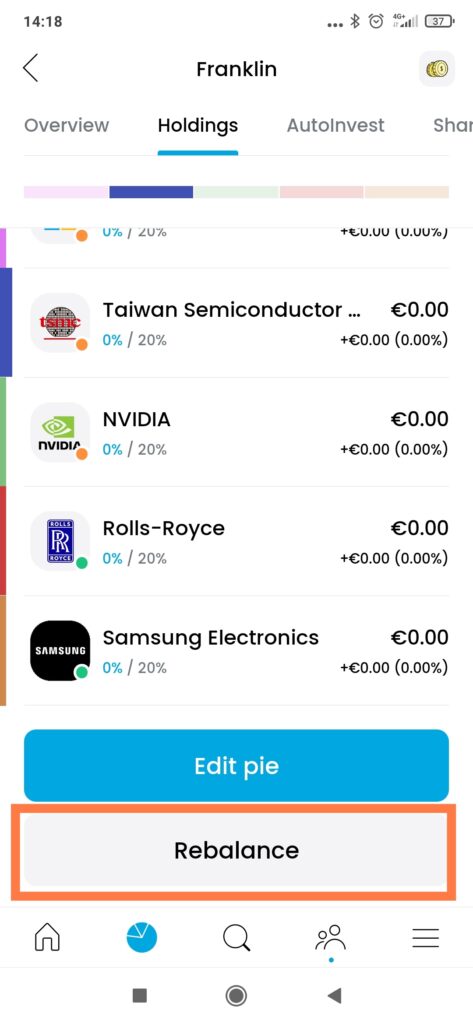
Trading 212 solves this problem in just a single tap called “Rebalance”. It will automatically adjust your pie to the desired target weights. Done. If you have assets trading in different areas, you may not see this effect immediately because some markets may be closed, but it should not take more than 24h to complete the rebalancing action.
Investment goals
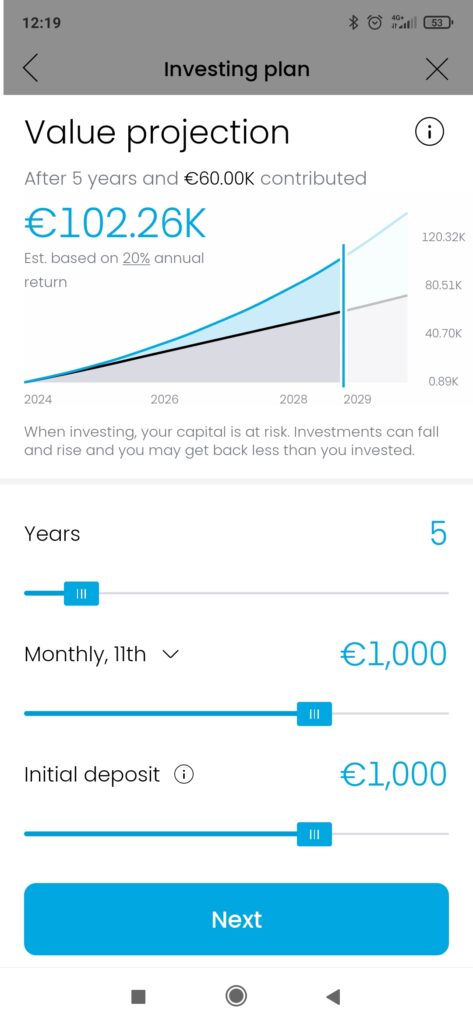
You may also set a goal for your investments to help you define a clear target.
Besides, Trading 212 will project how your investment value should evolve according to your pre-selected investment instruments and amounts. However, it is based on a historical basis, so it is never enough to stress that past performance is no guarantee of future results. A projection is still a projection. It feels great to see those numbers but, please, do not set too high expectations.
Does AutoInvest charge additional fees?
The answer is no. You do not pay any extra commissions or fees for using AutoInvest.
AutoInvest & Pies is designed to make you participate in the world of wealth creation while not committing too much of your precious time!
How to use AutoInvest
In our opinion, the best investment plan would be to use the AutoInvest feature. It is a strategy formerly known as Dollar Cost Averaging. The idea is to set a regular investment fixed amount and schedule (weekly, monthly,…) regardless of the market conditions. In some months, you will buy more shares (when prices are lower), and in others, you will buy fewer shares (when prices are higher).
It is a great tool to neutralize short-term volatility in the broader equity market and makes you avoid the typical mistakes in trying to time the market (market timing).
Fees
| Fee type | Classification |
| Real Stocks and ETFs | 0% commission |
| Currency conversion | 0.15% |
| Inactivity | €/£0 |
| Withdrawal | €/£0 |
| Custody | €/£0 |
In Trading 212 Invest, you only have the 0.15% currency conversion fee (=foreign exchange fee). That’s all!
In other related fees, Trading 212 does not charge withdrawal, deposit, or inactivity fees.
Cash interest on uninvested balances
One of Trading 212’s most attractive features in the current rate environment is the interest paid on uninvested cash balances. Rather than letting your idle cash sit at 0%, Trading 212 invests it in Qualifying Money Market Funds (QMMFs) – low-risk, highly liquid investments rated AAA – and shares the yield with you.
Current interest rates
As of June 2026, Trading 212’s headline rates are:
- EUR: 2.40% p.a. (3.50% for clients under Trading 212 EU GmbH);
- GBP: 3.55% p.a.;
- USD: 3.30% p.a.;
These rates are variable and tied to central bank policy (ECB, Bank of England, and US Federal Reserve respectively). As central bank rates change, Trading 212’s QMMF yields adjust accordingly – so the headline figures will move over time. The rates are competitive across all account tiers and remain consistent regardless of balance size, which is a notable advantage compared to some competitors that apply tier thresholds.
How the interest is calculated and paid
- Daily accrual: interest accrues daily based on your end-of-day cash balance;
- Monthly payment: interest is credited to your account on a monthly basis;
- Compounding: paid interest is added to your balance, where it then earns further interest (effectively daily compounding);
- No minimum balance: interest is paid from the first cent – no thresholds to clear;
- No maximum cap: unlike some competitors, Trading 212 doesn’t cap the amount eligible for interest;
- Opt-in required: users must enable the feature in their account settings (it’s not automatic) – simple one-time activation.
How Trading 212 generates this interest
Trading 212 doesn’t lend your cash to other clients or banks directly. Instead, your uninvested cash is invested in Qualifying Money Market Funds managed by major asset managers (such as BlackRock and Fidelity). These funds hold short-term, high-quality debt instruments like government treasuries and prime commercial paper. The yield generated by these funds is what Trading 212 passes through to you, minus a small spread to cover operational costs.
Because QMMFs are regulated separately from Trading 212’s general business operations, your cash invested in QMMFs benefits from an additional layer of protection: in the unlikely event that Trading 212 itself faced financial difficulty, your QMMF holdings would remain segregated and protected.
Tax treatment
Interest earned from QMMFs is typically classified as investment income in most European jurisdictions, which may be taxed differently from regular bank interest. For example:
- UK investors: interest is generally subject to Income Tax outside of an ISA wrapper – inside an ISA, the interest is tax-free;
- German investors: interest typically falls under the Abgeltungsteuer (capital gains tax) framework at 25% plus solidarity surcharge;
- Portuguese, Spanish, French, Italian investors: country-specific savings income or capital gains rules typically apply.
How Trading 212’s cash interest compares
Cash interest has become one of the most competitive areas in European brokerage. Here’s how Trading 212 stacks up against major competitors:
- vs Interactive Brokers: IBKR pays interest in 22+ currencies but applies tier thresholds (e.g., the first $10,000 USD earns no interest, full rate only applies to NAV $100K+). Trading 212 has no thresholds, making it more attractive for smaller balances;
- vs eToro: eToro pays interest on USD only and applies regional and balance-based tiers. Trading 212 covers EUR, GBP, and USD with simpler rate structures – better for European investors holding non-USD cash;
- vs Lightyear: both use a QMMF approach with similar yields. Lightyear offers similar rates with stronger product range expanding (bonds), while Trading 212 has the Pies and AutoInvest advantage;
- vs Scalable Capital: Scalable pays interest on EUR balances with similar mechanics, though plan-tier dependent. Trading 212’s structure is simpler and applies equally across all users.
For investors who hold meaningful cash positions between trades or as part of a portfolio buffer, Trading 212’s cash interest can add up to genuine annual returns – a €10,000 EUR balance at 2.40% generates roughly €240 per year, with zero effort beyond enabling the feature.
Safety and regulation
Trading 212 segregates customer funds and maintains this level of protection across all subsidiaries. This means that if it goes bust or insolvent, its client’s funds will be separated from the financial institution’s funds. In practice, you would only need to transfer your assets from Trading 212 to another broker.

Trading 212 is fully regulated and supervised by four tier-1 authorities across multiple jurisdictions: the UK’s Financial Conduct Authority (FCA), Germany’s Federal Financial Supervisory Authority (BaFin), the Cyprus Securities and Exchange Commission (CySEC), and the Australian Securities and Investments Commission (ASIC). Each regulator oversees a separate legal entity within the Trading 212 group:
- Trading 212 UK Ltd: regulated by the FCA (registration number 609146) – serves UK clients;
- Trading 212 EU GmbH: regulated by BaFin (licence number 10109603) – serves German clients and many other Eurozone residents;
- Trading 212 Markets Ltd: regulated by CySEC (registration number 398/21) – serves EU clients outside Germany via MiFID II passporting;
- Trading 212 AU PTY LTD: regulated by ASIC (AFSL 541122, ABN 46 660 342 763) – serves Australian clients.
Each of these entities is a member of an investor compensation scheme that protects client assets in the unlikely event of broker insolvency:
- Trading 212 UK Ltd: clients are covered by the Financial Services Compensation Scheme (FSCS), with protection up to £85,000 per client (cash + assets);
- Trading 212 EU GmbH (German clients): cash is protected up to €100,000 via the German Deposit Guarantee Scheme (EdB), and securities are protected up to €20,000 via the German Investor Compensation Scheme (EdW);
- Trading 212 Markets Ltd (other EU clients): clients are covered by the Cyprus Investor Compensation Fund (ICF), with protection up to €20,000 per client (cash + assets);
- Trading 212 AU PTY LTD (Australian clients): subject to Australian client money rules and the regulatory framework administered by ASIC – protections differ from the European schemes above and are typically governed by Australian Securities and Investments Commission Act requirements rather than a single named compensation fund.
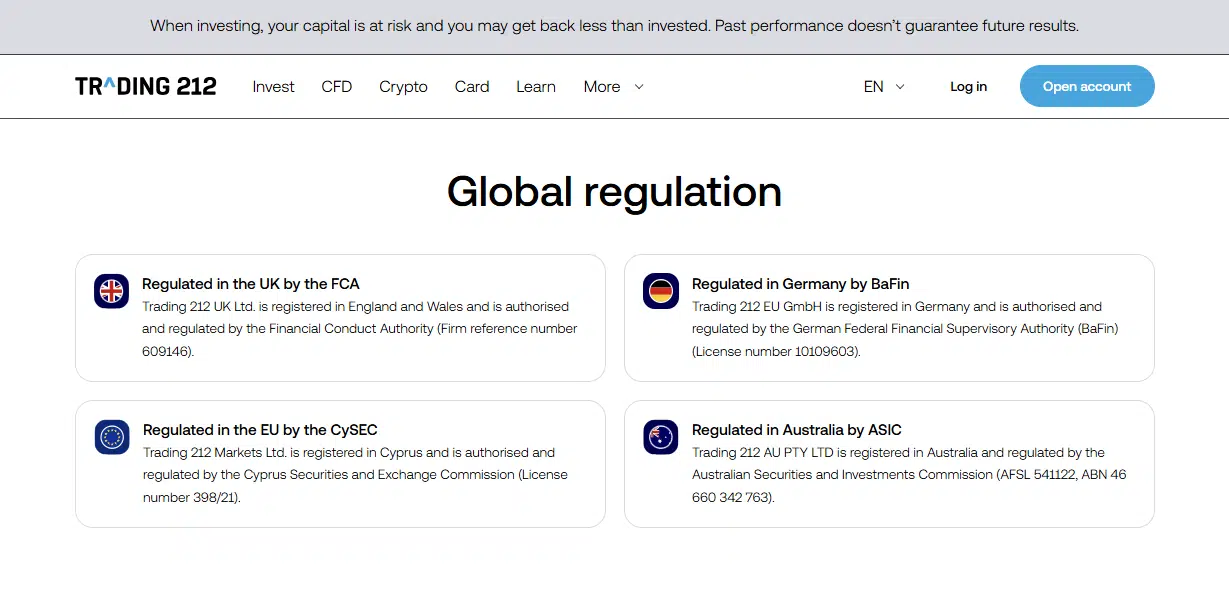
It is registered in several countries, meaning that it must have authorization from the local financial markets authorities. For instance, Trading 212 is registered in CMVM in Portugal.
Trading 212 is a private company, meaning there is less transparency in its financial situation compared to a company listed on the stock market. As a private company, it does not need to disclose its annual report on its site. So, this is something to take into account when deciding to open an account.
Stock lending program
Trading 212 offers an opt-in stock lending program that allows the broker to lend out shares held in your account to other market participants (typically hedge funds, market makers, and short sellers). In exchange, you receive a share of the lending revenue Trading 212 generates – the split is 50/50 after costs.
How it works in practice
- Opt-in only: stock lending is disabled by default – users must explicitly enable it in account settings;
- Collateralisation: every loaned share is fully collateralised, typically by government treasuries (often US Treasuries or equivalent high-grade sovereign debt) held in segregated accounts. The collateral value is typically marked at 102-105% of the loan value and adjusted daily;
- Revenue split: net lending revenue is split 50/50 between Trading 212 and the user whose shares were lent;
- You can sell at any time: lent shares are recalled automatically if you place a sell order – lending doesn’t restrict your ability to trade;
- You retain economic ownership: dividends paid during the lending period are passed through to you (sometimes as a “manufactured dividend” with similar economic value);
- Voting rights: when shares are on loan, voting rights typically transfer to the borrower – meaning you can’t vote in shareholder meetings during the lending period. If voting rights matter to you, this is worth considering.
How much can you actually earn?
Lending income varies significantly by stock – it depends on borrower demand. Heavily shorted stocks (e.g., heavily contested meme stocks, struggling sectors) can generate meaningful lending fees, sometimes 1-5% annualised. However, most blue-chip stocks generate minimal lending income – often less than 0.05% annualised, because demand to borrow them is low. For typical retail portfolios consisting of broad ETFs and large-cap stocks, expected annual lending income is generally modest (often a fraction of 1% of portfolio value per year).
What are the risks?
Stock lending is a standard practice in institutional finance, but it does introduce some additional considerations:
- Counterparty risk: theoretically, if the borrower defaults AND the collateral simultaneously loses value (an unlikely combined scenario), you could face a loss. In practice, this risk is very low due to the over-collateralisation and daily mark-to-market;
- Impact on investor protection coverage: this is an important nuance – shares that are on loan are technically not “your” shares for the lending period. This means they may not be covered by the standard investor compensation scheme (FSCS/CySEC ICF) during the lending period. The collateral is your protection instead. This is one of the most important reasons stock lending is opt-in only;
- Tax implications: lending income is typically taxed as miscellaneous income rather than as capital gains or qualified dividend income, which may affect your overall tax efficiency depending on your jurisdiction.
Should you opt in?
The decision depends on your priorities. Opt in if: you want to maximise yield on your portfolio, you’re comfortable accepting modest additional counterparty risk in exchange for incremental income, and you don’t care about voting rights on your holdings. Don’t opt in if: you want the maximum possible investor compensation scheme protection on your full portfolio, you actively vote in shareholder meetings, or you simply prefer the operational simplicity of holding unencumbered shares.
For most retail investors with modest portfolios, the additional income from stock lending is unlikely to be material, while the additional complexity and reduced compensation scheme coverage is a real cost. Conservative investors typically leave stock lending disabled – which is the default.
Do you want to read a deeper analysis? Check out our dedicated article on investment protection (for EU investors)!
Supported countries
Trading 212 operates in over 100 countries globally, including:
- Australia
- Denmark
- France
- Germany
- Italy
- Luxembourg
- Norway
- Portugal
- Spain
- Sweden
- The United Kingdom
- And the list goes on!
Account opening
The process of opening an account with Trading 212 is straightforward. You just need to follow an intuitive step-by-step registration procedure. Firstly, click “Open account” on the homepage:
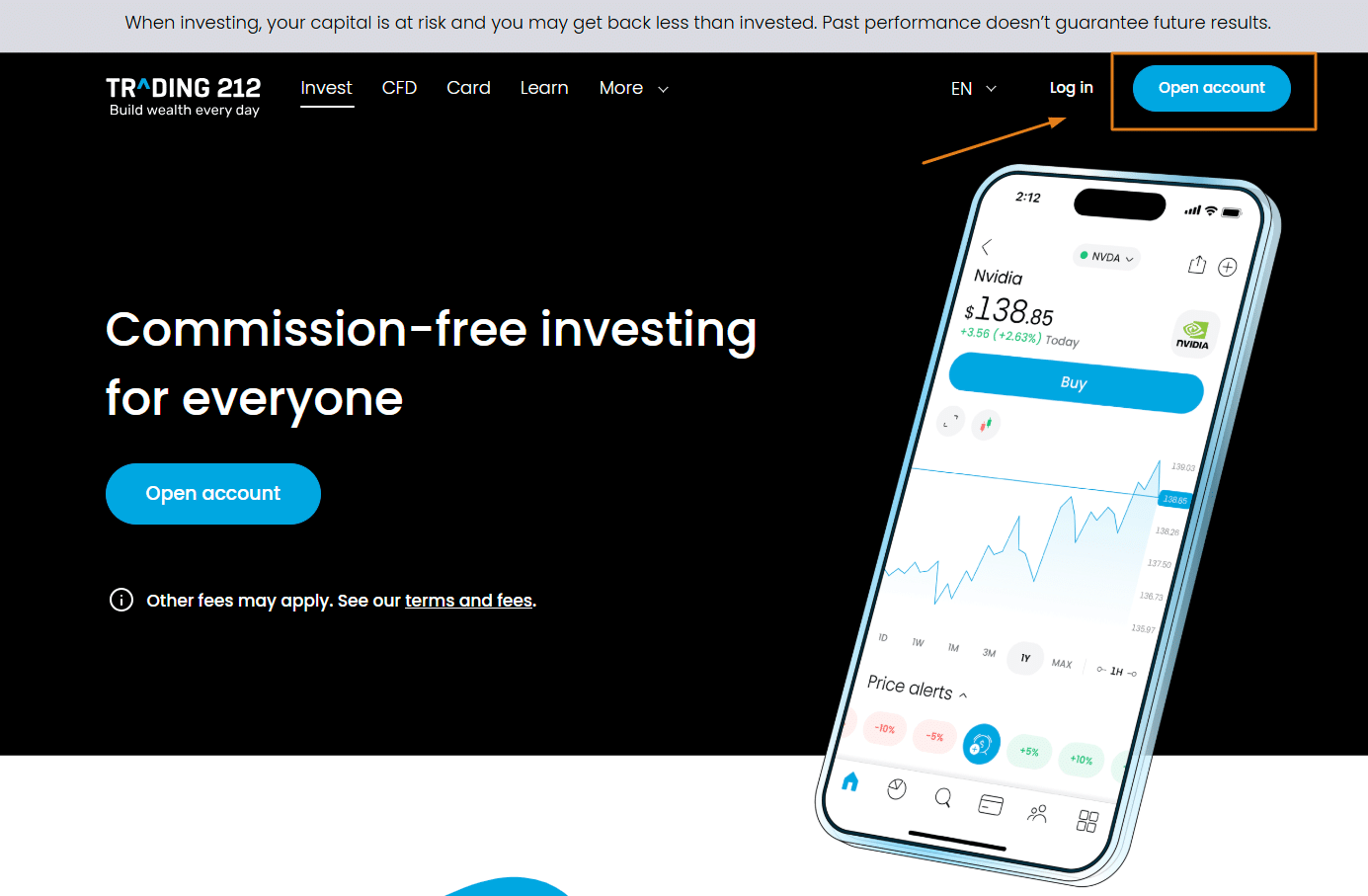
Then, choose your “country of residency” and click “next”:


Now, insert your chosen email and password. You must accept the terms & conditions that appear below. Keep in mind that the Trading 212 subsidiary will be the one dedicated to your country. Since we are registering from a European Union country, we are under the “Trading 212 Markets Ltd.”:

And you are ready to go (to deposit and withdraw, you will need to verify your account by providing your identity card and other information):
Select your account (remember that you will have access to both – this is only for you to choose which one to start with):

Bottom line
Trading 212 is a platform offering a comprehensive suite of investment tools and features, making it a viable option for novice and experienced investors. With its user-friendly interface and intuitive design, the platform ensures a seamless investing experience, allowing users to easily execute trades.
One of the critical advantages of Trading 212 is its cost-effective nature. The platform offers commission-free trading on stocks and ETFs, making it an attractive choice for investors looking to minimize trading expenses. Additionally, Trading 212’s commitment to investor education is another noteworthy aspect.
On the downside, the limited products available, the currency conversion fee of at 0.15% and the lack of fundamental tools may constrain your investment decisions.
We hope to have helped with this review!
