Choosing a trading platform in the UAE is difficult for any investor, and particularly so for beginners. Working out which platforms are trustworthy, straightforward to use, and free of hidden costs takes real effort.
We have personally tested numerous platforms and written over a thousand articles reviewing and comparing brokers, trading platforms, and investing apps.
Below we present and compare what we consider the best trading platforms in the UAE. Whether you are a beginner wanting something approachable, a long-term ETF investor, or trading CFDs and crypto actively, there is an option here.
Three factors matter more in the UAE than in most markets, and they shape our assessment throughout:
- Local regulation: whether the platform holds a DFSA, FSRA, or Securities and Commodities Authority licence, which determines your recourse if something goes wrong;
- AED support: platforms accepting dirhams as a base currency avoid conversion costs that recur on every deposit and withdrawal;
- Islamic accounts: swap-free options matter to many investors here, though note these differ from genuinely Sharia-screened portfolios.
In a hurry? Our summarised list is below.
Video summary
Watch a short recap of our highest-rated choices:
In a nutshell: Best Trading Platforms in the UAE
- Interactive Brokers: Best overall trading platform in the UAE. It now offers local AED funding via FAB (fast, low-cost deposits).
- Sarwa: Best trading app in the UAE. Great for beginners and auto-invest. New users earn a welcome bonus.
- eToro: Best for commission-free investing and social trading. New users earn a $50 bonus with our referral link.
- Freedom24: Best for access to high-yield ETFs (6%–12% in select cases)
- Plus500: Ideal for CFD trading
- XTB: Best for low-fee CFD and Forex trading
- Saxo Bank: Best for professionals
- Capital.com: Best for fee-free AED deposits and commission-free CFD trading (other fees may apply) with local (Dubai-based) support.
- amana: Best for 0% commissions. New users earn a $100 bonus with our amana promo code.


69-80% of retail CFD accounts lose money.

81% of retail CFD accounts lose money.

62% of retail CFD accounts lose money.


Investing in physical shares carries risk. Trading leveraged derivatives and volatile digital assets is high-risk and requires caution.
Comparison of the Best Trading Platforms in the UAE


Fees comparison
Transparency in fees is essential when choosing a trading platform.
While low fees might seem attractive in the short term, it’s important to consider the long-term implications.
Sometimes, it’s better to select a broker that charges reasonable fees necessary for sustaining their business, rather than one that is cheap now but may introduce hidden costs or monetize services in the future.
You want a broker you can rely on for the next 50 years as your investments grow, ensuring both stability and integrity in your trading experience.
Below, you can find a comparison of the main fees charged by all brokers:
Short reviews the top platform
#1 Interactive Brokers at a glance
Founded in 1978 and publicly listed on NASDAQ (ticker: IBKR, an S&P 500 constituent since 2024), Interactive Brokers has weathered multiple financial crises, demonstrating resilience and a rigorous risk management framework. It serves over 5 million client accounts with more than $900 billion in client equity.
IBKR offers an advanced platform spanning stocks, ETFs, options, futures, bonds, forex, and cryptocurrencies across 170+ markets in 36+ countries, with strong execution via IB SmartRouting and comprehensive analysis tooling. It accepts UAE dirhams (AED) as a base currency, which avoids the recurring conversion costs that apply on USD-only platforms.
Beginners and intermediate investors have educational resources through IBKR Campus, though the main platform has a steep learning curve. Customer support gives clear, precise answers.
On the downside, the fee structure is comparatively complex and registration is lengthy, though fully online. IBKR does not offer commission-free trading in the UAE, but factoring in FX conversion at 0.20 basis points, tight spreads, and the Stock Yield Enhancement Program, clients still achieve significant savings versus most brokers. There is no minimum deposit.
One consideration specific to this market: IBKR serves UAE clients from overseas entities rather than a locally licensed one, so you would fall under SEC and FINRA supervision with SIPC protection up to $500,000 rather than DFSA oversight. That is robust protection, but it is not local recourse.

Interactive Brokers also offers IBKR GlobalTrader, a modern mobile app for stocks, options, and ETFs, well suited to newer investors. It includes automatic currency conversion, fractional shares from $1, and a $10,000 virtual demo account for practice.
The practical advantage is that both apps run from the same account, so you can start on GlobalTrader and move to the full platform as your needs develop.
Want to know more? Check our Interactive Brokers review.
Pros
- Low commissions on US stock trading
- No monthly inactivity fee
- The broadest product and markets range in the brokerage industry
- Demo account
- Excellent reputation (founded in 1978)
- Extensive research and Education tools
- Has a modern mobile trading app to trade Stocks, Options and ETFs, ideal for novice investors, IBKR GlobalTrader.
- Offers interest on uninvested cash balances
Cons
- Complicated and lengthy account opening process (but fully online)
- Steeper learning curve for beginners
- Website is difficult to navigate
- Interactive Advisors (Robo-advisor feature) is only available for US customers
#2 Sarwa at a glance
Sarwa is an Abu Dhabi-headquartered investment platform founded in 2017, offering four main products:
- Sarwa Save: a cash management account earning returns on uninvested money;
- Sarwa Trade: self-directed trading in US-listed stocks, ETFs, and options;
- Sarwa Invest: a robo-advisory service building and rebalancing ETF portfolios automatically;
- Sarwa Crypto: cryptocurrency trading.
The platform is well regarded for accessibility, transparency, and a signup promotion, and is a reasonable option for beginners or anyone wanting a locally regulated provider.
Sarwa Invest, the flagship product, builds portfolios from low-cost ETFs, charging an annual management fee of 0.5% to 0.85% depending on portfolio size, plus roughly 0.1% in underlying fund costs. You can choose between Conventional, Halal, Socially Responsible, and Crypto-enhanced portfolios, each across several risk levels. The Halal option is genuinely Sharia-screened with a supervisory board and dividend purification, which distinguishes it from the swap-free accounts other brokers offer.
An important caveat on cost: Sarwa Invest applies a minimum charge of $7 per month. On a $500 portfolio – the stated entry point – that works out at roughly 17% annually, which would overwhelm any realistic return. The fee only becomes proportionate above around $10,000.
Sarwa Save suits those wanting a lower-risk home for cash, with no minimum balance. Returns are variable and track prevailing money market rates, so check the current figure rather than relying on any published number. A Halal version is available through an Islamic money market fund, carrying a 0.5% management fee.
Sarwa Crypto charges no commission but applies a 0.75% spread, and supports multiple order types. Sarwa Trade covers US stocks and ETFs with fractional shares, though without margin trading, at the greater of $1 or 0.25% per trade.
Sarwa also offers consultations with licensed advisers, free funding and withdrawals via local UAE bank transfers, and fixed AED-USD conversion rates. It is regulated by the FSRA in Abu Dhabi Global Market, with client assets held by established custodians including Saxo and, via Alpaca, BMO Harris Bank.
On the downside, the product range is limited to US-listed securities only – no bonds, no European or Asian markets, and no access to regional exchanges. Sarwa is also considerably younger than most names here, with a correspondingly shorter track record.

Pros
- Access to human financial advisor
- Low fees
- Slick and easy to use app
- Sarwa Invest (Robo-advisor) is a good option for beginners
- Sarwa Save is a good alternative to earn interest on cash
Cons
- Newcomer in the industry: short track record
- Limited asset offering: no bonds or stocks listed outside the USA
- US options are quite expensive ($4 per contract)
#3 eToro
eToro at a glance
Founded in 2007, eToro is a globally recognised fintech and the leading platform in social trading, with over 40 million users across 140+ countries. Alongside real stocks and ETFs, it offers CFDs and cryptocurrencies through an intuitive interface.
On pricing, ETFs trade commission-free, while stocks carry a $1 commission on most exchanges – rising to $2 on the Dubai and Abu Dhabi exchanges, which matters if you intend to trade regional listings. Other fees apply.
New users can claim a $50 bonus with our referral link (details here).
Opening an account is straightforward, with a $100,000 demo account for practice. On the downside, spreads can be wide on some products, and eToro operates in USD as its only base currency – so AED deposits are converted both ways, a recurring cost for a UAE-based investor.
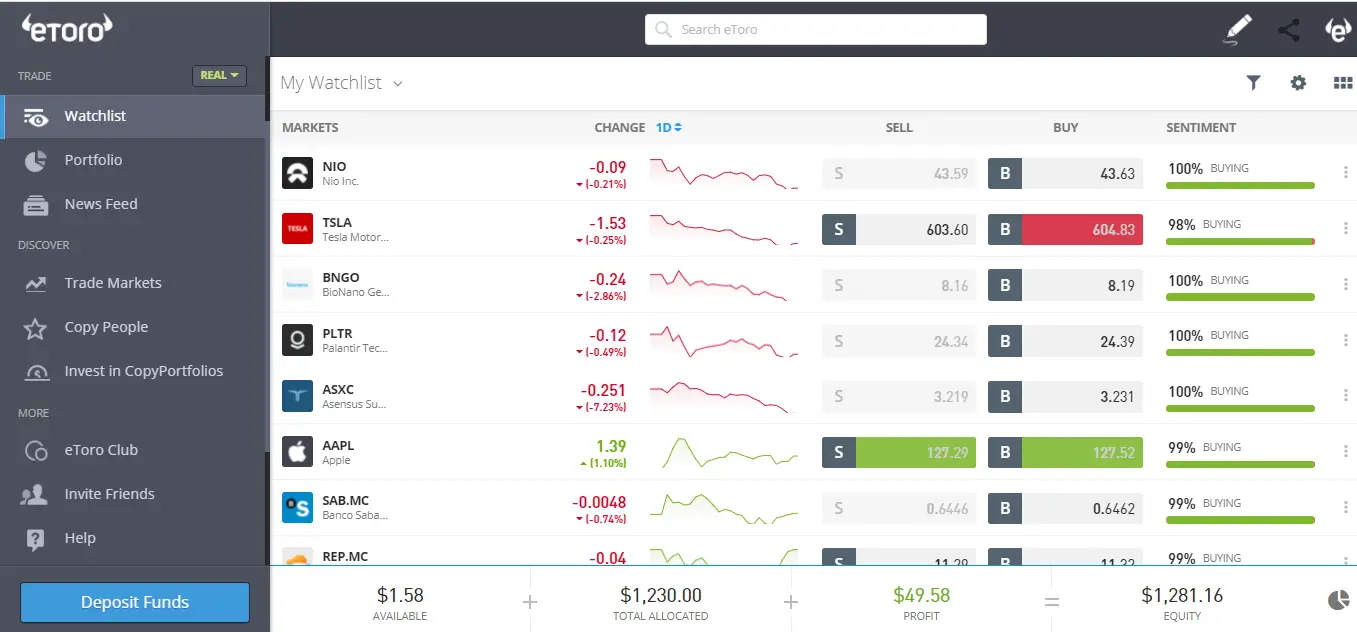
eToro offers an Islamic swap-free and interest-free account to clients who contact support and meet the minimum funding requirement. It also holds in-principle approval from the FSRA in Abu Dhabi Global Market, though unlike Plus500 and XTB it does not yet operate a fully licensed UAE entity – so you would be served from an overseas entity rather than a local one.
Want to know more? Visit eToro or read our review.
Pros
- Low stock trading fees (from $0 per trade)
- Commission-free ETFs (other fees apply)
- Social trading and other innovative products
- Wide variety of financial products
- Slick, modern, and easy for anyone to use
- European users have access to three account currencies: EUR, USD and GBP
- Top tier regulators
Cons
- Limited disclosed financial information
- Withdraw and inactivity fees
- Spread, overnight, inactivity, and currency conversion fees higher than average
- Doesn’t offer bonds, futures, or options
#4 Freedom24
Freedom24 at a glance
Investing involves risk of loss.
Freedom24, part of Freedom Holding Corp (NASDAQ: FRHC), gives retail investors access to a broad range of global products including stocks, bonds, futures, options, and a particularly strong ETF offering.

With access to more than 3,600 ETFs, Freedom24 covers the major issuers – Vanguard, iShares, Invesco – alongside more specialised strategies including dividend-focused funds, short-term bond ETFs, and covered call and swap-based products. If a specific ETF is not listed, clients can request its addition, which is unusual flexibility for a retail platform.
Its Bonds Showcase gives access to higher-rated bonds (B+ and above) from as little as €/$1,000, simplifying a market that retail investors usually find difficult to reach.
The web and mobile platforms are well designed, complemented by InvestIdeas for market analysis and Freedom Academy for education. New users can claim a signup promotion of up to 20 gift stocks.
With no minimum deposit, two pricing plans are available: All Inclusive in EUR (formerly Prime), with a dedicated account manager, and Smart in EUR, better suited to lower trading volumes. On the downside, a €7 withdrawal fee applies and cryptocurrencies are not offered.
Freedom Finance Europe Ltd is regulated by CySEC, with client assets covered up to €20,000 under the Investor Compensation Fund. Note that UAE clients are served from this European entity rather than a locally licensed one, and there is no AED base currency option.
Want to learn more? Check our Freedom24 review or visit Freedom24.
Pros
- Low commissions on stock and ETF trading
- No minimum deposit for general trading
- Demo trading
- Slick, modern, and easy for anyone to use
- No custody fee
Cons
- €7 per withdrawal
- No cryptocurrencies
#5 Plus500 at a glance
81% of retail CFD accounts lose money.
Founded in 2008, Plus500 offers CFDs on forex, indices, shares, commodities, options, ETFs, and cryptocurrencies. It operates in over 50 countries and is listed on the London Stock Exchange (ticker: PLUS) as a FTSE 250 constituent.
In the UAE only one account type is available: Plus500 CFD. Elsewhere Plus500 offers real share trading through Plus500 Invest, but that is not available to UAE investors – meaning you gain price exposure through derivatives without owning any underlying asset. That makes it suitable for active trading rather than long-term investing.
The platform is WebTrader, Plus500’s proprietary system, stable across devices with a demo account available for testing.
Spreads are competitive and accounts are supported in 16 base currencies including AED, so UAE residents can hold dirhams directly. A 0.70% currency conversion fee applies, alongside a $10 monthly inactivity fee after three months without activity.

Plus500 offers Islamic swap-free accounts to UAE residents, and negative balance protection now applies globally rather than only in the EU.
It is among the few brokers with a dedicated UAE subsidiary: Plus500AE Ltd, authorised and regulated by the Dubai Financial Services Authority (Licence No. F005651) – which gives local regulatory recourse that overseas-served brokers do not.
Want to know more? Check our Plus500 review.
Pros
- Acessible and responsive platform
- Low spreads
- No dealing commissions
- Demo Account
- Top-tier regulators
Cons
- No ETF offering
- Inactivity fee ($10 per month after no login activity in 3 months)
- High overnight funding fees
- Very little research and education provided
CFDs are complex instruments and come with a high risk of losing money rapidly due to leverage. 80% of retail investor accounts lose money when trading CFDs with this provider. You should consider whether you understand how CFDs work and whether you can afford to take the high risk of losing your money.
This information is NOT relevant to EU residents who are to be serviced by EU subsidiaries of the Plus500 Group, such as Plus500CY Ltd, authorized by CySEC (Reg. 250/14). Different regulatory requirements apply in Europe, such as leverage limitations and bonus restrictions.
#6 XTB at a glance
69-80% of retail CFD accounts lose money.
Founded in 2002 and listed on the Warsaw Stock Exchange, XTB serves over 1.7 million clients across 16 countries, regulated by the FCA, KNF, CySEC, and BaFin.
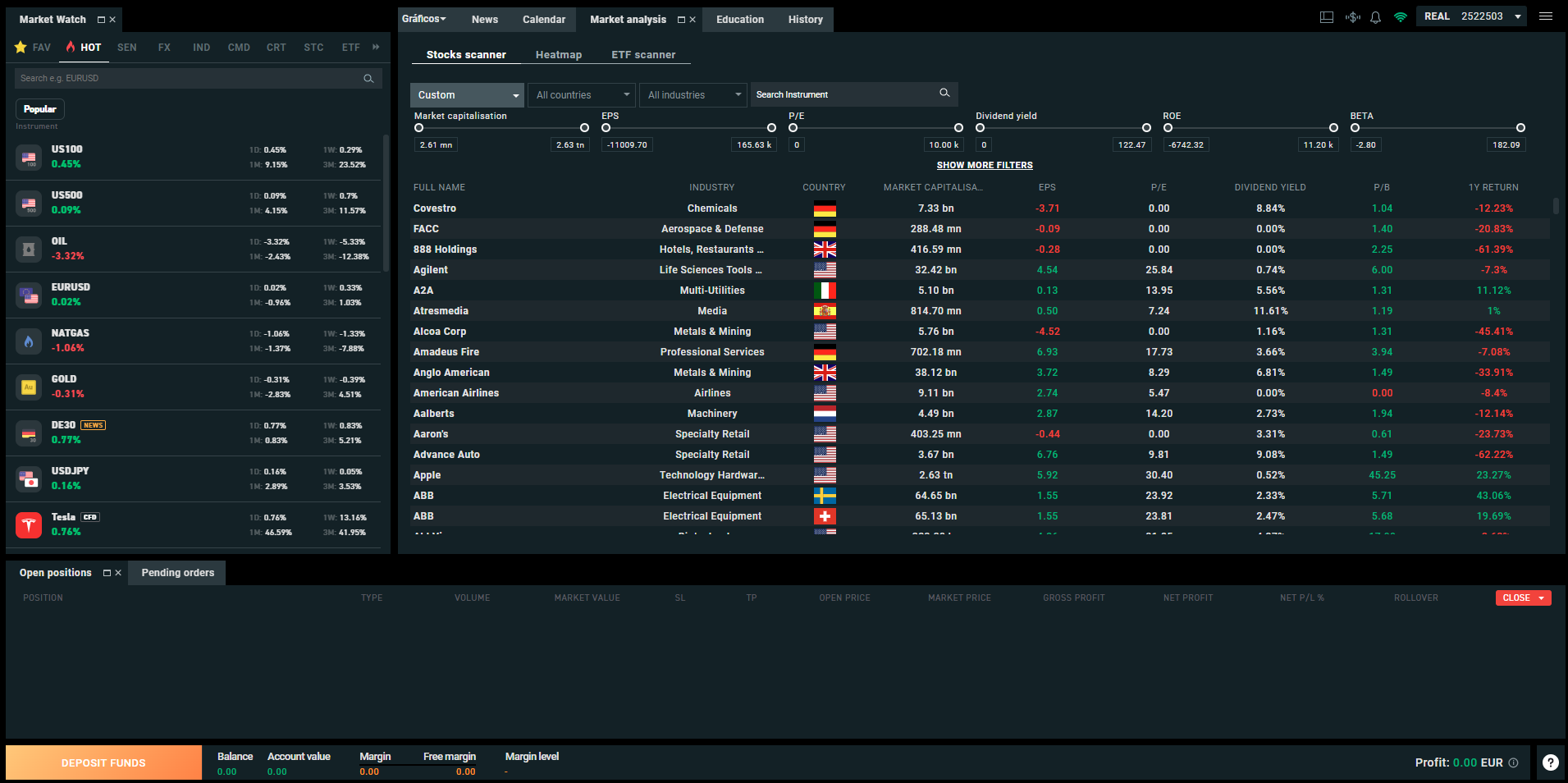
You can invest through xStation 5 and xStation Mobile across stocks, ETFs, forex, indices, commodities, and cryptocurrency CFDs, with offerings varying by country.
XTB operates a dedicated UAE entity, XTB MENA Limited, licensed by the Dubai Financial Services Authority (Licence No. F006316), and offers Islamic swap-free accounts to UAE residents.
Note on the UAE offering specifically: while XTB provides commission-free real stocks and ETFs in European markets, UAE clients access CFDs on stocks rather than the shares themselves. Verify what is available to you before opening an account, since it determines whether you can own assets or only trade derivatives.
Pros
- Free stocks trading (only applicable to some countries)
- Customizable trading platform (charts and workspace)
- Low Forex Spreads
- Demo account
- No minimum account deposit
- Valuable education materials
- Top-tier Regulators
Cons
- Complex trading platform for a beginner
- High Stock CFD spreads
- Limited product portfolio
- Withdrawal fees for transfers below $100
- Inactivity fee (€10/monthly after 1+ year with no activity plus no deposit in the last 90 days)
#7 SAXO at a glance
62% of retail CFD accounts lose money.
Saxo is a multi-asset broker known for platform quality and breadth, with over 71,000 tradable instruments. Founded in 1992 in Copenhagen, it was acquired by J. Safra Sarasin in March 2025 and holds an investment-grade A-/A2 credit rating from S&P – a level of financial strength few brokers can match.
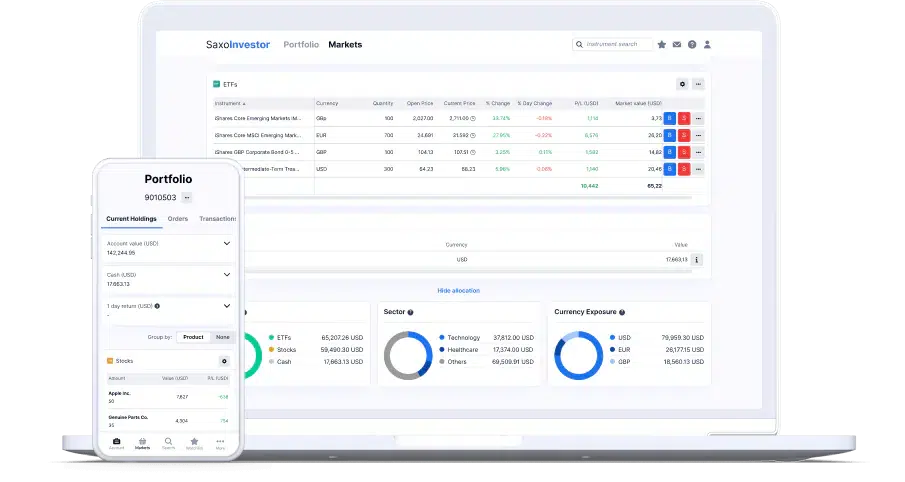
Saxo runs two platforms: SaxoInvestor for straightforward long-term investing, and SaxoTrader for advanced trading across web, mobile, and desktop, with multi-screen workspaces and Level 2 market depth. A single account gives access to both.
Accounts can be held in a wide range of currencies including AED, which avoids conversion costs on every deposit for UAE-based investors. Three tiers are available – Classic, Platinum, and VIP – based on portfolio value rather than deposit requirements, with pricing improving at each level. The Classic tier has carried no minimum since 2024.
For UAE investors specifically, Saxo offers something most alternatives here do not: genuine ownership of real assets across global markets, spanning stocks, ETFs, bonds, funds, options, and futures – rather than CFD exposure alone. Saxo operates in the region through its UAE representative office, licensed by the Central Bank of the UAE.
Note a custody fee of up to 0.15% per year on stock, ETF, and bond positions, avoidable by opting into securities lending. On a $100,000 portfolio that is $150 annually, which compounds over a long holding period.
Pros
- Excellent research materials
- Outstanding trading platforms (SaxoInvestor and SaxoTrader)
- Extensive range of investment products and commercial offers
- Long track record
- Supervised by worldwide top-tier regulators
Cons
- $0 in most countries; higher minimums in some regions (e.g. $5,000 in MENA)
- Fees higher than average
- Fee structure is complex
- Does not accept US residents
#8 Capital.com at a glance
Founded in 2016, Capital.com is a global CFD platform built on a commission-free model and accessible technology, offering CFDs on forex, stocks, indices, commodities, and cryptocurrencies.
For UAE investors, a notable advantage is the ability to deposit and withdraw in AED without conversion charges on the transfer itself (other conversion fees may apply). The platform includes its own web and mobile apps with AI-driven insights and risk management tools, alongside access via TradingView and MT4 for automated strategies.
A free demo account is available, and Islamic accounts are offered. Support is Dubai-based, available 24/7 in English and in Arabic during business hours – a meaningful practical advantage over brokers supporting the region from overseas.
Capital.com charges no commission, earning through the spread instead. Spreads are dynamic and widen with market conditions, though part is returned monthly through a rebate programme.
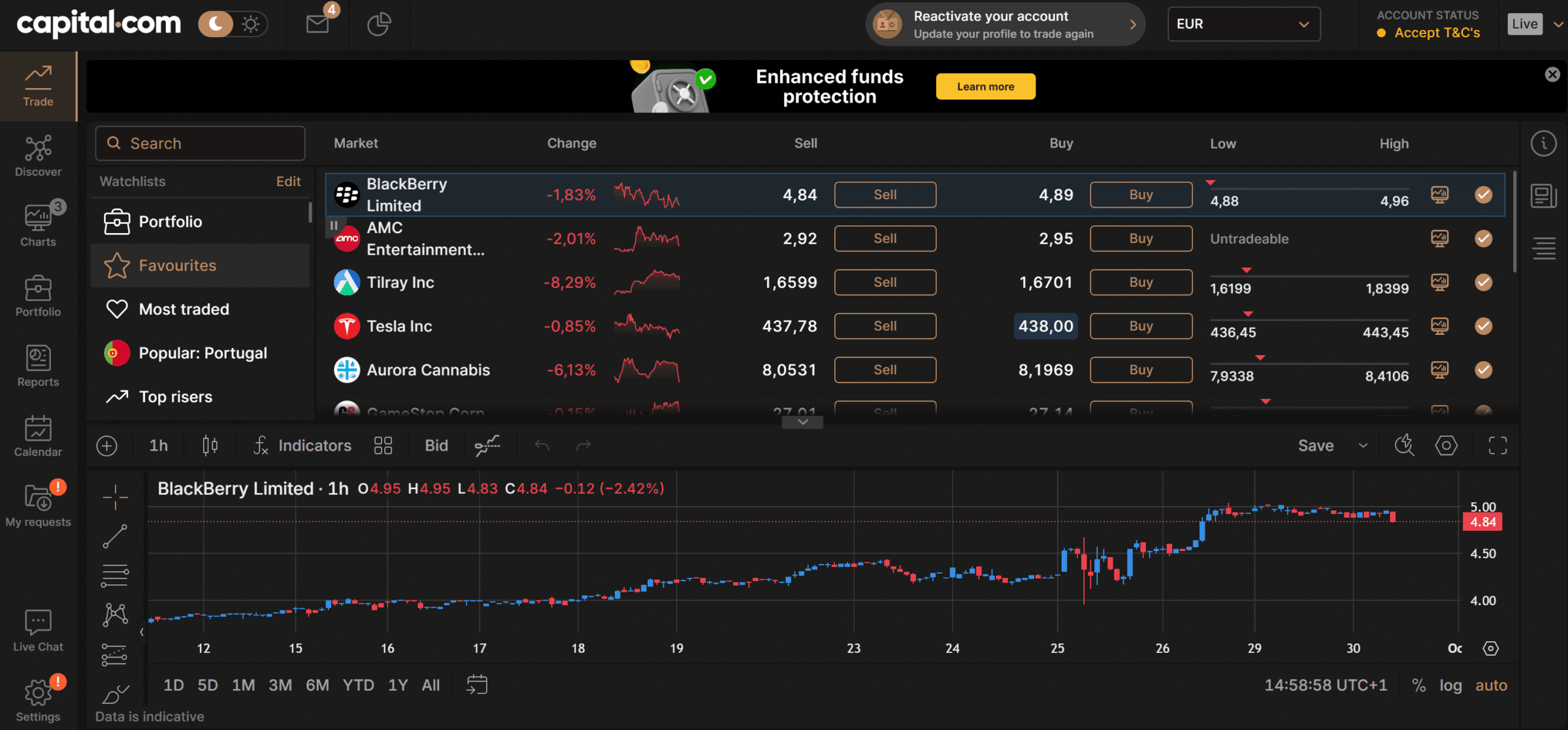
On the downside, Capital.com is unsuitable for anyone wanting traditional investment products – there are no real shares, bonds, ETFs, or retirement accounts, only derivatives.
Its UAE arm, Capital Com MENA Securities Trading LLC, holds a Category 1 licence (No. 20200000176) from the Securities and Commodities Authority – notable as onshore federal regulation, distinct from the DFSA and FSRA free zone regimes. It maintains a Dubai office with 24/7 support.
Pros
-
Minimum deposit of 20 USD/80 AED
-
Demo account
-
Customer support 24/7
-
Local regulator body and office
-
Extended trading hours (in index CFDs)
-
Lots of educational content, including on risk management
- Fee-free AED deposits
Cons
-
The product offering is still limited to CFDs (missing real assets)
-
It may be overwhelming for beginners
- Inactivity fee after 1 year
#9 amana at a glance
Investing in physical shares carries risk. Trading leveraged derivatives and volatile digital assets is high-risk and requires caution.
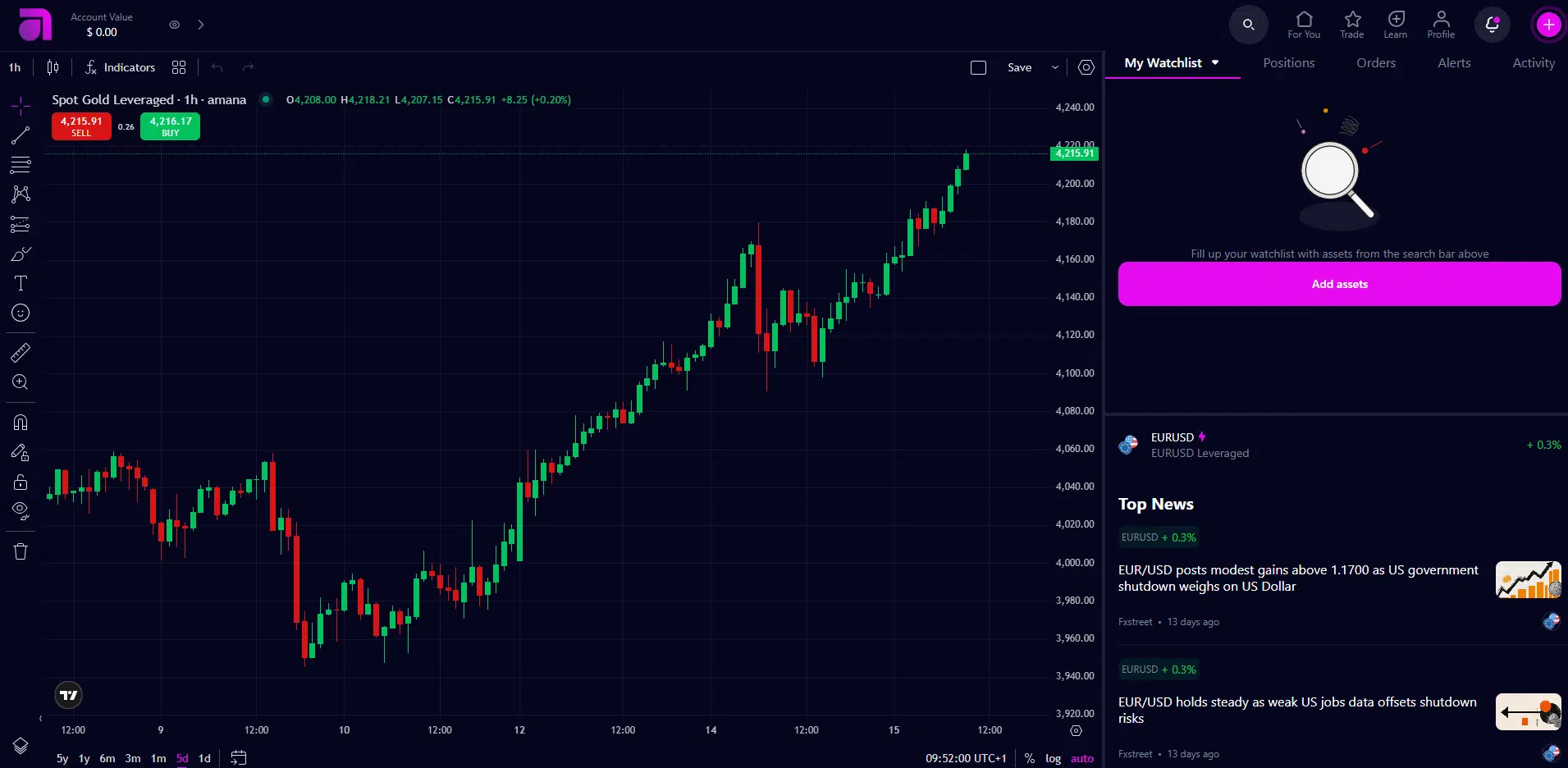
amana is a UAE-based brokerage with over 15 years in the market, headquartered in Dubai, offering access to local and global markets through a single app. New users can claim a $100 bonus with our promo code.
It offers 0% commission on US and international stocks, ETFs, cryptocurrencies (375+ digital assets), and MENA region shares – the last being genuinely distinctive, since few platforms here provide regional market access alongside global ones.
amana invest offers automated diversified portfolios for a hands-off approach, while active traders get 24/5 US stock trading hours, cashback of up to 20% per trade, and transparent pricing. Fractional investing lets you buy portions of higher-priced shares.
The crypto offering is broad, covering hundreds of coins including Bitcoin, Ethereum, and Solana with competitive spreads.
On the downside, the product range excludes bonds and options, and the professional tooling is lighter than global brokers offer.
An important point on regulation. While amana promotes its UAE presence through Amana Financial Services (Dubai) Ltd, clients opening accounts via the amana app contract with AFS Global Limited, licensed by the Labuan Financial Services Authority in Malaysia. Client funds are held in segregated accounts under LFSA rules, but the amana app is not a DFSA-regulated product and DFSA protections do not apply – even for UAE-based users.
That distinction is worth weighing seriously. Labuan is an offshore jurisdiction with materially lighter supervision than the DFSA or SCA, and it offers no investor compensation scheme. Before depositing, confirm which entity you are contracting with and what protection actually applies.
Pros
- 24/5 hours trading on stocks and ETFs
- $100 bonus with amana promo code “IITW”
- 0% commissions on stocks, ETFs and crypto
- Amana Invest (passive investment plans)
- Interest on idle cash
- Cashback on every trade (up to 20%)
- Multi-asset access: U.S. + MENA equities, forex, CFDs, and crypto all in one place.
- MT4/MT5 support for traditional traders
- Good local reach: Enables UAE/Saudi/Qatar trading, local AED deposits
- Amana Invest: Automated ETF and crypto portfolios with no management fees.
- 24/6 customer support
Cons
- Doesn’t offer bonds or options
- No position transfers to other brokers
- Limited product range: LSE/Irish ETFs not yet available
- Emphasis on leverage and CFDs, which may not fit conservative, long-term investors
*MENA stocks can be traded for zero commissions/zero exchange fees for the first $100,000 investment or 50 trades, then amana just passes the exchange fees based on each exchange.
Disclaimer: Investing in physical shares carries risk. Trading leveraged derivatives and volatile digital assets is high-risk and requires caution.
Account setup and process
Opening a trading account in the UAE is straightforward once you follow these steps:
- Obtain a National Investor Number (NIN), required only for trading on UAE exchanges. Register through the Dubai Financial Market or Nasdaq Dubai. This is not needed for international markets;
- Choose a licensed broker. Check whether the platform holds a DFSA, FSRA, or SCA licence, and confirm which entity would actually hold your account – several brokers promote a UAE presence while onboarding clients through overseas entities with weaker protection;
- Open the account. Complete the online application with your personal and financial details and submit identification for verification. Most brokers require passport, Emirates ID, and proof of address;
- Fund your account by bank transfer, card, or other available methods. Brokers accepting AED as a base currency avoid conversion costs that otherwise recur on every deposit and withdrawal;
- Set up your platform. Options range from SaxoInvestor or IBKR GlobalTrader for straightforward investing, through to SaxoTrader or Trader Workstation for more advanced use. Configure charts, market data, and analysis tools to suit how you intend to trade;
- Decide your strategy before placing trades. Consider your time horizon, how much volatility you can tolerate, and whether you want real asset ownership or derivative exposure – the two suit very different purposes;
- Start trading, and keep records of purchase dates and prices from the outset.
Types of trading platforms
The main categories available in the UAE:
- Stock trading platforms: buy and sell shares in listed companies, with genuine ownership of the underlying asset;
- Forex platforms: trade currency pairs, typically with leverage;
- Crypto platforms: buy, sell, and hold cryptocurrencies;
- CFD platforms: trade contracts for difference across various assets without owning them.
The distinction between real assets and CFDs matters more than any other on this list. With real shares you own the asset, receive dividends, and can hold indefinitely. With CFDs you hold a leveraged position against the broker, pay overnight financing on positions held beyond the trading day, and own nothing – which makes them unsuitable for long-term investing regardless of how attractive the pricing looks.
Several platforms available in the UAE offer CFDs only, so confirm which you are getting before opening an account.
Videos about investing from the UAE
Our in-depth videos on investing and choosing a platform in the UAE:
Which platform is best for the UAE?
Several factors matter when choosing a trading platform as a UAE resident:
- Real assets or CFDs? The most consequential question on this list. If you are building a long-term portfolio, you need genuine ownership – several platforms here offer derivatives only in this market;
- Which entity holds your account? Local authorisation from the DFSA, FSRA, or SCA gives you regulatory recourse within the UAE. Some brokers serve UAE clients from overseas or offshore entities with materially weaker protection, so verify rather than assume;
- Top-tier regulation: whether the parent entity is supervised by the FCA, SEC, CySEC, or an equivalent authority, and what investor compensation applies;
- AED support: platforms accepting dirhams as a base currency avoid conversion costs that recur on every deposit and withdrawal, and add up considerably over time;
- Islamic accounts: swap-free accounts are widely available, though note these remove interest charges rather than screening investments for Sharia compliance. Sarwa’s Halal portfolios, with a supervisory board and dividend purification, are a different proposition;
- Product range: whether the platform covers what you actually intend to trade, including regional exchanges if you want DFM or ADX exposure;
- Total cost: commissions, spreads, custody charges, conversion fees, and inactivity charges together rather than headline rates alone;
- Platform quality and support: whether the interface suits your experience level, and whether support is available locally and in your language.
The right platform depends on your profile, preferences, and objectives. Our research suggests each broker reviewed here is the best choice for a particular kind of investor:
Interactive Brokers
Best overall trading platform in the UAESarwa
Best for beginners and auto-investeToro
Best for commission-free investing and social tradingFreedom24
Best for access to high-yield ETFs (6%–12% in select cases)Plus500
Best for CFDsXTB
Best for low-fee CFD and Forex tradingSaxo
Best for professionalsCapital.com
Best for fee-free AED deposits and commission-free CFD trading with local support.amana
Best for 0% commissions
Please note that the above should not be seen as investment advice and should be considered information only. Investors should do their own due diligence about the best-suited services and opportunities for their risk levels, return objectives, and ESG considerations.
FAQs
Which trading platform is best for the UAE?
We find that the best online trading platform for global traders remains IBKR, while eToro is best for those looking to invest commission-free. However, choosing an online broker continues to be a personal choice, and we’ve dedicated our website and our time to helping you make the most informed decision.
Which has the best mobile trading app for the UAE?
Each of the brokers above have great trading apps. Generally, you want to see an app that is intuitive, streamlined, and presents all the necessary information within a few seconds.
What is an islamic account?
An islamic account follows the principles of shari’a, or islamic law, that forbids the use of interest or interest-based lending in any form. Fortunately, many online brokers can accommodate muslim traders and offer interest- or swap-free accounts. Swaps often bear an interest element.
Why is the UAE an attractive region?
Dubai has long been a top destination for nomad capitalists or globally minded professionals for many years. Recently, as Covid-19 abates, renewed interest has made Dubai and Abu Dhabi great cities for new expatriates.
What is the minimum balance to start trading in the UAE?
Many brokers do not require a minimum balance, meaning you can start trading for as little as 1 AED, USD, or EUR, for example.