With many online brokers in Spain, finding the best one can be challenging.
Our extensive experience in this field – reviewing and monitoring dozens of online brokers daily – will guide you in finding exactly what you need, whether it’s earning interest on cash, a platform for ETFs, or trading forex.
In this article, we’ll present and compare the best trading platforms in Spain that we identified based on our experience.
Best online brokers in Spain in 2026
Short on time? Check out our top picks for the best online brokers in Spain:
- Interactive Brokers: The best online broker in Spain overall. On the downside, it might be a bit overwhelming for beginners
- eToro: Best commission-free ETF investing
- Scalable Capital: Best for automatic investing (Robo-advisor)
- XTB: Best for forex
- Saxo Bank: Best for experienced investors
- DEGIRO: Best discount broker
Disclaimer: Investing involves risk of loss.
For a list of brokers we do not recommend, you can visit our full list of broker reviews, and filter by “Not recommended”.


52% of retail CFD accounts lose money.


69-80% of retail CFD accounts lose money.

62% of retail CFD accounts lose money.

Investing involves risk of loss.
Comparison of best online brokers in Spain


Other resources
- Check our Youtube channel! You will find step-by-step guides of how to invest in the S&P 500 on different apps, as well as other educational videos about investing and investment platforms.
- Explore our tools: Check our comparison tool, reviews, broker bonuses, broker interest rates, BrokerMatch, and others.
Broker reviews
eToro at a glance
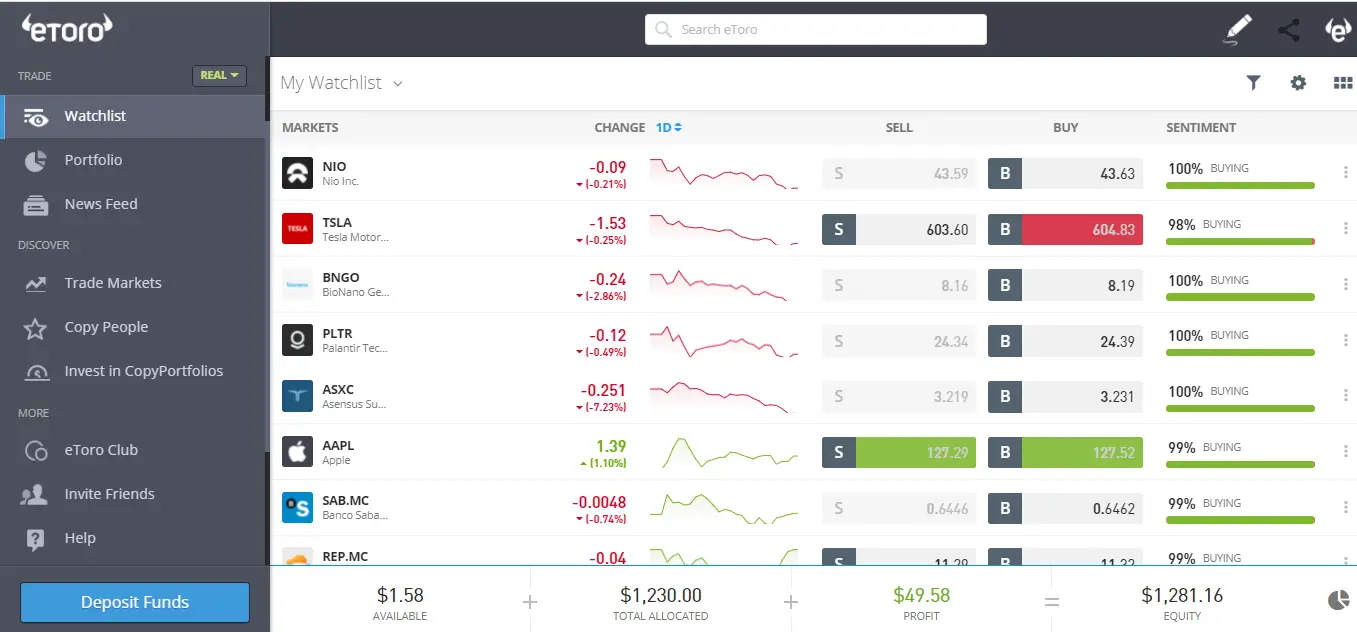
One of the best trading platforms available in Spain is eToro, an international online broker with over 40 million users across 140+ countries trading stocks, ETFs, and cryptocurrencies. It is best known for its social trading feature, which lets you replicate the trades of experienced investors through CopyTrader. Thousands of verified Popular Investors are available, and you can select based on past return on investment, risk score, drawdown, and other published metrics.
The platform gives Spanish users access to more than 3,000 financial instruments, including real stocks and ETFs from US, UK, and major EU exchanges – including BME (Bolsa de Madrid) for Spanish equities. Users can also invest in Smart Portfolios, ready-made thematic allocations grouping several assets or traders around a strategy such as AI, renewable energy, or dividend investing.
On pricing, ETFs trade commission-free regardless of transaction size or how the order is placed, whether manually, through CopyTrader, or via Smart Portfolios. Stock trades carry a $1 commission on most exchanges ($2 on the Australian, Hong Kong, Dubai, Abu Dhabi, and Tokyo exchanges), applied both when opening and closing a position. Whole and fractional shares are supported, with a $50 minimum first deposit. Other fees apply.
Opening an account and depositing is straightforward, and you can practise first with a $100,000 virtual demo account. On the downside, spreads can be relatively high on some products, and eToro operates in USD as its only base currency – so EUR deposits are converted to USD (FX cost ~50 pips), which is a meaningful consideration for euro-based Spanish investors. There is also a $5 withdrawal fee and a $10 monthly inactivity fee after 12 months without login.
eToro is regulated by top-tier authorities including the FCA (UK), ASIC (Australia), and the SEC/FINRA (US). Spanish residents are served by eToro (Europe) Ltd, authorised and regulated by the Cyprus Securities and Exchange Commission (CySEC) and passported into Spain under MiFID II with CNMV oversight. Client assets are covered by the Cyprus Investor Compensation Fund (ICF) up to €20,000, plus additional Lloyd’s of London insurance up to €1 million per eligible client. eToro has also been listed on NASDAQ (ticker: ETOR) since its May 2025 IPO.
Spanish tax note: as a non-Spanish broker, eToro does not act as a retenedor, so you must declare gains and dividends yourself in your declaración de la renta (IRPF). Holdings above €50,000 abroad may also trigger Modelo 720 reporting obligations.
If you want to learn more, check our eToro review.
Pros
- Low stock trading fees (from $0 per trade)
- Commission-free ETFs (other fees apply)
- Social trading and other innovative products
- Wide variety of financial products
- Slick, modern, and easy for anyone to use
- European users have access to three account currencies: EUR, USD and GBP
- Top tier regulators
Cons
- Limited disclosed financial information
- Withdraw and inactivity fees
- Spread, overnight, inactivity, and currency conversion fees higher than average
- Doesn’t offer bonds, futures, or options
Interactive Brokers at a glance
Another exceptional trading platform available in Spain is Interactive Brokers. Founded in 1978 and publicly listed on NASDAQ (ticker: IBKR; an S&P 500 constituent since 2024), it is a global online broker that has weathered multiple financial crises, demonstrating resilience and a rigorous risk management framework, with 3 million+ client accounts worldwide.
Interactive Brokers offers an advanced platform covering stocks, options, mutual funds, ETFs, futures, bonds, currencies, and cryptocurrencies across 170+ markets in 36+ countries – including BME (Bolsa de Madrid) for Spanish equities and access to Spanish government bonds. Trade execution is supported by IB SmartRouting, alongside a comprehensive set of technical and fundamental tools.
Beginners and intermediate investors have educational resources available through IBKR Campus (formerly Traders’ Academy), though the main TWS platform has a steep learning curve. Customer support typically provides clear, concise answers, reducing back-and-forth.
On the downside, the fee structure is comparatively complex, registration is lengthy (though fully online), and IBKR does not offer fully commission-free trading. However, factoring in FX conversion at 0.20 basis points (minimum $2), tight spreads, the Stock Yield Enhancement Program, and cash interest on uninvested EUR and USD balances, Spanish clients still achieve significant savings compared with most brokers. There is also no minimum deposit and native EUR base currency support.
Spanish clients are served by Interactive Brokers Ireland Limited, regulated by the Central Bank of Ireland and passported into Spain under MiFID II with CNMV oversight. As with other non-Spanish brokers, IBKR does not act as a retenedor, so IRPF declaration and potential Modelo 720 reporting fall to you.
Interactive Brokers also offers IBKR GlobalTrader, a modern mobile app for trading stocks, ETFs, and options, well suited to beginners. Features include automatic currency conversion, fractional shares from $1, and a $10,000 virtual demo account.
Want to know more about Interactive Brokers? Check our Interactive Brokers review.

Pros
- Low commissions on US stock trading
- No monthly inactivity fee
- The broadest product and markets range in the brokerage industry
- Demo account
- Excellent reputation (founded in 1978)
- Extensive research and Education tools
- Has a modern mobile trading app to trade Stocks, Options and ETFs, ideal for novice investors, IBKR GlobalTrader.
- Offers interest on uninvested cash balances
Cons
- Complicated and lengthy account opening process (but fully online)
- Steeper learning curve for beginners
- Website is difficult to navigate
- Interactive Advisors (Robo-advisor feature) is only available for US customers
Scalable Capital at a glance
Founded in 2014, Scalable Capital is a German fintech operating across Spain that offers two services: a Brokerage, where you can trade shares, ETFs, funds, crypto ETPs, and derivatives, and set up automated savings plans (the equivalent of a Spanish plan de inversión periódica); and a Wealth Service (robo-advisor), which delivers a personalised portfolio managed on your behalf.
On the brokerage side, the product range is substantial: 7,500+ shares, 2,400+ ETFs (many UCITS-compliant), 3,000+ funds, 70+ crypto ETPs, and 375,000+ derivatives, traded primarily on Xetra and Gettex. Scalable Capital offers three pricing plans: Free Broker (€0/month), Prime Broker (€2.99/month), and Prime Broker Flex (€4.99/month). All three include free trading on a curated list of PRIME ETFs, while commission-free share trading is included from the Prime Broker plan upwards.
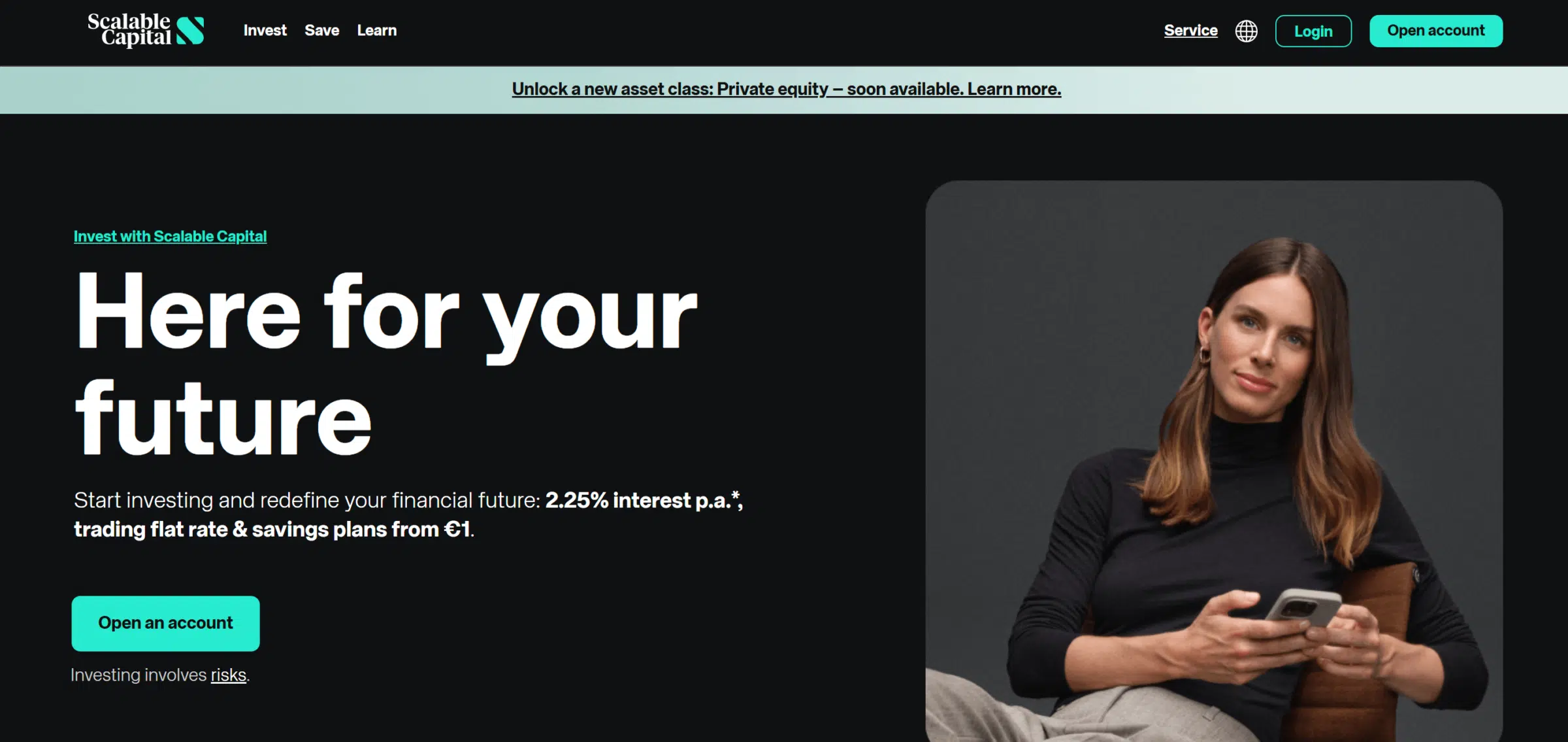
Within the Wealth Service, you are presented with a range of ETF-based portfolios and strategies. You first complete a short questionnaire to establish your risk profile, after which an appropriate portfolio is constructed and managed for you. The annual management fee is 0.75% up to €100,000, scaling down to a minimum of 0.49% per year on portfolios above €500,000 – competitive against traditional Spanish wealth management, though above the cheapest Spain-based robo-advisors such as Indexa Capital and inbestMe.
Scalable Capital holds regulatory permission from the German Federal Financial Supervisory Authority (BaFin) to provide securities services and is supervised by the Deutsche Bundesbank, with passporting into Spain under MiFID II and CNMV oversight. As a member of the German investor compensation framework, client cash is protected up to €100,000 under the German Deposit Guarantee Scheme, and securities up to 90% of losses, capped at €20,000, under the German Investor Compensation Scheme (EdW).
One consideration specific to Spanish investors: Scalable Capital does not act as a Spanish retenedor, so gains and dividends must be declared via your IRPF return, and foreign holdings above €50,000 may trigger Modelo 720 obligations. Spanish-domiciled alternatives such as Indexa Capital handle this at source and additionally offer traspasos, the tax-deferred transfer mechanism between index funds that is only available on Spanish fund structures – a genuine advantage for Spanish residents building long-term portfolios.
Pros
- Stocks and ETFs commission-free (in PRIME Broker)
- €1 minimum deposit
- Interest on idle cash
- No custody fee
- Regulated by Bafin
Cons
- No access to US stock exchanges
- No fractional shares
- Limited crypto available
- €3.99 per trade on Xetra
XTB at a glance
69-80% of retail CFD accounts lose money.
Founded in 2002 in Warsaw and publicly listed on the Warsaw Stock Exchange (ticker: XTB), XTB is a major European broker with more than 1.7 million clients across 16 countries. It is regulated by top-tier authorities including the CNMV (Spain), the FCA (UK), KNF (Poland), CySEC (Cyprus), BaFin (Germany), and AFM (Netherlands).
You can invest through xStation 5 and xStation Mobile across a broad product range including real stocks and ETFs (many UCITS-compliant), forex, indices, commodities, cryptocurrency CFDs, and vanilla options, launched in early 2026. XTB offers 0% commission on real stocks and ETFs up to €100,000 of monthly turnover (0.2% above, with a €10 minimum), and also applies 0% commission on stock and ETF CFDs.
Opening an account and transferring money is quick and fully online, with Spanish-language support available. For beginners, XTB provides a demo account to trade in realistic conditions before committing capital, alongside the XTB Trading Academy in Spanish. For intermediate and advanced investors, xStation 5 delivers a strong set of technical and fundamental tools to support investment decisions.

XTB also pays interest on uninvested cash balances. Rates are linked to ECB policy and vary by currency, with promotional rates typically applying for an introductory period after account opening before reverting to the standard rate. Verify current rates directly on XTB’s website, as these change with monetary policy.
On the downside, XTB charges a €10 monthly inactivity fee after one year without trading and no deposit in the past 90 days. Cryptocurrency CFDs carry relatively high spreads, though forex pricing is competitive. As a non-Spanish broker, XTB does not act as a retenedor, so gains and dividends must be declared via your IRPF return, with Modelo 720 obligations potentially applying to holdings above €50,000.
Want to know more about XTB? Check our XTB review.
CFDs are complex instruments and come with a high risk of losing money rapidly due to leverage. 76-83% of retail investor accounts lose money when trading CFDs with XTB.
Pros
- Free stocks trading (only applicable to some countries)
- Customizable trading platform (charts and workspace)
- Low Forex Spreads
- Demo account
- No minimum account deposit
- Valuable education materials
- Top-tier Regulators
Cons
- Complex trading platform for a beginner
- High Stock CFD spreads
- Limited product portfolio
- Withdrawal fees for transfers below $100
- Inactivity fee (€10/monthly after 1+ year with no activity plus no deposit in the last 90 days)
Saxo Bank at a glance
62% of retail CFD accounts lose money.
Launched in 1992 in Copenhagen, Saxo (formerly Saxo Bank) is one of the most solidly capitalised entities in the brokerage industry, with a proven long-term track record. In March 2025, Saxo was acquired by J. Safra Sarasin, one of the world’s most conservatively run private banking groups, and holds an A-/A2 credit rating from S&P. Saxo gives access to over 71,000 financial instruments through three platforms: SaxoInvestor, SaxoTraderGO, and SaxoTraderPRO.
The product range spans cash and margin trading across global markets, including stocks, ETFs, bonds, mutual funds, options, futures, forex, commodities, and CFDs. Saxo positions its research tooling around both long-term investing and leveraged trading.
Saxo’s account tiers are as follows:
- Classic: no minimum deposit since 2024, with access to competitive spreads and customer and technical support;
- Platinum: requires a portfolio value of €200,000+. Adds up to 30% lower trading costs and prioritised local-language support;
- VIP: requires a portfolio value of €1,000,000+. Offers the best pricing, direct access to trading specialists, and exclusive event invitations.
Note that Platinum and VIP are based on portfolio value rather than a deposit requirement, so tiers can be reached through account growth as well as through funding.

Pricing varies by account tier. A US stock order costs 0.08% of trade value (minimum $1) at Classic, falling to 0.05% at Platinum and 0.03% at VIP, with the same $1 minimum. Note also that accounts holding stocks, ETFs, ETCs, or bonds are subject to a custody fee of up to 0.15% per year. This fee can be avoided by opting into Saxo’s securities lending programme, which is worth doing if you intend to hold positions long term – over a multi-year horizon, 0.15% annually compounds into a meaningful drag.
Listed prices are indicative and vary by country of residence. For precise figures, check the trade tickets within the platform.
Saxo Bank A/S is a fully licensed European bank supervised by the Danish Financial Supervisory Authority (DFSA), with passporting into Spain under MiFID II and CNMV oversight. Saxo is a member of the Danish Guarantee Fund, which protects client cash deposits up to €100,000 and financial securities up to €20,000 per client.
Pros
- Excellent research materials
- Outstanding trading platforms (SaxoInvestor and SaxoTrader)
- Extensive range of investment products and commercial offers
- Long track record
- Supervised by worldwide top-tier regulators
Cons
- $0 in most countries; higher minimums in some regions (e.g. $5,000 in MENA)
- Fees higher than average
- Fee structure is complex
- Does not accept US residents
DEGIRO at a glance
Founded in 2013, DEGIRO is a low-cost brokerage that has become widely popular across Europe thanks to its competitive pricing. With more than 3 million users across 18+ European countries, its “do-it-yourself” platform gives Spanish investors direct access to a broad set of assets including stocks, ETFs, bonds, options, futures, warrants, investment funds, and certain leveraged products (not identical to CFDs. More info here).
DEGIRO’s Core Selection ETFs can be traded at low cost (subject to a €1.00 handling fee covering external costs), with no minimum investment required. US stocks cost €1.00 per order, while European stocks – including BME (Bolsa de Madrid) – are typically €3.90 plus the €1.00 handling fee. The web platform is basic but efficient and easy to learn, and the mobile app follows the same approach. On the downside, fundamental research is limited, a €2.50 annual connectivity fee per exchange applies, and price alerts are not available.

On the regulatory side, DEGIRO operates as the Dutch branch of flatexDEGIRO Bank AG, a German credit institution supervised by BaFin and the Deutsche Bundesbank, with passporting into Spain under MiFID II and CNMV oversight. In the unlikely event that segregated assets cannot be returned to clients, DEGIRO falls under the German Investor Compensation Scheme (EdW), covering 90% of losses up to a maximum of €20,000 – worth bearing in mind if you plan to invest substantially larger volumes. Cash held in a DEGIRO Cash Account with flatexDEGIRO Bank AG is additionally guaranteed up to €100,000 under the German Deposit Guarantee Scheme.
Still have doubts? Read our full DEGIRO review.
Pros
- ETF Core Selection: full range of ETFs/ETCs/ETNs on Tradegate (1,000+ products) for only the €/£1 handling fee, with no connectivity fee (external fees apply)
- User-friendly web and mobile app
- Wide range of investment options
- Education material: Investor’s Academy and Investing with DEGIRO
- Low overall commission structure
- No account opening, inactivity, or withdrawal fee
Cons
- 0.25% currency conversion fee (charged if you deposit or invest in a different currency than your base currency)
- €/£1 flat handling fee (charged in most transactions)
- €/£2.50 of connectivity fee (paid annually), per exchange where you’re invested
- Does not offer Forex or CFDs
- No ISA account (for UK residents)
- Low-quality customer support
- No interest paid on cash balances
Which platform should you choose?
Choosing a broker in Spain depends on your trading preferences, investment goals, and level of experience. Key factors worth weighing:
- Total cost of ownership: look beyond headline commissions to FX conversion fees, custody charges, inactivity fees, and connectivity costs. Saxo’s 0.15% annual custody fee and DEGIRO’s €2.50 per-exchange charge matter more over a long holding period than a small difference in per-trade commission;
- Regulation: verify supervision by a top-tier authority – either the Comisión Nacional del Mercado de Valores (CNMV) directly, or an EU regulator passporting into Spain under MiFID II – and confirm the investor compensation scheme covering you;
- Market access: check whether the broker offers BME (Bolsa de Madrid), the international markets you need, and instrument types such as options, bonds, or futures;
- EUR base currency: brokers with native EUR accounts (IBKR, XTB, DEGIRO, Saxo) avoid the recurring conversion costs that apply on USD-only platforms such as eToro;
- Tax handling: none of the international brokers above act as a Spanish retenedor, so gains and dividends must be declared through your IRPF return, and foreign holdings above €50,000 may require Modelo 720 filing. If you would rather avoid this, Spanish-domiciled providers handle withholding at source, and Spanish index funds additionally offer traspasos, the tax-deferred transfer mechanism unavailable through foreign brokers;
- Platform usability and support: Spanish-language customer service and an interface matching your experience level matter more in practice than a long feature list.
Research and compare brokers against your own requirements rather than headline rankings. The best platform for a long-term ETF investor looks quite different from the best one for an active trader.
Please note that the information provided above is not intended as investment advice and should be regarded solely as informative. Investors are encouraged to conduct their own research and due diligence to identify services and opportunities that align with their risk tolerance, expected returns, and impact strategy.
Other FAQs about brokers in Spain
How to invest in stocks from Spain?
You can use one of the online brokers shown above: eToro, Interactive Brokers, XTB, Saxo Bank, DEGIRO, and Scalable Capital. US-based brokers like TD Ameritrade and Vanguard are not available in Spain.
What is a brokerage company?
It is an entity designed to be the middleman between you and the people you are trying to buy or sell a stock, ETF, crypto,… you name it!
Which broker is best in Spain?
There is no single answer. It depends on what you value most: fees, security, investment platform or any relevant feature.
What are the types of investments you can make with a brokerage account?
You can trade stocks, ETFs, Forex, Bonds, Futures and CFDs on stocks, ETFs, indices, cryptocurrencies, and commodities.
How much money do I need to start trading online in Spain?
The amount needed to start trading online in Spain varies. Many brokers have low minimum deposit requirements, often with no minimum investment at all. However, the ideal amount depends on your trading strategy, risk tolerance, and the assets you plan to trade.