


The S&P 500 has returned about 11% a year since January 1993, according to State Street (to 31 August 2026, in US dollars). US stocks have also beaten European ones over the long run: since December 1987, the MSCI USA index returned 11.66% a year against 8.77% for the MSCI Europe (gross, in US dollars, to August 2026). That is why so many European investors ask how to gain exposure to it. Past performance doesn’t guarantee future results.
In this article, we look at how to buy the S&P 500 from Europe: how to choose a suitable S&P 500 ETF, how the leading investment platforms compare, the mistakes worth avoiding, and the tax considerations that apply to European investors.
First, an important point. As a European retail investor, you cannot buy the well-known US-listed S&P 500 ETFs such as SPY, VOO, or IVV. Under the EU PRIIPs regulation (Packaged Retail and Insurance-based Investment Products), funds sold to retail investors must publish a Key Information Document (KID), which US-domiciled funds do not provide, so EU brokers cannot sell them to retail clients. The route instead is through UCITS ETFs, European-domiciled funds tracking the same index, several of which are listed below. If you are weighing the S&P 500 against a global index, see our S&P 500 vs MSCI World comparison.
1. Pick an ETF tracking the S&P 500
The S&P 500 consists of the leading 500 publicly traded US businesses. It includes large, well-known companies like Apple, Amazon, and Microsoft, to name a few. It is, however, impossible to directly buy the S&P 500 index. What you can do is invest in the S&P 500 through an instrument that replicates its performance, like an exchange-traded fund (ETF).
The table below shows six of the biggest S&P 500 UCITS ETFs available to Europeans. We filtered them using justETF, a site that helps you find and compare ETFs, and took TERs and fund sizes from the issuers’ own websites.
| Name | TER | ISIN | Ticker* | Replication | Income | Fund size |
| iShares Core S&P 500 UCITS ETF | 0.07% | IE00B5BMR087 | CSPX | Physical | Accumulating | $155.0bn |
| Invesco S&P 500 UCITS ETF | 0.05% (+0.072% swap fee) | IE00B3YCGJ38 | SPXS | Synthetic | Accumulating | $59.9bn |
| Vanguard S&P 500 UCITS ETF | 0.07% | IE00B3XXRP09 | VUSA | Physical | Distributing | $53.4bn |
| SPDR S&P 500 UCITS ETF (Dist) | 0.03% | IE00B6YX5C33 | SPY5 | Physical | Distributing | $21.3bn |
| SPDR S&P 500 UCITS ETF (Acc) | 0.03% | IE000XZSV718 | SPYL | Physical | Accumulating | $19.2bn |
| Xtrackers S&P 500 Swap UCITS ETF | 0.15% | LU0490618542 | XSPX | Synthetic | Accumulating | €8.0bn |
*Tickers vary by listing venue. The same ETF trades under different tickers on Xetra, Euronext, Borsa Italiana, and the London Stock Exchange, so always search by ISIN rather than ticker when placing an order. Fund sizes are the providers’ own figures for each share class at the end of September 2026, except Xtrackers (fund level). The two SPDR share classes belong to the same fund. TERs and fund sizes change over time, so check the provider’s factsheet before investing.
Each ETF has several tickers, and we show one for simplicity. To see them all, search for the ISIN on justETF and open the “Stock exchange” tab. If you can, choose a listing in your own currency (for example, SXR8 in euros on Xetra rather than CSPX in dollars in London) to avoid your broker’s currency conversion fee.
Below, we explore in greater detail what the “Replication method” and “Use of income” mean.
2. Choose a good ETF broker
Once you have picked an ETF, you need a broker that offers it. This is where each ETF can be bought as a real ETF (not a CFD):
| Broker | CSPX | SPXS | VUSA | SPY5 | XSPX |
| eToro | ✔ | ✔ | ✔ | ✔ | ✘ |
| Interactive Brokers | ✔ | ✔ | ✔ | ✔ | ✔ |
| Lightyear | ✔ | ✔ | ✔ | ✘ (SPYL instead) | ✔ |
| DEGIRO | ✔ | ✔ | ✔ | ✔ | ✔ |
| Freedom24 | ✔ | ✔ | ✔ | ✔ | ✔ |
| XTB | ✔ | ✔ | ✔ | ✔ | ✔ |
| Trading 212 | ✔ | ✔ | ✔ | ✔ | ✔ |
Availability checked on each broker’s public instrument lists in September 2026. Some brokers list the ETF under another ticker or exchange (for example, the Xtrackers ETF appears as D5BM at XTB). At DEGIRO, all five trade on Tradegate. Search by ISIN to find them.
Fees, the minimum deposit, the range of ETFs and regulation matter too. Our summary for EU residents:
| Broker | ETF fees | Min. deposit | ETF range | Regulators |
| eToro | $0 commission (other fees apply) | $50 (varies by country) | 300+ | CySEC, FCA, ASIC |
| Interactive Brokers | 0.05% of trade value (min €1.25, max €29, Tiered) | €/$/£0 | 90+ market centres | Central Bank of Ireland, FCA, SEC and others |
| Lightyear | €0 execution fee (other fees may apply) | €/£1 | 6,000+ stocks and funds | Finantsinspektsioon (Estonia), FCA |
| Freedom24 | €0.02 per share + €2 per order (Smart plan) | €/£0 | 3,600+ | CySEC |
| DEGIRO | €0 + €1 handling fee (Core Selection), €2 + €1 on other ETFs | €0.01 | 700+ (Core Selection) | BaFin, AFM, DNB |
| XTB | €0 up to €100,000 a month, then 0.2% (min €10) | €0 | 2,200+ | KNF, CySEC, FCA and others |
| Trading 212 | €0 commission, 0.15% FX fee | €/£1 | 13,000+ stocks and ETFs | BaFin, CySEC, FCA, ASIC |
ETF fees for EU residents. Sources: broker fee pages, September 2026. Currency conversion fees may also apply: XTB charges 0.5% and Lightyear 0.35% when you buy an ETF in another currency. Trading 212: Other fees may apply. See terms and fees. 0,15% FX fee applies when converting funds. Other fees may apply. When investing, your capital is at risk and you may get back less than invested. Past performance doesn’t guarantee future results.
3. Place a “Buy Order” (in eToro)
- Search for the chosen ETF (we use SPY5):

- Click “Trade”: choose the amount you want to invest ($11 in our example) and make sure leverage is set to “X1”. With higher leverage, or if you choose “Short”, you would be trading a CFD, a derivative with higher risk and costs, and you would not own the ETF.

- Click “Buy”: You will see an “order filled” message, which means you now hold the ETF.

eToro charges no commission on ETFs (other fees apply), and you can trade on the web or in the mobile app. Your eToro account is held in US dollars unless you use one of its local currency accounts, so check the conversion fee before depositing euros. For a full walkthrough, see our guide to investing in the S&P 500 on eToro.
Note that eToro offers US-domiciled ETFs to EU and UK clients only as CFDs, so some S&P 500 ETFs on eToro are CFDs (not the case with SPY5). Make sure you buy the real ETF: a CFD is a different instrument, with other fees and no ownership of the underlying fund.
For example, eToro offers Vanguard’s US-listed VOO only as a CFD:

Your capital is at risk. Other fees apply. For more information, visit etoro.com/trading/fees. CFDs are complex instruments and come with a high risk of losing money rapidly due to leverage. 51% of retail investor accounts lose money when trading CFDs with this provider.
4. Place a “Buy Order” (in DEGIRO)
DEGIRO offers all six ETFs in our table. For this example, we use the iShares Core S&P 500 UCITS ETF (CSPX):
- Search for CSPX (quoted in euros on Euronext Amsterdam):

- Click “B” (buy): a panel opens on the right, where you choose the order type (a limit order in this case), the limit price and the number of shares.

- Click “Place Order”: DEGIRO shows the order details, including costs, and you confirm the trade. For more detail, see our guide to investing in the S&P 500 on DEGIRO.

What to look for in any ETF?
Not all ETFs are created equal. Different asset managers provide different ETFs tracking the same indices (like the S&P 500). The main differences are:
1. Fees (TER)
Every ETF charges an annual fee, deducted from the fund’s assets, known as the total expense ratio (TER) or ongoing charges figure (OCF). Lower fees leave more of the return for you. For S&P 500 UCITS ETFs, TERs now range from 0.03% to 0.15%: on €10,000, that is €3 to €15 a year.
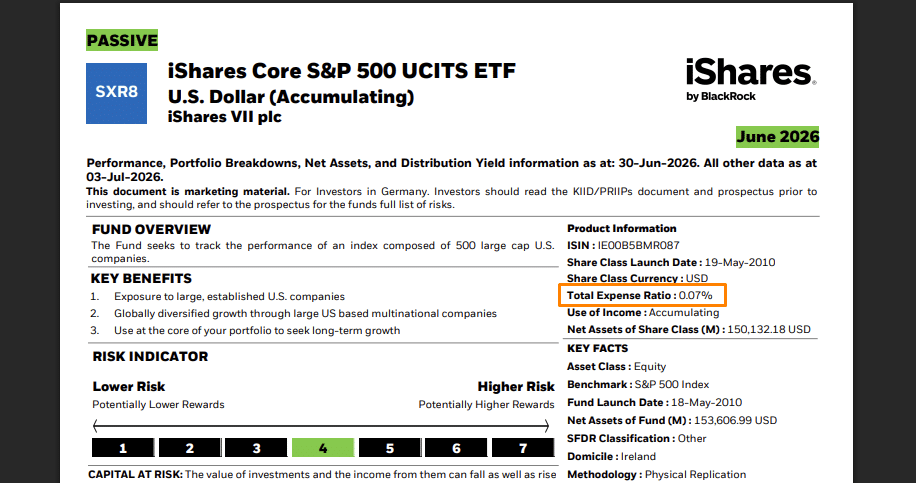
Using the iShares Core S&P 500 UCITS ETF (CSPX, shown as SXR8, its euro listing on Xetra) as an example, you can check its TER of 0.07% in the factsheet:
2. Replication method
There are two ways to replicate an index:
- Physical replication ETFs means the ETF will try to buy the underlying assets laid out in the index.
- Synthetic replication ETFs means that the ETF uses financial derivatives to replicate the performance of the index.
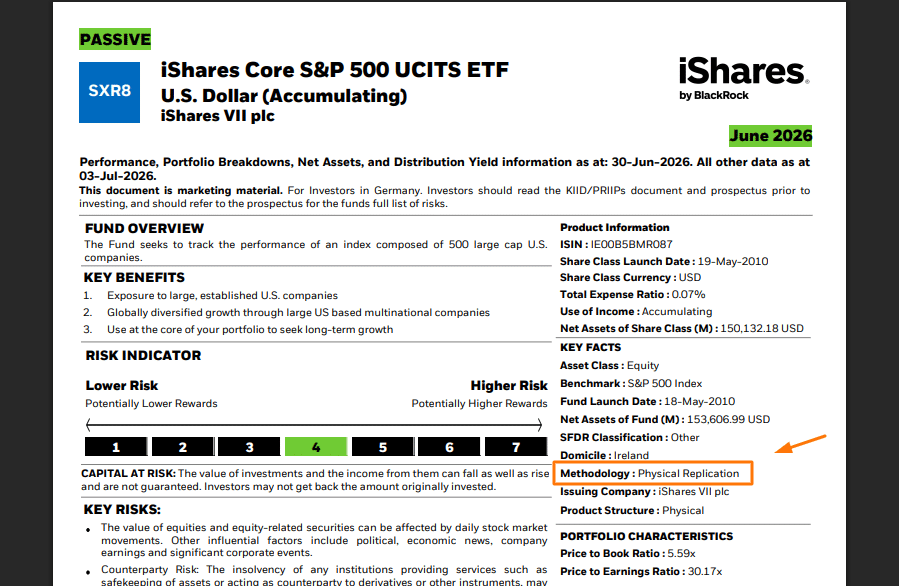
Physical ETFs are simpler to understand and carry no derivative counterparty risk. Synthetic ETFs rely on a swap with one or more banks, which adds that risk and, in Invesco’s case, a swap fee of 0.072% on top of the TER. Their advantage is that US dividends reach the fund without the 15% withholding tax that physical Irish funds pay, which can help them track the index more closely. Using CSPX again, you can see its method is “Physical Replication”:
3. Use of Income
Apart from their product structure, the ETFs also distinguish themselves in the following terms:
- Accumulating ETFs reinvest the dividends they receive. In many countries you only pay tax when you sell, although some, such as Germany and the Netherlands, tax these funds every year anyway.
- Distributing ETFs pay the dividends out to you, usually every quarter, into your brokerage account, and you normally pay tax on them in the year you receive them.
Which one is better? It depends on your goals and your country’s tax rules. If you are investing for the long term and do not need income, an accumulating ETF saves you from reinvesting dividends yourself. If you want regular income, a distributing ETF pays it out.
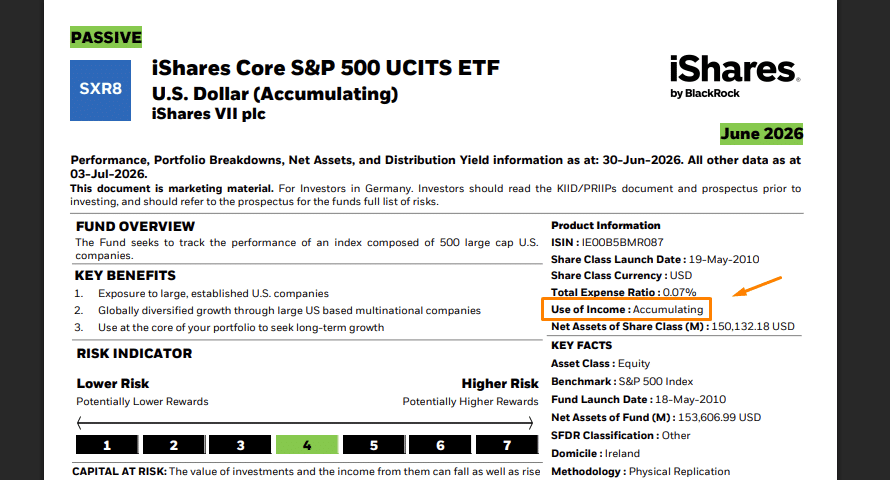
The CSPX is “Accumulating”:
4. Size
Fund size matters too. Small funds are more likely to be closed, in which case the fund sells its holdings and pays the proceeds to investors, which can trigger a taxable sale at a time you did not choose. All six ETFs in our table manage billions, so this risk is low for them.
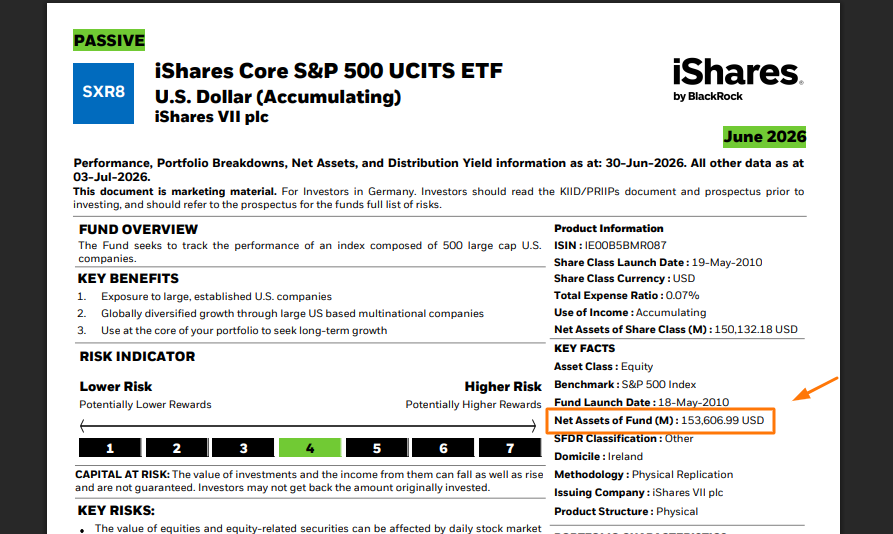
At the end of June 2026, CSPX had net assets of $153.6 billion:
5. Hedging
The S&P 500 is priced in US dollars, so as a euro or pound investor your return also depends on the exchange rate. Currency-hedged share classes use derivatives to reduce that effect, at a higher cost. All the ETFs in our table are unhedged, so your return includes the moves of the dollar.
Common mistakes to avoid
- Buying a CFD by mistake: on CFD brokers, check that you are buying the ETF itself with no leverage.
- Searching by ticker only: the same ticker can mean different ETFs on different exchanges. Search by ISIN.
- Paying currency fees you could avoid: buying a dollar listing with a euro account can cost 0.15% to 0.5% per trade at many brokers. A euro listing avoids it.
- Looking for SPY or VOO: as retail investors in the EU, you cannot buy US-domiciled ETFs. Use their UCITS equivalents.
- Forgetting your local tax rules: accumulating and distributing ETFs can be taxed differently depending on where you live.
Taxes for European investors
All the ETFs in our table are domiciled in Ireland, except the Xtrackers fund, which is in Luxembourg. This matters because of US withholding tax on dividends. Thanks to the tax treaty between Ireland and the US, physical Irish funds pay 15% US withholding tax on the dividends they receive, instead of the 30% standard rate. Synthetic funds avoid it because they receive the index return through a swap. None of this appears on your tax return, but it affects the fund’s return.
On your side, the tax you pay on gains and dividends depends on your country of residence. Some countries also have specific rules for funds, such as Germany’s annual Vorabpauschale or the Netherlands’ box 3 wealth tax. Check your local rules, or ask a tax adviser, before choosing between accumulating and distributing share classes.
How to invest on different European platforms
These guides show step by step how to buy the S&P 500 on each European platform:
- How to invest in the S&P 500 on Revolut
- How to invest in the S&P 500 on Trading 212
- How to invest in the S&P 500 on Trade Republic
- How to invest in the S&P 500 on Lightyear
- How to invest in the S&P 500 on eToro (see above)
- How to invest in the S&P 500 on Interactive Brokers
- How to invest in the S&P 500 on DEGIRO (see above)
- How to invest in the S&P 500 on Freedom24
Bottom line
To sum up, here’s what you need to do:
-
Pick an ETF tracking the S&P 500: compare TER, replication method, use of income and size. The largest funds, like CSPX and VUSA, are listed on several exchanges in different currencies, which can help you avoid currency conversion fees.
-
Find a suitable broker: Compare the ETFs on offer, the fees and who regulates the broker. Our list of the best ETF brokers in Europe can help.
-
Open an account and deposit money: After deciding which trading platform to use, you must go through the account opening process and deposit money.
-
Place a buy order: search for the ETF by ISIN and place your order.
Do your own research to find the strategy that suits you.
Disclaimer: When investing, your capital is at risk and you may get back less than invested. Past performance doesn’t guarantee future results.
FAQs
What is the S&P 500?
The S&P 500 is an index of 500 leading US companies, weighted by market value. It includes large companies such as Apple, Amazon and Microsoft.
What is an Exchange Traded Fund (ETF)?
An ETF is a publicly traded fund that holds assets like stocks. When you invest in an ETF, you indirectly buy a large portfolio of assets. In the case of an S&P 500 ETF that means it will track the performance of underlying holdings used in the index. That gives you exposure to around 500 companies with a single investment.
Is it possible to invest directly in the S&P 500?
No, an index is a measure of the performance of a theoretical portfolio, meaning that it is just a representation. It thus is impossible to directly buy an index.
What are S&P 500 CFDs?
A CFD (contract for difference) lets you speculate on price movements, up or down, usually with leverage, without owning the asset. CFDs are complex and high-risk products, and most retail accounts lose money trading them. Read more in our comparison of CFDs vs shares.
Can Europeans invest in SPY or VOO?
Not as retail investors in the EU, because of the PRIIPs rules. The UCITS ETFs in this article track the same index.
Is now a good time to invest in the S&P 500 in Europe?
Nobody can predict short-term market movements. Historically, the S&P 500 has risen over long periods, but it has also had deep falls, and past performance doesn’t guarantee future results.
Why do European investors buy the S&P 500?
Mainly for its long-term track record and its exposure to large US companies. Since December 1987, the MSCI USA index returned 11.66% a year against 8.77% for the MSCI Europe (in US dollars, to August 2026). The index is concentrated in the US and in large technology companies, and past performance doesn’t guarantee future results.



