Navigating the UK’s online brokerage scene can be difficult for any investor, especially beginners, with so many fee structures, products and marketing claims to compare.
In this article, you will find an in-depth analysis of what we consider to be the best online brokers in the UK, with fees and features checked on each broker’s website in October 2026. We cover options for beginners looking for a simple app, buy-and-hold ETF investors who want an ISA, and active traders.
Don’t want to read the whole article? Here is our summary:
In a nutshell: best online brokers in the UK in 2026
- Interactive Brokers: best UK broker overall
- eToro: best for social trading and commission-free ETFs
- Capital.com: best for CFDs and spread betting
- XTB: best for commission-free ETFs and a flexible ISA
- Pepperstone: best for forex and platform choice (MT4, MT5, cTrader and TradingView)
- Webull UK: best for quick exposure to US stocks
- Plus500: best for a demo account
- Saxo: best for professionals
- Freetrade: best for beginners
- Trading 212: best for automatic investing and ISA
- InvestEngine: cheapest ETF platform
Comparison of UK online stock brokers
| Broker | Fees on US stocks | Min. deposit | ISA / SIPP | Products | FCA-regulated UK entity |
| Interactive Brokers | $0.0005 to $0.0035 per share (min. $0.35, tiered) | £0 | ISA and SIPP | Stocks, ETFs, options, futures, forex, bonds and funds | Interactive Brokers (U.K.) Limited |
| eToro | $1 per trade ($0 on ETFs, other fees apply) | $50 | ISA (through Moneyfarm) | Stocks, ETFs, crypto and CFDs | eToro (UK) Ltd |
| Capital.com | Not applicable (CFDs and spread bets only) | £20 | No | CFDs and spread bets on indices, shares, forex and commodities | Capital Com (UK) Limited |
| XTB | £0 commission up to €100,000 a month (0.5% FX fee) | £0 | ISA | Stocks, ETFs, options and CFDs | XTB Limited |
| Pepperstone | Not applicable (spread bets and CFDs only) | £0 | No | Spread bets and CFDs on forex, indices, commodities, shares, ETFs and crypto | Pepperstone Limited |
| Webull UK | $0 commission (0.50% FX fee, 0.35% on Meridian) | £0 | ISA | US and UK stocks, ETFs and US options | Webull Securities (UK) Ltd |
| Plus500 | Not applicable (CFDs only in the UK) | £100 | No | CFDs on indices, forex, commodities, crypto, shares, options and ETFs | Plus500UK Ltd |
| Saxo | From 0.08% on Classic, plus a 0.12% custody fee | £0 | ISA and SIPP | Stocks, ETFs, bonds, funds, options, futures, forex and CFDs | Saxo Capital Markets UK Limited |
| Freetrade | £0 commission (0.99% FX fee on Basic) | £0 | ISA and SIPP | Stocks, ETFs, investment trusts, mutual funds and gilts | Freetrade Limited |
| Trading 212 | £0 commission (0.15% FX fee) | £1 | ISA and Cash ISA | Stocks and ETFs, fractional shares, Pies | Trading 212 UK Ltd |
| InvestEngine | Not applicable (ETFs only) | £100 | ISA and SIPP | ETFs only | InvestEngine (UK) Limited |
Fees checked on each broker’s website in October 2026 and subject to change. Other fees may apply: see each broker’s terms and fees. Trading 212: 0,15% FX fee applies when converting funds. Other fees may apply.
Interactive Brokers at a glance: Best overall

Interactive Brokers leads our list as the best online broker in the UK.
Founded in 1978, Interactive Brokers is one of the largest international brokers, listed on Nasdaq (ticker: IBKR) and part of the S&P 500 since 2025. UK clients are served by Interactive Brokers (U.K.) Limited, authorised and regulated by the FCA, and there is no minimum deposit.
IBKR suits both beginners and experienced investors who want a genuinely broad product range (stocks, ETFs, bonds, options, futures, forex, mutual funds and crypto) across 170+ markets, with advanced research tools and strong educational content.
For UK investors, Interactive Brokers offers a Stocks and Shares ISA and a SIPP, so you can invest through the standard UK tax wrappers rather than only a general investment account. Fractional shares are not available in the ISA.
You can hold several base currencies, including GBP, USD and EUR, and fund by bank transfer. With tiered pricing, UK shares cost from 0.05% of trade value and US shares from $0.0035 per share ($0.35 minimum). Currency conversion costs about 0.002% (minimum $2), far cheaper than the 0.5% to 1.5% typical at UK investment platforms, which matters if you buy US-listed shares regularly.
For investing on the go, the IBKR Mobile app offers advanced functionality, while IBKR GlobalTrader is a simpler app for global trading with fractional shares from $1 and a demo account.
On the downside, the number of features can feel overwhelming, especially if you are new to investing. IBKR offsets this with extensive educational content through IBKR Campus.
Want to know more? Read our comprehensive Interactive Brokers review.

Pros
- Low commissions on US stock trading
- No monthly inactivity fee
- The broadest product and markets range in the brokerage industry
- Demo account
- Excellent reputation (founded in 1978)
- Extensive research and Education tools
- Has a modern mobile trading app to trade Stocks, Options and ETFs, ideal for novice investors, IBKR GlobalTrader.
- Offers interest on uninvested cash balances
Cons
- Complicated and lengthy account opening process (but fully online)
- Steeper learning curve for beginners
- Website is difficult to navigate
- Interactive Advisors (Robo-advisor feature) is only available for US customers
eToro at a glance: Best for social trading and commission-free ETFs

55% of retail CFD accounts lose money.
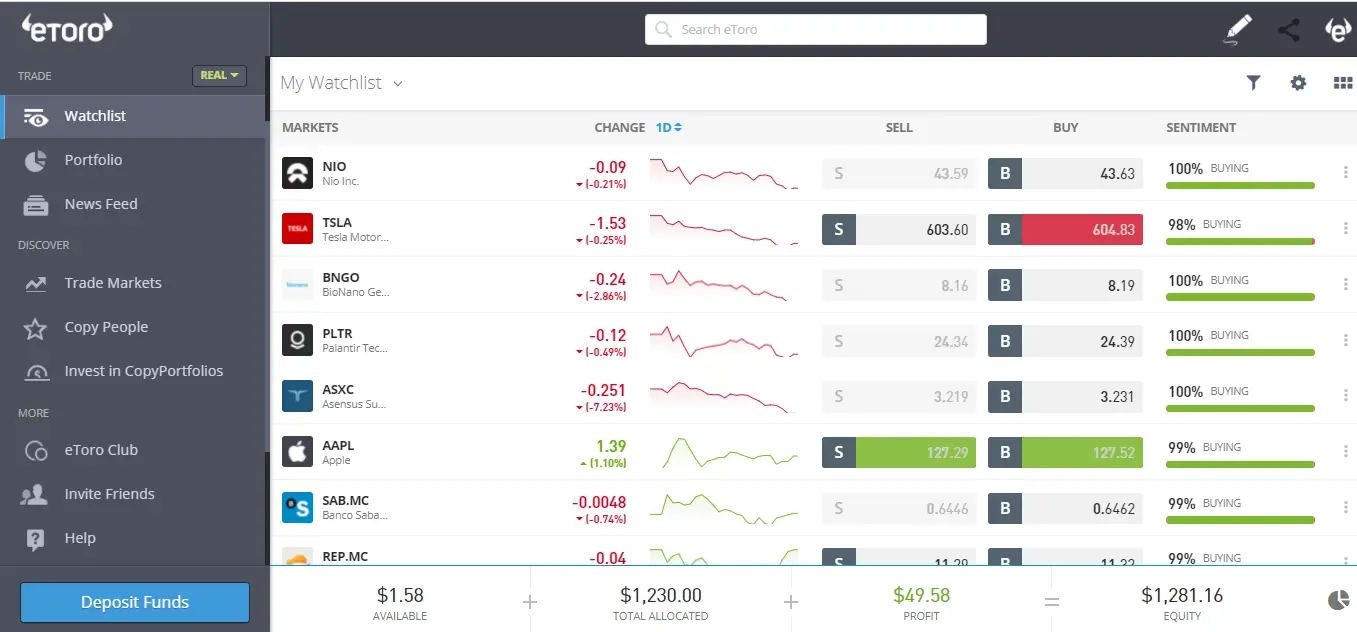
Another strong platform available in the UK is eToro, an international broker listed on Nasdaq (ticker: ETOR) since May 2025. It is best known for its social trading feature, which lets you copy the trades of experienced investors through CopyTrader, filtering Popular Investors by past returns, risk score, drawdown and other published metrics.
The platform gives access to thousands of instruments, including real stocks and ETFs from the London Stock Exchange, the US and major European exchanges. You can also invest in Smart Portfolios, ready-made thematic allocations around themes such as AI, renewable energy or dividends.
eToro offers commission-free ETF investing and charges a $1 commission when you open or close a position in real stocks on most exchanges ($2 on some Asian and Gulf exchanges), with whole or fractional shares. Other fees apply. UK clients can open a GBP account, which avoids converting every deposit and withdrawal to dollars.
eToro also offers a Stocks and Shares ISA run on Moneyfarm’s platform. Since July 2026, it charges no dealing commission and no annual custody fee, though a 0.70% FX charge applies on non-GBP assets.
Opening an account is straightforward, and you can practise first with a $100,000 virtual demo account. On the downside, spreads can be relatively high on some products, and withdrawals from the USD account cost $5. eToro no longer charges an inactivity fee.
UK clients are served by eToro (UK) Ltd, authorised and regulated by the FCA, with FSCS protection up to £85,000.
To learn more, read our eToro review.
Disclaimer: eToro is a multi-asset investment platform. The value of your investments may go up or down. Your capital is at risk. 51% of retail investor accounts lose money when trading CFDs with this provider.
Pros
- Low stock trading fees (from $0 per trade)
- Commission-free ETFs (other fees apply)
- Social trading and other innovative products
- Wide variety of financial products
- Slick, modern, and easy for anyone to use
- European users have access to three account currencies: EUR, USD and GBP
- Top tier regulators
Cons
- Limited disclosed financial information
- Withdraw and inactivity fees
- Spread, overnight, inactivity, and currency conversion fees higher than average
- Doesn’t offer bonds, futures, or options
Capital.com at a glance: Best for CFDs and spread betting

Spread bets and CFDs are complex instruments and come with a high risk of losing money rapidly due to leverage. 65% of UK retail investor accounts lose money when trading spread bets and CFDs with this provider.
Founded in 2016, Capital.com is a CFD and spread betting platform that has grown quickly thanks to its commission-free model and user-friendly technology. It offers CFDs on forex, shares, indices and commodities, spread betting and a 1X account for CFD trading without leverage.
You can trade through its own web platform and mobile app, which include AI-driven insights and risk management tools, or through TradingView and MT4, where you can run automated strategies. A free demo account lets you practise before trading with real money.
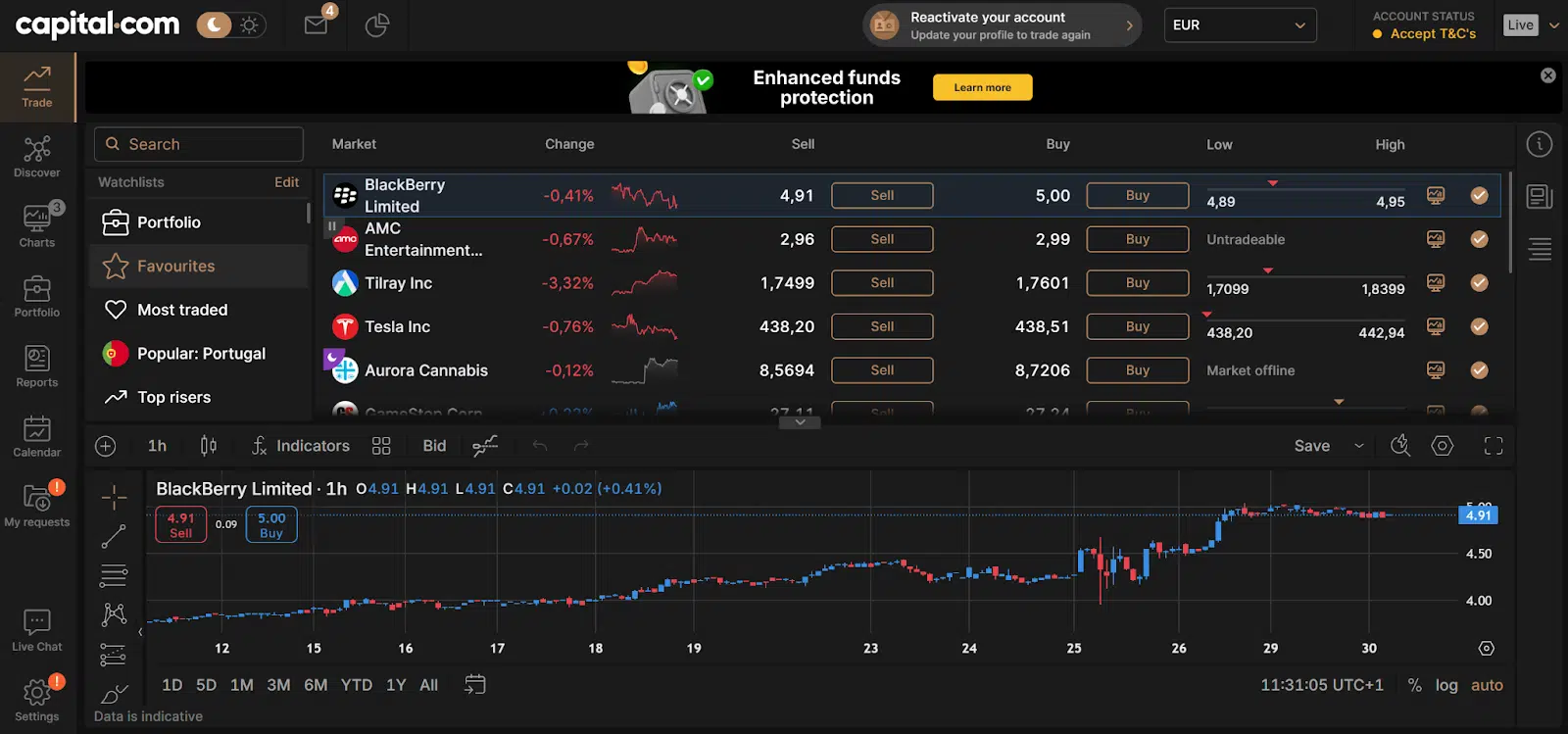
Capital.com doesn’t charge commission on trades. Its costs are in the spread (the difference between buy and sell prices), which changes with market conditions, plus fees for guaranteed stop-loss orders and overnight funding on leveraged positions held overnight.
On the downside, like other CFD-only brokers, it is not suitable if you want to own real shares or ETFs, hold bonds, or invest through an ISA or pension.
UK clients are served by Capital Com (UK) Limited, regulated by the FCA (firm reference number 793714). It holds client money in segregated accounts, provides negative balance protection for retail clients, and eligible clients are covered by the FSCS up to £85,000.
Capital.com suits traders looking for commission-free CFD trading (other fees may apply), spread betting and unleveraged CFDs.
Pros
- 0% commission trading (only spreads apply)
- Offers a 1X (non-leveraged) account with no overnight funding fees
- Spread betting is available
- User-friendly web and mobile platforms
- Integration with MT4 and TradingView
- Wide range of tradable assets (over 5,000 markets)
- Low minimum deposit of £20
- 24/7 index CFD trading (extended hours)
- 24/7 customer support
- Excellent educational resources, including guides and webinars
- Demo account
Cons
- No ownership of underlying assets (CFD/spread betting only)
- Overnight financing fees can become expensive for long-term, highly leveraged positions.
- Not suitable for passive or dividend-focused investors
- No interest on uninvested cash
Disclaimer: spread bets and CFDs are complex instruments and come with a high risk of losing money rapidly due to leverage. 65% of retail investor accounts lose money when trading spread bets and CFDs with this provider. You should consider whether you understand how spread bets and CFDs work and whether you can afford to take the high risk of losing your money.
XTB at a glance: Best for commission-free ETFs and a flexible ISA

69-80% of retail CFD accounts lose money.
Founded in 2002 in Warsaw and listed on the Warsaw Stock Exchange, XTB is a major European broker with more than 1 million active clients. UK clients are served by XTB Limited, regulated by the FCA, and XTB is also supervised by the KNF in Poland and CySEC in Cyprus.
You can invest through xStation 5 and the xStation mobile app in stocks, ETFs, forex, indices, commodities, crypto CFDs and vanilla options (added in early 2026). MetaTrader is no longer offered. XTB offers a flexible Stocks and Shares ISA with the following features:
- More than 3,000 stocks and 700 ETFs with 0% commission up to monthly turnover of €100,000 (0.2% above that, with a £10 minimum). A 0.5% currency conversion fee applies when you buy assets in another currency.
- Interest on uninvested GBP cash, calculated daily and paid monthly. Rates follow Bank of England policy, so check the current rate on XTB’s website.
- As a flexible ISA, you can withdraw money and put it back in the same tax year without using up more of your annual allowance.
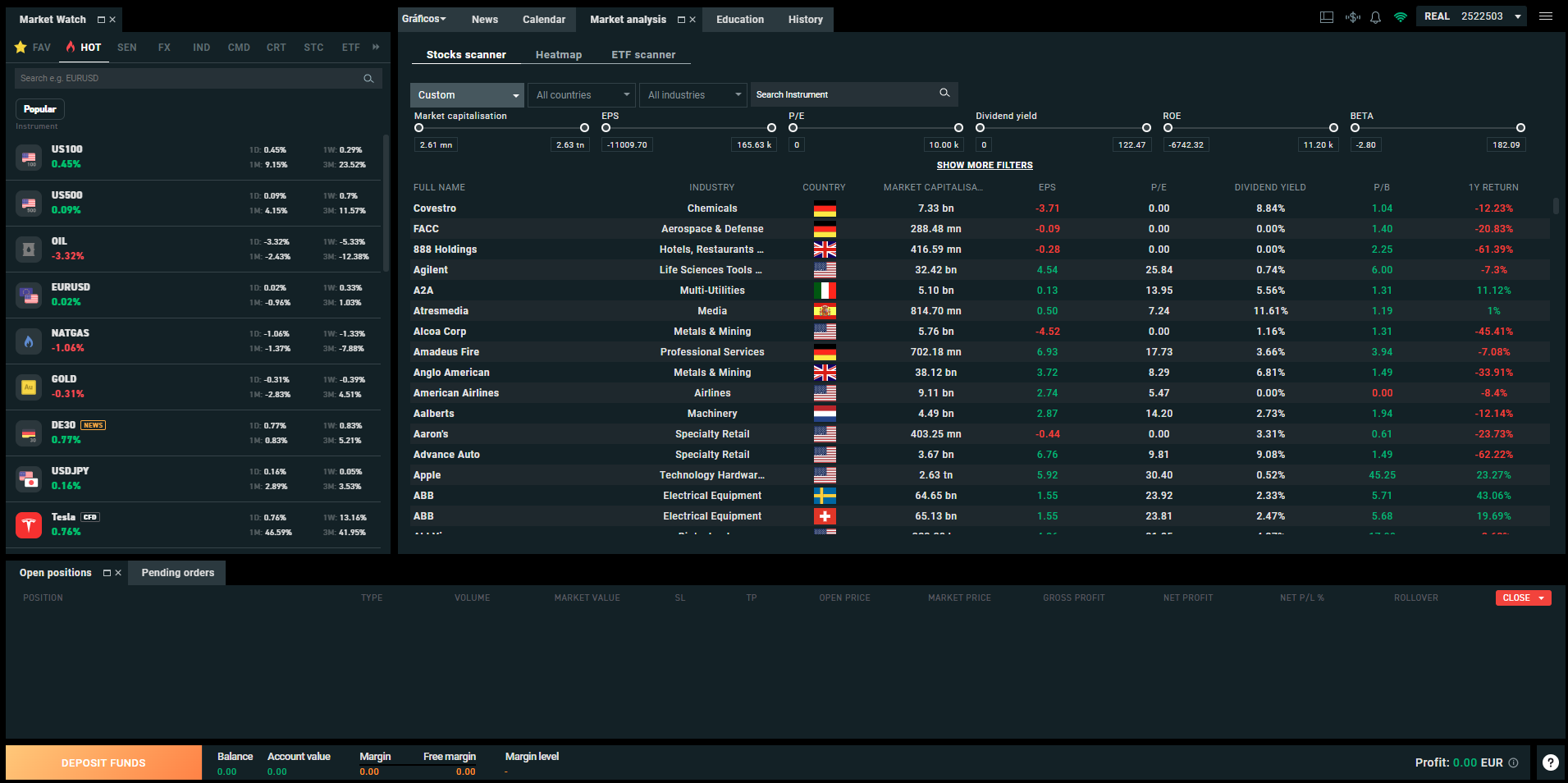
Opening an account and funding it is quick and fully online. Beginners get a demo account and the XTB Trading Academy, while xStation 5 offers a comprehensive set of technical and fundamental tools for more advanced investors.
On the downside, XTB charges a £10 monthly inactivity fee, but only if you haven’t opened or closed a position in 12 months and haven’t made a deposit in the last 90 days. Crypto CFDs have relatively wide spreads, though forex pricing is competitive.
Want to know more? Read our XTB review.
Disclaimer: CFDs are complex instruments and come with a high risk of losing money rapidly due to leverage. 74% of retail investor accounts lose money when trading CFDs with this provider. You should consider whether you understand how CFDs work and whether you can afford to take the high risk of losing your money.
Pros
- Free stocks trading (only applicable to some countries)
- Customizable trading platform (charts and workspace)
- Low Forex Spreads
- Demo account
- No minimum account deposit
- Valuable education materials
- Top-tier Regulators
Cons
- Complex trading platform for a beginner
- High Stock CFD spreads
- Limited product portfolio
- Withdrawal fees for transfers below $100
- Inactivity fee (€10/monthly after 1+ year with no activity plus no deposit in the last 90 days)
Pepperstone at a glance: Best for forex and platform choice

74-89% of retail CFD accounts lose money.
Founded in Melbourne in 2010, Pepperstone has become one of the largest independent forex and CFD brokers, with more than 900,000 accounts across the group as of March 2026. UK clients are served by Pepperstone Limited, authorised and regulated by the FCA under firm reference number 684312, and eligible client assets are covered by the FSCS up to £85,000.
Before going further, one key point separates Pepperstone from most brokers on this list: you cannot buy real shares here. Everything Pepperstone offers UK clients is a spread bet or a CFD, so you never own the underlying asset. There is no ISA, no SIPP, no real dividends and no shareholder rights. For a long-term portfolio, choose one of the other brokers. Pepperstone is on this list because, for active traders, especially in forex, it is one of the strongest packages available to UK clients.
UK traders get three account types: a spread betting account and two CFD accounts, Standard and Razor. The only difference is how you pay. Standard adds a mark-up to the raw spread, with no separate commission on forex, indices or commodities. Razor gives you raw spreads (from 0.0 pips on forex) plus a fixed commission (£2.25 per lot per side on GBP accounts, $3.50 on USD accounts). Razor is cheaper for most active traders, and the gap grows the more you trade.
The UK tax treatment is a real advantage of spread betting: profits are currently exempt from capital gains tax and stamp duty, depending on your circumstances and future changes in tax law. CFDs are exempt from stamp duty but subject to capital gains tax.
Pepperstone stands out for platform choice: alongside its own web platform and app, it supports MetaTrader 4, MetaTrader 5, cTrader and TradingView, and no other broker in this article offers all four. If you run an Expert Advisor or a cBot, or you already analyse the markets in TradingView, that alone can settle the decision. Scalping, hedging and automated trading are all permitted.
Non-trading costs are low: there are no inactivity, deposit or withdrawal fees, and GBP is available as a base currency. What does add up is overnight funding, charged on positions held past 5 pm New York time. Pepperstone also offers 24/5 spread bets and CFDs on 100+ US shares, so you can react to earnings and news outside regular market hours.
As an FCA-regulated firm, Pepperstone applies the UK retail rules: leverage is capped from 30:1 on major currency pairs down to 2:1 on crypto, with negative balance protection and a 50% margin close-out rule.
Disclaimer: spread bets and CFDs are complex instruments and come with a high risk of losing money rapidly due to leverage. 73.6% of retail investor accounts lose money when trading spread bets and CFDs with this provider. You should consider whether you understand how spread bets and CFDs work and whether you can afford to take the high risk of losing your money.
Pros
-
Raw spreads from 0.0 pips on forex (Razor account)
-
The widest platform choice in this article: MT4, MT5, cTrader and TradingView plus its own platform and app
-
Tax-free spread betting for UK clients (subject to individual circumstances)
-
Scalping, hedging and automated strategies all permitted
-
No inactivity, deposit or withdrawal fees
-
No minimum deposit and GBP base currency available
- Free demo account
Cons
-
No real share ownership: spread bets and CFDs only
-
No ISA and no SIPP
-
No interest paid on uninvested cash
-
Overnight funding makes longer holding periods expensive
-
No copy trading or social features
-
No guaranteed stop-loss orders
- Not suitable for beginners or long-term investors
Webull UK at a glance: Best for quick exposure to US stocks

Founded in 2017 in the US and launched in the UK in July 2023, Webull entered the British market with a low-cost offer focused on US stocks and options. It has since added UK stocks and ETFs and a Stocks and Shares ISA. New users can claim a signup bonus.
UK users get a demo account to practise under realistic conditions. According to Webull UK’s pricing page, US stocks are now commission-free, but buying them means converting pounds to dollars: the FX fee is 0.50% on the standard Go account and 0.35% on the Meridian account, plus small regulatory fees on sales. US options cost $0.50 per contract plus exchange and clearing fees.
That structure matters: because the FX charge applies both when you buy and when you sell, a round trip on a US stock costs about 1.00% on the Go account (0.70% on Meridian) before any price movement. For frequent traders or regular monthly investors, that adds up quickly compared with brokers charging a tiny fraction of a percent for conversion.

Fractional shares are a genuine advantage, since many US stocks trade at high prices per share. Webull UK now also offers a Stocks and Shares ISA, from £10, covering UK, US and other global stocks and ETFs, so you can keep gains and dividends free of UK tax. There is still no SIPP, and the product range is narrower than at full-service brokers such as Interactive Brokers or Saxo.
Webull UK is authorised and regulated by the FCA, and eligible client assets and cash are covered by the FSCS up to £85,000.
Pros
- Free Shares Sign Up Promotion
- Mobile-friendly app
- Fractional Shares
- Access to US-listed stocks and options
- One of the largest brokerages in the USA
- Regulated by the FCA
- Demo Account (paper trading)
Cons
- No ISA or SIPP
- Limited range of assets available - no ETFs, bonds, crypto
- FX fee
- No commission-free trading
Plus500 at a glance: Best for a demo account

81% of retail CFD accounts lose money.
Founded in 2008, Plus500 is a CFD broker listed on the London Stock Exchange (ticker: PLUS) and a FTSE 250 constituent, a useful signal of scale and disclosure standards for UK investors.
For UK clients, Plus500 offers CFDs only on forex, indices, shares, commodities, options, ETFs and crypto: its Plus500 Invest service for real shares is not available in the UK. Its main strength for this list is its free, unlimited demo account, which lets you practise on the full platform with virtual money before risking anything.
The proprietary WebTrader platform and mobile app are simple and stable, and customer support is available via chat inside the platform. Accounts are available in several base currencies, including GBP, so you can avoid converting deposits. Plus500 charges a currency conversion fee of up to 0.7% on trades in other currencies, a $10 monthly inactivity fee after three months without logging in, and overnight funding on positions held overnight. It offers guaranteed stop orders on many instruments.
UK clients are served by Plus500UK Ltd, authorised and regulated by the FCA, with FSCS protection up to £85,000. Plus500 does not offer an ISA.
Disclaimer: CFDs are complex instruments and come with a high risk of losing money rapidly due to leverage. 76% of retail investor accounts lose money when trading CFDs with this provider. You should consider whether you understand how CFDs work and whether you can afford to take the high risk of losing your money.
Want to know more? Read our Plus500 review.

Pros
- Acessible and responsive platform
- Low spreads
- No dealing commissions
- Demo Account
- Top-tier regulators
Cons
- No ETF offering
- Inactivity fee ($10 per month after no login activity in 3 months)
- High overnight funding fees
- Very little research and education provided
Saxo at a glance: Best for professionals

62% of retail CFD accounts lose money.
Launched in 1992 in Copenhagen, Saxo (formerly Saxo Bank) is one of the most established brokers in Europe. Since March 2026, it has been majority-owned by the Swiss private banking group J. Safra Sarasin, which in July 2026 agreed to acquire the remaining stake. Saxo serves more than a million clients and gives access to over 70,000 instruments through two platforms:
- SaxoInvestor: a simple investing platform for web and mobile covering stocks, ETFs, mutual funds and bonds, suited to long-term, buy-and-hold investors.
- SaxoTrader: the advanced platform for web, mobile and desktop, covering the full product range including margin and leveraged products, with multi-screen workspaces, Level 2 order book data and bulk position management.
One Saxo account gives you access to both platforms. Saxo does not offer direct crypto trading, only crypto ETPs and CFDs, and integrates with third-party tools such as TradingView.
Saxo’s account tiers:
- Classic: no minimum deposit, with competitive pricing and standard support.
- Platinum: for portfolios of £200,000 or more, with lower trading costs and priority support.
- VIP: for portfolios of £1,000,000 or more, with the best pricing and direct access to trading specialists.
Tiers are based on portfolio value, so you can reach them through portfolio growth as well as deposits.

Pricing depends on your tier: a US stock order costs 0.08% of the trade value on Classic and 0.03% on VIP. Saxo also charges an annual custody fee on stocks and ETFs of 0.12% on Classic and Platinum and 0.08% on VIP, which matters for long-term investors. UK investors can also open a Stocks and Shares ISA and a SIPP with Saxo.
UK clients are served by Saxo Capital Markets UK Limited, authorised and regulated by the FCA, and eligible clients are covered by the FSCS up to £85,000.
Pros
- Extensive range of investment products
- ISA and SIPP available
- Long track record
- FCA-regulated UK entity with FSCS cover
Cons
- Higher fees than low-cost apps and harder to understand
- Advanced platform can be complex for beginners
Freetrade at a glance: Best for beginners

Freetrade is a UK investing app founded in 2016 and owned by IG Group (FTSE 100) since April 2025. It lets you invest commission-free in more than 6,000 UK, US and European stocks, as well as ETFs, investment trusts, mutual funds and gilts.
Since January 2026, its free Basic plan includes the Stocks and Shares ISA, Junior ISA and SIPP, which makes it one of the cheapest ways to invest through a UK tax wrapper. The paid plans, Standard (£4.99 a month on annual billing) and Plus (£9.99 a month), now mainly buy a lower FX fee (0.59% and 0.39%) and a higher interest rate on cash: on Basic, buying a US stock costs a 0.99% FX fee, far more than at Trading 212 or Interactive Brokers.
Freetrade keeps things simple: there are no CFDs, no leverage and no day-trading features, and the app is remarkably easy to use. The main drawbacks are the FX fee on the free plan and the limited range compared with full-service brokers (no options, forex or direct crypto).

Pros
- Commission-free stocks and ETFs (other charges may apply)
- Free GIA, ISA, Junior ISA and SIPP on every plan
- No inactivity or account fees
- No minimum deposit
- Nice and user-friendly app
Cons
- No options, CFDs or direct crypto
- Limited research and education
- Graphs and portfolio tracking still need some development
- No phone support (in-app messages and email)
Trading 212 at a glance: Best for automatic investing and ISA

Capital at Risk. Sponsored Link. To get free fractional shares worth up to 100 EUR/GBP, you can open an account with Trading 212 through this link. Terms apply.
Founded in 2004 in Bulgaria and based in London since 2016, Trading 212 aims to make investing simple through its mobile app and web platform. UK clients are served by Trading 212 UK Ltd, regulated by the FCA.
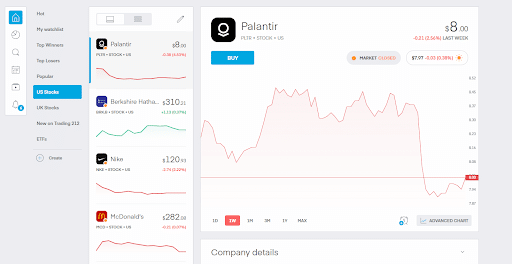
With Trading 212, you get commission-free stocks and ETFs (other fees may apply, see terms and fees), fractional shares and Pies and AutoInvest, which let you set up a portfolio and invest in it automatically on a schedule. UK clients can use a Stocks and Shares ISA and a Cash ISA, and Trading 212 pays interest on uninvested cash. There is no SIPP, and there are no bonds or options. A 0.15% FX fee applies when you buy assets in a currency other than your account currency.
Opening an account is quick and easy.
Sponsored Link. To get a free fractional share worth up to £100, you can open an account with Trading 212 through our sponsored link or with the promo code “IITW”. The value is random: there is an 80% chance it is worth £8 to £25, 15% for £25.01 to £50, 3% for £50.01 to £75 and 2% for £75.01 to £100. Terms apply.
To learn more, read our Trading 212 review.
Pros
- Commission-free real stock, ETFs and crypto trading (other fees may apply. See terms and fees)
- AutoInvest & Pies feature (execution-only service, not financial advice)
- Fast and easy account opening process
- Demo account
- Top Tier Regulators
- Free fractional shares worth up to €100
- High interest on uninvested cash
Cons
- Limited product portfolio (no Options, Bonds, Mutual Funds or Futures)
- No relevant Fundamental tools
- 0.15% of Foreign exchange fees
Disclaimer: when investing, your capital is at risk and you may get back less than invested. Past performance doesn’t guarantee future results. 0,15% FX fee applies when converting funds. Other fees may apply. Pies & Autoinvest is an execution-only service. Not investment advice or portfolio management. Automatic investing refers to executing scheduled deposits. You are responsible for all investment and rebalancing decisions. If you enable interest, Trading 212 will hold your cash in qualifying money market funds and banks. Otherwise, your cash will be held only in banks. Interest applies on cash in an investment account. Terms apply.
InvestEngine at a glance: Cheapest ETF platform

When investing your capital is at risk.
InvestEngine is a UK investment platform founded in 2016 and focused entirely on ETFs. Its DIY service charges no platform fee, no commission and no FX fee on its GBP-listed ETF range, making it one of the cheapest ETF platforms in the UK. With fractional investing, you can put as little as £1 into any of its 550+ ETFs once your account is open.
Its tools make ETF investing easy: smart orders calculate the trades needed to match your target weights, the Portfolio Look-through shows your exposure by company, sector and region, AutoInvest puts new cash to work automatically, and one-click rebalancing resets your portfolio to your target allocation.
If you prefer a hands-off approach, InvestEngine offers managed portfolios for different risk levels for 0.25% a year. You can invest through a general account, a Stocks and Shares ISA or a SIPP, with a £100 minimum to start, and eligible investments are covered by the FSCS up to £85,000.
Read our InvestEngine review for further analysis.

Pros
- Simple and intuitive investment platform
- No ISA fees
- No deposit or withdrawal fees
- Fractional Investing
- One-click rebalancing
- Auto-invest
Cons
- Only offers ETFs: no bonds, shares, and other products
- No interest on cash balances (still you can invest in money market funds)
How to choose an online broker in the UK
The right broker depends on how you invest. These are the points that matter most for UK investors:
- Tax wrappers: if you invest for the long term, an ISA (and possibly a SIPP) should come first, because gains and dividends inside them are tax-free. Of the brokers above, Interactive Brokers, Saxo, Freetrade and InvestEngine offer both an ISA and a SIPP, while eToro, XTB, Webull UK and Trading 212 offer an ISA.
- Real shares or CFDs: Capital.com, Pepperstone and Plus500 only offer CFDs or spread bets in the UK, which are leveraged, short-term trading products. For long-term investing, choose a broker that lets you own real shares and ETFs.
- Currency conversion: commission-free rarely means free. If you buy US stocks, the FX fee (from about 0.002% at Interactive Brokers to 0.99% on Freetrade’s free plan) often matters more than the commission.
- Protection: check that the UK entity is authorised by the FCA. Eligible investors are then covered by the FSCS up to £85,000 if the firm fails.
- Platform and support: a demo account is the best way to test whether a platform suits you before you deposit.
Bottom line
Interactive Brokers is our best online broker in the UK overall, thanks to its range of markets, very low FX costs and both an ISA and a SIPP. For a simple app, Freetrade and Trading 212 are easier to start with, InvestEngine is the cheapest home for an ETF portfolio, and Capital.com, Pepperstone and Plus500 suit traders who want CFDs or spread bets rather than real shares. Here is our full list of the best online brokers in the UK:
Interactive Brokers
Best UK broker overalleToro
Best for social trading and commission-free ETFsCapital.com
Best for CFDs and spread bettingXTB
Best for commission-free ETFs and a flexible ISAPepperstone
Best for forex and platform choiceWebull UK
Best for quick exposure to US stocksPlus500
Best for a demo accountSaxo
Best for professionalsFreetrade
Best for beginnersTrading 212
Best for automatic investing and ISAInvestEngine
Cheapest ETF platform
When choosing an online broker, look at the fees you will actually pay (including currency conversion), whether it is regulated by the FCA, whether it offers an ISA or SIPP, and the range of products you need.
This article is for information only and is not investment advice: do your own research on the services best suited to your goals and risk tolerance. Where possible, open a demo account and test the platform before making your final decision.
CFDs and spread bets are complex instruments and come with a high risk of losing money rapidly due to leverage. A large proportion of retail investor accounts lose money when trading CFDs and spread bets. You should consider whether you understand how they work and whether you can afford to take the high risk of losing your money. When investing, your capital is at risk.
FAQs
How do I invest in stocks from the UK?
Open an account with an FCA-regulated online broker, such as Interactive Brokers, eToro, XTB, Webull UK, Saxo, Freetrade, Trading 212 or InvestEngine, ideally through a Stocks and Shares ISA so your gains and dividends are tax-free. Capital.com, Pepperstone and Plus500 only offer CFDs and spread bets in the UK, not real shares.
What is a brokerage company?
A broker is the intermediary between you and the markets: it executes your orders to buy or sell stocks, ETFs and other assets, holds your investments on your behalf and provides the platform you use to trade.
Which broker is best in the UK?
There is no single answer: it depends on what you value most. Interactive Brokers is our best overall pick for its range, low costs and ISA and SIPP. Freetrade and Trading 212 are simpler for beginners, InvestEngine is the cheapest for ETF investors and Pepperstone suits active forex traders.
Which UK brokers offer a Stocks and Shares ISA?
Of the brokers in this article, Interactive Brokers, eToro, XTB, Webull UK, Saxo, Freetrade, Trading 212 and InvestEngine offer a Stocks and Shares ISA. You can invest up to £20,000 a year across all your ISAs. From April 2027, under-65s will only be able to put up to £12,000 of that into cash ISAs, but the full £20,000 can still go into stocks and shares.
Is my money protected if a UK broker goes bust?
If the broker’s UK entity is authorised by the FCA, client assets must be kept separate from the firm’s own money, and eligible investors are covered by the FSCS up to £85,000 if something is missing when the firm fails. This does not protect you against investment losses.
What can I invest in with a brokerage account?
Depending on the broker: stocks, ETFs, investment trusts, bonds and gilts, mutual funds, options and futures, as well as leveraged products such as CFDs and spread bets.