Whether you are an Emirati or an expat drawn to the United Arab Emirates (UAE)’s vibrant economy, you may wonder how to best allocate your disposable income. One easily accessible way to build and preserve wealth is through the stock market.
In this article, we’ll look at how UAE residents can pick stocks, buy shares on international markets, invest in the local stock exchanges (DFM and ADX), choose a broker, and what taxes to keep in mind. We also cover how foreigners can gain exposure to UAE shares.
Choose a stock to buy
Since there are tens of thousands of public companies around the world, there is no silver bullet when it comes to choosing a stock to buy. That said, companies are generally divided into two groups:
- Value stocks: these companies are usually attractively priced in terms of price-to-earnings or other ratios, but they tend to grow more slowly
- Growth stocks: these companies offer higher expected long-term growth, but they are usually more expensive from a valuation perspective
You can favour one type or combine both in your portfolio, depending on your goals and time horizon.
Resources you can use are:
- Stock screeners: use screeners like Finviz to filter and identify potential stocks based on specific criteria
- Company reports, filings and presentations: read the reports, official filings and presentations released by companies to understand their financial health and future plans
- Macroeconomic and industry publications: follow broader economic trends and industry news that could affect the companies you’re considering
You can also use the screeners provided by trading platforms in the UAE, or explore the screeners within trading apps for a more streamlined selection process.
In any case, consider several companies, compare their performance with competitors, and look at how each business is priced before you buy.
How to buy shares on international markets (step-by-step guide)
1. Choose a good stock broker
Once you have chosen the stock you want to invest in, you need a broker to make the purchase. There are plenty of trading platforms to choose from in the UAE. Below, we highlight five brokers available to UAE residents:
| Broker | US stock commission | Minimum deposit | Regulators |
| eToro* | $1 per trade (ETFs commission-free) | $100 | FSRA (ADGM), FCA, CySEC, ASIC |
| Sarwa | 0.25% of the order (min $1) | $500 | FSRA (ADGM) |
| Interactive Brokers | $0.0005 to $0.0035 per share, with a minimum of $0.35 (Tiered pricing) | $0 | SEC, FINRA, CFTC, CIRO, FCA, CBI, ASIC, SFC, SEBI, MAS, MNB |
| Saxo | 0.08% (Classic tier) | $5,000 | Danish FSA (UAE representative office licensed by the Central Bank of the UAE) |
| amana | $0 | $25 | DFSA, CMA (UAE), CySEC, LFSA, FSC, CMA (Lebanon) |
*CFDs are complex instruments and come with a high risk of losing money rapidly due to leverage. 52% of retail investor accounts lose money when trading CFDs with this provider. You should consider whether you understand how CFDs work and whether you can afford to take the high risk of losing your money.
Interactive Brokers lets you fund your account in UAE dirham (AED). If you use a UAE-licensed broker, check which entity holds your account: UAE brokers can be licensed onshore by the Capital Market Authority (CMA, formerly the Securities and Commodities Authority), by the DFSA in the DIFC, or by the FSRA in the ADGM.
2. Open and fund your account
Once you have weighed the pros and cons of each broker, you are ready to open an account. You will usually need your Emirates ID or passport and a proof of address, and the process can take from a few minutes to a few days while the broker verifies your identity. Once your account is approved, you can deposit money.
3. Place a buy order
Once you have opened and funded your account, you are ready to buy your stock. All you have to do is find the share on your broker’s platform and place a buy order. For this example, we will use eToro:
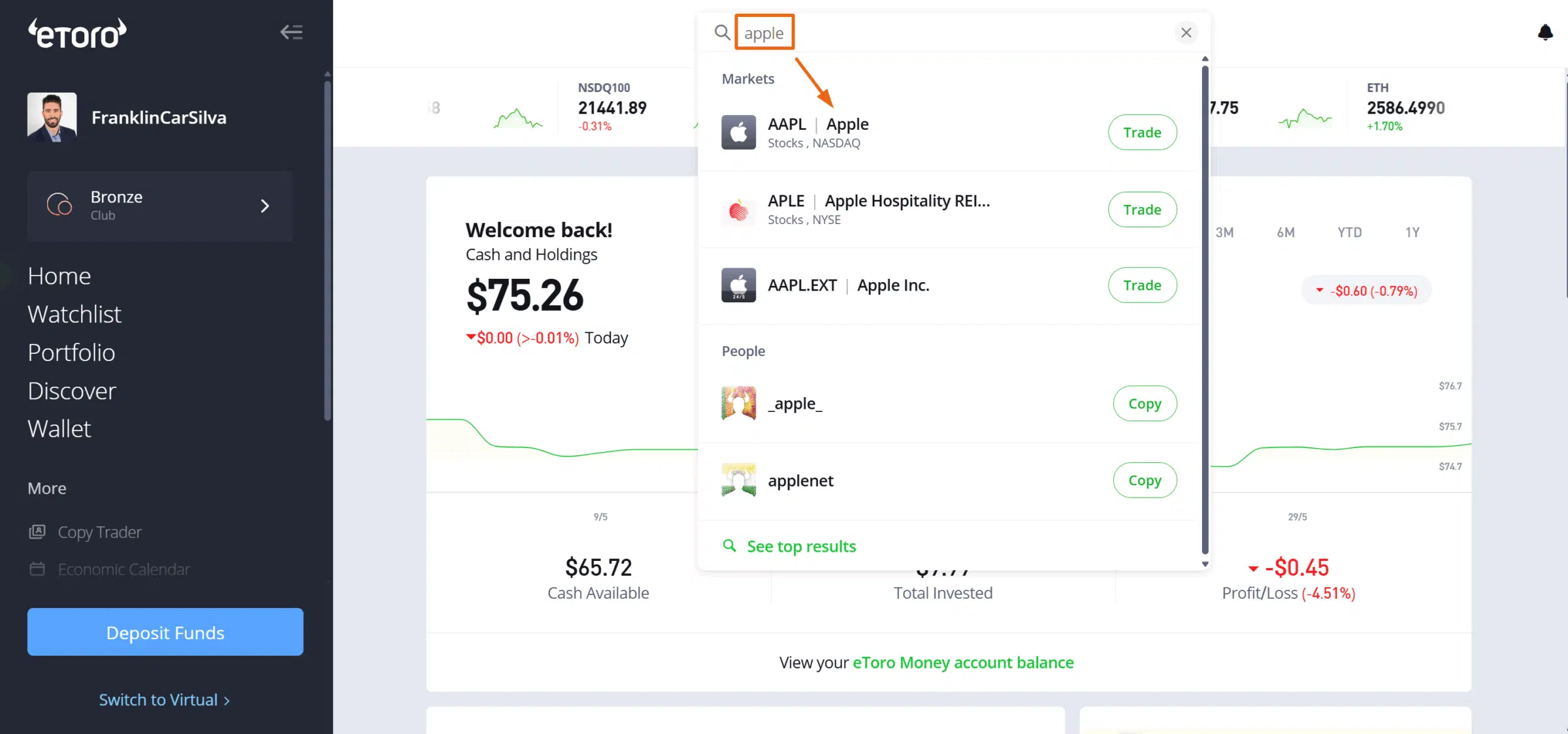
1: Search for the chosen stock (we will use Apple, ticker “AAPL”)
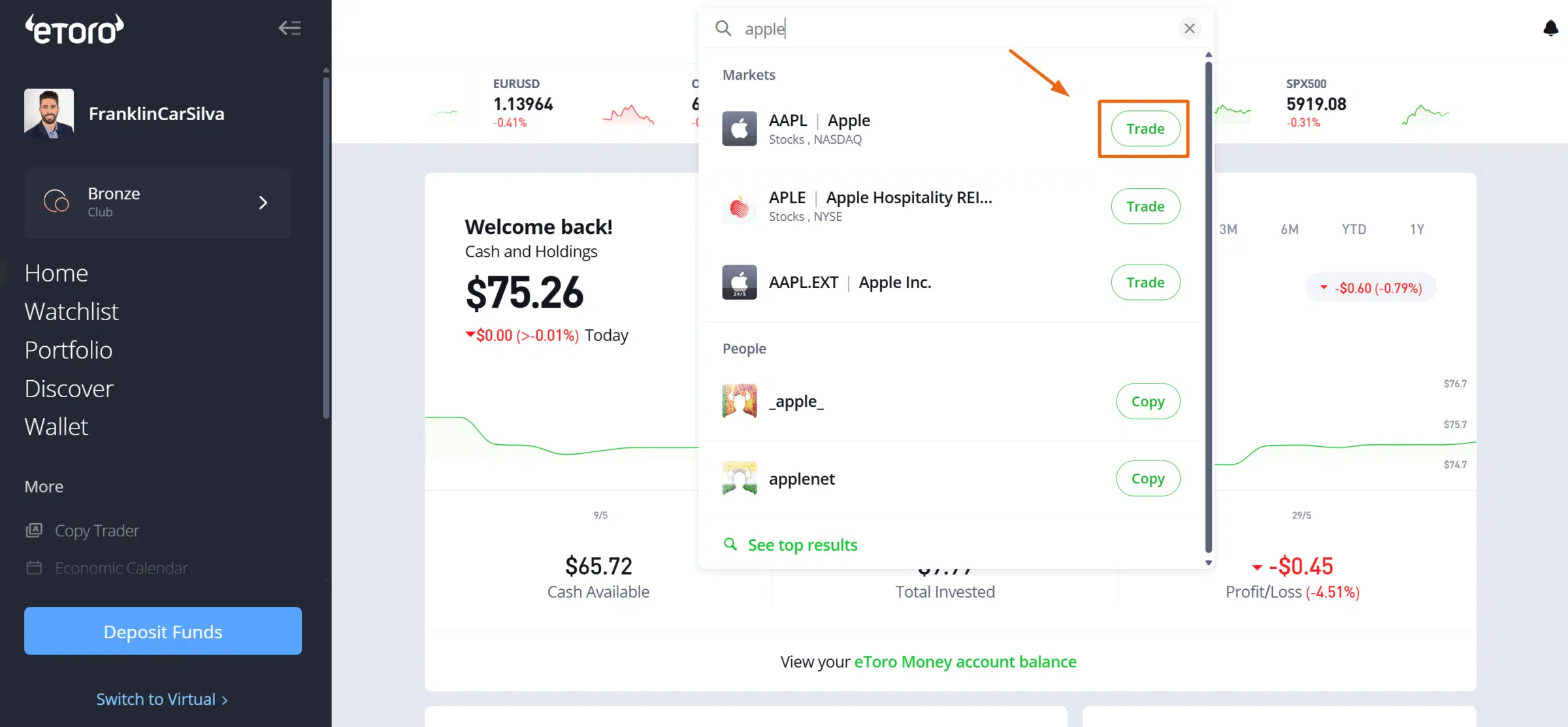
2: Click “Trade”
3: Choose the order details
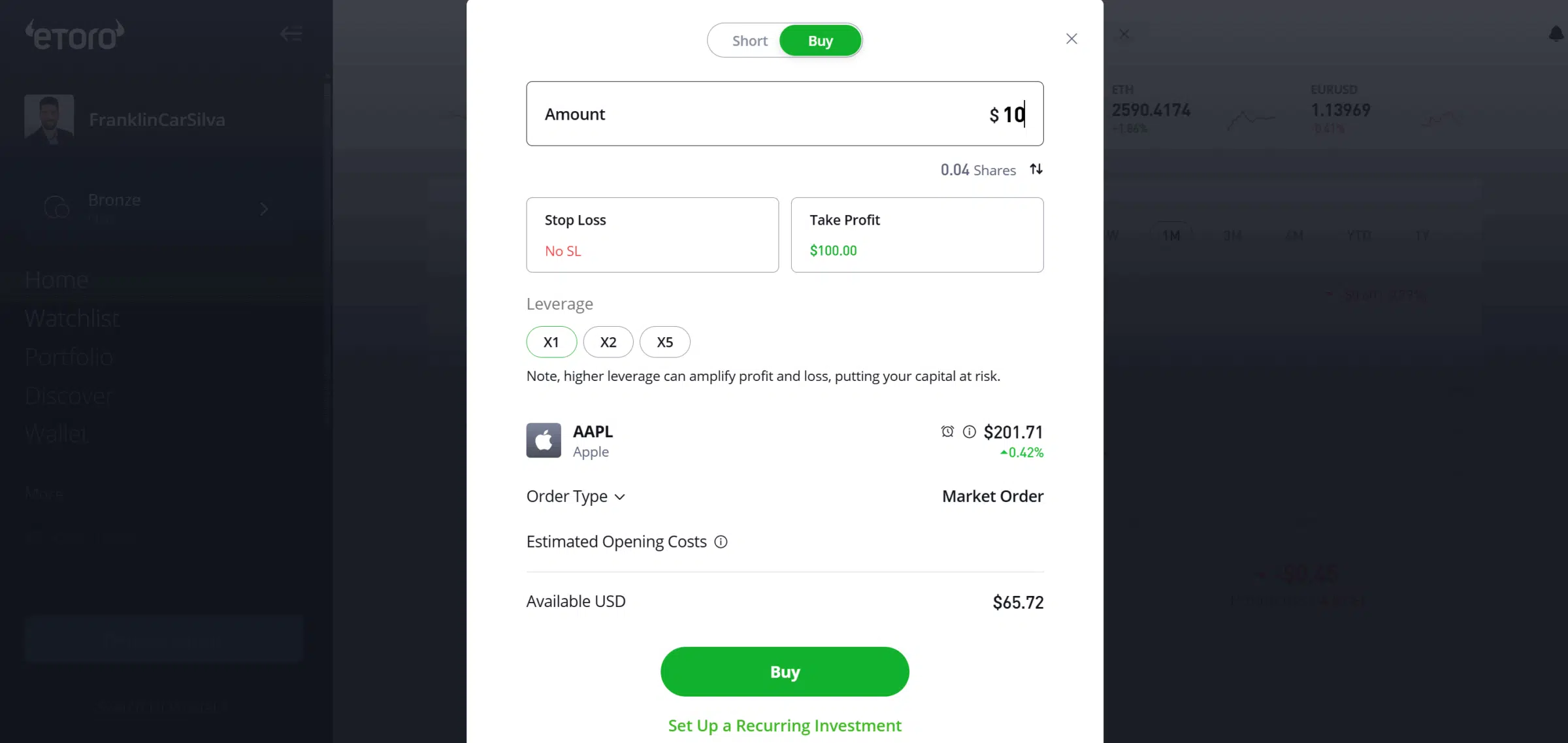
- Amount: you choose how much money you want to invest in Apple instead of the number of shares, so your investment may be fully or partly in fractional shares
- Shares: you choose the number of shares you want to buy (you can use either “Amount” or “Shares”)
- Stop loss: the maximum loss you accept before your position is closed automatically
- Take profit: the profit at which your position is closed automatically (if reached)
- Leverage: “X1” means no leverage. With “X2” or above, you would not be buying the real stock but a CFD on Apple stock instead, which is why the platform shows that you are buying the underlying asset
- Order type: you can choose a market order (buys at the best current price) or a limit order (buys at a maximum price you set)
Only “Amount” (or “Shares”), “Order type” and “Leverage” are mandatory fields.
4: Place the order
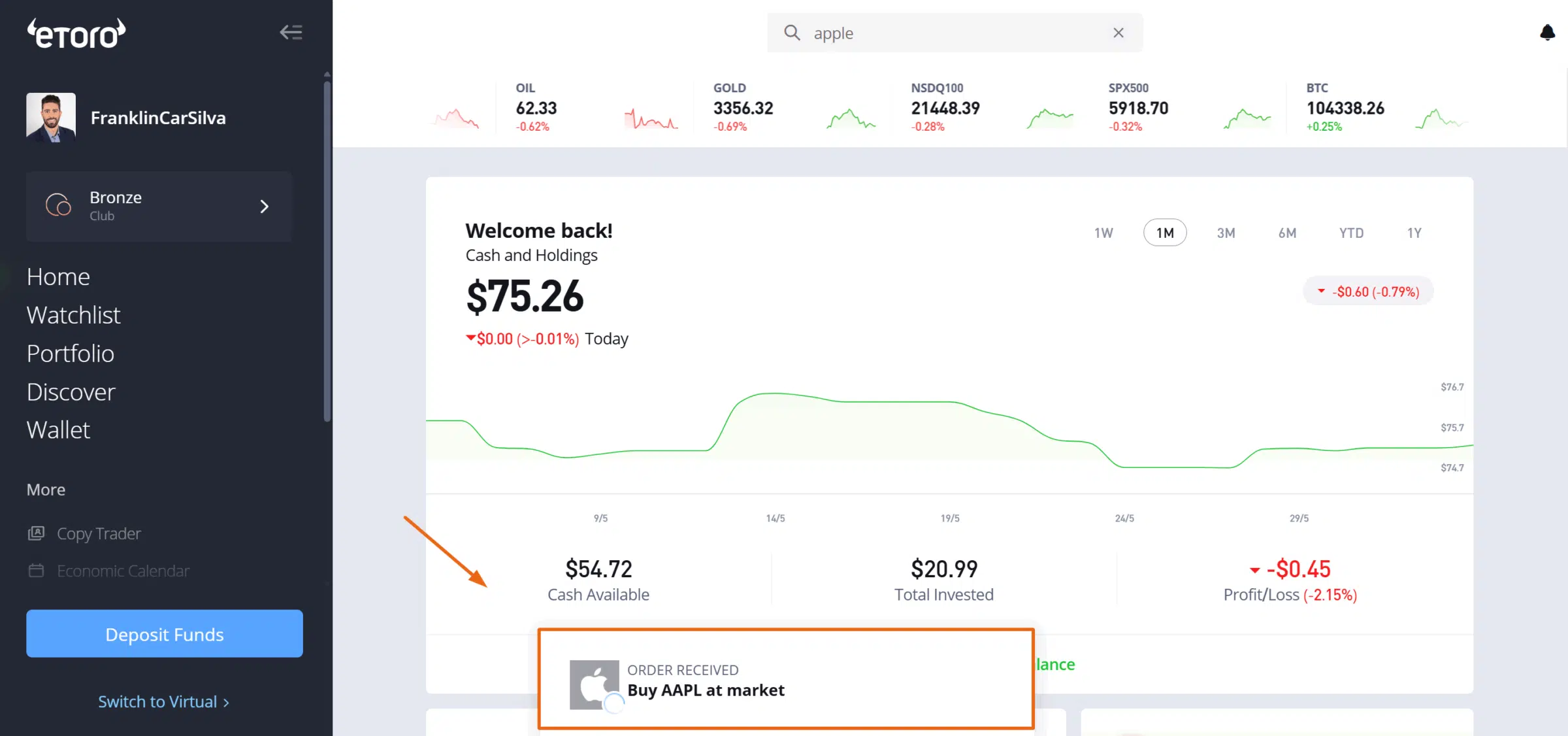
Click “Buy” and a new window will confirm that your order has been received. We placed this order while the market was closed. If the market were open and you had selected a market order, it would be filled right away.
ETFs: an alternative way to gain exposure
ETFs, or exchange-traded funds, let you invest in dozens or even hundreds of companies with a single purchase. ETFs can be a good option if you:
- Are unsure which specific stock to choose
- Want to limit your portfolio’s volatility (ETFs usually spread your money across many companies and sectors, which reduces the risk of any single company)
- Want to follow a specific theme (UAE stocks, technology stocks, real estate stocks, etc.)
Some ETFs you may want to consider are:
- iShares MSCI UAE ETF (ticker UAE) invests in around 60 UAE companies listed on the DFM and ADX. The ETF distributes dividends, and its benchmark is the MSCI All UAE Capped Index (capped indices limit the weight of any single company, which helps diversification). The expense ratio is 0.59%.
- SPDR S&P 500 ETF (SPY), launched in 1993, is the oldest US-listed ETF and the most traded ETF by value. It aims to track the price and yield performance of the S&P 500 Index, with an expense ratio of 0.0945%. Since February 2025, the cheaper Vanguard S&P 500 ETF (VOO, 0.03%) has been the largest ETF in the world by assets. You may also want to consider VUSA, an Irish-domiciled alternative.
You can choose from thousands of ETFs investing worldwide. If you’re interested in the S&P 500, check our step-by-step guide on how to invest in the S&P 500 from the UAE.
Buying shares on the UAE stock exchanges
The UAE has three stock exchanges: the Dubai Financial Market (DFM) and the Abu Dhabi Securities Exchange (ADX), which mostly list UAE companies, and Nasdaq Dubai. Both DFM and ADX are regulated by the Capital Market Authority (CMA). The DFM lists around 70 companies, and you can see the full list here.
The process of buying local shares is similar to the one outlined above. You need an account with a local broker (an exchange member), and you will also need an investor number (NIN) from the exchange. You can find the list of DFM brokers here. Some international platforms also give access to UAE shares. For example, eToro offers DFM and ADX stocks to UAE clients through its ADGM-licensed entity.
The main benefit of buying shares on the local market is that you avoid currency conversion, as DFM and ADX shares trade in UAE dirham. If you buy Apple stock, you have to:
- Sell AED and buy USD to open the trade
- Sell USD and buy AED to close the trade
This means paying two currency conversions. However, since the AED is pegged to the USD at 1 USD = 3.6725 AED, currency spreads are usually tight.
The drawback of the local market is its limited choice of companies, many of which are closely tied to the UAE’s economy. If you want to diversify your wealth worldwide, it makes sense to also invest overseas.
Taxes on stock investments in the UAE
The UAE does not charge personal income tax or capital gains tax on individuals’ investments. However, taxes may still apply at the source:
- US dividends: there is no income tax treaty between the US and the UAE, so dividends from US stocks and US-listed ETFs are usually subject to a 30% US withholding tax
- US estate tax: non-US investors may face US estate tax on US-listed assets above $60,000
For these reasons, some UAE investors prefer Irish-domiciled UCITS ETFs (such as VUSA) over US-listed ETFs. If you are not a UAE tax resident, or you still have tax obligations in your home country, check your personal situation with a tax advisor.
Accessing UAE equities as a foreigner
If you live outside the UAE and want exposure to the country’s economy, the most straightforward way to buy UAE equities is through an ETF, as highlighted above.
The downside is that ETFs covering smaller markets such as the UAE usually have higher expense ratios than ETFs covering large markets like the United States. Consider whether the return you expect justifies the higher cost.
If you want to buy a specific UAE company, you can contact one of the local exchange members, or check whether your broker offers access to DFM and ADX. The drawback is that you may pay currency conversion fees.
Videos about how to invest from the UAE
Check our in-depth videos where we explain how to invest from the UAE:
Bottom line
To sum it up, here’s what you need to do:
- Choose a stock to buy: if you invest outside the UAE, take time to decide which company or ETF to pick, as there are thousands to choose from. The local exchanges offer a smaller choice of companies, mostly tied to the UAE economy.
- Find a suitable stock broker: for international markets, check our list of the best online brokers in the UAE. For DFM and ADX, use a local exchange member or a broker that offers UAE shares. In any case, compare fees, regulation and market access.
- Open an account and deposit money: after choosing a platform, complete the account opening process and fund your account.
- Place a buy order: find the stock or ETF on your broker’s platform and place your order.
We hope this guide answered your questions. Make sure to do your own research to find the investing strategy that suits you best.
FAQs
Which brokers in the UAE offer access to stocks & ETFs?
Several brokers in the UAE offer access to stocks and ETFs, including Interactive Brokers, Saxo, eToro, Sarwa and XTB. Read our dedicated article on the best trading platforms in the UAE for a full comparison.
What is the minimum balance to start trading in the UAE?
The minimum amount required to start investing in the UAE depends on the broker. Some brokers, such as Interactive Brokers, have no minimum deposit, while others require a minimum balance, such as $100 at eToro, $500 at Sarwa (to start trading) or $5,000 at Saxo.
Is TD Ameritrade available in the UAE?
No. TD Ameritrade no longer exists as a separate broker, as its accounts were moved to Charles Schwab after Schwab acquired it. You can check our top TD Ameritrade alternatives in the UAE for other options.
Is Charles Schwab available in the UAE?
Charles Schwab is not an option for most UAE residents. You can check our top Charles Schwab alternatives in the UAE for other options.
Can I trade forex in the UAE?
Yes, several brokers in the UAE offer forex trading. Keep in mind that forex is usually traded with leverage, which increases your risk. You can check our list of the best forex brokers in the UAE for further details.