Finding the best online brokers in Iceland may seem like a daunting task, particularly if you’re just getting started (I was in your shoes some years ago!).
In this post, we’ll provide you with a detailed look at what we consider to be the best online brokers available to Icelandic investors. Whether you’re new to trading and looking for a user-friendly platform, or you’re interested in various investment alternatives (ETFs, cryptocurrencies, CFDs, etc.), there’s a solution for you.
A quick note for Icelandic investors before we dive in: Iceland is part of the European Economic Area (EEA) but not the EU – which means most EU-passported brokers can serve Icelandic residents, but tax treatment differs from EU member states. Iceland has its own tax regime, with capital gains and dividends typically taxed at 22%, and Icelandic krona (ISK) deposits at most international brokers will be converted to EUR, USD, or another major currency.
Best brokers in Iceland – Top 7 list
- eToro: Best broker for commission-free ETFs investing and social trading
- Interactive Brokers: Best EU broker overall
- XTB: Best broker for Low Forex spreads
- Freedom24: Best for access to high-yield ETFs (6%–12% in select cases)
- Plus500: Best broker for CFDs
- Saxo Markets: Best broker for professionals
- Trading 212: Best broker for beginners and auto-invest
Disclaimer: When investing, your capital is at risk and you may get back less than invested. Past performance doesn’t guarantee future results

52% of retail CFD accounts lose money.


69-80% of retail CFD accounts lose money.

Investing involves risk of loss.

81% of retail CFD accounts lose money.

62% of retail CFD accounts lose money.

Capital at Risk. Sponsored Link. To get free fractional shares worth up to 100 EUR/GBP, you can open an account with Trading 212 through this link. Terms apply.
Best brokers in Iceland – Comparison table


For a list of brokers we do not recommend, you can visit our full list of broker reviews, and filter by “Not recommended”.
Broker reviews
#1 Interactive Brokers: Best online broker in Iceland overall
Interactive Brokers leads the list as the best online broker for Icelandic investors.
Founded in 1978, Interactive Brokers is one of the largest international brokers listed on NASDAQ (ticker: IBKR) and a S&P 500 constituent since 2024. It is regulated by multiple top-tier authorities, including the FCA (UK), SEC and FINRA (US), Central Bank of Ireland, BaFin (Germany), and others – with no minimum deposit requirement.
IBKR caters to both beginners and professional investors looking for any type of financial product – bonds, ETFs, stocks, options, futures, currencies, and crypto – across 170+ markets in 36+ countries. The platform offers an extensive set of advanced technical and fundamental trading tools, as well as a strong educational component through IBKR Campus (formerly Traders’ Academy).
Interactive Brokers supports a wide range of account base currencies, including EUR, USD, GBP, and other major currencies. Note that Icelandic króna (ISK) is not supported as a base currency, so Icelandic investors will need to convert their funds to EUR, USD, or another major currency when funding the account. IBKR offers some of the most competitive FX conversion rates in the market (typically 0.002% with a $2 minimum), which is meaningful for Icelandic investors who need to convert ISK regularly. Funding is via bank transfer.
The broker offers some of the tightest spreads in the market, ensuring favourable trading conditions. For Icelandic residents, only the IBKR Pro commission structure is available – this uses tiered commissions starting at $0.005 per share with a $1 minimum order, varying with monthly trading volume. Note that IBKR Lite (the $0 commission tier) is restricted to US residents only, so it doesn’t apply to Icelandic investors.
For investors who prefer to trade on the go, Interactive Brokers offers the IBKR Mobile app, providing convenience and advanced functionality. IBKR GlobalTrader is a separate, simpler mobile trading app that allows traders to engage in straightforward global trading. The app supports fractional shares (from $1) and includes a simulated trading account with $10,000 in virtual cash to practise before opening a live account.
On the downside, the number of buttons and features available on Trader Workstation (TWS) can be overwhelming, especially for new investors. However, Interactive Brokers offers extensive educational materials and video tutorials to help you navigate and use the platforms effectively. For Icelandic investors who would prefer something simpler initially, IBKR GlobalTrader provides a much more streamlined experience while still being backed by the same regulated entity and product range.
Want to know more? Check out our comprehensive Interactive Brokers review and visit IBKR’s website.

Pros
- Low commissions on US stock trading
- No monthly inactivity fee
- The broadest product and markets range in the brokerage industry
- Demo account
- Excellent reputation (founded in 1978)
- Extensive research and Education tools
- Has a modern mobile trading app to trade Stocks, Options and ETFs, ideal for novice investors, IBKR GlobalTrader.
- Offers interest on uninvested cash balances
Cons
- Complicated and lengthy account opening process (but fully online)
- Steeper learning curve for beginners
- Website is difficult to navigate
- Interactive Advisors (Robo-advisor feature) is only available for US customers
#2 eToro: Best for commission-free stocks/ETFs investing and social trading
52% of retail CFD accounts lose money.
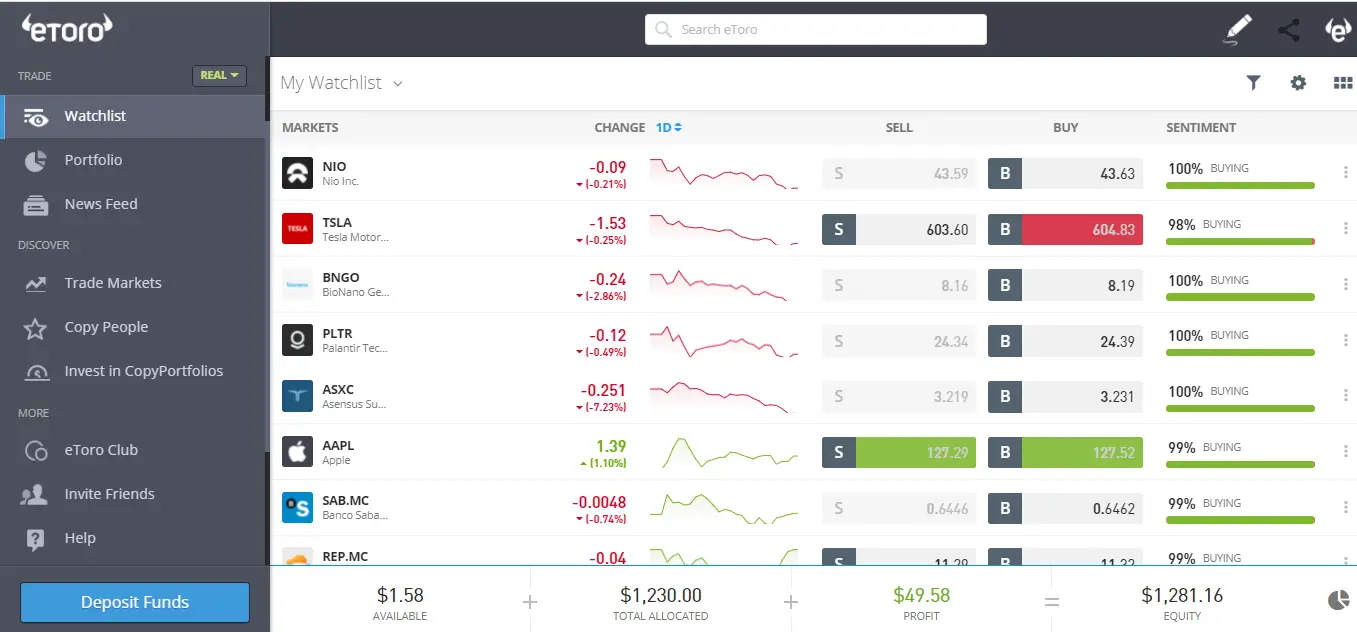
Another excellent trading platform available to Icelandic investors is eToro, an international online broker with over 40 million users worldwide who trade stocks, forex, commodities, cryptocurrencies, CFDs, and ETFs. eToro is best known for its social trading feature, where you can automatically copy the trades of experienced investors. There are thousands of verified traders on the platform, and you can select traders based on past Return on Investment (ROI), risk profile, asset focus, and other factors.
In May 2025, eToro listed on NASDAQ under the ticker ETOR – a major institutional milestone that strengthens the broker’s regulatory transparency and credibility. eToro is regulated by CySEC (Cyprus, EU passport covering Iceland under EEA), FCA (UK), ASIC (Australia), and SEC/FINRA (US), among others.
The eToro platform gives users access to over 3,000 financial instruments, including real stocks and ETFs (commission-free), cryptocurrencies, and CFDs on multiple asset classes. Users can also invest in Smart Portfolios – ready-made thematic portfolios curated by eToro’s investment team, covering themes like AI, renewable energy, dividend stocks, and crypto – and use CopyTrader to automatically replicate the trades of selected eToro users in real time.
eToro offers commission-free trading on real stocks and ETFs for Icelandic investors (other fees apply, such as a $5 withdrawal fee).
Opening an account and depositing is straightforward, with a $50 minimum first deposit ($10 for subsequent deposits) and a $100,000 virtual portfolio for new users to practise risk-free. On the downside, eToro now supports multiple account currencies (EUR, USD, GBP, and AUD) – but ISK is not directly supported, so Icelandic investors will incur FX conversion costs when funding their accounts. Spreads on certain CFD products can also be wider than at some competitors.
For Icelandic investors specifically, eToro’s EUR-denominated account option is particularly useful – it lets you hold funds in euros and avoid the double conversion (ISK to USD to EUR) that would otherwise apply when trading European-listed assets.
If you want to learn more, check out our eToro review.
Pros
- Low stock trading fees (from $0 per trade)
- Commission-free ETFs (other fees apply)
- Social trading and other innovative products
- Wide variety of financial products
- Slick, modern, and easy for anyone to use
- European users have access to three account currencies: EUR, USD and GBP
- Top tier regulators
Cons
- Limited disclosed financial information
- Withdraw and inactivity fees
- Spread, overnight, inactivity, and currency conversion fees higher than average
- Doesn’t offer bonds, futures, or options
#3 XTB: Best broker for Low Forex spreads
69-80% of retail CFD accounts lose money.
Founded in 2002, XTB is a major player in the brokerage industry with extensive international experience. The company is regulated by multiple top-tier authorities including the FCA (UK), KNF (Poland), CySEC (Cyprus), and others, and is publicly listed on the Warsaw Stock Exchange (ticker: XTB). XTB has been serving European retail clients for over two decades and operates across 16 countries globally, with over 1.7 million clients.
For Icelandic investors, XTB is accessible through its EU-regulated entity, with services passported across the EEA including Iceland. The platform offers 0% commission on stocks and ETFs up to €100,000 of monthly trading volume (0.2% commission applies above that). The platform was originally oriented around CFDs and forex trading – which remain its strongest product areas with highly competitive costs – but has expanded significantly into real stocks and ETFs over the past few years.
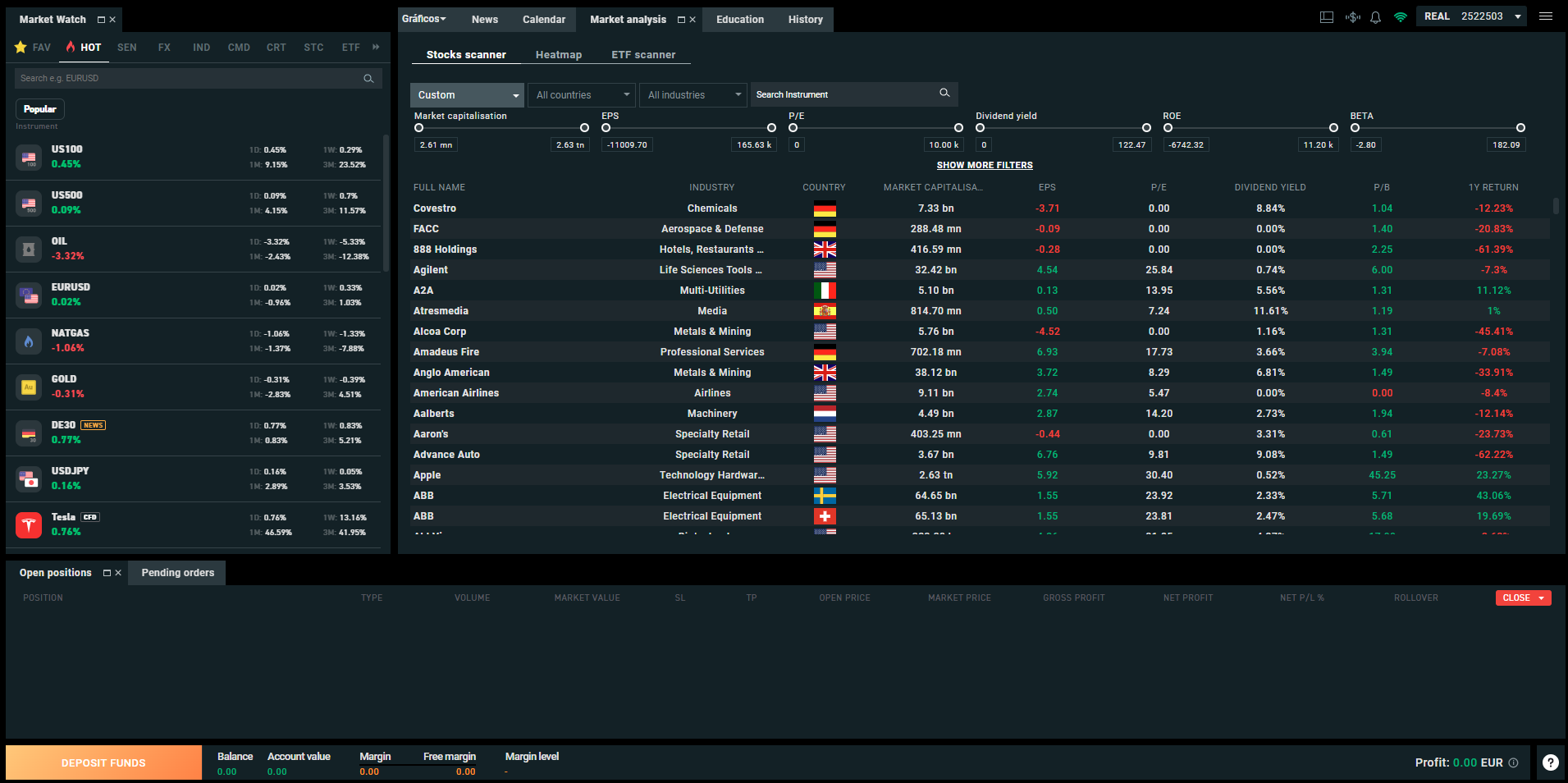
XTB offers its proprietary xStation platform across desktop, web, and mobile – widely regarded as one of the best-designed retail trading platforms in Europe. xStation 5 (desktop and web) is the flagship with advanced charting (50+ technical indicators), an in-platform economic calendar, customisable workspaces, and one-click trading. xStation Mobile mirrors the desktop’s execution capabilities with biometric login and price alerts. New users can practise with a demo account (virtual funds, 30 days extendable) before going live.
The product range covers 5,300+ real stocks and 1,300+ real ETFs from European and US exchanges, alongside CFDs on stocks, indices, 70+ forex pairs, commodities, and cryptocurrencies. Fractional shares are available from €10 for higher-priced stocks like Apple, Tesla, and NVIDIA. XTB also offers Investment Plans for automated recurring ETF portfolios (similar in concept to Trading 212 Pies) and pays interest on uninvested cash balances (rates vary by currency and central bank reference).
Fees are transparent: 0% commission on real stocks and ETFs up to €100,000 of monthly trading volume (0.2% with a €10 minimum above that), competitive CFD spreads on forex and indices, and a 0.5% FX conversion fee when trading instruments in a different currency from your account base – relevant for Icelandic investors converting from ISK. Withdrawals above €100 are free (€20 fee below). The one meaningful caveat is the €10/month inactivity fee after one year of no trading and no deposits in the last 90 days – a single trade or deposit per year avoids it entirely.
Opening an account is fast – typically under an hour online, with verification within 24 hours. XTB provides an extensive library of educational content (video courses, webinars, market analysis), real-time market data, and proprietary research from its market analysts. Still have questions? Read our XTB review.
Pros
- Free stocks trading (only applicable to some countries)
- Customizable trading platform (charts and workspace)
- Low Forex Spreads
- Demo account
- No minimum account deposit
- Valuable education materials
- Top-tier Regulators
Cons
- Complex trading platform for a beginner
- High Stock CFD spreads
- Limited product portfolio
- Withdrawal fees for transfers below $100
- Inactivity fee (€10/monthly after 1+ year with no activity plus no deposit in the last 90 days)
#4 Freedom24: Best for access to high-yield ETFs (6%–12% in select cases)
Investing involves risk of loss.
Freedom24, part of Freedom Holding Corp. (NASDAQ: FRHC), has emerged as a standout brokerage platform for retail investors by providing access to a diverse range of global financial products – including stocks, bonds, futures, options, and a strong focus on ETF investing.
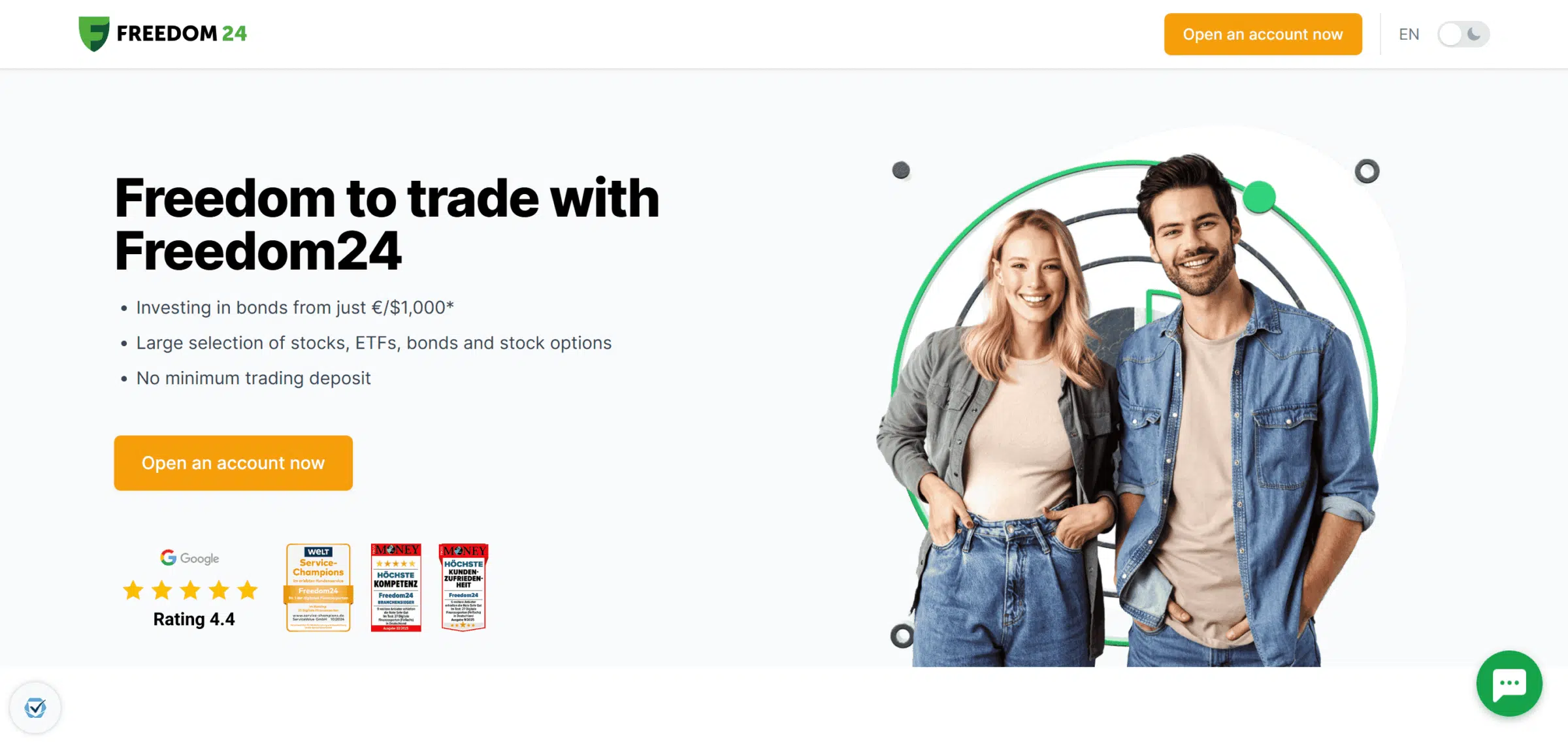
Freedom24 provides access to more than 3,600 ETFs, including not just the most popular ETFs from global issuers like Vanguard, iShares, and Invesco, but also a broad range of investment strategies – dividend-focused, short-term bond ETFs, and niche or high-yield options such as covered call and swap-based ETFs. If a specific ETF isn’t listed, clients can request its addition directly (a level of flexibility rarely seen in European brokerage platforms).
The platform’s web and mobile interfaces are intuitive and straightforward, complemented by Freedom24’s award-winning analyst team (“Investideas”) and educational resources (“Freedom Academy”) to support investment decisions. New users can also benefit from a signup promotion of up to 20 free stocks (valued up to $800 each).
With no minimum deposit, ETF and stock trade commissions start from €/$1.20 per order, with no hidden commissions or inactivity fees. Investors can choose from pricing models such as “Smart in EUR” (suitable for casual traders) or “All Inclusive in EUR” (for those seeking premium service and direct contact with their account manager). On the downside, Freedom24 charges a €7 withdrawal fee and does not offer cryptocurrencies. For Icelandic investors, the EUR-denominated account option is particularly useful since it avoids double FX conversion when trading European-listed assets.
Customer support is available both online and offline in 16 languages, and the company maintains physical offices across 11 European countries, ensuring localised service and regulatory compliance.
Freedom Finance Europe Ltd is regulated by the Cyprus Securities and Exchange Commission (CySEC), with services passported across the EEA – including Iceland. In the unlikely event that segregated assets cannot be returned to clients, Freedom24 falls under the Investor Compensation Fund (ICF), which compensates for losses from non-returned investments up to €20,000. The firm fully complies with MiFID II and ESMA investor protection standards.
Want to learn more? Check out our Freedom24 review or visit Freedom24 directly.
Pros
- Low commissions on stock and ETF trading
- No minimum deposit for general trading
- Demo trading
- Slick, modern, and easy for anyone to use
- No custody fee
Cons
- €7 per withdrawal
- No cryptocurrencies
#5 Plus500: Best broker for CFDs
81% of retail CFD accounts lose money.
Founded in 2008, Plus500 is an online broker offering a wide range of financial products, including real shares (via Plus500 Invest) and CFDs on forex, indices, shares, commodities, options, ETFs, and cryptocurrencies. It is available in over 50 countries and is publicly listed on the London Stock Exchange (ticker: PLUS, FTSE 250 constituent).
There are two distinct account types:
- Plus500 CFD: focused solely on CFD products;
- Plus500 Invest: where you can trade real shares.
As a side note, Plus500 Futures – a platform only available for US users where you can trade futures – is also part of the Plus500 group.
The trading platform is WebTrader, Plus500’s proprietary platform, offering a stable trading experience and reliable access across desktop, web, and a polished mobile app. All platforms are accessible and responsive, and you can start testing the features through a demo account.
Customer support is helpful and accessible through a chat function permanently visible within the trading platform. Spreads are tight, with accounts available in 16 currencies including USD, EUR, and GBP. However, Plus500 charges a 0.70% currency conversion fee and a $10 monthly inactivity fee after three months with no activity. On Plus500 Invest, they charge a small commission per trade (US market: $0.006 per share).
Plus500 is regulated by multiple financial authorities including the FCA, CySEC, ASIC, and MAS, ensuring appropriate supervision with an investor compensation scheme depending on the entity you open an account with. For example, an Icelandic investor opening an account through Plus500CY Ltd would be protected up to €20,000 via the Cyprus Investor Compensation Fund (ICF). Additionally, Plus500 provides negative balance protection for CFD trading on a per-account basis – applicable to retail clients in the European Union and EEA, including Iceland.
Want to know more about Plus500? Check our Plus500 review.

Pros
- Acessible and responsive platform
- Low spreads
- No dealing commissions
- Demo Account
- Top-tier regulators
Cons
- No ETF offering
- Inactivity fee ($10 per month after no login activity in 3 months)
- High overnight funding fees
- Very little research and education provided
#5 Saxo: Best broker for professional traders
62% of retail CFD accounts lose money.
Launched in 1992, Saxo is one of the most solid financial entities in the brokerage industry, with over three decades of operational track record. The firm rebranded from “Saxo Bank” to simply “Saxo” and was acquired by J. Safra Sarasin in March 2025, further strengthening its institutional credentials. Saxo holds an A- credit rating from S&P – a meaningful distinction in the brokerage industry. It lets you trade over 70,000 financial instruments across its proprietary platforms: SaxoTraderPRO (advanced desktop) and SaxoTraderGO (web and mobile).
The wide range of cash and margin trading products across global markets includes stocks, ETFs, bonds, mutual funds, cryptocurrencies, options, futures, CFDs, forex, and more. Saxo positions itself for both buy-and-hold investors and active leveraged traders, with advanced research and analytics tools to support both approaches.
Saxo’s account tiers are as follows:
- Classic: $0 minimum deposit since 2024 (no longer the $2,000 requirement that historically applied) – giving access to competitive spreads and 24/5 customer and technical support;
- Platinum: $200,000 minimum portfolio value. Lowers trading prices by up to 30% compared to Classic and prioritises local-language customer support;
- VIP: $1,000,000 minimum portfolio value. Provides Saxo’s best pricing, direct access to trading experts, and exclusive event invitations.

Pricing varies by account tier. For example, a US stock order is 0.08% of the trade value (minimum $1) in the Classic tier – the same trade would be 0.03% of the trade value (minimum $1) in the VIP tier. For accounts holding stocks, ETFs/ETCs, or bond positions, a custody fee of up to 0.15% per year applies (this can be avoided by opting in to securities lending or maintaining sufficient activity, depending on the entity).
Saxo Bank A/S is a fully licensed European bank supervised by the Danish Financial Supervisory Authority (DFSA). Saxo is a member of the Danish Guarantee Fund, which protects client cash deposits up to €100,000 and financial securities (stocks, ETFs, bonds) up to €20,000 per client. For Icelandic investors, Saxo provides services across the EEA through its Danish entity – the EEA passporting framework means Icelandic residents have the same investor protection standards as Danish residents.
Pros
- Excellent research materials
- Outstanding trading platforms (SaxoInvestor and SaxoTrader)
- Extensive range of investment products and commercial offers
- Long track record
- Supervised by worldwide top-tier regulators
Cons
- $0 in most countries; higher minimums in some regions (e.g. $5,000 in MENA)
- Fees higher than average
- Fee structure is complex
- Does not accept US residents
#6 Trading 212: Best broker for beginners and auto invest
Capital at Risk. Sponsored Link. To get free fractional shares worth up to 100 EUR/GBP, you can open an account with Trading 212 through this link. Terms apply.
Founded in 2004 (with its London-based fintech arm formally established in 2006), Trading 212 is a fintech that aims to democratise the entire investment process through a simple mobile application. The company allows users to invest in over 10,000 stocks and ETFs, alongside forex, commodities, CFDs, and cryptocurrencies. New users can claim a free fractional share worth up to €100.
Trading 212 offers commission-free stocks and ETFs trading (other fees may apply – see terms and conditions), fractional shares, and an automated investing system through the AutoInvest & Pies feature, which lets you build “pies” of assets with target weights and rebalance in a single tap. Opening an account is fast and fully digital. On the downside, the platform doesn’t offer bonds or options, and it charges a 0.15% currency conversion fee when buying assets denominated in a currency different from your account base currency – relevant for Icelandic investors who hold accounts in EUR or USD and trade across multiple markets.
Trading 212 also pays competitive interest on uninvested cash across 13 supported currencies (including EUR, USD, and GBP), with rates aligned to each currency’s central bank reference – making it a meaningful option for Icelandic investors who want to earn yield on idle cash within their brokerage account.

Within the app, you’ll notice two distinct sub-platforms: Trading 212 Invest, where you can trade real stocks and ETFs commission-free, and Trading 212 CFD, where you can trade leveraged financial products (CFDs). UK investors also have access to a Stocks & Shares ISA wrapper, though this is naturally not available to Icelandic residents.
Trading 212 is regulated by the FCA (UK), CySEC (Cyprus), and the Bulgarian Financial Supervision Commission (FSC). For Icelandic investors, the EEA passporting framework allows access through the Cyprus or Bulgarian entities, with client assets protected up to €20,000 under the relevant national investor compensation scheme.
If you want to learn more, check our Trading 212 review.
Pros
- Commission-free real stock, ETFs and crypto trading (other fees may apply. See terms and fees)
- AutoInvest & Pies feature (execution-only service, not financial advice)
- Fast and easy account opening process
- Demo account
- Top Tier Regulators
- Free fractional shares worth up to €100
- High interest on uninvested cash
Cons
- Limited product portfolio (no Options, Bonds, Mutual Funds or Futures)
- No relevant Fundamental tools
- 0.15% of Foreign exchange fees
How to choose the best broker in Iceland?
Choosing the right broker is one of the most important decisions you’ll make as an investor. Here are the key factors to consider for Icelandic investors:
- Regulation and investor protection: look for brokers regulated by trusted authorities such as the FCA, BaFin, CySEC, AFM, or other EU/EEA regulators. Make sure you understand which investor compensation scheme applies and the protection limits (typically €20,000-€100,000 depending on jurisdiction and asset type);
- Fees and commissions: compare not just headline commissions but also FX conversion fees (particularly important for Icelandic investors converting from ISK), withdrawal fees, inactivity fees, and underlying ETF expense ratios. Hidden costs can add up materially over time;
- Currency handling: since ISK isn’t directly supported by international brokers, look for platforms offering EUR-denominated accounts (ideal for trading European assets) or USD-denominated accounts (ideal for US assets). The right base currency reduces FX conversion costs significantly;
- Trading platforms: assess whether the broker offers user-friendly platforms across desktop, web, and mobile. A platform that matches your style (whether passive long-term or active trading) is crucial for a smooth experience;
- Financial instruments: ensure the broker provides the range of products that match your strategy – stocks, ETFs, bonds, options, futures, and crypto are common needs depending on your approach;
- Customer support: responsive support is essential when you have account or execution issues. Check whether support is available in English (most platforms supporting Iceland will offer English support) and the available channels (chat, email, phone);
- Reputation and track record: research reviews, ratings, and the broker’s regulatory history. Publicly listed brokers (Interactive Brokers, eToro, Plus500, IG, Trading 212’s parent) tend to offer additional transparency through their public financial reporting.
By weighing these factors against your specific investment goals, you can identify the platform that best fits your needs as an Icelandic investor.
Other resources
- Check our YouTube channel: step-by-step guides on how to invest in the S&P 500 across different apps, alongside other educational videos about investing and investment platforms;
- Explore our tools: our comparison tool, reviews, broker bonuses, broker interest rates, BrokerMatch, and others.
Bottom line
In conclusion, choosing the best online broker in Iceland depends on individual preferences and trading goals. Our top picks include:
Interactive Brokers
Known for low commission and a wide range of financial products.eToro
Renowned for commission-free stocks/ETFs investing and social trading.XTB
Ideal for commission-free ETF trading, and low forex spreads.Freedom24
Best for access to high-yield ETFs (6%–12% in select cases)Plus500
Best for CFDs, offering accessibility and low spreads.Saxo
Suited for professional traders, offering an extensive range of investment products.Trading 212
Known for auto-investing and Pies feature.
Consider factors like regulation, fees, trading platforms, available financial instruments, and customer support when making your choice. Always conduct thorough research based on your risk tolerance and investment strategy.
FAQs
Is Charles Schwab available in Iceland?
No, Charles Schwab is unavailable in Iceland. It is primarily a US broker. However, it accepts new accounts from a handful of other countries.
How to invest in stocks from Iceland?
You can use one of the online brokers shown above: Interactive brokers, eToro, XTB, DEGIRO, Plus500, Saxo, and Trading 212.
What is a brokerage company?
It is an entity designed to be the middleman between you and the people you are trying to buy or sell a stock, ETF, crypto,… you name it!
Which broker is best in Iceland?
There is no single answer. It depends on what you value most: fees, security, investment platform or any relevant feature.
What are the types of investments you can make with a brokerage account?
You can trade stocks, ETFs, Forex, Bonds, Futures and CFDs on stocks, ETFs, indices, cryptocurrencies, commodities.
Can I invest in US stocks from Iceland?
Yes, you can invest in US stocks from Sweden. To do so, you’ll need to open an international brokerage account that allows trading on US stock exchanges.