You have probably heard about the Robinhood app and want to know if it is available in Europe, right?
Robinhood is a modern, easy-to-use investment app from the US that popularised commission-free trading in stocks and ETFs, alongside rivals including Webull, E*TRADE (owned by Morgan Stanley), and Charles Schwab (which absorbed TD Ameritrade, a brand since fully retired).
Robinhood now serves over 28 million funded customers with approximately $369 billion in total platform assets (as of June 2026, per its Q2 2026 results), and has been listed on NASDAQ (ticker: HOOD) since 2021, joining the S&P 500 in 2025.
Want to know if Robinhood is available in Europe, what its expansion plans are, and which alternatives exist? We have got you covered.
Here is the video summary:
Is Robinhood available in Europe?
Yes, Robinhood is available in Europe, and no longer only for cryptocurrencies.
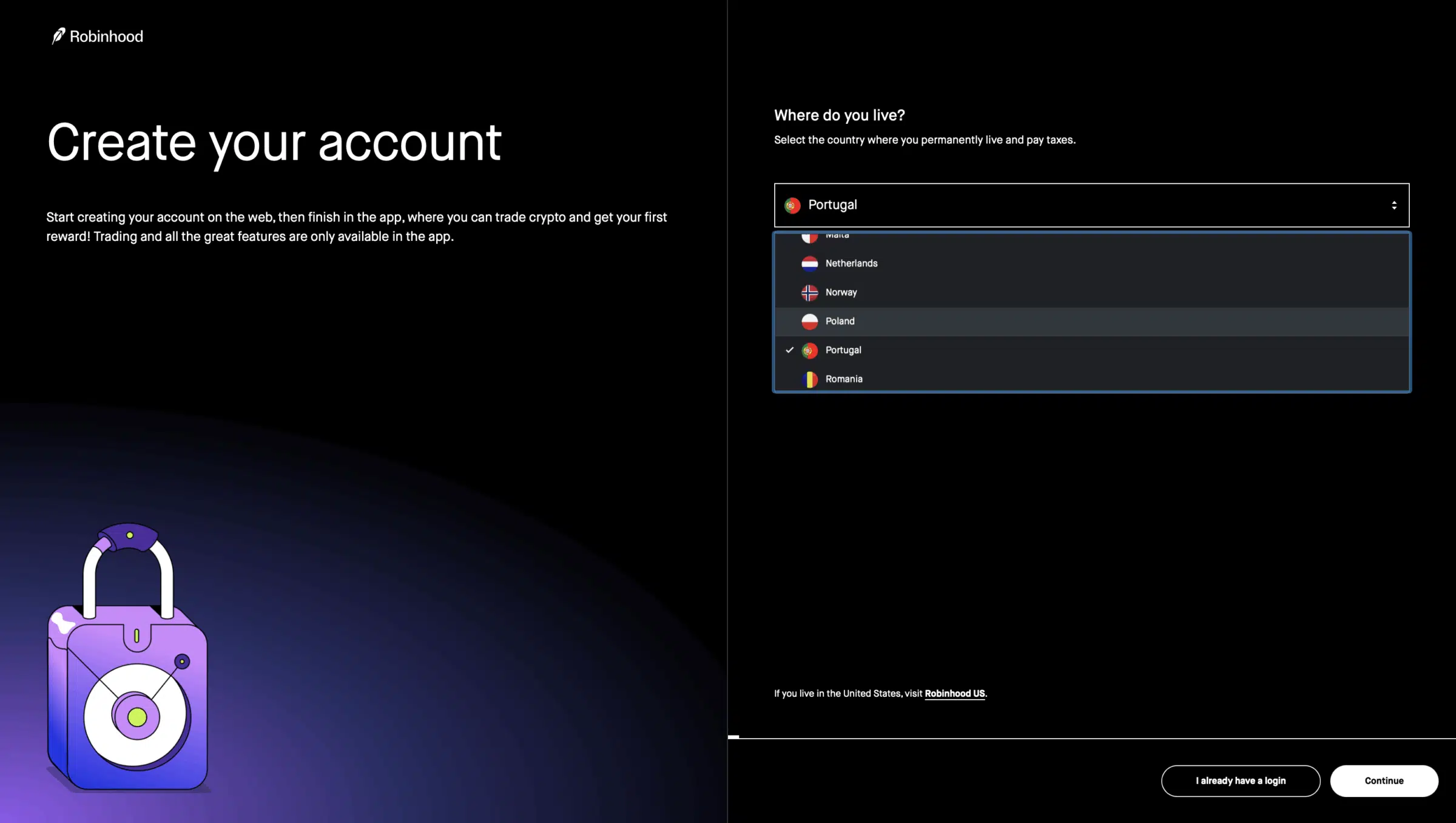
We opened a Robinhood Europe account, and at signup the available countries were:
- Austria
- Belgium
- Bulgaria
- Croatia
- Cyprus
- Czech Republic
- Denmark
- Estonia
- Finland
- France
- Germany
- Greece
- Hungary
- Iceland
- Ireland
- Italy
- Latvia
- Liechtenstein
- Lithuania
- Luxembourg
- Malta
- Netherlands
- Norway
- Poland
- Portugal
- Romania
- Slovakia
- Slovenia
- Spain
- Sweden
- United Kingdom
Note that the UK is served by a separate entity, Robinhood U.K. Ltd, regulated by the FCA, with a different product offering from the EU service.
Robinhood initially launched cryptocurrency trading in the European Union with around 25 digital assets. The list has since grown to more than 90 cryptocurrencies, including Bitcoin, Ethereum, and Solana.
The offering has also broadened well beyond crypto. European users can now trade tokenised versions of more than 2,000 US stocks and ETFs (Robinhood calls them Classic Stock Tokens), stake ETH and SOL, trade perpetual futures on crypto, commodities, ETFs and FX with up to 10x leverage, and earn interest on uninvested euros through a money market fund. The stock tokens provide fractional, 24/5 access to major US-listed equities such as Apple and Tesla, without a traditional brokerage account.
Stock tokens are not the same as owning real shares. They are derivative contracts between you and Robinhood Europe UAB that track the price of the underlying stock or ETF. Robinhood says it hedges them by holding the underlying securities 1:1, but those securities belong to Robinhood, not to you. You get price exposure to US equities, cash settlement, dividend-equivalent payments and no voting rights.
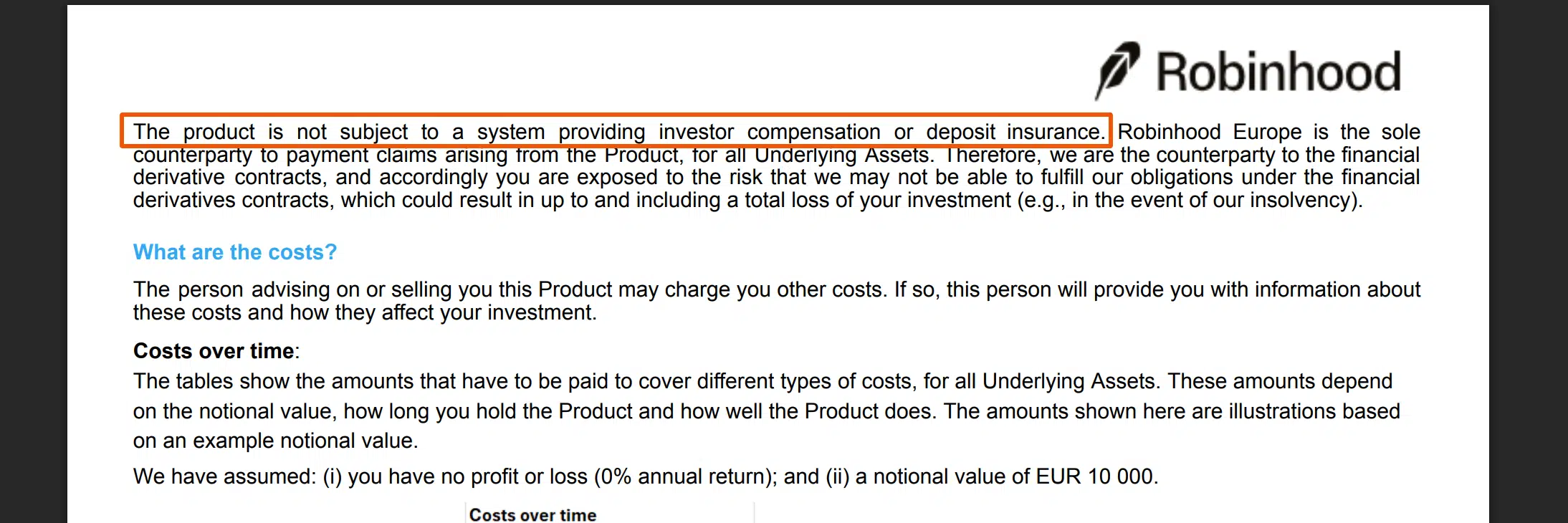
Critically, investments in stock tokens are not covered by any investor compensation scheme. This is stated explicitly in the Key Information Document for each token. As an example, here is the KID for Nvidia:
If that lack of protection concerns you, consider buying real shares through one of the brokers covered below instead.
In April 2025, the Bank of Lithuania granted Robinhood an A-category brokerage licence, the highest tier of investment firm authorisation under MiFID II. This allows Robinhood Europe UAB, headquartered in Vilnius, to passport its services across all EU and EEA member states.
The Bank of Lithuania operates within the European Single Supervisory Mechanism and applies the same MiFID II framework as BaFin or the AMF. Note, though, that the licence enables broader stock trading rather than automatically delivering it – real share trading has not replaced the tokenised offering for EU clients, and Robinhood has not confirmed a timeline.
If you decide to open a Robinhood Europe account, new users who sign up through a referral link and deposit at least €50 currently receive €50 in crypto. Our sister site explains the offer step by step in its Robinhood Europe referral guide. Terms apply and the amounts can change without notice.
Tax considerations for stock tokens
An important point for European investors: the tax treatment of stock tokens may differ from owning shares directly. Because they are structured as derivative-like instruments rather than direct equity:
- Some EU countries treat them as financial instruments subject to capital gains tax in the same way as shares, while others apply different rules;
- You do not receive dividends as a shareholder would – any dividend-equivalent payments are structured separately, which can change how they are taxed;
- Voting rights do not transfer to token holders;
- Reporting requirements for tokenised assets can be more complex than for a conventional brokerage account, and your broker may not provide the tax statements you would normally receive.
Consult a tax adviser familiar with your country’s treatment of tokenised instruments before investing. This matters particularly in Portugal, Italy, Spain, France, and Germany, where the treatment of crypto-assets and tokenised securities is still developing.
Taken together with the absence of investor compensation coverage, this is the central trade-off: stock tokens offer convenient access to US markets through a familiar app, but with less legal protection and more tax uncertainty than buying the same shares through a conventional broker.
Robinhood alternatives in Europe in 2026
- eToro: Best for commission-free ETF investing and social trading
- Interactive Brokers: Best overall trading platform in Europe
- Freedom24: Best for investment in bonds
- Plus500: Best for CFDs. Launched Plus500 Invest for real stock trading
- XTB: Best for CFD and Forex trading. Commission-free stock trading offered in some countries
- DEGIRO: Best for low-cost investing
Disclaimer: Investing involves risk of loss.

52% of retail CFD accounts lose money.


Investing involves risk of loss.

81% of retail CFD accounts lose money.

69-80% of retail CFD accounts lose money.

Investing involves risk of loss.
#1 eToro at a glance
52% of retail CFD accounts lose money.
Founded in 2007, eToro is an international online broker with over 40 million users across 140+ countries, offering more than 3,000 financial assets including stocks, ETFs, cryptocurrencies, and CFDs on stocks, ETFs, commodities, forex, indices, and cryptocurrencies.
On pricing, ETFs trade commission-free regardless of transaction size or how the order is placed, whether manually, through CopyTrader, or via Smart Portfolios. Stock trades carry a $1 commission on most exchanges ($2 on the Australian, Hong Kong, Dubai, Abu Dhabi, and Tokyo exchanges), applied both when opening and closing a position. Whole and fractional shares are supported, with a $50 minimum first deposit.
eToro’s platform, available on web and mobile, is a social trading hub. Investors can discuss ideas and market news with peers, replicate strategies through CopyTrader, or invest in thematic Smart Portfolios.
The demo account is particularly useful for beginners, with $100,000 in virtual money replicating live conditions. On the downside, eToro operates in USD as its only base currency, so euro deposits are converted on the way in and out (FX cost around 50 pips), and there is a $5 withdrawal fee plus a $10 monthly inactivity fee after 12 months without login.
eToro is regulated by top-tier authorities including the FCA (UK), ASIC (Australia), and the SEC/FINRA (US). European clients are served by eToro (Europe) Ltd, authorised and regulated by CySEC, with client assets covered up to €20,000 by the Cyprus Investor Compensation Fund plus Lloyd’s insurance up to €1 million per eligible client. eToro has been listed on NASDAQ (ticker: ETOR) since May 2025.
For more details, visit our eToro review.
CFDs are complex instruments and come with a high risk of losing money rapidly due to leverage. 52% of retail investor accounts lose money when trading CFDs with this provider. You should consider whether you understand how CFDs work and whether you can afford to take the high risk of losing your money.
#2 Interactive Brokers at a glance
Founded in 1978 and publicly listed on NASDAQ (ticker: IBKR, an S&P 500 constituent since 2024), Interactive Brokers is a global broker that has weathered multiple financial crises, demonstrating resilience and rigorous risk management. It serves over 5 million client accounts with more than $900 billion in client equity.
IBKR offers an advanced platform covering stocks, options, mutual funds, ETFs, futures, bonds, currencies, and cryptocurrencies across 170+ markets in 36+ countries, with solid execution via IB SmartRouting and comprehensive analysis tools.
US stock commissions start at $0.0035 per share ($0.35 minimum, capped at 1% of trade value), while European ETFs cost 0.05% of order value (€1.25 minimum, €29 maximum). FX conversion runs at roughly 0.20 basis points, among the lowest available.
Beginners have educational resources through IBKR Campus, though the main TWS platform has a steep learning curve, which is why we mainly recommend it to more experienced investors. Customer support gives clear, concise answers.
On the downside, the fee structure is complex and registration is lengthy, though fully online. Factoring in FX costs, tight spreads, the Stock Yield Enhancement Program, and interest on uninvested balances, clients still achieve significant savings versus most brokers. There is no minimum deposit and native EUR support.
IBKR also offers IBKR GlobalTrader, a modern mobile app for stocks, options, and ETFs, well suited to beginners, with automatic currency conversion, fractional shares from $1, and a $10,000 demo account.
Want to know more? Check our Interactive Brokers review.
#3 Freedom24 at a glance
Investing involves risk of loss.
Freedom24, part of Freedom Holding Corp (NASDAQ: FRHC), offers a cost-effective alternative to traditional brokers, with access to stocks, 3,600+ ETFs, bonds, futures, and options.
Its Bonds Showcase gives access to higher-rated bonds (B+ and above) from as little as €/$1,000, simplifying what is usually a difficult market for retail investors to access.
The web and mobile platforms are intuitive, complemented by InvestIdeas market analysis and Freedom Academy educational content. New users can claim a signup promotion of up to 20 gift stocks, though the headline value is a ceiling rather than a typical outcome.
With no minimum deposit, two pricing plans are available: All Inclusive in EUR (formerly Prime), with a dedicated account manager, and Smart in EUR, better suited to lower trading volumes. On the downside, a €7 withdrawal fee applies and cryptocurrencies are not offered.
Freedom Finance Europe Ltd is regulated by CySEC, with client assets covered up to €20,000 under the Investor Compensation Fund. The NASDAQ-listed parent is subject to SEC reporting and PCAOB audit oversight.
Want to learn more? Check our Freedom24 review or visit Freedom24 directly.
*The WELCOME promotion is subject to terms and conditions. Gift Shares are allocated randomly from a selection of eligible stocks, with higher-value shares awarded less frequently.
Investments in securities and other financial instruments always involve the risk of loss of your capital. The forecast or past performance is no guarantee of future results. It is essential to do your own analysis before making any investment.
#4 Plus500 at a glance
81% of retail CFD accounts lose money.
Founded in 2008, Plus500 offers real shares and CFDs on forex, indices, shares, commodities, options, ETFs, and cryptocurrencies. It operates in over 50 countries and is listed on the London Stock Exchange (ticker: PLUS) as a FTSE 250 constituent.
There are two account types:
- Plus500 CFD: focused exclusively on CFD products;
- Plus500 Invest: for trading real shares.
The main platform is WebTrader, Plus500’s proprietary system, stable across devices including a mobile app, with a demo account available for testing.
Support is accessible through a chat window permanently visible in the platform. Spreads are competitive and accounts are available in 16 base currencies including EUR. Plus500 charges a 0.70% currency conversion fee on CFDs (0.30% on Invest) and a $10 monthly inactivity fee after three months without activity. On Plus500 Invest, US market commissions are $0.006 per share (minimum $1).
Plus500 is regulated by the FCA, CySEC, ASIC, and others. European investors onboard through Plus500CY Ltd, covered up to €20,000. Negative balance protection now applies globally rather than only to EU retail clients.
As a side note, Plus500US, available only to US users for futures and prediction markets, is also part of the group.
Want to know more? Check our Plus500 review.
CFDs are complex instruments and come with a high risk of losing money rapidly due to leverage. 81% of retail investor accounts lose money when trading CFDs with this provider. You should consider whether you understand how CFDs work and whether you can afford to take the high risk of losing your money. Any educational content, market commentary, research, analysis, forecasts, coaching, training, or opinions provided by independent third parties do not represent the views of Plus500. Plus500 provides self-trading execution-only services and does not provide asset management nor investment, financial, legal, or tax advice. Plus500 accepts no responsibility or liability for any decisions made or losses incurred as a result of reliance on information, research, educational materials, coaching, or services provided by third parties.
#5 XTB at a glance
69-80% of retail CFD accounts lose money.
Founded in 2002 and listed on the Warsaw Stock Exchange, XTB serves over 1.7 million clients across 16 countries, regulated by the FCA, KNF, CySEC, BaFin, and AFM. It offers 0% commission on real stocks and ETFs up to €100,000 of monthly turnover (0.2% above, minimum €10), and pays cash interest on uninvested EUR balances linked to ECB policy.
You can invest through xStation 5 and xStation Mobile across stocks, ETFs, forex, indices, commodities, cryptocurrency CFDs, and vanilla options, added in early 2026 (availability varies by country).
Opening an account and transferring money is quick and fully online. Beginners get a demo account plus the XTB Trading Academy, while more experienced investors will find comprehensive technical and fundamental tools.
On the downside, XTB charges a €10 monthly inactivity fee after one year without trading and no deposit in the past 90 days. Cryptocurrency CFD spreads are wide, though forex pricing is competitive.
CFDs are complex instruments and come with a high risk of losing money rapidly due to leverage. Between 69-80% of retail investor accounts lose money when trading CFDs. You should consider whether you understand how CFDs work and whether you can afford to take the high risk of losing your money.
#6 DEGIRO at a glance
Investing involves risk of loss.
Founded in 2013, DEGIRO is a low-cost brokerage popular across Europe for its competitive pricing. With over 3 million users across 18+ countries, its “do-it-yourself” platform covers stocks, ETFs, bonds, options, futures, warrants, investment funds, and certain leveraged products (not identical to CFDs. More info here).
DEGIRO’s Core Selection ETFs trade commission-free subject to a €1.00 handling fee, with no minimum investment. The web platform is basic but efficient, as is the mobile app. On the downside, fundamental research is limited, no interest is paid on uninvested cash, a €2.50 annual connectivity fee per exchange applies, and price alerts are unavailable.
On security, DEGIRO operates as the Dutch branch of flatexDEGIRO Bank AG, supervised by BaFin and the Deutsche Bundesbank. Should segregated assets not be returned, DEGIRO falls under the German Investor Compensation Scheme, covering 90% of losses up to €20,000 – worth noting if you plan to invest substantially more. Cash held with flatexDEGIRO Bank AG is guaranteed up to €100,000 under the German Deposit Guarantee Scheme.
Still have doubts? Read our DEGIRO review.
Which platform should you choose?
Several factors are worth weighing when choosing an online broker in Europe:
- Real assets or tokens: the central question if you are comparing against Robinhood. Stock tokens give price exposure without ownership or investor compensation coverage, whereas the brokers above offer real shares protected up to €20,000;
- Total cost: commissions, currency conversion, custody, and inactivity fees together. For a euro-based investor buying US assets, FX costs often exceed the commission itself;
- Regulation: confirm which entity holds your account and what protection applies;
- Product range: not every platform offers EU-listed stocks, bonds, or options, so check the coverage matches what you intend to trade.
The right broker depends on your profile, preferences, and objectives. Explore the platforms above and decide for yourself.
The above should not be construed as investment advice and is provided for informational purposes only. Investors should do their own research and due diligence regarding the services best suited to their risk, return, and impact strategy.
FAQs
Can I use Robinhood from Europe with a VPN?
You do not need one. European residents can open a Robinhood Europe account directly, with access to crypto, stock tokens and perpetual futures. What a VPN will not get you is the US product (real shares, options, IRAs): the US entity requires proof of US residency and a Social Security number at onboarding.
How exactly does Robinhood make money?
The online broker earns money from interest earned on customers’ cash balances (money in your account not invested), by selling order information to third parties (high-frequency traders, for instance), and margin lending.
In the US, the biggest source is payment for order flow: market makers pay Robinhood to execute customer orders. Robinhood paid $65 million in December 2020 to settle SEC charges that, until 2018, it had not properly disclosed this practice. In Europe, payment for order flow has been banned since 30 June 2026, so Robinhood Europe earns its money from the 0.10% FX fee on stock tokens, crypto trading fees, perpetual futures fees and staking commissions.