You have probably heard about the Webull app and want to know if it is available in the UK, right?
Webull is a modern, easy-to-use investment app from the US that helped popularise commission-free trading in stocks and ETFs, alongside rivals including Robinhood, E*TRADE (now part of Morgan Stanley), and Charles Schwab (which absorbed TD Ameritrade, a brand since fully retired).
Webull is known particularly for its charting and technical analysis tools, which run deeper than most competitors at its price point.
Want to know if Webull is available in the UK, what its expansion plans look like, and which alternatives British investors have? We have got you covered.
Is Webull available in the United Kingdom?
Yes. Webull is available in the UK through Webull Securities (UK) Ltd, regulated by the Financial Conduct Authority, with client assets covered by the FSCS up to £85,000.
Webull has since expanded well beyond its original markets, now operating across the US, UK, EU (via the Netherlands), Canada, Australia, Japan, Singapore, Hong Kong, Brazil, Mexico, South Africa, Thailand, Indonesia, and Malaysia.

The launch in the UK occurred on July 12, 2023, but it is still limited in terms of product offering: it only allows you to invest in stocks, options, fractional shares – there is no access to ETFs, bonds, or over-the-counter (OTC) securities.
Besides that, Webull is not commission-free in the UK: a $0.10 minimum commission applies in US and HK stocks. For UK stocks, the minimum charge is £0.50.
Webull UK pros and cons
Pros
- Free Shares Sign Up Promotion
- Mobile-friendly app
- Fractional Shares
- Access to US-listed stocks and options
- One of the largest brokerages in the USA
- Regulated by the FCA
- Demo Account (paper trading)
Cons
- No ISA or SIPP
- Limited range of assets available - no ETFs, bonds, crypto
- FX fee
- No commission-free trading
Does Webull offer a signup bonus in the UK?
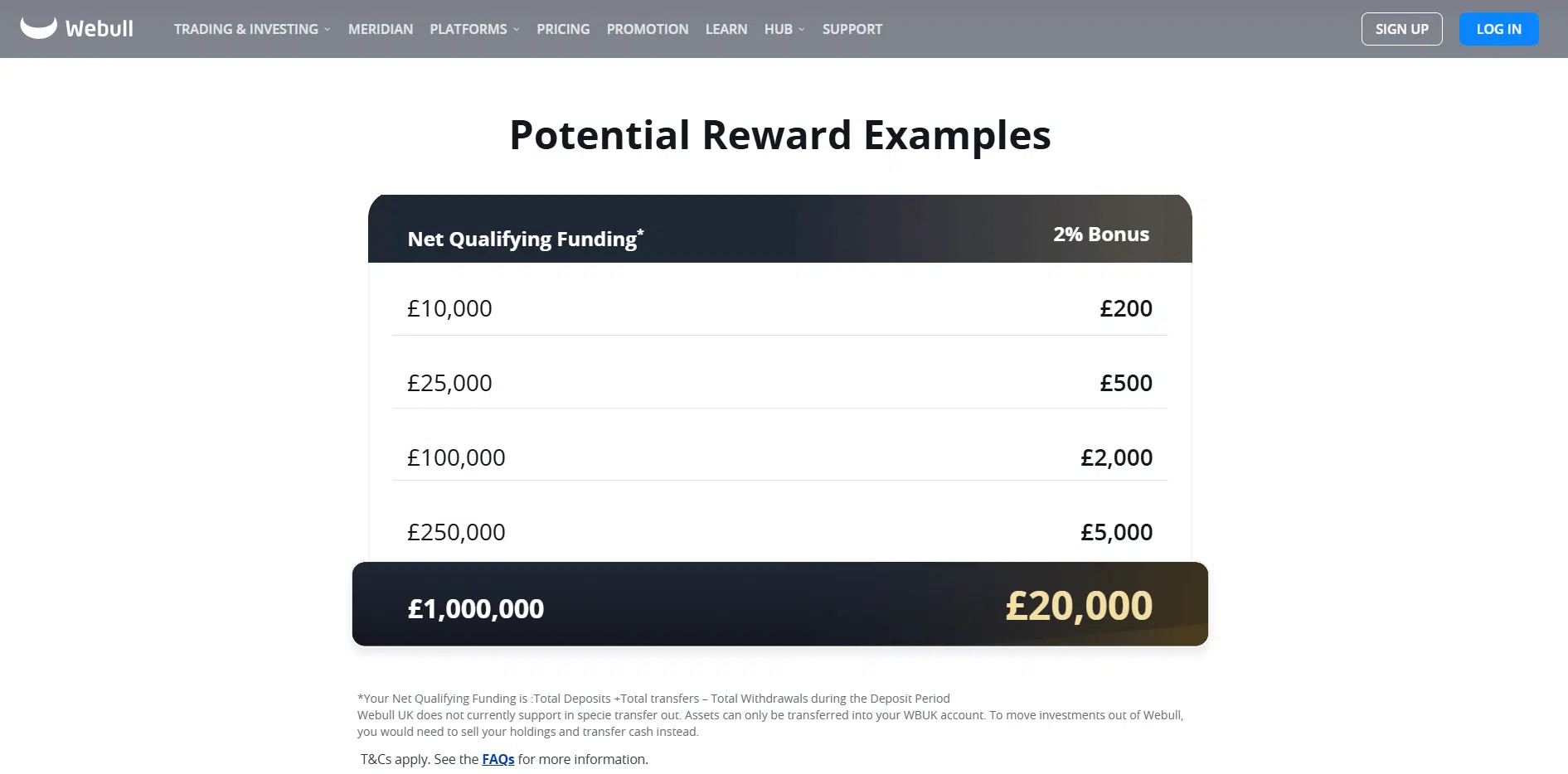
Webull does not offer a free share bonus in the UK, but instead runs a 2% cash reward for new UK users based on initial deposit:
- £10,000 deposit: £200 cash reward;
- £25,000 deposit: £500 cash reward;
- £100,000 deposit: £2,000 cash reward;
- £250,000 deposit: £5,000 cash reward;
- £1,000,000 or more: £20,000 cash reward.
Additional perks typically included:
- A £50 ETF trading voucher on an initial deposit of at least £100;
- One month of in-depth quotes;
- A one-month subscription to Level 2 Advance (NASDAQ TotalView) from signup.
Two things worth noting. The reward is a flat 2% across all tiers, so the headline £20,000 requires a £1 million deposit – the proportional return is identical whether you deposit £10,000 or £1 million. And cash rewards of this kind normally carry holding period conditions, requiring the deposit to remain in place for a set time before the reward unlocks. Check the current terms before committing capital you may need.
More importantly, weigh the 2% against what you would forgo. Depositing £20,000 with Webull rather than into a Stocks and Shares ISA earns you £400 once, while the ISA shelters gains from tax every year thereafter. For a long-term investor, that comparison rarely favours the bonus.
Promotional terms and dates change frequently – verify the current offer on Webull’s site before opening an account.
For more, see our overview of free share offers available in the UK.
Webull UK review
Want to know more about Webull in the UK?
Check our in-depth Webull UK review, where we review the pros and cons of the platform, fees, products available, and more!
Webull app alternatives in the UK
To help you find a Webull UK equivalent, we focused on low-cost online brokers available in the UK. Here are our suggestions:
eToro
With over 40 million users, eToro is the leading social investing platform (copy and follow other traders/investors). It offers commission-free stock and ETF trading (other fees apply).
Disclaimer: eToro is a multi-asset investment platform. The value of your investments may go up or down. Your capital is at risk.
Interactive Brokers
Founded in 1978, IBKR is one of the world’s most trustworthy brokers. It offers an enormous range of financial products (stocks, ETFs, Options, etc.), and low currency conversion fees (FX fees).
💡 Interactive Brokers also launched IBKR GlobalTrader, a modern mobile trading app to trade Stocks, Options, and ETFs, ideal for novice investors.
Capital.com
Capital.com is a global trading platform available in the UK, offering commission-free access to CFDs on markets such as stocks, commodities, indices, and forex. It also provides spread betting and 1X CFDs (no leverage). Best suited for active traders looking for a low-cost, multi-asset CFD platform.
XTB
Founded in 2002, XTB is a major player in the brokerage industry with extensive worldwide experience, regulated by the Financial Conduct Authority (FCA). It offers a flexible Stocks & Shares ISA with 0% commissions in stocks and ETFs plus interest on uninvested GBPs (calculated daily and paid out monthly).
Plus500
Plus500 is one of the leading CFD brokers. It offers no commissions when trading CFDs in Indices, Forex, Commodities, Cryptocurrencies, Shares, Options, and ETFs. It also recently launched Plus500 Invest for those who want to invest in real shares.
Disclaimer: 80% of retail CFD accounts lose money.
InvestEngine
InvestEngine is a UK-based robo-advisor and investment platform focused on ETFs. It is a great solution for buy-and-hold investors looking to only invest in ETFs for the long term.
Freetrade
The UK equivalent to Robinhood, Freetrade lets you invest in more than 6,000 stocks (from the US, the UK, German, Finland and the Netherlands) and ETFs for free. Offers SIPP and ISA accounts.
All the companies mentioned above are regulated and/or registered with the Financial Conduct Authority (FCA) in the UK.
eToro at a glance

52% of retail CFD accounts lose money.
Founded in 2007, eToro is an international online broker with over 40 million users across 140+ countries, offering more than 3,000 financial assets including stocks, ETFs, cryptocurrencies, and CFDs on stocks, ETFs, commodities, forex, indices, and cryptocurrencies.
For UK residents specifically, both stocks and ETFs trade commission-free – the UK is one of the markets where eToro applies no stock commission (other fees apply), with whole or fractional shares available. eToro also offers a Stocks and Shares ISA through its partnership with Moneyfarm, which shelters gains and dividends from UK tax.
eToro’s platform, available on web and mobile, is a social trading hub. Investors can discuss ideas and market news with peers, replicate strategies through CopyTrader, or invest in thematic Smart Portfolios.
The demo account is particularly useful for beginners, with $100,000 in virtual money replicating live conditions. On the downside, eToro operates in USD as its only base currency, so sterling deposits are converted both ways.
eToro is regulated by top-tier authorities including the FCA in the UK, ASIC in Australia, and the SEC/FINRA in the US. UK clients are served by eToro (UK) Ltd, with client assets covered by the FSCS up to £85,000. eToro has been NASDAQ-listed (ETOR) since May 2025.
For more details, visit our eToro review.
CFDs are complex instruments and come with a high risk of losing money rapidly due to leverage. 52% of retail investor accounts lose money when trading CFDs with this provider. You should consider whether you understand how CFDs work and whether you can afford to take the high risk of losing your money.Pros
- 0% commission trading (only spreads apply)
- Offers a 1X (non-leveraged) account with no overnight funding fees
- Spread betting is available
- User-friendly web and mobile platforms
- Integration with MT4 and TradingView
- Wide range of tradable assets (over 5,000 markets)
- Low minimum deposit of £20
- 24/7 index CFD trading (extended hours)
- 24/7 customer support
- Excellent educational resources, including guides and webinars
- Demo account
Cons
- No ownership of underlying assets (CFD/spread betting only)
- Overnight financing fees can become expensive for long-term, highly leveraged positions.
- Not suitable for passive or dividend-focused investors
- No interest on uninvested cash
Interactive Brokers at a glance

Founded in 1978 and publicly listed on NASDAQ (ticker: IBKR, an S&P 500 constituent since 2024), Interactive Brokers has weathered multiple financial crises, demonstrating resilience and rigorous risk management. It serves over 5 million client accounts with more than $900 billion in client equity.
IBKR offers an advanced platform covering stocks, options, funds, ETFs, futures, bonds, currencies, and cryptocurrencies across 170+ markets in 36+ countries, with solid execution via IB SmartRouting.
Beginners have educational resources through IBKR Campus, though the TWS platform has a steep learning curve, which is why we mainly recommend it to more experienced investors. Customer support gives clear, concise answers.
On the downside, the fee structure is complex and registration lengthy, though fully online, and IBKR does not offer fully commission-free trading. Factoring in FX conversion at 0.20 basis points, tight spreads, and the Stock Yield Enhancement Program, clients still achieve significant savings. There is no minimum deposit.
UK clients are served by Interactive Brokers (U.K.) Limited, FCA-regulated (firm reference 208159) with FSCS protection up to £85,000. IBKR offers both a Stocks and Shares ISA and a SIPP, which matters considerably for UK investors.
IBKR also offers IBKR GlobalTrader, a modern mobile app for stocks, options, and ETFs, well suited to beginners, with automatic currency conversion, fractional shares from $1, and a $10,000 demo account.
Want to know more? Check our Interactive Brokers review.
Pros
- Low commissions on US stock trading
- No monthly inactivity fee
- The broadest product and markets range in the brokerage industry
- Demo account
- Excellent reputation (founded in 1978)
- Extensive research and Education tools
- Has a modern mobile trading app to trade Stocks, Options and ETFs, ideal for novice investors, IBKR GlobalTrader.
- Offers interest on uninvested cash balances
Cons
- Complicated and lengthy account opening process (but fully online)
- Steeper learning curve for beginners
- Website is difficult to navigate
- Interactive Advisors (Robo-advisor feature) is only available for US customers
Capital.com at a glance

Spread bets and CFDs are complex instruments and come with a high risk of losing money rapidly due to leverage. 65% of UK retail investor accounts lose money when trading spread bets and CFDs with this provider.
Founded in 2016, Capital.com is a global CFD trading platform that has grown quickly on a commission-free model and accessible technology. It serves a substantial client base with access to CFDs on forex, stocks, indices, and commodities, plus spread betting – which for UK residents carries tax advantages, since spread betting profits are generally free from capital gains tax and stamp duty. It also offers an X1 account for CFD trading without leverage.
Capital.com provides its own web and mobile apps with AI-driven insights and risk management tools, alongside access via TradingView and MT4 for automated strategies. A free demo account is available.
Capital.com charges no commission on trades, earning instead through the spread. Spreads are dynamic and widen with market conditions. Additional charges apply on guaranteed stop-loss orders and overnight funding where leverage is used.
On the downside, as a CFD-focused broker it is unsuitable for investors wanting ETFs, bonds, tax-wrapped retirement accounts, or direct ownership of assets rather than derivatives. There is no ISA or SIPP.
Capital.com is regulated by the FCA under registration number 793714, holds client funds in segregated accounts, provides negative balance protection for retail clients, and is covered by the FSCS up to £85,000.
CFDs are complex instruments and come with a high risk of losing money rapidly due to leverage. A high percentage of retail investor accounts lose money when trading CFDs with this provider.
Pros
- 0% commission trading (only spreads apply)
- Offers a 1X (non-leveraged) account with no overnight funding fees
- Spread betting is available
- User-friendly web and mobile platforms
- Integration with MT4 and TradingView
- Wide range of tradable assets (over 5,000 markets)
- Low minimum deposit of £20
- 24/7 index CFD trading (extended hours)
- 24/7 customer support
- Excellent educational resources, including guides and webinars
- Demo account
Cons
- No ownership of underlying assets (CFD/spread betting only)
- Overnight financing fees can become expensive for long-term, highly leveraged positions.
- Not suitable for passive or dividend-focused investors
- No interest on uninvested cash
XTB at a glance

69-80% of retail CFD accounts lose money.
Founded in 2002 and listed on the Warsaw Stock Exchange, XTB serves over 1.7 million clients across 16 countries, regulated by the FCA alongside the KNF, CySEC, and BaFin.
You can invest through xStation 5 and xStation Mobile across stocks, ETFs, forex, indices, commodities, cryptocurrency CFDs, and vanilla options, added in early 2026. XTB offers 0% commission on real stocks and ETFs up to a monthly turnover threshold, including within its flexible Stocks and Shares ISA – a genuine advantage for UK investors, since the ISA shelters gains and dividends from tax entirely.
Opening an account is quick and fully online. Beginners get a demo account and the XTB Trading Academy, while experienced investors will find comprehensive technical and fundamental tooling.
XTB pays interest on uninvested GBP balances, calculated daily and paid monthly. Rates track Bank of England policy and are subject to change, so check the current figure before relying on it. Note also a 0.5% FX conversion fee within the ISA.
On the downside, an inactivity fee of £10 per month applies after one year without trading and no deposit in the past 90 days, and crypto CFD spreads are relatively wide compared with its competitive forex pricing.
Want to know more? Check our XTB review.
CFDs are complex instruments and come with a high risk of losing money rapidly due to leverage. 76-83% of retail investor accounts lose money when trading CFDs with XTB.
Pros
- Free stocks trading (only applicable to some countries)
- Customizable trading platform (charts and workspace)
- Low Forex Spreads
- Demo account
- No minimum account deposit
- Valuable education materials
- Top-tier Regulators
Cons
- Complex trading platform for a beginner
- High Stock CFD spreads
- Limited product portfolio
- Withdrawal fees for transfers below $100
- Inactivity fee (€10/monthly after 1+ year with no activity plus no deposit in the last 90 days)
Plus500 at a glance

81% of retail CFD accounts lose money.
Founded in 2008, Plus500 offers real shares and CFDs on forex, indices, shares, commodities, options, ETFs, and cryptocurrencies. It operates in over 50 countries and is listed on the London Stock Exchange (ticker: PLUS) as a FTSE 250 constituent.
Two account types are available:
- Plus500 CFD: CFD products only;
- Plus500 Invest: for trading real shares.
The main platform is WebTrader, Plus500’s proprietary system, stable across devices including a mobile app, with a demo account for testing.
Support is accessible through a chat window permanently visible in the platform. Spreads are competitive and accounts are available in 16 base currencies including GBP. Plus500 charges a 0.70% currency conversion fee on CFDs (0.30% on Invest) and a $10 monthly inactivity fee after three months without activity. On Plus500 Invest, US market commissions are $0.006 per share (minimum $1).
UK clients are served by Plus500UK Ltd, FCA-regulated with FSCS protection up to £85,000. Negative balance protection now applies globally. Note there is no ISA.
Want to know more? Check our Plus500 review.
CFDs are complex instruments and come with a high risk of losing money rapidly due to leverage. 81% of retail investor accounts lose money when trading CFDs with this provider. You should consider whether you understand how CFDs work and whether you can afford to take the high risk of losing your money. Any educational content, market commentary, research, analysis, forecasts, coaching, training, or opinions provided by independent third parties do not represent the views of Plus500. Plus500 provides self-trading execution-only services and does not provide asset management nor investment, financial, legal, or tax advice. Plus500 accepts no responsibility or liability for any decisions made or losses incurred as a result of reliance on information, research, educational materials, coaching, or services provided by third parties.Pros
- Acessible and responsive platform
- Low spreads
- No dealing commissions
- Demo Account
- Top-tier regulators
Cons
- No ETF offering
- Inactivity fee ($10 per month after no login activity in 3 months)
- High overnight funding fees
- Very little research and education provided
InvestEngine at a glance

When investing your capital is at risk.
InvestEngine is a UK broker and robo-advisor launched in 2020, offering low-cost, diversified ETF portfolios matched to your goals and risk tolerance. It provides both managed portfolios and a DIY option for investors building their own.
Pros:
- Exceptionally low cost: the DIY option charges 0% platform fee, with managed portfolios at 0.25% per year – among the cheapest available in the UK;
- ISA and SIPP available, so gains can be sheltered from tax entirely;
- Diversification: 700+ ETFs allow a portfolio built around your risk tolerance and objectives;
- Automatic rebalancing on managed portfolios, maintaining your target allocation;
- Fractional investing, so contributions are fully invested rather than leaving cash idle.
Cons:
- ETFs only: no individual stocks, bonds, or other instruments;
- Narrower selection than a full-service broker, which may constrain investors wanting specific or niche funds.
Overall, a strong option for buy-and-hold investors building a long-term ETF portfolio, particularly given the 0% DIY platform fee combined with ISA availability.
Want to know more? Check our InvestEngine review.
Pros
- Simple and intuitive investment platform
- No ISA fees
- No deposit or withdrawal fees
- Fractional Investing
- One-click rebalancing
- Auto-invest
Cons
- Only offers ETFs: no bonds, shares, and other products
- No interest on cash balances (still you can invest in money market funds)
Freetrade at a glance

Freetrade is a UK stockbroker founded in 2016, offering commission-free investing across 6,000+ stocks (US, UK, German, Finnish, and Dutch) alongside ETFs. Now available on web as well as mobile, following its acquisition by IG Group in 2025.
Freetrade set out to simplify a traditionally complex industry, with an emphasis on transparency and long-term outcomes rather than active trading. The app carries no CFDs or comparable leveraged products, does not encourage day trading, and has no hidden charges. Account opening is quick and the interface notably clean.
The main limitation is product range: no options, forex, CFDs, commodities, or cryptocurrencies.
Freetrade operates a freemium model, generating revenue through subscription tiers, an FX fee on US orders, and interest on client cash. Paid plans unlock an ISA, SIPP, limit orders, stop losses, and a wider instrument range – worth weighing, since the ISA in particular usually justifies the subscription cost for anyone investing meaningful amounts.
For more, read our full Freetrade review.
Pros
- Free stock and ETF trading
- GIA, ISA, and SIPP
- No inactivity, account, or withdrawal fees
- No minimum deposit
- Great community (forum) – where users share ideas and learn about investing
- Nice and user-friendly app
Cons
- Limited asset classes (only stocks, ETFs, REITs, and investment trusts)
- Limited research and education
- Graphs and portfolio tracking still need some development
- No phone support – however, live chat support is very fast and efficient
Which platform should you choose?
Several factors matter when choosing a broker in the UK:
- ISA and SIPP availability: arguably the most consequential factor. A Stocks and Shares ISA shelters up to £20,000 a year from capital gains and dividend tax entirely, and over any meaningful period that saving will exceed differences in trading commissions. Of the brokers above, eToro, Interactive Brokers, XTB, InvestEngine, and Freetrade all offer one;
- Real assets or CFDs: with real shares you own the underlying asset; with CFDs you hold a leveraged position with overnight financing costs, unsuitable for long-term holding;
- Total cost: commissions, platform fees, FX conversion, and inactivity charges together. For anyone buying US assets, the FX fee often exceeds the commission itself;
- Regulation: all the brokers here are FCA-regulated with FSCS protection up to £85,000, which covers firm failure rather than investment losses;
- Product range: check the platform covers what you intend to hold, whether that is LSE-listed shares, ETFs, bonds, options, or crypto.
The right broker depends on your profile, preferences, and objectives. Explore the platforms above and decide for yourself.
A reminder that the above should not be construed as investment advice and should be considered information only. Investors should do their own research and due diligence about the services and opportunities best suited for their risk, returns, and impact strategy.