
Public and Webull both charge $0 commission on US stocks, ETFs and stock options, have no account minimum and let you trade eligible stocks 24 hours a day, five days a week. The difference is in what each app gives back and what its paid plan adds. Public pays a rebate on stock options, charges 5.15% on margin and pays 3.30% on cash with no subscription. Webull offers futures, joint and custodial accounts, phone support and a $3.99 monthly Premium plan with 3.60% on cash.
In this comparison, we put the US figures from each broker's own website side by side and work out what each one costs or pays you in a year for eight types of investor.
Public vs Webull: quick take
- Public is best for investors who borrow on margin (5.15% against 8.74% at Webull, or 5.45% with Premium), options traders who want a rebate of $0.06 to $0.18 per contract, and anyone who wants interest on cash with no subscription (3.30%), bonds or Treasuries.
- Webull is best for futures traders ($1.00 per contract), investors who need a joint, custodial or rollover IRA account, and anyone who wants phone support, a paper trading account or 3.60% on cash with its $3.99 Premium plan.
Public vs Webull in a nutshell
| Category | Public | Webull |
| US stocks and ETFs | $0 commission | $0 commission |
| Stock and ETF options | $0, plus a rebate of $0.06 to $0.18 per contract | $0 per contract |
| Index options | $0.35 per contract | $0.50 per contract |
| Futures | Not offered | $1.00 per contract ($0.25 for micros) |
| Interest on cash | 3.30% APY (3.75% with Reserve, $20/month) | 0.50% (3.60% with Premium, $3.99/month) |
| IRA match | 1%, or 4% with Reserve | 1%, or 3.5% with Premium |
| Margin rate (under $25,000) | 5.15% | 8.74% (5.45% with Premium) |
| Phone support | No (chat and email) | 8 AM to 5 PM ET on weekdays |
| Outgoing transfer fee | $100 | $75 |
Source: Public fee schedule (updated 13 October 2026), Public Reserve and Public options rebate terms, and the Webull fee schedule (Premium, futures and margin tabs, checked on 27 November 2026). Public margin rates as of 17 September 2026. Data as of November 2026.
1. Overview
Public
Public is a US investing platform owned by Public Holdings, Inc., based in New York. Its brokerage accounts are held by Open to the Public Investing, Inc., a member of FINRA and SIPC, with Apex Clearing handling clearing and custody. Public has a free plan, Core, and a paid one, Reserve, which costs $20 a month or $200 a year and raises the rate on cash and the IRA match. Public only opens accounts for US residents, as we explain in our guide on where Public is available.
Webull
Webull is owned by Webull Corporation, which is headquartered in St. Petersburg, Florida, and listed on Nasdaq (BULL). US accounts are held by Webull Financial LLC, a member of FINRA and SIPC. The app is built for active trading, with charts, screeners and a paper trading account, and its paid plan, Webull Premium, costs $3.99 a month or $40 a year. You can read more in our Webull US review.
2. Products
Public: over 9,000 US stocks, ETFs, options, more than 60 cryptocurrencies, corporate bonds and Treasuries, a Bond Account, direct indexing, Generated Assets (indexes built by AI from an idea you type), prediction markets and a High-Yield Cash Account.
Webull: US stocks and ETFs, fractional shares from $1, options, OTC stocks, futures, crypto (with a 1% spread built into the price), prediction markets and US Treasury and corporate bonds. Since June 2026 it also offers mutual funds, but only in IRAs and only for permanent US residents.
If you trade futures, only Webull offers them, at $1.00 per regular contract for up to 5,000 contracts a month, before exchange and regulatory fees. Public covers more of fixed income, with bond fees from $0.10 per $100 of par value, a Bond Account and a Treasury ladder. For crypto, Public charges a flat fee on orders up to $500 (from $0.49 to $6.29) and 1.25% above that, while Webull builds a 1% spread into the price.
3. Interest on cash
Both brokers pay interest on cash, but in different ways:
- Public pays 3.30% APY to every customer in its High-Yield Cash Account, a separate account where cash is swept to partner banks with FDIC cover of up to $5 million. You have to move money into it, and Reserve members get 3.75% APY.
- Webull pays 3.60% to Premium members ($3.99 a month or $40 a year) and 0.50% to everyone else, on uninvested cash in the brokerage account, swept to partner banks with FDIC cover of up to $5 million.
On $10,000 of cash, you earn about $330 a year at Public with no fee, and about $320 at Webull after $40 of Premium ($50 without Premium). Public Reserve pays $375 on the same amount, but its $240 a year only pays off on much larger balances, as it adds 0.45 percentage points. All these rates are variable.
4. IRAs and account types
Both brokers add a match to IRA contributions. Public pays 1%, or 4% with Reserve ($300 at the 2026 limit of $7,500). Webull pays 1%, or 3.5% with Premium ($262.50). At both, you must keep the paid plan for a year and the money in the IRA for five years to keep the full match. Public also pays an uncapped 1% match on accounts and 401(k) rollovers you transfer in, and Webull 1% on IRA transfers with Premium.
Public accounts: individual brokerage and margin accounts, traditional and Roth IRAs, crypto IRAs and business accounts, with trust accounts listed as coming soon.
Webull accounts: individual cash and margin accounts, joint and custodial (UTMA/UGMA) accounts, traditional, Roth and rollover IRAs, plus futures, entity and crypto accounts.
If you want to invest with a partner or for a child, only Webull offers joint and custodial accounts.
5. Pricing
What a year costs
| Investor | Public | Webull |
| Buys an S&P 500 ETF every month | $0 | $0 |
| Keeps $10,000 in cash | Earns $330 ($135 with Reserve, after $240) | Earns $320 (with Premium, after $40) or $50 |
| Contributes $7,500 to an IRA | Gets $300 (with Reserve) or $75 | Gets $262.50 (with Premium) or $75 |
| Trades 20 stock option contracts a month | Gets back $14.40 or more | $0 |
| Trades 100 index option contracts a month | $420 | $600 |
| Trades 10 futures contracts a month (in and out) | Not offered | $240 |
| Borrows $20,000 on margin all year | $1,030 | $1,748 ($1,130 with Premium, plan included) |
| Moves the account to another broker | $100 | $75 |
Our calculation with each broker's November 2026 rates. Reserve at $240 a year and Premium at $40 a year. Stock options: 240 contracts a year at Public's lowest rebate of $0.06. Index options: 1,200 contracts a year, before exchange fees. Futures: 120 contracts a year, each bought and sold (240 sides). Margin: 5.15% at Public and 8.74% or 5.45% at Webull, interest only. Regulatory fees not included.
For a buy-and-hold investor in stocks and ETFs, both are free. Public costs less for margin, index options and stock options, where it pays a rebate instead of charging. Public's margin rate falls to 5.00% from $50,000 and 4.75% from $100,000, while Webull charges 8.74% at every balance, or 5.45% to 4.15% with Premium. Webull costs less to leave ($75 against $100) and is the only one with futures. Public also charges $3.99 a month on accounts under $70 with no activity for six months and $5 per paper statement. For every Webull cost, see our guide on Webull fees.
6. Platforms, trading hours and support
Webull offers a mobile app, a web platform and Webull Desktop, with advanced charts, screeners, order flow data and a paper trading account with real-time quotes. Public has a mobile app and web platform, plus a Trading API and Public MCP, which lets you trade through AI assistants such as ChatGPT and Claude.
Both brokers offer 24/5 trading on eligible stocks and ETFs, with an overnight session from 8 PM to 4 AM ET. Their order routing differs. Public says it does not accept payment for order flow on stock and ETF trades placed in the app or website during regular hours, and asks for an optional contribution instead. It does accept it for options, OTC stocks, extended-hours trades and API orders, and shares part of the options revenue with you through its rebate. Webull receives payment for order flow, as it discloses in its order routing reports.
Support is a clear difference. Webull's client service team answers the phone at +1 (888) 828-0618 from 8 AM to 5 PM ET on weekdays. Public says it does not offer phone support: you reach it by chat in the app or by email at [email protected], with priority support for Reserve members.
7. Regulation and security
Who regulates them: Open to the Public Investing, Inc. (CRD 127818) and Webull Financial LLC (CRD 289063) are broker-dealers registered with the SEC and members of FINRA, the self-regulator of US brokers. You can check both firms on FINRA BrokerCheck: Public Investing and Webull Financial.
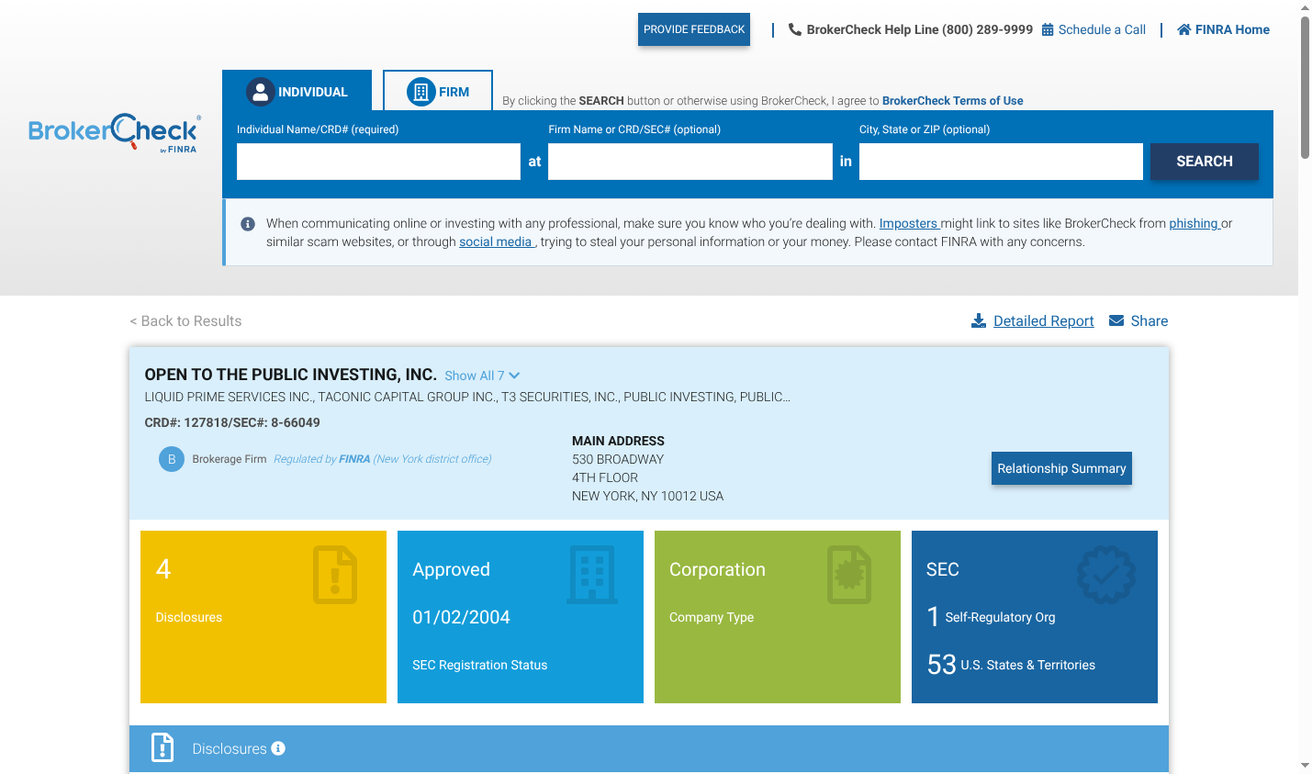
Open to the Public Investing on FINRA BrokerCheck
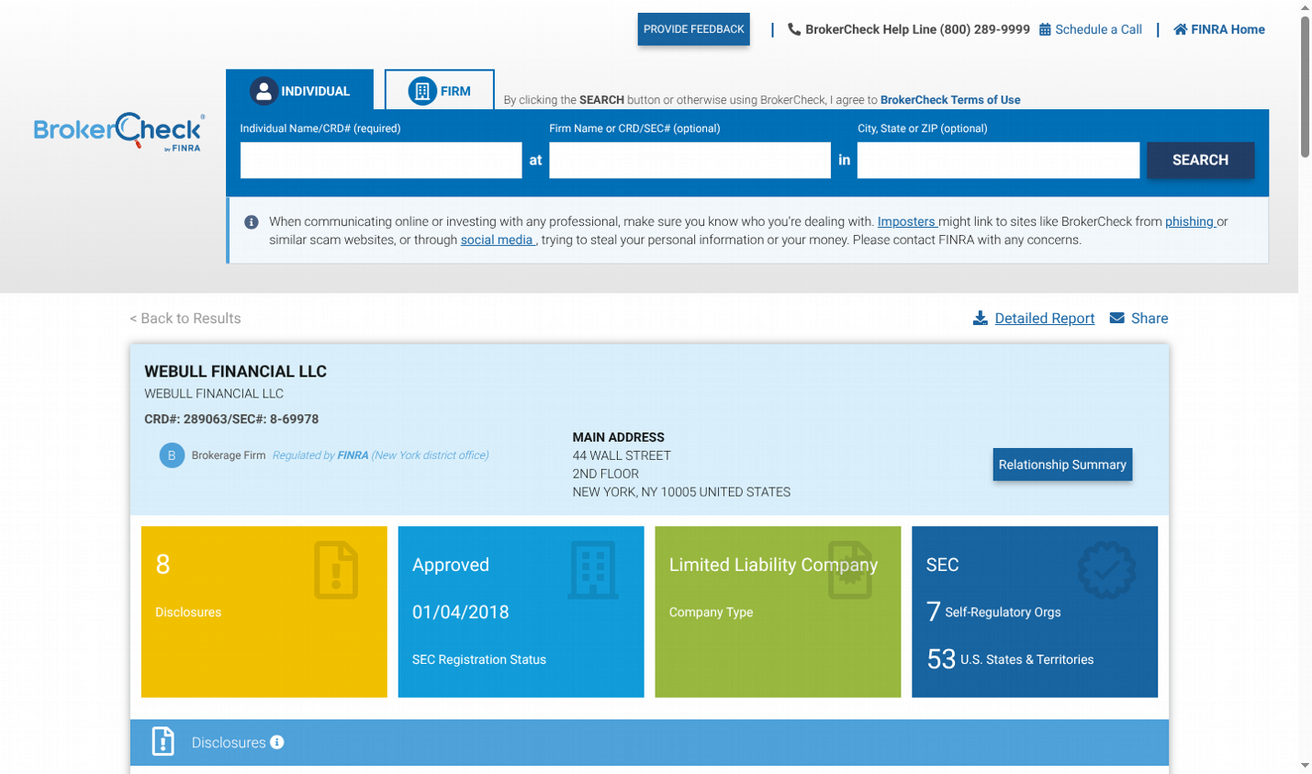
Webull Financial on FINRA BrokerCheck
Disciplinary history: as of 28 November 2026, BrokerCheck lists 4 disclosures for Open to the Public Investing, all regulatory events. Webull Financial has 8 (7 regulatory events and 1 arbitration, as of 26 November 2026), and its largest case was a $3 million FINRA fine in 2023 for approving customers for options trading without enough due diligence.
SIPC protection: both brokers are members of SIPC, which covers up to $500,000 per customer, including $250,000 for cash, if a member broker fails and customer assets are missing. It does not protect you against market losses.
Excess of SIPC: Public's clearing firm, Apex Clearing, has extra insurance above SIPC limits with an aggregate limit of $150 million across all its accounts. Webull's policy with Lloyd's of London has a $100 million aggregate limit, no per-account limit on securities and a $1.9 million limit on cash.
Products outside SIPC: Public's crypto is held by zerohash and its prediction markets run through KalshiEX. Webull's futures are offered by Webull Futures LLC, registered with the CFTC. At both brokers, crypto, futures and event contracts are not covered by SIPC, and crypto is not FDIC insured.
8. Pros and cons
The pros and cons below reflect our own assessment of each broker. Investing involves risk, and the value of your investments can go down as well as up, so you may get back less than you invest.
Public pros and cons
Pros
- Rebate of $0.06 to $0.18 per stock option contract
- Margin from 5.15%, with no plan needed
- 3.30% on cash with no subscription
- Bonds, Treasuries and a 4% IRA match with Reserve
Cons
- No phone support
- No futures, joint or custodial accounts
- $100 to transfer the account out
Webull pros and cons
Pros
- Futures at $1.00 per contract
- Joint, custodial and rollover IRA accounts
- Paper trading and advanced charts
- Phone support on weekdays
Cons
- Margin at 8.74% without Premium
- 0.50% on cash without Premium
- $0.50 per index option contract
Public vs Webull: our verdict
Public
Best for margin, options rebates and interest on cash with no planWebull
Best for futures, joint or custodial accounts and phone support
For US stocks and ETFs, both are free. Public costs less for most active investors: it pays you on stock options, charges 5.15% on margin against 8.74% and pays 3.30% on cash with no plan. Webull fits better if you trade futures, need a joint, custodial or rollover IRA account, want to practise with paper trading or like to call your broker, and its Premium plan brings cash to 3.60% for $40 a year.
Both offer welcome bonuses for new clients: see our Public referral code and Webull referral bonus guides. To compare each app with Robinhood, read our Public vs Robinhood and Webull vs Robinhood comparisons.
Disclaimer: When investing, your capital is at risk and you may get back less than invested. Options, futures and margin trading carry a high level of risk, and margin can lead to losses greater than your deposit. This information is not investment advice. Fees, rates and offers change often, so check them on each broker's website before you open an account.
FAQs
Is Public better than Webull?
It depends on how you invest. Public charges less for margin (5.15% against 8.74%), pays a rebate on stock options and pays 3.30% on cash with no plan. Webull offers futures, joint and custodial accounts, paper trading and phone support on weekdays.
Does Public pay you to trade options?
Yes. Public pays a rebate of $0.06 to $0.18 per stock or ETF options contract, depending on your monthly volume, taken off the cost of each trade. Index options cost $0.35 per contract. Webull charges $0 per contract on stock and ETF options and $0.50 on certain index options.
Which pays more interest on cash, Public or Webull?
Without a paid plan, Public: 3.30% APY in its High-Yield Cash Account, against 0.50% at Webull. With the paid plans, Public Reserve pays 3.75% for $20 a month and Webull Premium 3.60% for $3.99 a month. All these rates are variable.
Does Public have phone support?
No. Public says it does not offer phone support: you can reach it by chat in the app or by email at [email protected]. Webull answers the phone from 8 AM to 5 PM ET on weekdays.
Can I transfer my account from Webull to Public?
Yes. You request the transfer at Public and your shares move through ACATS without being sold. Public pays an uncapped 1% match on assets you transfer in, kept for five years. Webull charges $75 per outgoing stock transfer, as we explain in our guide on how to close a Webull account.