
Webull and Robinhood are the two best-known commission-free trading apps in the US. Both charge $0 on stocks, ETFs and options, both sell a paid plan ($3.99 a month at Webull, $5 at Robinhood) and both now operate in the UK.
The differences are in the details: margin rates, the IRA match, paper trading, transfer fees and what each paid plan includes. In this comparison, we put the figures side by side so you can see which app costs less for the way you invest.
Webull vs Robinhood: quick take
- Webull is best for investors who want paper trading, a higher IRA match (3.5% with Premium) and a cheaper paid plan.
- Robinhood is best for investors who use margin without a subscription, and for UK investors who want a commission-free ISA with low currency fees.
Webull vs Robinhood in a nutshell
| Category | Webull (US) | Robinhood (US) |
| Stocks, ETFs and options | $0 commission (plus regulatory fees) | $0 commission (plus regulatory fees) |
| Index options | $0.50 per contract | $0.50 per contract ($0.35 with Gold) |
| Paid plan | Webull Premium: $3.99/month or $40/year | Robinhood Gold: $5/month or $50/year |
| Interest on uninvested cash | 3.60% APY with Premium | 3.60% APY with Gold |
| Margin rate (up to $25,000) | 8.74% (5.45% with Premium) | 5.25% (first $1,000 free with Gold) |
| IRA match on contributions | 3.5% with Premium, 1% without | 3% with Gold, 1% without |
| Level 2 data | Included with Premium | Included with Gold |
| Paper trading | Yes | No |
| Outgoing transfer fee | $75 | $100 |
| Available in the UK | Yes (FCA) | Yes (FCA) |
Source: Webull pricing, margin and Premium pages, and the Robinhood Financial fee schedule and Gold pages. Webull margin rates as of 16 October 2026, Robinhood margin rates as of 16 September 2026, APYs as of 17 September 2026. Data as of November 2026.
1. Overview
Webull
Webull is owned by Webull Corporation, which is headquartered in St. Petersburg, Florida, and listed on Nasdaq (BULL). In the US, accounts are held by Webull Financial LLC, which is registered with the SEC and is a member of FINRA and SIPC. The app is known for its charts, screeners and free paper trading account. You can read more in our Webull US review.
Robinhood
Robinhood Markets is based in Menlo Park, California, listed on Nasdaq (HOOD) and part of the S&P 500 since September 2025. US brokerage accounts are held by Robinhood Financial LLC, a FINRA member and SIPC member, with clearing by Robinhood Securities LLC. The app is known for its simple design, and its desktop platform, Robinhood Legend, adds advanced charts for active traders.
2. Products
In the US, both apps offer stocks, ETFs, fractional shares, options, futures, crypto and prediction markets. Webull also offers OTC stocks and US Treasury and corporate bonds.
Crypto is priced differently: Webull builds a 1% spread into the price of each crypto trade, while Robinhood charges no commission when crypto orders go to market makers, so the cost is in the price you get.
3. Trading platforms
Webull: offers a mobile app, a web platform and a desktop app (Webull Desktop 9.0) with order flow data and custom indicators. Its paper trading account lets you practise with real-time quotes and no real money.
Robinhood: offers a mobile app, a web platform and Robinhood Legend for desktop trading. Robinhood has no paper trading account, so you can only practise with real money.
Both apps include Nasdaq TotalView Level 2 data in their paid plan.
4. Webull Premium vs Robinhood Gold
Neither plan is needed to trade, since stocks, ETFs and options are commission-free without it. The plans raise the interest on cash, add Level 2 data and a bigger IRA match, and cut some fees.
| Benefit | Webull Premium | Robinhood Gold |
| Price | $3.99/month or $40/year | $5/month or $50/year (first 30 days free) |
| Interest on cash | 3.60% APY (individual and joint cash accounts) | 3.60% APY (taxable investing accounts) |
| Margin | Rate cut from 8.74% to between 5.45% and 4.15% | First $1,000 interest-free |
| IRA match | 3.5% on contributions | 3% on contributions |
| Index options | Volume discounts: $0.50, then $0.40 and $0.30 per contract | $0.35 per contract |
| Level 2 data | Nasdaq TotalView | Nasdaq TotalView |
Source: Webull Premium help pages and Robinhood Gold and High-Yield Cash pages, November 2026. Rates are variable.
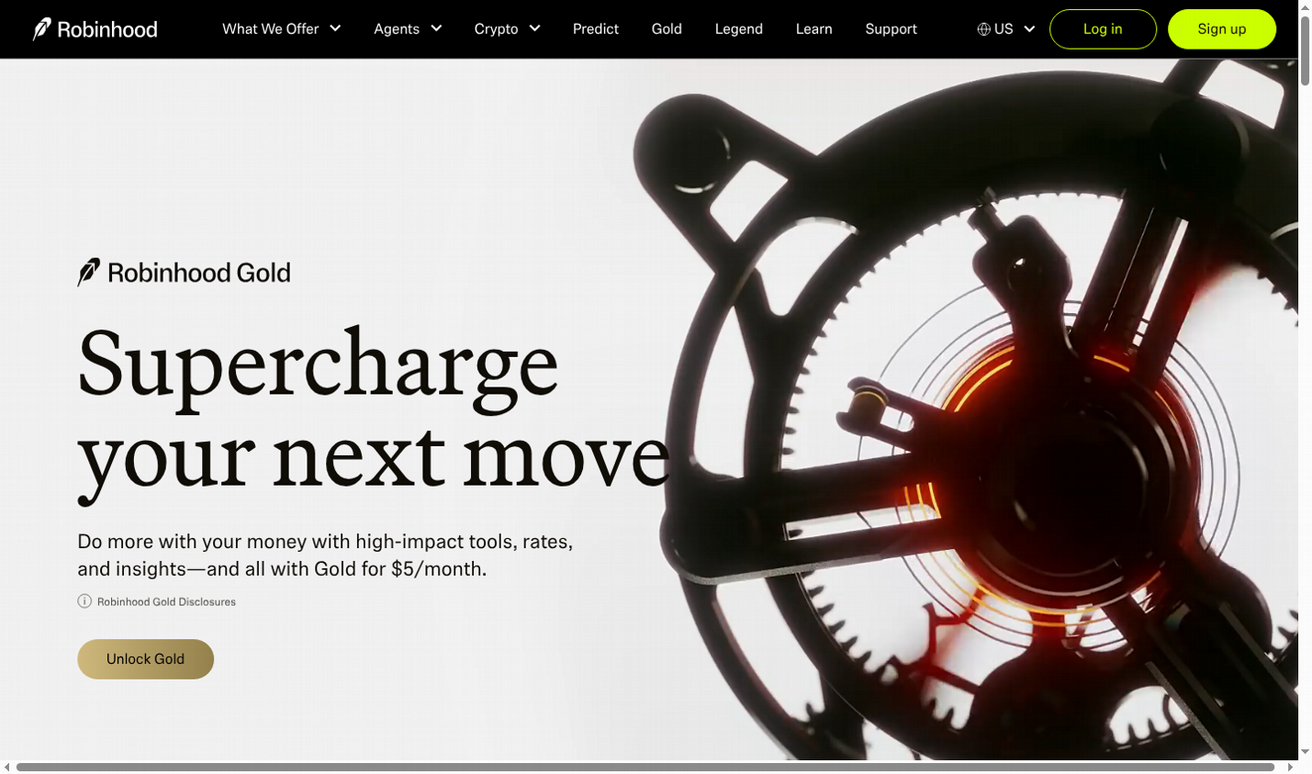
Robinhood Gold page
The cash rates are the same, so the plans differ on margin and on the IRA match. Webull Premium costs $10 a year less and pays a higher IRA match. Robinhood Gold makes more sense if you trade index options often, at $0.35 per contract.
5. Account types and IRA match
Webull: offers individual and joint cash and margin accounts, custodial accounts and traditional, Roth and rollover IRAs.
Robinhood: offers individual, joint, custodial and trust accounts, and traditional and Roth IRAs.
Both add a match to IRA contributions: 1% for everyone, rising to 3.5% with Webull Premium or 3% with Robinhood Gold. At the 2026 limit of $7,500, that is $262.50 at Webull against $225 at Robinhood. At both, you must keep the paid plan for one year and the money in the IRA for five years to keep the full match.
6. Account opening
Both apps let you open an account online with no minimum deposit. You need at least $2,000 in equity to trade on margin at Webull. Leaving costs $75 per outgoing stock transfer at Webull and $100 at Robinhood, as we explain in our guides on how to close a Webull account and how to close a Robinhood account.
7. Pricing
Margin rates
| Margin balance | Webull Premium | Robinhood |
| $10,000 | 5.45% | 5.25% |
| $75,000 | 5.25% | 5.05% |
| $250,000 | 4.70% | 4.75% |
| $750,000 | 4.65% | 4.75% |
Source: Webull margin page (rates as of 16 October 2026) and Robinhood Financial fee schedule (rates as of 16 September 2026). Without Premium, Webull charges 8.74% at every balance. Robinhood's rates apply with or without Gold.
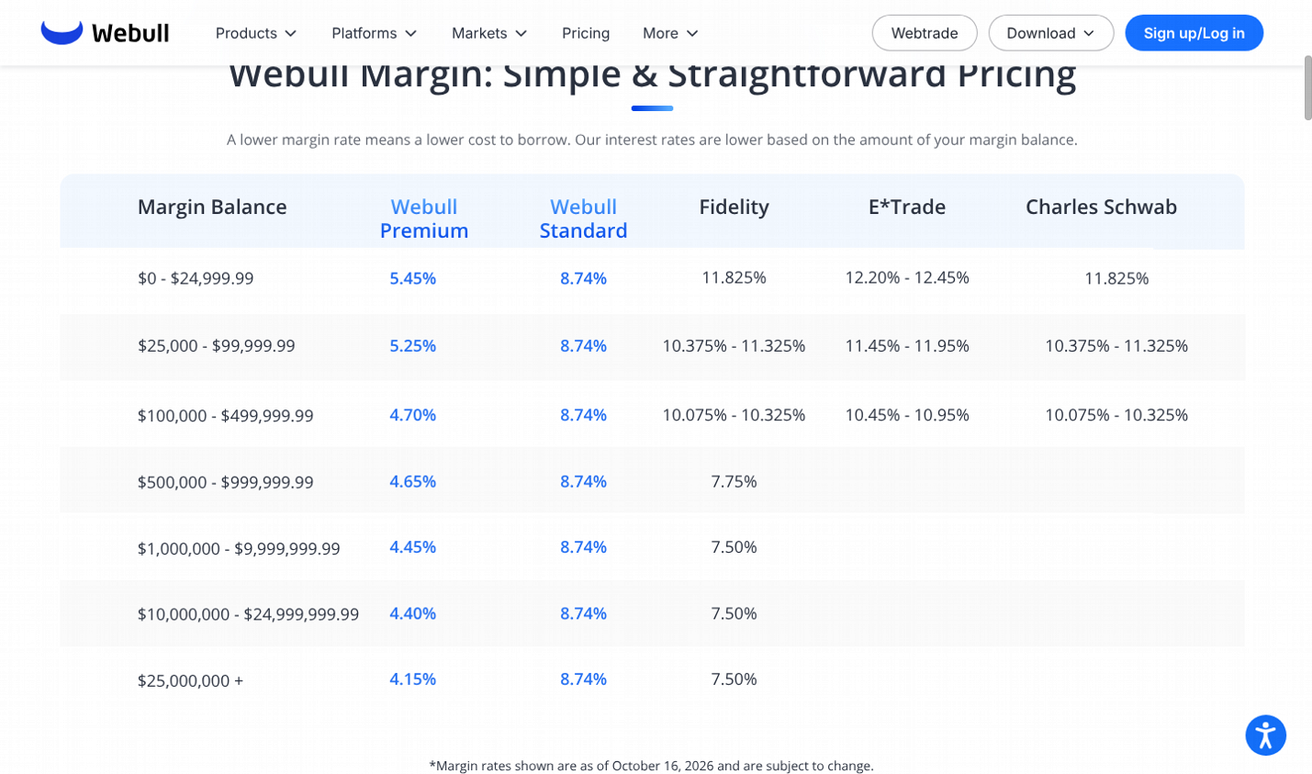
Webull margin rates
Borrowing $10,000 for a year costs $525 at Robinhood ($473 with Gold, since the first $1,000 is free, plus $50 for the plan) and $545 at Webull with Premium (plus $40 for the plan). Without a subscription, Webull charges $874. Robinhood is cheaper on margin for small and mid-sized loans, and Webull Premium becomes slightly cheaper from $100,000.
Other fees
Both pass on the same regulatory fees when you sell. Webull charges $0.10 per contract on oversized options orders, and Robinhood charges up to 1.75% for instant withdrawals ($1 to $150). For every cost, see our full guides on Webull fees and Robinhood fees.
8. Webull vs Robinhood in the UK
Both apps are authorised by the FCA and charge no commission on US shares. The main cost is currency conversion: Robinhood charges 0.10% (0.30% from Friday evening to Sunday evening, US time), while Webull charges 0.50% on its free Go plan and 0.35% on Meridian. Robinhood's Stocks and Shares ISA is free, while Webull's ISA requires the Meridian plan. Webull also offers UK shares and ETFs, which Robinhood does not. More in our Webull UK review and our guide to Robinhood in the UK.
9. Security
Both US brokers are SIPC members, which protects securities up to $500,000, including $250,000 for cash, if the broker fails. Webull adds excess SIPC cover through Lloyd's of London. Uninvested cash in the interest programmes is swept to partner banks with FDIC cover of up to $5 million at Webull and up to $2.5 million at Robinhood. None of this protects you against market losses.
10. Pros and cons
The pros and cons below reflect our own assessment of each broker. Investing involves risk, and the value of your investments can go down as well as up, so you may get back less than you invest.
Webull pros and cons
Pros
- Free paper trading account
- Cheaper paid plan ($3.99 a month) with a 3.5% IRA match
- OTC stocks and corporate bonds
- Lower outgoing transfer fee ($75)
Cons
- 8.74% margin rate without Premium
- 1% spread on crypto trades
- Higher currency conversion fee in the UK (0.50% on the free plan)
Robinhood pros and cons
Pros
- 5.25% margin rate with no subscription
- Lower index options fee with Gold ($0.35 per contract)
- Free Stocks and Shares ISA and 0.10% FX fee in the UK
- Simple app for beginners
Cons
- No paper trading account
- $100 fee to transfer your account out
- Pricier paid plan with a lower IRA match (3%)
Webull vs Robinhood: our verdict
Webull
Best for paper trading, IRAs and a cheaper paid planRobinhood
Best for margin without a subscription and UK investors
For a buy-and-hold investor, both apps are free to trade and pay the same 3.60% on cash with their paid plan, so the choice comes down to the extras. Webull fits better if you want to practise with paper trading, contribute to an IRA (3.5% match against 3%) or pay less for the subscription. Robinhood fits better if you borrow on margin without paying for a plan, trade index options often, or live in the UK and want a free ISA with low currency fees.
Both offer welcome bonuses for new clients: see our Webull referral bonus and Robinhood free stock guides. If you are also considering Moomoo, read our Webull vs Moomoo comparison.
Disclaimer: When investing, your capital is at risk and you may get back less than invested. Trading on margin can lead to losses greater than your deposit. This information is not investment advice. Fees, rates and offers change often, so check them on each broker's website before you open an account.
FAQs
Is Webull better than Robinhood?
Neither is better for everyone. Both are commission-free on stocks, ETFs and options. Webull has paper trading, a cheaper paid plan and a higher IRA match, while Robinhood has a lower margin rate without a subscription and a cheaper offer for UK investors.
Which has lower margin rates, Webull or Robinhood?
Robinhood, for most investors. It charges 5.25% on loans up to $50,000, with or without Gold. Webull charges 8.74% without Premium and 5.45% to 4.15% with it, which only beats Robinhood on loans of $100,000 or more.
Does Robinhood have paper trading like Webull?
No. Webull has a free paper trading account with real-time quotes, while Robinhood has no demo or practice mode.
Is Webull Premium or Robinhood Gold worth it?
Only if you use what they add. At 3.60% APY, $1,000 of uninvested cash earns about $36 a year, close to the $40 or $50 cost of the plans. They pay off with larger cash balances, regular IRA contributions or, at Webull, margin loans.
Can I transfer my account from Robinhood to Webull?
Yes. You request the transfer at Webull and your shares move through ACATS without being sold. Robinhood charges $100 for the outgoing transfer, and Webull charges $75 if you go the other way.