


As your business grows and cash flow stabilises, you may want to invest part of your company’s capital in the financial markets.
DEGIRO is a popular choice for individual investors, but can companies use it?
In this article, we explain whether DEGIRO offers business accounts and compare the best alternatives for companies, based on reputation, security, fees and customer support.
Does DEGIRO offer corporate accounts?
No. DEGIRO says it can no longer offer business or corporate accounts because of stricter customer due diligence rules, so it only serves individual investors, as its FAQs explain:

So, if you run a limited company or another type of legal entity, you need to look elsewhere.
Best DEGIRO alternatives for companies
- Interactive Brokers: Best overall
- Saxo: Best for companies with larger portfolios
- Lightyear: Best for low-cost stocks, ETFs and money market funds
- eToro: Best for crypto and a user-friendly platform


62% of retail CFD accounts lose money.

Terms apply, seek guidance if necessary. When you invest, your capital is at risk.

52% of retail CFD accounts lose money.
Comparison
Varies depending on the subsidiary. Two examples: Up to £85,000 for clients under IB U.K. Limited; Up to €20,000 for clients under IB Ireland Limited.

Europe: up to €100,000 for cash and €20,000 for securities; UK: up to £85,000; Switzerland: CHF 100,000; Hong Kong: HKD 500,000

Up to €20,000 for European investors; Up to £85,000 for UK investors
Up to €20,000 for clients under eToro (Europe) Ltd; Up to £85,000 for clients under eToro (UK) Ltd.
Reviews
Interactive Brokers corporate accounts at a glance
Founded in 1978 and listed on the NASDAQ (ticker: IBKR), Interactive Brokers is a global online broker that has come through several major financial crises, thanks to its strict risk management. At the end of June 2026, it had 5.19 million client accounts and total equity of USD 22.3 billion.
Interactive Brokers lets you invest in stocks, options, futures, currencies, bonds and funds on more than 175 markets in 40 countries and territories from a single integrated account. Its account management tools let you set user permissions, so different people in your company can trade or view the account.
With Interactive Brokers, businesses around the world can open a company account, including corporations, partnerships, limited liability companies, hedge funds, proprietary trading firms and family offices. There is no minimum deposit, although monthly activity and other minimum fees may apply. It offers strong order execution through IB SmartRouting and a wide set of technical and fundamental research tools. Companies in the European Economic Area are served by Interactive Brokers Ireland, and UK companies by Interactive Brokers (U.K.) Limited.
On the downside, the fee structure is complex, the application takes longer than at app-based brokers (although it is fully online), and there is no commission-free trading on European exchanges. However, thanks to low currency conversion fees, tight pricing and interest on cash balances above set thresholds, companies can save a lot compared with most brokers.
Want to know more? Read our step-by-step guide on how to open a business brokerage account with Interactive Brokers.

Pros
- Low commissions on US stock trading
- No monthly inactivity fee
- The broadest product and markets range in the brokerage industry
- Demo account
- Excellent reputation (founded in 1978)
- Extensive research and Education tools
- Has a modern mobile trading app to trade Stocks, Options and ETFs, ideal for novice investors, IBKR GlobalTrader.
- Offers interest on uninvested cash balances
Cons
- Complicated and lengthy account opening process (but fully online)
- Steeper learning curve for beginners
- Website is difficult to navigate
- Interactive Advisors (Robo-advisor feature) is only available for US customers
Saxo corporate accounts at a glance
62% of retail CFD accounts lose money.
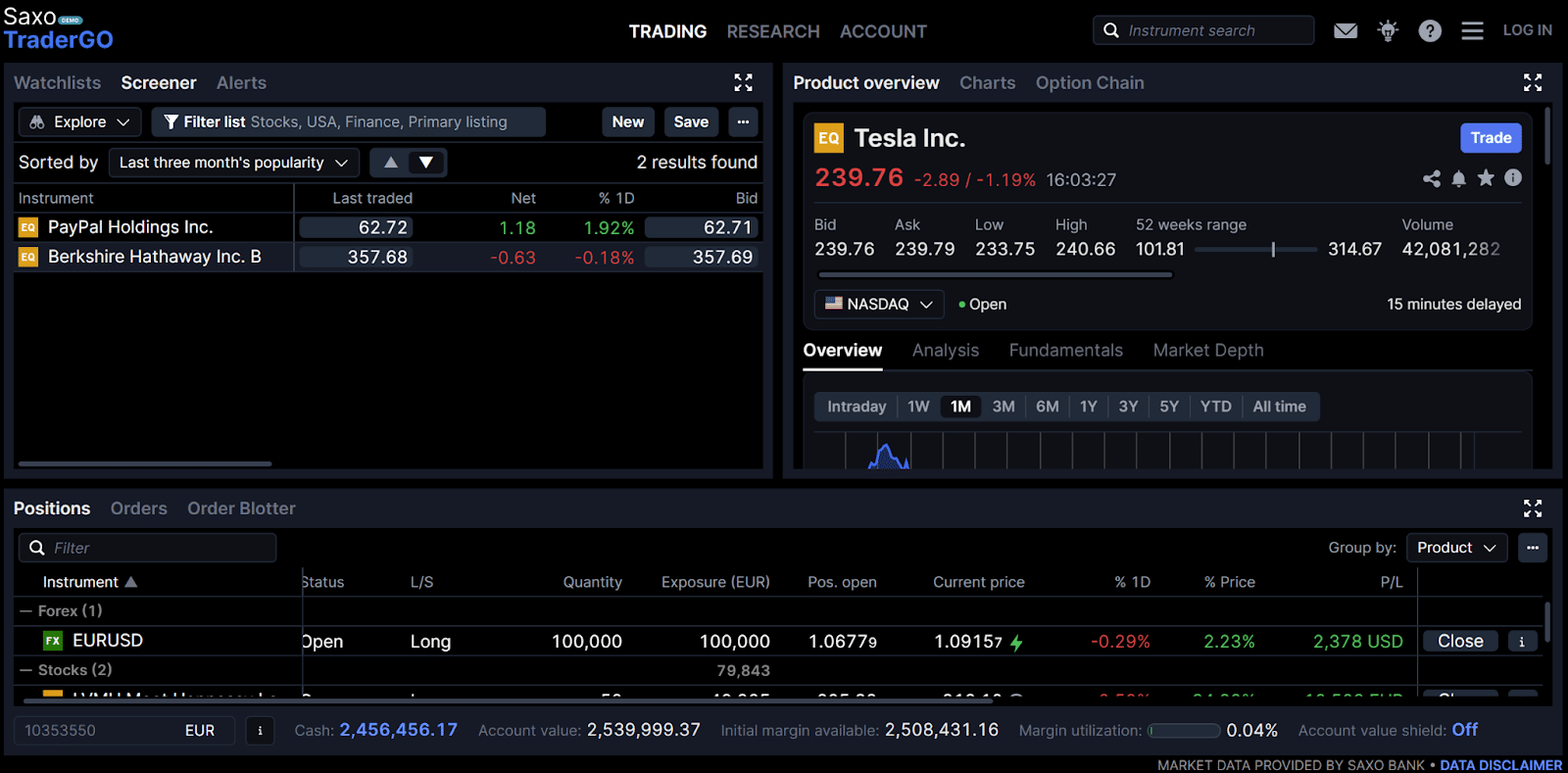
Founded in Denmark in 1992, Saxo is a Danish bank owned by the Swiss J. Safra Sarasin Group, which bought a majority stake in March 2026 and has since taken full ownership. According to Saxo, it serves more than 1.5 million clients with over €150 billion in client assets, and Saxo Bank A/S has an A- credit rating from S&P. It gives you access to stocks, ETFs, mutual funds, bonds, options, futures, forex and CFDs from one cross-collateralised account, through its SaxoInvestor and SaxoTrader platforms.
Saxo places corporate accounts in one of three tiers, based on the initial funding in the first 30 days. After three months, your tier depends on your trading activity:
- Classic: the minimum initial funding depends on your country of residence. US stocks and ETFs cost 0.08% of the trade value.
- Platinum: for companies depositing €200,000 or more, or with a certain trading volume. US stocks and ETFs cost 0.05%, and you get priority support.
- VIP: for companies depositing €1,000,000 or more, or with a certain trading volume. US stocks and ETFs cost 0.03%, and you get invitations to exclusive events.
Companies with more than €5 million in assets or €200 million in annual trading volume may qualify for Saxo Elite, with a dedicated relationship manager.
Saxo says corporate accounts are usually approved in about one week, as long as the company has a corporate bank account and sends clear copies of:
- Memorandum and Articles of Association
- Certificate of Incorporation
- Proof of the company’s business address, if different from its registered address (for example, a company bank statement or utility bill less than three months old)
- Latest financial statement
- Group structure diagram (only for companies within complex group structures)
Each beneficial owner with 25% or more of the company and each director must also send:
- Passport (photo and signature pages)
- Proof of residency: a utility bill less than three months old showing the date, name and the address on the application
A corporate account can also be classified as a professional client if it meets at least two criteria: a portfolio above €500,000, an average of 10 significant trades per quarter over the last four quarters, or authorised traders with relevant experience in the financial sector. Professional clients get more flexibility, but fewer retail protections.
Find more details on Saxo’s page for corporate accounts.
Pros
- Excellent research materials
- Outstanding trading platforms (SaxoInvestor and SaxoTrader)
- Extensive range of investment products and commercial offers
- Long track record
- Supervised by worldwide top-tier regulators
Cons
- $0 in most countries; higher minimums in some regions (e.g. $5,000 in MENA)
- Fees higher than average
- Fee structure is complex
- Does not accept US residents
CFDs are complex instruments and come with a high risk of losing money rapidly due to leverage. 66% of retail investor accounts lose money when trading CFDs with this provider. You should consider whether you understand how CFDs work and whether you can afford to take the high risk of losing your money.
Lightyear business accounts at a glance
Terms apply, seek guidance if necessary. When you invest, your capital is at risk.
Lightyear is a European investment app. In the EU, it operates through Lightyear Europe AS, authorised and regulated by the Estonian Financial Supervision Authority (EFSA, licence numbers 4.1-1/31 and 4.1-1/147), and in the UK through Lightyear UK Ltd, authorised and regulated by the Financial Conduct Authority (FCA, FRN 987226).
Lightyear business accounts are available in 22 countries, including the UK, Estonia and Hungary, and can be opened by freelancers and sole directors as well as small, medium and large companies. There is no minimum or maximum deposit. The company’s director needs a personal Lightyear account first.
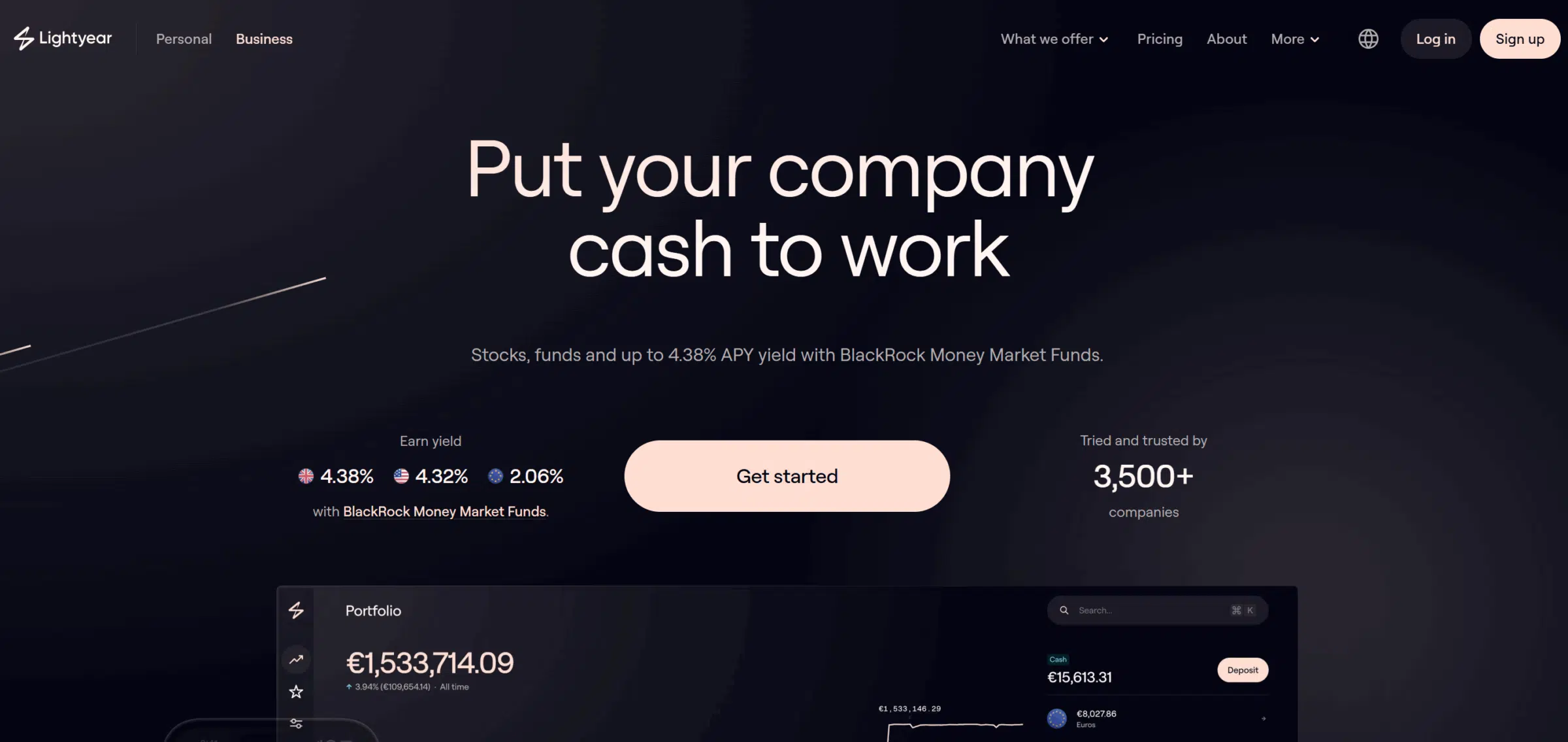
With a business account, you can invest in more than 6,000 stocks and ETFs and in Money Market Funds (MMFs), in EUR, GBP and USD, in select countries. Depending on your country, the MMFs are managed by BlackRock or J.P. Morgan Asset Management. Rates (net, variable, true as of 25-Aug-2026):
- EUR: 2.22% (AER/APY) with BlackRock or 2.24% (AER/APY) with J.P. Morgan
- GBP: 3.82% (AER/APY) with BlackRock or 3.84% (AER/APY) with J.P. Morgan
- USD: 3.70% (AER/APY) with BlackRock or 3.67% (AER/APY) with J.P. Morgan
Learn more about how Lightyear’s money market funds work.
Lightyear also completes the W-8BEN-E form automatically, so your company pays a reduced tax rate on US dividends, and it lets you register a Legal Entity Identifier (LEI) directly: £42.50 + VAT in the UK or €48 + VAT in the EU, with renewal at £40 + VAT.
On fees, ETFs have no Lightyear commission (fund manager fees apply). US stocks cost 0.1% per order (minimum $0.10, maximum $1), UK stocks £1 and euro-denominated stocks €1. Currency conversion costs 0.35%, which you can reduce with the multi-currency account in EUR, GBP and USD. The MMF annual fee is 0.10%, and the rates above are shown net of fees. On EU business accounts, crypto costs 0.45% per trade.
Lightyear offers companies up to €300 in a fractional share or ETF or MMF with the promo code “INVESTINGINTHEWEBBIZ“. Individual investors can get a similar offer on a personal account.
On the downside, the product range is limited: there are no options, bonds, commodities or forex.
Disclaimer: Investing involves risk. See full T&Cs. Terms apply: lightyear.com/terms. Only invest excess capital. Money market funds are considered investments and are not FSCS protected.
Pros
- 0% Lightyear execution commission on ETF trading (other fees, like fund manager and FX fees, may apply)
- No account opening, inactivity, or withdrawal fees
- High interest on EUR, USD & GBP through MMFs
- Free multi-currency account
- Minimum deposit of €/£/$1
- Fractional Shares
- Account opening promotion with the promo code INVESTINGINTHEWEB
- You can automate your investments with "Plans"
Cons
- Limited financial instruments (no options or futures; commodities only via ETCs such as gold, silver and copper; bonds limited to a small Baltic selection)
- No demo account
- Only available in 25 european countries (not available internationally)
- 0.35% currency conversion fee (0.10% for UK GIA and ISA accounts)
eToro corporate accounts at a glance
52% of retail CFD accounts lose money.
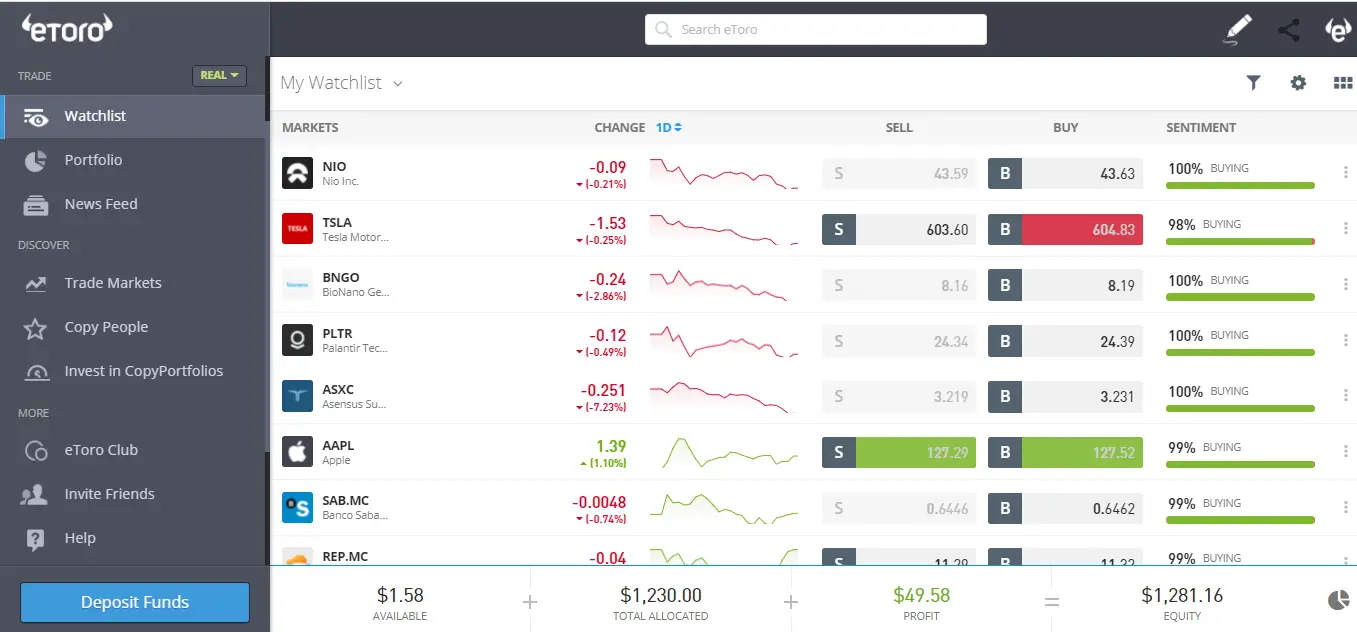
Founded in 2007, eToro is a multi-asset investment platform with more than 40 million registered users, known for its social and copy trading features. You can invest in stocks, ETFs and crypto, and trade CFDs on stocks, indices, currencies and commodities.
Companies can open a corporate account with eToro, although the products available depend on where the company is based. The minimum first deposit depends on the country: $10,000 in Australia, Denmark, Estonia, France, Germany, Ireland and the UK, $25,000 in Italy and $50,000 in all other eligible countries. You must send it in USD from your business bank account within 30 days of approval. Some sectors are not accepted, and every company needs an LEI code (and a W-8 form if it is based outside the US).
According to eToro’s help centre, companies incorporated in many countries, including the UK, Germany, France, Italy, Spain, Portugal, the Netherlands and the UAE, can apply directly by choosing “Join as Business” on the sign-up page. Companies from other countries follow these steps:
- Sign up for a personal eToro account, without depositing any money.
- Open a ticket in eToro’s Customer Service Center to request a corporate account.
- Fill in the application form and send the documents on the checklist that eToro emails you, such as your company’s Memorandum and Articles of Association.
- Once your application is approved, eToro converts your personal account into a corporate account.
- Fund the account from your company’s bank account within 30 days.
Approval times depend on the size of the company and the number of shareholders, so sending all documents at once speeds things up. Read eToro’s help article on corporate accounts for more details.
eToro is a multi-asset investment platform. The value of your investments may go up or down. Your capital is at risk.
Pros
- Low stock trading fees (from $0 per trade)
- Commission-free ETFs (other fees apply)
- Social trading and other innovative products
- Wide variety of financial products
- Slick, modern, and easy for anyone to use
- European users have access to three account currencies: EUR, USD and GBP
- Top tier regulators
Cons
- Limited disclosed financial information
- Withdraw and inactivity fees
- Spread, overnight, inactivity, and currency conversion fees higher than average
- Doesn’t offer bonds, futures, or options
What is a corporate brokerage account?
A brokerage account is an investment account that gives you access to financial products such as stocks, ETFs, bonds, futures and crypto. “Corporate” means that the account holder is a legal entity (a company, LLC, partnership and so on), not an individual.
The products are usually similar to those of personal accounts, but corporate accounts can come with higher minimum deposits, different pricing and more personalised support.
Companies invest through a corporate account for reasons such as putting excess cash to work, diversification and keeping business and personal assets separate. The tax treatment depends on your country, so speak to an accountant before you start.
You will need an LEI code: what is it?
LEI stands for Legal Entity Identifier. It is a 20-character code that identifies legal entities, such as companies and trusts, that take part in financial transactions.
In the EU and the UK, brokers need your company’s LEI before they can execute trades in shares, ETFs and other instruments on its behalf, so that every transaction can be linked to a verified entity. This makes markets more transparent and helps prevent fraud.
Some brokers, such as Lightyear, let you register an LEI directly. You can also get one from an accredited LEI issuer, such as LEIservice. Compare prices, as they vary between issuers.
Documents needed to open a corporate account
Each broker has its own requirements, but you can expect to provide the following (unless stated otherwise, documents must usually be less than six months old):
- Company name and registration number
- Principal place of business address
- Tax residency and tax identification number
- A description of your business activities, products and services, and the countries where you operate
- Information on the source of funds for the account
- Identity documents and proof of address for directors and beneficial owners
- The W-8BEN-E form, if you want to invest in US stocks
Bottom line
DEGIRO no longer offers business accounts, but there are good alternatives. Interactive Brokers is the most complete option for most companies, Saxo suits companies with larger portfolios, Lightyear is a simple, low-cost choice for stocks, ETFs and money market funds, and eToro combines crypto and stocks in a user-friendly app.
Whatever your goals, choose the broker that matches your company’s products, costs and service needs.
The information above is not investment advice. Do your own research to decide which services best suit your company’s risk profile and goals.



