Finding the best brokers in Switzerland can feel daunting, particularly if you’re just getting started (we’ve been in your shoes!).
In this article, we provide a detailed look at what we consider the best online brokers in Switzerland in 2026. Whether you’re new to investing and looking for a user-friendly platform, or want exposure to a wider range of investment options (ETFs, cryptocurrencies, CFDs, and more), there’s an option here for you.
One important consideration for Swiss investors is the country’s tax framework: no capital gains tax for private investors on stocks, ETFs, and bonds (one of the most investor-friendly setups in Europe), but dividends are taxed as ordinary income at federal, cantonal, and communal levels. Foreign brokers don’t withhold Swiss tax at source, so Swiss residents file their own annual Steuererklärung. Note that active trading can trigger reclassification as a “professional securities trader” by the federal tax authority (ESTV), which makes capital gains taxable – worth watching if you trade frequently or use leverage.
Video summary
Best brokers in Switerzland – Top 7 list
- eToro: Best broker for commission-free investing and social trading
- Interactive Brokers: Best broker overall
- XTB: Best broker for Low Forex spreads
- DEGIRO: Best broker for long-term investors
- Plus500: Best broker for CFDs
- Saxo Bank Switzerland: Best broker for professionals
- Trading 212: Best broker for beginners and auto-invest
Disclaimer: Investing involves risk of loss.

52% of retail CFD accounts lose money.


69-80% of retail CFD accounts lose money.

Investing involves risk of loss.

81% of retail CFD accounts lose money.

62% of retail CFD accounts lose money.

Capital at Risk. Sponsored Link. To get free fractional shares worth up to 100 EUR/GBP, you can open an account with Trading 212 through this link. Terms apply.
Best brokers in Switerzland – Comparison table


Online brokers to avoid ❌
Prioritize safety: safe beats cheap! Remember that investing is a long-term game, so it’s best to choose a provider that you can trust as years go by. Make sure that it is allowed to operate in your country.
Check our list of investment platforms, and filter by “Not approved” to check the list of platforms that we do not recommend.
If you’re still unsure about a specific platform, feel free to reach out to us – we’re happy to help!
Short reviews
#1 Interactive Brokers: Best online broker in Switerzland overall
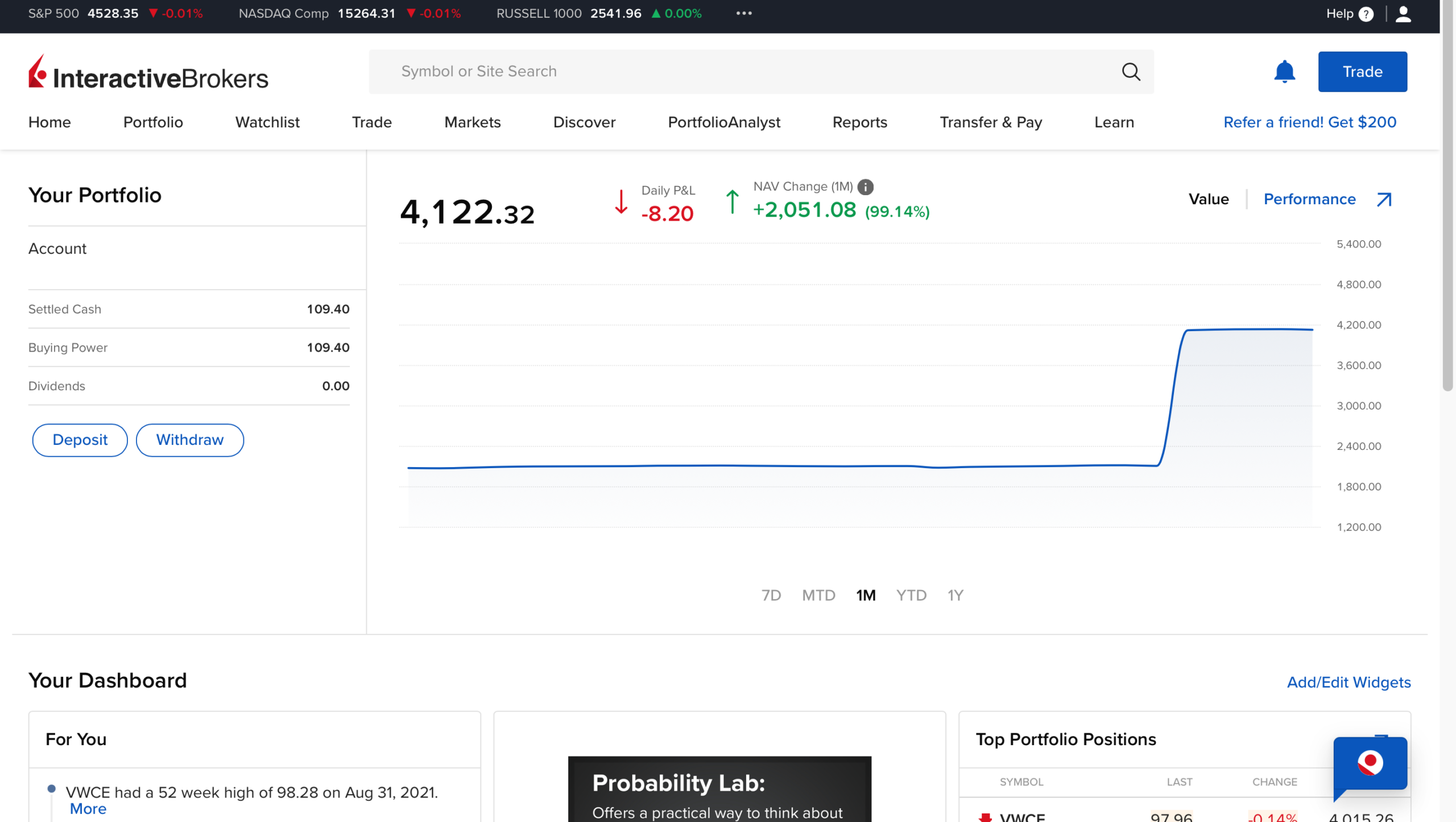
Interactive Brokers leads the list as one of the best online brokers for Swiss investors.
Founded in 1978, Interactive Brokers is one of the largest international brokers, listed on NASDAQ (ticker: IBKR). It’s regulated by multiple international top-tier authorities, with no minimum deposit requirement. Swiss investors are typically served by Interactive Brokers Ireland Ltd, regulated by the Central Bank of Ireland (CBI), which provides EU/EEA passporting that covers Switzerland.
IBKR caters to both beginners and professional investors looking for any type of financial product (stocks, ETFs, bonds, options, futures, forex, commodities, and more), with an easy-to-use platform, advanced technical and fundamental trading tools, and strong educational resources.
Interactive Brokers supports a wide range of account base currencies including CHF, EUR, USD, GBP, and many others – meaningful for Swiss investors who hold the bulk of their cash in CHF and want to avoid unnecessary FX conversion costs. Account funding is via bank transfer only. The broker offers some of the tightest spreads and lowest commissions in the industry, with tiered pricing that scales with monthly trading volume – giving Swiss investors access to 150+ markets across 30+ countries, including the SIX Swiss Exchange (SWX), Frankfurt/Xetra, US markets, and most major European and Asian markets from a single account.
For investors who prefer to trade on the go, IBKR offers the IBKR Mobile app, providing convenience and advanced functionality. IBKR GlobalTrader is another mobile app designed for simple, accessible global trading – with fractional shares from $1, automatic currency conversions, and a paper trading mode with $10,000 in simulated cash. Well-suited to newer investors easing into the IBKR ecosystem.
On the downside, IBKR’s main platforms (Trader Workstation, IBKR Desktop, Client Portal) can feel overwhelming if you’re new to investing. Fortunately, IBKR offers extensive educational materials and video tutorials, and GlobalTrader provides a smoother entry point for beginners.
One important consideration for Swiss residents: IBKR doesn’t withhold Swiss tax at source. Swiss residents handle their own annual Steuererklärung for dividend income, with capital gains generally tax-free for private investors. IBKR provides comprehensive year-end statements that are well-formatted for Swiss tax filing – and the broker also auto-applies the 15% reduced US dividend withholding rate under the Swiss-US tax treaty when you file a W-8BEN form during onboarding (rather than the default 30%).
Want to know more? Check our comprehensive Interactive Brokers review and visit IBKR’s website.
Pros
- Low commissions on US stock trading
- No monthly inactivity fee
- The broadest product and markets range in the brokerage industry
- Demo account
- Excellent reputation (founded in 1978)
- Extensive research and Education tools
- Has a modern mobile trading app to trade Stocks, Options and ETFs, ideal for novice investors, IBKR GlobalTrader.
- Offers interest on uninvested cash balances
Cons
- Complicated and lengthy account opening process (but fully online)
- Steeper learning curve for beginners
- Website is difficult to navigate
- Interactive Advisors (Robo-advisor feature) is only available for US customers
#2 eToro: Best for commission-free investing and social trading
52% of retail CFD accounts lose money.
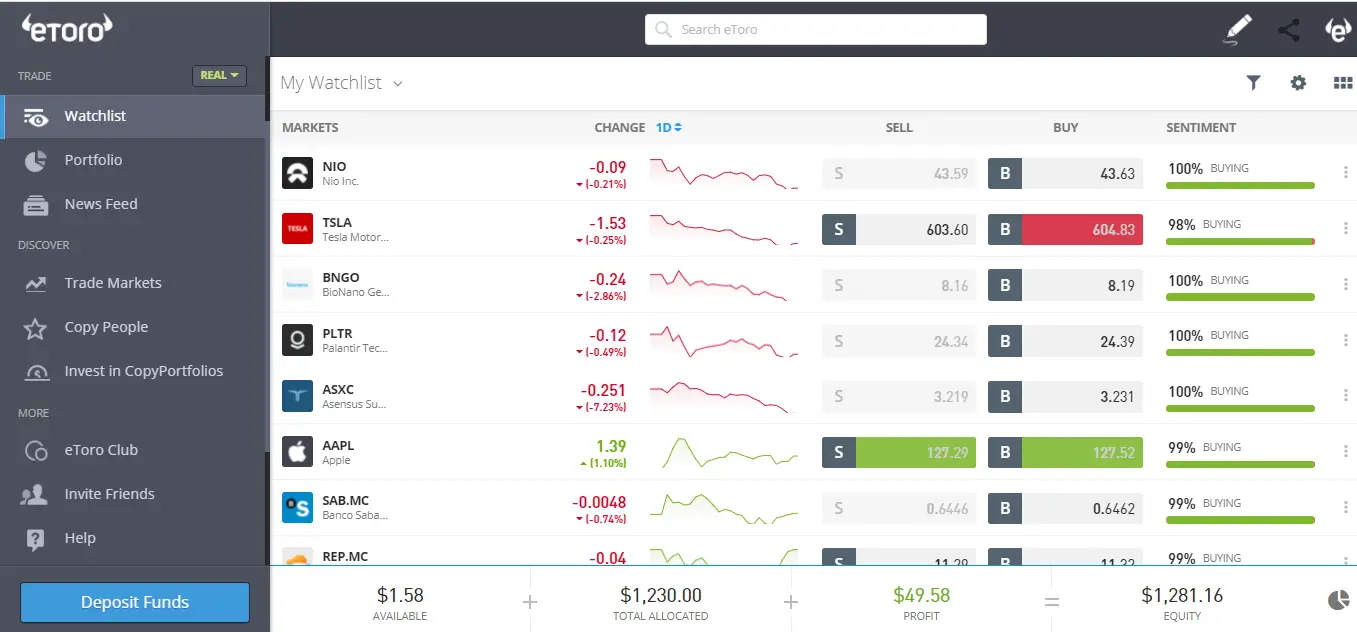
Another excellent trading platform for Swiss investors is eToro, an international online broker with over 40 million users who trade stocks, ETFs, forex, commodities, real cryptocurrencies, and CFDs. It went public on NASDAQ (ticker: ETOR) in May 2025 – a notable credibility milestone. eToro is best known for its social trading feature, which lets you copy the trades of other experienced investors. There are thousands of verified traders on eToro, and you can choose who to follow based on past Return on Investment (ROI), risk profile, and other factors.
The eToro platform gives users access to thousands of financial instruments, including real stocks and ETFs across major US and European exchanges (including Frankfurt/Xetra and other major markets). Users can also invest in Smart Portfolios – ready-made baskets that combine multiple assets or top traders around a particular theme or strategy.
eToro offers commission-free real ETF trading in Switzerland. Stock trades carry a $1 commission on US, European, and most Asian exchanges, with $2 on Australia, Hong Kong, Dubai, and Abu Dhabi exchanges. Swiss investors can now open and fund their account in EUR or USD directly. Note that CHF is not yet supported as a base currency, so funding from a CHF account still triggers an FX conversion to EUR or USD – a consideration for Swiss investors who hold most of their cash in francs.
Opening an account is straightforward and fully digital, and you can practise with a free demo account ($100,000 in virtual funds) before committing real money. On the downside, spreads can be wider on some products than at specialist brokers, and withdrawals carry a $5 fee with a $30 minimum. Like other foreign brokers, eToro doesn’t withhold Swiss tax at source – Swiss residents handle their own annual Steuererklärung for dividend income (with capital gains generally tax-free for private investors).
If you’d like to learn more, check our eToro review.
Pros
- Low stock trading fees (from $0 per trade)
- Commission-free ETFs (other fees apply)
- Social trading and other innovative products
- Wide variety of financial products
- Slick, modern, and easy for anyone to use
- European users have access to three account currencies: EUR, USD and GBP
- Top tier regulators
Cons
- Limited disclosed financial information
- Withdraw and inactivity fees
- Spread, overnight, inactivity, and currency conversion fees higher than average
- Doesn’t offer bonds, futures, or options
#3 XTB: Best broker for Low Forex spreads
69-80% of retail CFD accounts lose money.
Founded in 2002, XTB is a major player in the brokerage industry with extensive worldwide experience. It’s regulated by multiple top-tier authorities including the FCA (UK), KNF (Poland), CySEC (Cyprus), and DFSA (Dubai), and is listed on the Warsaw Stock Exchange (ticker: XTB). XTB serves over 1.9 million clients globally.
XTB offers 0% commission on real stocks and ETFs up to €100,000 of monthly turnover (a 0.2% commission, €10 minimum, applies above that threshold), with fractional shares from €10 and an Investment Plan feature for recurring ETF investing. It also offers CFDs on stocks, ETFs, indices, forex, commodities, and cryptocurrencies for those who want leveraged exposure – though CFDs are complex, higher-risk instruments and a majority of retail accounts lose money trading them.
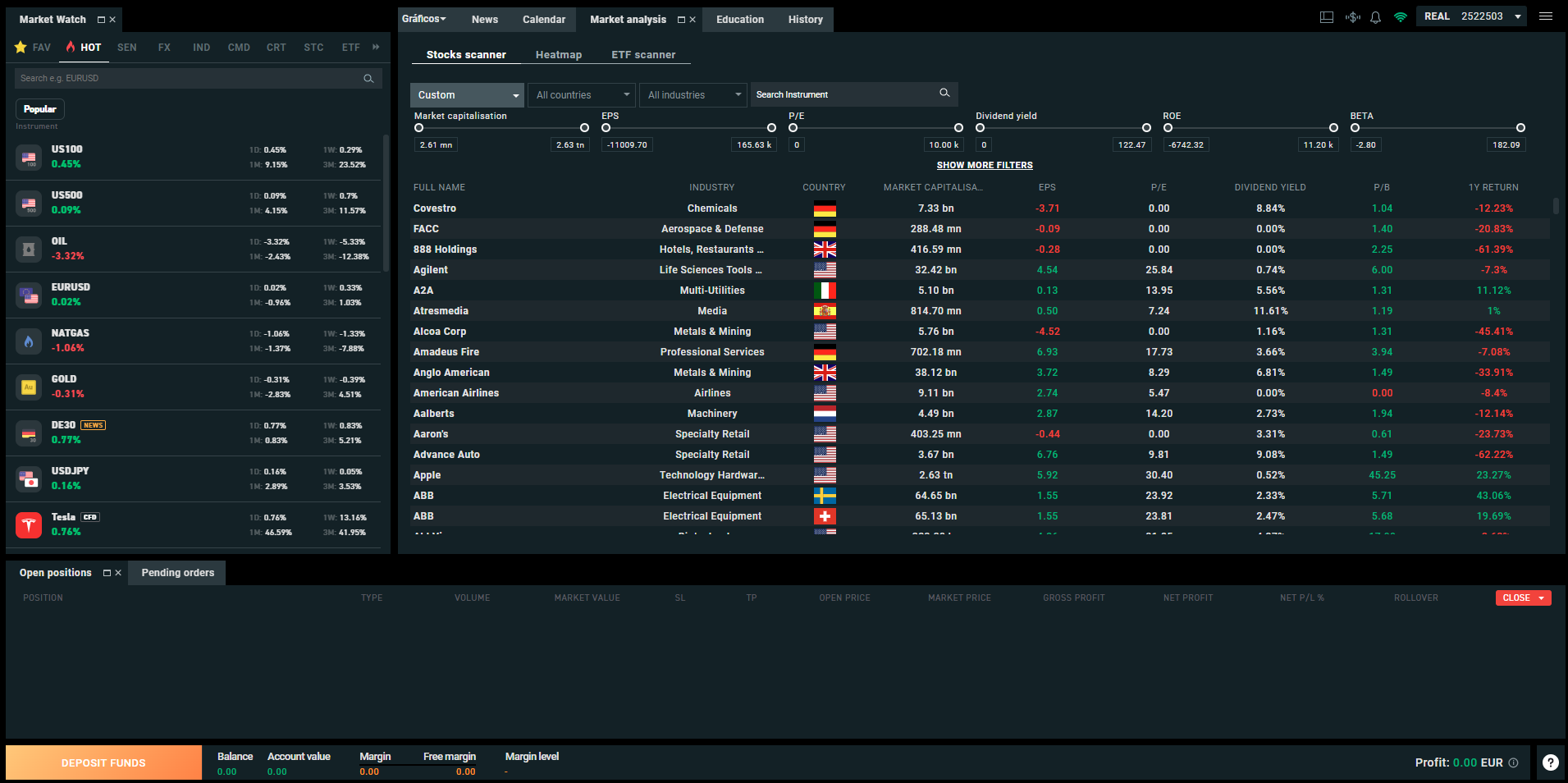
Opening an account and transferring funds is quick and hassle-free. For beginners, XTB offers a free demo account where you can practise as if with real money, alongside a strong library of educational tools (XTB Academy). For intermediate and advanced investors, the platform provides plenty of technical and fundamental analysis tools to help inform your decisions.
XTB also offers other financial products including commodities and cryptocurrencies (through CFDs). Spreads on crypto CFDs are on the higher side, while forex spreads are competitive. Note that XTB charges an inactivity fee of CHF 10/month after 12 months of no trading, if you also haven’t deposited in the previous 90 days. XTB doesn’t withhold Swiss tax at source – Swiss residents handle their own annual Steuererklärung for dividend income (with capital gains generally tax-free for private investors). Swiss residents are typically onboarded through XTB’s EU entity, with CHF available as one of XTB’s supported account currencies.
Still have questions? Go through our XTB review.
Pros
- Free stocks trading (only applicable to some countries)
- Customizable trading platform (charts and workspace)
- Low Forex Spreads
- Demo account
- No minimum account deposit
- Valuable education materials
- Top-tier Regulators
Cons
- Complex trading platform for a beginner
- High Stock CFD spreads
- Limited product portfolio
- Withdrawal fees for transfers below $100
- Inactivity fee (€10/monthly after 1+ year with no activity plus no deposit in the last 90 days)
#4 DEGIRO: Best broker for long-term investors
Investing involves risk of loss.
Founded in 2008 in Amsterdam (with retail services launched in 2013), DEGIRO is a low-cost brokerage that has become one of the most popular options across Europe thanks to its competitive pricing. With over 3 million users, DEGIRO is widely known for its “do-it-yourself” philosophy – giving you the tools to invest on your own without high-touch advisory services. Notably for Swiss investors, DEGIRO offers a localised Swiss platform (degiro.ch) with CHF-denominated accounts – one of the few non-EUR account currencies it supports (alongside Denmark, Poland, Sweden, and Czech Republic), which removes the FX conversion friction that applies to most foreign brokers funding from CHF.
DEGIRO offers a wide range of financial assets including stocks, ETFs, bonds, options, futures, warrants, investment funds, and some leveraged products (not the same as CFDs – more details here). You can trade ETFs at very low cost (a CHF 1.00 flat handling fee plus external costs typically applies), with no minimum deposit required. The web and mobile platforms are straightforward and easy to use – you’ll get comfortable with them within minutes.
On the downside, fundamental research is limited, US stock trades carry a CHF 1.00 commission, a CHF 2.50 connectivity fee applies per exchange annually, and the platform doesn’t offer price alerts or advanced charting tools. DEGIRO also doesn’t offer forex trading or crypto trading in Switzerland (though crypto has been rolled out in some other EU markets).

On safety, DEGIRO operates as the Dutch branch of flatexDEGIRO Bank AG – a German-regulated bank supervised by BaFin and the Deutsche Bundesbank, alongside Dutch regulators (DNB and AFM). In the unlikely event that segregated client assets cannot be returned, DEGIRO falls under the German Investor Compensation Scheme, which compensates losses up to 90% with a maximum of €20,000 (CHF equivalent) per investor – worth keeping in mind for larger portfolios. Additionally, any cash held on a DEGIRO Cash Account with flatexDEGIRO Bank AG is protected up to €100,000 (CHF equivalent) under the German Deposit Guarantee Scheme.
For Swiss residents: DEGIRO doesn’t withhold Swiss tax at source, so you handle your own annual Steuererklärung for dividend income (with capital gains generally tax-free for private investors). DEGIRO provides annual tax reports that simplify the reporting process, including the data needed for the Swiss tax declaration.
Still have questions? Check our DEGIRO review.
Pros
- ETF Core Selection: full range of ETFs/ETCs/ETNs on Tradegate (1,000+ products) for only the €/£1 handling fee, with no connectivity fee (external fees apply)
- User-friendly web and mobile app
- Wide range of investment options
- Education material: Investor’s Academy and Investing with DEGIRO
- Low overall commission structure
- No account opening, inactivity, or withdrawal fee
Cons
- 0.25% currency conversion fee (charged if you deposit or invest in a different currency than your base currency)
- €/£1 flat handling fee (charged in most transactions)
- €/£2.50 of connectivity fee (paid annually), per exchange where you’re invested
- Does not offer Forex or CFDs
- No ISA account (for UK residents)
- Low-quality customer support
- No interest paid on cash balances
#5 Plus500: Best broker for CFDs
81% of retail CFD accounts lose money.
Founded in 2008, Plus500 is an online broker offering a wide range of financial products, including real shares and CFDs on forex, indices, shares, commodities, options, ETFs, and cryptocurrencies. It’s available in over 50 countries and is listed on the London Stock Exchange (ticker: PLUS) as a constituent of the FTSE 250.
There are two distinct account types:
- Plus500 CFD: focused exclusively on CFD products.
- Plus500 Invest: where you can trade real shares of companies (you own the underlying stock).
As a side note, Plus500 Futures, a platform available only for US users where you can trade futures, is also part of the Plus500 group.
The main web platform is WebTrader, Plus500’s proprietary platform, offering a stable, responsive trading experience across desktop, web, and mobile. You can start by testing the features through a free demo account before committing real money.
Customer support is helpful and readily available through a chat function visible on the trading platform at all times. Spreads are competitive, and accounts can be opened in sixteen currencies including USD, EUR, and GBP – though CHF is not currently supported as a base currency, so Swiss investors funding in francs will incur the 0.70% currency conversion fee on deposits and withdrawals. A $10 monthly inactivity fee applies after three months of no trading activity. On Plus500 Invest, you’ll only pay a small commission per trade (for example, $0.006 per share on the US market).
Plus500 is regulated by multiple top-tier financial authorities including the FCA (UK), CySEC (Cyprus), ASIC (Australia), and MAS (Singapore), ensuring appropriate supervision and an investor protection scheme under the entity where you open your account. Swiss investors are typically served through Plus500CY Ltd (CySEC-regulated, Licence No. 250/14), with client funds protected up to €20,000 (CHF equivalent) under the Cyprus Investor Compensation Fund. Plus500 also provides negative balance protection for CFD trading on a per-account basis – mandatory for retail clients in the EU and UK under ESMA/FCA rules. Plus500 doesn’t withhold Swiss tax at source, so Swiss investors handle their own annual Steuererklärung for dividend income (with capital gains generally tax-free for private investors).
Want to know more about Plus500? Check our Plus500 review.

Pros
- Acessible and responsive platform
- Low spreads
- No dealing commissions
- Demo Account
- Top-tier regulators
Cons
- No ETF offering
- Inactivity fee ($10 per month after no login activity in 3 months)
- High overnight funding fees
- Very little research and education provided
#6 Saxo: Best broker for professional traders
62% of retail CFD accounts lose money.
Launched in 1992 in Copenhagen, Saxo (rebranded from “Saxo Bank” in 2024-2025) is one of the most established financial entities in the brokerage industry, with a track record spanning over three decades. It lets you trade more than 71,000 financial instruments through its unified SaxoTrader platform (which consolidated SaxoTraderGO and SaxoTraderPRO into a single experience in 2025), plus the simpler SaxoInvestor app designed for beginners and long-term investors. In March 2025, Saxo was acquired by J. Safra Sarasin Group, the Swiss-Brazilian private banking group – notably, a Swiss-based acquirer that adds further local credibility for Saxo’s Swiss client base.
The product range across global markets includes stocks, ETFs, bonds, mutual funds, options, futures, CFDs, forex, and commodities. Saxo provides advanced research tools suited to both “buy-and-hold” investors and active leverage-based traders. Saxo also offers AutoInvest, which allows commission-free investing in 100+ ETFs with no custody fees and no minimum investment amount – useful for long-term portfolio building.
Saxo’s account tiers:
- Classic: no minimum deposit since 2024, giving access to competitive spreads and customer support 24/5.
- Platinum: $200,000 minimum, lower trading prices (typically 30% reduction), priority local-language support.
- VIP: $1,000,000 minimum, best pricing, direct access to trading experts, and exclusive event invitations.

Pricing varies by account tier. For example, a US stock order is around 0.08% of trade value (minimum $1) in Classic, dropping to roughly 0.03% (minimum $1) in VIP. When trading assets denominated in currencies other than CHF, a 0.25% conversion fee applies. Notably, Swiss investors benefit from no custody fees – unlike clients in other Saxo jurisdictions, who face a custody fee of up to 0.15% per year on stock/ETF/bond positions. This makes Saxo particularly competitive for Swiss long-term investors.
Saxo Bank (Switzerland) Ltd. is a fully-licensed Swiss bank supervised by the Swiss Financial Market Supervisory Authority (FINMA) – giving Swiss clients the credibility and protection that comes with a domestic banking licence. As a Swiss bank, Saxo Bank (Switzerland) is a member of the esisuisse Swiss depositor protection scheme, which protects deposits up to CHF 100,000 per client. This is genuinely one of the most important Saxo Switzerland advantages: client funds are held under Swiss banking regulation rather than under the EU/Danish framework that applies to Saxo’s other entities.
Saxo provides comprehensive year-end statements that are well-formatted for the Swiss Steuererklärung, simplifying the annual tax reporting process for Swiss residents (with capital gains generally tax-free for private investors).
Pros
-
Excellent research materials
-
Outstanding trading platforms (SaxoTrader and SaxoInvestor)
-
Extensive range of investment products
-
Long track record
- Supervised by worldwide top-tier regulators
Cons
- No fractional shares
#7 Trading 212: Best broker for beginners and auto invest
Capital at Risk. Sponsored Link. To get free fractional shares worth up to 100 EUR/GBP, you can open an account with Trading 212 through this link. Terms apply.
Founded in 2004, Trading 212 is a fintech headquartered in London that aims to democratise investing through one of the cleanest mobile and web platforms in European retail. It serves over 5 million clients managing more than €30 billion in assets, with access to over 13,000 stocks and ETFs across UK, US, and European markets – plus forex, commodities, CFDs, and (via 212 Crypto, launched March 2026 under MiCA) real cryptocurrencies. New users get a free fractional share worth up to €100 with our promo code “IITW“.
Trading 212 offers commission-free stocks and ETFs (other fees may apply – see terms and conditions), fractional shares from €1, and the popular Pies & AutoInvest feature for building diversified portfolios with one-tap rebalancing. Opening an account is fast and fully digital. On the downside, the product range still has some gaps – no individual bonds, options, or futures – and the platform is less suited to advanced traders looking for deep charting tools. Trading 212 charges a 0.15% FX conversion fee when trading assets in a currency different from your base account, which is among the lowest in European retail – though CHF is not yet supported as a base currency, so Swiss investors funding from CHF will trigger an FX conversion to EUR, GBP, or USD.

Within the app, you’ll find three distinct sub-platforms:
- Trading 212 Invest: trade real stocks and ETFs commission-free, with fractional shares and Pies & AutoInvest.
- Trading 212 CFD: trade leveraged financial products (CFDs are complex instruments and a majority of retail accounts lose money trading them).
- Trading 212 Crypto: launched March 2026 under MiCA, lets you buy and hold real cryptocurrencies directly (subject to country availability – Switzerland availability should be verified through the registration flow given Switzerland’s non-EU status).
Trading 212 is regulated by multiple top-tier authorities including the FCA (UK), CySEC (Cyprus), BaFin (Germany), and operates a Bulgarian entity (FSC) for some EEA markets. Swiss investors are typically served through Trading 212’s EU-passported entity (Switzerland is not in the EEA but is reached through international service arrangements). Note that Trading 212 doesn’t withhold Swiss tax at source – Swiss residents handle their own annual Steuererklärung for dividend income (with capital gains generally tax-free for private investors).
If you want to learn more, check our Trading 212 review.
Pros
- Commission-free real stock, ETFs and crypto trading (other fees may apply. See terms and fees)
- AutoInvest & Pies feature (execution-only service, not financial advice)
- Fast and easy account opening process
- Demo account
- Top Tier Regulators
- Free fractional shares worth up to €100
- High interest on uninvested cash
Cons
- Limited product portfolio (no Options, Bonds, Mutual Funds or Futures)
- No relevant Fundamental tools
- 0.15% of Foreign exchange fees
Disclaimer: When investing, your capital is at risk and you may get back less than invested. Past performance doesn’t guarantee future results.
How to choose the best broker in Switzerland
Picking the right broker is important for a smooth long-term investing experience. Here are the key factors to weigh up for Swiss investors:
- Regulation: look for brokers regulated by trusted authorities. The strongest credibility comes from FINMA (the Swiss Financial Market Supervisory Authority) for Swiss-domiciled brokers like Saxo Bank (Switzerland) or Swissquote, alongside top-tier EU regulators (FCA, BaFin, CBI, CySEC) for brokers serving Switzerland through international service arrangements. Check the investor protection framework: Swiss banking licences provide CHF 100,000 esisuisse depositor protection, while EU-regulated brokers typically offer €20,000-€22,000 under their relevant Investor Compensation Fund.
- CHF account support: a meaningful Swiss-specific factor. Saxo Bank (Switzerland), DEGIRO, IBKR, and XTB support CHF as a base currency, removing FX conversion costs when funding from your Swiss bank account. Most other foreign brokers require EUR or USD base currencies – triggering FX conversion on every CHF deposit.
- Fees and commissions: compare trading commissions, FX conversion fees, custody fees, withdrawal fees, and inactivity fees. Lower all-in costs compound meaningfully over decades.
- Trading platforms: a clean, reliable platform (web + mobile) matters for long-term users. Try the demo account before committing where available.
- Financial instruments: make sure the broker covers the asset classes you actually want – stocks, ETFs, bonds, options, futures, crypto – and the exchanges you care about. For Swiss investors, this typically means access to the SIX Swiss Exchange (Nestlé, Novartis, Roche, ABB, UBS, etc.), Frankfurt/Xetra, US markets, and London.
- Customer support: German, French, and Italian language support if that matters to you (Switzerland’s official languages); otherwise, responsive English support.
- Reputation and track record: check independent reviews, Trustpilot ratings, regulatory history, and how long the broker has been operating. Established brokers with strong reputations carry less operational risk.
- Tax handling and reporting: foreign brokers require Swiss residents to file their own annual Steuererklärung for dividend income. Look for brokers that provide comprehensive, well-formatted year-end statements – Interactive Brokers, Saxo, and DEGIRO score particularly well here. Remember: Swiss capital gains are generally tax-free for private investors (provided you don’t trigger reclassification as a “professional securities trader”), but dividends are taxed as ordinary income.
By weighing up these factors, you can pick the broker that best matches your investment goals and tax-reporting preferences.
Other resources
- Check our YouTube channel for step-by-step guides on how to invest in the S&P 500 on different brokers, alongside other educational videos about investing and platforms.
- Explore our tools: the broker comparison tool, reviews, BrokerMatch, brokers offering the highest cash interest rates, and sign-up bonuses.
Bottom line
In conclusion, choosing the best online broker in Switerzland depends on individual preferences and trading goals. Our top picks include:
Interactive Brokers
Known for low commission and a wide range of financial products.eToro
Renowned for commission-free investing and social trading.XTB
Ideal for commission-free ETF trading, and low forex spreads.DEGIRO
Best broker in Europe for long-term investorsPlus500
Best for CFDs, offering accessibility and low spreads.Saxo
Suited for professional traders, offering an extensive range of investment products.Trading 212
Known for auto-investing and Pies feature.
Consider factors like regulation, fees, trading platforms, available financial instruments, and customer support when making your choice. Always conduct thorough research based on your risk tolerance and investment strategy.
FAQs
Is Charles Schwab available in Switerzland?
No, Charles Schwab is unavailable in Switerzland. It is primarily a US broker. However, it accepts new accounts from a handful of other countries.
How to invest in stocks from Switerzland?
You can use one of the online brokers shown above: Interactive brokers, eToro, XTB, DEGIRO, Plus500, Saxo, and Trading 212.
What is a brokerage company?
It is an entity designed to be the middleman between you and the people you are trying to buy or sell a stock, ETF, crypto,… you name it!
Which broker is best in Switerzland?
There is no single answer. It depends on what you value most: fees, security, investment platform or any relevant feature.
What are the types of investments you can make with a brokerage account?
You can trade stocks, ETFs, Forex, Bonds, Futures and CFDs on stocks, ETFs, indices, cryptocurrencies, commodities.
Can I invest in US stocks from Switerzland?
Yes, you can invest in US stocks from Switerzland. To do so, you’ll need to open an international brokerage account that allows trading on US stock exchanges.