Investing in the stock market has never been easier, thanks to the numerous online trading apps available today. Choosing one, however, is harder than it looks.
Without proper research you could end up with a platform that is difficult to use, expensive, or simply too limited for your investment profile and experience.
We have analysed many trading apps and published detailed reviews, so we can clear up some of the questions and help you decide.
In this article, we list the best stock trading apps in the UAE, comparing what they offer and highlighting their strengths and weaknesses.
Don’t want to read the whole article? Find our summarised list below.
In a nutshell: Best apps in the UAE
- eToro: Best trading app overall. New users earn a free share worth $50 with our referral link. More details here.
- Sarwa: Best for beginners and auto-invest. New users get up to an AED 3,000 bonus.
- Interactive Brokers: Best for intermediate and advanced investors
- XTB: Best for forex and CFDs
- Plus500: Ideal for demo account and CFDs
- Saxo: Best for professionals
- amana: Best for 0% commissions. New users get a $100 bonus.
- Capital.com: Best for fee-free AED deposits and commission-free CFD trading (other fees may apply) with local support.

52% of retail CFD accounts lose money.


69-80% of retail CFD accounts lose money.

81% of retail CFD accounts lose money.

62% of retail CFD accounts lose money.

Investing in physical shares carries risk. Trading leveraged derivatives and volatile digital assets is high-risk and requires caution.

Comparison of best trading apps in Dubai and the UAE


#1 eToro: Best trading app overall
eToro at a glance
52% of retail CFD accounts lose money.
Founded in 2007, eToro is a well-known global fintech and the leader in social trading, with over 40 million registered users. It has been listed on the Nasdaq since May 2025 under the ticker ETOR. You can invest in stocks and ETFs through its intuitive platform, as well as CFDs and cryptocurrencies. ETF trading is commission-free, while real stock trades carry a flat commission of $1 or $2 depending on your country and the exchange (other fees apply).
Opening an account and depositing is easy, and you can try it with virtual money first. On the downside, spreads can be high on some products, and currency conversion is the cost most investors underestimate when funding in AED.
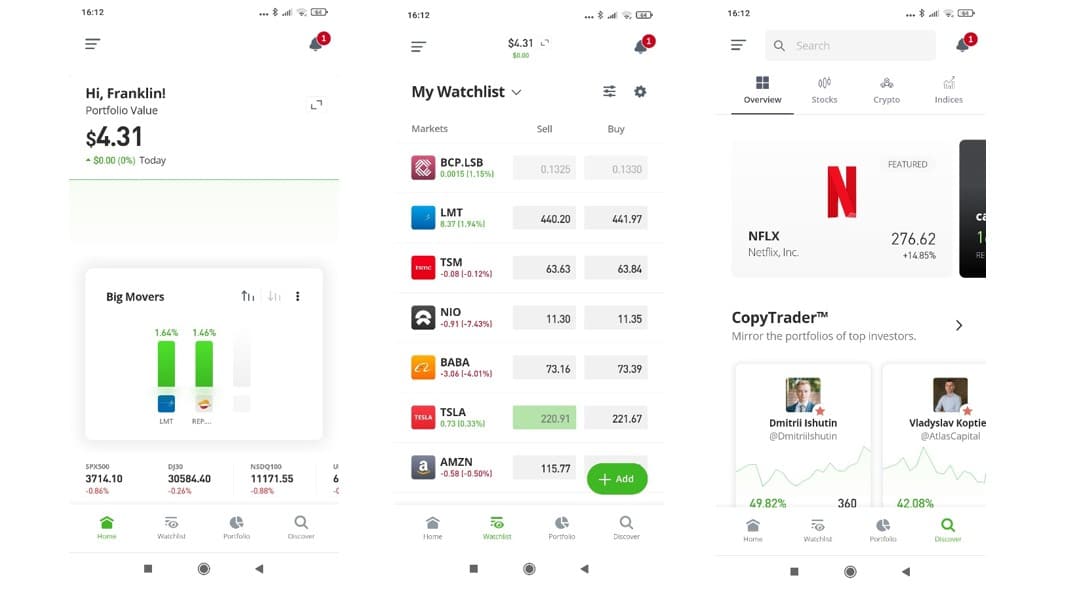
eToro’s trading app, available on web and mobile, lets investors discuss markets with other traders, copy strategies, and open a demo account. Both interfaces are comprehensive and easy to navigate, giving access to stocks from the US, UK, Germany and many other markets, alongside ETFs, cryptocurrencies and CFDs.
On safety, eToro is regulated by top-tier authorities including the FCA, ASIC and CySEC, client funds are segregated, and there is private insurance cover of up to €1 million. As a listed company it also publishes audited accounts. If you want more detail, see the article we prepared on eToro’s safety.
eToro offers an Islamic (swap-free and interest-free) account to clients who contact customer service and fund their account with at least $1,000.
Taken together, eToro is a solid option for beginner, intermediate and experienced investors, and one of the best stock trading apps in the UAE.
Want to know more? Check eToro’s website and read our review.
Pros
- Low stock trading fees (from $0 per trade)
- Commission-free ETFs (other fees apply)
- Social trading and other innovative products
- Wide variety of financial products
- Slick, modern, and easy for anyone to use
- European users have access to three account currencies: EUR, USD and GBP
- Top tier regulators
Cons
- Limited disclosed financial information
- Withdraw and inactivity fees
- Spread, overnight, inactivity, and currency conversion fees higher than average
- Doesn’t offer bonds, futures, or options
#2 Sarwa
Sarwa at a glance
Sarwa is a Dubai-based investment company offering four main products:
- Sarwa Save: a savings account to earn a return on your cash;
- Sarwa Trade: a trading account for US-listed stocks, US options and ETFs;
- Sarwa Invest: a robo-advisory solution that builds and manages ETF portfolios automatically;
- Sarwa Crypto: an account for trading cryptocurrencies.
The platform is known for its low fees, accessibility, transparency and promo code bonus. It is a strong option for beginners or anyone wanting a locally regulated solution.
Its flagship product, Sarwa Invest, builds tailored portfolios from low-cost ETFs, charging an annual management fee between 0.5% and 0.8% depending on portfolio size, plus around 0.1% in underlying fund costs. You can choose Conventional, Halal, Socially Responsible or Crypto plans, each with six risk levels.
Sarwa Save is aimed at cash management, with no minimum balance or management fee on the conventional version. The Halal version carries a 0.5% management fee. Sarwa Crypto charges no commission but applies a spread. Sarwa Trade covers US stocks and ETFs with fractional shares, though it does not support margin trading.
Sarwa also offers consultations with licensed advisers. Transfers via local UAE banks carry no funding or withdrawal charges, and the platform uses fixed AED to USD exchange rates.
On the downside, it lacks bonds and shares listed outside the US, and it is a newer company with a shorter track record than several names on this list. Minimum deposits differ by product, so check the requirement for the account you want.

Pros
- Access to human financial advisor
- Low fees
- Slick and easy to use app
- Sarwa Invest (Robo-advisor) is a good option for beginners
- Sarwa Save is a good alternative to earn interest on cash
Cons
- Newcomer in the industry: short track record
- Limited asset offering: no bonds or stocks listed outside the USA
- US options are quite expensive ($4 per contract)
#3 Interactive Brokers (IBKR GlobalTrader)
Interactive Brokers at a glance
Interactive Brokers is one of the most reliable brokers in the market. Founded in 1978, it has come through many financial crises and is regulated by numerous top-tier authorities. As of June 2026 it held 5.19 million customer accounts and $930 billion in customer equity.
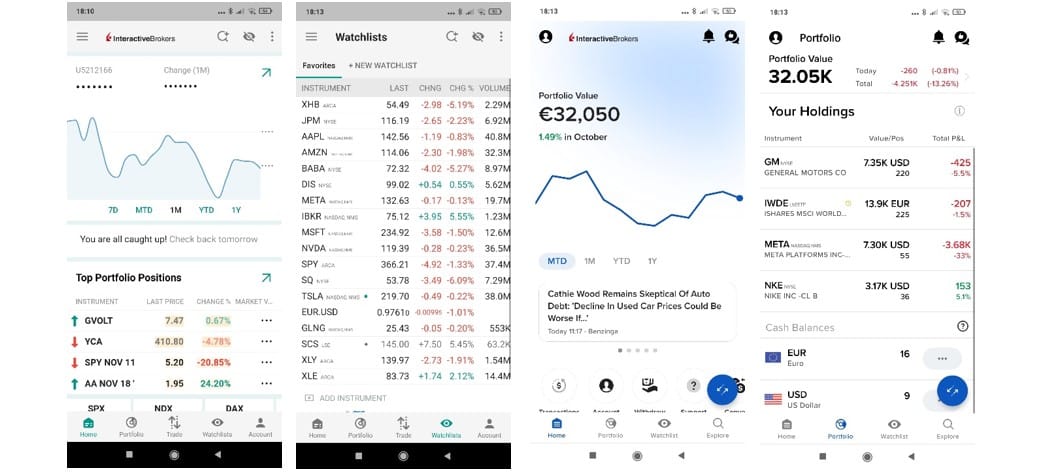
It offers trading apps with sophisticated tools, a wide product range across more than 170 exchanges in 40 countries, and low prices. Different mobile and web platforms suit different strategies and experience levels. The IBKR GlobalTrader app, redesigned in December 2025, is user-friendly and well suited to beginners, simplifying the experience without losing the underlying capability.
If you want the full toolset, IBKR Mobile is the more complete app for trading stocks, ETFs and options. It can overwhelm beginners, so we would recommend IBKR GlobalTrader if you are less experienced.
It also accepts UAE dirhams (AED), which removes a conversion step for local investors.
On the downside, the fee structure is complex, registration is lengthy though fully online, and there is no commission-free trading in the UAE. However, once FX fees, narrower spreads and the stock loan programme are taken into account, IBKR clients still save against most apps. Its currency conversion cost of roughly 0.002% is by a wide margin the lowest here.
Overall, Interactive Brokers offers some of the best stock trading apps in the UAE, whatever your needs.
Pros
- Low commissions on US stock trading
- No monthly inactivity fee
- The broadest product and markets range in the brokerage industry
- Demo account
- Excellent reputation (founded in 1978)
- Extensive research and Education tools
- Has a modern mobile trading app to trade Stocks, Options and ETFs, ideal for novice investors, IBKR GlobalTrader.
- Offers interest on uninvested cash balances
Cons
- Complicated and lengthy account opening process (but fully online)
- Steeper learning curve for beginners
- Website is difficult to navigate
- Interactive Advisors (Robo-advisor feature) is only available for US customers
#4 XTB
XTB at a glance
69-80% of retail CFD accounts lose money.
Founded in 2002, XTB is a major player in the brokerage industry with extensive worldwide experience, regulated by the Financial Conduct Authority and other bodies, and listed on the Warsaw Stock Exchange.
You can invest through xStation Mobile in stocks, ETFs, and CFDs on forex, indices and commodities. It offers 0% commission on real stocks and ETFs up to €100,000 of monthly turnover, above which 0.2% applies with a €10 minimum. Most retail investors never reach that threshold.
XTB has a UAE presence through XTB MENA Limited, licensed by the DFSA to operate in the region, and offers Islamic (swap-free) accounts to UAE residents.
Worth factoring in: the currency conversion fee is 0.5%, which for anyone buying assets priced outside their account currency usually costs more over a year than the commission saved.
With no commission on stocks and ETFs, no minimum deposit, Islamic accounts and a free demo account, XTB is a reliable option for beginners and advanced investors alike.

Pros
- Free stocks trading (only applicable to some countries)
- Customizable trading platform (charts and workspace)
- Low Forex Spreads
- Demo account
- No minimum account deposit
- Valuable education materials
- Top-tier Regulators
Cons
- Complex trading platform for a beginner
- High Stock CFD spreads
- Limited product portfolio
- Withdrawal fees for transfers below $100
- Inactivity fee (€10/monthly after 1+ year with no activity plus no deposit in the last 90 days)
#5 Plus500
Plus500 at a glance
81% of retail CFD accounts lose money.
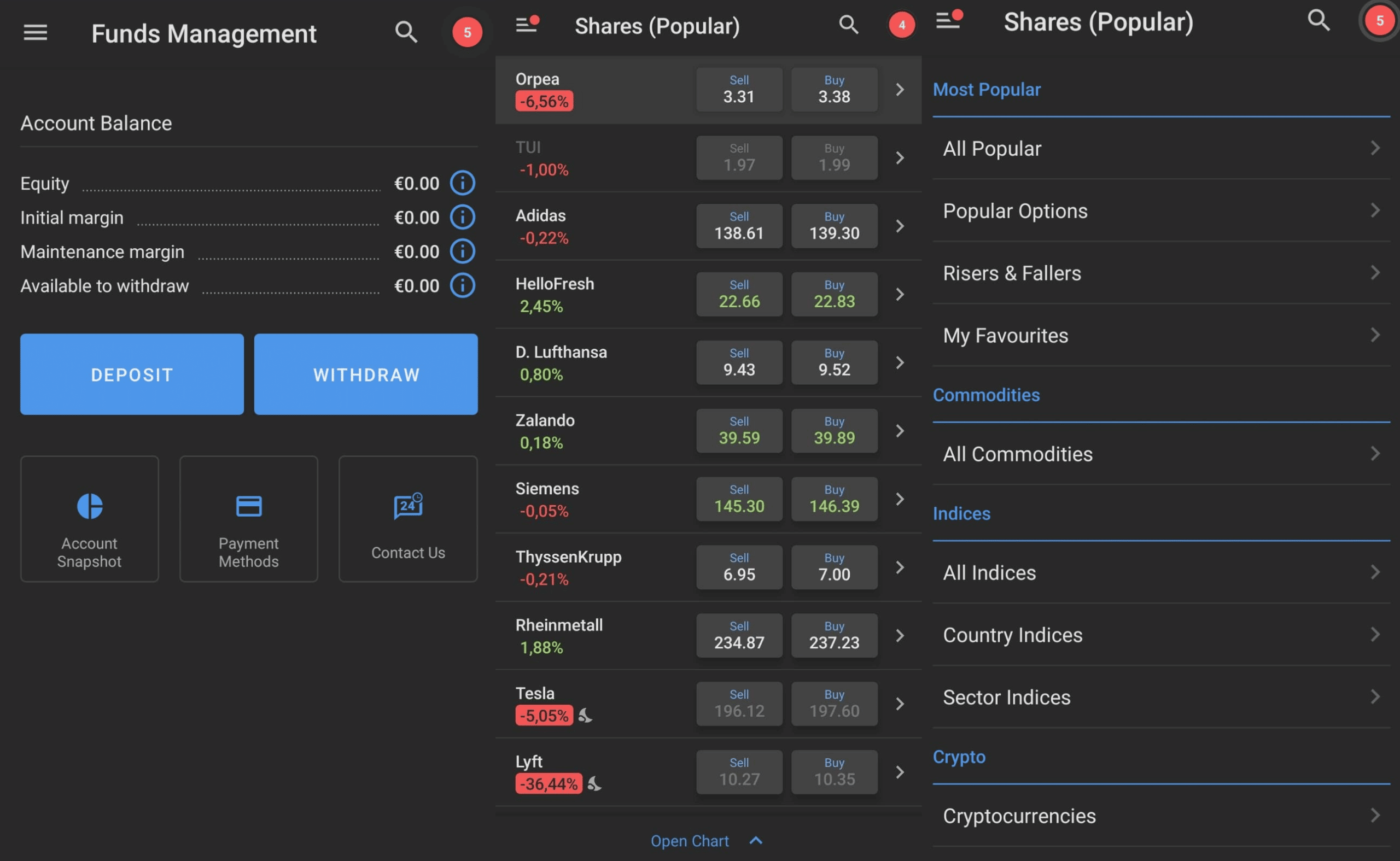
Plus500 was founded in 2008, is listed on the London Stock Exchange, and operates in the UAE through Plus500AE Ltd, authorised and regulated by the Dubai Financial Services Authority (Licence No. F005651). Regulated by top-tier authorities including the FCA and CySEC, it offers a mobile app and a web platform called WebTrader. Both are accessible and comprehensive, and you can test the features with a demo account.
When trading from the UAE you can only access Plus500 CFD, meaning CFDs on various instruments rather than real stocks. CFDs are leveraged products and carry a higher risk of loss.
Overall the broker offers solid CFD trading apps for UAE customers, with low costs, good usability and useful features for beginners and experienced traders. Islamic accounts are available. The main limitation is the absence of real stocks and ETFs.
To learn more, see our full Plus500 review.
This information is NOT relevant to EU residents who are to be serviced by EU subsidiaries of the Plus500 Group, such as Plus500CY Ltd, authorized by CySEC (Reg. 250/14). Different regulatory requirements apply in Europe, such as leverage limitations and bonus restrictions.
Pros
- Acessible and responsive platform
- Low spreads
- No dealing commissions
- Demo Account
- Top-tier regulators
Cons
- No ETF offering
- Inactivity fee ($10 per month after no login activity in 3 months)
- High overnight funding fees
- Very little research and education provided
#6 Saxo
Saxo at a glance
62% of retail CFD accounts lose money.
Saxo is a multi-asset broker known for its trading platforms and an extensive range of more than 70,000 tradable instruments. Founded in 1992, it offers advanced tools, in-depth research and premium features.
Ownership changed recently. In March 2026 the Swiss private banking group J. Safra Sarasin completed its acquisition of a majority stake, with Daniel Belfer becoming CEO and founder Kim Fournais moving to Chairman. In July 2026 the group agreed to acquire Fournais’s remaining holding, subject to regulatory approval.
Saxo lets you open an account in a wide range of currencies including USD, EUR, GBP and AED, and offers three account tiers (Classic, Platinum and VIP), each with its own pricing and services.
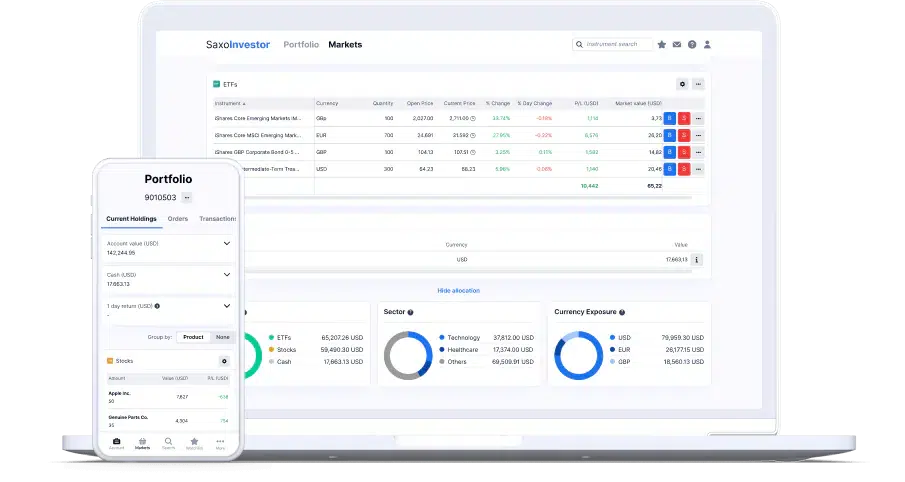
It operates in the UAE through a representative office licensed by the Central Bank of the UAE. Its two proprietary platforms are SaxoInvestor, aimed at investors wanting a simpler interface, and SaxoTrader, available on web, desktop and mobile, which is highly customisable, offers sophisticated analysis tools and supports multiple screens.
With strong educational resources, competitive pricing at higher tiers and an impressive range of assets, Saxo earns its place on this list. The main barrier is the minimum deposit, which varies considerably by country of residence and can be substantial, so check the figure that applies to you before applying.
Pros
- Excellent research materials
- Outstanding trading platforms (SaxoInvestor and SaxoTrader)
- Extensive range of investment products and commercial offers
- Long track record
- Supervised by worldwide top-tier regulators
Cons
- $0 in most countries; higher minimums in some regions (e.g. $5,000 in MENA)
- Fees higher than average
- Fee structure is complex
- Does not accept US residents
#7 amana
amana at a glance
Investing in physical shares carries risk. Trading leveraged derivatives and volatile digital assets is high-risk and requires caution.
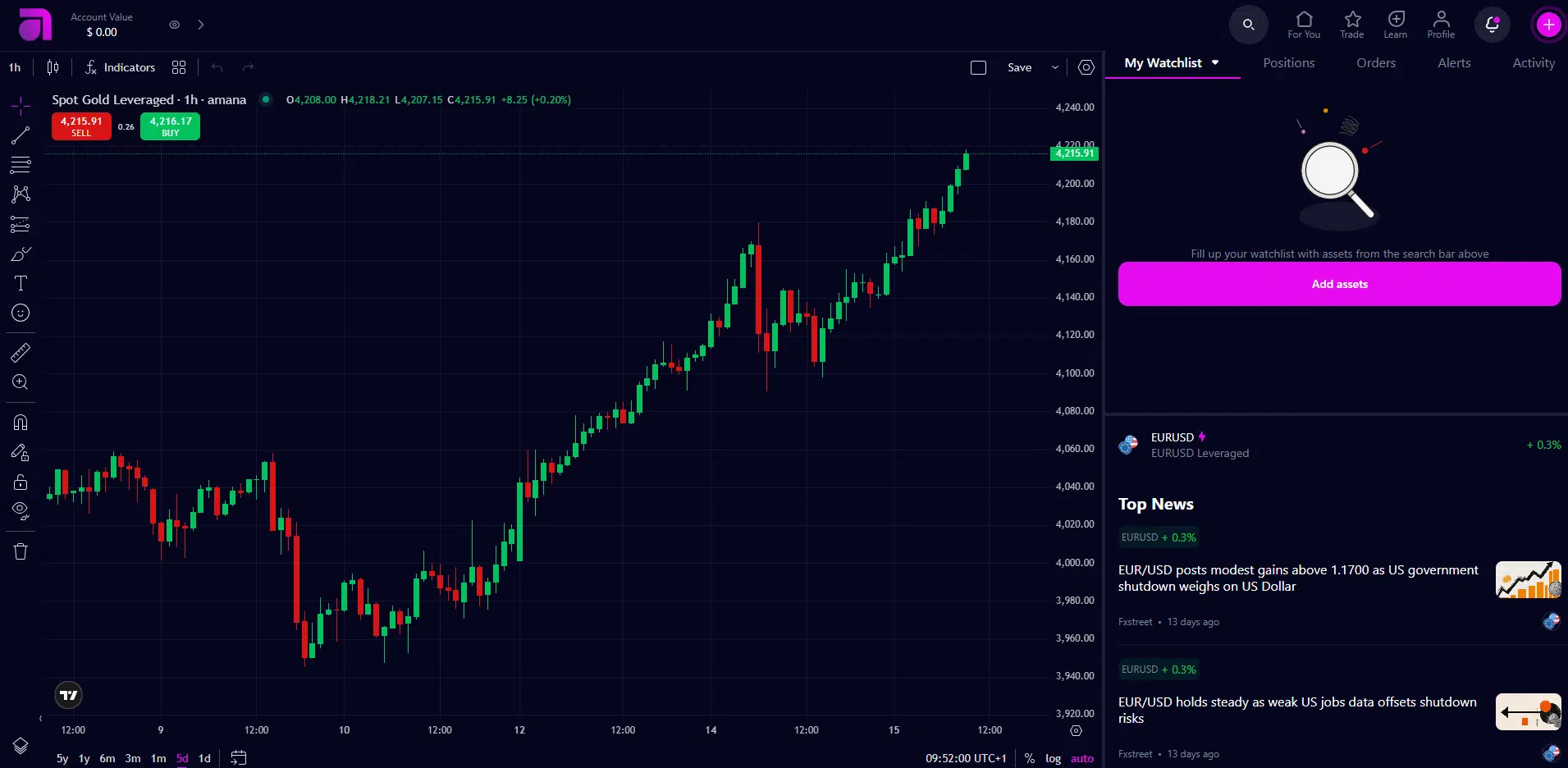
amana is a UAE-based, regulated brokerage firm with over 15 years of experience in the financial markets. Headquartered in Dubai, it offers a modern way for investors in the Middle East and beyond to access both local and global markets through a single app. New users get a $100 bonus with our promo code “IITW”.
It allows users to trade with 0% commissions on US and international stocks, ETFs, cryptocurrencies (over 375 digital assets), and MENA region shares*, as well as leveraged products such as forex and commodities.
Investors preferring a hands-off approach can use amana invest, which builds diversified portfolios through automated plans. Active traders benefit from 24/5 US stock trading hours, cashback on every trade of up to 20%, and a transparent fee structure with no hidden charges.
Fractional investing is available, so you can buy part of a high-priced share such as Apple, Tesla or Amazon with a small starting amount.
amana also stands out for its crypto offering, supporting hundreds of coins including Bitcoin, Ethereum and Solana, with competitive spreads and simple onboarding.
On the downside, the product range, while broad, does not include everything a global broker offers, such as bonds and options, and access is region-focused.
One point deserves attention. While amana promotes its UAE presence through Amana Financial Services (Dubai) Ltd, clients opening accounts through the amana app are legally contracting with AFS Global Limited, licensed by the Labuan Financial Services Authority (LFSA).
Client funds are held in segregated accounts with reputable banks in accordance with LFSA rules. However, the amana app is not a DFSA-regulated product, and DFSA protections do not apply to amana app users even if they are based in the UAE.
Pros
- 24/5 hours trading on stocks and ETFs
- $100 bonus with amana promo code “IITW”
- 0% commissions on stocks, ETFs and crypto
- Amana Invest (passive investment plans)
- Interest on idle cash
- Cashback on every trade (up to 20%)
- Multi-asset access: U.S. + MENA equities, forex, CFDs, and crypto all in one place.
- MT4/MT5 support for traditional traders
- Good local reach: Enables UAE/Saudi/Qatar trading, local AED deposits
- Amana Invest: Automated ETF and crypto portfolios with no management fees.
- 24/6 customer support
Cons
- Doesn’t offer bonds or options
- No position transfers to other brokers
- Limited product range: LSE/Irish ETFs not yet available
- Emphasis on leverage and CFDs, which may not fit conservative, long-term investors
*MENA stocks can be traded with zero commission and zero exchange fees for the first $100,000 invested or the first 50 trades, after which amana passes on the exchange fees for each market.
Disclaimer: Investing in physical shares carries risk. Trading leveraged derivatives and volatile digital assets is high-risk and requires caution.
#8 Capital.com
Capital.com at a glance
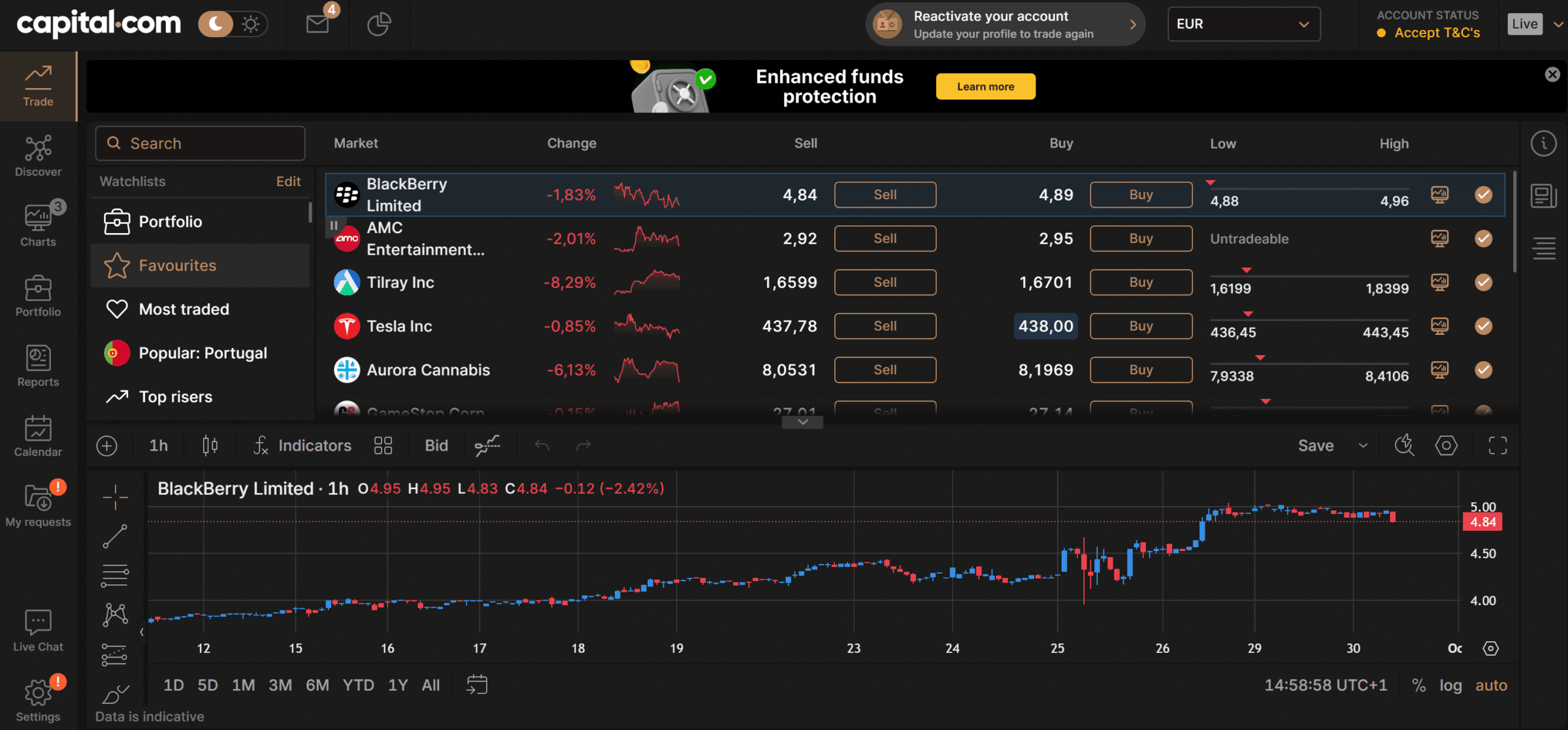
Founded in 2016, Capital.com is a global CFD trading platform that has grown quickly on the back of its commission-free model and user-friendly technology. Trusted by 750k+ traders worldwide, it offers access to a wide range of markets including CFDs on forex, stocks, indices, commodities and cryptocurrencies.
For UAE investors, a standout advantage is the ability to deposit and withdraw in AED without fees (other conversion fees or charges may apply). Alongside its own web and mobile apps, which include AI-driven insights and risk management features, you can trade through TradingView and MT4, where automated strategies are possible.
A free demo account is available, and Capital.com offers Islamic accounts. Customer support is Dubai-based, available 24/7 in English and in Arabic from 9:00 to 18:00, Monday to Friday.
Capital.com charges no commission on trades, earning instead through the spread, which is dynamic and varies with market conditions. Part of the spread is returned each month as a rebate.
On the downside, it is not suitable for investors wanting traditional products such as bonds, real ETFs or retirement accounts, and its currency conversion fee of around 0.70% applies in some regions.
On regulation, its UAE arm, Capital Com MENA Securities Trading LLC, holds a Category 1 licence (No. 20200000176) from the Securities and Commodities Authority (SCA), with a local office in Dubai. In January 2026 the group also received a licence from Kenya’s Capital Markets Authority, part of a broader pattern of seeking local authorisation in the markets it serves.
Pros
-
Minimum deposit of $20 / AED 80
-
Demo account
-
Customer support 24/7
-
Locally regulated by the SCA with a Dubai office
-
Extended trading hours on index CFDs
-
Extensive educational content, including risk management
- Fee-free AED deposits
Cons
-
Product offering limited to CFDs, with no real assets
-
May be overwhelming for beginners
-
Inactivity fee after 1 year
- Currency conversion fee applies in some regions
Methodology
In compiling this list we wanted to help UAE investors make an informed choice. Each app has its own strengths, and we aimed for a range that suits different investor profiles. Here is what we considered:
- Prices: cost is not the only factor, but it matters. There is no reason to pay more for the same quality of service. Look beyond the headline commission to currency conversion, which is often the larger cost for a UAE investor buying US assets.
- Educational resources: good educational material is a real advantage, particularly for beginners who want to learn before committing money.
- Range of products and markets: does the app offer real stocks and ETFs, or only CFDs? Is crypto available? This is the sharpest dividing line on this list.
- Customer service: problems arise sooner or later, and it matters whether you can reach someone who can help.
- The app itself: functionality, usability and specific features. An intuitive interface that works for both beginners and experienced traders is worth a great deal.
- Regulation: which authority supervises the entity you will actually contract with, and what protection that gives you.
Understanding UAE regulation
The UAE has several financial regulators rather than one, and which applies depends on where the provider is based:
- DFSA supervises firms in the Dubai International Financial Centre (DIFC);
- SCA, the Securities and Commodities Authority, regulates at federal level;
- FSRA supervises Abu Dhabi Global Market (ADGM);
- VARA covers virtual assets across Dubai outside the DIFC.
The practical point is that some international brokers serve UAE clients through offshore entities rather than locally licensed ones. amana is the clearest example on this list: its UAE presence is DFSA-regulated, but app clients contract with a Labuan-licensed entity instead. Check which entity your account sits under before depositing, as the protections differ substantially.
Account setup and process
Setting up a trading account in the UAE is straightforward if you follow these steps:
- Obtain a National Investor Number (NIN), only if investing on UAE stock exchanges. Register through the Dubai Financial Market (DFM) or Nasdaq Dubai.
- Choose a licensed brokerage firm. Check which UAE authority regulates the entity you will contract with, and confirm the licence covers the service you want.
- Open a brokerage account. Complete the online application with your personal and financial details, and submit the documentation required for verification.
- Fund your account. Deposit by bank transfer, card or another available method. Several brokers now accept AED directly, which avoids a conversion step.
- Set up your platform. Use SaxoTrader for advanced use or IBKR GlobalTrader if you are newer to investing, and customise your dashboard with charts, market data and analysis tools.
- Develop your strategy. Use the research and portfolio tools your broker provides, and diversify across asset classes rather than concentrating in one.
- Start trading. Execute through your chosen platform.
Types of trading platforms
The main types available in the UAE:
- Stock trading platforms: buy and sell shares in publicly traded companies.
- Forex trading platforms: trade currency pairs.
- Crypto trading platforms: buy, sell and trade cryptocurrencies.
- CFD trading platforms: trade contracts for difference on various assets without owning them.
Choosing the right type ensures the app matches your strategy and goals. Note that several apps on this list offer CFDs only, which means you never own the underlying asset.
Videos about investing from the UAE
Check our in-depth YouTube videos on how to invest and how to choose a trading app in the UAE:
Bottom line
To summarise, here is the list of best trading apps in Dubai and the UAE:
eToro
Best overall trading appSarwa
Best for beginnersInteractive Brokers
Best for intermediate and advanced investorsXTB
Best for CFD and Forex tradingPlus500
Best for demo account and CFDsSaxo
Best for professionalsamana
Best for 0% commissionsCapital.com
Best for fee-free AED deposits and commission-free CFD trading with local support.
Choosing the right trading platform in the UAE is not easy. We have listed what we consider the best stock trading apps in Dubai and the UAE, comparing what they offer and highlighting their strengths.
Two things are worth carrying into your decision. First, decide whether you want to own real assets or trade CFDs, because several apps here offer only the latter and the difference matters more than any fee. Second, look at currency conversion costs rather than commissions alone, since converting AED to USD on every deposit is often the largest recurring expense.
Investing is a reasonable route to building wealth, but like anything it carries risk. We hope this analysis helps you make an informed decision, whether you are experienced or just starting out.
Keep studying, do your due diligence, know your investor profile, and invest wisely.
FAQs
What are the safest trading platforms in the UAE?
All the platforms in this article are regulated, though by different authorities and with different protections. To recap:
- eToro: regulated by the FCA, CySEC and ASIC, with segregated funds and private insurance up to €1 million. Listed on the Nasdaq, so it publishes audited accounts.
- Interactive Brokers: regulated by multiple top-tier authorities including FINRA, SIPC, SEC and the FCA, listed on the Nasdaq, with a long record of financial strength.
- XTB: regulated by the FCA, KNF, CySEC, BaFin and FSC, with a UAE presence through XTB MENA Limited under the DFSA. Listed on the Warsaw Stock Exchange.
- Plus500: regulated by the FCA, CySEC, MAS, ASIC, FMA and DFSA, and listed on the London Stock Exchange.
- Saxo: a licensed bank supervised by the Danish FSA, with authorisations from the FCA, ASIC, MAS, FINMA and DFSA, and a UAE representative office licensed by the Central Bank.
- Sarwa: regulated by the DFSA in Dubai.
- Capital.com: its UAE entity holds a Category 1 licence from the SCA, alongside FCA, CySEC, ASIC and other authorisations.
- amana: its UAE entity is DFSA-regulated, but app clients contract with a Labuan-licensed entity, so DFSA protections do not apply to app users.
The most useful check you can make is confirming which entity holds your account and what compensation, if any, applies to it.
What factors should I consider when choosing a trading platform in the UAE?
Consider regulatory status, available products, fees and commissions, the user interface, customer support and educational resources. On fees, check the currency conversion cost as well as the commission, since converting AED to USD on every deposit usually costs more over a year. On regulation, identify which authority supervises the entity you will contract with, whether that is the DFSA, the SCA, the FSRA or a foreign regulator.
What is the Dubai Financial Services Authority (DFSA)?
The Dubai Financial Services Authority is the regulator responsible for financial and related services conducted in or from the Dubai International Financial Centre (DIFC).
Its responsibilities include licensing and supervising financial institutions, protecting consumers, maintaining market integrity and enforcing its regulatory framework. It covers banking, asset management, insurance and securities trading. Note that it is one of several UAE regulators rather than the only one.
What is the difference between a stock and a stock CFD?
A stock gives you an ownership right in a share of the company. A CFD does not. A stock CFD is a derivative contract where the underlying asset is the stock, and the broker pays you the difference in value between opening and closing the position.
CFDs are leveraged, which amplifies both gains and losses, and they carry overnight financing costs on positions held beyond a day. They are riskier instruments and are generally not suitable for beginners or for long-term investing.
What is an Islamic account?
An Islamic account follows the principles of Islamic law, which forbids interest or interest-based lending in any form. Many online brokers accommodate Muslim traders by offering interest-free or swap-free accounts, meaning no overnight financing charges accrue on positions held beyond a day.
Among the platforms covered here, eToro, XTB, Plus500 and Capital.com all offer Islamic accounts, and Sarwa offers Halal portfolio options within Sarwa Invest. Conditions vary, including minimum funding requirements, so confirm the terms with the broker directly.
Do I pay tax on investment gains in the UAE?
The UAE levies no personal income tax and no capital gains tax on individuals, so personal investment gains are generally untaxed. Corporate tax of 9% applies to business profits above the AED 375,000 threshold, which can catch activity that amounts to a business rather than personal investing.
If you remain tax resident elsewhere, or hold a nationality with citizenship-based taxation, obligations may still follow you. Confirm your position with a qualified UAE tax adviser.