Investing in the stock market is easier than ever thanks to the many online trading apps available. However, choosing the best trading app in Qatar can be challenging.
To help, we reviewed and compared top trading apps in Qatar, highlighting their features and strengths to guide your decision.
Best stock trading apps in Qatar
Interactive Brokers | Best for intermediate and advanced investors
Online broker with a sophisticated trading platform that offers a wide range of products. The company, founded in the US, provides the app IBKR GlobalTrader, which is ideal for beginners.
XTB | Best for forex and CFDs
Headquartered in Poland and listed on the Warsaw Stock Exchange, XTB offers access to a range of CFD on stocks on its trading app, where you can also trade Forex at a competitive price.
Saxo Bank | Best for powerful trading tools
Full-service broker who offers stocks, ETFs, bonds, derivatives, crypto, and other products. You can access 36 different markets overseas from Qatar using their powerful trading apps.
Plus500 | Ideal for demo account and CFDs
Plus500 is a multi-asset online broker with commission-free CFDs on Indices, Forex, Commodities, Cryptocurrencies, Shares, Options, and ETFs.
81% of retail CFD accounts lose money.
Best stock trading apps in Qatar compared
| Broker | Fees on stocks | Minimum deposit | Trading apps | Real stocks available |
| Interactive Brokers | From $0.0035 per US share (minimum $0.35). Other markets from 0.01% to 0.08% of trade value | $0 | IBKR GlobalTrader, IBKR Mobile, TWS | Yes |
| Saxo | 0.03% to 0.08% of trade value on US stocks (minimum $1), depending on account tier. Custody fee up to 0.15% per year also applies | $0 (Classic tier; may vary by region) | SaxoInvestor, SaxoTrader | Yes |
| XTB | $0 commission on stock CFDs (0.30% markup included in the spread) | $0 | xStation 5 | No (stock CFDs only) |
| Plus500 | Spread-based pricing on CFDs | $100 | Plus500 WebTrader and mobile app | No (CFDs only in Qatar) |
Verify current pricing and product availability directly with each broker, as terms vary by region and account type.
#1 Interactive Brokers (IBKR GlobalTrader) at a glance

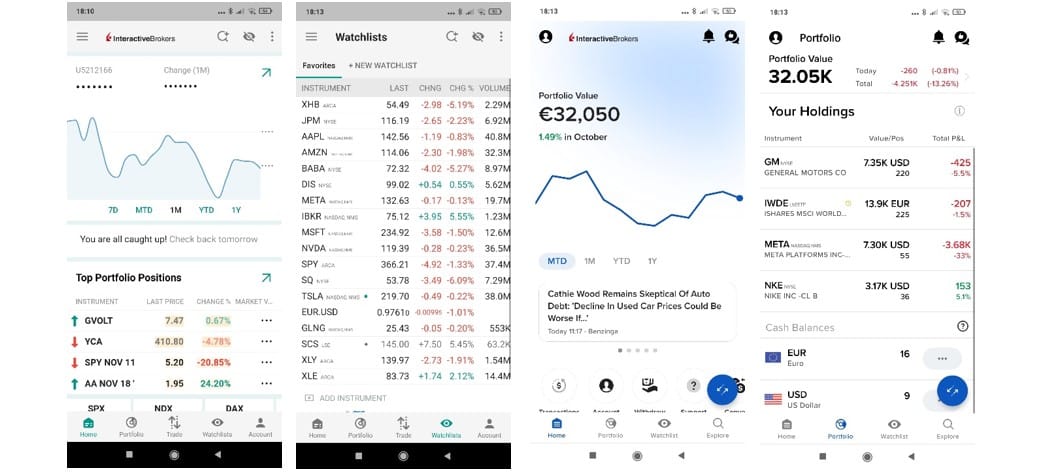
Interactive Brokers is among the most reliable brokers available. Founded in 1978 and listed on NASDAQ (ticker: IBKR, an S&P 500 constituent since 2024), it has weathered multiple financial crises and now serves over 3 million client accounts, supervised by top-tier regulators worldwide.
IBKR offers sophisticated tools, access to 170+ markets in 36+ countries, and consistently low pricing. The platform range is tiered by experience: IBKR GlobalTrader is the accessible mobile option, simplifying the experience without losing the underlying capability, and includes fractional shares from $1 plus a $10,000 virtual demo account.
For more capability, IBKR Mobile is the fuller mobile app covering stocks, ETFs, and options, while Trader Workstation (TWS) on desktop offers the complete professional toolset. TWS in particular can feel overwhelming initially, which is why we would point newer investors to GlobalTrader first.
For Qatari investors specifically, two things stand out: no minimum deposit, and FX conversion at roughly 0.20 basis points (minimum $2). Since investing internationally from Qatar means converting riyals to dollars, that conversion cost typically matters more than the trading commission itself.
Overall, Interactive Brokers offers the strongest combination of platform choice and pricing available in Qatar, whatever your experience level.
Read our Interactive Brokers review for more detail.
#2 XTB at a glance

69-80% of retail CFD accounts lose money.
XTB is a Polish company founded in 2002 and listed on the Warsaw Stock Exchange, serving over 1.7 million clients across 16 countries. It operates in Qatar through XTB MENA Limited, authorised and regulated by the Dubai Financial Services Authority (Licence No. F006316), alongside licences from the FCA, KNF, CySEC, and BaFin elsewhere.
The award-winning xStation 5 platform, available on mobile and desktop, gives access to a wide instrument range with strong technical analysis tools and comprehensive educational content through the XTB Trading Academy.
An important limitation: in Qatar, XTB offers only CFDs on stocks. You would gain price exposure through a derivative rather than owning shares, with no shareholder rights, no dividends in the conventional sense, and overnight financing costs on positions held beyond the trading day. CFDs are complex, leveraged instruments and most retail investors lose money trading them.
On the positive side, XTB offers no commission on stock CFDs, no minimum deposit, Islamic swap-free accounts, and a free demo account. It is also one of the best forex brokers in Qatar, which is arguably where its offering fits best.
For more detail, read our XTB review.
CFDs are complex instruments and come with a high risk of losing money rapidly due to leverage. 76-83% of retail investor accounts lose money when trading CFDs with XTB.

#3 Saxo at a glance

62% of retail CFD accounts lose money.
Saxo is a Danish bank founded in 1992, acquired by J. Safra Sarasin in March 2025 and holding an investment-grade A-/A2 credit rating from S&P. It suits both experienced traders and long-term investors, combining institutional-grade safety with competitive pricing and access to over 71,000 instruments. Saxo operates in the region through its UAE representative office, licensed by the Central Bank of the UAE.
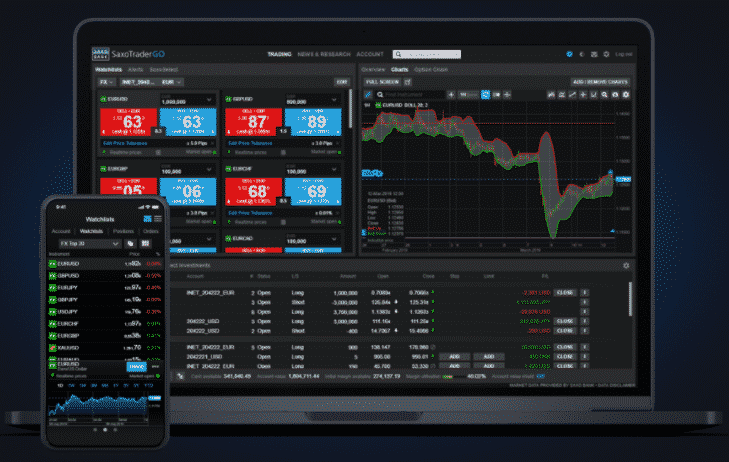
Saxo runs two platforms. SaxoInvestor is the straightforward web and mobile platform aimed at long-term investors in stocks, ETFs, funds, and bonds. SaxoTrader is the advanced platform available on web, mobile, and desktop, covering the full product range with detailed analytics; the desktop version supports multi-screen workspaces of up to six screens, Level 2 order book data through Depth Trader, and time and sales data. A single account gives access to both.
With strong educational resources, competitive pricing, and an exceptional instrument range, Saxo earns its place on this list. The main consideration is the custody fee of up to 0.15% per year on stock, ETF, and bond positions, which can be waived by opting into securities lending – worth doing if you intend to hold long term. Qatari clients should verify current funding requirements directly, as regional thresholds vary.
#4 Plus500 at a glance

81% of retail CFD accounts lose money.
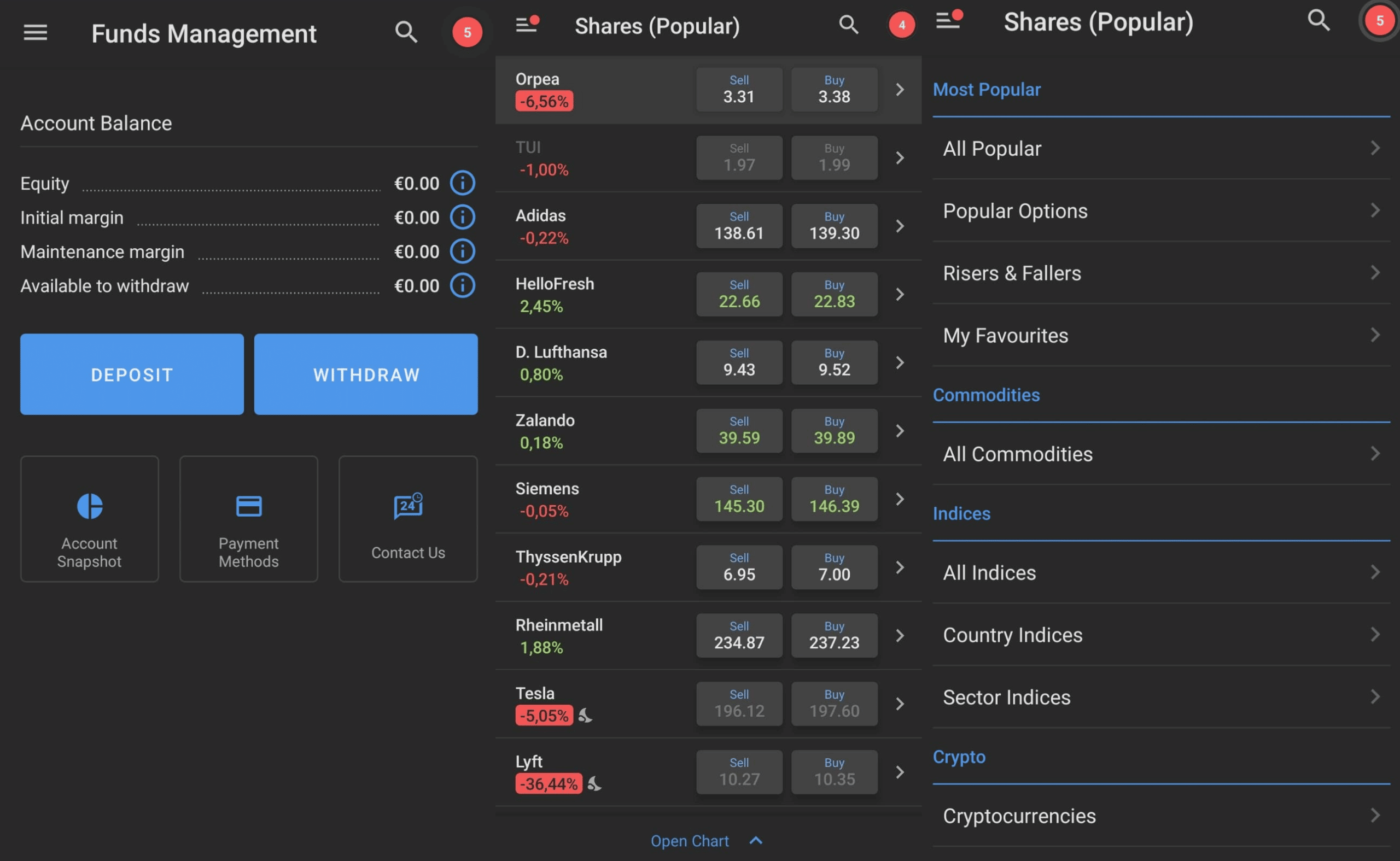
Plus500 is a broker founded in 2008, listed on the London Stock Exchange (ticker: PLUS) as a FTSE 250 constituent. It operates in Qatar through Plus500AE Ltd, authorised and regulated by the Dubai Financial Services Authority (Licence No. F005651), with additional oversight across its group from the FCA, CySEC, ASIC, and MAS. The platform is available through the Plus500 mobile app and the WebTrader web platform, both accessible and testable via a demo account.
Trading from Qatar, you can only access Plus500 CFD, meaning CFDs across a range of instruments but no real shares or ETFs. CFDs are leveraged products that magnify losses as readily as gains and are designed for short-term trading rather than long-term investing.
Within that constraint, Plus500 offers a reliable platform with competitive costs, solid usability, and Islamic swap-free accounts available. Accounts are supported in 16 base currencies, and negative balance protection now applies globally. The clear limitation is the absence of real asset ownership.
To learn more, read our full Plus500 review.
CFDs are complex instruments and come with a high risk of losing money rapidly due to leverage. 80% of retail investor accounts lose money when trading CFDs with this provider.
This information is NOT relevant to EU residents who are to be serviced by EU subsidiaries of the Plus500 Group, such as Plus500CY Ltd, authorized by CySEC (Reg. 250/14). Different regulatory requirements apply in Europe, such as leverage limitations and bonus restrictions.
Methodology
Our aim is to help Qatari investors make an informed choice. Each platform covered has different strengths, and we have tried to reflect a range of investor profiles. Here is what we assessed:
- Costs: not the only factor, but an important one. We looked at commissions, spreads, currency conversion, custody, and inactivity fees together rather than headline rates in isolation. For a riyal-based investor, conversion costs often matter most;
- Real stocks versus CFDs: the most consequential distinction on this list. Owning shares outright is fundamentally different from holding a leveraged derivative position, and only two of the four brokers here offer real stock ownership in Qatar;
- Regulation: which entity serves Qatari clients and which authority supervises it – DFSA, the Central Bank of the UAE, or an overseas regulator – and what investor protection applies;
- Sharia-compliant options: whether Islamic swap-free accounts are available, a decisive factor for many investors in the region;
- Product and market range: coverage of stocks, ETFs, bonds, options, and access to international exchanges;
- Educational resources: particularly valuable for newer investors;
- Platform quality and customer service: functionality, usability, and responsiveness when problems arise.
Bottom Line
To summarize, here’s the list of “Best stock trading apps in Qatar”:
- Interactive Brokers: Ideal for intermediate and advanced investors
- XTB: Ideal for forex and CFDs
- Saxo Bank: Ideal for advanced traders
- Plus500: Ideal for demo account and CFDs
It is hard to choose the right stock trading app in Qatar. Luckily, we helped many people in the same situation before, and we can help you now. To facilitate your choice, we listed a few of the best stock trading apps in Qatar in our opinion, comparing what they can offer and highlighting their strengths.
We know that trading stocks is a good way to achieve financial freedom, but, like everything in life, there are risks involved. We hope that our analysis was enough to help you make an educated decision that acknowledges those risks, whether you are experienced or a novice in the world of trading.
In any case, keep on studying, do due diligence, know your investment profile, and invest wisely!
Other FAQs
What is the difference between a stock and a stock CFD?
While the stock gives you a property right over a share of the company, the CFD does not. The stock CFD is a derivative contract where the underlying asset is the stock and where the broker promises to pay you back the difference in value between the time you opened the position and the time you close it. CFDs have a leverage effect: if you buy a stock CFD and its price goes down, you will need to borrow money from the broker to keep the position open. This makes the instrument a risky option that is not suitable for beginners.
What is an Islamic account?
An Islamic account follows the principles of Islamic law, which forbids the use of interest or interest-based lending in any form. Many online brokers can accommodate Muslim traders and offer interest- or swap-free accounts.