Investing in exchange-traded funds (ETFs) is one of the most cost-efficient and accessible ways to build a diversified portfolio, spreading your money across many holdings in a single trade rather than betting on one asset.
European investors should note one key point: you will mostly be buying UCITS ETFs, the EU-regulated fund structure, since US-domiciled ETFs (such as SPY or VTI) are not available to EU retail investors under PRIIPs rules. Beyond that, finding the best ETF broker in Europe can be challenging given how many brokers there are, each with different strengths. You must weigh the number of ETFs on offer, the fees you’ll incur, the trading platform, and which regulator supervises the broker.
Without further delay, here are the best ETF brokers in Europe and why you should consider them:
- eToro: Best for social trading and commission-free ETF investing. New users in the EU and UK can get a welcome bonus in free stocks worth up to $500, depending on the first deposit (terms apply).
- Interactive Brokers: Best for the largest ETF offering.
- Freedom24: Best for a variety of global ETFs.
- DEGIRO: Best for low-cost ETF trading.
- XTB: Best for commission-free ETF investing, with 0% commission up to €100,000 in monthly turnover.
- Lightyear: Best for beginners and those looking for a cheap ETF broker. New users can get a free share worth up to €100 with the promo code INVESTINGINTHEWEB (terms apply).
Disclaimer: Investing involves risk of loss.
Best ETF brokers in Europe for 2026
| Broker | ETF fees | Min. deposit | ETFs |
| eToro | $0 (other fees apply) | $50 (varies by country) | 300+ |
| Interactive Brokers | 0.05% of trade value (min €1.25, max €29, Tiered) | €/$/£0 | 90+ market centres |
| Freedom24 | €0.02 per share + €2 per order (Smart plan) | None stated | 3,600+ |
| DEGIRO | €0 + €1 handling fee (Core Selection), €2 + €1 on other ETFs | €0.01 | 700+ (Core Selection) |
| XTB | €0 up to €100,000 a month, then 0.2% (min €10) | €0 | 2,200+ |
| Lightyear | €0 (other fees may apply) | None stated | Hundreds |
ETF fees for EU clients. Sources: broker fee pages, September 2026. Other fees, like currency conversion, may apply.
ETF brokers to avoid ❌
Prioritize safety: safe beats cheap! Remember that investing is a long-term game, so it’s best to choose a provider that you can trust as years go by. Make sure that it is allowed to operate in your country.
Check our list of investment platforms, and filter by “Not approved” to check the list of platforms that we do not recommend.
If you’re still unsure about a specific platform, feel free to reach out to us. We’re happy to help!
Broker reviews
In the following detailed reviews, we discuss the features of each broker in terms of pricing, accessible markets and instruments, and other special features.
eToro at a glance

52% of retail CFD accounts lose money.
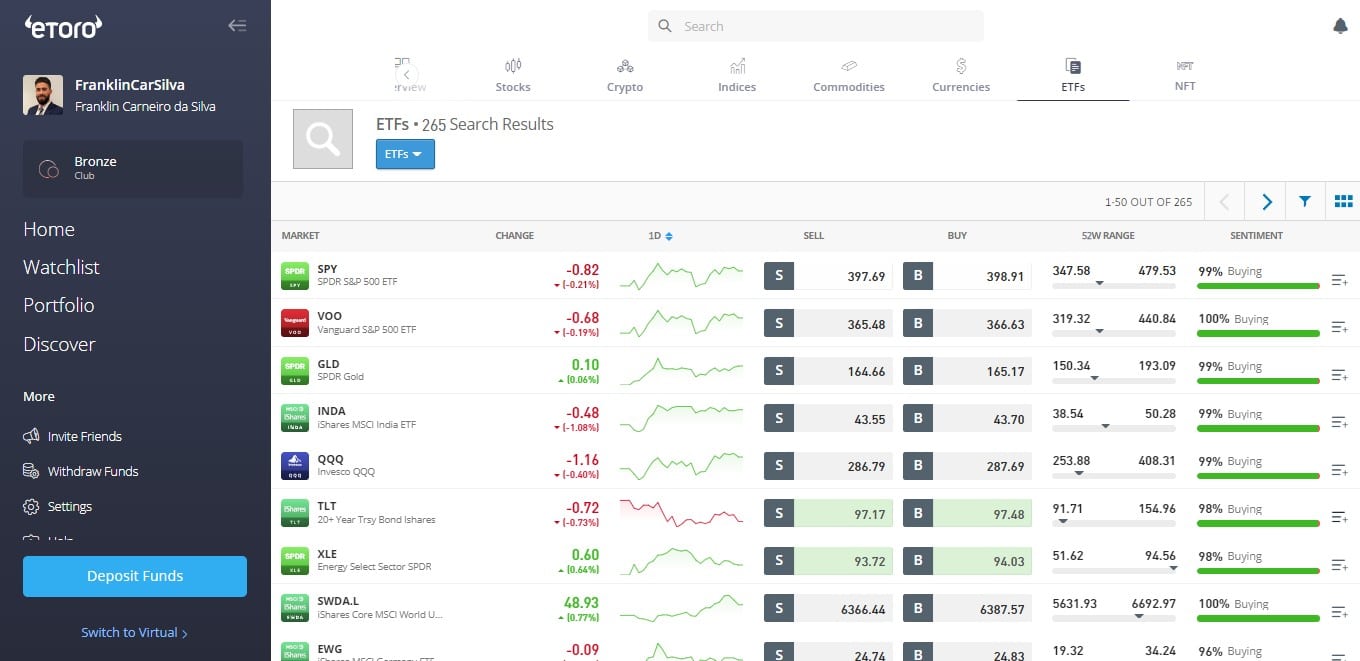
eToro, a global online broker, tops our list of the best ETF brokers in Europe. It is best known for its social trading platform, where you can copy the trades of other successful investors, and it has more than 40 million registered users and offers over 300 ETFs. That ETF range is more curated than the thousands offered by IBKR or DEGIRO, but it covers the major index, sector, and thematic funds most investors want, and you can buy them as fractional shares from as little as $10, which is handy for building a diversified portfolio with small amounts.
The platform is intuitive, and you can open and fund an account through various methods such as credit or debit cards, PayPal, Skrill, and bank transfers. The minimum deposit is relatively low at $50 (depending on your country), there are no deposit fees, and you benefit from commission-free trading on real ETFs (other fees apply). EU clients trade UCITS-compliant ETFs in line with European regulations.
eToro is regulated and supervised by several top-tier authorities, including the Financial Conduct Authority (FCA), the Australian Securities and Investments Commission (ASIC), and the Cyprus Securities and Exchange Commission (CySEC). In line with European Securities and Markets Authority (ESMA) rules, eToro also provides negative balance protection on a per-account basis for forex and CFD trading to retail clients in the European Union.
EU clients can hold a EUR account, so deposits and withdrawals in euros carry no conversion fee and withdrawals from it are free. On the downside, moving money into the USD account carries a conversion fee, and withdrawals from the USD account cost $5.
New users in the EU and UK can also get free stocks worth up to $500 with their first deposit: $10 for deposits from $200, $30 from $500, $200 from $2,500 and $500 from $5,000. The deposit must stay in the account for 90 days, and the offer excludes CFD accounts.
For a full assessment, read our comprehensive eToro review.
Interactive Brokers at a glance

Interactive Brokers is another outstanding broker, offering one of the widest ranges of ETFs of any broker on this list and letting you trade almost any financial instrument, including stocks, options, futures, forex, commodities, bonds, and even over-the-counter (OTC) securities. Founded in 1978, it is regulated by many top-tier authorities, including the SEC in the US, the FCA in the UK, and the Central Bank of Ireland, which oversees the entity serving most EU clients.
On the ETF side, IBKR’s main draw is sheer breadth: ETFs from more than 90 market centres around the world, and you can buy eligible ETFs as fractional shares from $1 to invest precise amounts. European investors will trade UCITS ETFs, with access spanning the major European listing venues as well as global markets.
Nearly all Europeans can open an account, and IBKR suits any investor, though beginners may find the toolset overwhelming. Its web-based Client Portal, the GlobalTrader mobile app, and the professional Trader Workstation (TWS) are all well designed, with the simpler apps easing the learning curve.
Deposits can be made by bank wire, with no minimum to open an account. ETF trading follows tier-based pricing that varies by exchange and trading volume: most EU-listed ETFs cost 0.05% of trade value, with a minimum of €1.25 and a maximum of €29.00.
For customer support, you can reach IBKR by phone, email, live chat, or its automated “iBot.” The team is experienced, though email inquiries may not get an immediate reply.
You can read our IBKR review for more information.

Freedom24 at a glance

Investing involves risk of loss.
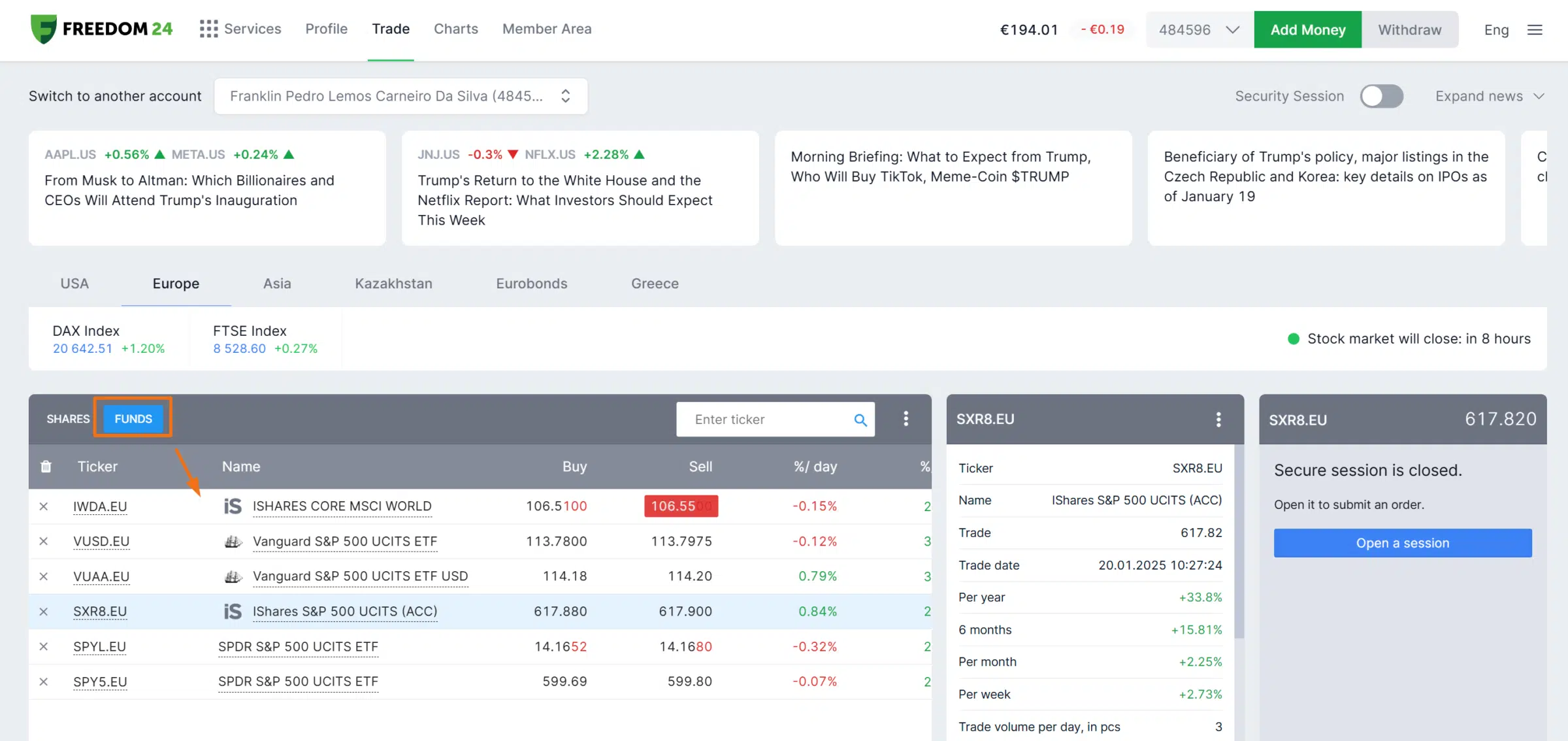
Founded in 2008, Freedom24 is the European brokerage arm of Freedom Holding Corp, a group listed on the NASDAQ (ticker: FRHC) with 874,000 retail brokerage customers at 30 June 2026. It gives you access to several international markets, including NASDAQ, NYSE, CME, HKEX, LSE, and Deutsche Börse, with more than 1,000,000 instruments, among them over 3,600 ETFs and 147,000 bonds spanning US and European listings.
The company offers a web-based platform and a mobile app that first-time users can navigate easily, and you can trade stocks, ETFs, bonds and options. Deposits can be made by bank transfer (free) or card (2% fee). Freedom24’s European operations are run by Freedom Finance Europe Ltd, regulated by Cyprus’s CySEC (licence 275/15).
On ETF pricing, the Smart plan uses a per-share model rather than a percentage of trade value: €0.02 per ETF share plus €2 per order. The All Inclusive plan charges 0.5% plus €0.012 per share and €1.20 per order. The per-share structure can work out cheaper than percentage-based fees on larger orders of low-priced ETFs. For the full fee schedule, visit this page.
On the downside, Freedom24 charges €7 per withdrawal, which is relatively high compared with other brokers. For more information, read our Freedom24 review.
DEGIRO at a glance

Investing involves risk of loss.
DEGIRO joins the list in fourth place as a low-cost ETF trading broker. It launched for retail investors in the Netherlands in 2013, joined flatex in 2020 and now serves more than 3 million clients in 15 European countries.
There is no minimum requirement to open an account at DEGIRO, and it charges no fees for maintenance, inactivity, deposits, or withdrawals, which is ideal for investors looking to minimise trading costs and build long-term portfolios. Its real ETF draw is the Core Selection, which now covers more than 700 ETFs, ETCs and ETNs traded on Tradegate with no commission, only a €1 handling fee per transaction. Other ETFs cost €2 plus the €1 handling fee.
On top of stocks and ETFs, DEGIRO gives you access to mutual funds, bonds, warrants, futures, and options across more than 45 exchanges. Its platform ranks among the best trading platforms in Europe, with a modern design and features added regularly based on client feedback.
DEGIRO, officially flatexDEGIRO Bank Dutch Branch, is overseen by the DNB and AFM in the Netherlands, while its parent, flatexDEGIRO Bank SE, is regulated by Germany’s BaFin.
On the downside, DEGIRO offers no demo account, charges a connectivity fee of up to €2.50 a year for each foreign exchange you trade on (0.25% of your account value, capped), and provides little research. For further details, read our DEGIRO review.

XTB at a glance

69-80% of retail CFD accounts lose money.
XTB was founded in 2002 and is listed on the Warsaw Stock Exchange (ticker: XTB). It provides access to stocks, ETFs, and CFDs on indices, commodities, forex, and cryptocurrencies to more than 2.8 million clients worldwide (June 2026). It has a strong reputation for affordable pricing, which varies by account type, and for excellent customer service available by live chat, phone, and email.
XTB is regulated by several top-tier authorities, including the FCA in the UK and Poland’s KNF. For ETF investors, the appeal is real stocks and ETFs with 0% commission up to €100,000 in monthly turnover (0.2% beyond that, with a €10 minimum), the ability to buy fractional ETFs from as little as €10, and Investment Plans that let you automate recurring contributions into a basket of ETFs. XTB offers more than 2,200 European-listed ETFs, and a 0.5% currency conversion fee applies when you buy an ETF in a currency other than your account’s.
Once you open an account, you’ll have access to XTB’s two trading platforms, xStation 5 and xStation Mobile, which are highly customisable but, in our opinion, a little complicated for first-timers.
Lastly, XTB’s relatively limited product range and its €10 monthly inactivity fee (charged after more than a year without trading and no deposit in the previous 90 days) are drawbacks, particularly for some long-term investors.
More information can be found in our XTB review.

Lightyear at a glance

Terms apply, seek guidance if necessary. When you invest, your capital is at risk.
Lightyear is a European investment app founded in 2021 in Tallinn by former Wise employees. It operates through Lightyear Europe AS, authorised and regulated by the Estonian Financial Supervision Authority (Finantsinspektsioon, licence number 4.1-1/31), with clients’ assets covered up to €20,000 by the Estonian investor protection fund. UK clients are served by Lightyear UK Ltd, authorised by the FCA.
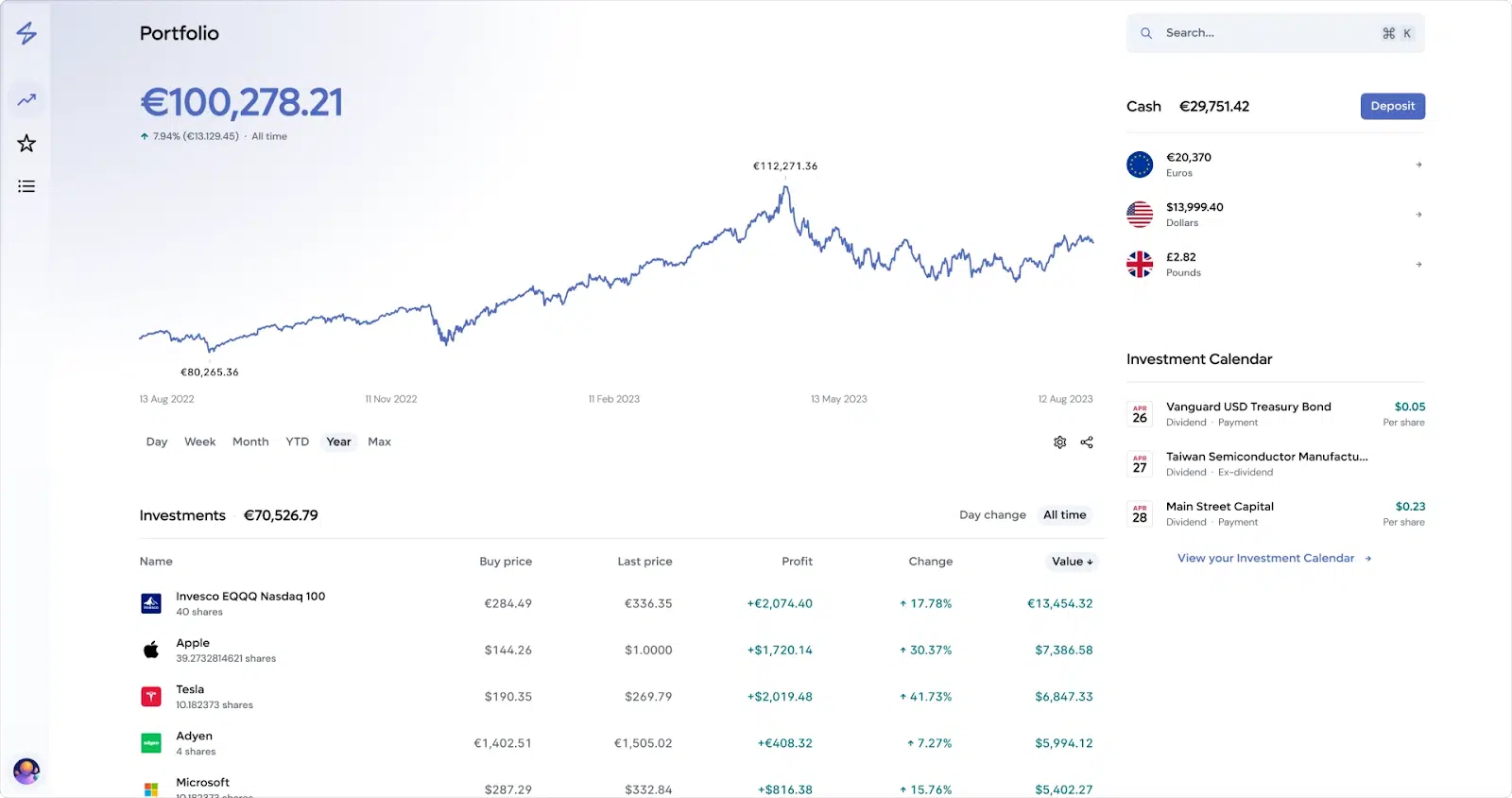
For ETF investors, the appeal is straightforward: there are no Lightyear execution fees to trade ETFs, you can buy them as fractional shares, and any uninvested cash earns interest through money market funds, so your money keeps working between purchases. For stocks, US shares cost 0.1% (min $0.10, max $1), UK shares £1 and euro-denominated shares €1, and a 0.35% currency conversion fee applies (you can reduce this with Lightyear’s multi-currency accounts in EUR, GBP and USD, which also help when buying USD- or GBP-denominated ETFs). Its money market funds paid around 2.42% on EUR, 3.85% on GBP and 3.89% on USD (net, variable, September 2026). Cryptocurrency trades carry a 0.45% fee.
The platform suits beginners and intermediate investors, with fractional shares and an easy-to-use app offering more than 6,000 stocks and funds, including hundreds of ETFs, a simple way to get diversified exposure.
There are some downsides, though: the product range is limited (no options, commodities, or forex) and there is no demo account.
Lightyear also offers a free share worth up to €100 with our promo code INVESTINGINTHEWEB, if you deposit at least €100 within 30 days. The value is random and most rewards are between €10 and €15 (terms apply).
Check our Lightyear review for more detailed information.
Disclaimer: Capital at risk. The provider of investment services is Lightyear UK Ltd for the UK and Lightyear Europe AS for the EU. Terms apply: lightyear.com/terms. Seek qualified advice if necessary.
Methodology
Investing in the Web aims to offer investors fair and unbiased reviews of online brokers. Our team thoroughly examined each of the brokers mentioned above to come up with this list, taking into account several variables, including:
- Regulation (supervised by at least one European regulator)
- ETF offering (access to several exchanges)
- Low trading and non-trading fees
- Easy deposit and withdrawal methods
- Sound customer service
Finally, we ensured that all the brokers give you access to other financial products, in case you want to expand your investing beyond ETFs.
What makes a good ETF broker?
A good ETF broker should, above all, be safe, which means being regulated by one of the top-tier financial authorities. Deposits and withdrawals should be available through traditional methods such as bank transfer and debit or credit card, alongside other quick and simple options.
On fees, many brokers now offer commission-free ETF trading, but the non-trading fees matter just as much: inactivity, deposit, withdrawal, and currency conversion fees should all be low, since converting EUR to buy a USD-denominated ETF can quietly erode your returns.
For ETF investors specifically, a few extras make a real difference: a broad selection of ETFs across multiple exchanges (and, for Europeans, access to UCITS ETFs), the ability to buy fractional shares so you can invest exact amounts, and recurring or automated investment plans that make regular, cost-averaged investing effortless. A demo account is a useful bonus for testing the platform, though it matters less for long-term, buy-and-hold ETF investors than for active traders.
Bottom line
To summarise, here’s the list of “Best ETF brokers in Europe”:
- eToro: Best for social trading and commission-free ETF investing
- Interactive Brokers: Best for the largest ETF offering
- Freedom24: Best for a variety of global ETFs
- DEGIRO: Best for low-cost ETF trading
- XTB: Best for commission-free ETF investing up to €100,000 a month
- Lightyear: Best emerging low-cost broker in Europe
Finally, finding the best ETF broker in Europe is challenging due to the many brokers available, each offering different features with different pricing. We examined the tools offered by major European brokers and created this list to assist you in choosing the best ETF broker.
It includes brokers that provide access to a wide variety of ETFs globally and have key points of differentiation compared to other brokers. You may always visit our broker’s reviews page for an in-depth, unbiased assessment of various brokers’ services and our comparison tool, a dynamic solution for comparing top brokers in your country.
Before choosing, compare the full fee schedule of each broker for your country and, where available, try its demo account.
Other FAQs
What is an ETF? How does it work?
ETFs allow investors to mix their funds and collectively invest in a basket of securities. They typically track the performance of a particular industry, index, commodity, or other asset class and are bought and sold throughout the day on an exchange. As a result, although their prices may change in response to supply and demand, they often stay close to the underlying securities’ net asset value (NAV). Over the last decade, ETFs have been the main financial instrument used by robo-advisors to create their investment portfolios.
Do ETFs pay dividends?
Not all. There are two types of ETFs: distribution and accumulation. Distributing ETFs pay the whole amount of dividends received from the underlying stocks they hold, and usually, the payment frequency is quarterly. However, accumulating ETFs do not distribute dividends but rather use them to reinvest in the stocks that the ETF already owns.
What's the difference between an ETF and a mutual fund?
Despite many similarities, mutual funds and ETFs differ significantly in a few ways. For example, ETFs can be exchanged throughout the day on an exchange like stocks, while mutual funds can only be bought at the close of each trading day based on their net asset value. Another significant difference is the method each fund is managed. ETFs typically track a market index or sector and are passively managed. On the other hand, many mutual funds are actively managed and have a fund manager who often buys and sells assets for the fund based on a specific investment mandate.