
Choosing the right stock trading app isn’t easy, especially when you’re just getting started. At Investing in the Web, we follow more than 100 investment platforms globally to keep track of fees, features, regulation, and product quality.
Prioritise safety, safe beats cheap. Investing is a long-term game, so pick a platform you can trust over years and decades. For UK investors, that means choosing brokers authorised by the Financial Conduct Authority (FCA), with client assets protected up to £85,000 under the Financial Services Compensation Scheme (FSCS). EU-passported alternatives (CySEC, BaFin) typically provide €20,000 protection under the relevant Investor Compensation Fund.
In this article, we compare some of the best stock trading apps available to UK investors in 2026 to help you choose the right fit for your needs, whether that’s commission-free investing, tax-wrapped accounts (ISA, SIPP, LISA, JISA), fractional shares, or international market access.
Best Stock Trading Apps in the UK
Interactive Brokers
Best UK Stock Trading App Overall.
eToro
Best for commission-free stocks and ETFs (other fees apply).
Disclaimer: Your capital is at risk. Other fees apply. For more information, visit etoro.com/trading/fees.
Trading 212
Best for automating investments and earning interest. Sponsored Link. New users can get free fractional shares, whose value varies by share. Terms apply. See the Trading 212 promo code page for the current offer.
Webull
Best for beginners looking for quick exposure to US stocks. New users get a signup promotion.
Freetrade
Best for low Fees.
Hargreaves Lansdown
Best for Stocks and Shares ISA.
Interactive Investor
Best for Bonds and Gilts.
Lightyear
Best for interest on uninvested cash. New users get a free fractional share with the promo code INVESTINGINTHEWEB.
Trading apps that we do not recommend
For a list of brokers we do not recommend, you can visit our full list of broker reviews, and filter by “Not recommended”.
Stock trading apps in the UK compared
At a high level, we’ve outlined some of the best UK stock trading apps across the features investors typically prioritise, cost, tax-wrapped account support, fractional shares, educational resources, and international market access.
If you want to dig deeper, the comparison table below summarises the key differences across the leading UK platforms, followed by a brief review of each.
| Broker | Fees on stocks and ETFs | Minimum deposit | Educational resources | Stocks & Shares ISA | Demo account |
| eToro | $0 commission on real ETFs; a $1 or $2 stock commission may apply depending on the exchange. GBP account available to UK clients | $50 | ✔ (eToro Academy) | ✔ (via Moneyfarm partnership) | ✔ |
| Interactive Brokers | From $0.0035 a share on US stocks (min $0.35); £3 per trade on UK stocks | £0 | ✔ (IBKR Campus) | ✔ (S&S ISA + JISA via IBUK, £3/month activity fee) | ✔ |
| Trading 212 | No commissions on stocks and ETFs. 0.15% FX fee applies when converting funds. Other fees may apply, see terms and fees | £1 | ✔ (in-app academy + community) | ✔ (S&S ISA, Cash ISA) | ✔ |
| Webull | £0 on US shares; 50p minimum commission on UK shares | £0 | ✔ (Webull Learn) | ✔ (launched April 2026, Meridian plan only) | ✔ |
| Freetrade | £0 commission on stocks and ETFs. FX 0.99% on Basic, 0.59% on Standard, 0.39% on Plus | £0 | ✔ | ✔ (S&S ISA, Junior ISA and SIPP on every plan) | ✘ |
| Hargreaves Lansdown | £6.95 per share deal, £3.95 from 20 deals a month. Platform fee 0.35%, capped at £12.50 a month on shares and ETFs | £0 | ✔ (extensive) | ✔ (S&S ISA, SIPP, LISA, JISA) | ✘ |
| Interactive Investor | Flat-fee subscription from £5.99 a month; UK and US trades from £2.99 | £0 | ✔ | ✔ (S&S ISA, SIPP, JISA) | ✘ |
| Lightyear | Commission-free on UK, US and EU shares and on ETFs | £1 | Limited | ✔ (S&S ISA launched 2024) | ✘ |
Fees and product offerings were checked in September 2026 and change regularly. Six of these platforms repriced between February and April 2026, so figures published elsewhere may be out of date. Every platform listed is authorised by the FCA, with client assets protected under the FSCS up to £85,000, which is the investment limit rather than the higher limit that applies to bank deposits.
Other resources to check
Want to explore other alternatives? Some useful resources:
- BrokerMatch tool, get matched with the right broker based on your country and preferences.
- Biggest brokers by assets, check which platforms have the largest AUM and how they compare. Larger brokers often have stronger operational stability and trust signals.
- Broker comparison tool.
- Broker reviews.
- Sign-up bonuses.
- Best brokers for earning interest on cash.
Picking a single “best” trading app is hard, the right choice depends on where you live, your investor experience, the products you want to trade, the tax wrappers you need, and your priorities on cost vs. features. Explore the pages above, use our tools, and decide what fits you best.
If you need help along the way, feel free to reach out.
UK stock trading apps reviewed
#1 Interactive Brokers

Trading since 1977 and running a brokerage since 1993, publicly listed on NASDAQ (ticker: IBKR) and an S&P 500 constituent since August 2025, Interactive Brokers is a global online broker that has weathered every major financial crisis over nearly five decades. UK clients are typically served by Interactive Brokers (U.K.) Limited (IBUK), regulated by the Financial Conduct Authority (FCA) and covered by the FSCS up to £85,000.
IBKR offers an advanced investment platform with an exceptionally wide product range (stocks, ETFs, options, futures, bonds, mutual funds, forex, and more) across 170+ global markets, including the LSE, NYSE, NASDAQ, and major European and Asian exchanges. The platform features Smart Routing for high-quality trade execution and a comprehensive set of technical and fundamental analysis tools.
For UK investors, IBKR also offers a UK Stocks & Shares ISA and Junior ISA via IBUK Ltd (HMRC ISA Manager reference Z2056), with no minimum deposit, but a £3/month activity fee on adult ISAs (£1/month on JISAs). UK and EU stock trades are charged at £3/€3 per trade, while US stock trades use IBKR’s tiered pricing (from $0.0035/share, min $0.35). IBKR’s FX conversion fees (0.20 basis points, min $2) are some of the tightest in the market, meaningful for UK investors trading US-listed assets.
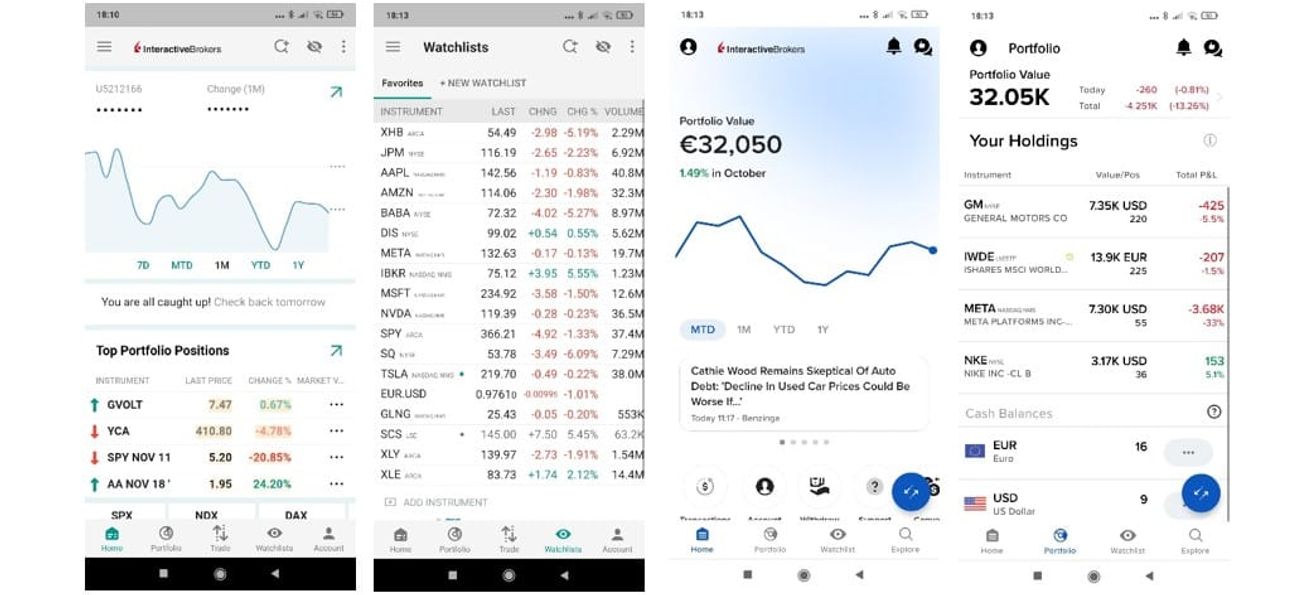
For newer investors, IBKR also offers IBKR GlobalTrader, a modern mobile app designed for stocks, ETFs, and options trading with automatic currency conversions, fractional shares from $1, and a paper trading mode, ideal for easing into the IBKR ecosystem before moving on to more advanced tools.
On the downside, IBKR’s fee structure can feel complex, account opening takes a few days, and the broker isn’t commission-free. The main platforms (Trader Workstation, IBKR Desktop) also have a steep learning curve for beginners. That said, when factoring in tight FX fees, narrow spreads, securities lending income (via the Stock Yield Enhancement Program), and access to 170+ global markets from a single account, IBKR clients typically save significantly compared with most other brokers over time, particularly UK investors making regular USD-denominated trades.
IBKR mobile apps
Pros
- Low commissions on US stock trading
- No monthly inactivity fee
- The broadest product and markets range in the brokerage industry
- Demo account
- Excellent reputation (founded in 1978)
- Extensive research and Education tools
- Has a modern mobile trading app to trade Stocks, Options and ETFs, ideal for novice investors, IBKR GlobalTrader.
- Offers interest on uninvested cash balances
Cons
- Complicated and lengthy account opening process (but fully online)
- Steeper learning curve for beginners
- Website is difficult to navigate
- Interactive Advisors (Robo-advisor feature) is only available for US customers
Want to know more about Interactive Brokers? Check our Interactive Brokers Review.
#2 eToro

55% of retail CFD accounts lose money.
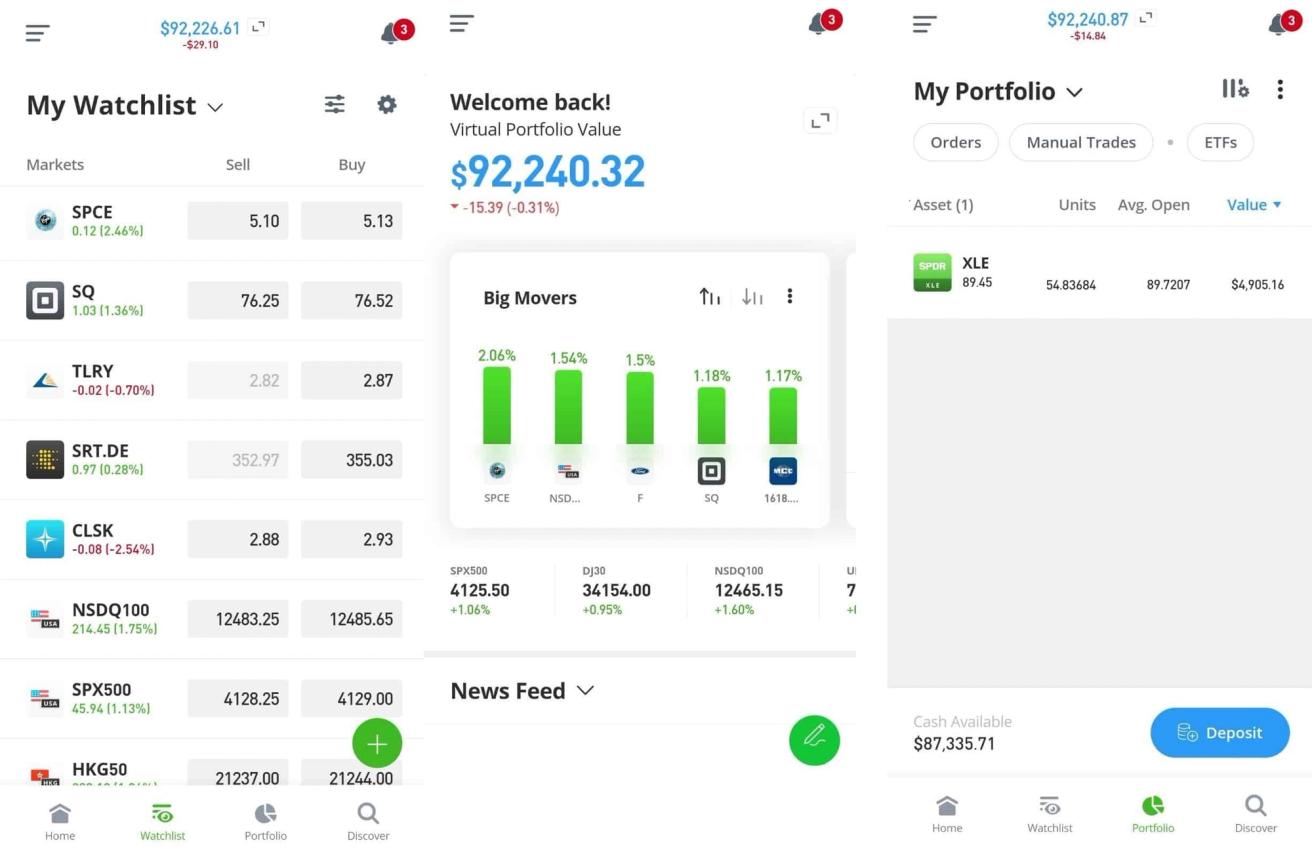
Founded in 2007, eToro is a well-known global fintech and the leader in social trading, following and copying other investors’ trades automatically. The platform now serves 40 million registered users across 75 countries and went public on NASDAQ (ticker: ETOR) in May 2025, adding a meaningful credibility milestone for UK investors. The interface is clean and intuitive, making it well-suited to beginners. eToro offers commission-free real ETF trading, while stock trades carry a $1 or $2 commission depending on the exchange and your country of residence, charged both on opening and closing a position.
For UK investors, eToro offers an ISA powered by Moneyfarm, now in three variants: a Cash ISA, a Stocks and Shares ISA covering 1,000+ stocks, ETFs, bonds and funds, and a Managed ISA. Transfers in are free. UK clients are served by eToro (UK) Ltd, FCA-regulated (FRN 583263), with FSCS protection up to £85,000.
Opening an account is fast and fully digital, and you can practise with a free demo account ($100,000 in virtual funds) before committing real capital.
On currency, the picture has improved and is still widely misreported. eToro now offers UK clients a GBP local-currency account, provided by etoro Money UK Ltd, so you can deposit, hold and trade in sterling with zero conversion fees on GBP-denominated assets and no withdrawal fee. The $5 withdrawal fee applies only to the USD account, and converting between the two costs 0.75%. Note that the rollout is gradual, so it may not be live on every account yet, and trading fees are still calculated in USD. Spreads can be wider on some products than at specialist brokers, which is the trade-off for the social trading and copy trading features.
Social trading lets users observe and learn from experienced traders in real time. Newer investors can follow the strategies of successful traders, understand their decision-making, and gain insight into market behaviour and execution. eToro’s social trading feed is intuitive, you can filter by asset class, region, or trader profile, and engage with other users on the companies and themes most relevant to you. The platform’s CopyTrader feature lets you automatically mirror up to 100 traders simultaneously, and Smart Portfolios bundle thematic strategies (AI, semiconductors, dividend stocks, clean energy) into single allocations.
eToro mobile app
Pros
- Low stock trading fees (from $0 per trade)
- Commission-free ETFs (other fees apply)
- Social trading and other innovative products
- Wide variety of financial products
- Slick, modern, and easy for anyone to use
- European users have access to three account currencies: EUR, USD and GBP
- Top tier regulators
Cons
- Limited disclosed financial information
- Withdraw and inactivity fees
- Spread, overnight, inactivity, and currency conversion fees higher than average
- Doesn’t offer bonds, futures, or options
eToro is a multi-asset investment platform. The value of your investments may go up or down. Your capital is at risk.
CFDs are complex instruments and come with a high risk of losing money rapidly due to leverage. 55% of retail investor accounts lose money when trading CFDs with this provider. You should consider whether you understand how CFDs work and whether you can afford to take the high risk of losing your money.Copy Trading does not amount to investment advice. The value of your investments may go up or down. Your capital is at risk.
Don’t invest unless you’re prepared to lose all the money you invest. This is a high-risk investment and you should not expect to be protected if something goes wrong. Take 2 mins to learn more.
#3 Trading 212

Trading 212 at a glance
Capital at Risk. Sponsored Link. To get free fractional shares worth up to 100 EUR/GBP, you can open an account with Trading 212 through this link. Terms apply.
Trading 212 is a London-headquartered fintech that aims to democratise investing through one of the cleanest mobile and web platforms in the European retail market.
The platform reports over 5 million lifetime funded accounts and gives access to thousands of stocks and ETFs across UK, US, and European markets. A point UK readers should know: Trading 212 launched a spot crypto service in October 2025, but it runs through a Cyprus entity under MiCA and is not available in the UK.
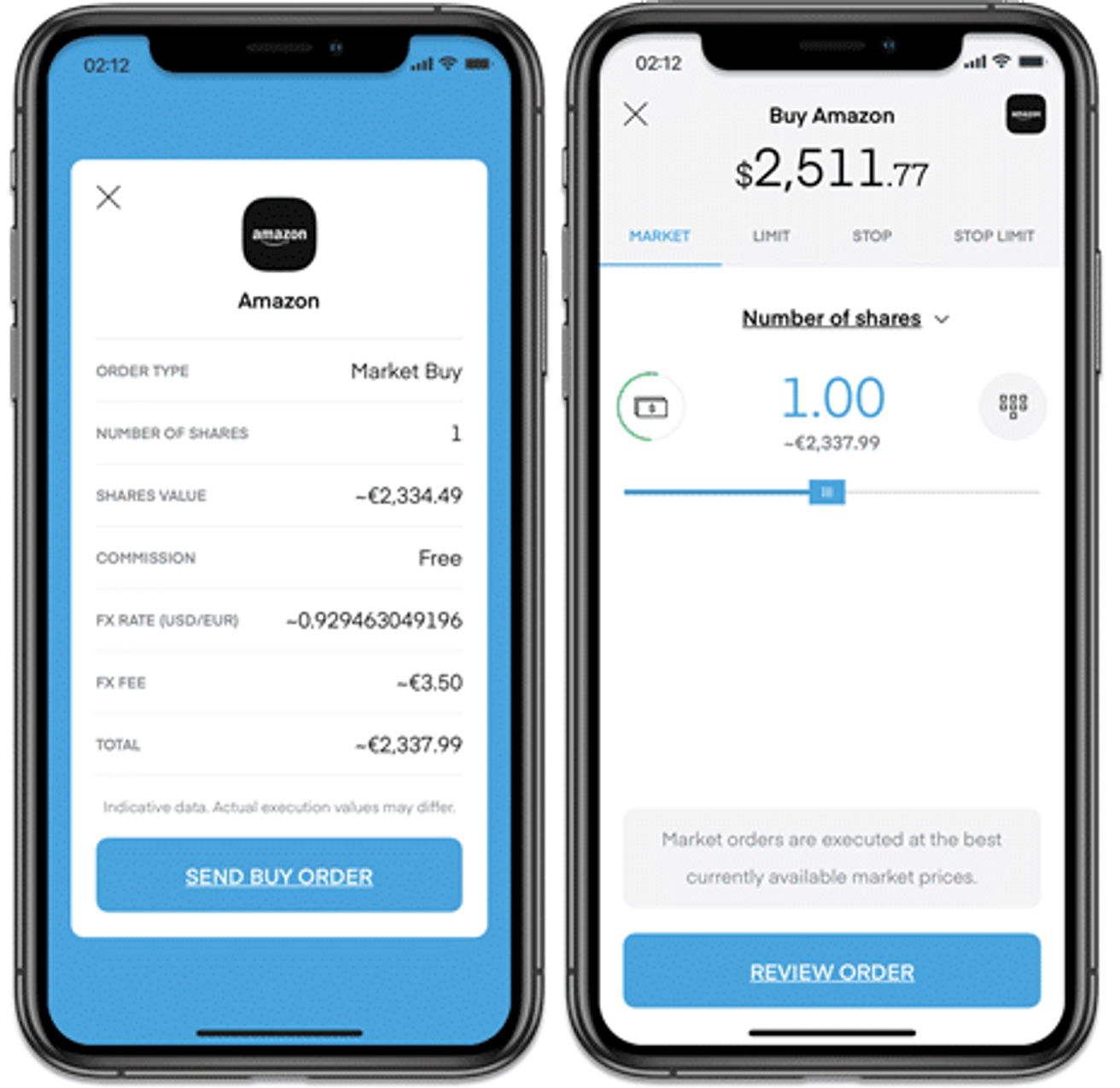
Trading 212 offers no commissions on stocks and ETFs. A 0.15% FX fee applies when converting funds, and other fees may apply, so check the terms and fees page. It also offers fractional shares and an automatic investment system via Pies & AutoInvest, which lets you build a portfolio of stocks and ETFs in your chosen allocations, with one-tap rebalancing. Pies and AutoInvest is an execution-only service. Not investment advice or portfolio management. Automatic investing refers to executing scheduled deposits. You are responsible for all investment and rebalancing decisions.
The platform also pays interest on uninvested cash, published at around 3.55% on GBP when we checked in September 2026. When investing, your capital is at risk. If you enable interest, Trading 212 will hold your cash in qualifying money market funds and banks. Otherwise, your cash will be held only in banks. Interest applies on cash in an investment account. Terms apply. Rates change frequently, so the figure shown may no longer be current; refer to the terms and fees page for live rates.
For UK investors, Trading 212 offers a Stocks and Shares ISA and a Cash ISA, the latter live since May 2024, and added a SIPP in 2026. The Cash ISA rate is published as a formula rather than a number: the Bank of England base rate minus 0.15%. Trading 212 UK Limited is FCA-regulated (FRN 609146), with FSCS protection up to £85,000.
Sponsored Link. New users can get free fractional shares by opening an account through our link; the value of each share varies and the maximum is around £100. Terms apply. On the downside, the product range still has gaps, notably no individual bonds, options or futures, and the platform is less suited to advanced active traders looking for sophisticated charting tools.
Pros
- Commission-free real stock, ETFs and crypto trading (other fees may apply. See terms and fees)
- AutoInvest & Pies feature (execution-only service, not financial advice)
- Fast and easy account opening process
- Demo account
- Top Tier Regulators
- Free fractional shares worth up to €100
- High interest on uninvested cash
Cons
- Limited product portfolio (no Options, Bonds, Mutual Funds or Futures)
- No relevant Fundamental tools
- 0.15% of Foreign exchange fees
Disclaimer: When investing, your capital is at risk and you may get back less than invested. Past performance doesn’t guarantee future results.
#4 Webull

Webull is one of the largest US discount brokers, reporting 27.6 million registered users and 5.1 million funded accounts at 31 March 2026. It launched its UK operation in 2023 and has expanded its UK product range steadily since.
UK users can invest in US stocks (including fractional shares), US options, UK shares and ETFs. Webull cut commissions twice in a year: to a flat $0.10 per trade in October 2025 and then to zero on US and Hong Kong shares on 1 April 2026. UK shares and ETFs carry a 50p minimum commission, and the FX fee is 0.50% on the free Go plan or 0.35% on Meridian.
The UK range is split across two tiers, which matters more than it sounds. Webull Go is free and covers US shares and options, FTSE 100 constituents and 20 ETFs. Webull Meridian costs £5 a month and adds UK shares beyond the FTSE 100, the full UK ETF range, multi-currency accounts and lower fees. The Stocks and Shares ISA, launched on 1 April 2026, is available to Meridian subscribers only. New users can receive a sign-up bonus. Webull also offers a separate GBP cash savings product paying up to 4.00% AER through a third-party bank, rather than interest on uninvested cash in the trading account itself.
The platform features no minimum deposit, no deposit/withdrawal/inactivity/platform fees, and a free paper trading account for practising risk-free. The mobile app is particularly polished, one of the better designed apps in the UK retail space, with strong charting tools, advanced order types, and real-time market data.
On the downside, the product range is still narrower than longer-established UK brokers, notably no cryptocurrency trading, no bonds, and no SIPP yet (Webull has signalled SIPP launch plans). All in all, Webull is a strong choice for UK investors looking for low-commission US market access, polished mobile experience, and beginner-friendly tools.
Webull Securities (UK) Limited is authorised and regulated by the Financial Conduct Authority (FRN 961286), with client assets protected up to £85,000 under the FSCS.
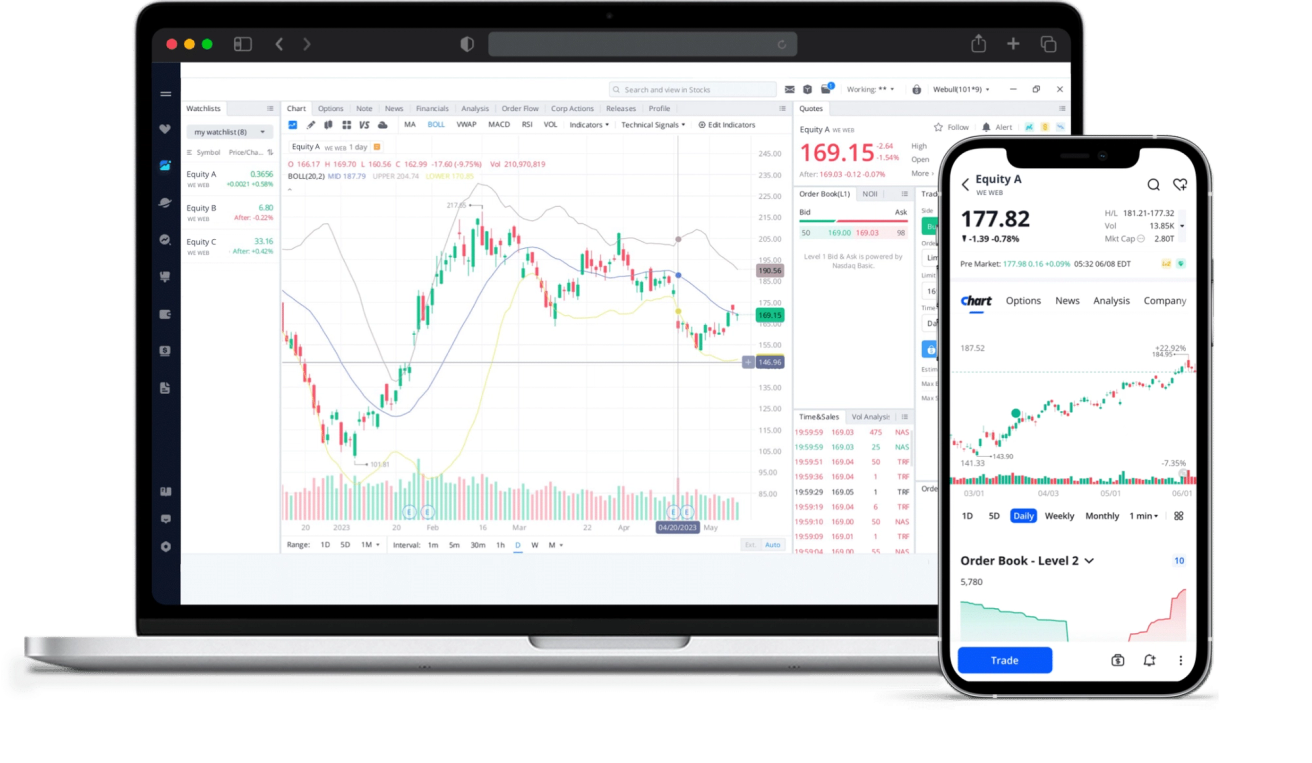
Webull trading platform
Pros
- Free Shares Sign Up Promotion
- Mobile-friendly app
- Fractional Shares
- Access to US-listed stocks and options
- One of the largest brokerages in the USA
- Regulated by the FCA
- Demo Account (paper trading)
Cons
- No ISA or SIPP
- Limited range of assets available - no ETFs, bonds, crypto
- FX fee
- No commission-free trading
#5 Freetrade

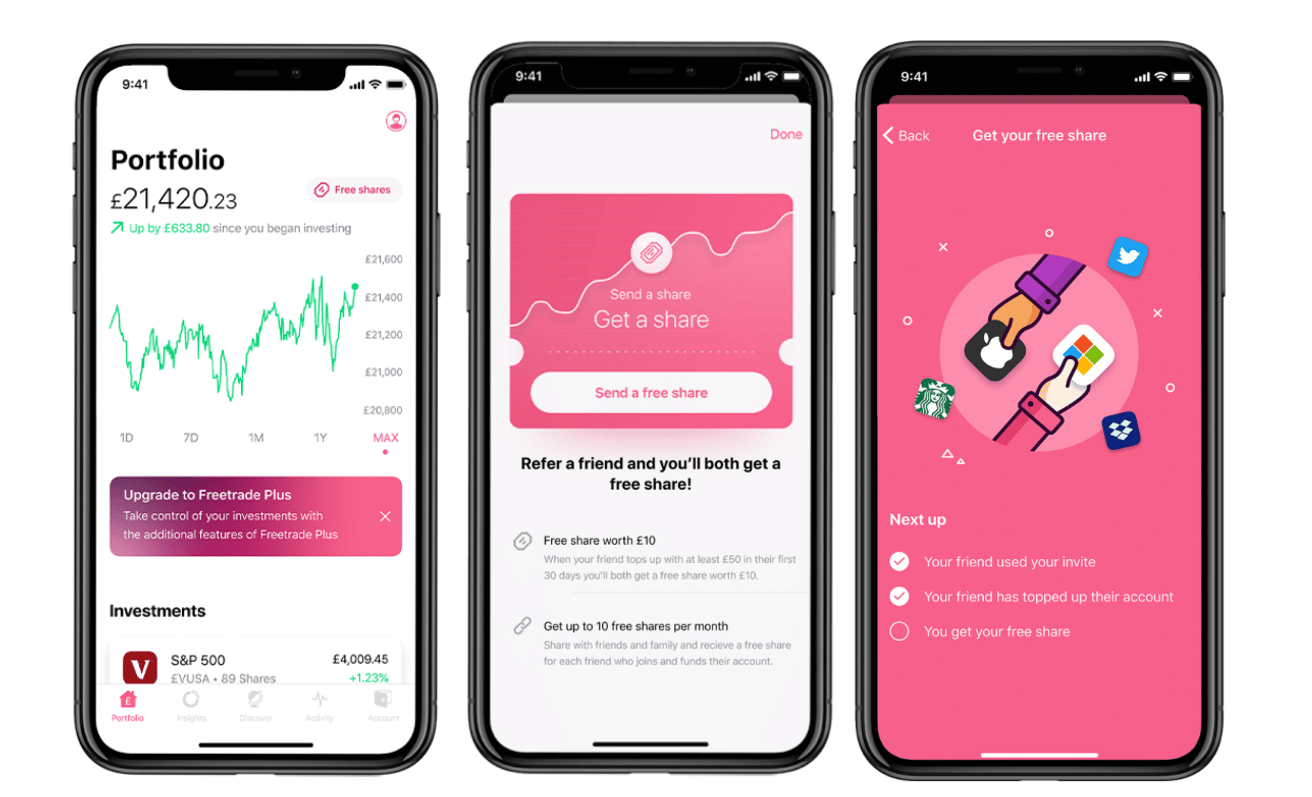
Freetrade is a UK-headquartered commission-free stockbroker. It’s a strong option for investors building a long-term portfolio of stocks and ETFs without paying per-trade commissions.
Freetrade operates under a tiered subscription model:
- Basic (free): 0.99% FX fee, 1% variable interest on uninvested cash up to £1,000, limit orders, stop losses, recurring orders and extended hours trading.
- Standard (£4.99 a month billed annually, £5.99 monthly): 0.59% FX fee, 2.5% variable interest up to £2,000, richer fundamentals.
- Plus (£9.99 a month billed annually, £11.99 monthly): 0.39% FX fee, 3.5% variable interest up to £3,000, priority customer service and free same-day withdrawals.
One correction worth making, because most comparisons get it wrong: the Stocks and Shares ISA, Junior ISA, SIPP and General Investment Account are all included on every plan, Basic included. What the paid tiers buy is a lower FX fee, better cash interest and more tools, not the tax wrappers themselves.
For UK investors trading US stocks regularly, the FX conversion fees do add up. Even the lowest tier, 0.39% on Plus, is higher than Trading 212 at 0.15%, Lightyear at 0.1% or Interactive Brokers at 0.20 basis points. Weigh that against the simplicity and the clean UK-native experience Freetrade offers.
Freetrade Ltd is FCA-regulated (FRN 783189), with FSCS protection up to £85,000. On 1 April 2025, Freetrade was acquired by IG Group, the LSE-listed broker, for around £160 million, which has strengthened its long-term backing and is expected to support continued product expansion.
Pros
- Commission-free stocks and ETFs (other charges may apply)
- Free GIA, ISA, Junior ISA and SIPP on every plan
- No inactivity or account fees
- No minimum deposit
- Nice and user-friendly app
Cons
- No options, CFDs or direct crypto
- Limited research and education
- Graphs and portfolio tracking still need some development
- No phone support (in-app messages and email)
#6 Hargreaves Lansdown

Hargreaves Lansdown is one of the UK’s largest investment platforms for individual investors. It reported 2,018,000 active clients and £172.7 billion in assets under administration at 30 June 2025. In March 2025, HL was acquired by a consortium of CVC Capital Partners, Nordic Capital and Abu Dhabi Investment Authority in a deal valuing the company at £5.4 billion, taking it private after nearly two decades on the London Stock Exchange.
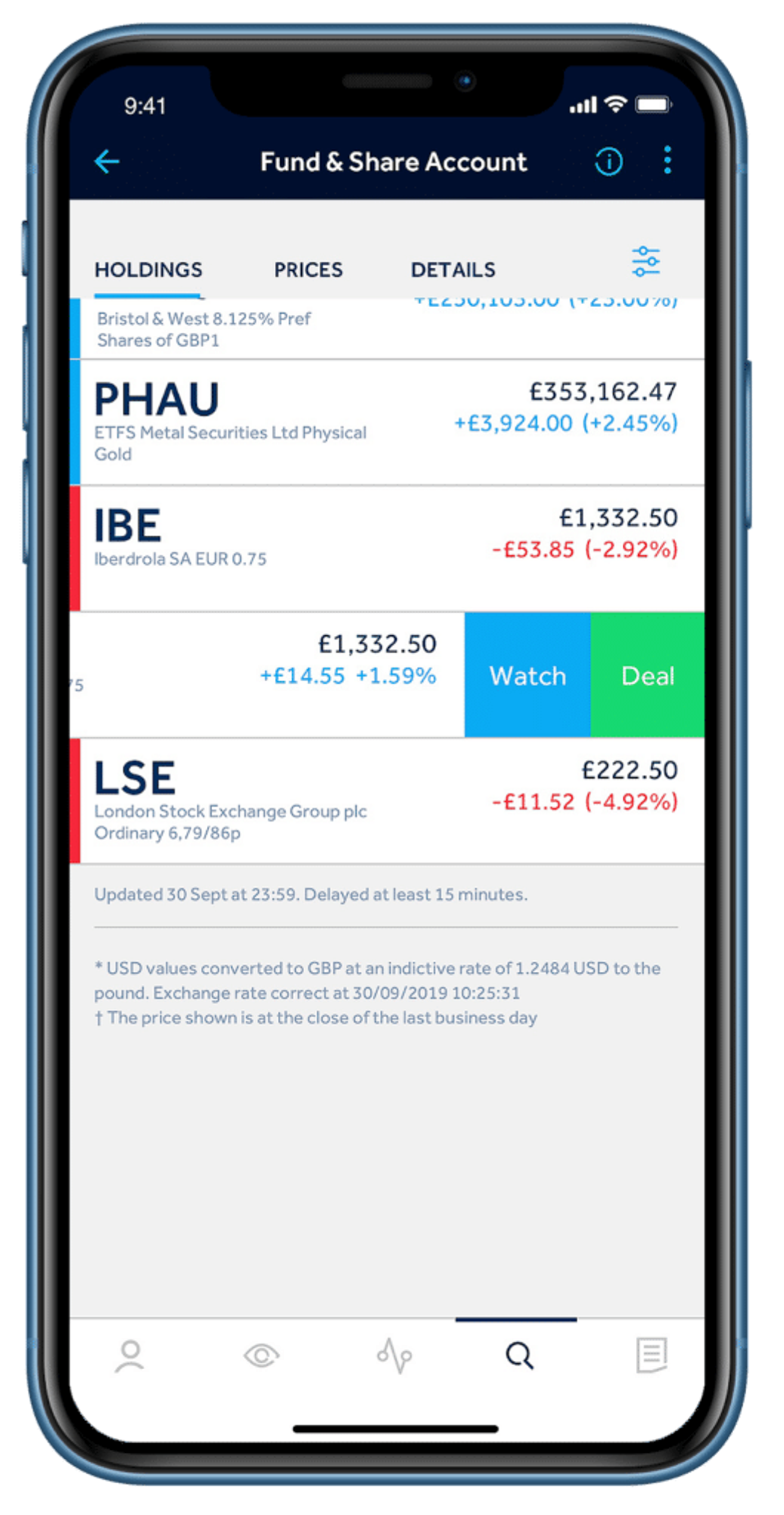
The platform offers a comprehensive range of financial instruments, UK and international stocks, ETFs, mutual funds, investment trusts, bonds, and gilts. UK investors have full access to all the major tax wrappers: Stocks & Shares ISA, SIPP, LISA, JISA, and Cash ISA.
HL repriced on 1 March 2026 and the old schedule is now wrong everywhere it is still quoted. The platform fee on funds is 0.35% up to £250,000, falling in tiers above that and free above £2 million. On shares, ETFs, investment trusts, bonds and gilts it is also 0.35%, but capped at £12.50 a month, which is £150 a year. That cap replaced the old £45 ISA cap, so the headline rate fell while the ceiling more than tripled. Share dealing is now £6.95 per online deal, or £3.95 once you place 20 or more in a month, and free via monthly direct debit. One-off online fund deals now cost £1.95.
HL is FCA-regulated, with client assets protected up to £85,000 under the FSCS. Customer service is widely regarded as market-leading among UK platforms, and HL’s educational resources (HL Insight, market commentary, fund research) are among the most comprehensive in the UK. The trade-off is the higher fee structure, HL is best suited to investors who value the full-service experience and don’t mind paying for it.
Pros
- Excellent research and educational tools
- Great customer service
- No inactivity fee
- No withdrawal fee
- No minimum deposit
- High reliability and security
- Listed in the FTSE 100 index
- Has ISA, SIPP, and other products and services catered to british investors
Cons
- High trading commissions (UK and overseas shares, investment trusts, ETFs, gilts and bonds)
- Annual account charges for funds (up to 0.45%)
- No demo account
- Only one base currency: GBP
- High currency conversion fee (up to 1%)
#7 Interactive Investor

Disclaimer: As investment values can go down as well as up, you may not get back all of the money you invest. If you’re unsure if an investment account is right for you, please speak to an authorised financial adviser.
Interactive Investor describes itself as the UK’s number one flat-fee investment platform, and publishes over 500,000 customers and £85 billion in assets under administration. Its parent puts the figures higher still at 30 June 2026, at 525,000 customers and £108 billion, which it says is around a fifth of UK direct-to-consumer platform assets. The platform was acquired in 2022 for £1.49 billion by Aberdeen Group plc, which was called abrdn until its 2025 rename.
Interactive Investor has a strong focus on UK investors, and says over half of its customers have been with the platform for more than ten years. It offers a vast selection of investment options including UK and international stocks, ETFs, funds, investment trusts, and bonds, along with the full range of UK tax wrappers (Stocks & Shares ISA, SIPP, JISA).
ii’s distinctive feature is its flat-fee subscription model rather than percentage-based fees, which is particularly attractive for larger portfolios, where percentage-based platforms get more expensive as they grow. Note that ii replaced its entire price list on 1 February 2026: the old Investor Essentials, Investor, Pension Builder and Super Investor plans are retired, and all three current plans include an ISA, a SIPP and a Trading Account.
- Core (£5.99 a month): portfolios up to £100,000, with UK and US trades at £3.99 and a 0.75% FX fee.
- Plus (£14.99 a month): no portfolio limit, adds Junior ISAs and up to five free family accounts, one free trade a month, FX falling to 0.25% above £50,000.
- Premium (£39.99 a month): unlimited family accounts, two free trades a month, trades at £2.99 and a flat 0.25% FX fee.
If responsible investing is a priority, ii publishes the ACE 40, a rated list of 40 sustainable funds, alongside a wider sustainable investment screener. The platform is FCA-regulated, with FSCS protection up to £85,000.
Pros
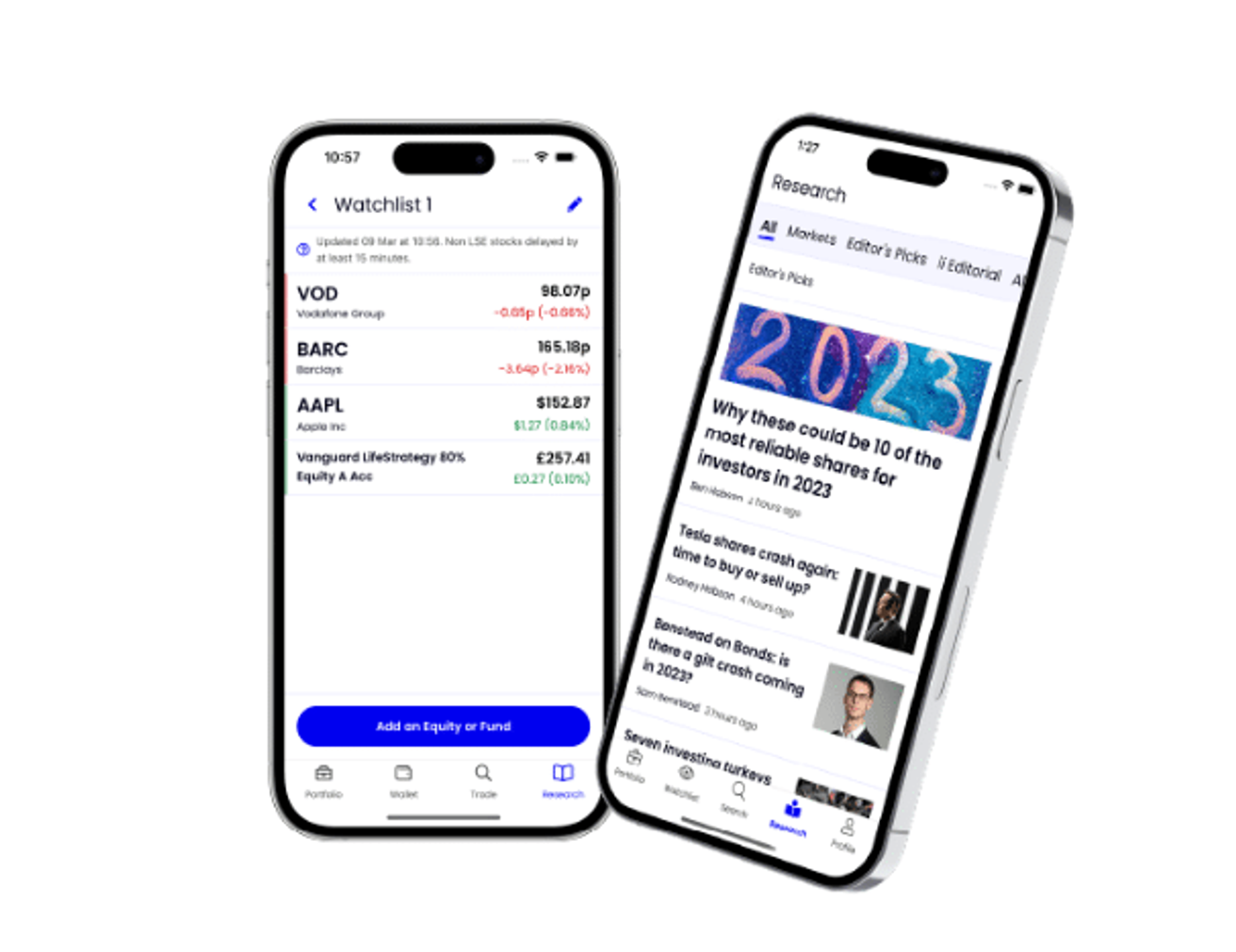
- User-friendly trading platforms
- Multi-currency account
- Access over 40,000 global investments
- Exclusive seminars and events
- Good educational resources
Cons
- Limited product offering
- Basic charting (limited customization) and analytic tools
- Expensive for investors with smaller portfolios
#8 Lightyear

Terms apply, seek guidance if necessary. When you invest, your capital is at risk.
Lightyear is a fast-growing European broker founded in 2021 in Tallinn, Estonia, by ex-Wise alumni. It has positioned itself as a low-cost, mobile-first option for European and UK investors. The product offering is more focused than larger platforms, but Lightyear makes up for it with very low fees, a clean app design, and competitive returns on uninvested cash, published at around 3.85% AER on GBP. Read that carefully: Lightyear Vaults are not a deposit account but BlackRock money market funds, which track the central bank overnight rate, pay out monthly and are not covered by FSCS deposit protection.
FX conversion fees are often where brokers quietly add up costs, particularly when trading US stocks from a GBP account. Lightyear’s multi-currency account lets you hold cash in GBP, EUR and USD, so you can avoid repeated conversions on every trade. Lightyear cut its pricing on 11 March 2026: conversion now costs 0.1%, and UK, US and EU shares and ETFs trade commission-free in both the general account and the ISA. That 0.1% is among the lowest in the UK retail market, against 0.15% at Trading 212 and 0.39% to 0.99% at Freetrade.
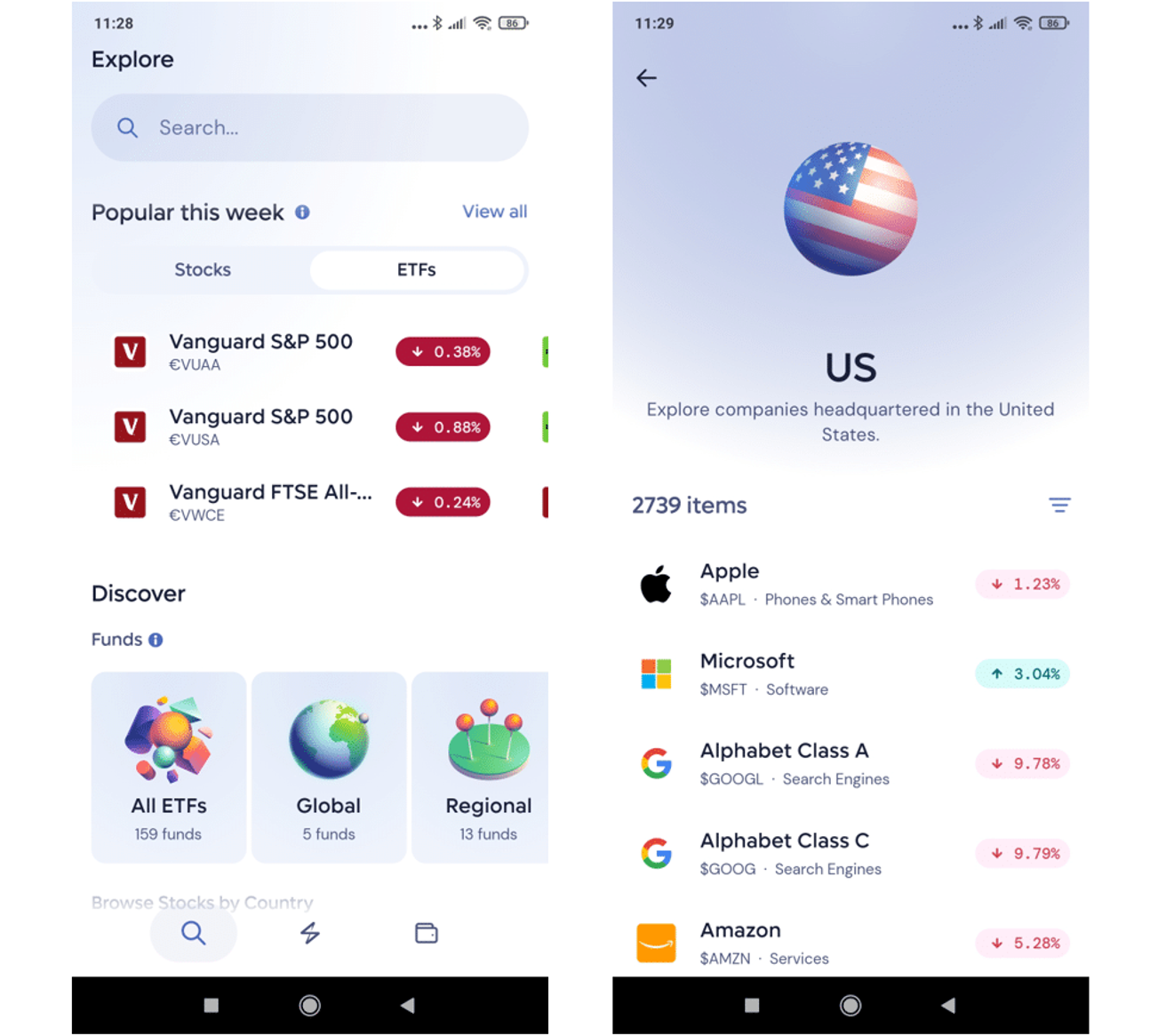
Lightyear mobile app
Lightyear also offers a free share worth up to £100 via our promo code.
For UK investors, Lightyear launched both a Stocks and Shares ISA and a Cash ISA on 23 January 2025, closing what was previously a meaningful gap against UK-native brokers. On regulation, the UK entity is Lightyear U.K. Ltd, directly authorised by the Financial Conduct Authority under FRN 987226 since November 2024, not passported from Estonia. UK clients have FSCS protection up to £85,000 on investments.
On the downside, the product range is narrow: single equities, ETFs and money market funds, with no options, forex, individual bonds or pension. Lightyear did launch crypto in May 2026, but through its Estonian entity under MiCA, and it is not available in the UK. Lightyear is best suited to investors who want a clean, low-cost UK investing experience focused on stocks, ETFs, and money market fund-based cash interest, rather than a full-service platform with every product category.
Pros
- 0% Lightyear execution commission on ETF trading (other fees, like fund manager and FX fees, may apply)
- No account opening, inactivity, or withdrawal fees
- High interest on EUR, USD & GBP through MMFs
- Free multi-currency account
- Minimum deposit of €/£/$1
- Fractional Shares
- Account opening promotion with the promo code INVESTINGINTHEWEB
- You can automate your investments with "Plans"
Cons
- Limited financial instruments (no options or futures; commodities only via ETCs such as gold, silver and copper; bonds limited to a small Baltic selection)
- No demo account
- Only available in 25 european countries (not available internationally)
- 0.35% currency conversion fee (0.10% for UK GIA and ISA accounts)
Disclaimer: Capital at risk. The provider of investment services is Lightyear U.K. Ltd for the UK and Lightyear Europe AS for the EU. Terms apply: lightyear.com/terms. Seek qualified advice if necessary.
The bottom line
Ultimately, the right stock trading app for you depends on your experience level, the products and features you actually need (tax wrappers, fractional shares, international markets, cash interest, etc.), and your overall investment goals. UK investors are genuinely spoiled for choice in 2026, a great problem to have, but one that can make the final decision feel harder than it needs to be.
A quick framing to help narrow things down:
- Beginner, mobile-first, low-cost: Trading 212, Lightyear, or Webull.
- Full-service platform with strong research: Hargreaves Lansdown or Interactive Investor.
- Global market access and professional-grade tools: Interactive Brokers.
- Social and copy trading: eToro.
- Pension-focused (SIPP): Interactive Investor, Hargreaves Lansdown, Freetrade or Trading 212, which added a SIPP in 2026.
If you’re still unsure which app suits you best, try our Help Me Choose tool, it gives you a tailored shortlist based on your country, experience level, and priorities.
Disclaimer: This article is for informational purposes only and does not constitute financial or investment advice. Investments can go down as well as up, past performance is not a reliable indicator of future returns. UK tax rules around ISAs, SIPPs, and other tax wrappers are subject to change; consider consulting a qualified financial advisor about your specific situation.
FAQs
What are the most important features to have in a stock trading app in the UK?
It can be a bit of a minefield when you are trying to pick a stock trading app in the UK; there are so many different options with their own unique features. When it boils down to it, there are some basics that your stock trading app should have.
Here is a list of questions to ask yourself when you are assessing what stock trading app to choose:
- Is it User-Friendly?
- Can you top up your account from your Mobile?
- Portfolio Tracking, Is it easy to clearly track your portfolio’s performance?
- Security, are there two-factor authentication (2FA) or biometric authentication methods available?
- Can you open a demo account?
- Does it offer fractional share investing?
- News and Alerts, keep track of the latest market developments