
Webull and Fidelity both charge $0 commission on US stocks and ETFs, but they suit different investors. Webull is a trading app with free options contracts and paper trading, while Fidelity is a full-service broker with mutual funds, bonds, retirement accounts and interest on cash by default.
In this comparison, we put the US figures side by side and show what each broker costs in a year for an options trader, a margin borrower and an investor who keeps cash in the account.
Webull vs Fidelity: quick take
- Webull is best for options traders, who pay $0 per contract against $0.65 at Fidelity, and for investors who borrow on margin or want paper trading.
- Fidelity is best for long-term investors who want mutual funds, bonds, a wide choice of retirement accounts and interest on cash with no subscription.
Webull vs Fidelity in a nutshell
| Category | Webull | Fidelity |
| US stocks and ETFs | $0 commission | $0 commission |
| Stock and ETF options | $0 per contract | $0.65 per contract |
| Margin rate (under $25,000) | 8.74% (5.45% with Premium) | 12.075% |
| Interest on uninvested cash | 3.60% APY with Premium ($3.99/month) | 3.61% (SPAXX 7-day yield), no subscription |
| Mutual funds | No | Yes ($0 on Fidelity funds) |
| Paper trading | Yes | No (strategy backtesting only) |
| Outgoing transfer fee | $75 | $0 |
Source: Webull pricing, margin and Premium pages, and Fidelity commissions and margin rates page. Webull margin rates as of 16 October 2026, Fidelity base rate as of 18 September 2026, SPAXX yield as of 25 November 2026. Data as of November 2026.
1. Overview
Webull
Webull is owned by Webull Corporation, which is headquartered in St. Petersburg, Florida, and listed on Nasdaq (BULL). US accounts are held by Webull Financial LLC, which is registered with the SEC and is a member of FINRA and SIPC. The app is built for active trading, with charts, screeners and a paper trading account. You can read more in our Webull US review.
Fidelity
Fidelity Investments (FMR LLC) is a privately owned financial group. Its US brokerage accounts are held by Fidelity Brokerage Services LLC, a member of FINRA and SIPC, with clearing by National Financial Services. Fidelity covers investing, retirement and wealth management, with branches (Investor Centers) across the US and its own range of mutual funds.
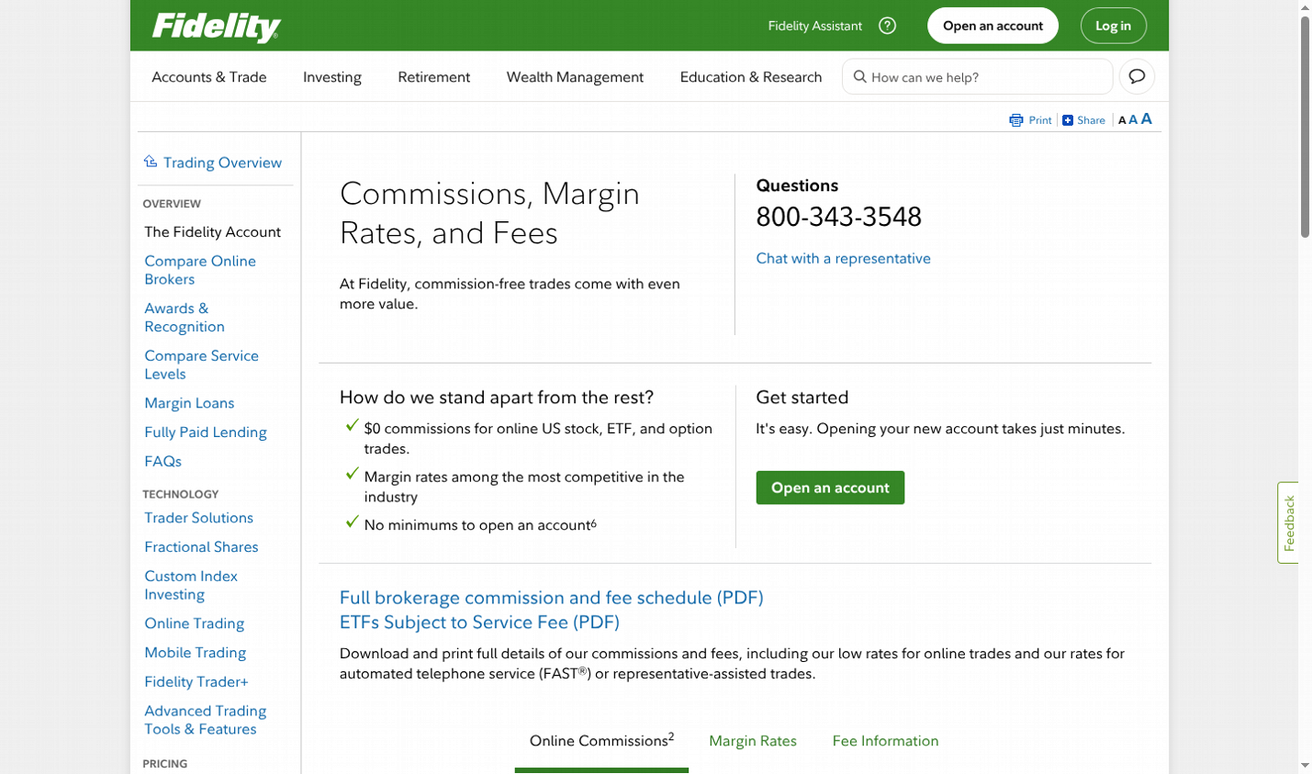
Fidelity commissions page
2. Products
Webull: US stocks and ETFs, fractional shares, options, OTC stocks, futures, crypto, prediction markets and US Treasury and corporate bonds.
Fidelity: US stocks and ETFs, fractional shares, options, Fidelity and third-party mutual funds (including four ZERO index funds with no expense ratio), bonds, CDs and Treasuries, crypto, and stocks on 25 foreign markets in their local currency.
Crypto costs about the same: Fidelity charges a 1% fee on each buy and sell, and Webull builds a 1% spread into the price of each trade.
3. Trading platforms
Webull: mobile app, web platform and Webull Desktop, with charting, screeners and a paper trading account with real-time quotes. Nasdaq TotalView Level 2 data is included in Webull Premium.
Fidelity: website, mobile app and the Fidelity Trader+ platform for active traders, with options analytics and Strategy Testing, which simulates a trading strategy on past prices. Fidelity has no paper trading account with virtual money.
4. Interest on cash
Fidelity: sweeps uninvested cash into a money market fund, usually the Fidelity Government Money Market Fund (SPAXX), whose 7-day yield was 3.61% on 25 November 2026, after the fund's 0.42% expense ratio. You earn it by default, with no plan to pay for.
Webull: pays 3.60% APY on uninvested cash in individual and joint cash accounts to Webull Premium members, with FDIC coverage of up to $5 million through program banks. Premium costs $3.99 a month or $40 a year.
On $10,000 of cash, both pay about $360 a year, but Webull needs the $40 Premium plan, so you keep about $361 at Fidelity and $320 at Webull. Both rates are variable.
5. Account types
Webull: individual and joint cash and margin accounts, custodial accounts and traditional, Roth and rollover IRAs. IRA contributions get a 3.5% match with Webull Premium, or 1% without it, if you keep Premium for a year and the money in the IRA for five years.
Fidelity: brokerage accounts, IRAs, health savings accounts (HSAs), 529 college savings plans, small business retirement plans and managed accounts, including the Fidelity Go robo-advisor (no fee below $25,000, then 0.35% a year).
6. Account opening and transfers
Both brokers let you open an account online with no minimum deposit. Leaving is free at Fidelity, while Webull charges $75 per outgoing stock transfer, as we explain in how to close a Webull account. Webull pays a 1% match on IRA transfers and rollovers for a limited time.
7. Pricing
What a year costs
| Investor | Webull | Fidelity |
| Buys US ETFs every month | $0 | $0 |
| Trades 20 option contracts a month | $0 | $156 |
| Borrows $20,000 on margin all year | $1,748 ($1,130 with Premium, plan included) | $2,415 |
| Moves the account to another broker | $75 | $0 |
Our calculation with each broker's November 2026 rates. Options: 240 contracts a year at $0.65. Margin: 8.74% or 5.45% at Webull, 12.075% at Fidelity, interest only. Regulatory fees not included.
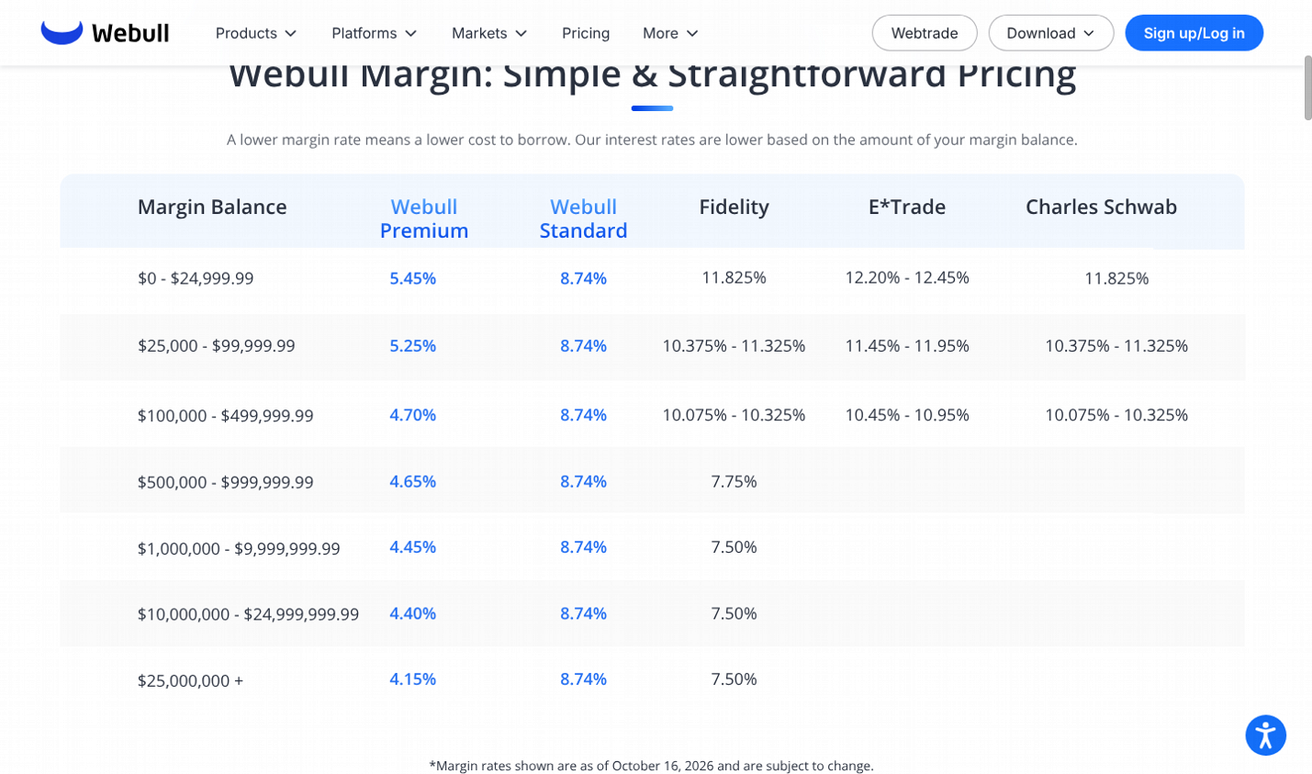
Webull margin rates
For a buy-and-hold investor in US stocks and ETFs, both brokers are free. Fidelity costs more for options and margin, where its rates run from 12.075% on small loans to 10.325% between $250,000 and $499,999, and less for anyone who keeps cash without paying for a plan or later moves the account. For every cost, see our guides on Fidelity fees and Webull fees.
8. Regulation and security
Who regulates them: Webull Financial LLC (CRD 289063) and Fidelity Brokerage Services LLC (CRD 7784) are broker-dealers registered with the SEC and members of FINRA, the self-regulator of US brokers. Fidelity's trades are cleared by National Financial Services LLC, while Webull uses Apex Clearing. You can look up both firms on FINRA BrokerCheck, linked in the overview above.
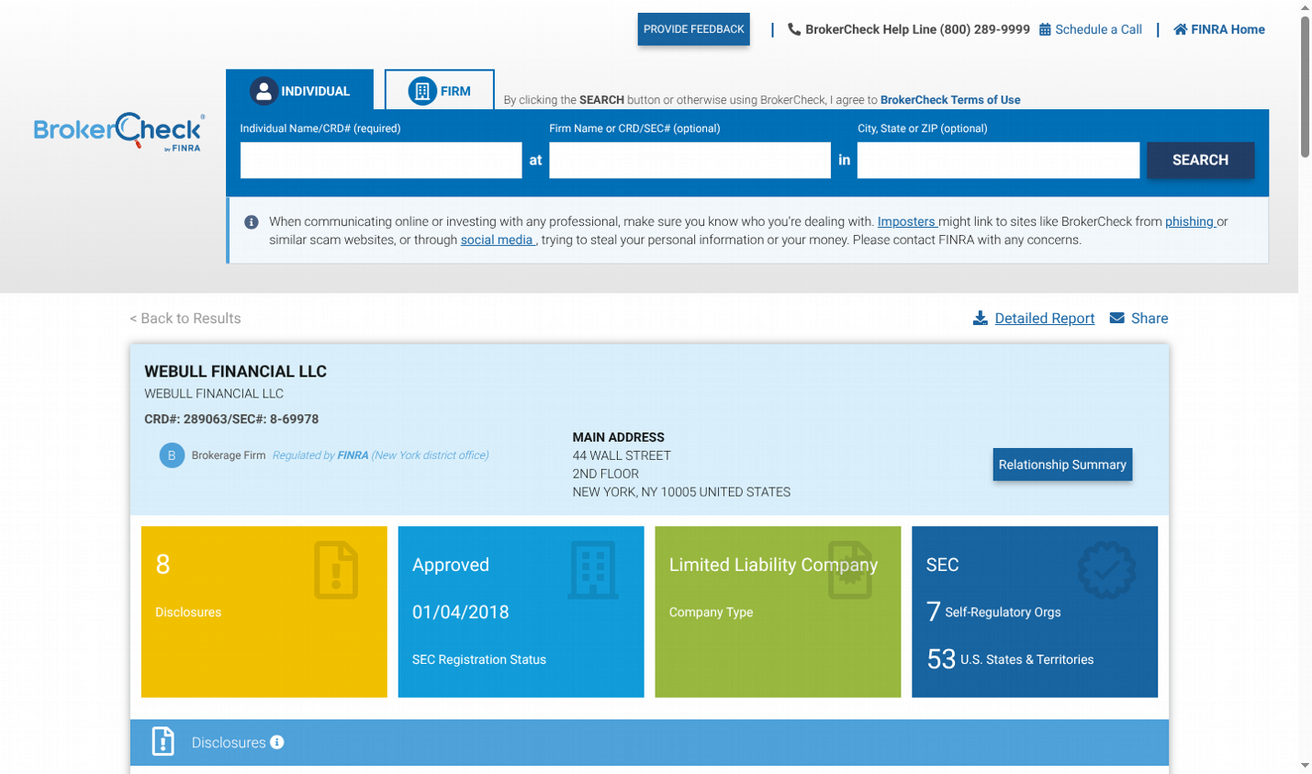
Webull Financial on FINRA BrokerCheck
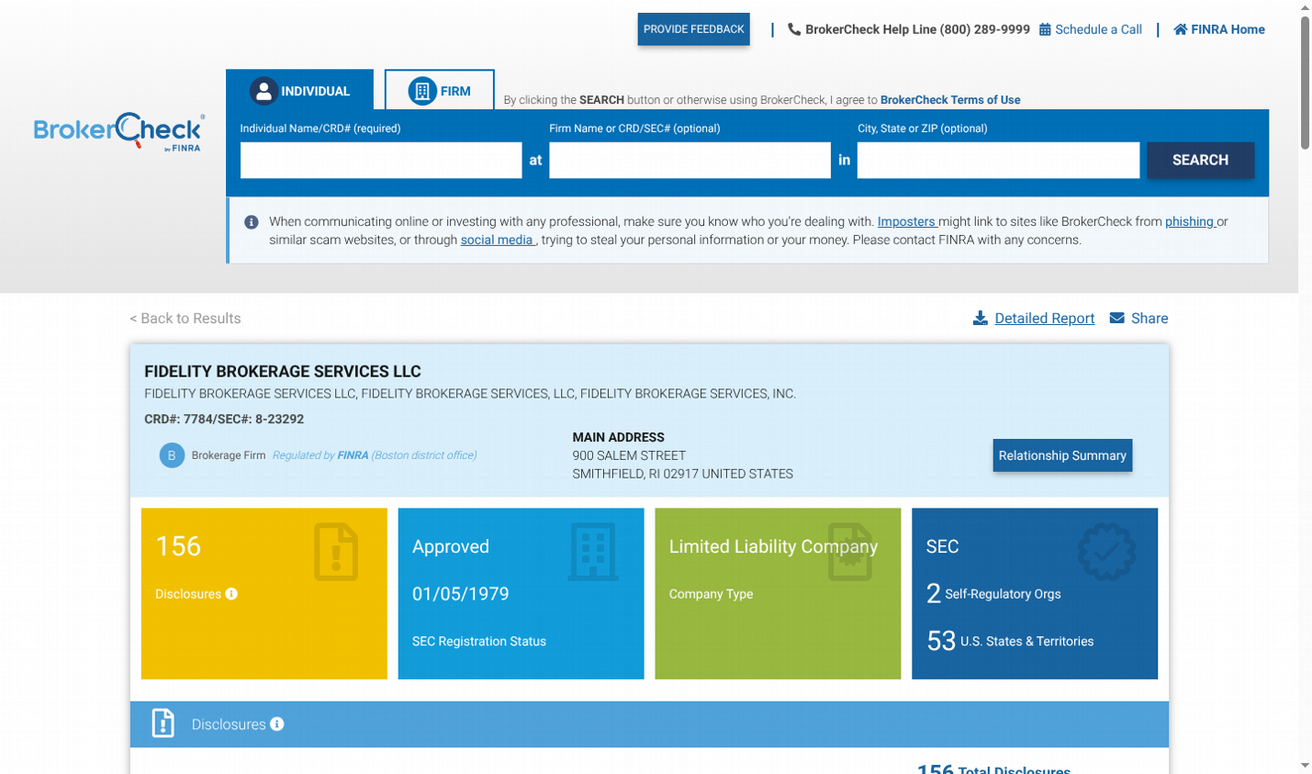
Fidelity Brokerage Services on FINRA BrokerCheck
Disciplinary history: as of 26 November 2026, BrokerCheck lists 8 disclosures for Webull Financial (7 regulatory events and 1 arbitration) and 156 for Fidelity Brokerage Services (24 regulatory events and 132 arbitrations). The totals are not directly comparable, since Webull has been registered since 2018 and Fidelity since 1979, with far more clients. Webull's largest case was a $3 million FINRA fine in 2023 for approving customers for options trading without enough due diligence and for weak handling of customer complaints.
SIPC protection: both brokers are members of SIPC, which covers up to $500,000 per customer, including $250,000 for cash, if a member broker fails and customer assets are missing. It does not protect you against market losses.
Excess of SIPC: both brokers also buy insurance that applies once SIPC limits are used up. Webull's policy is underwritten by Lloyd's of London, with a $100 million aggregate limit, no per-account limit on securities and a $1.9 million limit on cash. Accounts held directly with Apex Clearing are covered by Apex's own policy instead. Fidelity's policy has a $1 billion aggregate limit, with no per-customer limit on securities and a $1.9 million per-customer limit on cash.
Cash: Webull's cash programme sweeps uninvested cash to program banks, where it is eligible for FDIC insurance. Fidelity's default cash position, SPAXX, is a money market fund: SIPC covers it as a security, but it is not FDIC insured.
Futures: Webull Financial is also a futures commission merchant registered with the CFTC and a member of the NFA. Futures accounts are not covered by SIPC.
Outside the US, Fidelity.com is only for US residents, and Fidelity's UK platform is a separate business with a service fee. Webull also operates in the UK, the EU, Canada, Singapore, Australia and other markets. If you live outside the US, see our Fidelity alternatives.
9. Pros and cons
The pros and cons below reflect our own assessment of each broker. Investing involves risk, and the value of your investments can go down as well as up, so you may get back less than you invest.
Webull pros and cons
Pros
- $0 per contract on stock and ETF options
- Lower margin rates, especially with Premium
- Paper trading account
- IRA match of up to 3.5%
Cons
- Interest on cash requires Premium
- No mutual funds
- $75 fee to transfer shares out
Fidelity pros and cons
Pros
- Interest on cash by default, with no subscription
- Mutual funds, including ZERO index funds, bonds and CDs
- Wide choice of accounts (IRAs, HSAs, 529 plans)
- No fee to transfer your account out
Cons
- $0.65 per options contract
- High margin rates (up to 12.075%)
- No paper trading account
Webull vs Fidelity: our verdict
Webull
Best for options traders and marginFidelity
Best for long-term investors and retirement accounts
If you trade options or borrow on margin, Webull costs less: $0 per contract against $0.65, and 8.74% or 5.45% on margin against 12.075% on small loans. If you invest for the long term, want mutual funds or bonds, or keep cash in the account, Fidelity pays interest by default, offers more account types and charges nothing to leave.
New Webull clients can also get a welcome offer, as we explain in our Webull referral bonus guide. If you are also considering Robinhood, read our Webull vs Robinhood comparison. To compare Fidelity with a broker built for margin and global markets, see our Interactive Brokers vs Fidelity comparison.
For Fidelity against the other big US trading app, with the cost of Gold and the IRA match, see our Robinhood vs Fidelity comparison.
Disclaimer: When investing, your capital is at risk and you may get back less than invested. Options and margin trading carry a high level of risk, and margin can lead to losses greater than your deposit. This information is not investment advice. Fees, rates and offers change often, so check them on each broker's website before you open an account.
FAQs
Is Webull better than Fidelity?
For options and margin, Webull is cheaper: $0 per options contract and margin from 5.45% with Premium. For long-term investing, Fidelity offers mutual funds, bonds, more account types and interest on cash without a subscription.
Is Fidelity good for options trading?
Fidelity offers options analytics on Fidelity Trader+, but charges $0.65 per contract, so 20 contracts a month cost $156 a year. Buy-to-close orders priced at $0.65 or less are free. Webull charges $0 per contract on stock and ETF options.
Which pays more interest on cash, Webull or Fidelity?
The rates are close: 3.60% APY at Webull with Premium and 3.61% at Fidelity through SPAXX on 25 November 2026. Fidelity pays it without a subscription, so after the $40 Premium fee you keep more at Fidelity at any balance.
Can I transfer my account from Webull to Fidelity?
Yes. You request the transfer at Fidelity and your shares move through ACATS without being sold. Webull charges $75 per outgoing stock transfer, and Fidelity charges nothing if you move the other way.