
Interactive Brokers and Fidelity both offer $0 commissions on US stocks and ETFs (on the IBKR Lite plan at Interactive Brokers), but they suit different investors. Interactive Brokers gives access to 175 markets in 40 countries, with margin from 5.38%, while Fidelity is a full-service broker with its own mutual funds, a wide choice of retirement and savings accounts and interest on cash by default.
In this comparison, we put the US figures side by side and show what each broker costs in a year for an options trader, a margin borrower and an investor who keeps cash in the account.
Interactive Brokers vs Fidelity: quick take
- Interactive Brokers is best for investors who borrow on margin, at 5.38% on IBKR Pro against 12.075% at Fidelity on small loans, and for anyone who wants foreign stocks, futures or forex in one account.
- Fidelity is best for buy-and-hold investors in the US who keep cash in the account, want Fidelity mutual funds or need an HSA or a 529 plan.
Interactive Brokers vs Fidelity in a nutshell
| Category | Interactive Brokers | Fidelity |
| US stocks and ETFs | $0 on IBKR Lite ($0.005 per share on Pro Fixed) | $0 commission |
| Stock and ETF options | $0.65 per contract (from $0.15 on Pro Tiered) | $0.65 per contract |
| Margin rate (under $25,000) | 5.38% on Pro (6.38% on Lite) | 12.075% |
| Interest on uninvested cash | 3.38% on Pro (2.38% on Lite), only on cash above $10,000 | 3.58% (SPAXX 7-day yield) from the first dollar |
| Mutual funds | Over 50,000 funds (20,000+ with no transaction fee) | Yes ($0 on Fidelity funds) |
| International stocks | 175 markets in 40 countries | 25 countries |
| Paper trading | Yes | No (strategy backtesting only) |
| Outgoing transfer fee | $0 | $0 |
Source: Interactive Brokers margin rates, interest rates and commissions pages, and Fidelity commissions and margin rates page. Fidelity base rate as of 18 September 2026, SPAXX yield as of 20 November 2026. Data as of November 2026.
1. Overview
Interactive Brokers
Interactive Brokers is headquartered in Greenwich, Connecticut. US accounts are held by Interactive Brokers LLC, a member of NYSE, FINRA and SIPC, regulated by the SEC and the CFTC. You choose between two pricing plans: IBKR Lite, with $0 commissions on US-listed stocks and ETFs for US residents, and IBKR Pro, with per-share pricing, a higher rate on cash and lower margin rates, as we explain in IBKR Pro vs Lite. You can switch plans at any time. You can read more in our Interactive Brokers review.
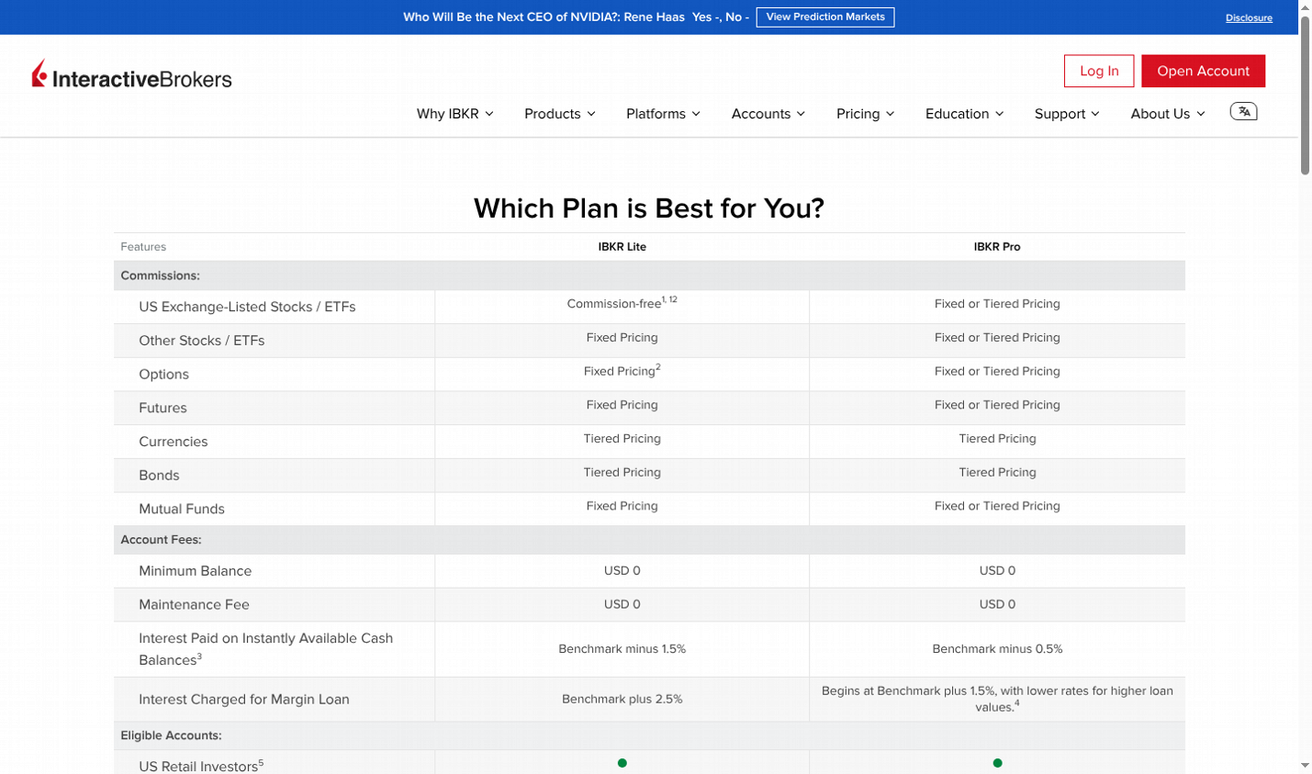
IBKR Lite and IBKR Pro plans
Fidelity
Fidelity Investments (FMR LLC) is a privately owned financial group. Its US brokerage accounts are held by Fidelity Brokerage Services LLC, a member of FINRA and SIPC, with clearing by National Financial Services. Fidelity covers investing, retirement and wealth management, with branches (Investor Centers) across the US and its own range of mutual funds.
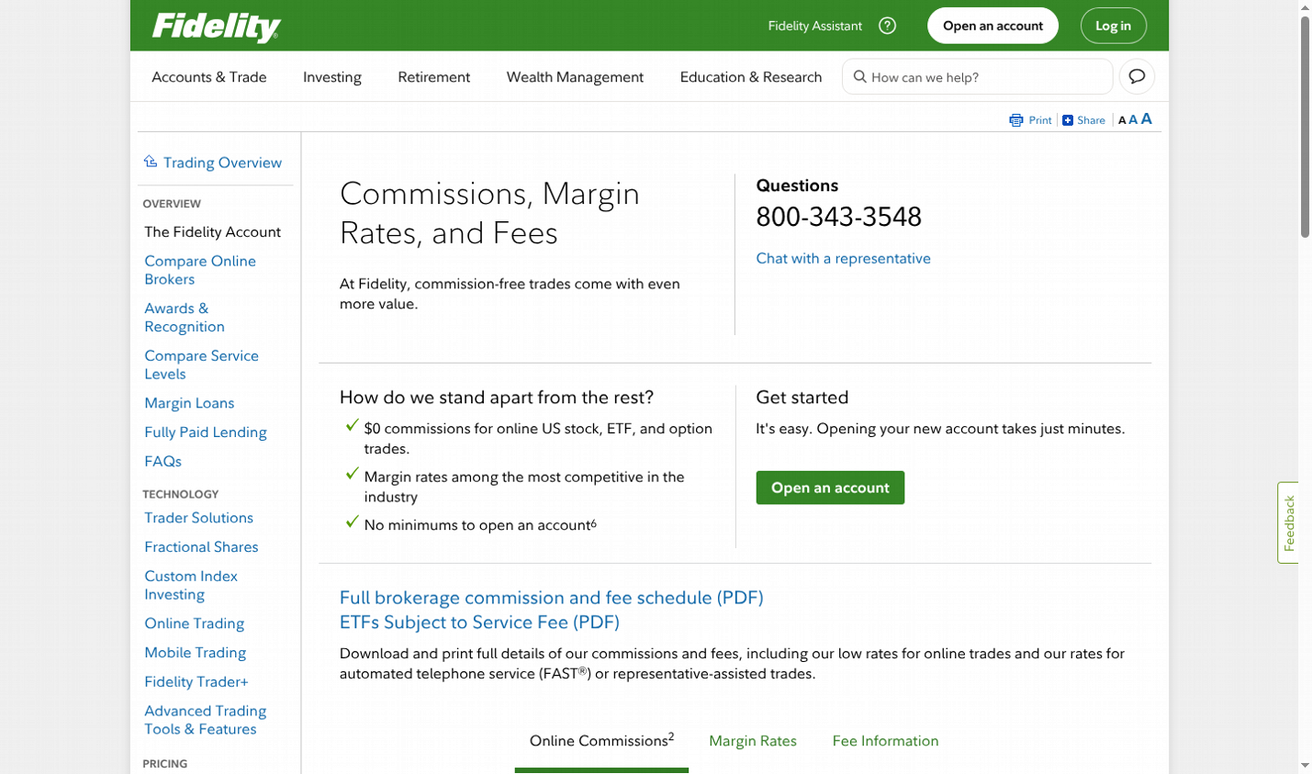
Fidelity commissions page
2. Products
Interactive Brokers: stocks, ETFs, options, futures, currencies, bonds, mutual funds, US spot gold and prediction markets on 175 markets in 40 countries, plus crypto through Paxos or Zero Hash. Fractional shares are available.
Fidelity: US stocks and ETFs, fractional shares, options, Fidelity and third-party mutual funds (including four ZERO index funds with no expense ratio), bonds, CDs and Treasuries, crypto, and stocks in 25 countries with 16 currencies.
For mutual funds, Fidelity charges $0 on its own funds and $49.95 to buy most funds from other companies that are outside its no-transaction-fee list. Interactive Brokers lists over 50,000 funds, more than 20,000 of them with no transaction fee, and charges 3% of the trade value, up to $14.95, on the rest.
Crypto costs less at Interactive Brokers: 0.12% to 0.18% of the trade value (minimum $1.75, capped at 1%), against a 1% fee on each buy and sell at Fidelity.
3. Trading platforms
Interactive Brokers: Client Portal on the web, IBKR Mobile, IBKR Desktop, Trader Workstation (TWS) for active traders, IBKR GlobalTrader for simple stock and options trading, and APIs. You also get a paper trading account and free real-time data for US stocks and ETFs from their primary exchanges.
Fidelity: website, mobile app and the Fidelity Trader+ platform for active traders, with options analytics and Strategy Testing, which simulates a trading strategy on past prices. Fidelity has no paper trading account with virtual money.
4. Interest on cash
Fidelity: sweeps uninvested cash into a money market fund, usually the Fidelity Government Money Market Fund (SPAXX), whose 7-day yield was 3.58% on 20 November 2026, after the fund's 0.42% expense ratio. You earn it from the first dollar.
Interactive Brokers: pays 3.38% on USD cash above $10,000 on IBKR Pro (benchmark minus 0.5%) and 2.38% on IBKR Lite. The first $10,000 earns nothing, and accounts with a net asset value (NAV) below $100,000 get a proportionally lower rate.
With $50,000 in cash in an account worth over $100,000, IBKR Pro pays about $1,352 a year (3.38% on $40,000) and Fidelity about $1,790. With $10,000 or less in cash, Interactive Brokers pays nothing. Both rates are variable.
5. Account types
Interactive Brokers: individual, joint, trust and custodial (UGMA/UTMA) accounts, and traditional, rollover, inherited, Roth, SEP and SIMPLE IRAs. IRAs are open to US citizens living anywhere, except residents of Australia, Canada, Hong Kong, Japan, Singapore and India.
Fidelity: brokerage accounts, IRAs, health savings accounts (HSAs), 529 college savings plans, small business retirement plans and managed accounts, including the Fidelity Go robo-advisor (no fee below $25,000, then 0.35% a year).
6. Account opening and transfers
Both brokers let you open an account online with no minimum deposit. Neither charges to transfer an account out through ACATS, and Interactive Brokers does not charge for incoming ACATS transfers either. Crypto positions at Interactive Brokers cannot move through ACATS.
7. Pricing
What a year costs
| Investor | Interactive Brokers | Fidelity |
| Buys US ETFs every month | $0 on Lite | $0 |
| Trades 20 option contracts a month | $156 | $156 |
| Borrows $20,000 on margin all year | $1,076 on Pro ($1,276 on Lite) | $2,415 |
| Keeps $10,000 in cash | Earns $0 | Earns about $358 |
| Moves the account to another broker | $0 | $0 |
Our calculation with each broker's November 2026 rates. Options: 240 contracts a year at $0.65 (IBKR Fixed pricing). Margin: interest only, at 5.38% (IBKR Pro), 6.38% (IBKR Lite) and 12.075% (Fidelity). Cash: 3.58% SPAXX yield at Fidelity. Regulatory and exchange fees not included.
For a buy-and-hold investor in US stocks and ETFs, IBKR Lite and Fidelity are both free, and options cost the same $0.65 per contract on IBKR Fixed pricing. Active traders on IBKR Pro can pay less per share and per contract on Tiered pricing, as we show in IBKR Fixed vs Tiered.
The gap is in margin and cash. Fidelity charges between 10.325% and 12.075% on loans below $500,000, against 5.38% at IBKR Pro on the first $100,000 and 4.88% above it. Fidelity pays interest on cash from the first dollar, while Interactive Brokers pays nothing on the first $10,000. For every cost, see our guides on Interactive Brokers fees and Fidelity fees.
8. Security
Both brokers are SIPC members, which protects securities up to $500,000, including $250,000 for cash, if the broker fails. Interactive Brokers adds an excess SIPC policy with Lloyd's of London of up to $30 million per account (cash up to $900,000), subject to a $150 million aggregate limit, and its Insured Bank Deposit Sweep Program can extend FDIC cover to $5 million for eligible individual accounts. Fidelity's default cash sits in a money market fund, which is a security rather than a bank deposit. None of this protects you against market losses. For more detail, read is Interactive Brokers safe.
9. If you live outside the US
Fidelity.com is only for US residents, and Fidelity's UK platform is a separate business. Interactive Brokers accepts clients from most countries, except those on US sanctions lists or that it considers higher risk, through local companies in markets such as the UK, Ireland, Australia, Hong Kong and Singapore. Fees, protection schemes and products differ by entity. If you live outside the US, see our Fidelity alternatives.
10. Pros and cons
The pros and cons below reflect our own assessment of each broker. Investing involves risk, and the value of your investments can go down as well as up, so you may get back less than you invest.
Interactive Brokers pros and cons
Pros
- Margin from 5.38% on IBKR Pro
- 175 markets in 40 countries
- Futures, forex and bonds in one account
- Paper trading account
Cons
- No interest on the first $10,000 of cash
- Lower cash rate for accounts under $100,000
- Trader Workstation is complex for beginners
Fidelity pros and cons
Pros
- Interest on cash from the first dollar
- Fidelity mutual funds, including ZERO index funds
- HSAs, 529 plans and a robo-advisor
- Investor Centers across the US
Cons
- High margin rates (up to 12.075%)
- $49.95 to buy most outside mutual funds
- Only for US residents
Interactive Brokers vs Fidelity: our verdict
Interactive Brokers
Best for margin, global markets and active tradersFidelity
Best for US investors who keep cash and use mutual funds
If you borrow on margin, buy stocks outside the US or want futures and forex, Interactive Brokers costs less and gives you more markets: 5.38% on margin against 12.075% on small loans, and 175 markets against 25 countries. If you invest for the long term in the US, keep cash in the account or want HSAs, 529 plans and Fidelity's own funds, Fidelity pays interest from the first dollar and offers more account types.
New Interactive Brokers clients can also earn a referral bonus, as we explain in our Interactive Brokers referral bonus guide. If you are also considering a trading app, read our Webull vs Fidelity and Moomoo vs Interactive Brokers comparisons.
Disclaimer: When investing, your capital is at risk and you may get back less than invested. Options and margin trading carry a high level of risk, and margin can lead to losses greater than your deposit. This information is not investment advice. Fees, rates and offers change often, so check them on each broker's website before you open an account.
FAQs
Is Interactive Brokers better than Fidelity?
For margin, foreign stocks, futures and forex, Interactive Brokers is cheaper and offers more: margin from 5.38% on IBKR Pro and 175 markets. For long-term investing in the US with cash in the account, Fidelity pays interest from the first dollar and offers its own mutual funds, HSAs and 529 plans.
Which pays more interest on cash, Interactive Brokers or Fidelity?
Fidelity, in most cases. SPAXX had a 7-day yield of 3.58% on 20 November 2026 and applies to all your cash. IBKR Pro pays 3.38% only on cash above $10,000, and less if your account is worth under $100,000.
Is IBKR Lite free like Fidelity?
For US-listed stocks and ETFs, yes: IBKR Lite charges US residents $0 commission, like Fidelity, and options cost $0.65 per contract at both. IBKR Lite pays less on cash (2.38% above $10,000) and charges 6.38% on margin.
Can I transfer my account from Fidelity to Interactive Brokers?
Yes. You request the transfer at Interactive Brokers and your positions move through ACATS without being sold. Neither Fidelity nor Interactive Brokers charges a fee for it.
Can non-US residents open a Fidelity account?
No. Fidelity.com brokerage accounts are for US residents. Interactive Brokers accepts clients from most countries through its local companies, with fees and investor protection that depend on where you live.