
Webull and E*TRADE both charge $0 commission on US stocks and ETFs, have no account minimum and let you trade through the night, but they suit different investors. Webull is a trading app with free options contracts, paper trading and a $3.99 monthly Premium plan. E*TRADE, owned by Morgan Stanley since 2020, adds thousands of mutual funds, bonds and CDs, plans for the self-employed and phone support at any hour.
In this comparison, we put the US figures from each broker's own website side by side and work out what each one costs or pays you in a year for six types of investor.
Webull vs E*TRADE: quick take
- Webull is best for options traders ($0 per contract against $0.65), investors who borrow on margin (5.45% with Premium against 12.70% on small loans) and anyone who adds money to an IRA, thanks to its IRA match of 1%, or 3.5% with Premium.
- E*TRADE is best for investors who want mutual funds in any account, bonds and CDs, a Solo 401(k) or SEP IRA, or phone support 24/7, all in one account with $0 commission on stocks and ETFs.
Webull vs E*TRADE in a nutshell
| Category | Webull | E*TRADE |
| US stocks and ETFs | $0 commission | $0 commission online |
| Stock and ETF options | $0 per contract | $0.65 per contract ($0.50 with 30+ trades a quarter) |
| Futures | $1.00 per contract ($0.25 for micros) | $1.50 per contract, per side |
| Interest on uninvested cash | 3.60% with Premium ($3.99/month), 0.50% without | 0.01% APY (sweep under $500,000) |
| IRA match | 1%, or 3.5% with Premium | None |
| Margin rate (under $10,000) | 8.74% (5.45% with Premium) | 12.70% |
| Mutual funds | In IRAs only | Yes (6,000+ no-transaction-fee funds) |
| Managed portfolios | 0.20% a year, $100 minimum | 0.30% a year, $500 minimum |
| Phone support | 8 AM to 5 PM ET on weekdays | 24/7 |
| Outgoing transfer fee | $75 | $75 |
Source: Webull fee schedule (Premium, futures and margin tabs, checked on 27 November 2026), E*TRADE pricing and rates and E*TRADE sweep rates. E*TRADE margin rates effective 21 September 2026 and sweep rates as of 27 November 2026. Data as of November 2026.
1. Overview
Webull
Webull is owned by Webull Corporation, which is headquartered in St. Petersburg, Florida, and listed on Nasdaq (BULL). US accounts are held by Webull Financial LLC, a member of FINRA and SIPC, with clearing by Apex Clearing. The app is built for active trading, with charts, screeners and a paper trading account. You can read more in our Webull US review.
E*TRADE
E*TRADE was one of the first online brokers in the US and has been part of Morgan Stanley since 2020. Its brokerage accounts are now offered by Morgan Stanley Smith Barney LLC, a member of FINRA and SIPC, and its bank accounts by Morgan Stanley Private Bank. E*TRADE accounts are for US residents, as we explain in our guide on whether E*TRADE works internationally.
2. Products
Webull: US stocks and ETFs, fractional shares from $1, options, OTC stocks, futures, crypto (with a 1% spread built into the price), prediction markets and US Treasury and corporate bonds. Since June 2026 it also offers mutual funds, but only in IRAs and only for permanent US residents, and not every fund is available.
E*TRADE: US stocks and ETFs, options, futures and options on futures, over 6,000 mutual funds with no transaction fee in any account, bonds and CDs ($1 per bond on the secondary market, $0 for Treasuries) and crypto through zerohash, at 0.50% per trade. Fractional shares are available on a growing list of stocks and ETFs, starting with the S&P 100, from $5, as we explain in our guide to E*TRADE fractional shares.
If you want mutual funds in a taxable account, or CDs, only E*TRADE covers them. If you want OTC stocks or prediction markets, only Webull does. Webull is cheaper for futures: $1.00 per regular contract for up to 5,000 contracts a month (less with Premium above that), against $1.50 per side at E*TRADE, before exchange and regulatory fees.
3. Interest on cash
Both brokers pay interest on idle cash, but the gap is large:
- Webull pays 3.60% to Premium members ($3.99 a month or $40 a year) and 0.50% to everyone else, through a programme that sweeps uninvested cash to partner banks with FDIC cover of up to $5 million.
- E*TRADE sweeps uninvested cash to its Bank Deposit Program, which paid 0.01% APY on balances under $500,000 on 27 November 2026.
To earn more at E*TRADE, you can move cash to a Morgan Stanley Private Bank Premium Savings account, which paid a base rate of 3.75% APY on 27 November 2026 and is FDIC insured up to $500,000. That money sits outside your brokerage account, so you have to move it back before you invest.
On $10,000 left in the brokerage account, you earn about $320 a year at Webull after $40 of Premium ($50 without Premium) and about $1 at E*TRADE, or about $375 if you move it to Premium Savings. All these rates are variable.
4. IRAs and account types
Webull adds a match to IRA contributions: 1% for everyone and 3.5% with Premium, plus 1% on IRA transfers with Premium. At the 2026 limit of $7,500 (under age 50), that is $262.50 with Premium or $75 without. You must keep Premium for a year and the money in the IRA for five years to keep the full match. E*TRADE does not match IRA contributions, although it runs one-time bonuses for new retirement accounts, such as $150 for a deposit of $5,000 to $19,999 with its RETIRE26 offer.
Webull accounts: individual and joint cash and margin accounts, custodial accounts and traditional, Roth and rollover IRAs.
E*TRADE accounts: brokerage and custodial accounts, Coverdell education accounts, traditional, Roth, rollover and inherited IRAs, IRAs for minors, and plans for the self-employed and small businesses: Solo 401(k) (traditional or Roth), SEP IRA and SIMPLE IRA. If you run your own business, only E*TRADE covers these plans.
5. Managed portfolios
Webull Advisors charges 0.20% a year (at least $1 a month) from a $100 minimum, with portfolios of ETFs. E*TRADE's Core Portfolios charges 0.30% a year from a $500 minimum, and clients with larger balances can work with a Morgan Stanley financial advisor.
| Balance | Webull Advisors | E*TRADE Core Portfolios |
| $20,000 | $40 | $60 |
| $50,000 | $100 | $150 |
| $200,000 | $400 | $600 |
Our calculation with each broker's published advisory fees, November 2026. Fund costs not included.
6. Pricing
What a year costs
| Investor | Webull | E*TRADE |
| Buys an S&P 500 ETF every month | $0 | $0 |
| Keeps $10,000 in cash | Earns $320 (with Premium, after $40) or $50 | Earns $1 ($375 in Premium Savings) |
| Contributes $7,500 to an IRA | Gets $262.50 (with Premium) or $75 | Gets $0 |
| Trades 20 option contracts a month | $0 | $156 |
| Borrows $20,000 on margin all year | $1,748 ($1,130 with Premium, plan included) | $2,490 |
| Moves the account to another broker | $75 | $75 |
Our calculation with each broker's November 2026 rates. Premium at $40 a year. Options: 240 stock or ETF contracts a year at $0.65 ($120 at $0.50 with 30+ trades a quarter). Margin: 8.74% or 5.45% at Webull, 12.45% at E*TRADE for loans from $10,000 to $24,999, interest only. IRA: excludes one-time sign-up bonuses. Regulatory fees not included.
For a buy-and-hold investor in stocks and ETFs, both are free. Webull costs less for options, futures, margin and IRA contributions, and pays far more on idle cash. E*TRADE's margin rates run from 12.70% under $10,000 down to 10.70% for loans of $250,000 to $499,999, against 8.74% at every balance at Webull, or 5.45% to 4.15% with Premium. You need at least $2,000 in equity to trade on margin at Webull. Webull charges $0.50 per contract on certain index options, and E*TRADE charges $25 for broker-assisted trades. For every Webull cost, see our guide on Webull fees.
7. Platforms, trading hours and support
Webull offers a mobile app, a web platform and Webull Desktop, with charts, screeners, order flow data and a paper trading account with real-time quotes. E*TRADE has its main app and website plus Power E*TRADE, aimed at active stock, options and futures traders, and research from Morgan Stanley and third parties such as Argus.
Both brokers let you trade 24 hours a day, five days a week on eligible stocks and ETFs. Each runs an overnight session from 8 PM to 4 AM ET, Sunday to Thursday, on top of pre-market and after-hours trading, with limit orders. Both also receive payment for order flow, which means market makers pay them for routing some customer orders, as each one discloses in its order routing reports.
Support is a clear difference. E*TRADE says it is available 24 hours a day, 7 days a week, including by phone at 800-387-2331. Webull's client service team answers the phone at +1 (888) 828-0618 from 8 AM to 5 PM ET on weekdays, and you can also write through the Support Hub in the app or by email.
8. Regulation and security
Who regulates them: Webull Financial LLC (CRD 289063) and Morgan Stanley Smith Barney LLC (CRD 149777), which offers E*TRADE brokerage accounts, are broker-dealers registered with the SEC and members of FINRA, the self-regulator of US brokers. You can check both firms on FINRA BrokerCheck: Webull Financial and Morgan Stanley Smith Barney.
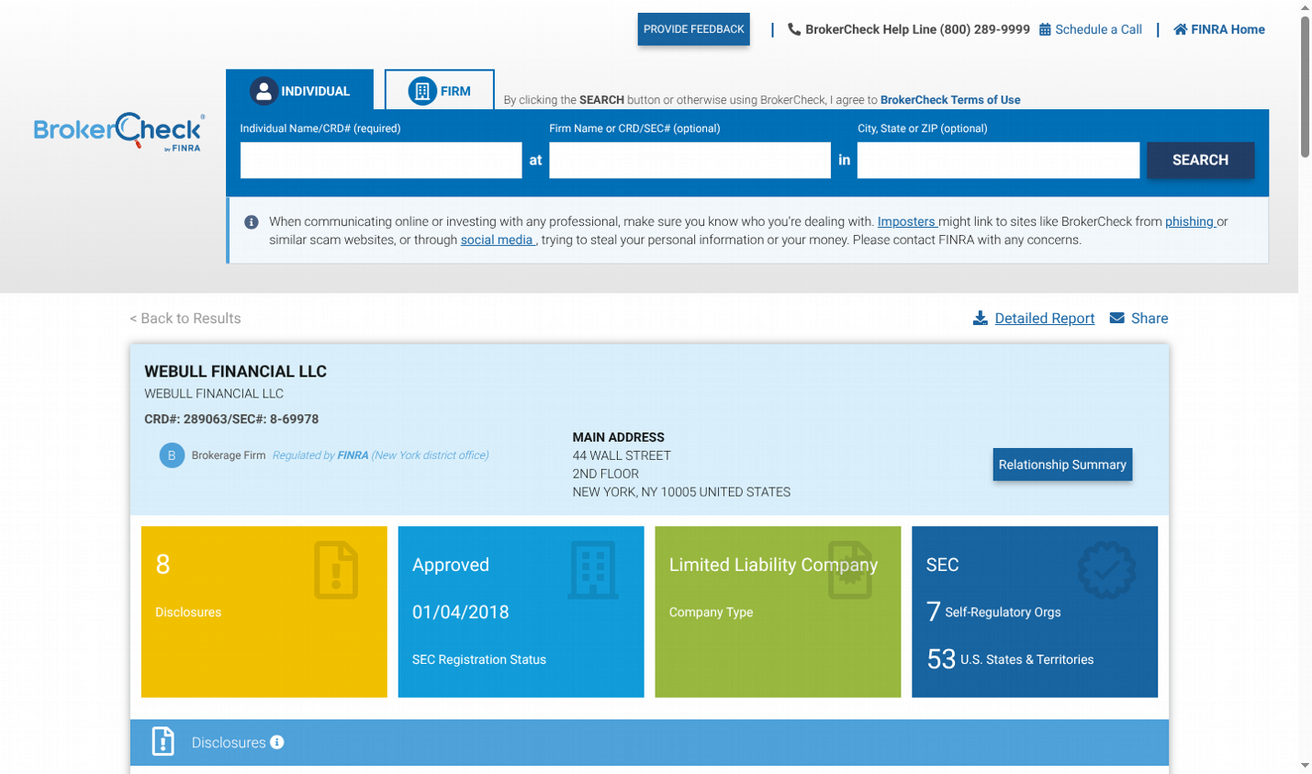
Webull Financial on FINRA BrokerCheck
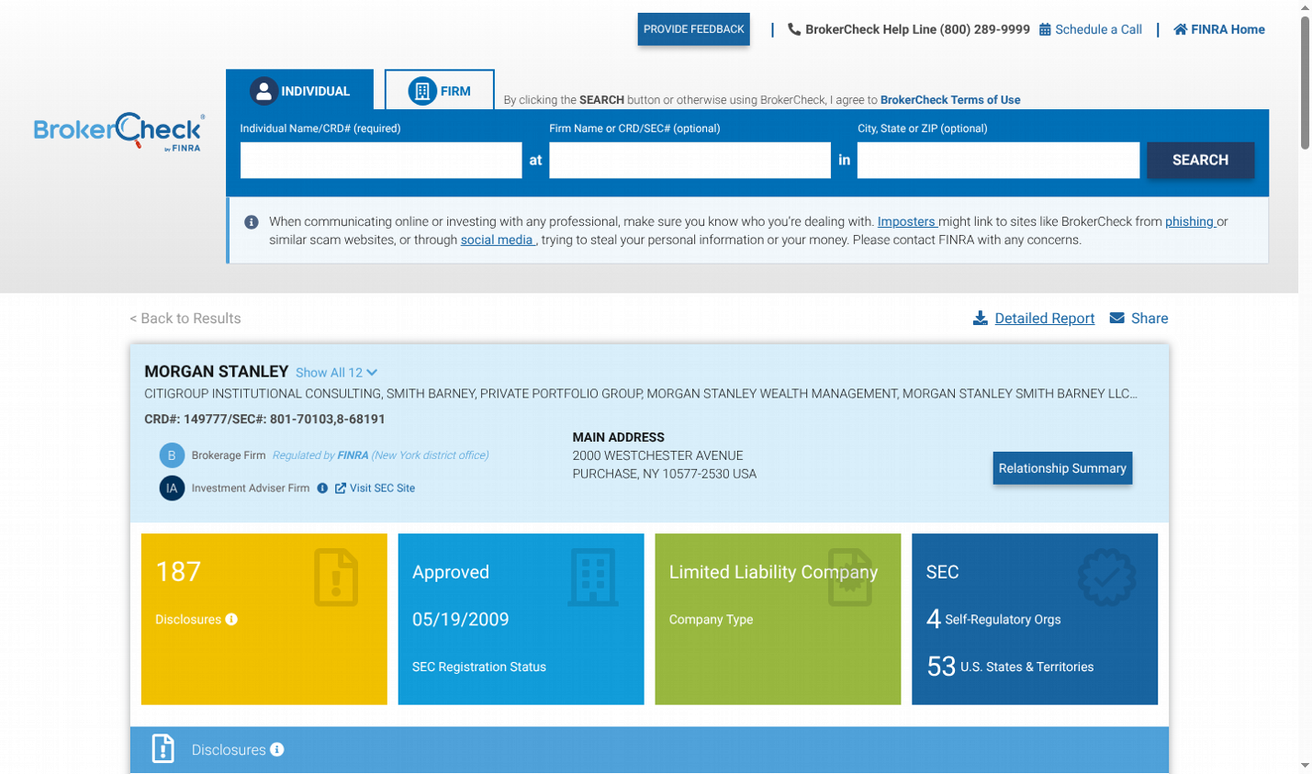
Morgan Stanley Smith Barney on FINRA BrokerCheck
Disciplinary history: BrokerCheck lists 8 disclosures for Webull Financial (7 regulatory events and 1 arbitration, as of 26 November 2026) and 187 for Morgan Stanley Smith Barney (67 regulatory events and 120 arbitrations, as of 27 November 2026). The Morgan Stanley figure covers its whole US wealth management business, with thousands of financial advisors, not only E*TRADE. Webull's largest case was a $3 million FINRA fine in 2023 for approving customers for options trading without enough due diligence. Morgan Stanley Smith Barney paid $35 million in 2022 over the protection of customer data and $15 million in 2024 over failures to supervise advisors who stole from clients.
SIPC protection: both brokers are members of SIPC, which covers up to $500,000 per customer, including $250,000 for cash, if a member broker fails and customer assets are missing. It does not protect you against market losses.
Excess of SIPC: Webull's policy with Lloyd's of London has a $100 million aggregate limit, no per-account limit on securities and a $1.9 million limit on cash (accounts held directly with Apex Clearing are covered by Apex's own policy instead). Morgan Stanley keeps excess of SIPC insurance for E*TRADE clients too, with a firmwide cap of $1 billion for securities and up to $1.9 million per client for uninvested cash.
Products outside SIPC: Webull's futures are offered by Webull Futures LLC and E*TRADE's by E*TRADE Futures LLC, both registered with the CFTC and members of the NFA. E*TRADE's crypto is offered through zerohash. At both brokers, crypto and futures are not covered by SIPC, and crypto is not FDIC insured.
9. Pros and cons
The pros and cons below reflect our own assessment of each broker. Investing involves risk, and the value of your investments can go down as well as up, so you may get back less than you invest.
Webull pros and cons
Pros
- $0 per contract on stock and ETF options
- IRA match of 1%, or 3.5% with Premium
- 3.60% on idle cash with Premium
- Paper trading account
Cons
- Mutual funds only in IRAs
- No CDs or Solo 401(k)
- Phone support only on weekdays
E*TRADE pros and cons
Pros
- Over 6,000 no-transaction-fee mutual funds, bonds and CDs
- Solo 401(k), SEP IRA and SIMPLE IRA
- Phone support 24/7
- Research from Morgan Stanley and third parties
Cons
- 0.01% on cash in the sweep
- $0.65 per options contract
- Margin rates of up to 12.70%
- No IRA match
Webull vs E*TRADE: our verdict
Webull
Best for options, margin, cash and IRA contributionsE*TRADE
Best for mutual funds, bonds and self-employed retirement plans
If you trade options, borrow on margin or add money to an IRA every year, Webull leaves more money in your account: $0 per contract, 5.45% on margin with Premium, a match of up to 3.5% and 3.60% on cash, all for $40 a year. If you want mutual funds outside an IRA, CDs or a Solo 401(k) in the same place as your stocks, or you value phone support at any hour, E*TRADE covers more of your finances, but keep idle cash out of its 0.01% sweep.
New Webull clients can also get a welcome offer, as we explain in our Webull referral bonus guide. To see how each broker compares with other apps, read our Webull vs Robinhood and Robinhood vs E*TRADE comparisons. If you are choosing between full-service brokers, see E*TRADE vs Fidelity.
Disclaimer: When investing, your capital is at risk and you may get back less than invested. Options, futures and margin trading carry a high level of risk, and margin can lead to losses greater than your deposit. This information is not investment advice. Fees, rates and offers change often, so check them on each broker's website before you open an account.
FAQs
Is Webull better than E*TRADE?
It depends on how you invest. Webull is cheaper for options, futures and margin, pays an IRA match of up to 3.5% and pays 3.60% on cash with Premium. E*TRADE offers mutual funds in any account, CDs, plans for the self-employed and phone support 24/7.
Does Webull offer mutual funds?
Yes, but only in IRAs. Webull added mutual funds for IRA accounts in June 2026, for permanent US residents, and not every fund is available. E*TRADE offers over 6,000 mutual funds with no transaction fee in any account.
Does E*TRADE charge for options?
Yes. E*TRADE charges $0.65 per options contract, or $0.50 if you make at least 30 trades a quarter. Webull charges $0 per contract on stock and ETF options and $0.50 on certain index options.
Does Webull pay interest on uninvested cash?
Yes. Webull pays 3.60% to Premium members and 0.50% to everyone else. E*TRADE's sweep paid 0.01% APY on balances under $500,000 on 27 November 2026. All these rates are variable.
Can I transfer my account from Webull to E*TRADE?
Yes. You request the transfer at E*TRADE and your shares move through ACATS without being sold. Webull charges $75 per outgoing stock transfer, as we explain in our guide on how to close a Webull account. If you hold a Webull IRA with a match, money moved out within five years can lose part of the match.