
Robinhood and E*TRADE both charge $0 commission on US stocks and ETFs, have no account minimum and offer trading through the night, but they are built for different investors. Robinhood is a trading app with free options contracts, cheap margin and a $5 monthly Gold plan. E*TRADE, owned by Morgan Stanley since 2020, adds mutual funds, bonds, more retirement accounts, a bank and 24/7 phone support.
In this comparison, we put the US figures from each broker's own website side by side and work out what each one costs or pays you in a year for six types of investor.
Robinhood vs E*TRADE: quick take
- Robinhood is best for options traders ($0 per contract against $0.65), investors who borrow on margin (5.25% against 12.70% on small loans) and anyone who adds money to an IRA, thanks to its IRA match of 1%, or 3% with Gold.
- E*TRADE is best for investors who want mutual funds, bonds and CDs, a self-employed retirement plan such as a Solo 401(k), or phone support at any hour, all in one account with $0 commission on stocks and ETFs.
Robinhood vs E*TRADE in a nutshell
| Category | Robinhood | E*TRADE |
| US stocks and ETFs | $0 commission | $0 commission online |
| Stock and ETF options | $0 per contract | $0.65 per contract ($0.50 with 30+ trades a quarter) |
| Futures | $0.75 per contract ($0.50 with Gold) | $1.50 per contract, per side |
| Interest on uninvested cash | 3.60% APY with Gold ($5/month), 0% without | 0.01% APY (sweep under $500,000) |
| IRA match | 1%, or 3% with Gold | None |
| Margin rate (under $10,000) | 5.25% | 12.70% |
| Mutual funds and bonds | No | Yes (6,000+ no-transaction-fee funds) |
| Managed portfolios | 0.25% a year, $50 minimum | 0.30% a year, $500 minimum |
| Extended hours | 24 Hour Market (24/5) | Overnight, pre-market and after-hours (24/5) |
| Research | Nasdaq Level II with Gold | Morgan Stanley and third-party research |
| Phone support | 7 AM to 9 PM ET on weekdays | 24/7 |
| Outgoing transfer fee | $100 | $75 |
Source: Robinhood Financial fee schedule, Robinhood Gold and futures pages, E*TRADE pricing and rates and E*TRADE sweep rates. Robinhood margin rates as of 17 September 2026 and Gold APY checked on 27 November 2026. E*TRADE margin rates effective 21 September 2026 and sweep rates as of 27 November 2026. Data as of November 2026.
1. Overview
Robinhood
Robinhood Markets is based in Menlo Park, California, and listed on Nasdaq (HOOD). US brokerage accounts are held by Robinhood Financial LLC, with clearing by Robinhood Securities LLC, both SIPC members. The app is known for its simple design, and Robinhood Legend adds a desktop platform for active traders. You can read more in our Robinhood review.
E*TRADE
E*TRADE was one of the first online brokers in the US and has been part of Morgan Stanley since 2020. Its brokerage accounts are now offered by Morgan Stanley Smith Barney LLC, a member of FINRA and SIPC, and its bank accounts by Morgan Stanley Private Bank. E*TRADE accounts are for US residents, as we explain in our guide on whether E*TRADE works internationally.
2. Products
Robinhood: US stocks and ETFs, fractional shares from $1 on most stocks and ETFs, options, futures, crypto and prediction markets. It does not offer mutual funds, individual bonds or CDs.
E*TRADE: US stocks and ETFs, options, futures and options on futures, over 6,000 mutual funds with no transaction fee, bonds and CDs ($1 per bond on the secondary market, $0 for Treasuries) and crypto through zerohash, at 0.50% per trade. Fractional shares are available on a growing list of stocks and ETFs, starting with the S&P 100, from $5.
If you want mutual funds, bonds or CDs, only E*TRADE covers them. If you want prediction markets, only Robinhood offers them, and its fractional shares cover far more stocks. Robinhood is also cheaper for futures: $0.75 per contract, or $0.50 with Gold, against $1.50 per side at E*TRADE, before exchange and regulatory fees.
3. Interest on cash
Both brokers pay interest on idle cash, but the gap is large:
- Robinhood pays 3.60% APY to Gold members ($5 a month or $50 a year) who enable the High-Yield Cash program. Without Gold, uninvested cash earns nothing, and Robinhood self-directed IRAs are not eligible.
- E*TRADE sweeps uninvested cash to its Bank Deposit Program, the only sweep option for most clients, which paid 0.01% APY on balances under $500,000 on 27 November 2026.
To earn more at E*TRADE, you can move cash to a Morgan Stanley Private Bank Premium Savings account, which paid a base rate of 3.75% APY on 27 November 2026 and offers FDIC coverage of up to $500,000 for individual accounts. That money sits outside your brokerage account, so you have to move it back before you invest.
On $10,000 left in the brokerage account, you earn about $300 a year at Robinhood after $60 of Gold ($310 with the annual plan) and about $1 at E*TRADE, or about $375 if you move it to Premium Savings. All these rates are variable.
4. IRAs and account types
Robinhood adds a match to IRA money: 1% on contributions, transfers and 401(k) rollovers for everyone, and 3% on annual contributions with Gold. At the 2026 limit of $7,500 (under age 50), that is $225 with Gold or $75 without. You must keep Gold for a year and the money in the IRA for five years to keep the full match. E*TRADE does not match IRA contributions, although it runs one-time bonuses for new retirement accounts, such as $150 for a deposit of $5,000 to $19,999 with its RETIRE26 offer.
Robinhood accounts: individual, joint, custodial and revocable trust accounts, and traditional and Roth IRAs.
E*TRADE accounts: brokerage and custodial accounts, Coverdell education accounts, traditional, Roth, rollover and inherited IRAs, IRAs for minors, and plans for the self-employed and small businesses: Solo 401(k) (traditional or Roth), SEP IRA and SIMPLE IRA. If you run your own business, only E*TRADE covers these plans. Neither broker offers a self-directed 529 plan.
5. Managed portfolios
Robinhood Strategies charges 0.25% a year, capped at $250 for Gold members (no fee on assets above $100,000), from a $50 minimum. E*TRADE's Core Portfolios charges 0.30% a year from a $500 minimum, and clients with larger balances can work with a Morgan Stanley financial advisor.
| Balance | Robinhood Strategies | E*TRADE Core Portfolios |
| $20,000 | $50 | $60 |
| $50,000 | $125 | $150 |
| $200,000 | $500 ($250 with Gold, plus $60 for the plan) | $600 |
Our calculation with each broker's published advisory fees, November 2026. Fund costs not included. Managed IRAs at Robinhood do not get the IRA match.
6. Pricing
What a year costs
| Investor | Robinhood | E*TRADE |
| Buys an S&P 500 ETF every month | $0 | $0 |
| Keeps $10,000 in cash | Earns $300 (with Gold, after $60) | Earns $1 ($375 in Premium Savings) |
| Contributes $7,500 to an IRA | Gets $225 (with Gold) or $75 | Gets $0 |
| Trades 20 option contracts a month | $0 | $156 |
| Borrows $20,000 on margin all year | $1,050 ($997.50 with Gold) | $2,490 |
| Moves the account to another broker | $100 | $75 |
Our calculation with each broker's November 2026 rates. Gold at $5 a month (the $50 annual plan saves $10). Options: 240 stock or ETF contracts a year at $0.65 ($120 at $0.50 with 30+ trades a quarter). Margin: 5.25% at Robinhood (first $1,000 free with Gold), 12.45% at E*TRADE for loans from $10,000 to $24,999, interest only. IRA: excludes one-time sign-up bonuses. Regulatory fees not included.
For a buy-and-hold investor in stocks and ETFs, both are free. Robinhood costs less for options, futures, margin and IRA contributions, and pays far more on idle cash if you have Gold. E*TRADE's margin rates run from 12.70% under $10,000 down to 10.70% for loans of $250,000 to $499,999, against 4.75% to 5.25% at Robinhood for balances up to $1 million. E*TRADE also charges $25 for broker-assisted trades and $2 a quarter for paper statements unless an exemption applies. For every Robinhood cost, see our guide on Robinhood fees.
7. Platforms, trading hours and support
Both brokers now let you trade through the night. Robinhood's 24 Hour Market covers a list of popular stocks and ETFs from Sunday 8 PM to Friday 8 PM ET, with limit orders, and Robinhood Legend adds a desktop platform with advanced charts. E*TRADE has pre-market trading from 4 AM, after-hours trading until 8 PM and an overnight session from 8 PM to 4 AM ET, Sunday to Thursday, for eligible symbols with limit orders. Its Power E*TRADE platform is aimed at active stock, options and futures traders.
Both brokers receive payment for order flow, which means market makers pay them for routing some customer orders, as each one discloses in its order routing reports.
Research is another difference. E*TRADE clients get research from Morgan Stanley and from third-party providers such as Argus. Robinhood Gold adds Nasdaq Level II market data, but Robinhood stopped offering Morningstar research reports on 10 August 2026, so it offers less research than E*TRADE.
Support is a clear difference. E*TRADE says it is available 24 hours a day, 7 days a week, including by phone at 800-387-2331. Robinhood has 24/7 chat and calls you back when you request it in the app, with phone support for investing from 7 AM to 9 PM ET on weekdays.
8. Regulation and security
Who regulates them: Robinhood Financial LLC (CRD 165998) and Morgan Stanley Smith Barney LLC (CRD 149777), which offers E*TRADE brokerage accounts, are broker-dealers registered with the SEC and members of FINRA, the self-regulator of US brokers. You can check both firms on FINRA BrokerCheck: Robinhood Financial and Morgan Stanley Smith Barney.
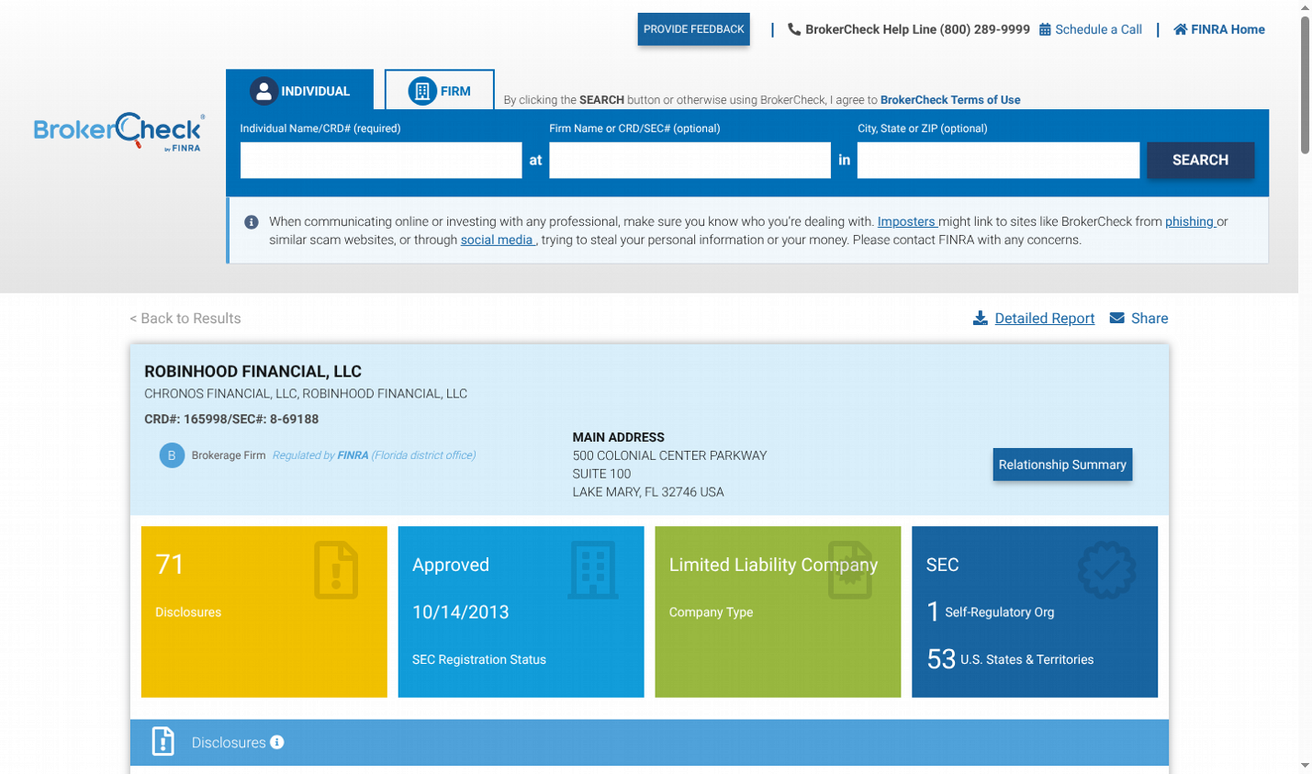
Robinhood Financial on FINRA BrokerCheck
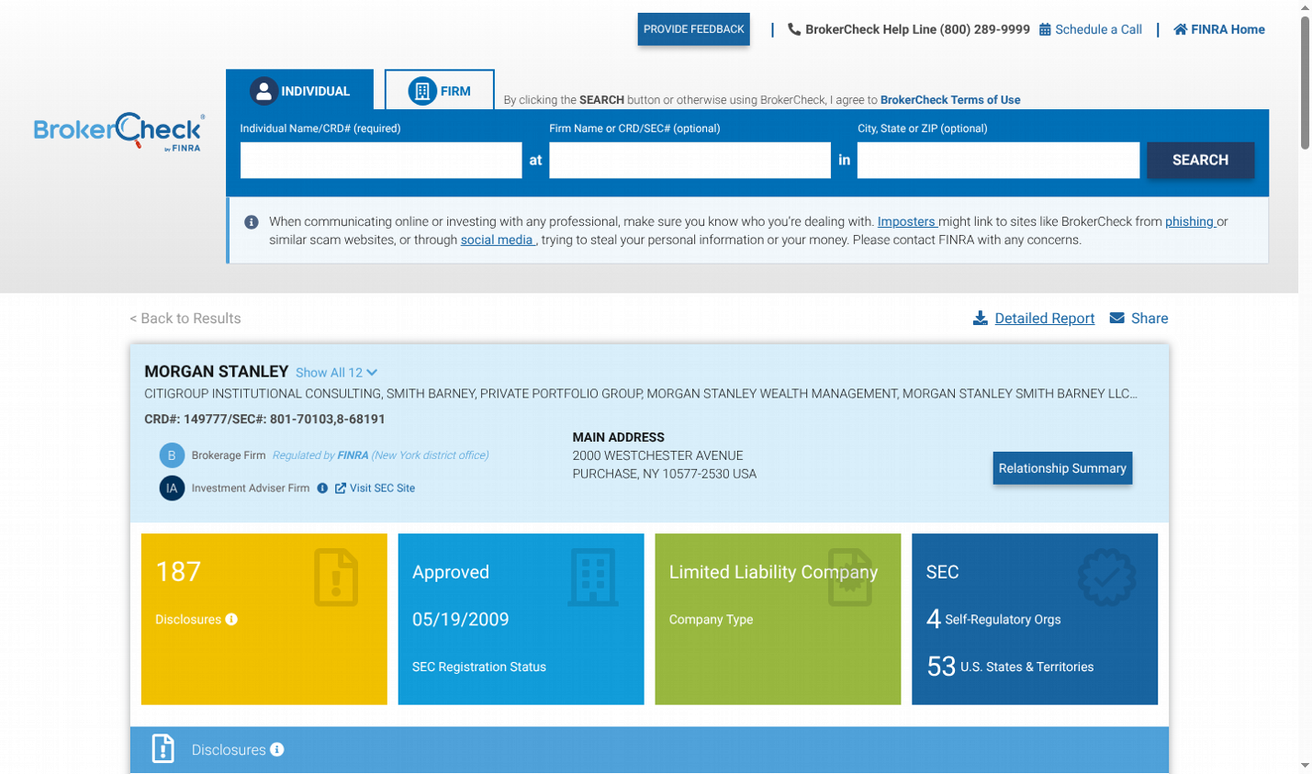
Morgan Stanley Smith Barney on FINRA BrokerCheck
Disciplinary history: as of 27 November 2026, BrokerCheck lists 71 disclosures for Robinhood Financial (56 regulatory events and 15 arbitrations) and 187 for Morgan Stanley Smith Barney (67 regulatory events and 120 arbitrations). The Morgan Stanley figure covers its whole US wealth management business, with thousands of financial advisors, not only E*TRADE. Robinhood's largest cases were a record FINRA penalty of about $70 million in 2021 and $45 million in SEC penalties in January 2025. Morgan Stanley Smith Barney paid $35 million in 2022 over the protection of customer data and $15 million in 2024 over failures to supervise advisors who stole from clients.
SIPC protection: both brokers are members of SIPC, which covers up to $500,000 per customer, including $250,000 for cash, if a member broker fails and customer assets are missing. It does not protect you against market losses.
Excess of SIPC: Robinhood's policy with Lloyd's of London has a $1 billion aggregate limit and up to $50 million per customer, including $1.9 million in cash. Morgan Stanley keeps excess of SIPC insurance for E*TRADE clients too, with a firmwide cap of $1 billion for securities and up to $1.9 million per client for uninvested cash.
Cash: above the first $10,000, Robinhood's brokerage cash sweep moves uninvested cash to program banks, where it is eligible for FDIC insurance of up to $2.5 million in individual accounts. E*TRADE's Bank Deposit Program places uninvested cash in interest-bearing deposit accounts at FDIC-insured banks.
Products outside SIPC: Robinhood's crypto is held by Robinhood Crypto, LLC (NMLS 1702840) and its futures by Robinhood Derivatives, LLC, registered with the CFTC. E*TRADE's crypto is offered through zerohash and its futures by E*TRADE Futures LLC, a member of the NFA. At both brokers, crypto and futures are not covered by SIPC, and crypto is not FDIC insured.
9. Pros and cons
The pros and cons below reflect our own assessment of each broker. Investing involves risk, and the value of your investments can go down as well as up, so you may get back less than you invest.
Robinhood pros and cons
Pros
- $0 per contract on stock and ETF options
- IRA match of 1%, or 3% with Gold
- Margin from 4.75% to 5.25%
- 3.60% on idle cash with Gold
Cons
- No interest on cash without Gold
- No mutual funds, bonds or CDs
- Phone support only on weekdays
- No Morningstar reports since August 2026
E*TRADE pros and cons
Pros
- Over 6,000 no-transaction-fee mutual funds, bonds and CDs
- Solo 401(k), SEP IRA and SIMPLE IRA
- Phone support 24/7
- Overnight, pre-market and after-hours trading
- Research from Morgan Stanley and third parties
Cons
- 0.01% on cash in the sweep
- $0.65 per options contract
- Margin rates of up to 12.70%
- No IRA match
Robinhood vs E*TRADE: our verdict
Robinhood
Best for options, margin, cash and IRA contributionsE*TRADE
Best for mutual funds, bonds and self-employed retirement plans
If you trade options, borrow on margin or add money to an IRA every year, Robinhood leaves more money in your account: $0 per contract, 5.25% on margin, a match of up to 3% and 3.60% on cash with Gold. If you want mutual funds, bonds or a Solo 401(k) in the same place as your stocks, or you value phone support at any hour, E*TRADE covers more of your finances, but keep idle cash out of its 0.01% sweep.
New clients can get a free stock at Robinhood, as we explain in our Robinhood free stock guide. To compare Robinhood with other full-service brokers, read our Robinhood vs Fidelity, Robinhood vs Schwab and Robinhood vs Vanguard comparisons. If you are also considering Webull, see our Webull vs E*TRADE comparison. To compare E*TRADE with another full-service broker, read E*TRADE vs Fidelity.
Disclaimer: When investing, your capital is at risk and you may get back less than invested. Options, futures and margin trading carry a high level of risk, and margin can lead to losses greater than your deposit. This information is not investment advice. Fees, rates and offers change often, so check them on each broker's website before you open an account.
FAQs
Is E*TRADE better than Robinhood?
It depends on how you invest. E*TRADE offers mutual funds, bonds, CDs, more retirement accounts and phone support 24/7. Robinhood is cheaper for options, futures and margin, pays an IRA match of up to 3% and pays 3.60% on cash with Gold.
Does E*TRADE charge for options?
Yes. E*TRADE charges $0.65 per options contract, or $0.50 if you make at least 30 trades a quarter, with $0 commission on the trade itself. Robinhood charges $0 per contract on stock and ETF options.
Does E*TRADE pay interest on uninvested cash?
Yes, but little. Its Bank Deposit Program sweep paid 0.01% APY on balances under $500,000 on 27 November 2026. You can earn more by moving cash to a Morgan Stanley Private Bank Premium Savings account, which paid 3.75% APY.
Does E*TRADE offer fractional shares?
Yes. E*TRADE offers fractional shares on a growing list of stocks and ETFs, starting with companies in the S&P 100, with a minimum of $5 per order. Robinhood offers them from $1 on most stocks and ETFs worth over $1 a share.
Can I transfer my account from Robinhood to E*TRADE?
Yes. You request the transfer at E*TRADE and your shares move through ACATS without being sold. Robinhood charges $100 for the outgoing transfer, and E*TRADE charges $75 for a full transfer out if you later move the other way. If you hold a Robinhood IRA with a match, money moved out within five years can lose part of the match.