
Robinhood and Vanguard both charge $0 commission on US stocks and ETFs and have no account minimum, but they suit different investors. Robinhood is a trading app with free options contracts, cheaper margin and a $5 monthly Gold plan, while Vanguard is built for long-term investors in index funds, with its own mutual funds and ETFs and no payment for order flow.
In this comparison, we put the US figures side by side and work out what each broker costs or pays you in a year for six types of investor, from someone who buys an S&P 500 ETF every month to someone who borrows on margin.
Robinhood vs Vanguard: quick take
- Robinhood is best for options traders ($0 per contract against $1), investors who borrow on margin and anyone who adds money to an IRA, thanks to its IRA match of 1%, or 3% with Gold.
- Vanguard is best for buy-and-hold investors in index funds, as uninvested cash earns the money market fund yield (3.92% on 25 November 2026) with no subscription, and it offers Vanguard mutual funds, bonds and a robo-advisor from $100.
Robinhood vs Vanguard in a nutshell
| Category | Robinhood | Vanguard |
| US stocks and ETFs | $0 commission | $0 commission online |
| Stock and ETF options | $0 per contract | $1 per contract |
| Interest on uninvested cash | 3.60% APY with Gold ($5/month), 0% without | 3.92% (VMFXX settlement fund, no subscription) |
| IRA match | 1%, or 3% with Gold | None |
| Margin rate (under $20,000) | 5.25% | 12.25% |
| Mutual funds | No | Yes (Vanguard funds $0 online) |
| Managed portfolios | 0.25% a year (Robinhood Strategies) | About 0.15% a year, $100 minimum (Digital Advisor) |
| Fractional shares | Stocks and ETFs | Vanguard ETFs only |
| Extended hours | 24 Hour Market (24/5) | 4 PM to 5:30 PM ET only |
| Outgoing transfer fee | $100 | $100 |
| Annual account fee | $0 | $25 (waived with e-delivery) |
Source: Robinhood Financial fee schedule, Robinhood Gold page, Vanguard Brokerage commission and fee schedules (effective 10 July 2026) and Vanguard margin and fund pages. Robinhood margin rates as of 17 September 2026 and Gold APY checked on 27 November 2026. Vanguard base margin rate as of 18 September 2026 and VMFXX 7-day SEC yield as of 25 November 2026. Data as of November 2026.
1. Overview
Robinhood
Robinhood Markets is based in Menlo Park, California, and listed on Nasdaq (HOOD). US brokerage accounts are held by Robinhood Financial LLC, with clearing by Robinhood Securities LLC, both SIPC members. The app is known for its simple design, and Robinhood Legend adds a desktop platform for active traders. You can read more in our Robinhood review.
Vanguard
The Vanguard Group is based in Malvern, Pennsylvania, and is owned by its US funds, which are in turn owned by the investors in those funds. It is one of the largest fund managers in the world and best known for low-cost index funds such as the Vanguard 500 Index Fund. Brokerage accounts are offered by Vanguard Brokerage Services, a division of Vanguard Marketing Corporation, a member of FINRA and SIPC. For every Vanguard cost, see our guide on Vanguard fees.
2. Products
Robinhood: US stocks and ETFs, fractional shares, options, futures, crypto and prediction markets. It does not offer mutual funds or individual bonds.
Vanguard: US stocks and ETFs, options, Vanguard and other companies' mutual funds, bonds, CDs and US Treasuries ($0 online). Fractional investing from $1 works only for Vanguard ETFs, and other stocks and ETFs are bought in whole shares. Vanguard does not offer futures or direct crypto, allows only select third-party crypto ETFs and generally does not accept new purchases of leveraged or inverse products.
If you want mutual funds, individual bonds or CDs, only Vanguard covers them. If you want crypto, futures, prediction markets or fractional shares of any stock, only Robinhood does.
3. Interest on cash
Both brokers pay interest on idle cash, but on different terms:
- Vanguard keeps uninvested brokerage cash in its settlement fund, the Vanguard Federal Money Market Fund (VMFXX), by default. Its 7-day SEC yield was 3.92% on 25 November 2026, with no subscription and nothing to buy by hand.
- Robinhood pays 3.60% APY only to Gold members ($5 a month or $50 a year) who enable the High-Yield Cash program. Without Gold, uninvested cash earns nothing, and Robinhood self-directed IRAs are not eligible.
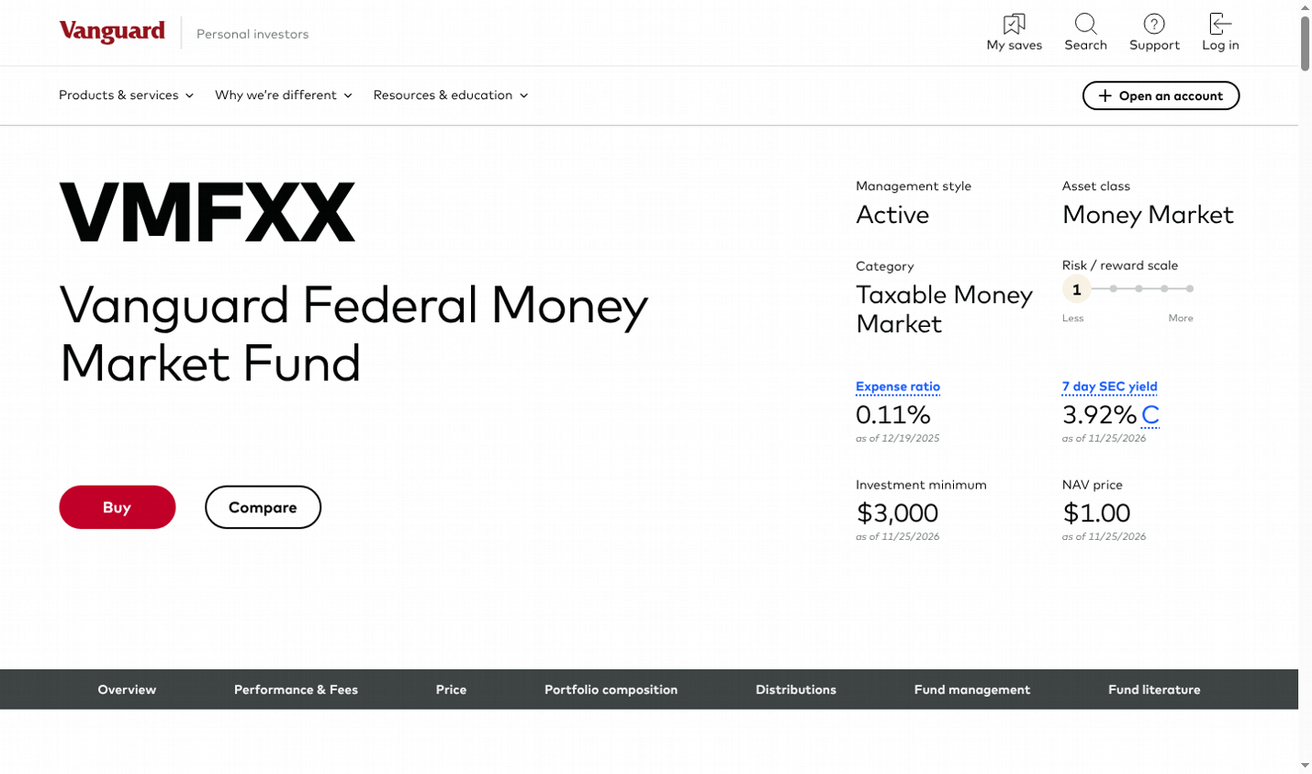
Vanguard settlement fund yield
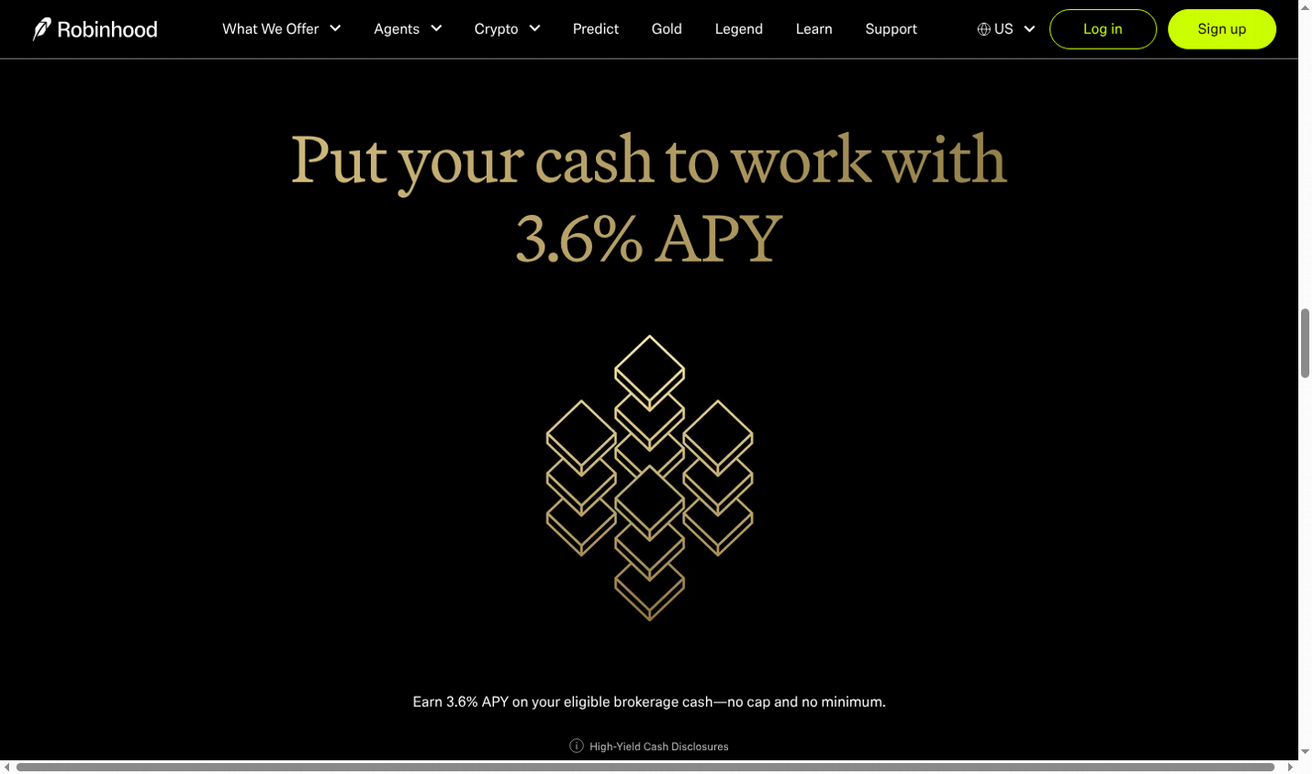
Robinhood Gold cash rate
On $10,000 left as cash, you earn about $392 a year at Vanguard and about $300 at Robinhood after $60 of Gold ($310 with the annual plan). Both rates are variable.
The protection differs. VMFXX is a money market fund that invests at least 99.5% in cash and US government securities: it is not a bank deposit, is not FDIC insured and could lose value, but as a security in your brokerage account it is covered by SIPC. Robinhood's swept cash above $10,000 sits at FDIC-insured program banks. Vanguard also has a separate Cash Plus Account, whose bank sweep is FDIC insured up to $1.25 million for individual accounts and paid 3.50% APY on 27 November 2026 (3.65% for eligible clients, such as those with $1 million or more at Vanguard), less than VMFXX.
4. IRAs and account types
Robinhood adds a match to IRA money: 1% on contributions, transfers and 401(k) rollovers for everyone, and 3% on annual contributions with Gold. At the 2026 limit of $7,500 (under age 50), that is $225 with Gold or $75 without. You must keep Gold for a year and the money in the IRA for five years to keep the full match. Vanguard does not match IRA contributions.
Robinhood accounts: individual, joint, custodial and revocable trust accounts, and traditional and Roth IRAs.
Vanguard accounts: brokerage accounts, traditional, Roth, spousal and custodial IRAs, SEP-IRAs for the self-employed, 529 education accounts, UGMA/UTMA accounts for minors, trust accounts and organization accounts. If you are self-employed or want a 529 plan, only Vanguard covers it.
5. Managed portfolios
Robinhood Strategies charges 0.25% a year, capped at $250 for Gold members (no fee on assets above $100,000), from a $50 minimum. Vanguard Digital Advisor needs $100 to start and charges a gross 0.20% for its all-index option, reduced by a credit for the fund fees Vanguard keeps, so you pay about $15 to $16 per $10,000 a year. The first 90 days are free of advisory fees.
| Balance | Robinhood Strategies | Vanguard Digital Advisor |
| $20,000 | $50 | About $30 |
| $50,000 | $125 | About $75 to $80 |
| $200,000 | $500 ($250 with Gold, plus $60 for the plan) | About $300 to $320 |
Our calculation with each broker's published advisory fees, November 2026, using Vanguard's all-index option. Fund costs not included. Managed IRAs at Robinhood do not get the IRA match.
At $200,000, Robinhood with Gold costs about the same as Vanguard. Below $100,000, Digital Advisor costs less, and its portfolios are built from Vanguard index funds.
Human advice: Vanguard Personal Advisor adds access to a financial advisor from $50,000, for about $30 to $31 per $10,000 a year (a gross 0.35% for the all-index option). Robinhood has no advisor service of its own: the Robinhood Advisor Network refers eligible customers to independent advisory firms, which set their own fees. If you want an advisor who manages your money and plans with you, only Vanguard offers it in-house.
6. Pricing
What a year costs
| Investor | Robinhood | Vanguard |
| Buys an S&P 500 ETF every month | $0 | $0 |
| Keeps $10,000 in cash | Earns $300 (with Gold, after $60) | Earns $392 |
| Contributes $7,500 to an IRA | Gets $225 (with Gold) or $75 | Gets $0 |
| Trades 20 option contracts a month | $0 | $240 |
| Borrows $20,000 on margin all year | $1,050 ($997.50 with Gold) | $2,350 |
| Moves the account to another broker | $100 | $100 |
Our calculation with each broker's November 2026 rates. Gold at $5 a month (the $50 annual plan saves $10). Options: 240 stock or ETF contracts a year at $1. Margin: 5.25% at Robinhood (first $1,000 free with Gold), 11.75% at Vanguard for loans from $20,000 to $49,999, interest only. Vanguard figures assume e-delivery, which waives the $25 account service fee. Regulatory fees not included.
For a buy-and-hold investor, both are free, and Vanguard pays more on idle cash without any subscription. Robinhood costs less for options, margin and IRA contributions. Vanguard's standard margin rates run from 10.25% to 12.25% on loans up to $499,999 for investors with less than $1 million at Vanguard, against 4.75% to 5.25% at Robinhood for balances up to $1 million. For every Robinhood cost, see our guide on Robinhood fees.
7. Platforms, trading hours and order execution
Robinhood's 24 Hour Market lets you trade a list of popular stocks and ETFs from Sunday 8 PM to Friday 8 PM ET, using limit orders, and Robinhood Legend adds a desktop platform with advanced charts. Vanguard keeps things simple: its website and app focus on buying funds and ETFs, and it offers only an after-hours session from 4 PM to 5:30 PM ET for limit orders on stocks.
Order routing is a real difference. Robinhood is paid by market makers for routing stock and ETF orders (payment for order flow), as its SEC Rule 606 reports show. Vanguard says it is never compensated for routing your orders to specific market centers, as explained on its order execution page.
Support works differently too. Robinhood has 24/7 chat and calls you back when you request it in the app, with phone support for investing from 7 AM to 9 PM ET on weekdays. Vanguard takes calls and charges a $25 commission on broker-assisted trades for clients with less than $1 million at Vanguard, so placing trades online is the cheaper route.
8. Regulation and security
Who regulates them: Robinhood Financial LLC (CRD 165998) and Vanguard Marketing Corporation (CRD 7452), which runs Vanguard Brokerage Services, are broker-dealers registered with the SEC and members of FINRA, the self-regulator of US brokers. You can check both firms on FINRA BrokerCheck: Robinhood Financial and Vanguard Marketing Corporation.
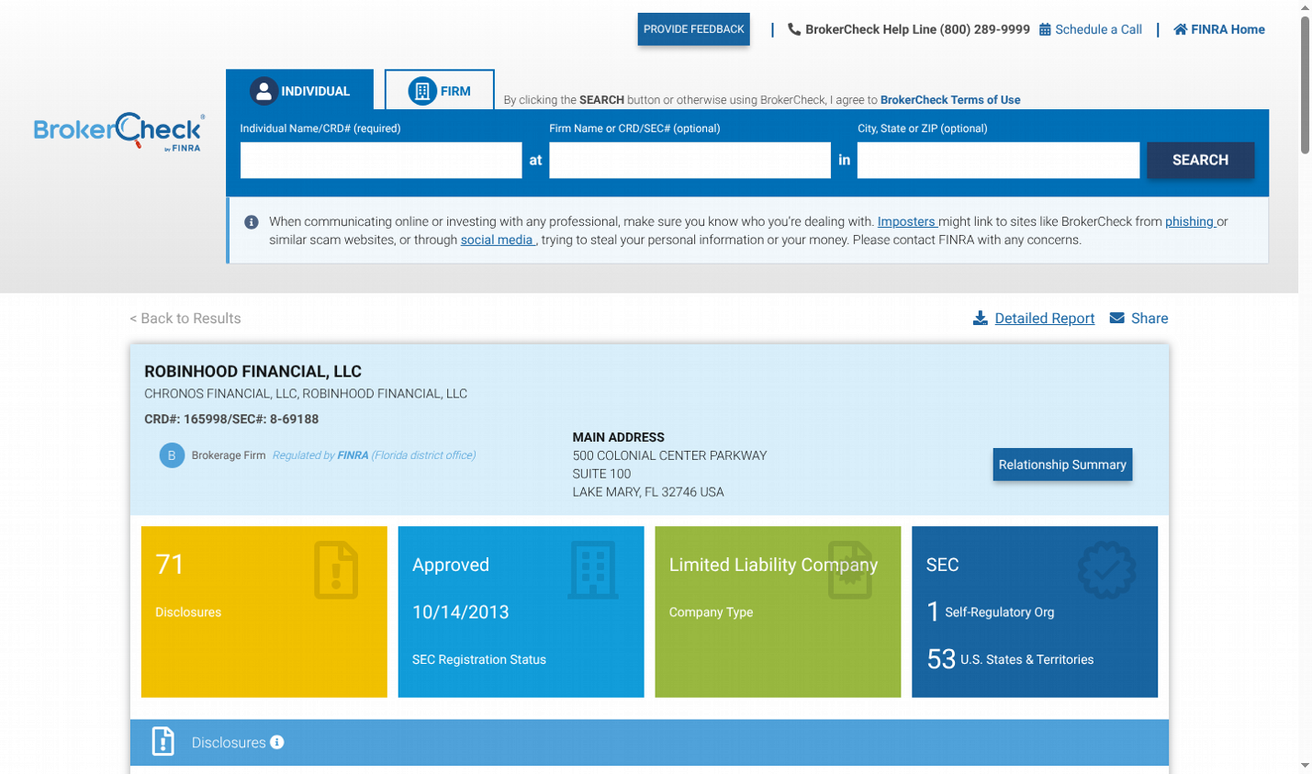
Robinhood Financial on FINRA BrokerCheck
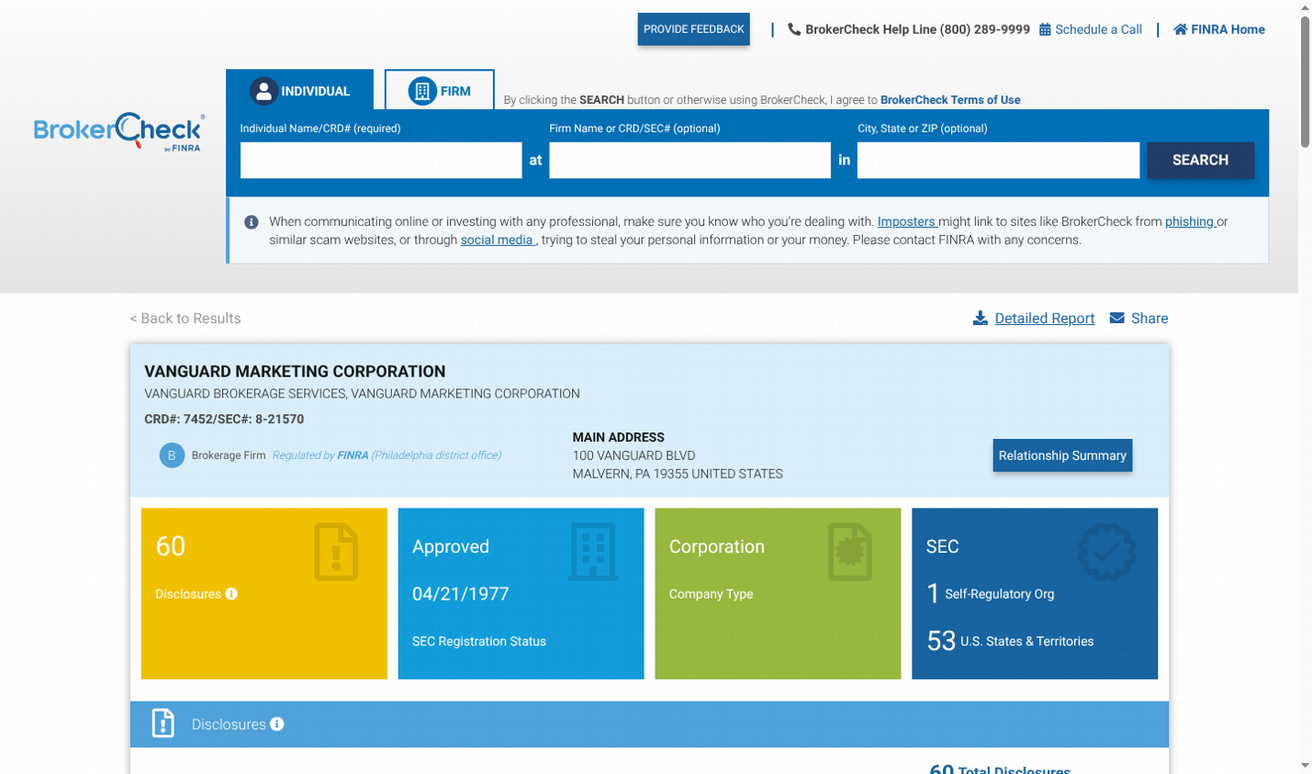
Vanguard Marketing Corporation on FINRA BrokerCheck
Disciplinary history: as of 27 November 2026, BrokerCheck lists 71 disclosures for Robinhood Financial (56 regulatory events and 15 arbitrations) and 60 for Vanguard Marketing Corporation (52 regulatory events and 8 arbitrations), which has been registered since 1977. Robinhood's largest cases were a record FINRA penalty of about $70 million in 2021 and $45 million in SEC penalties in January 2025. At Vanguard, the fund manager The Vanguard Group agreed in January 2025 to pay $106.41 million to settle SEC charges over misleading statements on capital gains in its Investor Target Retirement Funds, and in August 2025 Vanguard Advisers paid a $19.5 million penalty for not properly disclosing conflicts of interest in its Personal Advisor program.
SIPC protection: both brokers are members of SIPC, which covers up to $500,000 per customer, including $250,000 for cash, if a member broker fails and customer assets are missing. It does not protect you against market losses. Vanguard funds held directly with The Vanguard Group, outside a brokerage account, are not covered by SIPC.
Excess of SIPC: Robinhood's policy with Lloyd's of London has a $1 billion aggregate limit and up to $50 million per customer, including $1.9 million in cash. Vanguard's brokerage account agreement says it keeps additional coverage through an insurer on top of SIPC, but Vanguard does not publish the limits.
Cash: above the first $10,000, Robinhood's brokerage cash sweep moves uninvested cash to program banks, where it is eligible for FDIC insurance of up to $2.5 million in individual accounts. At Vanguard, the VMFXX settlement fund is a security covered by SIPC, and only the Cash Plus bank sweep is eligible for FDIC insurance.
Products outside SIPC: Robinhood's crypto is held by Robinhood Crypto, LLC (NMLS 1702840), licensed by the New York State Department of Financial Services, and its futures by Robinhood Derivatives, LLC, registered with the CFTC. Crypto and futures are not covered by SIPC, and crypto is not FDIC insured. Vanguard does not offer either.
Managed portfolios: Robinhood Strategies is run by Robinhood Asset Management, LLC, and Vanguard Digital Advisor by Vanguard Advisers, Inc. Both are SEC-registered investment advisers, which you can look up on the SEC's Investment Adviser Public Disclosure site.
Both comparisons above cover US accounts. Vanguard runs separate businesses with different products in other countries, such as the UK, and Robinhood's UK and EU apps are also separate businesses.
9. Pros and cons
The pros and cons below reflect our own assessment of each broker. Investing involves risk, and the value of your investments can go down as well as up, so you may get back less than you invest.
Robinhood pros and cons
Pros
- $0 per contract on stock and ETF options
- IRA match of 1%, or 3% with Gold
- 5.25% margin rate with no subscription
- 24/5 trading and fractional shares of any stock
Cons
- No interest on cash without Gold
- No mutual funds or individual bonds
- Paid for order flow on stock and ETF orders
Vanguard pros and cons
Pros
- 3.92% on idle cash in VMFXX with no subscription
- Vanguard mutual funds, bonds, CDs and $0 Treasuries
- No payment for order flow
- Robo-advisor from $100 for about 0.15% a year
- Human advisors from $50,000
Cons
- $1 per options contract
- Margin rates of up to 12.25%
- Fractional shares only for Vanguard ETFs
- Only a short after-hours session
Robinhood vs Vanguard: our verdict
Robinhood
Best for options, margin and IRA contributionsVanguard
Best for long-term index investors and cash
If you trade options, borrow on margin or add money to an IRA every year, Robinhood leaves more money in your account: $0 per contract, 5.25% on margin and a match of up to 3%. If you buy index funds and hold them for years, Vanguard costs nothing to trade online, pays 3.92% on idle cash without a subscription and does not sell your order flow.
If you plan to buy Vanguard's own ETFs, such as VOO, you can do it at either broker for $0 commission, as we explain in our guide on how to invest in VOO. New clients can get a free stock at Robinhood, as we explain in our Robinhood free stock guide. To compare Robinhood with other full-service brokers, read our Robinhood vs Fidelity, Robinhood vs Schwab and Robinhood vs E*TRADE comparisons.
Disclaimer: When investing, your capital is at risk and you may get back less than invested. Options and margin trading carry a high level of risk, and margin can lead to losses greater than your deposit. This information is not investment advice. Fees, rates and offers change often, so check them on each broker's website before you open an account.
FAQs
Is Vanguard better than Robinhood?
For long-term investing in index funds, Vanguard offers its own mutual funds, bonds, a robo-advisor from $100 and a 3.92% yield on idle cash without a subscription. Robinhood is cheaper for options and margin and pays an IRA match of up to 3%, so it depends on how you invest.
Is it safer to hold VOO at Vanguard or Robinhood?
VOO is the same ETF at both brokers, and either way your shares are held for you by a SIPC member broker, with up to $500,000 of SIPC cover if the broker fails. Both firms also buy extra insurance on top of SIPC. Neither SIPC nor that insurance protects you from a fall in VOO's price.
Does Vanguard pay interest on uninvested cash?
Yes. Cash in a Vanguard brokerage account sits in the Vanguard Federal Money Market Fund (VMFXX) by default, whose 7-day SEC yield was 3.92% on 25 November 2026. Robinhood pays 3.60% APY on cash only with Gold.
Does Vanguard charge an account fee?
Vanguard may charge a $25 annual account service fee per brokerage account. It is waived if you sign up for e-delivery of statements and documents, or if you have at least $1 million at Vanguard.
Can I transfer my account from Robinhood to Vanguard?
Yes. You request the transfer at Vanguard and your shares move through ACATS without being sold. Robinhood charges $100 for the outgoing transfer, and Vanguard may also charge $100 for a full transfer out if you later move the other way. If you hold a Robinhood IRA with a match, money moved out within five years can lose part of the match.