
Robinhood and Charles Schwab both charge $0 commission on US stocks and ETFs and have no account minimum, but they are built for different investors. Robinhood is a trading app with free options contracts and a $5 monthly Gold plan, while Schwab is a full-service broker with mutual funds, bonds, branches and the thinkorswim platforms.
In this comparison, we put the US figures side by side and work out what each broker costs or pays you in a year for six types of investor, from someone who keeps cash in the account to someone who borrows on margin.
Robinhood vs Schwab: quick take
- Robinhood is best for options traders ($0 per contract against $0.65), investors who borrow on margin and anyone who adds money to an IRA, thanks to its IRA match of 1%, or 3% with Gold.
- Charles Schwab is best for investors who want mutual funds, bonds and a robo-advisor with no advisory fee, active traders who want thinkorswim, and anyone who values branches and phone support.
Robinhood vs Schwab in a nutshell
| Category | Robinhood | Schwab |
| US stocks and ETFs | $0 commission | $0 commission |
| Stock and ETF options | $0 per contract | $0.65 per contract |
| Interest on uninvested cash | 3.60% APY with Gold ($5/month), 0% without | 0.01% APY (3.79% if you buy SWVXX) |
| IRA match | 1%, or 3% with Gold | None |
| Margin rate (under $25,000) | 5.25% | 12.075% |
| Mutual funds | No | Yes (thousands with no transaction fee) |
| Managed portfolios | 0.25% a year (Robinhood Strategies) | No advisory fee, $5,000 minimum (Intelligent Portfolios) |
| 24/5 trading | Yes (24 Hour Market) | Yes (1,300+ stocks and ETFs on thinkorswim) |
| Outgoing transfer fee | $100 | $50 (full transfer) |
Source: Robinhood Financial fee schedule, Robinhood Gold and High-Yield Cash pages, and Schwab pricing guide, margin and cash pages. Robinhood margin rates as of 17 September 2026 and Gold APY checked on 27 November 2026. Schwab base margin rate as of 18 September 2026, SWVXX yield as of 25 November 2026 and brokerage cash APY as of 27 November 2026. Data as of November 2026.
1. Overview
Robinhood
Robinhood Markets is based in Menlo Park, California, and listed on Nasdaq (HOOD). US brokerage accounts are held by Robinhood Financial LLC, with clearing by Robinhood Securities LLC, both SIPC members. The app is known for its simple design, and Robinhood Legend adds a desktop platform for active traders. You can read more in our Robinhood review.
Charles Schwab
The Charles Schwab Corporation is based in Westlake, Texas, and listed on the NYSE (SCHW). Brokerage accounts are held by Charles Schwab & Co., Inc., a member of SIPC. Since buying TD Ameritrade, Schwab offers the thinkorswim platforms (desktop, web and mobile) next to the Schwab website and app, and runs branches across the US. For its size and client numbers, see our Charles Schwab statistics.
2. Products
Robinhood: US stocks and ETFs, fractional shares, options, futures, crypto and prediction markets. It does not offer mutual funds or individual bonds.
Schwab: US stocks and ETFs, fractional shares, options, mutual funds (thousands with no transaction fee through Mutual Fund OneSource), bonds, CDs and US Treasuries ($0 online), futures ($2.25 per contract), forex and crypto (0.75% of trade value).
If you want mutual funds, individual bonds or CDs, only Schwab covers them. If you want prediction markets, only Robinhood does.
3. Interest on cash
This is the biggest difference for an investor who keeps cash in the account:
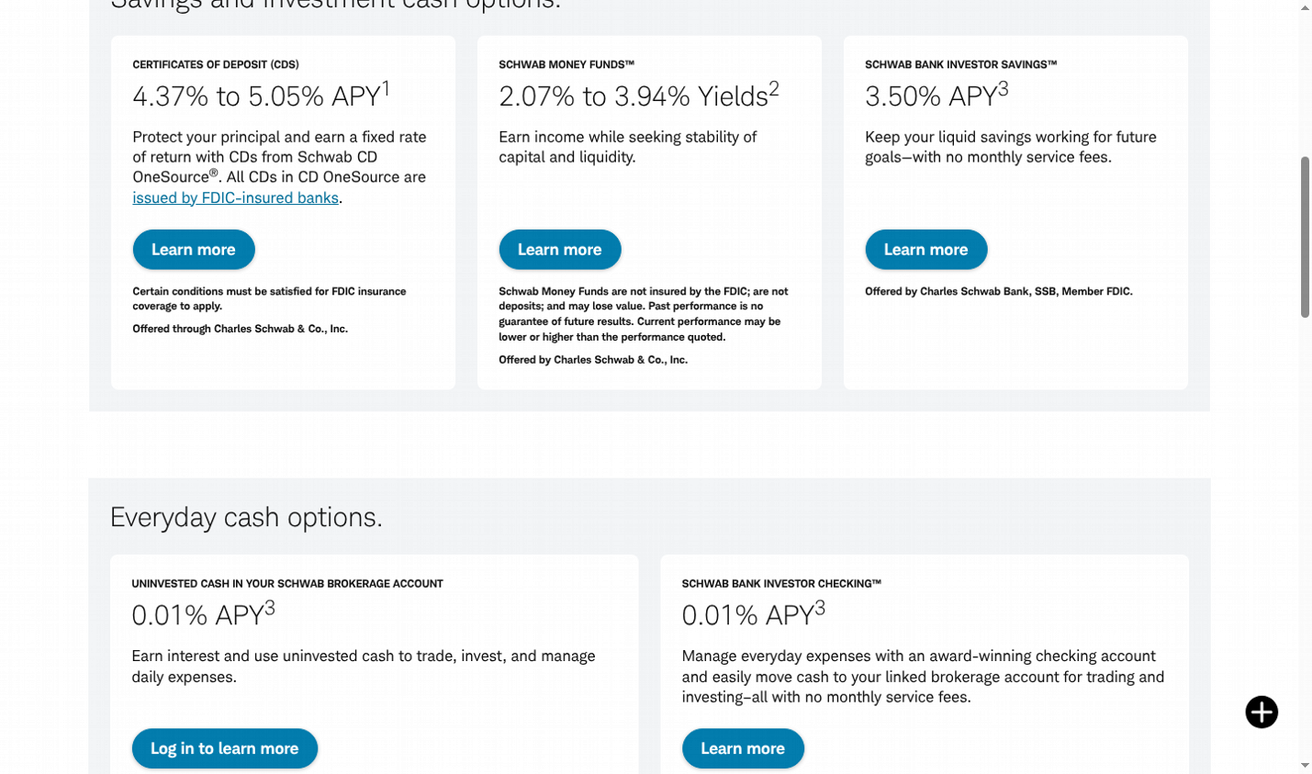
- Schwab pays 0.01% APY on uninvested cash in a brokerage account (as of 27 November 2026). To earn more, you have to buy a money market fund yourself, such as the Schwab Prime Advantage Money Fund (SWVXX), whose 7-day yield was 3.79% on 25 November 2026.
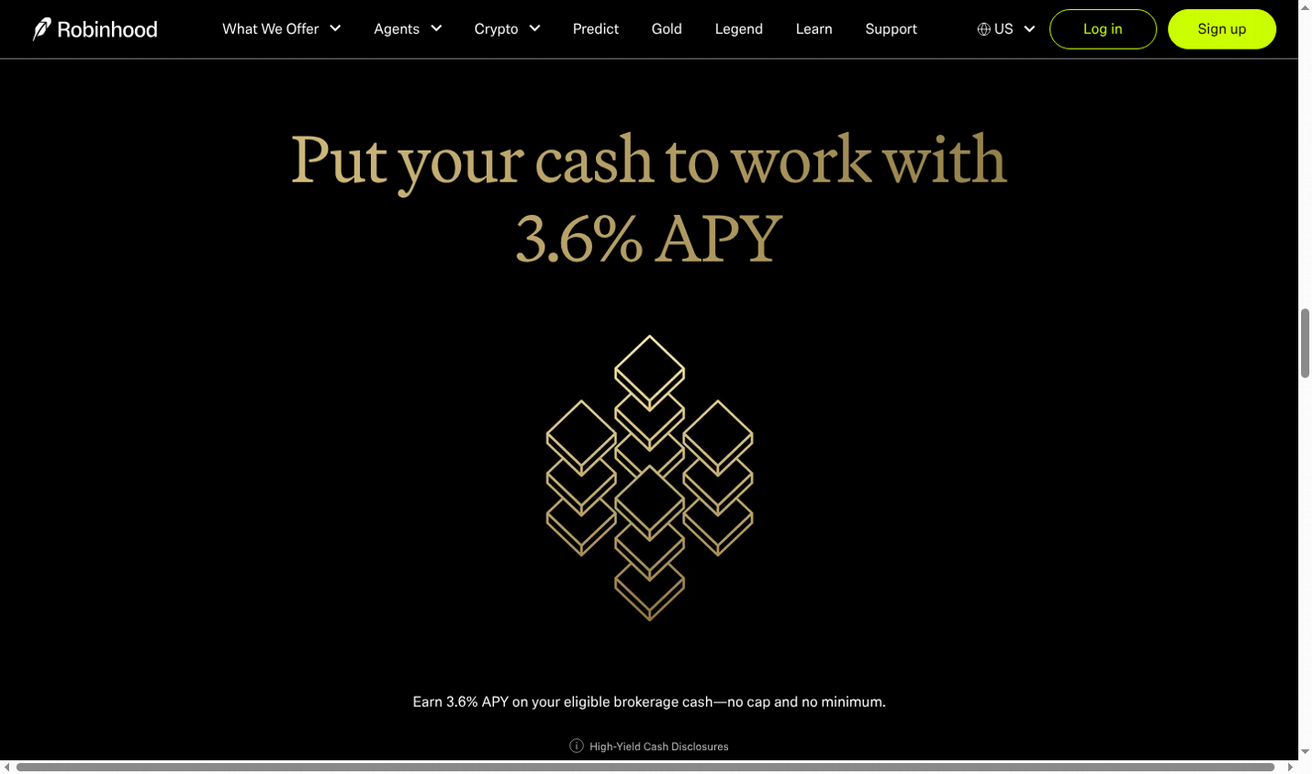
- Robinhood pays 3.60% APY only to Gold members ($5 a month or $50 a year) who enable the High-Yield Cash program. Without Gold, uninvested cash earns nothing, and Robinhood self-directed IRAs are not eligible.
Schwab cash options
Robinhood Gold cash rate
On $10,000 left as cash, you earn about $1 a year at Schwab and about $300 at Robinhood after $60 of Gold ($310 with the annual plan). If you move the cash into SWVXX at Schwab, you earn about $379, more than at Robinhood, but you have to buy and sell the fund yourself. All of these rates are variable.
The protection differs too. SWVXX is a money market fund, not a bank deposit: it is not FDIC insured, can lose value, and is a prime fund that may charge a fee when you sell in times of stress. Robinhood's swept cash above $10,000 sits at FDIC-insured program banks.
If you also want a bank account next to your brokerage account, Schwab Bank Investor Checking links to a Schwab One brokerage account and has no monthly fees, no foreign transaction fees and unlimited ATM fee rebates worldwide. Cash moves between the two accounts in seconds.
4. IRAs and account types
Robinhood adds a match to IRA money: 1% on contributions, transfers and 401(k) rollovers for everyone, and 3% on annual contributions with Gold. At the 2026 limit of $7,500 (under age 50), that is $225 with Gold or $75 without. You must keep Gold for a year and the money in the IRA for five years to keep the full match. Schwab does not match IRA contributions.
Robinhood accounts: individual, joint, custodial and trust accounts, and traditional and Roth IRAs.
Schwab accounts: brokerage accounts, traditional, Roth, rollover and inherited IRAs, custodial accounts, 529 college savings plans, trusts, Individual 401(k), SEP-IRA and SIMPLE IRA plans, all with no minimum to open. If you are self-employed or want a 529 plan, only Schwab covers it.
5. Managed portfolios
Robinhood Strategies charges 0.25% a year, capped at $250 for Gold members (no fee on assets above $100,000), from a $50 minimum. Schwab Intelligent Portfolios charges no advisory fee and needs $5,000 to start. Schwab Intelligent Portfolios Premium adds a certified financial planner for $300 upfront and $30 a month.
| Balance | Robinhood Strategies | Schwab Intelligent Portfolios |
| $20,000 | $50 | $0 |
| $50,000 | $125 | $0 |
| $200,000 | $500 ($250 with Gold, plus $60 for the plan) | $0 |
Our calculation with each broker's published advisory fees, November 2026. ETF costs not included. Managed IRAs at Robinhood do not get the IRA match.
Schwab's portfolios are not free of cost: part of each portfolio is held in cash at Schwab Bank, which earned 3.51% APY from 2 November 2026, and you pay the expense ratios of the ETFs. That cash allocation lowers the share of your money in the market, so check its size for your risk profile before you sign up.
6. Pricing
What a year costs
| Investor | Robinhood | Schwab |
| Buys US ETFs every month | $0 | $0 |
| Keeps $10,000 in cash | Earns $300 (with Gold, after $60) | Earns $1 ($379 in SWVXX) |
| Contributes $7,500 to an IRA | Gets $225 (with Gold) or $75 | Gets $0 |
| Trades 20 option contracts a month | $0 | $156 |
| Borrows $20,000 on margin all year | $1,050 ($997.50 with Gold) | $2,415 |
| Moves the account to another broker | $100 | $50 |
Our calculation with each broker's November 2026 rates. Gold at $5 a month (the $50 annual plan saves $10). Options: 240 stock or ETF contracts a year at $0.65. Margin: 5.25% at Robinhood (rates as of 17 September 2026, first $1,000 free with Gold), 12.075% at Schwab, interest only. Regulatory fees not included.
For a buy-and-hold investor in US stocks and ETFs, both are free. Robinhood costs less for options, margin and IRA contributions, while Schwab costs less to leave and pays more on cash only if you buy a money fund. Schwab's margin rate falls to 10.325% between $250,000 and $499,999, still about double Robinhood's 4.75% at that size. For every Robinhood cost, see our guide on Robinhood fees.
7. Platforms, order execution and support
Robinhood's 24 Hour Market lets you trade a list of popular stocks and ETFs from Sunday 8 PM to Friday 8 PM ET, using limit orders. Schwab offers 24/5 trading on more than 1,300 stocks and ETFs, including all S&P 500, Nasdaq 100 and Dow 30 stocks, but only on thinkorswim. Other Schwab platforms trade in the pre-market and after-hours sessions.
thinkorswim also includes a paper trading mode, options analytics and futures trading in one platform, which makes Schwab the stronger choice for active traders who want advanced tools. Robinhood answers with Robinhood Legend, its free desktop platform.
Both brokers are paid by market makers for routing stock and ETF orders (payment for order flow), as their SEC Rule 606 reports show, including Schwab's quarterly reports. This does not appear as a fee on your statement.
Support works differently. Schwab has 24/7 phone support and more than 400 US branches. Robinhood has 24/7 chat, but no number you can call about your account: you request a call back in the app, usually within 30 minutes, and phone support for investing runs 7 AM to 9 PM ET, Monday to Friday.
8. Regulation and security
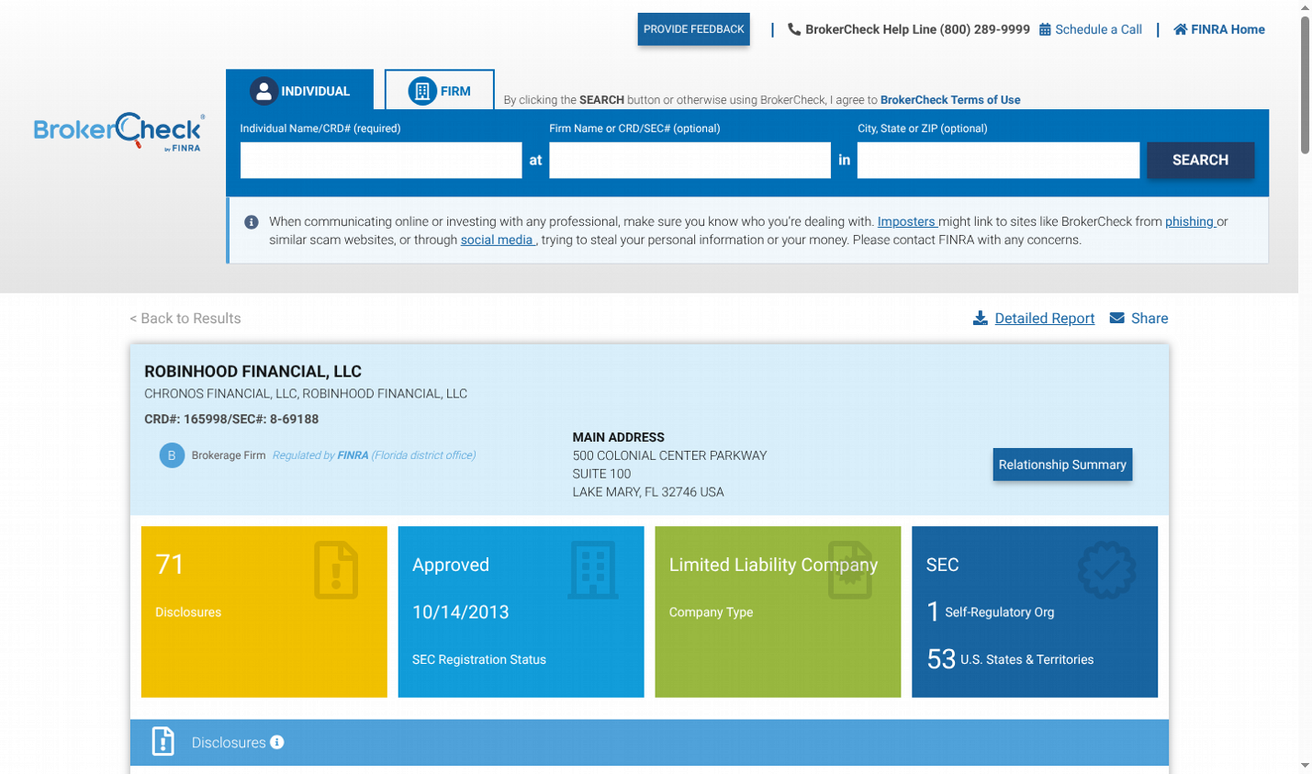
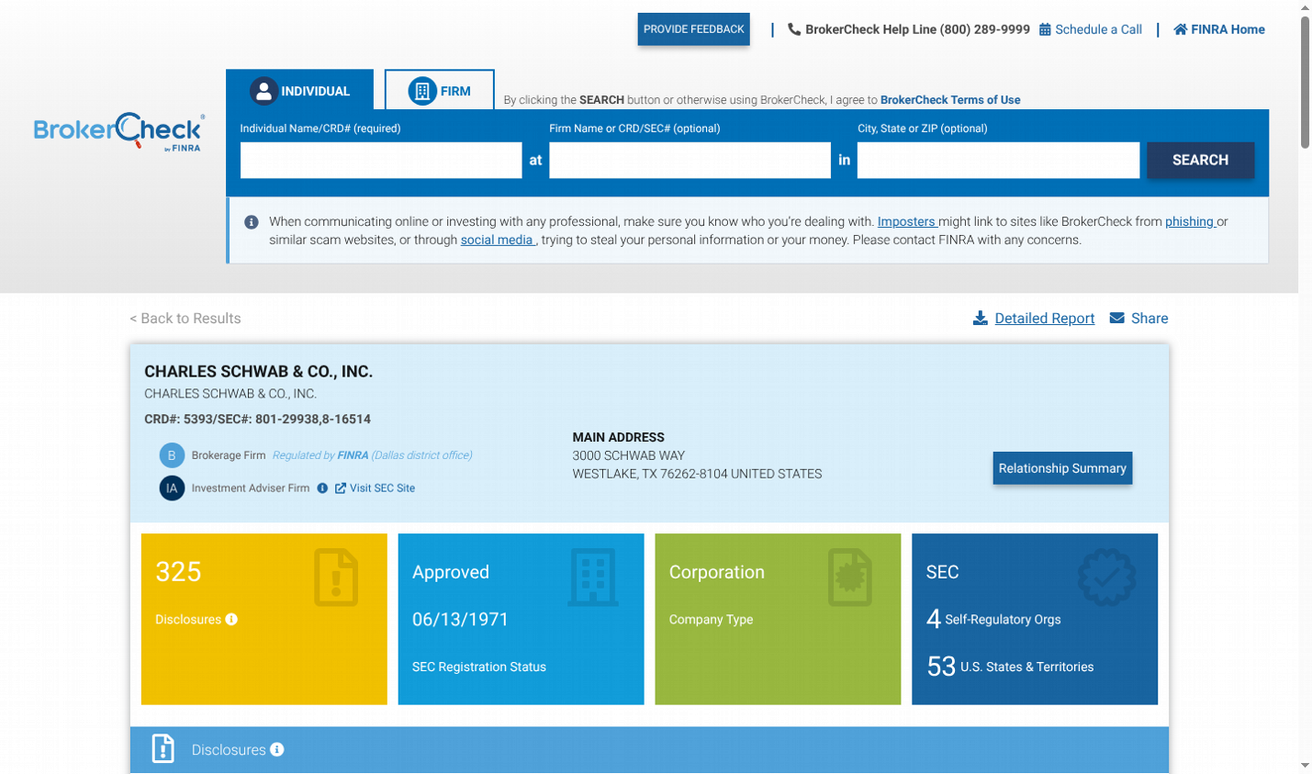
Who regulates them: Robinhood Financial LLC (CRD 165998) and Charles Schwab & Co., Inc. (CRD 5393) are broker-dealers registered with the SEC and members of FINRA, the self-regulator of US brokers. Schwab is also registered as an investment adviser. You can check both firms on FINRA BrokerCheck: Robinhood Financial and Charles Schwab & Co.
Robinhood Financial on FINRA BrokerCheck
Charles Schwab & Co. on FINRA BrokerCheck
Disciplinary history: as of 27 November 2026, BrokerCheck lists 71 disclosures for Robinhood Financial (56 regulatory events and 15 arbitrations) and 325 for Charles Schwab & Co. (59 regulatory events, 261 arbitrations, 3 civil events and 2 bond claims). The totals are not directly comparable, since Schwab has been registered since 1971 and serves far more clients. Robinhood's largest cases were a record FINRA penalty of about $70 million in 2021 and $45 million in SEC penalties in January 2025. Schwab's largest recent case is the $187 million it paid in 2022 to settle SEC charges that it did not disclose how the cash in its robo-advisor portfolios reduced client returns.
SIPC protection: both brokers are members of SIPC, which covers up to $500,000 per customer, including $250,000 for cash, if a member broker fails and customer assets are missing. It does not protect you against market losses.
Excess of SIPC: both brokers also buy insurance from Lloyd's of London that applies once SIPC limits are used up. Robinhood's policy has a $1 billion aggregate limit and up to $50 million per customer, including $1.9 million in cash. Schwab's policy has a $600 million aggregate limit and a combined return of up to $150 million per customer, including $1.15 million in cash.
Cash: above the first $10,000, Robinhood's brokerage cash sweep moves uninvested cash to program banks, where it is eligible for FDIC insurance of up to $2.5 million in individual accounts. At Schwab, uninvested cash is either a free credit balance at the broker, covered by SIPC, or swept to deposit accounts at Schwab's banks, covered by FDIC insurance, depending on your account's cash feature.
Products outside SIPC: Robinhood's crypto is held by Robinhood Crypto, LLC (NMLS 1702840), licensed by the New York State Department of Financial Services, and its futures by Robinhood Derivatives, LLC. Schwab's futures and forex are offered by Charles Schwab Futures and Forex LLC, and its crypto by Charles Schwab Premier Bank, SSB. Both futures firms are registered with the CFTC and are members of the NFA. Crypto and futures are not covered by SIPC at either broker, and crypto is not FDIC insured.
Managed portfolios: Robinhood Strategies is run by Robinhood Asset Management, LLC, and Schwab Intelligent Portfolios by Charles Schwab & Co., Inc. Both are SEC-registered investment advisers, which you can look up on the SEC's Investment Adviser Public Disclosure site.
Schwab.com is designed for US residents, and non-US clients use Schwab's international accounts, with different rules. Robinhood's UK app is a separate business with different products.
9. Pros and cons
The pros and cons below reflect our own assessment of each broker. Investing involves risk, and the value of your investments can go down as well as up, so you may get back less than you invest.
Robinhood pros and cons
Pros
- $0 per contract on stock and ETF options
- IRA match of 1%, or 3% with Gold
- 5.25% margin rate with no subscription
- 3.60% APY on cash with Gold
Cons
- No interest on cash without Gold
- No mutual funds or individual bonds
- $100 fee to transfer your account out
Schwab pros and cons
Pros
- Mutual funds, bonds, CDs and $0 Treasuries
- thinkorswim with paper trading and 24/5 trading
- Robo-advisor with no advisory fee
- Branches and more account types (529, Individual 401(k))
Cons
- 0.01% APY on uninvested brokerage cash
- $0.65 per options contract
- Margin rates of up to 12.075%
Robinhood vs Schwab: our verdict
Robinhood
Best for options, margin and IRA contributionsCharles Schwab
Best for mutual funds, bonds and active trading tools
If you trade options, borrow on margin or add money to an IRA every year, Robinhood leaves more money in your account: $0 per contract, 5.25% on margin and a match of up to 3%. If you want mutual funds, bonds, a robo-advisor with no advisory fee or the thinkorswim platforms, Schwab offers more, as long as you move idle cash into a money fund instead of leaving it at 0.01%.
New clients can get a free stock at Robinhood, as we explain in our Robinhood free stock guide. To compare Robinhood with another full-service broker, read our Robinhood vs Fidelity, Robinhood vs Vanguard and Robinhood vs E*TRADE comparisons, and for another trading app, our Webull vs Robinhood comparison.
Disclaimer: When investing, your capital is at risk and you may get back less than invested. Options and margin trading carry a high level of risk, and margin can lead to losses greater than your deposit. This information is not investment advice. Fees, rates and offers change often, so check them on each broker's website before you open an account.
FAQs
Is Schwab better than Robinhood?
For long-term investing, Schwab offers mutual funds, bonds, more account types, branches and a robo-advisor with no advisory fee. Robinhood is cheaper for options and margin and pays an IRA match of up to 3%, so it depends on how you invest.
Does Schwab pay interest on uninvested cash?
Yes, but little: 0.01% APY on brokerage cash as of 27 November 2026. To earn more you can buy a Schwab money market fund such as SWVXX, which yielded 3.79% on 25 November 2026. Robinhood pays 3.60% APY on cash with Gold.
Is Robinhood or Schwab cheaper for options?
Robinhood charges $0 per contract on stock and ETF options, while Schwab charges $0.65, so 20 contracts a month cost $156 a year at Schwab. Schwab waives the fee on online buy-to-close orders priced at $0.05 or less.
Does Schwab have 24-hour trading like Robinhood?
Yes. Schwab offers 24/5 trading on more than 1,300 stocks and ETFs, but only on thinkorswim. Robinhood's 24 Hour Market covers a list of popular stocks and ETFs from Sunday 8 PM to Friday 8 PM ET in its app.
Can I transfer my account from Robinhood to Schwab?
Yes. You request the transfer at Schwab and your shares move through ACATS without being sold. Robinhood charges $100 for the outgoing transfer, and Schwab charges $50 for a full transfer out if you later move the other way. If you hold a Robinhood IRA with a match, money moved out within five years can lose part of the match.
Can I call Robinhood or Schwab by phone?
Schwab answers the phone 24/7 and has more than 400 branches. Robinhood offers 24/7 chat and calls you back when you request it in the app, with phone support for investing from 7 AM to 9 PM ET on weekdays.