
E*TRADE and Charles Schwab are two of the largest full-service online brokers in the US. Both charge $0 commission on US stocks and ETFs and $0.65 per options contract, have no account minimum and answer the phone 24/7. The differences are in futures and crypto costs, robo-advisors, account types, branches and what it costs to leave.
In this comparison, we put the US figures from each broker's own website side by side and work out what each one costs or pays you in a year for seven types of investor.
E*TRADE vs Schwab: quick take
- E*TRADE is best for active traders who want cheaper futures ($1.50 per contract against $2.25), a lower options rate with 30+ trades a quarter ($0.50 per contract) and cheaper crypto (0.50% against 0.75%).
- Charles Schwab is best for investors who want a robo-advisor with no advisory fee, 529 plans, 24/5 trading on 1,300+ stocks and ETFs in thinkorswim, more than 400 branches and a slightly lower fee to leave ($50 against $75).
E*TRADE vs Schwab in a nutshell
| Category | E*TRADE | Schwab |
| US stocks and ETFs | $0 commission online | $0 commission online |
| Stock and ETF options | $0.65 per contract ($0.50 with 30+ trades a quarter) | $0.65 per contract |
| Futures | $1.50 per contract, per side | $2.25 per contract |
| Crypto | 0.50% per trade | 0.75% of trade value |
| Interest on uninvested cash | 0.01% APY (3.75% in Premium Savings) | 0.01% APY (3.79% if you buy SWVXX) |
| Margin rate (under $25,000) | 12.70% under $10,000, 12.45% from $10,000 | 12.075% |
| Managed portfolios | 0.30% a year, $500 minimum | No advisory fee, $5,000 minimum |
| Paper trading | Yes (Power E*TRADE) | Yes (thinkorswim) |
| Branches | No | 400+ |
| Outgoing transfer fee | $75 | $50 (full transfer) |
Source: E*TRADE pricing and rates, E*TRADE sweep rates, the Schwab pricing guide and Schwab margin and cash pages. E*TRADE margin rates effective 21 September 2026 and sweep rates as of 27 November 2026. Schwab base margin rate as of 18 September 2026, SWVXX yield as of 25 November 2026 and brokerage cash APY as of 27 November 2026. Data as of November 2026.
1. Overview
E*TRADE
E*TRADE was one of the first online brokers in the US and has been part of Morgan Stanley since 2020. Its brokerage accounts are now offered by Morgan Stanley Smith Barney LLC, a member of FINRA and SIPC, and its bank accounts by Morgan Stanley Private Bank. E*TRADE accounts are for US residents, as we explain in our guide on whether E*TRADE works internationally.
Charles Schwab
The Charles Schwab Corporation is based in Westlake, Texas, and listed on the NYSE (SCHW). Brokerage accounts are held by Charles Schwab & Co., Inc., a member of SIPC. Since buying TD Ameritrade, Schwab offers the thinkorswim platforms (desktop, web and mobile) next to the Schwab website and app, and runs more than 400 branches across the US. For its size and client numbers, see our Charles Schwab statistics.
2. Products
E*TRADE: US stocks and ETFs, options, futures and options on futures, over 6,000 mutual funds with no transaction fee, bonds and CDs ($1 per bond on the secondary market, $0 for Treasuries) and crypto through zerohash, at 0.50% per trade. Fractional shares cover a growing list of stocks and ETFs, starting with the S&P 100, from $5, as we explain in our guide to E*TRADE fractional shares.
Schwab: US stocks and ETFs, fractional shares of any S&P 500 company from $5 (Schwab Stock Slices), options, mutual funds (4,000+ with no transaction fee through Mutual Fund OneSource), bonds, CDs and US Treasuries ($0 online), futures ($2.25 per contract), forex and crypto (0.75% of trade value).
The product ranges are close. Both cover mutual funds, bonds, futures and crypto, and both sell fractional shares only of large companies. Only Schwab offers forex. Schwab charges a $49.95 short-term redemption fee on OneSource funds held for 90 days or less.
3. Interest on cash
Both brokers pay 0.01% APY on uninvested brokerage cash, so you have to act to earn more:
- E*TRADE: move cash to a Morgan Stanley Private Bank Premium Savings account, which paid a base rate of 3.75% APY on 27 November 2026 and is FDIC insured up to $500,000. That money sits outside your brokerage account, so you have to move it back before you invest.
- Schwab: buy a money market fund in the brokerage account, such as the Schwab Prime Advantage Money Fund (SWVXX), whose 7-day yield was 3.79% on 25 November 2026. You have to buy and sell the fund yourself.
On $10,000 left as cash, you earn about $1 a year at either broker. Moved to Premium Savings or SWVXX, it earns about $375 at E*TRADE or $379 at Schwab. All these rates are variable.
4. IRAs and account types
Neither broker matches IRA contributions. E*TRADE runs one-time bonuses for new retirement accounts, such as $150 for a deposit of $5,000 to $19,999 with its RETIRE26 offer.
E*TRADE accounts: brokerage and custodial accounts, Coverdell education accounts, traditional, Roth, rollover and inherited IRAs and IRAs for minors, plus Solo 401(k) (traditional or Roth), SEP IRA and SIMPLE IRA plans.
Schwab accounts: brokerage accounts, traditional, Roth, rollover and inherited IRAs, custodial accounts, 529 college savings plans and trusts, plus Individual 401(k), SEP-IRA and SIMPLE IRA plans, all with no minimum to open.
Both cover the self-employed. For school costs, E*TRADE offers a Coverdell account and Schwab a 529 plan. Schwab also offers Schwab Bank Investor Checking, linked to a Schwab One brokerage account, with no foreign transaction fees and ATM fee rebates worldwide.
5. Managed portfolios
Schwab Intelligent Portfolios charges no advisory fee and needs $5,000 to start. E*TRADE's Core Portfolios charges 0.30% a year from a $500 minimum, and clients with larger balances can work with a Morgan Stanley financial advisor.
| Balance | E*TRADE Core Portfolios | Schwab Intelligent Portfolios |
| $20,000 | $60 | $0 |
| $50,000 | $150 | $0 |
| $200,000 | $600 | $0 |
Our calculation with each broker's published advisory fees, November 2026. ETF costs not included.
Schwab's portfolios are not free of cost: part of each portfolio is held in cash at Schwab Bank, which earned 3.51% APY from 2 November 2026, and you pay the expense ratios of the ETFs. That cash lowers the share of your money in the market, so check its size for your risk profile before you sign up.
6. Pricing
What a year costs
| Investor | E*TRADE | Schwab |
| Buys an S&P 500 ETF every month | $0 | $0 |
| Keeps $10,000 in cash | Earns $1 ($375 in Premium Savings) | Earns $1 ($379 in SWVXX) |
| Trades 20 option contracts a month | $156 ($120 with 30+ trades a quarter) | $156 |
| Trades 10 futures contracts a month (in and out) | $360 | $540 |
| Borrows $20,000 on margin all year | $2,490 | $2,415 |
| Has $50,000 in a robo-advisor | $150 | $0 |
| Moves the account to another broker | $75 | $50 |
Our calculation with each broker's November 2026 rates. Options: 240 stock or ETF contracts a year at $0.65 ($0.50 at E*TRADE with 30+ trades a quarter). Futures: 120 contracts a year, each bought and sold, before exchange and regulatory fees. Margin: 12.45% at E*TRADE for loans from $10,000 to $24,999 and 12.075% at Schwab, interest only. Robo-advisor: advisory fee only.
For a buy-and-hold investor in stocks and ETFs, both are free. Both charge high margin rates: E*TRADE's run from 12.70% under $10,000 down to 10.70% for loans of $250,000 to $499,999, and Schwab's from 12.075% to 10.325% at the same size. Broker-assisted trades cost $25 at both, and E*TRADE charges $2 a quarter for paper statements unless an exemption applies.
7. Platforms, trading hours and support
E*TRADE has its main app and website plus Power E*TRADE, aimed at active stock, options and futures traders, with paper trading and research from Morgan Stanley and third parties such as Argus. Schwab has its website and app plus thinkorswim, which includes paper trading, options analytics and futures trading in one platform.
E*TRADE has pre-market trading from 4 AM, after-hours trading until 8 PM and an overnight session from 8 PM to 4 AM ET, Sunday to Thursday, for eligible symbols with limit orders. Schwab offers 24/5 trading on more than 1,300 stocks and ETFs, including all S&P 500, Nasdaq 100 and Dow 30 stocks, but only on thinkorswim. Both brokers receive payment for order flow on stock and ETF orders, as their SEC Rule 606 reports show.
Both offer customer service 24/7, and E*TRADE's number is 800-387-2331. Schwab also has more than 400 US branches and a Satisfaction Guarantee, which E*TRADE does not offer.
8. Regulation and security
Who regulates them: Morgan Stanley Smith Barney LLC (CRD 149777), which offers E*TRADE brokerage accounts, and Charles Schwab & Co., Inc. (CRD 5393) are broker-dealers registered with the SEC and members of FINRA, the self-regulator of US brokers. You can check both firms on FINRA BrokerCheck: Morgan Stanley Smith Barney and Charles Schwab & Co.
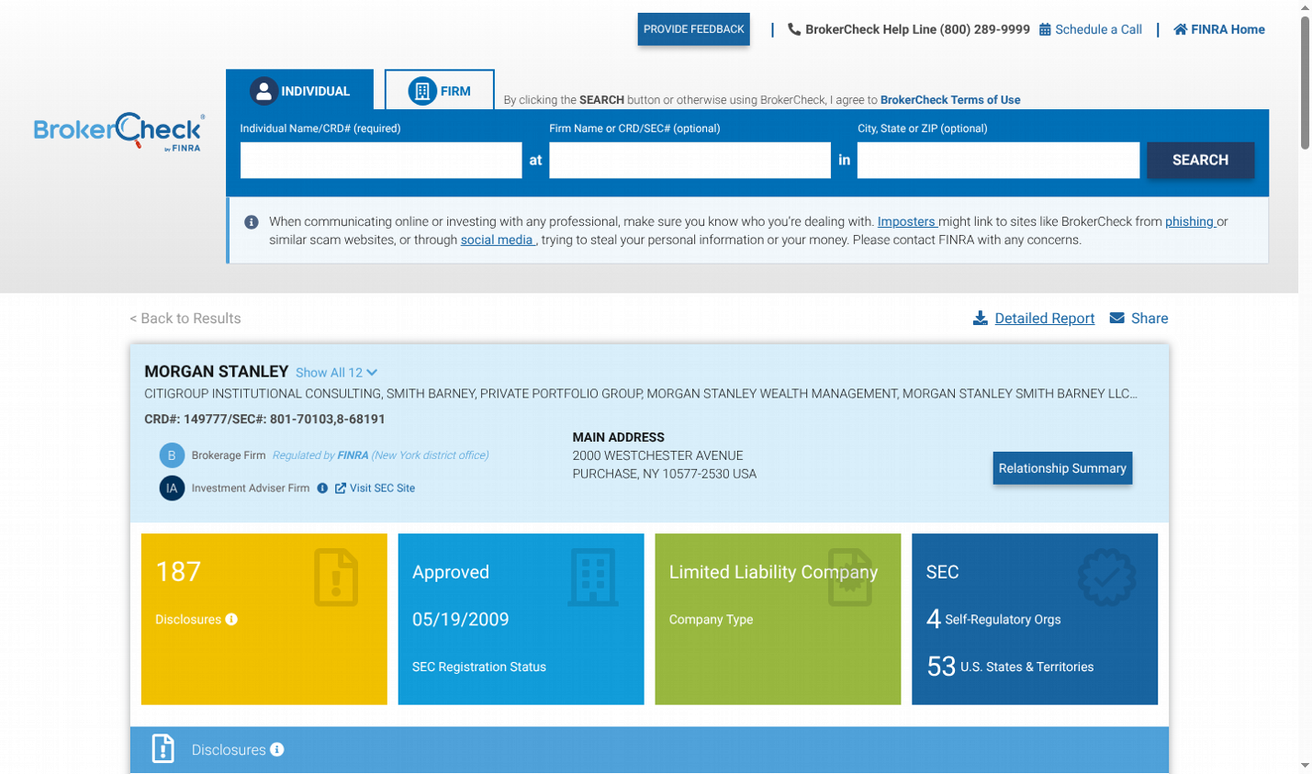
Morgan Stanley Smith Barney on FINRA BrokerCheck
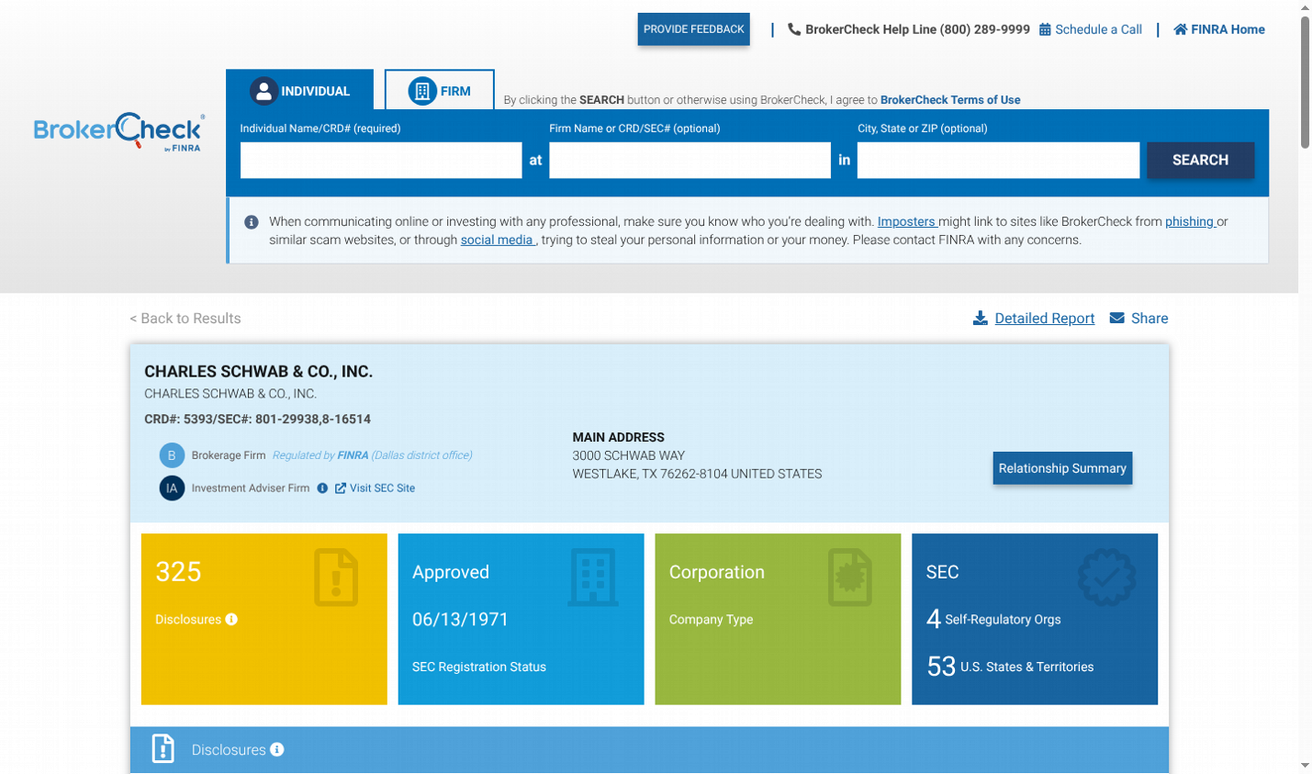
Charles Schwab & Co. on FINRA BrokerCheck
Disciplinary history: as of 27 November 2026, BrokerCheck lists 187 disclosures for Morgan Stanley Smith Barney (67 regulatory events and 120 arbitrations) and 325 for Charles Schwab & Co. (59 regulatory events, 261 arbitrations, 3 civil events and 2 bond claims). Both are large firms: the Morgan Stanley figure covers its whole US wealth management business, not only E*TRADE, and Schwab has been registered since 1971. Morgan Stanley Smith Barney paid $35 million in 2022 over the protection of customer data. Schwab paid $187 million in 2022 to settle SEC charges that it did not disclose how the cash in its robo-advisor portfolios reduced client returns.
SIPC protection: both brokers are members of SIPC, which covers up to $500,000 per customer, including $250,000 for cash, if a member broker fails and customer assets are missing. It does not protect you against market losses.
Excess of SIPC: Morgan Stanley's cover for E*TRADE clients has a firmwide cap of $1 billion for securities and up to $1.9 million per client for uninvested cash. Schwab's policy from Lloyd's of London has a $600 million aggregate limit and a combined return of up to $150 million per customer, including $1.15 million in cash.
Products outside SIPC: E*TRADE's futures are offered by E*TRADE Futures LLC and its crypto through zerohash. Schwab's futures and forex are offered by Charles Schwab Futures and Forex LLC and its crypto by Charles Schwab Premier Bank, SSB. Crypto and futures are not covered by SIPC at either broker, and crypto is not FDIC insured.
9. Pros and cons
The pros and cons below reflect our own assessment of each broker. Investing involves risk, and the value of your investments can go down as well as up, so you may get back less than you invest.
E*TRADE pros and cons
Pros
- Futures at $1.50 per contract
- $0.50 per options contract with 30+ trades a quarter
- Crypto at 0.50% per trade
- 6,000+ no-transaction-fee mutual funds
Cons
- 0.01% on uninvested cash
- 0.30% a year for Core Portfolios
- $75 to transfer the account out
- No branches
Schwab pros and cons
Pros
- Robo-advisor with no advisory fee
- 24/5 trading on 1,300+ stocks and ETFs
- 529 plans and 400+ branches
- thinkorswim platforms with paper trading
Cons
- 0.01% on uninvested cash
- Futures at $2.25 per contract
- Fractional shares only for S&P 500 stocks
E*TRADE vs Schwab: our verdict
E*TRADE
Best for futures, frequent options traders and cheaper cryptoSchwab
Best for a free robo-advisor, 529 plans and branches
For most investors the costs are the same: $0 on stocks and ETFs, $0.65 per options contract and 0.01% on idle cash at both. E*TRADE costs less if you trade futures or crypto, or make 30+ options trades a quarter. Schwab costs less if you want a managed portfolio, and it adds 529 plans, branches and 24/5 trading in thinkorswim. At either broker, move idle cash into Premium Savings or a money fund.
To compare each broker with a lower-cost app, read our Robinhood vs Schwab, Robinhood vs E*TRADE and Webull vs E*TRADE comparisons. If you are also considering Fidelity, see E*TRADE vs Fidelity.
Disclaimer: When investing, your capital is at risk and you may get back less than invested. Options, futures and margin trading carry a high level of risk, and margin can lead to losses greater than your deposit. This information is not investment advice. Fees, rates and offers change often, so check them on each broker's website before you open an account.
FAQs
Is E*TRADE better than Schwab?
It depends on how you invest. E*TRADE is cheaper for futures, crypto and frequent options trading. Schwab offers a robo-advisor with no advisory fee, 529 plans, more than 400 branches and 24/5 trading on 1,300+ stocks and ETFs.
Do E*TRADE and Schwab charge the same for options?
Both charge $0.65 per contract and $0 commission on the trade itself. E*TRADE cuts the rate to $0.50 per contract if you make at least 30 trades a quarter.
Which pays more interest on cash, E*TRADE or Schwab?
Neither, by default: both pay 0.01% APY on uninvested brokerage cash. At E*TRADE you can earn 3.75% APY in a Morgan Stanley Private Bank Premium Savings account, and at Schwab 3.79% by buying the SWVXX money market fund (rates as of late November 2026).
Is E*TRADE owned by Schwab?
No. E*TRADE has been owned by Morgan Stanley since 2020. Schwab bought TD Ameritrade, not E*TRADE.
Can I transfer my account from E*TRADE to Schwab?
Yes. You request the transfer at Schwab and your shares move through ACATS without being sold. E*TRADE charges $75 for a full transfer out, and Schwab charges $50 if you later move the other way.