


As your business grows and cash flows stabilize, it’s time to consider investing your capital. With cash reserves available, you’re likely exploring options to diversify in the financial markets.
Trading 212 is a good option for retail clients, but is it available for businesses?
This article explores whether Trading 212’s business/corporate account is available and other viable options based on factors like reputation, security, fees, and customer support. Let’s dive in!
Does Trading 212 offer business accounts?
No. Trading 212 only offers accounts for personal use, not for businesses, as stated in its help centre:
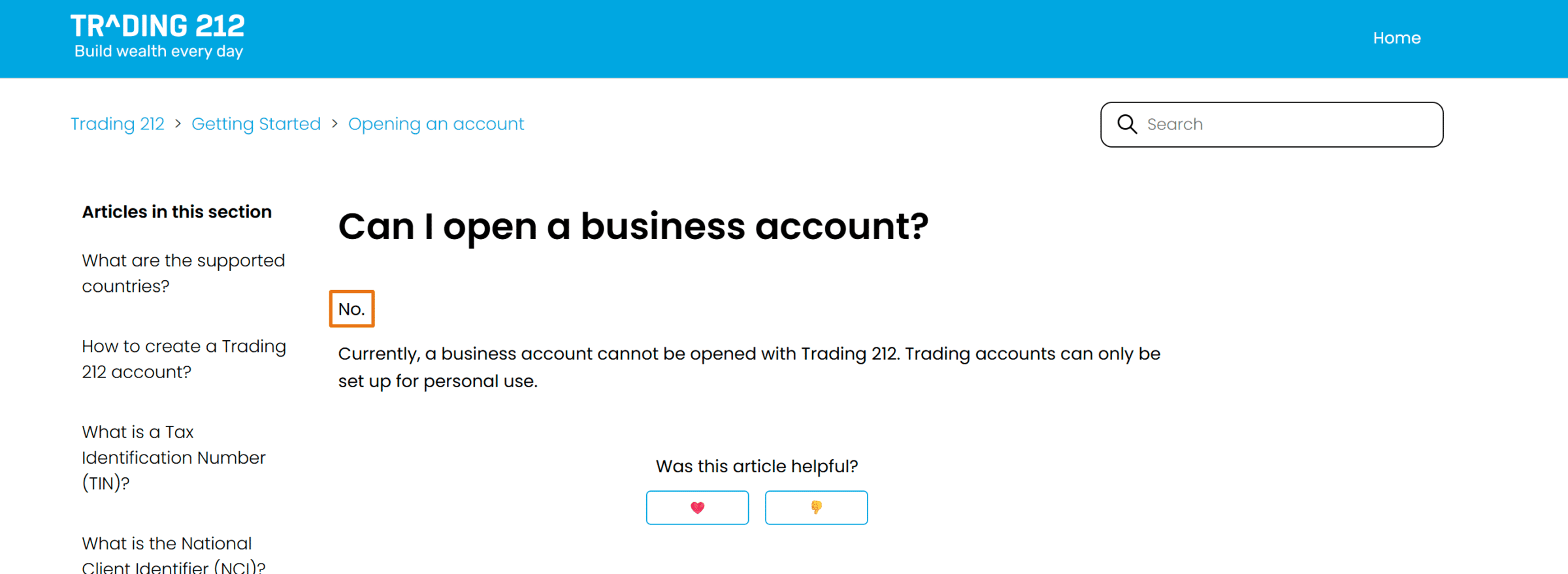
So, if you run a limited company, or other type of corporation, you’ll have to look elsewhere!
We have spoken with the Trading 212 team, and business accounts are among its future plans. We will update this article as soon as they become available.
Best Trading 212 alternatives for businesses
- Interactive Brokers: Best overall
- Saxo: Best for professionals who want a wide range of products
- Lightyear: Best for money market funds and low fees
- eToro: Most user-friendly platform


62% of retail CFD accounts lose money.

Terms apply, seek guidance if necessary. When you invest, your capital is at risk.

52% of retail CFD accounts lose money.
Comparison
Varies depending on the subsidiary. Two examples: Up to £85,000 for clients under IB U.K. Limited; Up to €20,000 for clients under IB Ireland Limited.

Europe: up to €100,000 for cash and €20,000 for securities; UK: up to £85,000; Switzerland: CHF 100,000; Hong Kong: HKD 500,000

Up to €20,000 for European investors; Up to £85,000 for UK investors
Up to €20,000 for clients under eToro (Europe) Ltd; Up to £85,000 for clients under eToro (UK) Ltd.
Reviews
Interactive Brokers corporate accounts at a glance
Founded in 1978, listed on Nasdaq (ticker: IBKR) and part of the S&P 500 since August 2025, Interactive Brokers is a global online broker with more than 5.5 million client accounts that has come through significant financial crises, showing resilience and a rigorous risk management process.
Interactive Brokers offers an advanced investment platform that allows you to invest globally in stocks, options, futures, currencies, bonds, and funds from a single integrated account. Its advanced trading and account management tools let you control and delegate user permission for a business brokerage account.
With Interactive Brokers, businesses around the world can open a company account. Some institutions that can open an Interactive Brokers account include Small Businesses, Hedge Funds, Prop Traders, Family Offices, and more. It gives you solid trade execution through IB SmartRouting, and a set of technical and fundamental tools to help you make investment decisions.
Interactive Brokers’ fee structure is quite complex and the registration process is lengthy but fully online. However, with currency conversion at 0.002% (minimum $2), narrow spreads and the stock lending program, Interactive Brokers’ clients still get significant savings compared to most brokers.
Want to know more about Interactive Brokers? Read more details directly on Interactive Brokers’ landing page, or check our step-by-step guide on how to open a business brokerage account with Interactive Brokers.

Pros
- Low commissions on US stock trading
- No monthly inactivity fee
- The broadest product and markets range in the brokerage industry
- Demo account
- Excellent reputation (founded in 1978)
- Extensive research and Education tools
- Has a modern mobile trading app to trade Stocks, Options and ETFs, ideal for novice investors, IBKR GlobalTrader.
- Offers interest on uninvested cash balances
Cons
- Complicated and lengthy account opening process (but fully online)
- Steeper learning curve for beginners
- Website is difficult to navigate
- Interactive Advisors (Robo-advisor feature) is only available for US customers
Saxo Bank business accounts at a glance
62% of retail CFD accounts lose money.
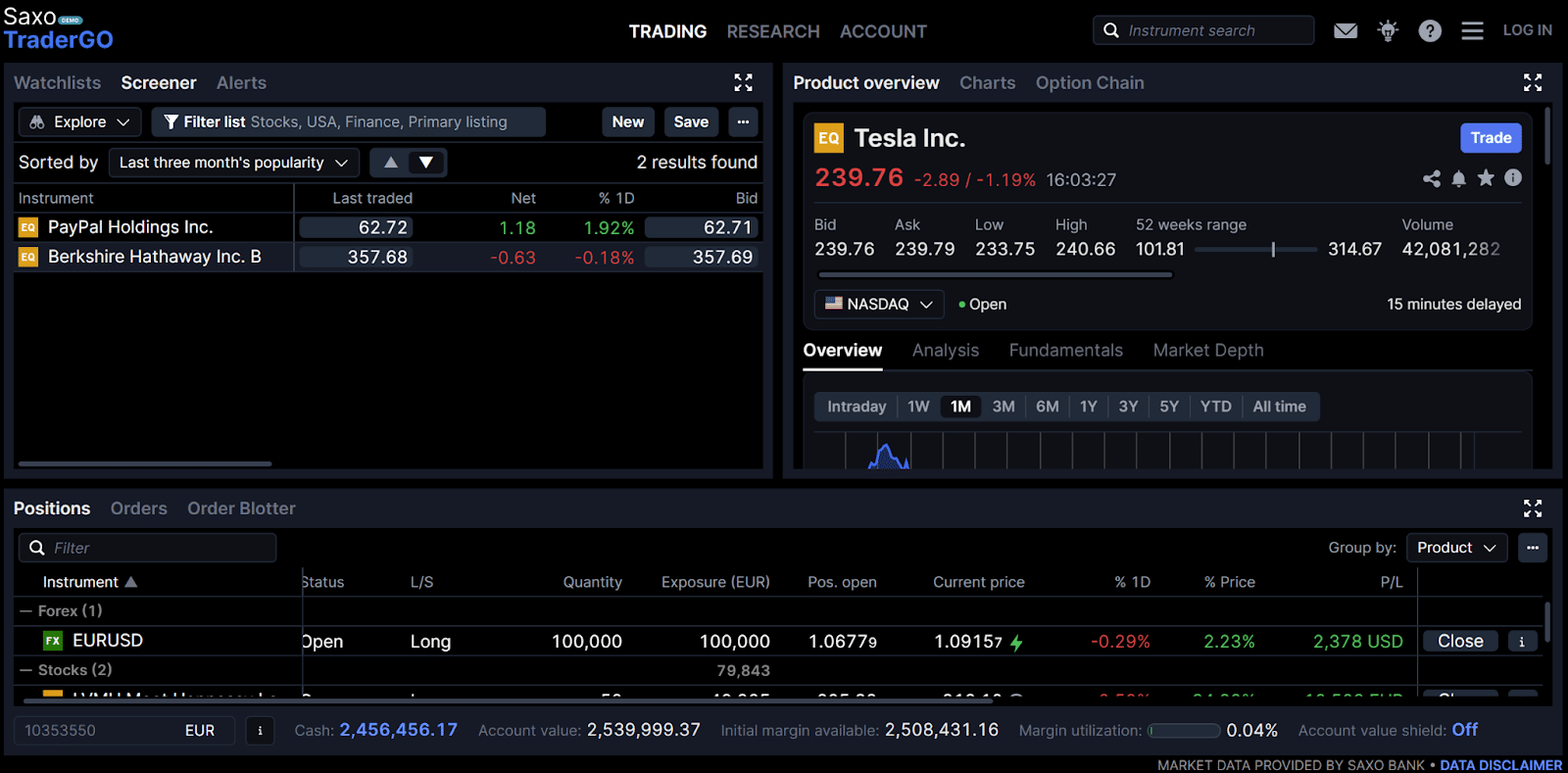
Launched in 1992 and now majority-owned by Swiss bank J. Safra Sarasin, Saxo Bank is one of the most solid financial entities in the brokerage industry, with more than 1.5 million clients and an S&P rating of A-. Its corporate accounts give access to all asset classes from one cross-collateralised account through the SaxoTrader platform (web, desktop and mobile).
Minimum initial funding varies by country of residence. Your tier depends on your initial deposit (within 30 days) or your trading volume (after the first three months):
- Classic: the base tier.
- Platinum: from €200,000 in deposits or qualifying trading volume, with lower prices than Classic.
- VIP: from €1,000,000 in deposits or qualifying trading volume, with the lowest prices.
The pricing structure varies according to your account tier. For instance, a US stock order costs 0.08% (min. $1) of the trade value in Classic, and less on Platinum and VIP.
Saxo Bank states that a corporate account is generally approved in about one week, provided you have an existing corporate bank account and send clear copies of the following documents:
- Memorandum and Articles of Association.
- Certificate of Incorporation.
- Proof of the company’s business address if different from its registered address (e.g. a company bank statement or utility bill less than three months old and issued in the company’s name).
- Latest financial statement.
- Group structure diagram (for entities within complex group structures only).
In addition, every beneficial owner with a 25% or greater company holding and each company director should send other documents, namely:
- Passport (photo and signature pages).
- Proof of residency – a utility bill less than three months old that displays the date, applicant’s name and address that matches the one on the application.
If you want to know more details about Saxo Bank’s corporate account, check their landing page for corporate investment accounts.
Pros
- Excellent research materials
- Outstanding trading platforms (SaxoInvestor and SaxoTrader)
- Extensive range of investment products and commercial offers
- Long track record
- Supervised by worldwide top-tier regulators
Cons
- $0 in most countries; higher minimums in some regions (e.g. $5,000 in MENA)
- Fees higher than average
- Fee structure is complex
- Does not accept US residents
Lightyear business accounts at a glance
Terms apply, seek guidance if necessary. When you invest, your capital is at risk.
Lightyear is a European investment app that operates in the EU through Lightyear Europe AS, authorised and regulated by the Estonian Financial Supervision Authority (EFSA, licence number 4.1-1/31), and in the UK through Lightyear UK Ltd, which is directly authorised and regulated by the Financial Conduct Authority (FCA, FRN 987226).
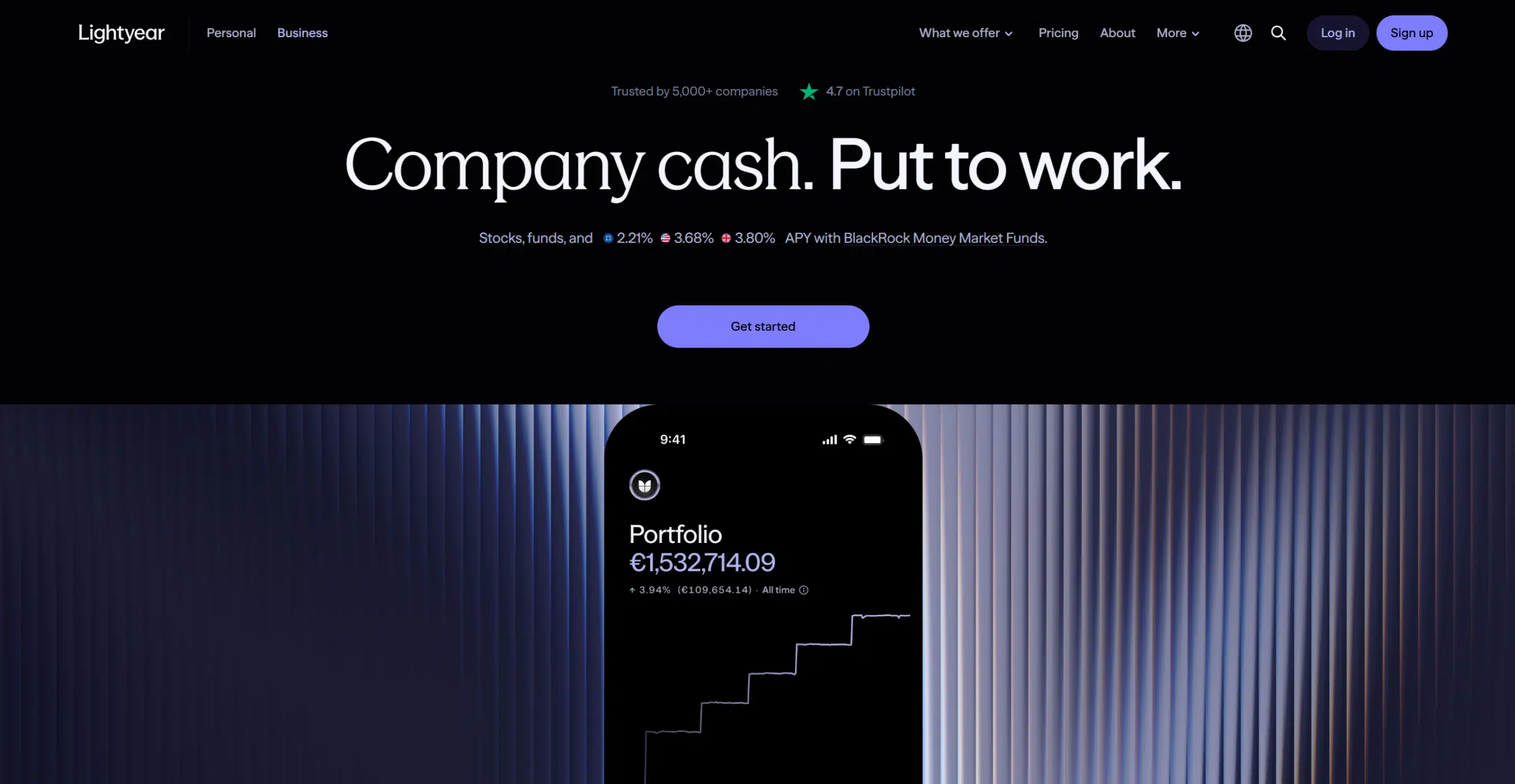
Business accounts are available in 22 countries, including the UK, Estonia and Hungary, and can be opened by freelancers and sole directors as well as small, medium and large companies, with no minimum or maximum deposit. More than 5,000 companies across Europe already use them. You can invest in more than 6,000 stocks and ETFs and in Money Market Funds (MMFs) managed by BlackRock or J.P. Morgan, depending on your country, which are highly liquid, AAA-rated and rated 1 out of 7 for risk. Lightyear also offers Legal Entity Identifier (LEI) registration for £42.50 + VAT in the UK or €48 + VAT in the EU, and automatically completes the W-8BEN-E form to get a reduced tax rate on dividends from US stocks.
There are no Lightyear execution fees to trade ETFs (fund manager fees apply). US stocks cost 0.1% per order ($0.10 minimum, $1 maximum), UK stocks £1 and euro-listed stocks €1, and there is a flat 0.35% fee for currency conversion, which you can limit with the multi-currency account in EUR, GBP and USD. Crypto costs 0.45% per trade and is only available on EU business accounts.
The Money Market Funds currently offer, net of fees and variable: EUR 2.43% (AER/APY) with BlackRock or 2.44% (AER/APY) with J.P. Morgan, GBP 3.85% (AER/APY) and USD 3.89% (AER/APY) with BlackRock, true as of 7 October 2026. Lightyear charges an annual fee of 0.10% on the MMFs, and the rates shown are net of fees.
You can claim up to €300 in a fractional share or ETF or MMF with the promo code “INVESTINGINTHEWEBBIZ” (UK business accounts get £100). Retail investors have a similar offer.
However, Lightyear has some downsides: the product offering is limited (there are no options, commodities or forex), and the director must open a personal account first.
Disclaimer: Investing involves risk. See full T&Cs. Terms apply: lightyear.com/terms. Only invest excess capital. Money market funds are considered investments and are not FSCS protected.
Pros
- 0% Lightyear execution commission on ETF trading (other fees, like fund manager and FX fees, may apply)
- No account opening, inactivity, or withdrawal fees
- High interest on EUR, USD & GBP through MMFs
- Free multi-currency account
- Minimum deposit of €/£/$1
- Fractional Shares
- Account opening promotion with the promo code INVESTINGINTHEWEB
- You can automate your investments with "Plans"
Cons
- Limited financial instruments (no options or futures; commodities only via ETCs such as gold, silver and copper; bonds limited to a small Baltic selection)
- No demo account
- Only available in 25 european countries (not available internationally)
- 0.35% currency conversion fee (0.10% for UK GIA and ISA accounts)
eToro business accounts at a glance
52% of retail CFD accounts lose money.
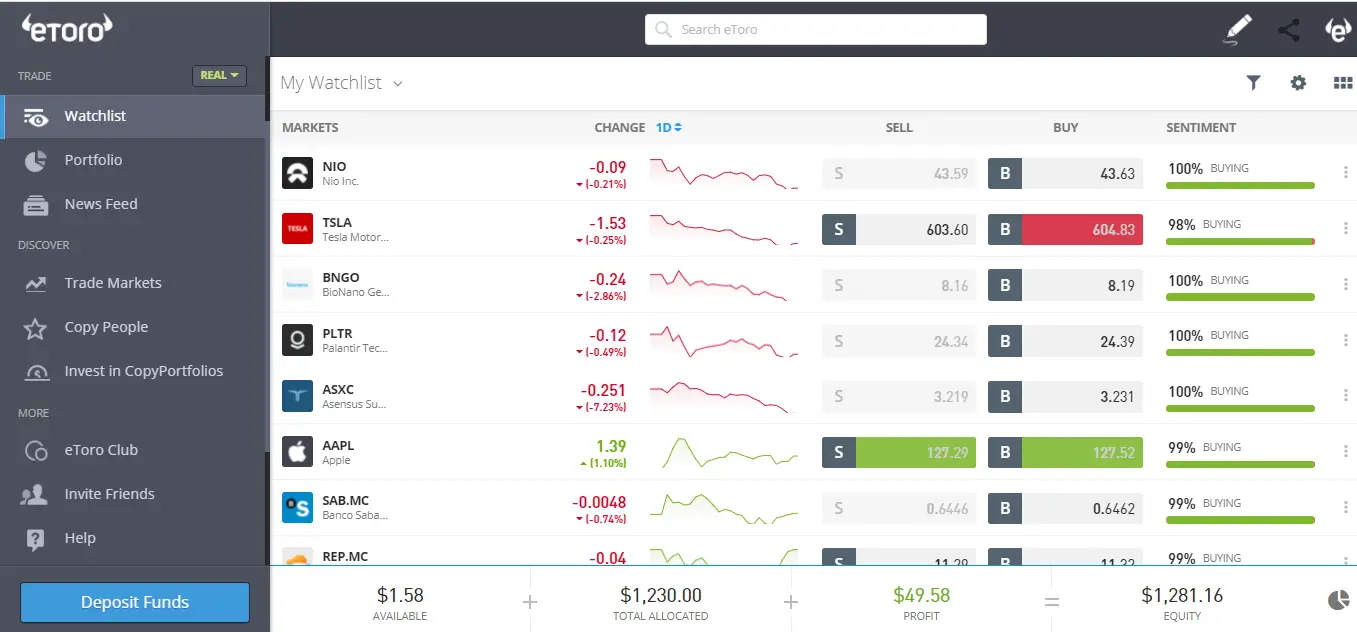
Founded in 2007 and listed on Nasdaq since May 2025, eToro is a multi-asset investment platform with more than 4 million funded accounts. It offers stocks (from $1 per trade), commission-free ETFs, crypto and CFDs on stocks, indices, currencies and commodities.
Opening a business investment account through eToro is possible. However, depending on your location, the products and markets available to trade might vary. In some cases, corporate account holders can have access to better spreads and fees and increased leverage.
Your first step to opening an eToro corporate account is to contact customer support because there is no place on their website where you can start the process on your own. Since we have already contacted them, you can save time by providing the following information in your first message.
To open an eToro business investment account, you should open a ticket and provide eToro with the following information:
- What is the purpose of opening a corporate account with eToro?
- What type of legal entity is your company?
- Where is your company incorporated?
- Please provide a detailed description of your company’s business activity.
- Please provide a copy of your company Memorandum and Articles of Association or the local equivalent.
- The minimum initial deposit for a corporate account is 10,000 USD. Please confirm this will be acceptable.
Want to know more? See eToro’s corporate account opening questionnaire (EU).
Pros
- Low stock trading fees (from $0 per trade)
- Commission-free ETFs (other fees apply)
- Social trading and other innovative products
- Wide variety of financial products
- Slick, modern, and easy for anyone to use
- European users have access to three account currencies: EUR, USD and GBP
- Top tier regulators
Cons
- Limited disclosed financial information
- Withdraw and inactivity fees
- Spread, overnight, inactivity, and currency conversion fees higher than average
- Doesn’t offer bonds, futures, or options
eToro is a multi-asset investment platform. The value of your investments may go up or down. Your capital is at risk.
CFDs are complex instruments and come with a high risk of losing money rapidly due to leverage. 52% of retail investor accounts lose money when trading CFDs with this provider. You should consider whether you understand how CFDs work and whether you can afford to take the high risk of losing your money.What is a business brokerage account?
A brokerage account is an investment account that gives you access to various financial products such as stocks, ETFs, bonds, futures, crypto, and more! The word “Business” only indicates that the entity opening the account is some kind of business structure (Corporation, LLC, Partnership,…).
In practice, the product offering for corporate investment accounts will be similar to retail accounts. However, some slight twists may apply, such as higher minimum deposits, lower spreads, commissions, and more personalised customer support.
Some reasons people choose to invest through their company include taxes (investing through a corporate legal entity can help reduce or mitigate taxes), diversification, and protection/limited liability.
You will need a “LEI” code, what is that?
“LEI” stands for “Legal Entity Identifier.” It is a 20-character unique identifier that identifies entities such as a limited company, trust, or any organisation involved in making investments in the financial markets. Under the MiFIR rules that apply in the UK and the EU, a company needs a LEI before a broker can execute trades on its behalf.
For instance, a company investing in stocks, ETFs or derivatives traded on the London Stock Exchange (LSE) must have a LEI. This ensures that every transaction can be attributed to a recognised and verified entity, which reduces the risk of fraud and makes reporting more transparent. Whether you run a multinational, a local company, a trust or a charity, you need a LEI to invest in the financial markets, and it must be renewed every year.
There are several websites where you can get your LEI, such as LEIservice. Some brokers, such as Lightyear, can also register it for you when you open the account.
Documents needed to open a business account
When applying for a business account with any of the providers mentioned above, you will be asked to provide the documents listed below (this is a general overview, your broker may ask for additional information). Unless specified otherwise, all documents must be less than six months old.
Here they are:
- Company name and registration number.
- Principal place of business address.
- Tax residency and tax identification number.
- Description of your business activities, any products and services you offer and the countries in which you conduct business.
- Information on the source of funds and a description of the activity from which you fund your business and the account you are opening.
- If you wish to trade in US-incorporated stocks, you will need to complete the W-8BEN-E form.
- A Legal Entity Identifier (LEI).
Bottom line
With a business investment account, you will have plenty of options to manage your company’s money. You can look into more conservative options, such as money market funds, or, if you are inclined to take more risk, use it as a share dealing account for your limited company.
Please do remember that the above should not be construed as investment advice and is only intended as an information resource. Investors should do their research and due diligence about the services and opportunities to determine which are best suited for their risk, returns, and impact strategy.
FAQs
Can I open a Trading 212 business account?
No. Trading 212 only offers accounts for personal use, so companies need to use another broker.
Which brokers offer business investment accounts?
Interactive Brokers, Saxo, Lightyear and eToro all accept companies. Interactive Brokers and Lightyear let you open the account online with no minimum deposit, while Saxo’s minimum funding varies by country and eToro asks for $10,000 for corporate accounts.
Do I need a LEI to invest through my company?
Yes. In the UK and the EU, a company needs a Legal Entity Identifier (LEI) before a broker can execute trades for it, and it must be renewed every year.
What documents do I need to open a business brokerage account?
Usually the certificate of incorporation, articles of association, proof of business address, recent financial statements, and ID and proof of address for directors and owners with 25% or more. US stocks also require the W-8BEN-E form.



