
eToro, the leading social trading platform, is available in Germany. The platform has more than 40 million registered users worldwide, who can trade a wide range of assets, stocks, ETFs, commodities, forex, indices, and cryptocurrencies (with CFDs available as a separate, leveraged option). eToro went public on NASDAQ (ticker: ETOR) in May 2025.
The platform offers ETFs with no commission and stocks from $1 per trade (other fees apply), including German stocks from the Frankfurt Stock Exchange and Xetra such as Adidas, Bayer, BMW, SAP and Allianz, a clean and intuitive interface, and the ability to follow and automatically copy other investors through the platform’s signature CopyTrader feature.
German clients can open a EUR account (provided by eToro Money Malta Ltd), so they can deposit, hold and withdraw euros without converting to USD. Currency conversion fees still apply when you trade assets priced in USD with euros. To invest in actual underlying shares (rather than CFDs on those shares), you need to open a “Buy” position without leverage. Otherwise you’ll be trading a CFD, which is a leveraged derivative. CFDs are complex instruments and a majority of retail accounts lose money trading them (check our article on the differences between CFDs and real stocks).
Note also that eToro does not withhold German capital gains tax (Abgeltungsteuer) or issue a German tax certificate (Steuerbescheinigung) the way local brokers such as Trade Republic, comdirect or Scalable Capital do. You declare your gains yourself in the Anlage KAP of your tax return. eToro does offer a downloadable tax report for eToro Club members in Germany, which makes this easier.
Want to know more? We’ve got you covered, keep reading.
Is eToro legal in Germany?
Yes. eToro publishes a list of restricted countries on its website, and Germany is not on it. Using eToro as an investment platform is fully legal for German residents.
German clients are onboarded under eToro (Europe) Ltd, regulated by the Cyprus Securities and Exchange Commission (CySEC, licence 109/10), which passports its services across the EU under MiFID II (the Markets in Financial Instruments Directive), including into Germany. Germany’s financial regulator, BaFin, is notified of these services under the EU passporting rules, and German retail clients are covered by the Cyprus Investor Compensation Fund (ICF) up to €20,000. For crypto, eToro (Europe) Ltd received a MiCA licence from CySEC in February 2025, which it passports to Germany. MiCA, the EU Markets in Crypto-Assets Regulation, has applied in full since December 2024.
eToro Germany highlights
| 👨⚖️ Legal in Germany | Yes (CySEC-regulated, EU passporting) |
| 💰 Stock fees | $1 or $2 per trade, depending on the exchange and your country (other fees apply) |
| 💰 ETF fees | $0 commission (other fees apply) |
| 💰 CFD fees | Spread-based (varies by instrument) |
| 💰 Crypto fees | 1% per position (lower for higher eToro Club tiers) |
| 💰 Currency conversion fee | None with the EUR account. Applies when converting EUR to USD to trade USD assets |
| 💰 Inactivity fee | None |
| 💰 Withdrawal fee | $5 from the USD account, free from the EUR account |
| 💵 Minimum deposit | $50 (varies by country and payment method) |
| 📍 Products offered | Real stocks, ETFs, real cryptocurrencies, CFDs (stocks, indices, commodities, forex, crypto CFDs) |
| 🎮 Demo account | Yes ($100,000 virtual) |
| 📜 Regulatory entities | CySEC (EU and Germany), FCA (UK), ASIC (Australia), SEC and FINRA (US), FSA (Seychelles), FSRA (Abu Dhabi) |
| 📈 Listed on | NASDAQ (ticker: ETOR) since May 2025 |
How safe is eToro?
Safety is usually the first concern when choosing an investment platform, and rightly so. eToro provides multiple layers of protection for client funds and assets:
- Segregated client assets: when you open a non-leveraged “Buy” position in a stock or ETF, you acquire the actual underlying asset, which is held in a segregated custodian account separately from eToro’s own balance sheet. If anything were to happen to eToro as a business, your securities would remain yours and could be transferred to another broker.
- Statutory investor protection (CySEC and ICF): as a German investor, you open your account through eToro (Europe) Ltd, regulated by the Cyprus Securities and Exchange Commission (CySEC, Licence No. 109/10). As a regulated investment firm, eToro is a member of the Cyprus Investor Compensation Fund (ICF), which provides cover of up to €20,000 per client per account in the event of insolvency.
- Private insurance: eToro maintains a private insurance policy underwritten by Lloyd’s of London, providing additional coverage of up to €1 million per eligible client, on top of the statutory ICF protection, at no extra cost.
- NASDAQ-listed parent company: since May 2025, eToro Group Ltd has been publicly listed on NASDAQ (ticker: ETOR), which imposes additional disclosure, audit and corporate governance requirements.
For a deeper analysis, check our full piece on the safety of eToro.
What financial instruments and features will I find?
You can trade a wide range of financial products on eToro:
- Stocks: trade across 20+ stock exchanges, including Frankfurt and Xetra (for German equities), Zurich, Amsterdam, London, Madrid, Milan, Paris, Stockholm, Copenhagen, Helsinki, NYSE, and NASDAQ. Fractional shares are supported (positions from $10), making it easy to invest in expensive shares without committing to a full share.
- ETFs: hundreds of ETFs from leading providers including iShares (BlackRock), Vanguard, SPDR (State Street), Invesco, Amundi, Xtrackers (DWS) and others, with no commission (other fees apply).
- Real cryptocurrencies: 100+ cryptocurrencies available to buy and hold directly (1% fee per position), offered under eToro’s MiCA licence.
- Commodities: exposure to gold, silver, copper, platinum, palladium, and energy commodities, primarily through CFDs.
- Forex: exposure to the foreign exchange market through 40+ currency pairs (majors, minors and selected exotics) via CFDs.
- CFDs: eToro lets you trade leveraged CFDs across stocks, ETFs, commodities, forex, indices, and crypto. CFDs are complex, leveraged instruments and a majority of retail investor accounts lose money trading CFDs. They should only be used by experienced traders who fully understand leverage and the risk of total account loss.
Beyond the product range, eToro’s signature features include:
- CopyTrader: automatically copy other investors’ trades in real time, mirroring their positions and trades in proportion to your allocation. You can follow up to 100 traders simultaneously.
- Smart Portfolios: thematic baskets curated by eToro (or by select institutional partners) around specific strategies (AI, clean energy, semiconductors, dividend stocks, top traders and more), giving you diversified exposure in a single allocation.
- eToro Academy: educational content, courses, and webinars for beginners and intermediate investors.
- Demo account: $100,000 in virtual funds to practise the platform risk-free before committing real capital.
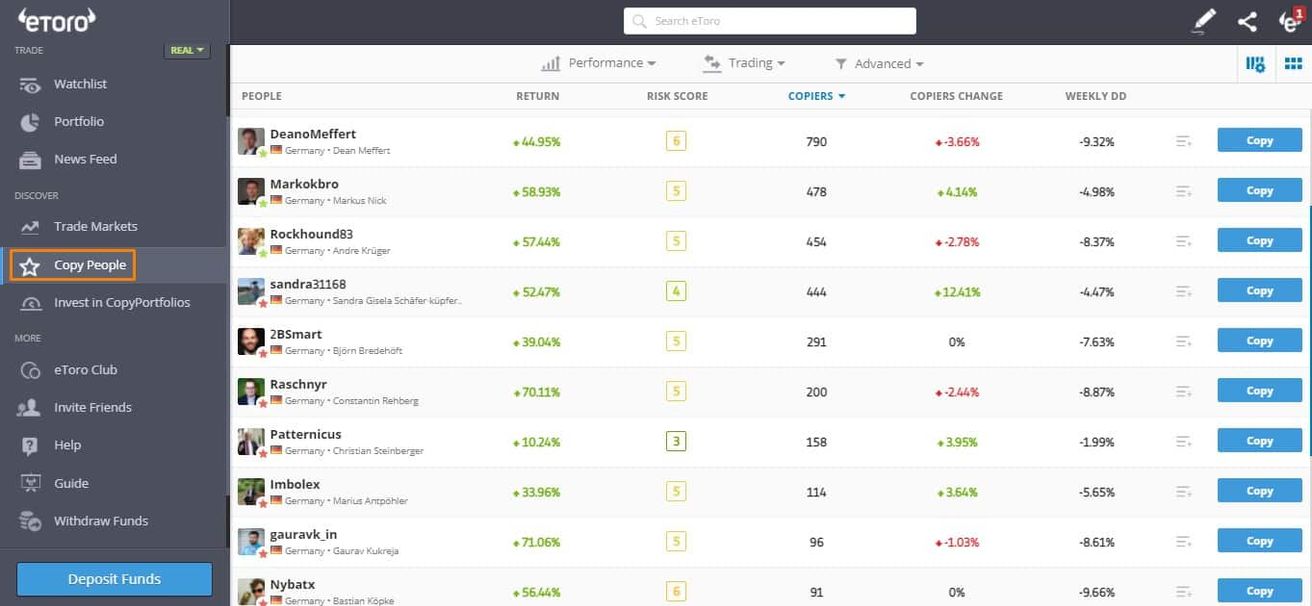
eToro's Copy People feature
eToro’s fees
Like any business, eToro needs to generate revenue. Its primary income sources are spreads (the difference between bid and ask prices), commissions on real stock trades, FX conversion fees, and overnight financing on leveraged CFD positions.
Here’s how the fee structure breaks down:
- Real stocks: $1 or $2 per trade, depending on the exchange and your country of residence.
- ETFs: $0 commission (other fees apply, including currency conversion if you buy assets in a currency other than your account’s).
- Real cryptocurrencies: 1% fee per position, with discounts for higher eToro Club tiers.
- CFDs: charged via the spread on every open and close. Spreads vary by instrument, tighter on major pairs such as EUR/USD or popular indices and wider on smaller stocks and exotic forex pairs. Check the eToro fees page for your instrument.
- Overnight fees: applied to leveraged CFD positions held overnight. These can add up over time and are often overlooked by newer CFD traders.
- Currency conversion fee: none when you deposit and withdraw euros through the EUR account. A fee applies when you convert euros to trade USD assets, and it varies with your eToro Club tier (Platinum members get 50% off and Diamond members pay none).
- Inactivity fee: none.
- Withdrawal fee: $5 per withdrawal from the USD account, free from the EUR account.
How to open an account?
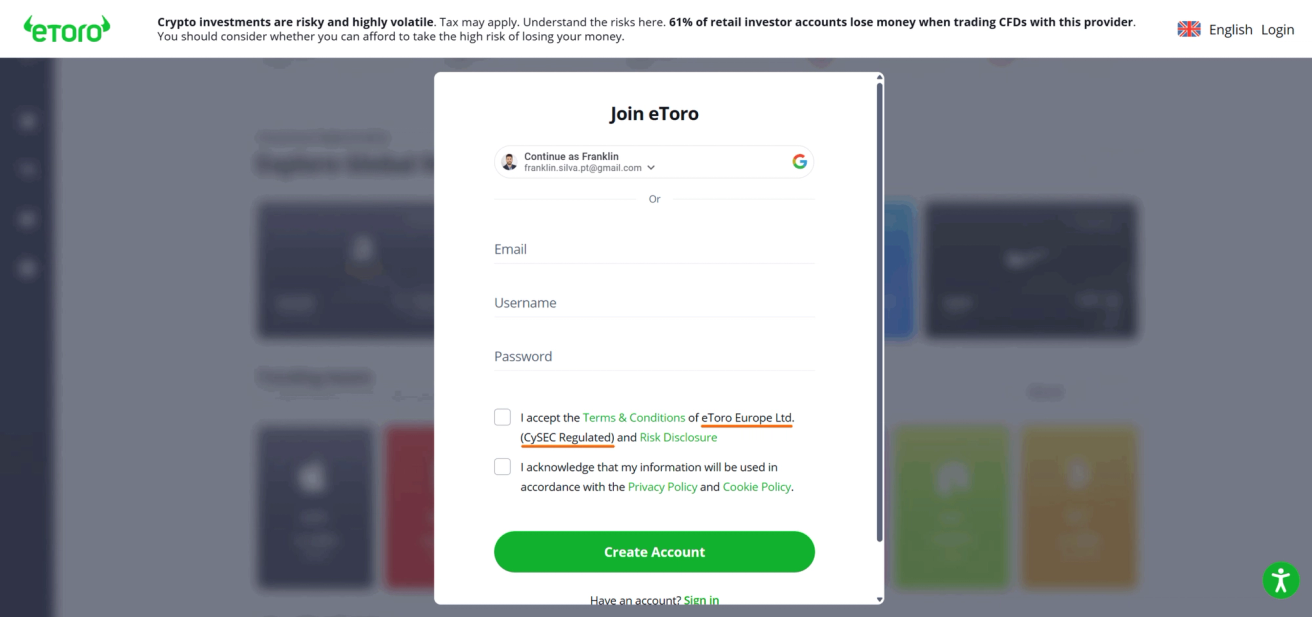
To open an account, you need to go to eToro’s website, click on “Join now”, and provide the required information, as shown in the following image:
Account opening and legal entity
In the first check box (underlined in red), confirm in which subsidiary you are registering.
After this step, you need to verify your identity and address. Your proof of identity could be your ID or your passport. Meanwhile, your proof of residency could be your driving licence, a copy of a bank statement or a utility bill.
We suggest you submit all the remaining documents as soon as you open an account to prevent delays when withdrawing your money! We have witnessed no issues in taking money out of the platform, but it may take a more extended period if your account is not fully updated or verified.
Once everything is correctly set up, you’ll be able to deposit money to start trading with your real account on the eToro platform:
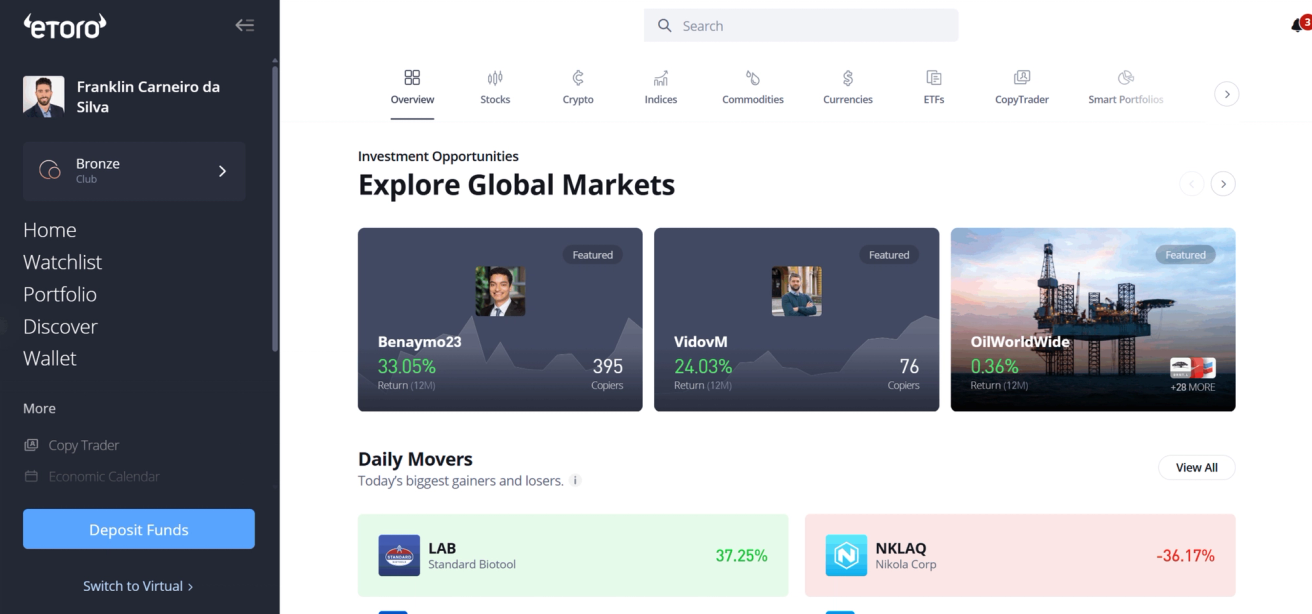
eToro's dashboard
It is effortless to navigate through all the sidebars and the search function on the top. We are confident that you will find what you came looking for in less than a minute.
How to deposit and withdraw?
Before answering this question, let us remind you that you have the option to use a Demo Account before deciding whether to deposit funds or not.
Deposits: On your eToro dashboard, you will find “Deposit Funds”. When clicking on it, you will notice a pop-up window with six types of deposit options. The eToro minimum deposit in Germany is $50.
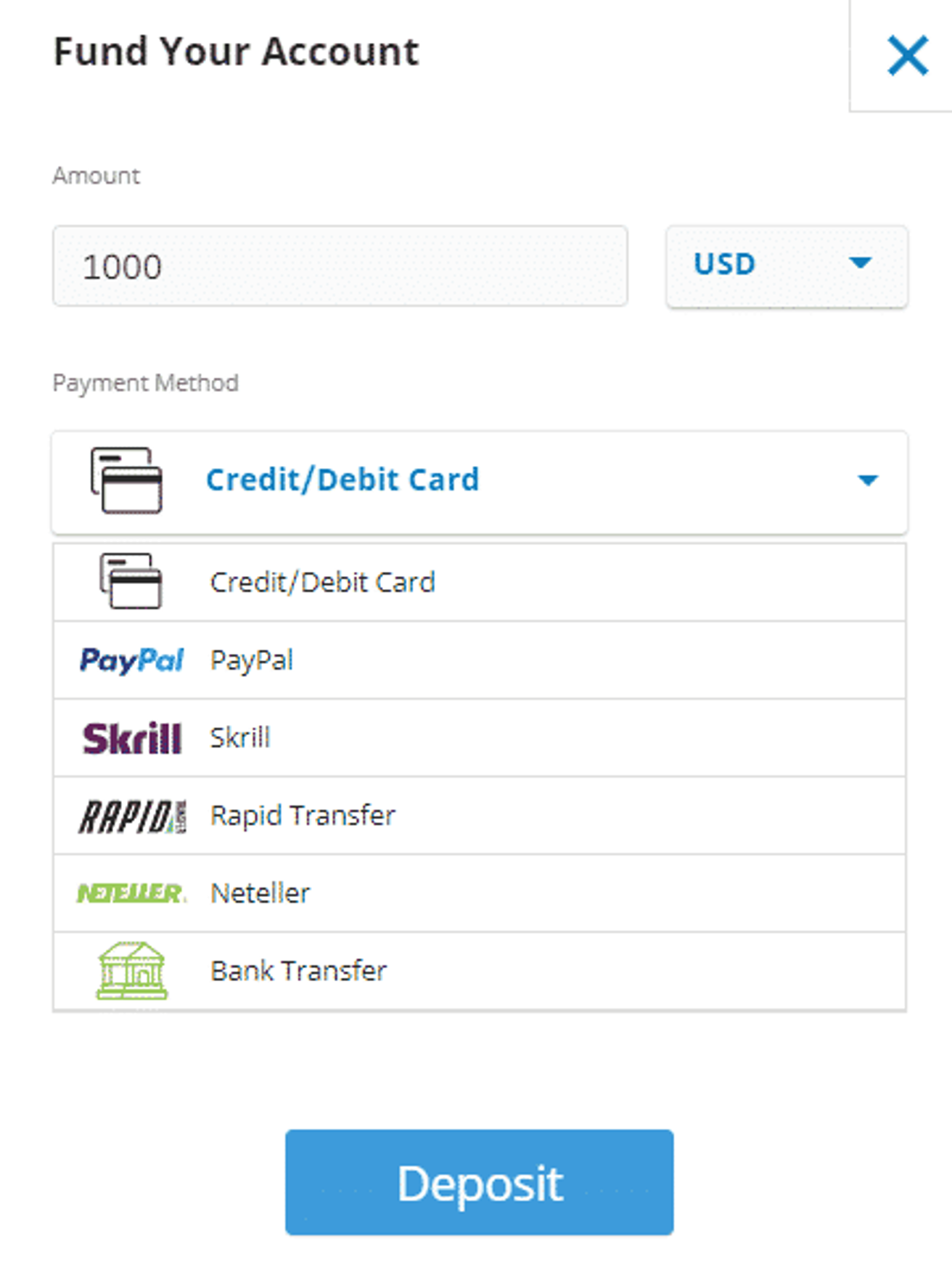
eToro's deposit options
Withdrawals: You will also find a tab called “Withdraw Funds”. The method you used for depositing should be the same for withdrawing money from the platform. Withdrawals from the USD account cost $5 each, while withdrawals from the EUR account are free and have no minimum.
Note: if you deposit euros into the USD account, a currency conversion fee applies on the deposit and again on the withdrawal. Using the EUR account avoids this, and you only pay conversion when you trade assets priced in another currency.
How to trade stocks or any other security?
The process for buying or selling stocks is straightforward, and is similar to other asset classes (ETFs, CFDs or any security).
First, use the search bar to find the company you are looking for and then click on “Trade”, as shown in the image below:
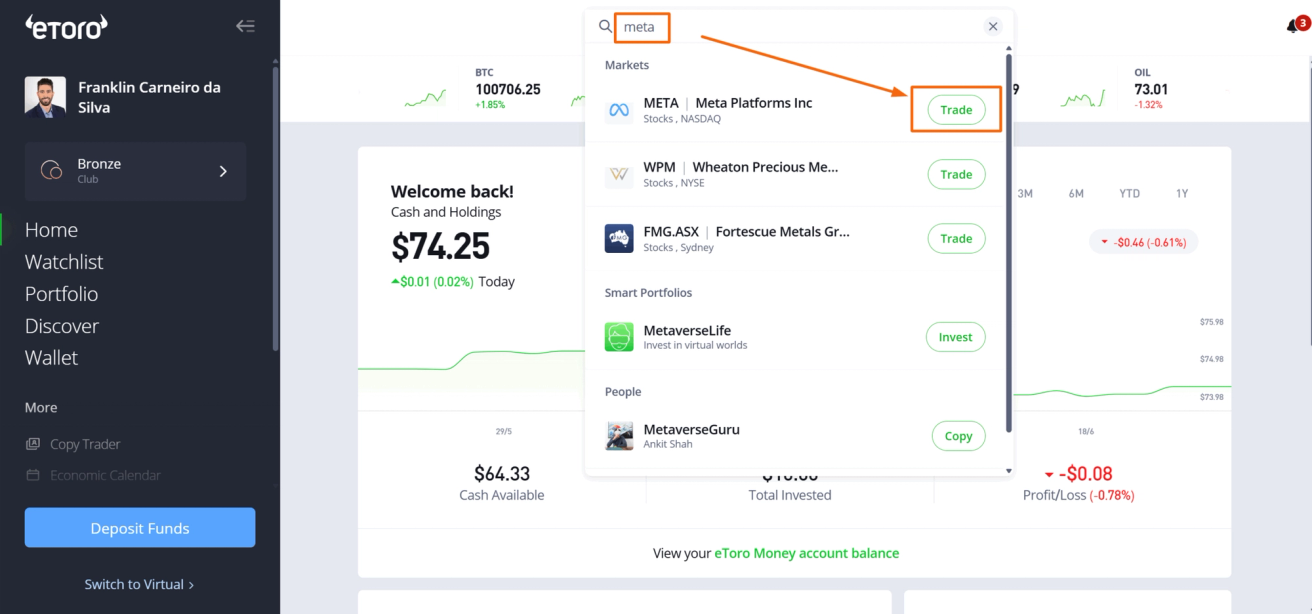
How to place an order
Second, a pop-up will appear where you can buy (or short) the stock. In this case, you are buying the underlying asset, and not a CFD. If you want to leverage your investment, you will need to change the “X1” to “X2” or to any other level of exposure that eToro allows.
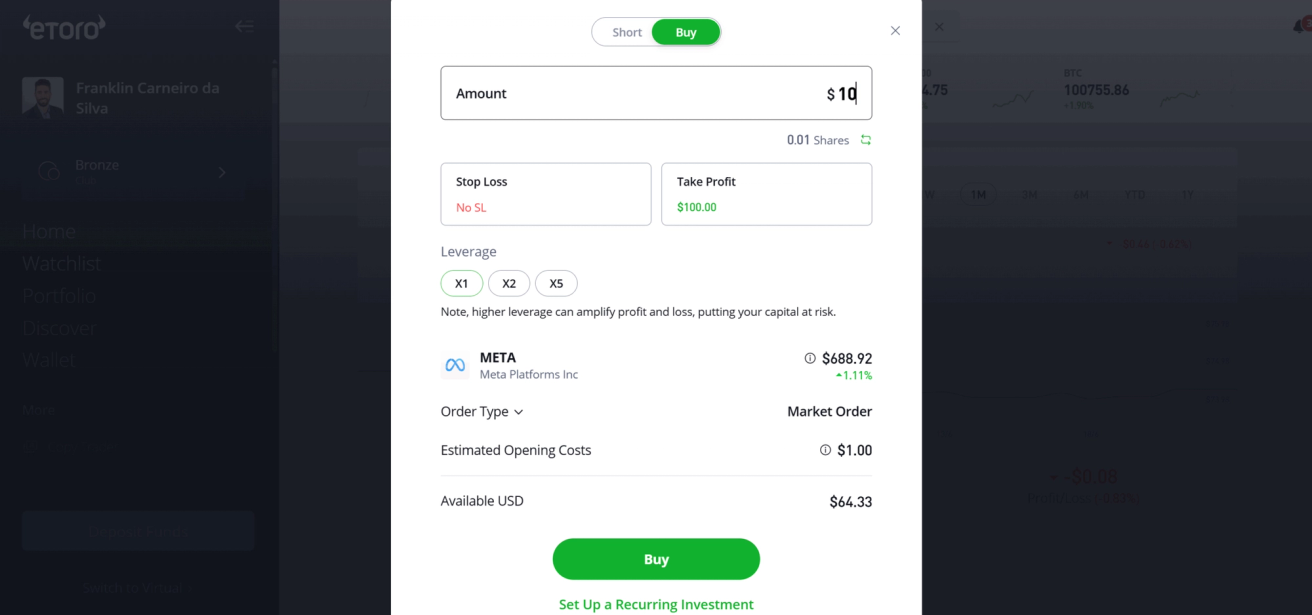
How to place an order
Customer support
Our assessment of customer support is based on our own direct experience with the platform. Response times have improved significantly in recent years as eToro has scaled its support operations.
We’ve contacted eToro’s customer support multiple times. In typical circumstances, responses generally come within 1 to 3 days via the in-app ticket system. During peak periods (volatile market conditions, major product launches), response times can stretch longer. eToro also offers live chat in some regions and a comprehensive help centre with detailed self-service articles, which often resolves common questions without needing to wait for a support agent.
One area where eToro has been frequently criticised historically is the lack of phone support, all interactions are through digital channels (in-app messaging, email, chat). For German clients who prefer phone-based support, this is worth noting before opening an account.
Final thoughts
Overall, eToro is a solid option for German investors, whether you’re a beginner exploring the markets, an intermediate user looking for social trading features, or a more experienced trader who values a wide product range across stocks, ETFs, crypto, and CFDs in a single platform.
eToro has matured significantly as a business, culminating in its NASDAQ IPO in May 2025, which introduced additional disclosure, audit and corporate governance obligations. It now has over 40 million registered users globally and continues to expand its product range, regulatory footprint, and platform features.
That said, German investors should weigh up a few specific considerations before opening an account:
- Currency conversion: the EUR account removes conversion on deposits and withdrawals, but buying US stocks with euros still involves a conversion fee, which adds up for active investors.
- No automatic German tax withholding: unlike local brokers (Trade Republic, comdirect, Scalable Capital), eToro does not withhold Abgeltungsteuer or issue a Steuerbescheinigung. German residents declare their gains themselves, with help from eToro’s tax report for Club members.
- Customer support is digital-only: no phone-based support, which some traditional German banking customers may miss.
For a complete overview of how eToro operates globally, check our full eToro review.
FAQs
Does eToro deduct German taxes?
No. eToro does not withhold Abgeltungsteuer, the solidarity surcharge or church tax. You declare your gains and dividends in the Anlage KAP of your German tax return and pay the tax yourself. eToro Club members in Germany can download a tax report to help with this.
Does eToro have an inactivity fee?
No. eToro does not charge an inactivity fee.
Can I hold euros on eToro?
Yes. German clients can open a EUR account provided by eToro Money Malta Ltd, which lets you deposit, hold and withdraw euros without conversion fees and with no withdrawal fee.
Is my money protected if eToro goes bankrupt?
Your real stocks and ETFs are held separately from eToro’s own assets. In addition, the Cyprus Investor Compensation Fund covers up to €20,000 per client, and eToro’s private insurance with Lloyd’s of London adds up to €1 million per eligible client. These schemes do not protect you against market losses.