
Investors looking to buy and sell stocks will often look towards recognisable names and brands. Charles Schwab is an investment company that is well known and respected around the world, so it is no surprise that investors in Israel want to know whether it is possible to invest through the platform.
Keep reading to find out whether Charles Schwab is available to investors in Israel, what the account actually involves, and which alternatives may suit you better.
Is Charles Schwab available in Israel?
Yes, signing up for the Schwab One International brokerage account from Israel is possible. But there are some important things investors need to understand before doing so.
Charles Schwab works primarily in the US, and offers an international service open to applicants from Israel. It is a genuine US brokerage account rather than a local one, which brings both advantages, such as direct access to US markets with $0 online commissions on listed US stocks, and complications around tax and reporting that we cover below.
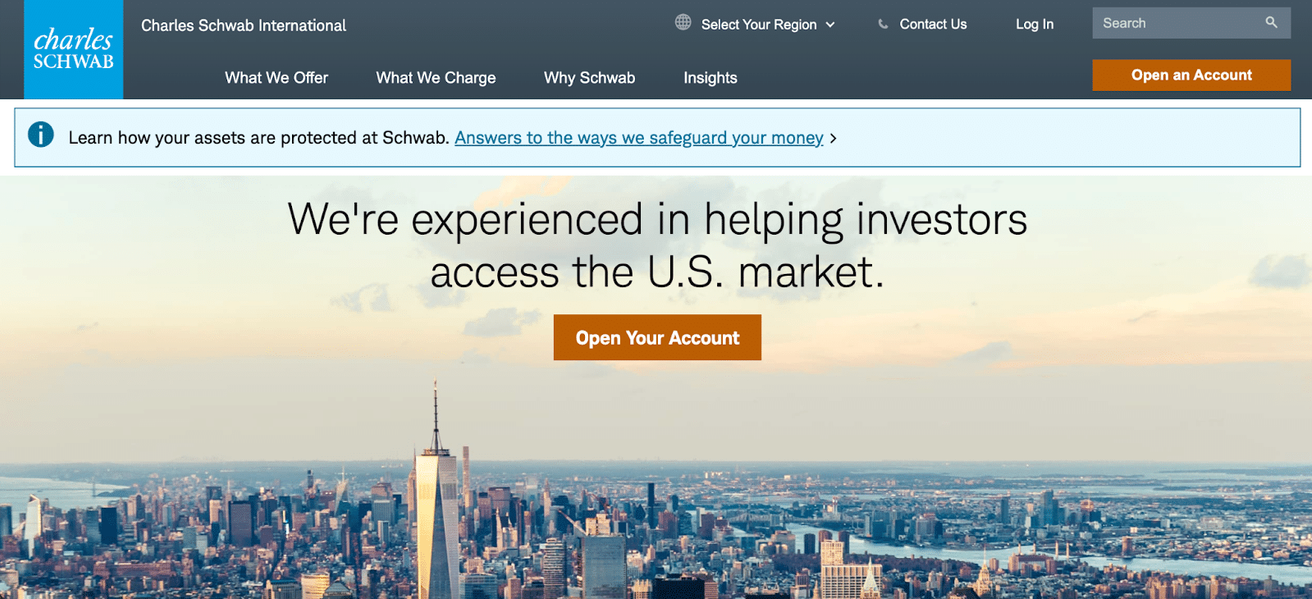
Charles Schwab homepage
How to use Charles Schwab in Israel?
To open a Schwab One International account from Israel, you will need the following:
- Tax ID: your Israeli identity number or equivalent tax identification number.
- Current ID: your passport or another suitable form of identification.
- Proof of residence: a recent utility bill (gas, electricity, water, cable) or other proof of address showing your full name, address and a date.
- Employment details: the name and mailing address of your current employer.
- Access to a scanner: the application is document-heavy and you will need to upload scans, so a printer and scanner are useful.
Points to consider before opening a Schwab account from Israel:
- You can only trade in US dollars: if you hold shekels, you will pay a currency conversion cost to invest, and again to take money out.
- Converting shekels is your job: funding usually means converting shekels to dollars with your bank or a currency service first and sending a US dollar wire, so compare exchange rates before you transfer.
- Getting money back to an Israeli bank account takes planning: withdrawals leave Schwab in US dollars, so you pay wire and conversion costs on the way back.
- US stocks and ETFs trade commission-free: online listed equity trades cost $0 and options $0.65 per contract, but the investment universe is limited to what a US brokerage offers.
- Check the debit card before relying on it: many Olim value Schwab’s debit card for withdrawing shekels at Israeli ATMs, but Schwab’s international site does not mention a debit card for international clients, so confirm with Schwab that you can get one as an Israeli resident.
Schwab’s international site lists a $0 account minimum.
The tax considerations that matter most
This is the part that gets least attention and matters most, particularly with a US-based account.
US estate tax exposure: A Schwab One International account holds US securities directly, which makes them US-situs assets. Schwab states plainly in its own material that when a non-US investor dies holding US assets, those assets are subject to federal estate tax at rates from 18% up to 40%, and that the exemption for these investors is only $60,000, against a far larger allowance for US citizens and residents. For a portfolio of any size, this is a significant and often overlooked exposure, and it does not apply in the same way to Irish-domiciled UCITS funds held through a European broker.
US dividend withholding: foreign investors generally pay a flat 30% withholding on dividend income from US securities, reduced where a tax treaty applies and a valid Form W-8BEN is on file. Under the US-Israel tax treaty, the rate on dividends for individuals is 25%. Schwab acts as withholding agent and reports on Form 1042-S.
Publicly traded partnerships: Since January 2023, Schwab One International accounts held by non-US individuals are subject to an additional 10% withholding on gross proceeds from sales of PTP interests. If you hold any partnership-structured products, factor this in.
Israeli reporting: Israeli residents are taxed on worldwide income, generally at 25% on capital gains and dividends for individuals. Foreign brokers do not withhold Israeli tax at source the way an Israeli broker does, so the reporting obligation falls to you. New immigrants and long-term returning residents still get a ten-year exemption from Israeli tax on foreign income. However, Amendment No. 272 to the Income Tax Ordinance cancelled the matching reporting exemption for anyone who gains that status from 1 January 2026, so newer Olim must report foreign income even while it is tax-exempt. In practice this usually means engaging an Israeli accountant. Factor that cost into your comparison, particularly if you would not otherwise need to file.
None of the above is tax advice. Confirm your position with a qualified Israeli tax adviser, and take cross-border advice if your situation spans both systems.
Charles Schwab alternatives in Israel
If you are in Israel and want broader choice and flexibility, several alternatives to Charles Schwab are worth considering.
Here are some of the best brokerages available in Israel that may suit you better than a US-based account:
Interactive Brokers
Founded in 1978, IBKR is one of the world’s most trustworthy brokers. It offers an enormous range of financial products (stocks, ETFs, options and more) and a currency conversion fee of just 0.002% (min $2), the lowest of the brokers here, which matters if you are converting shekels. It also offers IBKR GlobalTrader, a mobile trading app for stocks, ETFs and options aimed at newer investors.
Saxo
Saxo is a multi-asset broker giving retail and institutional clients access to stocks, ETFs, bonds, funds and derivatives through its own platforms, SaxoInvestor, SaxoTraderGO and SaxoTraderPRO.
Plus500
Plus500 is an online broker founded in Israel that offers CFDs (contracts for difference) on shares, currencies, commodities and indices. In Israel it operates through Plus500IL Ltd, licensed by the Israel Securities Authority (ISA). CFDs are complex, leveraged instruments and most retail accounts lose money trading them.
| Broker | Fees for US stocks | Minimum Deposit |
| Interactive Brokers | $0.0005-$0.0035 per share (min. $0.35 per order) | $0 |
| Saxo | Classic: 0.08% (min. $1), Platinum: 0.05% (min. $1), VIP: 0.03% (min. $1) | Varies by country of residence |
| Plus500 | No commission, costs built into the spread (CFDs only) | $100 |
Fees as of 9 October 2026, taken from each broker’s website.
#1 Interactive Brokers

Founded in 1978 and publicly listed on the NASDAQ (ticker: IBKR), Interactive Brokers is a global online broker that has come through major financial crises with a rigorous risk management record. It has more than 5.5 million client accounts.
It offers an advanced platform covering stocks, options, mutual funds, ETFs, futures, bonds and currencies across 170 markets in 40 countries, solid trade execution through IB SmartRouting, and a full set of technical and fundamental tools.
Its currency conversion fee of 0.002% (min $2) is by a wide margin the lowest of the brokers here, which matters more than the commission if you are moving between shekels and dollars regularly.
The Israel Securities Authority (ISA) supervises the local capital market. IBKR is not regulated by the ISA, but operates internationally under regulators such as the SEC, FINRA, FCA and CBI.
Want to know more? Check our Interactive Brokers Review and visit the Interactive Brokers website.
#2 Saxo

62% of retail CFD accounts lose money.
Launched in 1992, Saxo is one of the most established names in the brokerage industry, with a long track record. It offers its own platforms: SaxoInvestor, aimed at investors who want a simpler interface, and SaxoTraderGO and SaxoTraderPRO for more active users.
The range of cash and margin trading products across global markets includes stocks, ETFs, bonds, mutual funds, crypto ETPs, options, futures, CFDs and forex, supported by advanced research tools for both buy-and-hold investors and leveraged traders.
Ownership changed recently. The Swiss private banking group J. Safra Sarasin became majority owner in March 2026 and sole owner in July 2026.
Saxo Bank A/S is a licensed European bank supervised by the Danish Financial Supervisory Authority, and the group holds authorisations from the FCA, ASIC, MAS and FINMA among others. Saxo also charges a custody fee on stocks and ETFs of up to 0.15% a year on the Classic tier, which varies by country of residence. Note that minimum deposits vary considerably by country of residence, so check the figure that applies to you before applying.
To learn more, check our Saxo review and visit Saxo’s website.
CFDs are complex instruments and come with a high risk of losing money rapidly due to leverage. 62% of retail investor accounts lose money when trading CFDs with this provider. You should consider whether you understand how CFDs work and whether you can afford to take the high risk of losing your money.
#3 Plus500

82% of retail CFD accounts lose money.
Founded in Israel in 2008 and listed on the London Stock Exchange (ticker: PLUS), Plus500 is an online CFD broker. Israeli clients are served by Plus500IL Ltd, licensed by the Israel Securities Authority, which makes it the only broker on this list with a local licence.
With CFDs, you speculate on price movements of shares, currencies, commodities and indices without owning the underlying asset, and leverage magnifies both gains and losses. That makes Plus500 a different kind of alternative to Schwab: it suits experienced short-term traders, not investors building a long-term portfolio. Plus500 Invest, its real-share service, is closed to new clients.
The proprietary WebTrader platform works across devices, including a mobile app, and you can test it with a demo account before trading with real money. There is a 0.70% currency conversion fee and a $10 monthly inactivity fee after three months without activity.
If you want to know more about Plus500, check our Plus500 Review or visit the Plus500 website.
82% of retail CFD accounts lose money.CFDs are complex instruments and come with a high risk of losing money rapidly due to leverage. You should consider whether you understand how CFDs work and whether you can afford to take the high risk of losing your money.
This information is NOT relevant to EU residents who are to be serviced by EU subsidiaries of the Plus500 Group, such as Plus500CY Ltd, authorized by CySEC (Reg. 250/14). Different regulatory requirements apply in Europe, such as leverage limitations and bonus restrictions.
Bottom line
Charles Schwab does offer a Schwab One International account to residents of certain countries including Israel, and it has genuine strengths: $0 online commissions on listed US stocks and ETFs and a $0 account minimum.
The drawbacks are structural rather than about fees. Everything trades in dollars, moving money in and out of an Israeli bank account is cumbersome, and holding US securities directly exposes a non-US investor to US estate tax above a $60,000 threshold, which is the consideration most worth taking advice on.
The alternatives above give broader market access and, in the case of Interactive Brokers, a currency conversion fee of just 0.002%, which is the fee that matters most when you are converting shekels regularly. Whichever route you take, factor in the Israeli reporting obligation that comes with any foreign brokerage account, which since 2026 also applies to new Olim during their ten-year tax exemption.