


Choosing a stock trading app in Singapore comes down to fees, access to the Singapore Exchange (SGX) and US markets, and regulation by the Monetary Authority of Singapore (MAS).
In this article, we compare three apps licensed by the MAS, explain how they hold your shares and how your investments are taxed, and answer the most common questions.
Best stock trading apps in Singapore
- Interactive Brokers: Best overall
- Plus500: Ideal for CFDs
- Saxo: Best for advanced investors


81% of retail CFD accounts lose money.

62% of retail CFD accounts lose money.
Best stock trading apps in Singapore compared
| Broker | Fees on stocks | Minimum deposit | Trading apps |
| Interactive Brokers | Tiered: $0.0005 to $0.0035 per US share ($0.35 minimum). Fixed: $0.005 per share ($1 minimum). IBKR Lite: $0 on US stocks and ETFs | S$0 | IBKR GlobalTrader, IBKR Mobile, and Trader Workstation |
| Plus500 | CFDs only: no commission, spreads and overnight funding apply | Not published | Plus500 app and WebTrader |
| Saxo | From US$1 per order on US stocks and from S$3 on SGX stocks, depending on account tier | S$0 | SaxoInvestor, SaxoTraderGO, and SaxoTraderPRO |
Fees from the brokers’ Singapore websites as of 8 October 2026. Singapore goods and services tax (GST) of 9% applies to commissions for Singapore residents.
#1 Interactive Brokers
Interactive Brokers has proven to be one of the most reliable brokers in the market. It serves Singapore clients through Interactive Brokers Singapore Pte. Ltd., which holds a Capital Markets Services (CMS) licence from the MAS (licence no. CMS100917). The group was founded in 1978, is listed on Nasdaq and has been part of the S&P 500 index since August 2025.
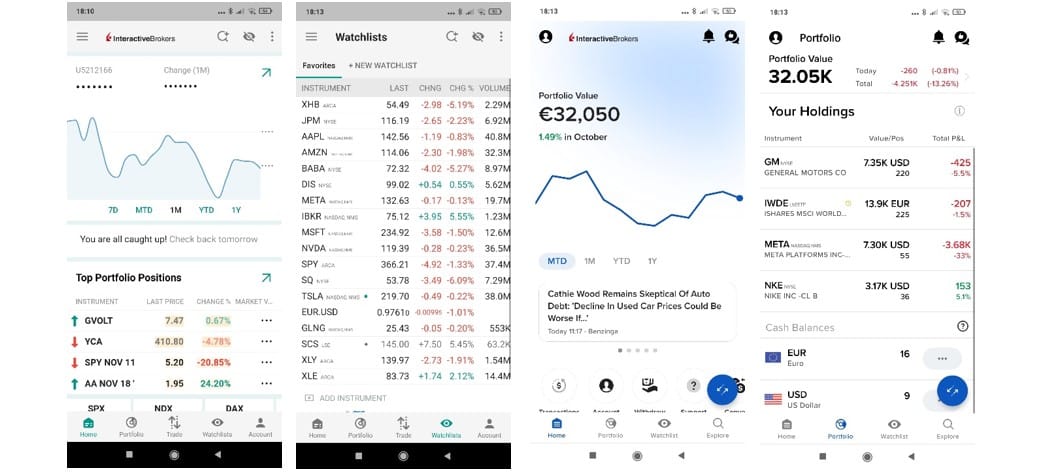
It offers trading apps with powerful tools, access to 170 markets in 40 countries, including SGX, and low prices. Singapore retail investors can also choose IBKR Lite, which charges no commission on US stocks and ETFs. The broker provides different mobile apps and web-based platforms you can use depending on your knowledge and experience. The mobile app IBKR GlobalTrader is a user-friendly app suitable for beginners, as it simplifies investing without losing the powerful tools the broker is famous for.
If you want to make the most of the broker’s powerful tools, you can use IBKR Mobile, a complete and sophisticated trading app for stocks, ETFs, and options. However, since the app’s features can be overwhelming for beginners, we recommend IBKR GlobalTrader if you do not have much experience.
In addition to the mobile apps, you will also find a desktop app (Trader Workstation) and web-based platforms with advanced trading tools to access global financial markets. Overall, we believe Interactive Brokers offers the best stock trading apps in Singapore, with something to suit every type of investor. Check our Interactive Brokers review to find out more.
#2 Plus500
81% of retail CFD accounts lose money.
Plus500 is a broker founded in Israel in 2008 whose shares are traded on the London Stock Exchange. Its group companies are regulated by authorities such as the UK Financial Conduct Authority (FCA) and the Cyprus Securities and Exchange Commission (CySEC), and it serves Singapore through Plus500SG Pte Ltd, which holds a CMS licence from the MAS (licence no. CMS100648).
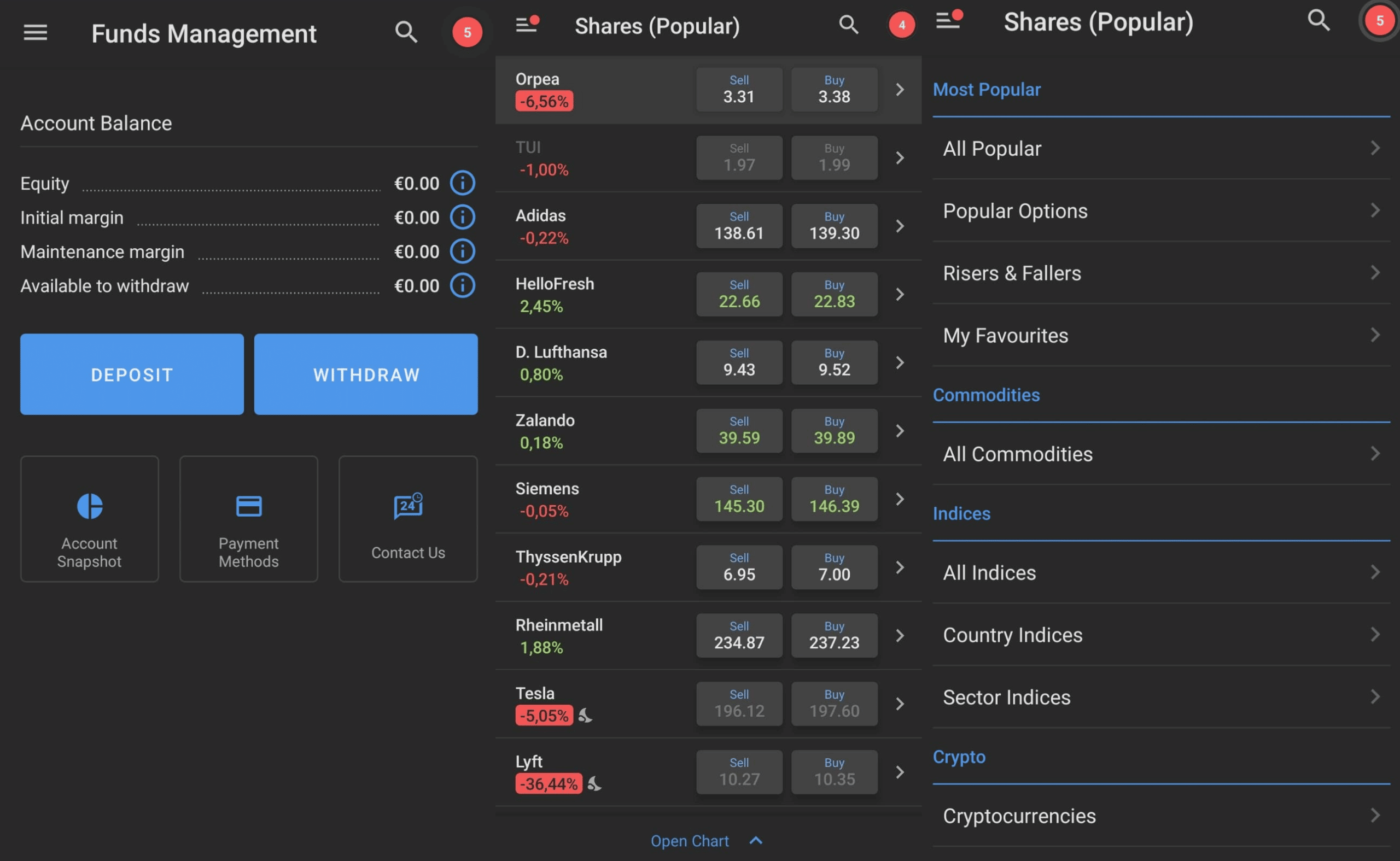
The broker provides a mobile app named Plus500 and a web-based platform called WebTrader. Both are accessible, and you can test their features with a free demo account.
In Singapore, Plus500 offers contracts for difference (CFDs) only, so you do not own the underlying shares.

CFDs let you speculate on the price of shares, indices and other assets with leverage, which magnifies both gains and losses. CFDs are complex instruments and come with a high risk of losing money rapidly due to leverage.
Plus500 charges no commission and earns mainly from the spread. Other costs include overnight funding on positions held past the daily cut-off, a currency conversion fee of up to 0.7% on trades in a currency other than your account’s, and an inactivity fee of up to US$10 a month after three months without logging in. Plus500 suits traders who want short-term exposure. If you want to buy and hold real shares or ETFs, Interactive Brokers or Saxo are better fits. If you want to learn more about Plus500, please check our full Plus500 review.
This information is NOT relevant to EU residents who are to be serviced by EU subsidiaries of the Plus500 Group, such as Plus500CY Ltd, authorized by CySEC (Reg. 250/14). Different regulatory requirements apply in Europe, such as leverage limitations and bonus restrictions.
#3 Saxo
Saxo at a glance
62% of retail CFD accounts lose money.
Saxo is a Danish investment firm founded in 1992 that operates in Singapore through Saxo Capital Markets Pte. Ltd., which holds a CMS licence from the MAS. Since March 2026, it has been majority-owned by Swiss private bank J. Safra Sarasin, which became its sole owner in July 2026. Saxo offers some of the best stock trading apps in Singapore, led by SaxoInvestor.
SaxoInvestor is Saxo’s simple, intuitive platform for everyday investors, giving easy access to stocks, ETFs, mutual funds, and bonds on web and mobile. For more active traders, SaxoTraderGO is an award-winning, customisable platform (mobile and desktop) with advanced charting and analytical tools. The broker also provides SaxoTraderPRO, a desktop platform (Windows and Mac) built for advanced traders. It is highly customisable, offers sophisticated tools to analyse and track performance, and can be used across up to six screens. A single Saxo account gives you access to all three.
Considering the excellent educational resources, low prices, and impressive range of tradable assets, Saxo earns third place on our list of the best stock trading apps in Singapore. Saxo Singapore has no minimum funding requirement. A custody fee of 0.12% a year (0.06% for VIP clients) applies only if you opt out of securities lending, and Singapore residents pay no custody fee on SGX stocks and ETFs.

Methodology
When making this list, we wanted to help investors in Singapore make an informed choice when picking the best stock trading app. Each of the apps we presented has its own main features, and we tried to provide a diverse list that suits the needs of different investor profiles. In any case, we prepared this list considering the following criteria:
- Prices: price should not be the only factor when choosing a trading app, but you do not want to pay more for a service when you can get the same quality for less.
- Educational resources: high-quality educational resources help beginners learn before investing money.
- Range of products and markets available: does the app offer real stocks and ETFs, or only CFDs? Does it have crypto?
- Access to the local market: all apps in this list give exposure to SGX shares (Plus500 through CFDs).
- Customer service: problems can always appear, so it matters that the broker helps you quickly when they do.
- The trading app itself: we considered the functionality and usability of the platform, as well as its specific features.
- Security: all platforms in the list are regulated not only in Singapore but also by top-tier authorities in other jurisdictions.
Taxes and custody for Singapore investors
Before you pick an app, it helps to know how your investments are taxed and how your shares are held:
- No capital gains tax: Singapore does not tax capital gains for individual investors, unless trading is your business.
- Dividends: dividends from Singapore companies are tax-free for shareholders, and foreign-sourced investment income received by individuals is generally not taxed in Singapore (IRAS).
- US withholding tax: Singapore has no income tax treaty with the US, so dividends from US stocks and US-domiciled ETFs are taxed at 30% at source. Your broker will ask you to complete a W-8BEN form, which certifies that you are not a US taxpayer. Ireland-domiciled UCITS ETFs pay 15% inside the fund instead.
- CDP or custodian account: SGX shares can be held in your own account at the Central Depository (CDP), or by a broker’s custodian on your behalf. Interactive Brokers and Saxo use the custodian model, which usually means lower fees, but company communications and voting go through the broker. Some local brokers let you hold SGX shares directly in your CDP account.
Bottom line
To summarize, here is our list of the best stock trading apps in Singapore:
- Interactive Brokers: Best overall
- Plus500: Ideal for CFDs
- Saxo: Best for advanced investors
Interactive Brokers is the best all-round choice for low costs and global market access, Saxo suits investors who value research and polished platforms, and Plus500 is an option only if you want to trade CFDs. Whatever you choose, invest within your risk tolerance and diversify.
Please let us know if the article was helpful or if you have any feedback.
FAQs
What is the difference between a stock and stock CFD?
While the stock gives you a property right over a share of the company, the CFD does not. The stock CFD is a derivative contract where the underlying asset is the stock and where the broker promises to pay you back the difference in value between the time you opened the position and the time you close it. CFDs are traded with leverage: you only put up a margin, so a small price move against you can wipe out that margin, and the broker may close your position if you do not add funds. CFDs are complex instruments and come with a high risk of losing money rapidly due to leverage. They are not suitable for beginners.
Is Robinhood available in Singapore?
No, the US-based stock trading app Robinhood is not available in Singapore.
Do I pay tax on stock trading gains in Singapore?
Not usually. Singapore does not tax capital gains for individual investors, unless the authorities consider trading to be your business. Dividends from Singapore companies are tax-free, but dividends from US stocks are taxed at 30% at source because Singapore has no tax treaty with the US.
Is IBKR Lite available in Singapore?
Yes. IBKR Lite is available to Singapore retail investors with individual, joint or trust accounts, and charges no commission on US-listed stocks and ETFs. Singapore GST applies to commissions on other markets.



