Sharia-compliant investing rests on three requirements: avoiding riba (interest), which is what swap-free accounts address, screening out companies whose business is impermissible, such as conventional banking, alcohol, gambling or tobacco, and avoiding excessive gharar (uncertainty), which is why many scholars see highly speculative derivatives as problematic even without swaps.
That last point matters: a swap-free CFD account removes the interest, but it doesn’t make leveraged speculation compliant in the view of many scholars. Below we compare the leading Halal trading apps and platforms, with fees and features checked in September 2026.
Best Halal trading apps and platforms in 2026

69-80% of retail CFD accounts lose money.


Best Halal trading apps and platforms compared
| Platform | Sharia offering | Min. deposit | Products | Countries |
| XTB | Islamic swap-free account (no screening) | $0 | Real stocks and ETFs, plus CFDs on forex, indices, commodities and crypto | MENA and other selected markets |
| Sarwa | Halal portfolios and Halal savings, screened | $500 for Halal portfolios, $1 for Sarwa Trade | ETFs, US stocks, options, crypto | UAE and international, exceptions apply |
| Interactive Brokers | None, but a cash account avoids interest | $0 | Stocks, ETFs, options, futures, forex, bonds, funds | International, few exceptions |
| Wealthsimple | Halal portfolio certified by a scholar board | $0 | Stocks, ETFs, crypto | Canada only |
| Robinhood | None | $0 | Stocks, ETFs, options, futures, crypto | US, UK and EU |
| Wahed Invest | Fully Halal, Sharia supervisory board | $100 | ETF and sukuk portfolios | International, 100+ countries |
Checked in September 2026. Fees and availability change, so confirm with each provider before opening an account.
Best Halal trading apps and platforms reviewed
#1 XTB at a glance
69-80% of retail CFD accounts lose money.
XTB is a global broker operating since 2002, listed on the Warsaw Stock Exchange, with more than 1.19 million active clients at the end of 2025. It is regulated by several top-tier authorities, including the DFSA in Dubai through XTB MENA Limited, and it offers Islamic swap-free accounts, which remove the overnight interest that would otherwise apply to leveraged positions.
The Islamic account is available through XTB International in specific countries, including the UAE, Saudi Arabia, Kuwait, Oman, Qatar, Jordan, Bahrain, Lebanon, Egypt, Algeria, Morocco, Tunisia and Malaysia.
For anyone prioritising compliance, the real stock and ETF offering is worth separating from the CFD side: owning shares outright avoids the leverage and speculation concerns that many scholars raise about CFDs, even swap-free ones. XTB charges 0% commission on real stocks and ETFs up to a monthly turnover limit, with 0.2% above it.
Its platforms are xStation 5 (desktop and web) and xStation Mobile, with advanced charting, a trader calculator for margin and commission, and configurable alerts. MetaTrader is no longer offered. Education and support are strong points, with the XTB Trading Academy and live chat, phone and email support.
Read our XTB review for more detail.
CFDs are complex instruments and come with a high risk of losing money rapidly due to leverage. A high percentage of retail investor accounts lose money when trading CFDs with this provider. A swap-free account removes interest charges, but it does not remove the leverage risk.

#2 Sarwa at a glance
Sarwa, a UAE fintech founded in 2017, runs two main services: Sarwa Invest, a robo-advisor with a dedicated Halal option, and Sarwa Trade, a self-directed platform for US stocks and ETFs.
Its Halal portfolios hold only companies meeting Islamic investing principles, screening out alcohol, gambling, tobacco, pork and conventional interest-based finance. They are built from Sharia-compliant ETFs across several asset classes, including sukuk fixed income, commodities, US equities, global developed equities and emerging market equities.
There are seven risk levels, from very conservative to aggressive. The minimum for a Halal portfolio is $500, with management fees of 0.5% to 0.85% a year depending on portfolio size.
Sarwa Trade has no minimum deposit and gives access to over 4,000 US stocks and ETFs at $1 or 0.25% of trade value. Note that it does not screen holdings for compliance, so if that matters, the Halal portfolio is the cleaner route.
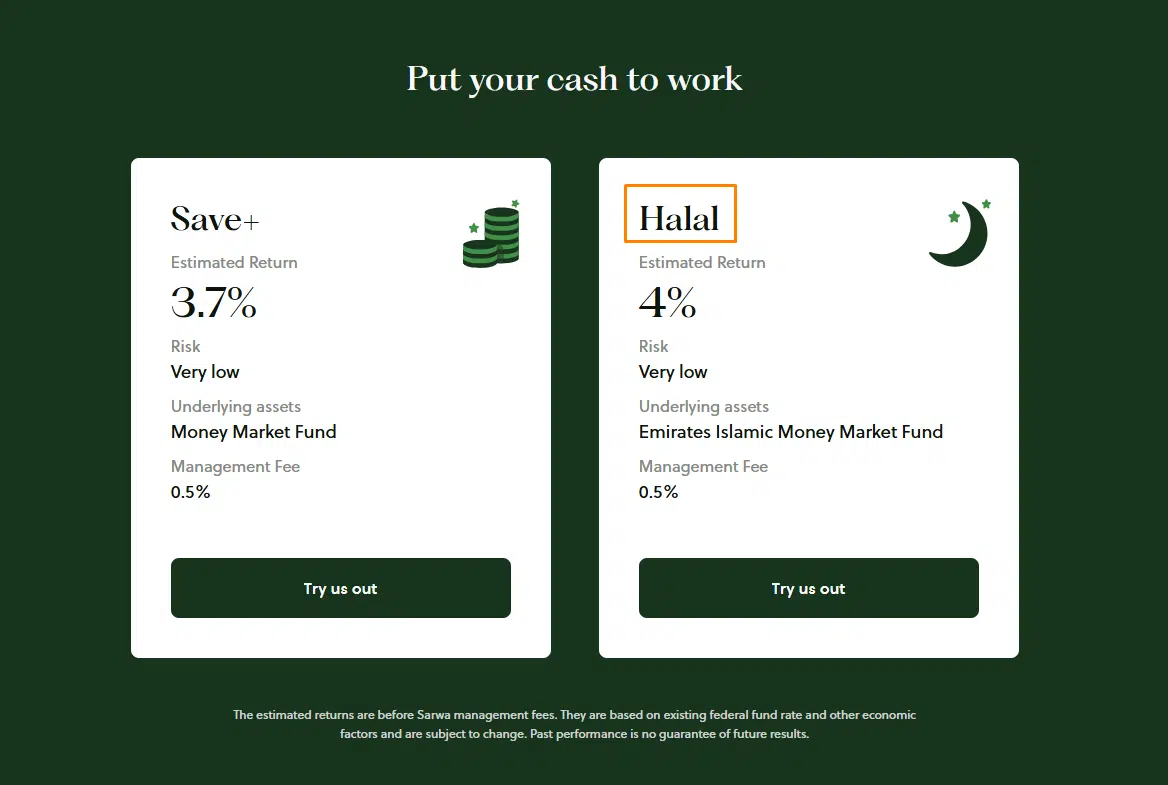
Sarwa also offers Sarwa Save Halal, a Sharia-compliant cash product built on the Emirates Islamic Money Market Fund, with a projected return of 4% a year as of August 2026 and a 0.5% management fee. The rate is variable, so check the current figure before committing.
New users signing up with the promo code RLLAA29D can get a bonus of up to AED 3,000.
#3 Interactive Brokers at a glance
Founded in 1978, Interactive Brokers is one of the largest international brokers, listed on Nasdaq (ticker: IBKR) and an S&P 500 constituent since 2025. It serves over 3 million client accounts, is regulated by several top-tier authorities and has no minimum deposit.
IBKR does not offer a dedicated Islamic account. Trading through a cash account avoids interest entirely, which addresses the riba concern that applies to margin accounts.
A cash account requires you to hold the full cost of each trade plus commissions. That structure aligns with several Sharia principles:
- No short selling and no margin borrowing.
- Options activity is restricted, and multi-currency trading happens through direct conversion rather than borrowing.
- Sale proceeds are available only once the trade settles, so you never trade on unsettled funds and no interest is charged.
One caveat: a cash account removes the interest, but it doesn’t screen your holdings. Compliance of the companies you buy is entirely your responsibility, so you would need to screen them yourself or use Sharia-compliant ETFs.
IBKR supports multiple base currencies, with funding by bank transfer. Commissions are tiered by monthly volume, and currency conversion costs around 0.2 basis points (minimum $2), among the lowest anywhere.
The platforms cover every level: the web Client Portal, the IBKR GlobalTrader mobile app, IBKR Mobile and the professional Trader Workstation, with IB SmartRouting selecting the execution venue for each order.

IBKR GlobalTrader is the simpler mobile app, with fractional shares from $1. A simulated account gives you $10,000 in virtual cash to practise with first.
On the downside, the sheer number of features can overwhelm newer investors. IBKR offsets this with IBKR Campus and video tutorials for each platform.
For a fuller picture, read our Interactive Brokers review.
#4 Wealthsimple at a glance
Founded in 2014, Wealthsimple is one of Canada’s leading investment platforms, with over 3.4 million clients and more than CAD 124 billion in assets under administration. It is regulated by the Canadian Investment Regulatory Organization (CIRO), formed in 2023 from the merger of IIROC and the MFDA, with client assets covered by the Canadian Investor Protection Fund. It offers three main services:
- Wealthsimple Invest: automated portfolios with contributions, dividend reinvestment and adviser access, including Halal portfolios.
- Wealthsimple Cash: a spending account and card with cashback in cash, stock or crypto.
- Self-directed investing: commission-free stock and ETF trading.
The Halal portfolio is where Wealthsimple stands apart from platforms that only offer swap-free accounts. A board of Islamic scholars certifies and audits it twice a year, and quarterly reviews remove companies that no longer qualify. Dividend purification figures, the share of income from impermissible sources that observant investors donate, are calculated by a third party and published quarterly, which is something most platforms marketing themselves as Halal leave to the investor.
You can start with $1. Managed portfolio fees run from 0.2% to 0.5% a year depending on assets. Canadian trades are commission-free, though US trades carry a 1.5% currency conversion fee, a real cost if you invest in US markets regularly. The self-directed account does not screen for compliance.
The main limitation is geographic: Wealthsimple is available to Canadian residents only.

#5 Robinhood at a glance
Robinhood is a commission-free platform founded in 2013, now serving over 27 million funded customers with roughly $324 billion in assets under custody. It is listed on Nasdaq (ticker: HOOD) and joined the S&P 500 in 2025.
Robinhood is not a Halal platform and makes no claim to be. There is no Sharia screening, no Islamic account and no dividend purification. What it offers is commission-free access to stocks, ETFs, options, futures and crypto, which an observant investor can use as execution infrastructure while handling compliance separately.
That distinction matters: the entire screening burden falls on you. You would need to check each holding yourself or through a screening service, avoid margin and short selling, and calculate purification independently. Some investors do this successfully, but it takes discipline that a dedicated Halal platform handles for you.
Robinhood is no longer US-only: it launched in the UK in early 2024 and expanded across the EU in 2025 through Robinhood Europe UAB.
There are no commissions and no annual, inactivity or transfer fees. Opening an account through our Robinhood link can give you a free stock, subject to conditions. See our guide on how to claim the Robinhood bonus.

#6 Wahed Invest at a glance
Wahed Invest, founded in 2015, is a robo-advisor built exclusively around Halal investing rather than offering compliance as one option among conventional portfolios. With offices in 10 countries, including the US, the UK and the UAE, it serves over 400,000 clients in more than 100 countries.
Every holding passes through screening that excludes tobacco, alcohol, firearms, gambling, adult entertainment, impure food production, interest-based lending and companies carrying excessive debt. A dedicated Sharia supervisory board oversees the process, which is the structural difference from platforms that leave compliance to the investor.
Portfolios range from very conservative to very aggressive, built from US and international equities, sukuk, REITs and gold. You start with a risk questionnaire, after which Wahed proposes a matching portfolio.
Fees are 0.79% a year below $100,000 and 0.49% at $100,000 and above, with a $100 minimum.
For investors who want compliance handled end to end, Wahed is the most complete option here. The trade-off is cost: 0.79% is more than a self-directed portfolio of Sharia-compliant ETFs, and more than several conventional robo-advisors. You are paying for the screening, the board and the monitoring.

Three models, three levels of assurance
Whether an app can be used in a Sharia-compliant way depends heavily on how you use it. The labels blur together, so it helps to separate the three models:
- Fully Sharia-compliant platforms (Wahed, or the Halal portfolios at Wealthsimple and Sarwa): screening, board oversight and dividend purification are handled for you. The highest assurance, at a higher cost.
- Swap-free or Islamic accounts (XTB): these remove interest on overnight positions but don’t screen what you hold. They address riba, not the permissibility of the underlying asset.
- Conventional platforms used carefully (Interactive Brokers, Robinhood): no compliance features at all, but usable with a cash account and disciplined self-screening. The lowest cost, with the highest burden on you.
Before committing, look at the products, the transparency on fees and compliance checks, and whether any Sharia oversight is genuinely independent. If a platform calls itself Halal, look for a named supervisory board and published audit certificates rather than taking the label at face value.
How do I know if an investment is Sharia-compliant?
Assessing an individual investment means looking at both the business and the balance sheet:
- Business activities: whether the company’s main operations involve alcohol, tobacco, gambling, conventional banking and insurance, adult entertainment or weapons, all generally considered impermissible.
- Revenue sources: most standards allow a small tolerance for incidental income from non-compliant sources, commonly around 5% of revenue, with that portion subject to purification.
- Debt levels: excessive leverage makes a company non-compliant. Widely used standards limit interest-bearing debt to roughly a third of market capitalisation.
- Interest-bearing assets: cash and interest-generating securities are capped in the same way.
- Sharia board approval: holdings certified by recognised scholars carry the strongest assurance.
Standards differ: AAOIFI, Dow Jones Islamic Market and FTSE Shariah use different thresholds, so a stock can qualify under one and not another. Scholars also differ on some questions, which is why a knowledgeable adviser matters if you have specific concerns.
Screening tools make self-screening practical. Zoya publishes compliance reports for over 20,000 global stocks, with a portfolio tracker, ETF and fund screeners, alerts when a company’s status changes, and Zakat calculation. It links to several brokerage accounts, which removes most of the manual work.
Conclusion
The right platform depends on how much of the compliance work you want to do yourself:
- XTB: best for forex and CFDs
- Sarwa: best for savings and automated investing
- Interactive Brokers: best for range of products
- Wealthsimple: best for Canadian investors
- Robinhood: best for commission-free US investing
- Wahed Invest: best for a fully Halal robo-advisor
If you want compliance handled for you, Wahed or a Halal portfolio at Wealthsimple or Sarwa is the straightforward choice. If you prefer to pick your own holdings and keep costs down, a cash account at Interactive Brokers plus a screening tool works, provided you keep up the discipline. Whichever you choose, check the instruments themselves with a knowledgeable adviser rather than relying on the account type alone.
Disclaimer: this article is for information only and is not investment or religious advice. When investing, your capital is at risk and you may get back less than invested. Screening standards and platform features change, so verify the current position with the provider and with a knowledgeable adviser.
FAQs
What is Halal investing?
Investing is considered Halal when it follows the principles of Sharia law: no interest (riba), no ownership of businesses whose activity is impermissible (alcohol, gambling, tobacco, conventional banking, adult entertainment, weapons) and no excessive uncertainty or speculation (gharar). Income from incidental non-compliant sources is purified by donating that share to charity.
What is a Halal trading platform?
A platform that lets you invest in line with Islamic finance principles. In practice this ranges from full compliance, with screening and a Sharia supervisory board, to a swap-free account that only removes interest charges, so it’s worth checking exactly which one a platform offers.
Is a swap-free account enough to make trading Halal?
Not on its own. A swap-free account removes the interest on overnight positions, which addresses riba, but it doesn’t screen the underlying asset and doesn’t remove the leverage and speculation concerns that many scholars raise about CFDs. If compliance is your priority, owning real shares or using screened portfolios is the more straightforward route.
What is the minimum to start?
It depends on the model. Self-directed accounts at Interactive Brokers, Robinhood, Wealthsimple and Sarwa Trade have no minimum deposit and allow fractional shares from about $1. Managed Halal portfolios ask for more: $100 at Wahed and $500 at Sarwa.
Do Halal platforms offer demo accounts?
Some do and some don’t. XTB and Interactive Brokers offer demo or simulated accounts, while Sarwa, Wealthsimple, Robinhood and Wahed don’t. With a robo-advisor there is less need for one, since you aren’t placing trades yourself.
What is dividend purification?
It’s the practice of donating the share of dividend income that comes from impermissible sources. Some platforms calculate and publish the percentage for you, as Wealthsimple does each quarter, while on most others you have to work it out yourself.