Looking to use Acorns in Europe? Unfortunately, Acorns isn’t available to European residents. However, there are good alternatives in Europe that offer automated investing and, in some cases, similar ways to save and invest small amounts.
Acorns is not available anywhere in Europe. If you live in the UK, France, Germany, Ireland or any other European country, you cannot open an account. To use Acorns, you must be a US citizen or permanent resident aged 18 or over:
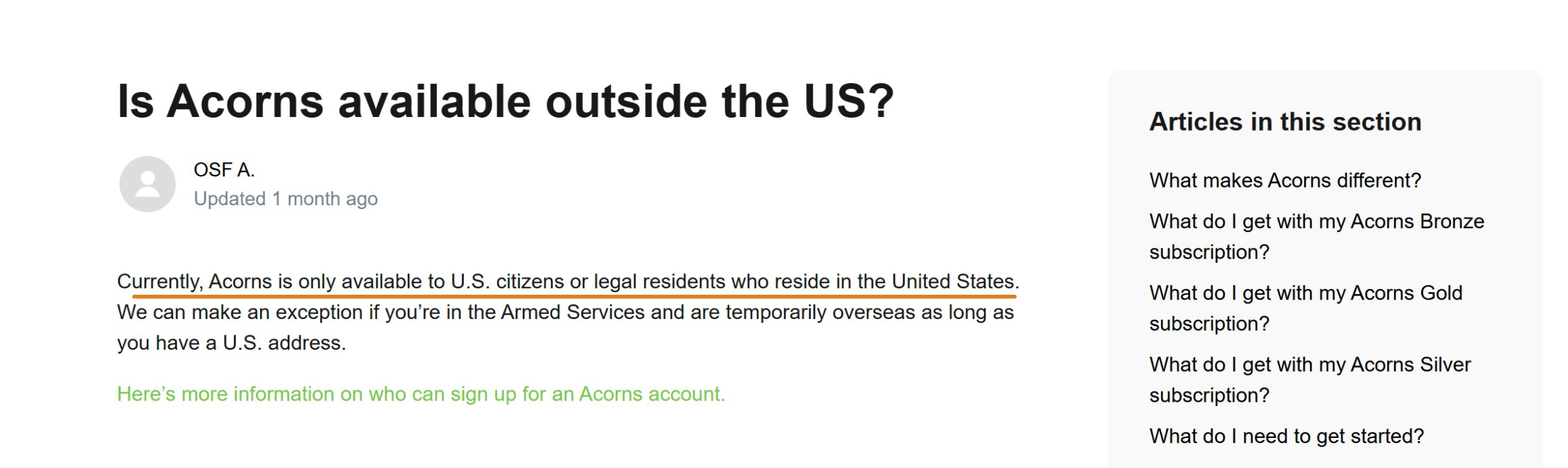
As of September 2026, Acorns has not announced any plan to expand its investing app outside the US. We will keep this article updated if that changes.
Would you like to know the best alternatives to Acorns in Europe? We’ve got you covered!
What is Acorns, and why has it become so popular in the US?
Acorns is a California-based financial services company that offers micro-investing through a robo-advisor model. As of 2025, Acorns had over 10 million customers and more than $25 billion in assets under management.
Acorns removes some of the biggest barriers new investors face. You can open an account in a few minutes and set up automatic investments on a weekly, fortnightly or monthly basis into a portfolio that matches your profile.
Its best-known feature is “Round-Ups”: it invests the spare change from your everyday purchases. For example, if your grocery bill is $55.70, Acorns rounds it up to $56 and invests the $0.30 difference in a portfolio of exchange-traded funds (ETFs).
This feature is especially popular with younger users, who are often surprised by how much they can save and invest this way. Acorns is designed for people who do not have much capital to start with, helping them build an investing habit early by making the process easy.
Is Acorns available in Europe? What are their expansion plans?
Acorns is not available in any country apart from the US. That does not mean Europeans are left without options: many automated investing services are available in Europe, and some are cheaper than Acorns for larger amounts.
As of September 2026, Acorns has not announced any plan to launch its investing app outside the US. However, in 2023, Acorns acquired GoHenry, a UK-based money app for children and teenagers, which gives it a foothold in the UK. Whether that leads to a wider European launch is, for now, pure speculation on our part.
Top alternatives to Acorns in Europe for 2026
Since Acorns is not available in Europe, you can choose one of the popular robo-advisors that offer a similar hands-off service for people who want to invest without managing their portfolio themselves. If you’re interested, check our list of robo-advisors available by country and our comparison table.
Our BrokerMatch tool can also help you find a broker or robo-advisor that matches your preferences.
We’ve also compiled our favourite European alternatives based on fees, services and user experience, among other factors. Our top picks:
Scalable Capital
One of the largest robo-advisors in Europe, with portfolios of ETFs across equities, bonds, real estate and commodities. Its Scalable Wealth service charges between 0.75% and 0.49% a year depending on the amount invested (plus ETF costs), and you can start from €20.
inbestMe
A Spanish robo-advisor with multiple portfolio options, including index fund, ETF and socially responsible portfolios. It charges a management fee of up to 0.41% a year, plus custody and fund costs, and offers tax-efficient options.
Indexa Capital
The largest independent robo-advisor in Spain, focused on low-cost index fund portfolios. Its management fee goes from 0.52% to as little as 0.08% a year depending on the amount invested (plus custody and fund costs), and you can start from €1,000. Read our Indexa Capital review.
Saxo
Its “Managed Portfolios” let experts such as BlackRock and Morningstar manage your investments. Fees and minimums depend on the strategy and your country. Companies can also open a Saxo business account.
Moneyfarm
A digital wealth manager available in the UK and Italy. In the UK, fees go from 0.70% to 0.25% a year depending on the amount invested (plus fund costs), with a £500 minimum.
When investing, your capital is at risk and you may get back less than invested. Past performance doesn’t guarantee future results.
# Scalable Capital

Scalable Capital at a glance
Founded in Munich in 2014, Scalable Capital has grown into one of the largest digital investment platforms in Europe, combining a broker with a robo-advisor, Scalable Wealth. It now operates as a bank, Scalable Capital Bank, with a full banking licence from the European Central Bank.
Scalable Wealth builds and manages ETF portfolios based on your risk profile. Unlike many robo-advisors that only invest in stocks and bonds, its strategies can also include real estate and commodity ETFs. Its “How we invest” page explains clearly how it selects ETFs, based on costs, liquidity, tracking error and replication method.
It charges a tiered fee of 0.75% to 0.49% a year depending on the amount invested, plus ETF costs of around 0.15%, for an all-in cost of roughly 0.90% a year for most investors. That is cheaper than traditional wealth managers, but more expensive than the lowest-cost robo-advisors. On the plus side, you can start from as little as €20, including through a savings plan.
Scalable Capital no longer serves retail clients in the UK. It focuses on continental Europe, and its robo-advisor is mainly aimed at investors in Germany and Austria. It is regulated by the German Federal Financial Supervisory Authority (BaFin).
# inbestMe

inbestMe at a glance
Launched in 2013, inbestMe is a Spanish robo-advisor that provides fully managed investment portfolios tailored to your risk profile, goals and time horizon. You can follow your portfolio on the web or in its mobile app.
It builds your portfolio using index funds (mainly for Spanish investors) or ETFs (for international investors). The management fee is up to 0.41% a year, plus custody costs of around 0.11% and the funds’ own costs, for a total of roughly 0.65% to 0.70% a year. It also offers socially responsible portfolios and a kids’ account.
The website opens in Spanish by default, but you can switch to English from the menu at the top. Some educational materials are only available in Spanish.
On the downside, portfolios mainly invest in stocks and bonds, distributing ETFs may be less tax-efficient in some countries, and the minimum for ETF portfolios is relatively high at €5,000 (€1,000 for index fund portfolios).
inbestMe is registered with Spain’s securities regulator, the CNMV (number 272), and is a member of the Spanish investor compensation scheme (FOGAIN), which covers up to €100,000 per investor if the firm fails.
# Indexa Capital

Ind. Cap. at a glance
Founded in 2015, Indexa Capital is the largest independent robo-advisor in Spain, with over €5 billion under management and more than 160,000 clients as of mid-2026. When it launched, it charged roughly half what its competitors did, and it has cut its fees every year since.
The process is simple. First, you answer a questionnaire to determine your investor profile and the right asset allocation for your risk tolerance. Then you make your first deposit, from €1,000 for new clients since June 2026. Finally, Indexa invests, monitors and rebalances your portfolio to keep it in line with your profile.
The management fee falls as you invest more: 0.40% for portfolios under €10,000, 0.38% between €10,000 and €100,000 and lower above that, down to 0.08% for very large portfolios. A 0.52% rate applies to new accounts under €2,000. On top of that come custody costs and the funds’ own costs, for an average total cost of around 0.53% a year.
Indexa uses index funds instead of ETFs. Is that a big deal? Not really: ETFs can be traded throughout the day, while index funds are priced once a day, but for long-term investors the returns should be very similar. In Spain, index funds also have a tax advantage, since you can switch between funds without paying tax.
The main downside is that Indexa is designed mainly for residents of Spain, and its website is mostly in Spanish.
Indexa Capital is regulated and supervised by Spain’s securities regulator, the CNMV.
# Saxo | Managed Portfolios

Saxo Managed Portfolios at a glance
62% of retail CFD accounts lose money.
Founded in 1992, Saxo (formerly Saxo Bank) is a Danish bank with an online trading platform that offers a very wide range of products, from stocks and ETFs to more complex instruments. It is now owned by the J. Safra Sarasin Group.
We include Saxo in our list because of its Managed Portfolios, its version of a robo-advisor. The main advantage compared with other robo-advisors is its partnerships with world-leading asset managers, such as BlackRock and Morningstar, which design the portfolios.
Each portfolio is built to match your risk appetite and goals. Fees and minimum investments depend on the strategy and your country of residence, and they tend to be higher than those of the cheapest robo-advisors, so check the conditions on Saxo’s website before investing.
Saxo is regulated by several authorities worldwide, including the Danish Financial Services Authority (FSA) and the UK Financial Conduct Authority (FCA).
# Moneyfarm

Moneyfarm at a glance
Founded in Italy in 2011 and now also based in the UK, Moneyfarm describes itself as a “digital wealth manager”. Like any sensible robo-advisor, it does not promise quick gains, but gives you the tools to grow your wealth over time.
Moneyfarm offers actively managed, fixed allocation and socially responsible portfolios, as well as ISAs, pensions and general investment accounts in the UK. It also offers access to a financial consultant, which sets it apart from purely automated robo-advisors.
The minimum investment is £500. In the UK, the management fee falls as you invest more: 0.70% up to £50,000 (with a minimum of £1.25 a month), 0.45% up to £100,000, 0.35% up to £1.5 million and 0.25% above that. Fixed allocation portfolios cost 0.40%. Fund costs come on top. For small portfolios, these costs are higher than those of some competitors.
Moneyfarm is authorised and regulated by the Financial Conduct Authority (FCA) in the UK.
Bottom line
Acorns is not available in Europe, and there is no sign that this will change soon. The good news is that Europe has several strong robo-advisors that do the same core job: they build a diversified portfolio for you and manage it automatically.
When choosing, pay close attention to the total cost (management fee plus custody and fund costs), the minimum investment, which countries the service is available in, whether it is regulated by a top-tier authority, and how easy the app is to use.
Take your time and choose wisely!
A reminder that the above should not be construed as investment advice and should be considered information only. Investors should do their own research and due diligence about the services and opportunities best suited to their risk, return and impact strategy.