SpaceX went public on June 12, 2026, in one of the most anticipated IPOs in history, listing on Nasdaq under the ticker SPCX at $135 per share. Six weeks later, on July 27, 2026, CME Group made it one of the 50+ names in its new single stock futures launch, giving traders a second way to trade SpaceX’s price: with leverage, long or short, nearly 23 hours a day.
For a stock this volatile, that combination is powerful. SPCX has already traded in a 52-week range of roughly $105 to $226, swinging on launch events, Starlink subscriber numbers and its first earnings reports as a public company. In this guide, we explain how SpaceX single stock futures work and walk through a real trade, step by step, on a demo account.
Why SpaceX futures are special
Most single stock futures compete with a simple alternative: just buy or short the stock. SpaceX is the exception, for three reasons.
- Limited float: SpaceX listed with a relatively small share of the company available to trade, which is part of why the stock has been so volatile since the IPO. A cash-settled future does not depend on share availability at all: it tracks the price without anyone needing to own or borrow stock.
- Shorting without a borrow: With a tight float, shorting hard-to-locate shares can be expensive or impractical. Selling a SpaceX future requires no locate and no borrowing fee: you simply sell a contract.
- Event risk around the clock: SpaceX moves on events that do not respect market hours: launch outcomes, Starship test flights, Starlink announcements, and earnings. Its first quarterly report as a public company, released on August 4, 2026, showed revenue up 92% year over year to $7.8 billion, and the stock swung sharply in both regular and after-hours trading. Futures trade nearly 23 hours a day, five days a week, so you can react while the stock market is closed.
SpaceX single stock futures: contract specifications
| Feature | Standard contract | Micro contract |
| Underlying | SpaceX (SPCX) | SpaceX (SPCX) |
| Contract size | 100 shares | 10 shares |
| Symbol (Sep 2026 contract) | SSPCXU6 | See the “Micro Single Stocks” section of your platform |
| Settlement | Cash (financially settled) | Cash (financially settled) |
| Exchange | CME (Globex) | CME (Globex) |
| Trading hours | ~23 hours/day, Sunday evening to Friday afternoon (ET) | Same |
| Minimum margin | 15% of notional value (CME minimum; brokers typically require more) | Same |
Here is what those numbers mean with real prices. In early August 2026, with the September SpaceX future trading around $114.54, one standard contract represented about $11,454 of notional exposure, and the margin required to open it on the Plus500 Futures platform was $3,351.70, roughly 29% of notional, or about 3.4x leverage on your posted capital.
That is well above CME’s 15% minimum, a reflection of how volatile this particular name is. Compare either figure with buying shares outright (100% of capital upfront) and the capital efficiency is clear. So is the risk: SpaceX has already shown it can move close to 10% in a single session, and futures losses are not limited to your initial margin.
Because the contracts are cash settled, no shares ever change hands: at expiration, your position is closed against SpaceX’s closing price and the difference is credited or debited to your account. To keep exposure beyond expiration, you roll to the next contract month.
How to trade SpaceX futures, step by step
To show exactly how this works, we placed a real trade on Plus500 Futures. The example below is a long position, buying one contract, but every step is identical for a short: you simply press Sell instead of Buy, and profit if the price falls instead of rises.
1. Open an account with a broker offering CME single stock futures. At launch, the list includes Plus500, NinjaTrader, Charles Schwab and Optimus Futures; we compare them in our guide to the best brokers for single stock futures. We used Plus500 for this walkthrough.
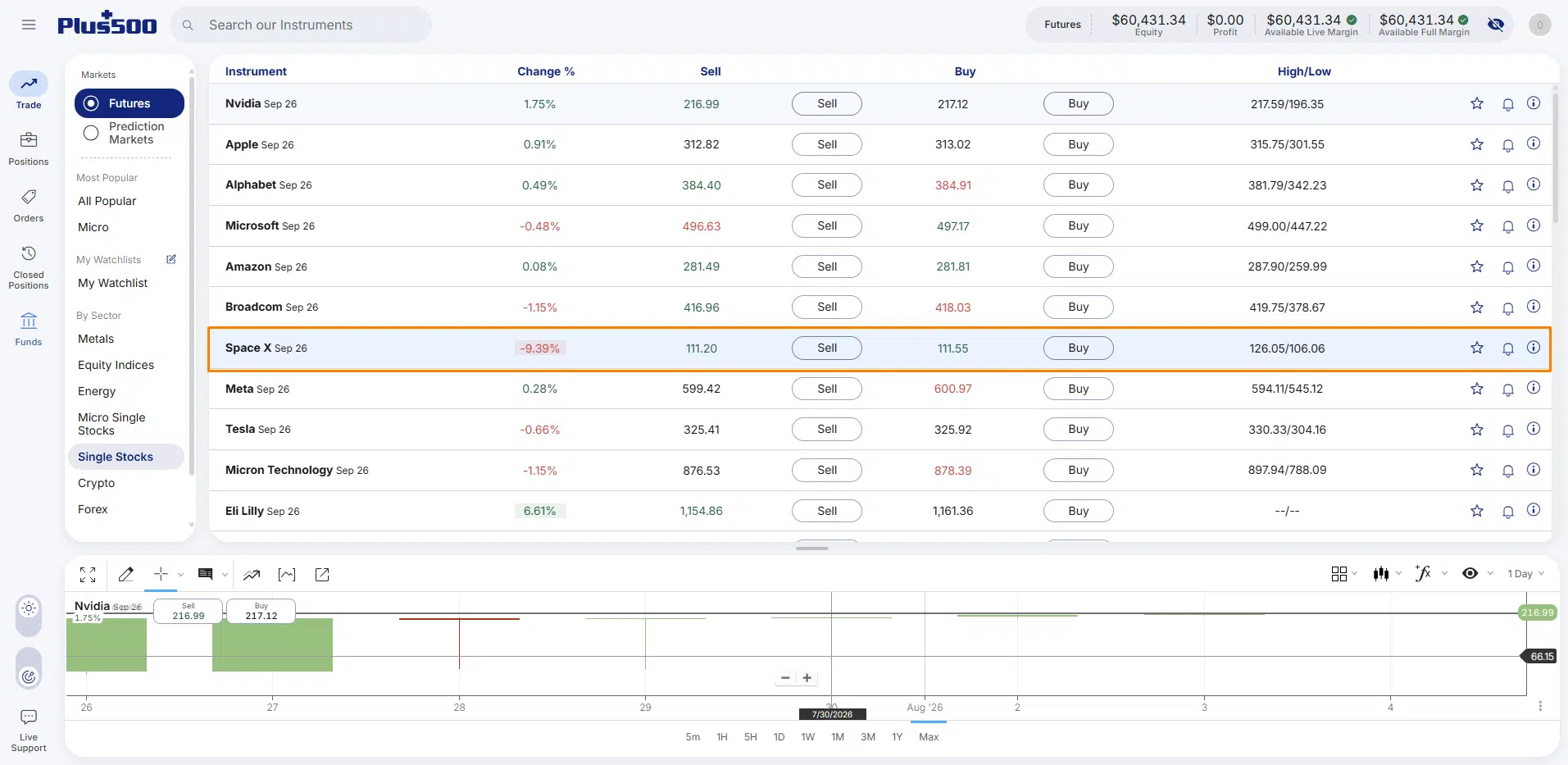
2. Find the contract. In the platform, SpaceX sits under the “Single Stocks” sector (with the smaller version under “Micro Single Stocks”). On the day of our trade, the September contract was down 9.39%, quoted at 111.20 to sell and 111.55 to buy, exactly the kind of volatile session where these contracts earn their keep:
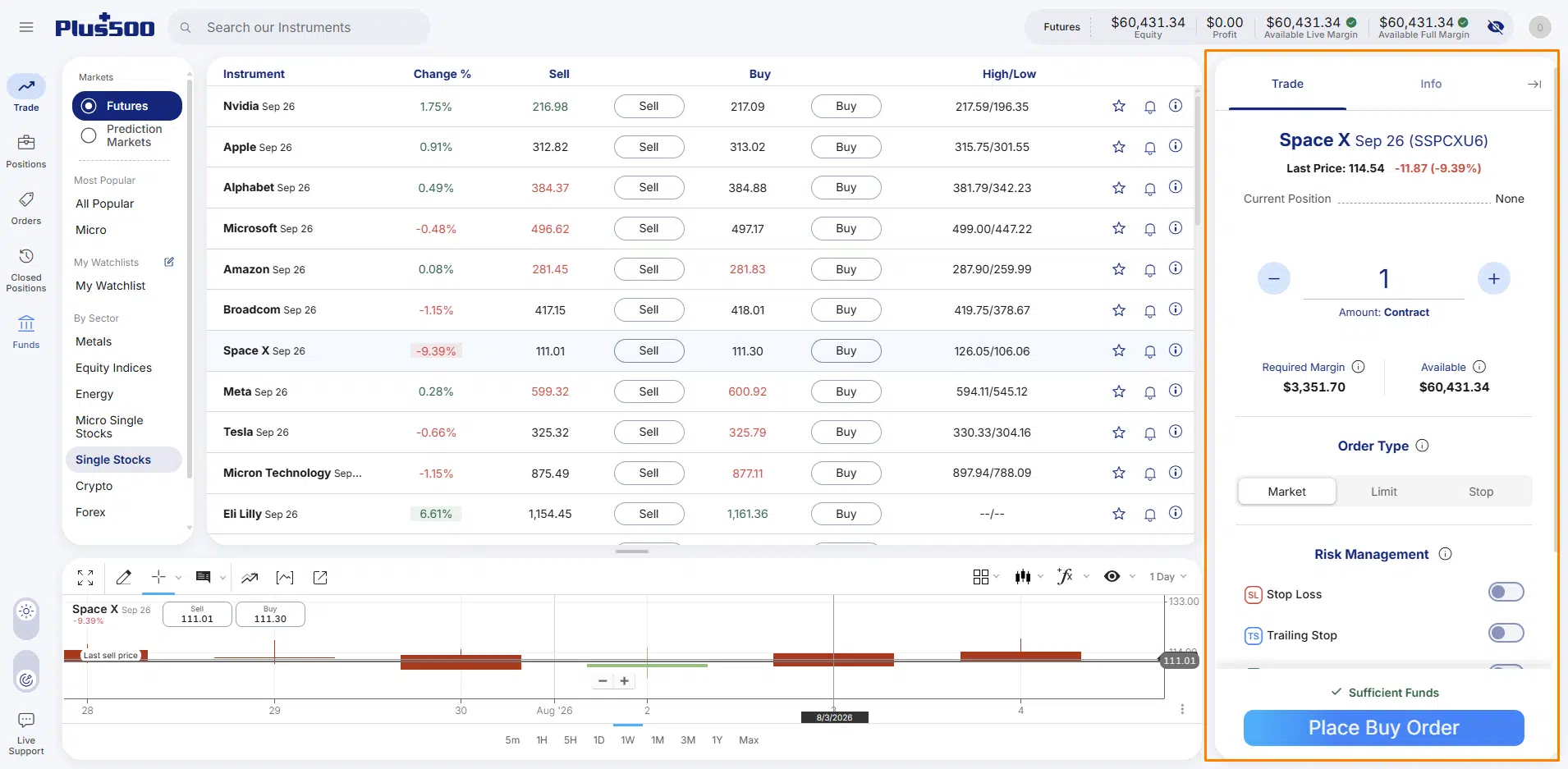
3. Review the order ticket. Clicking the instrument opens the trade panel, which shows the full contract name and symbol, Space X Sep 26 (SSPCXU6), the last price, and, crucially, the Required Margin for one contract: $3,351.70 against our available balance. You can choose Market, Limit or Stop orders, and attach risk management before entering: with this much leverage on this volatile a stock, we would always recommend enabling the Stop Loss toggle at this stage.
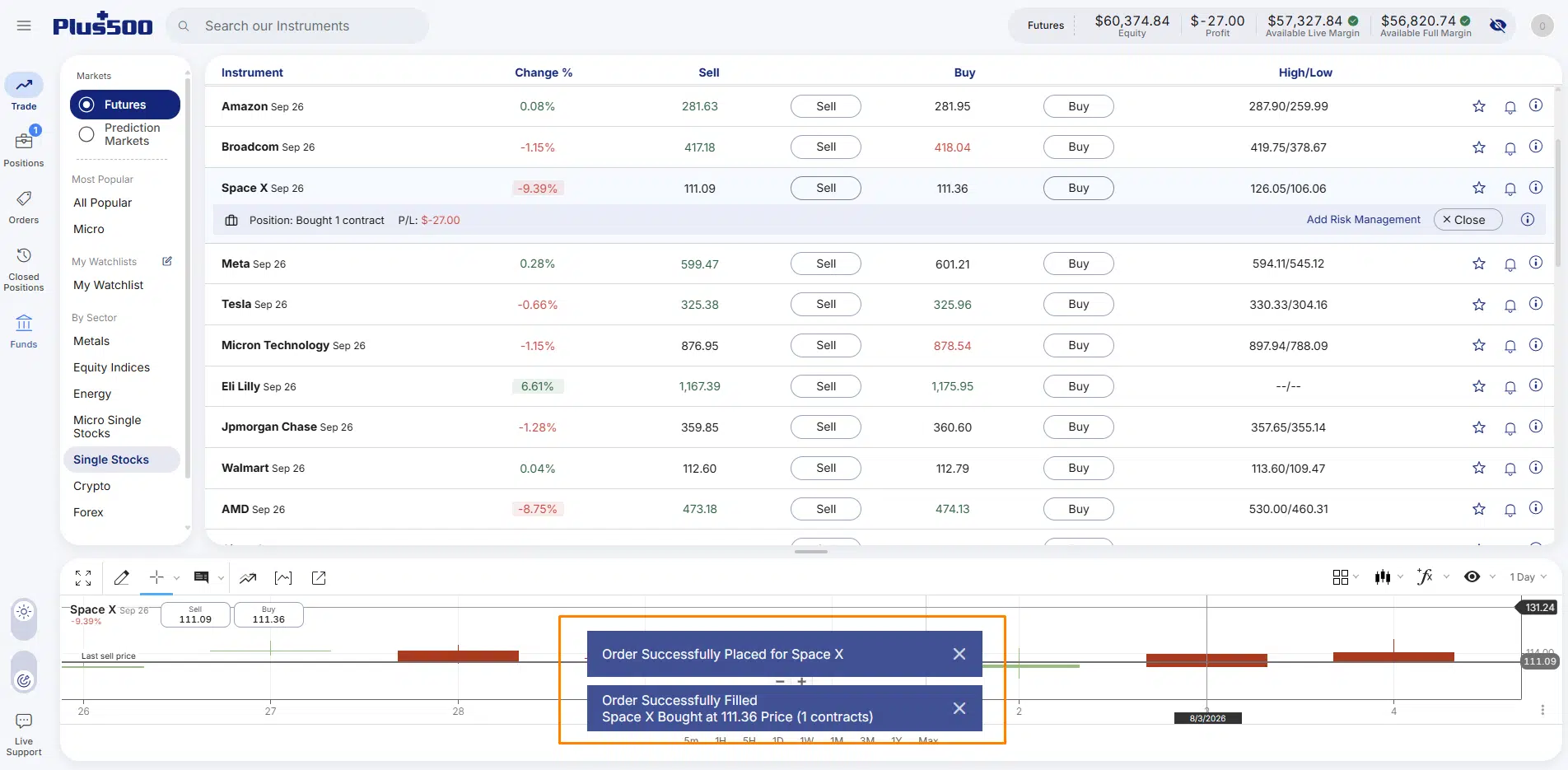
4. Place the order. We placed a market order to buy one contract, filled instantly at 111.36. The platform confirms both the placement and the fill, and the position appears immediately under the instrument with its running profit and loss, which is marked to market in real time. Note how the P/L was negative from the first second: the difference between the buy and sell quote (the spread) means every position starts slightly underwater, another reason to size conservatively.
5. Manage the position. The Positions tab shows the open trade, its P/L, and two buttons that matter: Add Risk Management (to attach or adjust a Stop Loss or Trailing Stop on a live position) and Close. From here you either close the trade manually, let your stop do its job, or, if you want to keep exposure past expiration, close this contract and reopen the next month (rolling). On Plus500, positions left open at expiration are auto-liquidated for a $10 fee, since delivery is not supported.
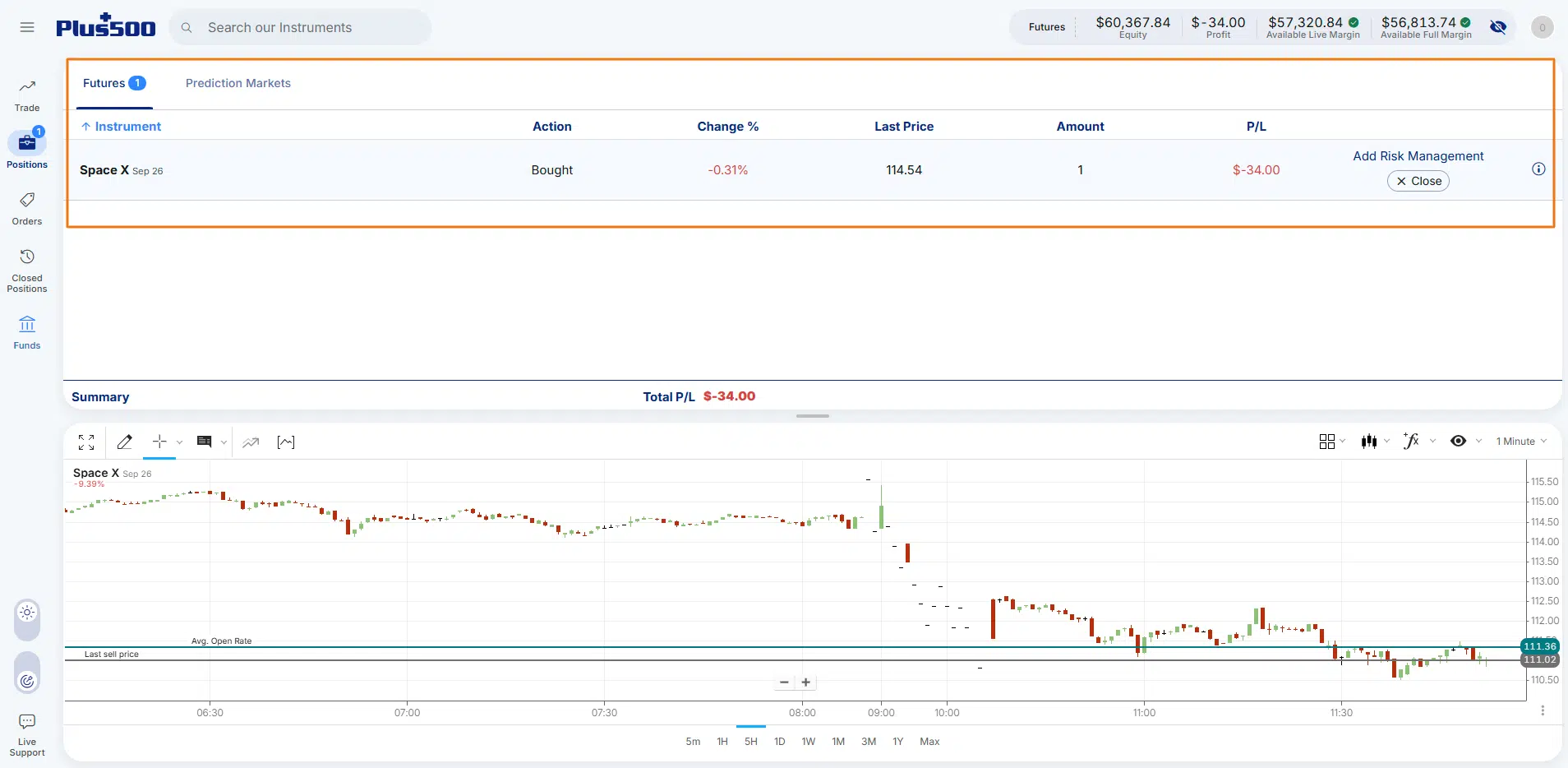
That is the entire mechanic. A short position would look identical in every screen, except the position would show “Sold” instead of “Bought” and would profit as the price declines.
Three ways traders are using SpaceX futures
- Trading events outside market hours: Launches and announcements often land at night or on weekends… but note futures pause from Friday afternoon to Sunday evening ET, so weekend events still gap. For weekday evening events, earnings above all, SSFs let you trade the reaction in real time instead of waiting for the open.
- Expressing a bearish view: Whether you think the valuation has run ahead of the fundamentals or expect a specific catalyst to disappoint, selling a future is operationally far simpler than shorting a tight-float stock.
- Hedging SPCX shares: IPO investors and employees sitting on stock they cannot or do not want to sell can short futures against the position to hedge through a volatile event, without triggering a sale of the shares themselves. Depending on your situation, this may have tax and lock-up implications, so check with a professional first.
Where to trade SpaceX futures
Our pick for getting started: Plus500US
Plus500US (Plus500US Financial Services LLC), a CFTC-registered Futures Commission Merchant and NFA member, offered SpaceX single stock futures from day one of the CME launch, in both standard and Micro sizes. It is the platform we used for the walkthrough above.
- Low commissions, from $0.49 per Micro contract, with no hidden fees
- Free real-time market data, which most futures brokers charge for
- Unlimited demo account with $50,000 in virtual funds, so you can practice trading SpaceX futures at real prices, as we did above, before risking capital
- Minimum deposit of just $10, with a simple platform on web and mobile
Want the full picture first? Read our complete Plus500US review or visit Plus500’s website.
For alternatives with different platforms and fee structures, see our full comparison of the best brokers for single stock futures.

Futures trading involves substantial risk of loss and is not suitable for every investor. You may lose more than your initial investment.
The risks, specifically for SpaceX
Everything that makes this contract interesting also makes it dangerous. SpaceX is a newly public company with a short trading history, a tight float, and binary event risk: a launch failure or a disappointing quarter can gap the price violently, straight through stop levels. The stock has already fallen roughly 50% from its post-IPO high, and moves of 8-10% in a session have not been rare; the demo trade above was placed on a day the contract was down 9.39%. Applied to leverage, moves like that can wipe out your posted margin and more, since futures losses are not limited to your initial investment.
The elevated margin requirement (about 29% at Plus500 in our example, roughly double CME’s minimum) is itself a signal: the market treats this as one of the riskiest names in the SSF lineup. Liquidity is also still building in these brand-new contracts, and spreads on SpaceX futures may be wider than on names like Nvidia or Tesla, especially in overnight hours, exactly when you may most want to trade. Start with Micro contracts, use a demo first, and never hold a leveraged SpaceX position through a binary event with more size than you can afford to lose.
This article is for information purposes only and does not constitute investment advice or a recommendation. Futures trading involves leverage and carries a substantial risk of loss; you may lose more than your initial investment. Past performance is no indication of future results.
Frequently asked questions
What is the SpaceX futures symbol?
The September 2026 SpaceX single stock future trades under the symbol SSPCXU6, following the usual CME convention where the final characters indicate the contract month (U = September) and year (6 = 2026). Later expirations use the same root with different month codes.
Can I buy actual SpaceX stock instead?
Yes. Since June 12, 2026, SpaceX trades on Nasdaq under the ticker SPCX, and you can buy shares through any standard stockbroker. The futures are an alternative for leveraged, short, or after-hours exposure, not a replacement for owning shares.
What is the price of SpaceX futures?
SpaceX futures track the SPCX share price, adjusted for the futures basis (expected interest and dividends until expiration). Since SpaceX pays no dividend, the futures price typically sits very close to the stock price.
Is there a Micro SpaceX futures contract?
Yes. The Micro contract represents 10 shares of exposure, about one tenth of the standard contract, making it accessible to smaller accounts. You will find it under “Micro Single Stocks” on Plus500.
Do SpaceX futures pay dividends?
No, and SpaceX currently pays no dividend on its shares either. If it ever did, expected dividends would be priced into the futures basis rather than paid to holders.
Can I trade SpaceX futures outside the US?
CME single stock futures require an account with a participating US futures broker, and access for non-US residents depends on each broker’s onboarding policies. International readers can compare alternatives in our guide to the best futures trading platforms.