Futures allow participants to hedge risk or gain exposure to commodities, equity indices, interest rates, and currencies through standardised, exchange-traded contracts with deep liquidity and nearly 24-hour sessions.
Platforms differ widely in execution quality, costs, available markets, and tools. In the United States, futures trading is overseen by the Commodity Futures Trading Commission (CFTC) and the National Futures Association (NFA), and this guide evaluates the best futures trading platforms on consistent criteria: regulation, fees, execution reliability, functionality, and market access.
The best futures trading platforms
Here’s the list of our top picks for the best futures trading platforms:
- Plus500 Futures: The best futures trading platform overall for US traders. A clean, purpose-built futures platform with all-in commissions from $0.49 per micro contract, a $10 minimum deposit, no data or platform fees, and a free $50,000 demo.
- Interactive Brokers: Best futures platform for experienced and professional traders. Trader Workstation delivers depth of market, advanced order types, spread trading, and futures on 30+ global exchanges.
- Optimus Futures: Best for platform choice and low commissions ($0.25 per side on micros). The free Optimus Flow platform plus support for TradingView, Sierra Chart, MultiCharts, Quantower, and more. US only.
- Saxo: Best futures platform for international (non-US) traders, with 250+ contracts on SaxoTraderGO and SaxoTraderPRO. Note: not available to US residents.
- TradeStation: Best for systematic and analytics-driven traders, with EasyLanguage strategy automation and tiered pricing.
- tastytrade: Best for execution-focused retail traders who want flat, predictable pricing.
For a list of trading platforms we do not recommend, you can visit our full list of brokers, and filter by “Not recommended”.
Comparison table – futures trading platforms


Other resources
- Check our YouTube channel! You will find step-by-step guides on how to invest through different trading platforms, as well as other educational videos about trading and brokers.
- Explore our tools: Check our comparison tool, reviews, broker bonuses, and others.
Review of each broker
Plus500 Futures
Plus500 Futures at a glance

Futures fees: $0.49 per side (micros), $0.89 per side (standard and E-minis), including exchange and NFA fees.
Founded in 2008 and listed on the London Stock Exchange (ticker: PLUS), Plus500 is one of the world’s most established trading groups. Plus500 Futures is its US futures arm, giving traders direct access to regulated exchanges such as the CME Group through Plus500US Financial Services LLC, a Futures Commission Merchant registered with the CFTC and a member of the NFA and the CME Group.
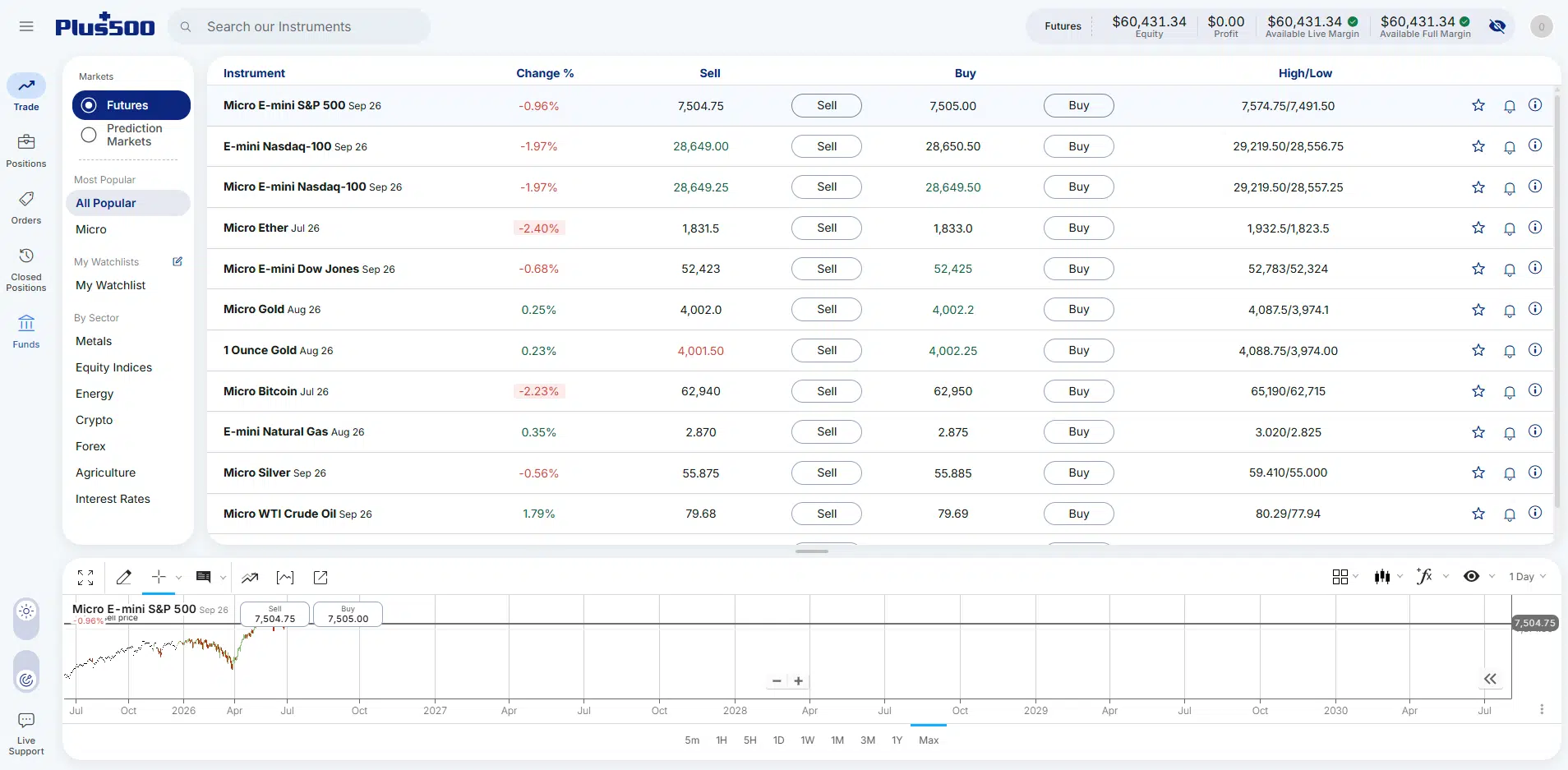
The platform is 100% purpose-built for futures, which shows in the design: an intuitive, customisable dashboard with watchlists, alerts, and technical analysis tools, where order placement, margin requirements, and contract specifications are clearly presented inside each instrument’s details. The order ticket supports Market, Limit, and Stop orders with attached Take Profit and Stop Loss, and monetary history reports and daily/monthly statements can be generated in a few clicks.
Market coverage spans seven asset classes: equity indices (S&P 500, Nasdaq 100, Dow, Russell 2000, Nikkei), energy (WTI and Brent, natural gas, gasoline), metals (gold, silver, copper, platinum), agriculture, forex, interest rates, and crypto (micro Bitcoin and Ethereum), with mini and micro contracts across most classes.
Plus500 also offers Prediction Markets, event-based contracts on outcomes such as economic data or rate decisions, at $0.01 per contract – see our comparison of the best prediction markets platforms for US investors.
Pricing is the platform’s calling card: $0.49 per side on micros and $0.89 per side on standard and E-mini contracts, including exchange and NFA fees, with no market data, platform, routing, or inactivity fees, and free wire withdrawals. The one charge to watch is a $10 auto-liquidation fee per contract if a position is not closed or rolled before expiration.
The minimum deposit is $10, the free demo carries $50,000 in virtual funds with real pricing, and new users can earn a first-deposit commission credit bonus from $20 (on a $500 deposit) up to $200 (on a $10,000 deposit), subject to terms. Support runs 24/7 via live chat, and the free Futures Trading Academy rounds out the package.
Pros
-
Purpose-built futures platform with a clean, fast interface
-
Transparent all-in commissions ($0.49 micro / $0.89 standard per side, including exchange and NFA fees)
-
No market data, platform, routing, or inactivity fees
-
$10 minimum deposit and a free $50,000 demo account with real pricing
-
Seven asset classes plus Prediction Markets
-
Futures Trading Academy and 24/7 live chat support
-
Commission credit bonus on first deposit (terms apply)
- CFTC-regulated and NFA member, part of an LSE-listed group (FTSE 250)
Cons
-
Available to US residents only
-
Limited advanced tools (no custom indicators, DOM ladder, or algorithmic trading)
-
$10 auto-liquidation fee per contract if a position is held into expiration
- Futures funds are not protected by SIPC (standard for all futures accounts)
Want to learn more? Check our full Plus500 Futures review.
Interactive Brokers (IBKR)
Interactive Brokers at a glance

Futures fees: From $0.25 per contract; typically $0.85 per contract (below 1,000 contracts/month), plus exchange and regulatory fees.
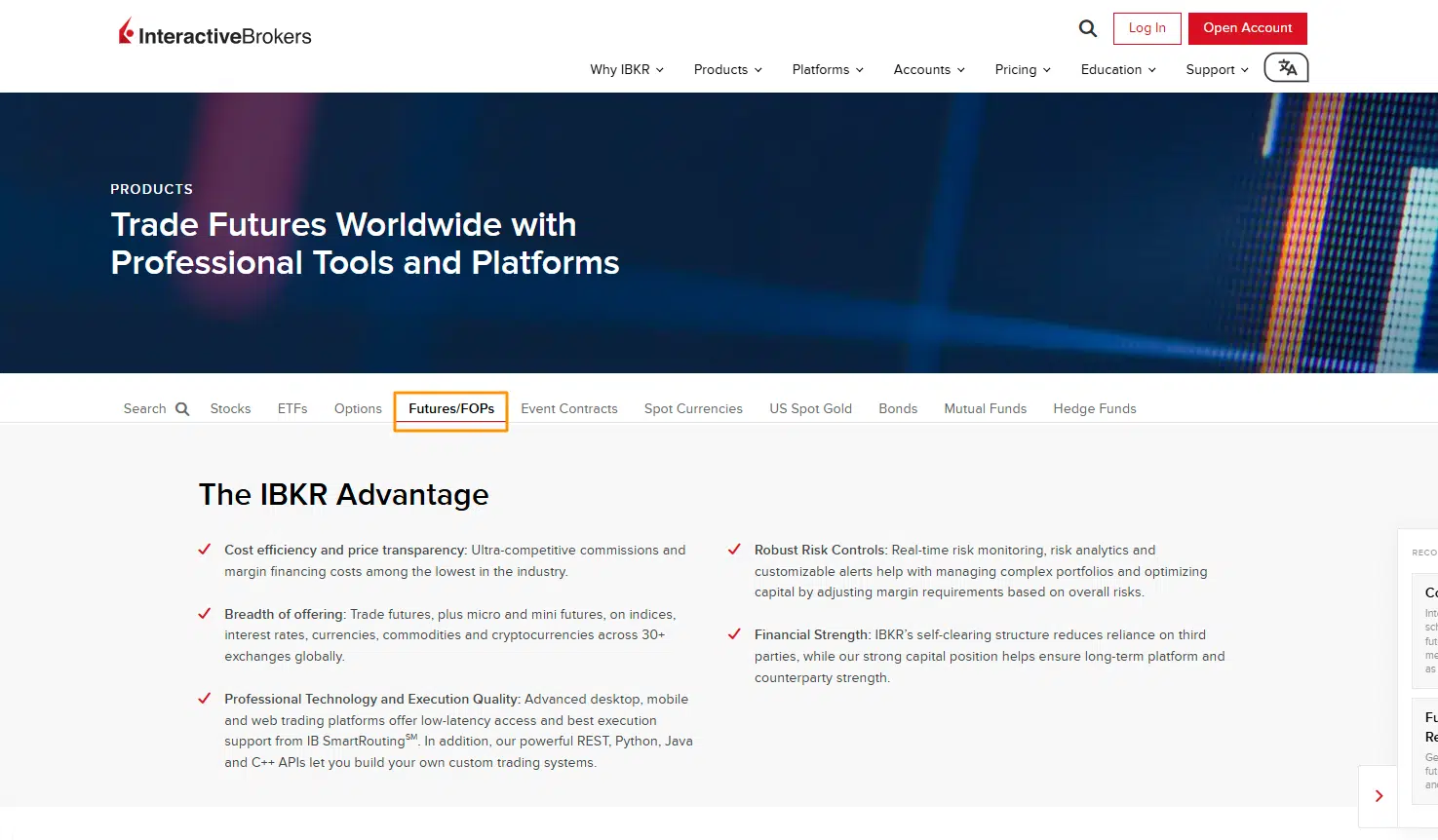
Founded in 1978 and listed on NASDAQ (ticker: IBKR), Interactive Brokers is one of the most established and globally recognised brokers for futures trading, offering real futures contracts across more than 30 exchanges worldwide, including CME, CBOT, NYMEX, ICE, and Eurex.
Futures trading runs primarily through Trader Workstation (TWS), IBKR’s flagship platform, with professional charting, depth of market (DOM), advanced order types, spread trading, and direct exchange routing, exactly the toolkit experienced and systematic futures traders rely on. IBKR Desktop (launched 2024) offers a cleaner modern alternative, Client Portal covers browser-based account management, and IBKR Mobile brings full futures support to the phone.
Fees start at $0.25 per contract, though most users pay $0.85 per contract (the rate below 1,000 contracts per month), plus exchange and regulatory fees. Margin requirements are transparent and generally competitive, particularly for intraday futures trading, and idle cash earns interest – see how IBKR ranks among the best brokers for cash interest.
The caveats: futures permissions must be requested and approved (you need to demonstrate sufficient knowledge and experience), and the platform depth comes with a steep learning curve that can overwhelm newcomers used to simpler software.
Pros
-
Futures and options on futures across 30+ global exchanges
-
Professional-grade tools: DOM, spread trading, 100+ algorithmic order types
-
Very low commissions with volume discounts (from $0.25 per contract)
-
Interest paid on uninvested cash
-
Wide platform choice (TWS, IBKR Desktop, Client Portal, IBKR Mobile)
- Top-tier regulation (SEC, CFTC, FINRA, NFA) and NASDAQ-listed parent
Cons
-
Futures permissions must be requested and approved before trading
-
Steep learning curve, especially on TWS
- Fee calculation can feel complex (commissions plus pass-through fees)
Want to learn more? Check our full Interactive Brokers review.
Optimus Futures
Optimus Futures at a glance

Futures trading contains substantial risk of loss and is not for every investor.
Futures fees: $0.25 per side on micros, $0.75 per side on standard contracts, plus exchange and regulatory fees.
Optimus Futures is a US-only futures specialist whose defining strength on a platforms list is choice: the free proprietary Optimus Flow platform sits alongside support for TradingView, Sierra Chart, MultiCharts, Quantower, and a long list of other professional tools, so you can run the exact software your strategy needs without switching brokers.
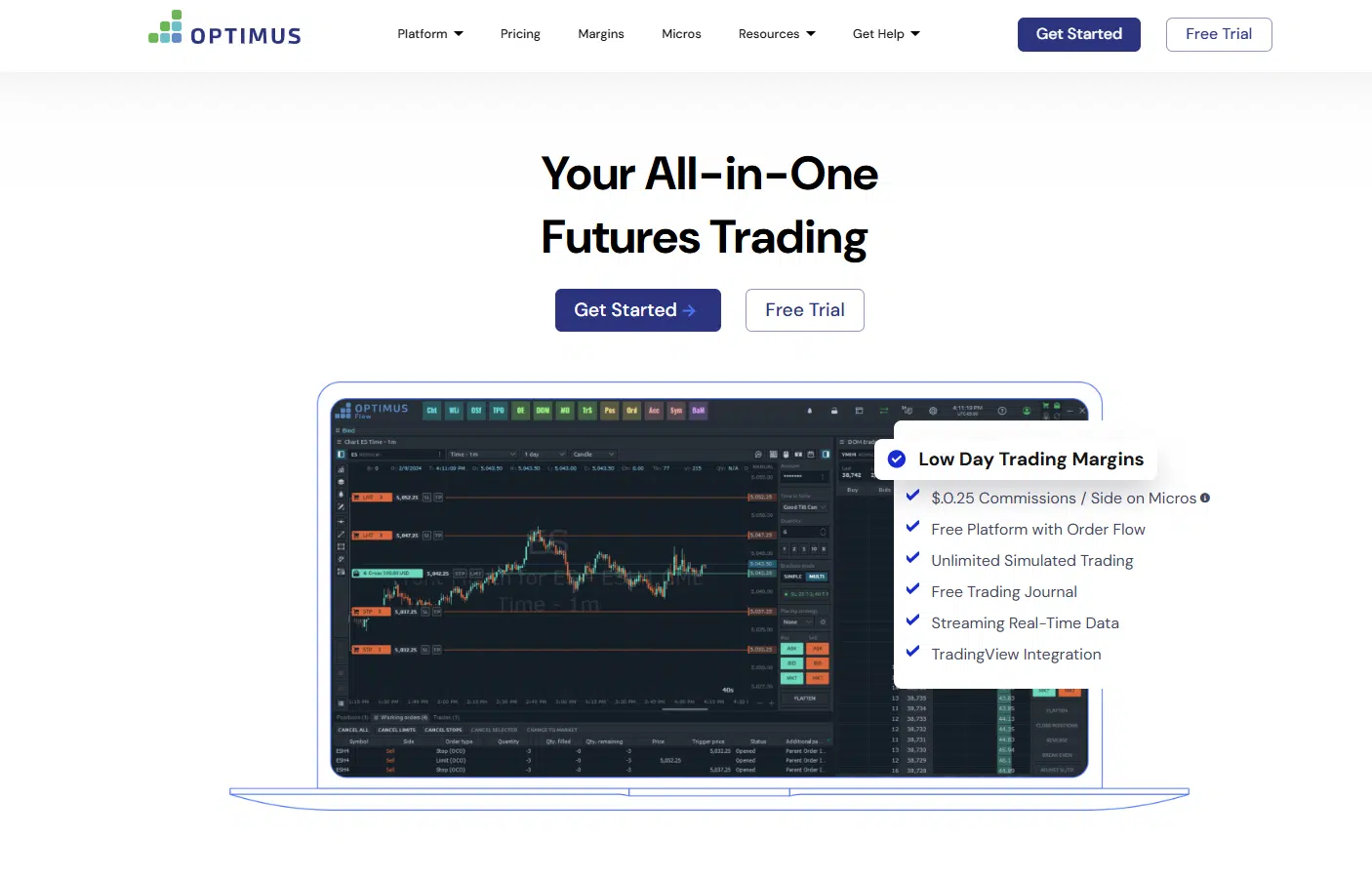
Optimus Flow itself punches well above its price (free, with no monthly platform fee): order flow analysis, DOM ladder trading, volume analysis, TPO profiles, and clean charting, plus a free trading journal, a free real-time news subscription with alerts (Optimus News), and streaming real-time data for quotes and charts, features that usually cost a monthly subscription elsewhere.
Pricing is transparent and among the lowest in the industry: $0.25 per side on micro contracts and $0.75 per side on standard contracts, plus exchange and regulatory fees, combined with low day-trading margins on popular contracts and 24-hour trade desk access for when your platform or connection fails mid-position. Account minimums are $500 for micro futures and $2,000 for E-minis and standard contracts.
The introducing-broker model, clearing through multiple established FCMs, is what enables the flexible platform menu, though it means your exact setup involves a few more choices than at integrated competitors. What holds it all together is Optimus’s well-earned reputation for hands-on support and futures education (their YouTube channel and podcast are staples among US futures traders).
Pros
-
Unmatched platform choice: free Optimus Flow plus TradingView, Sierra Chart, MultiCharts, Quantower and more
-
Transparent deep-discount pricing: $0.25 per side on micros, $0.75 on standard contracts
-
Order flow, DOM, volume analysis, trading journal, real-time news and data included free
-
Low day-trading margins for active traders
- 24-hour trade desk access and excellent human support
Cons
-
Available to US residents only
-
Higher minimum deposit than Plus500 Futures ($500 for micros, $2,000 for standard contracts)
-
Setup involves clearing firm and data-feed choices
- Futures only, no stocks or ETFs
Saxo
Saxo at a glance

62% of retail CFD accounts lose money.
Futures fees: From $1 (VIP) to $3 (Classic) per contract, charged per trade (buy, sell or at expiry), excluding exchange fees.
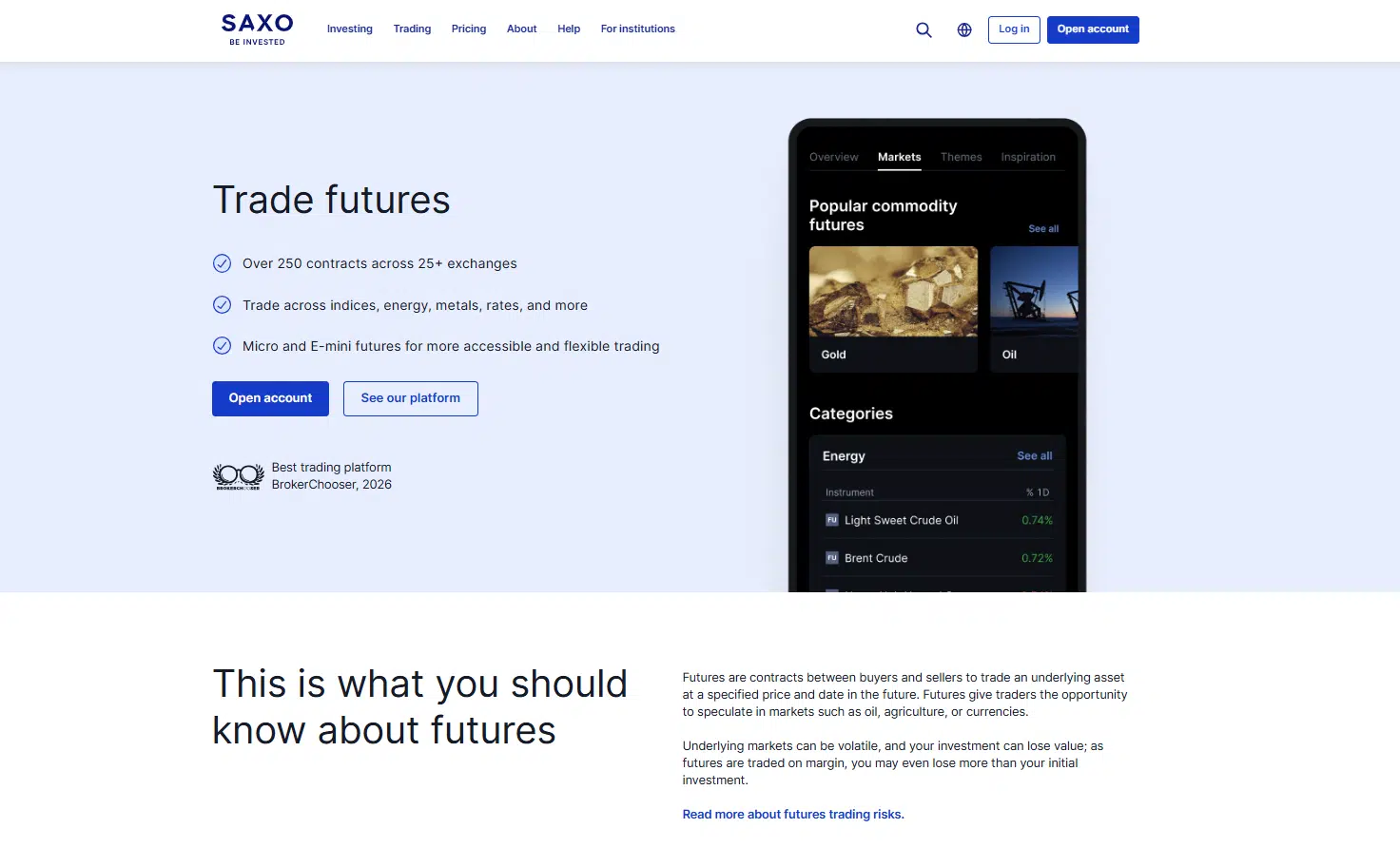
Founded in 1992 and owned by Swiss private banking group J. Safra Sarasin, Saxo offers 250+ futures contracts across global exchanges, covering equity indices, energy, metals, agriculture, interest rates, and currencies, all from a single multi-asset account.
The platform is a genuine strength: SaxoTrader, Saxo’s unified flagship available on web, desktop, and mobile, covers everyday trading with strong charting and integrated SaxoStrats research, while the desktop version unlocks multi-window workspaces, depth of market, and advanced order handling for serious futures traders.
Pricing runs from $3 per contract on the Classic tier down to $1 on VIP, charged per contract per trade and excluding exchange fees. Note that Saxo also applies a carrying cost on futures positions held overnight, calculated on the daily margin requirement (3.5% rate on Classic, 1.5% Platinum, 0.5% VIP), a cost US futures brokers do not charge, which makes Saxo comparatively better suited to intraday and short-hold strategies.
The S&P A- credit rating plus three decades of history give a counterparty profile few retail brokers can match.
Pros
-
250+ futures across global exchanges from one account
-
Bank-grade trust profile (S&P A- rated, owned by J. Safra Sarasin)
- Integrated in-house research (SaxoStrats)
Cons
-
Not available to US residents
-
Commissions higher than US discount futures brokers ($3 per contract on Classic)
- Carrying cost charged on futures positions held overnight
Want to learn more? Check our full Saxo review.
TradeStation
TradeStation at a glance

Futures fees: Tiered: standard contracts from $1.75 down to $0.50 per side; micros from $0.50 down to $0.25 per side, plus exchange and regulatory fees.
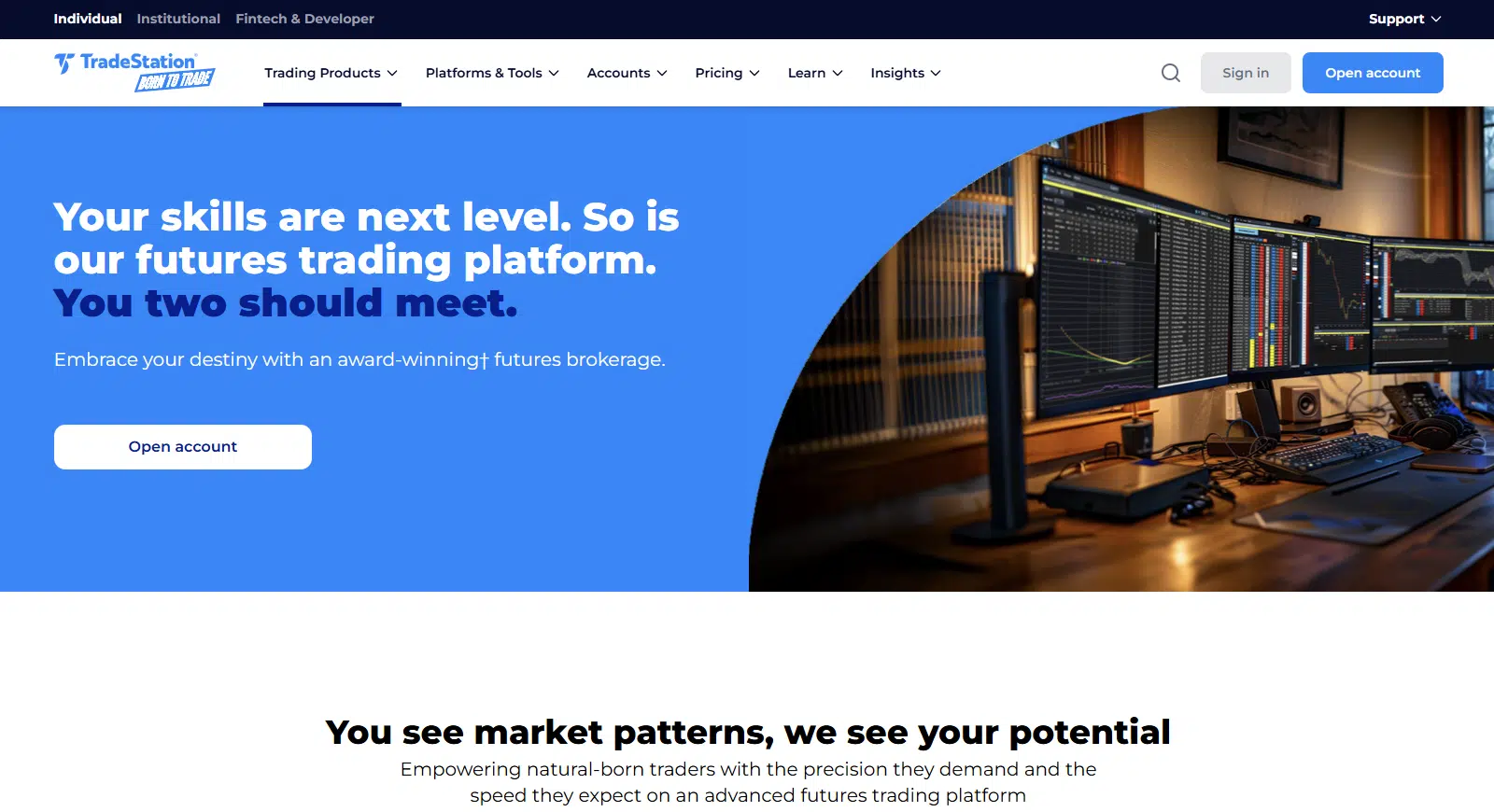
TradeStation is a well-established US brokerage known for combining professional-grade trading technology with competitive pricing. Its futures offering provides direct access to CME Group exchanges (CME, CBOT, NYMEX, and COMEX) and focuses on real, exchange-traded contracts.
On a platforms list, TradeStation’s differentiator is analytics and automation: decades-refined charting, the RadarScreen real-time scanner, and EasyLanguage, its strategy-coding environment that lets systematic traders build, backtest, and automate futures strategies without leaving the platform.
The tiered commission model rewards volume, standard contracts from $1.75 per side (0-500 contracts) down to $0.50 (10,000+), micros from $0.50 down to $0.25, plus exchange, clearing, and regulatory fees. There are no platform fees, no minimum balance requirement, and reduced intraday margins (E-mini S&P 500 from as little as $50 per contract, conditions permitting) suit active day traders. The trade-off is familiar: this much capability can feel complex for newcomers, and there are no deposit incentives.
Pros
-
Professional analytics, scanning, and EasyLanguage strategy automation
-
Tiered commissions that reward volume
-
Reduced intraday margins for day traders
-
No platform fees or minimum balance
- Long-standing US regulation (SEC, CFTC, FINRA, NFA)
Cons
-
Entry-tier commissions ($1.75 standard) higher than Plus500 Futures or Optimus
-
Interface and tools can overwhelm first-time futures traders
- No deposit or trading bonuses
tastytrade
tastytrade at a glance

Futures fees: Flat $1.00 per contract to open and $1.00 to close, plus exchange and regulatory fees.
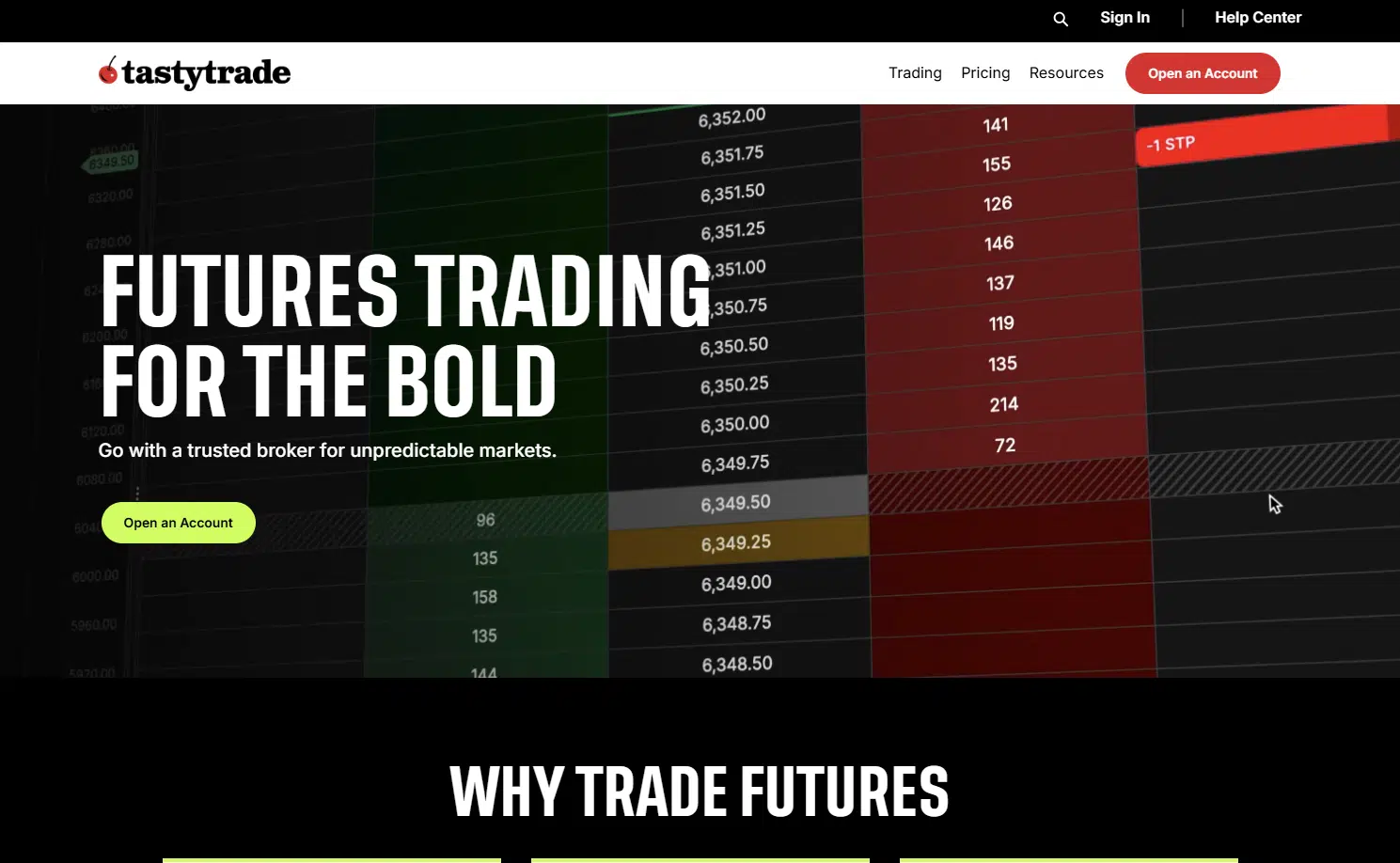
tastytrade is a US brokerage built primarily for active derivatives traders, with a strong focus on futures and options. The platform emphasises simplicity, fast execution, and transparent pricing rather than complex professional-grade analytics, and its futures offering covers CME Group exchanges including CME, CBOT, NYMEX, and COMEX.
Pricing is flat regardless of volume: $1.00 per contract to open and $1.00 to close, plus pass-through exchange and regulatory fees, with no platform fees and no minimum balance. Intraday margins are competitive, often below exchange overnight levels.
The trade-offs: no demo or simulated futures account, and charting and customisation are deliberately lean compared with professional platforms, tastytrade optimises for execution speed and simplicity, backed by the excellent free education of the tastylive network.
Pros
-
Simple, flat, predictable pricing at any volume
-
Strong futures and options-on-futures integration
-
Competitive intraday margins and micro futures support
-
Outstanding free education via tastylive
- No platform fees or minimum balance
Cons
-
No demo or simulated trading account
-
Fewer advanced charting and customisation tools than professional platforms
- Flat pricing less competitive for very high-volume traders
Criteria for the best futures trading platforms
The selection of futures trading platforms featured in this article is based on criteria that, in our view, address the needs of most retail futures traders. Our assessment focuses on platforms that combine regulatory safety, competitive and transparent pricing, and reliable execution.
Below are the key factors considered:
1. Regulation and safety
All US platforms selected operate under the CFTC and NFA, with client funds held in segregated accounts. We also weighed each parent company’s financial strength and transparency (public listings, credit ratings), since futures accounts are not covered by SIPC.
2. Fees and commissions
For futures traders, costs compound quickly: even $0.20 per contract adds up to thousands per year at volume. We compared per-side and round-turn commissions, whether exchange and NFA fees are bundled (as at Plus500 Futures) or passed through, volume discounts, market data charges, overnight carrying costs (relevant at Saxo), and margin policies, including how intraday margins behave around major news events.
3. Execution and platform stability
Execution quality is non-negotiable in leveraged markets. We prioritised low-latency order routing, minimal slippage, fast order acknowledgements, and, above all, stability during high-impact events (FOMC, CPI, NFP), when a frozen platform can turn a winning trade into a loss.
4. Tools and analytics
Depending on trader profile, we assessed charting depth (tick, volume, and range charts), depth of market (DOM), bracket and OCO orders, daily loss limits, and automation capabilities, while recognising that for many traders a clean, fast interface beats feature overload.
5. Market access
We favoured platforms covering the main futures asset classes, equity indices, energy, metals, agriculture, interest rates, currencies, and crypto, with micro contracts available for smaller accounts, and checked session access, data feed quality, and whether real-time data is included or billed separately.
How your funds are protected
Futures accounts in the US work differently from stock brokerage accounts. Funds deposited with a Futures Commission Merchant (FCM) are not protected by the Securities Investor Protection Corporation (SIPC), even where the firm also holds an SEC registration.
Instead, protection comes from the CFTC’s customer funds segregation regime: FCMs must hold customer funds in segregated accounts, separate from the firm’s own capital, with daily reporting to regulators.
Customer funds are pooled at the FCM level, so in an extreme failure scenario you could be exposed to losses incurred by other customers if the FCM’s capital proves insufficient, one more reason to favour well-capitalised, transparent brokers such as the ones in this list.
Which futures trading platform should you choose?
There is no single perfect futures trading platform: the right choice depends on your experience level, trading style, and cost sensitivity. What matters most over time is not feature overload, but reliable execution, transparent fees, stable margin rules, and strong regulation.
As a final reference, here is how each platform in this guide is best positioned: Plus500 Futures is the best overall platform for US traders, with the simplest interface and the most transparent all-in pricing. Interactive Brokers is the choice for experienced and professional traders needing global market access and institutional-grade tools. Optimus Futures wins on platform choice and deep-discount costs, TradeStation on analytics and strategy automation, and tastytrade on flat, predictable pricing for active retail traders.
For readers outside the US, Saxo is the standout bank-grade option. And if intraday trading is your focus, our guide to the best futures trading platforms for day trading digs deeper into execution and margins. See also our guides to the best futures brokers for beginners and the best futures trading apps.
Before committing capital, test platforms in simulation, calculate realistic all-in trading costs based on your expected volume, and assess how well each platform supports your risk management. The right platform won’t make you profitable, but the wrong one can quietly hold you back.
FAQs
Are futures suitable for day trading?
Yes. Futures are among the most popular instruments for day trading due to liquidity, leverage, and low transaction costs, and the pattern day trader (PDT) rule does not apply to futures – learn more in our guide on how to avoid the PDT rule. Reduced intraday margins at brokers like TradeStation and Optimus Futures make day trading accessible even to smaller accounts.
Can international traders trade US futures?
Yes, but only through globally regulated brokers such as Interactive Brokers or region-specific futures brokers like Saxo. Plus500 Futures and Optimus Futures serve US residents only, while TradeStation and tastytrade serve the US and select international countries.
What is the cheapest futures trading platform?
It depends on volume and contract type. For most retail traders, Plus500 Futures’ all-in $0.49 (micro) and $0.89 (standard) per-side pricing with no data fees is the simplest and among the cheapest, while Optimus Futures’ $0.25 (micro) and $0.75 (standard) per side plus pass-through fees is highly competitive for active traders. High-volume traders may do better with IBKR’s or TradeStation’s volume-based tiers.
Disclaimer: This content does not constitute investment advice. Futures are leveraged derivative instruments and involve a high risk of rapid capital loss. Funds deposited with futures commission merchants are not protected by SIPC. Before trading, make sure you fully understand how futures work and whether you can afford to lose your entire investment.