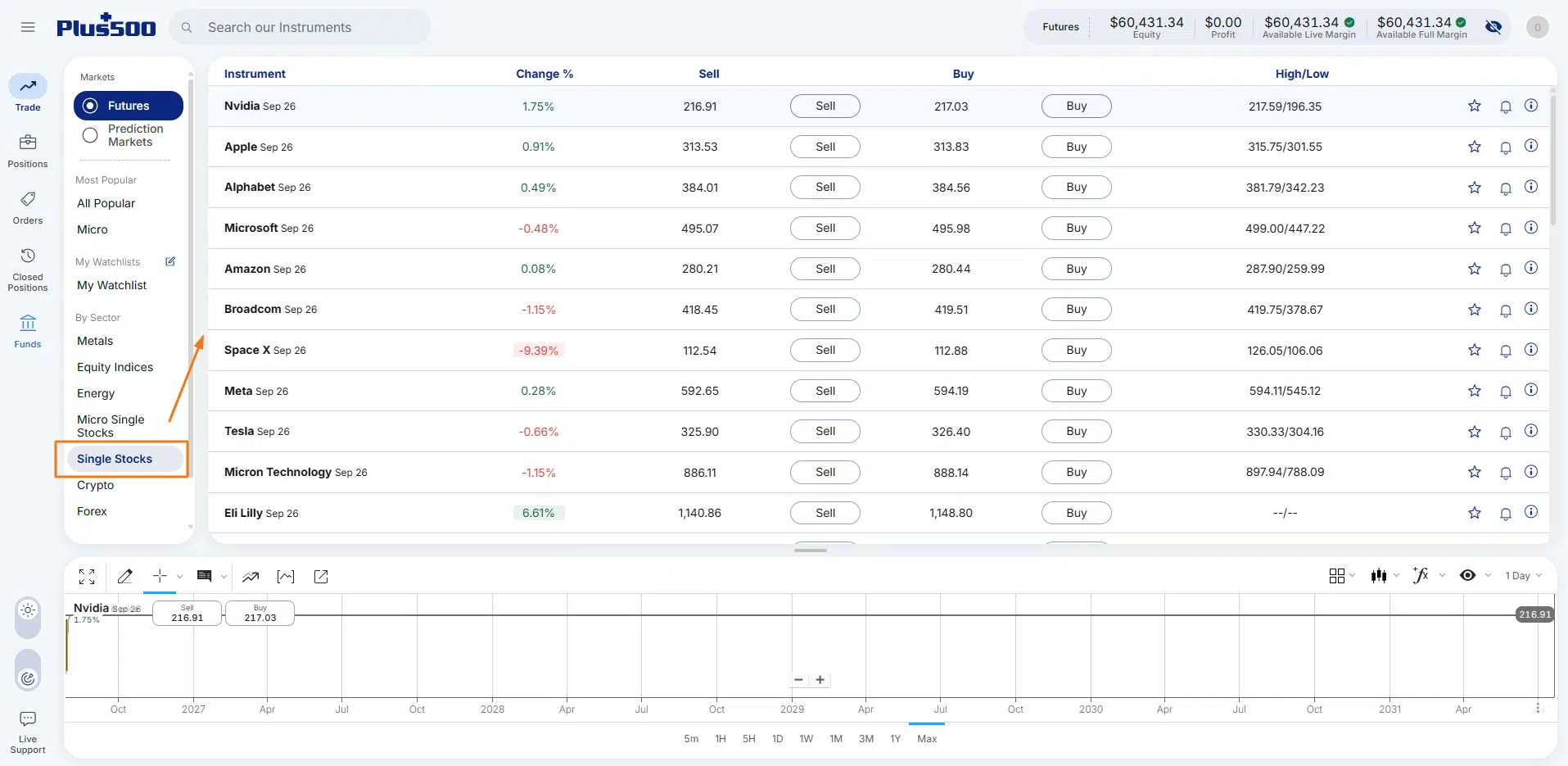
For the first time in years, US traders can once again trade futures on individual stocks. On July 27, 2026, CME Group launched Single Stock futures (SSFs) on more than 50 of the largest US companies, including Nvidia, Tesla, Apple, Alphabet, Amazon, Meta and, notably, SpaceX.
If you have ever wanted to react to an earnings report at 2 a.m., short a stock without paying borrowing fees, or get leveraged exposure to a mega-cap name without touching options Greeks, this new product was built for you. In this guide, we explain what single stock futures are, how the contracts work in practice, how they compare to stocks and options, and where you can trade them today.
What are single stock futures?
A single stock future is a standardized futures contract whose underlying asset is one individual stock, rather than an index like the S&P 500. When you buy (go long) an SSF, you profit if the stock rises; when you sell (go short), you profit if it falls. You never own the actual shares.
CME’s new contracts are financially settled (cash settled). At expiration, no shares change hands: your position is closed out and the difference is credited to or debited from your account. This makes them simpler than the physically delivered single stock futures the US market experimented with in the 2000s.
Each standard contract represents 100 shares of the underlying stock, while Micro contracts represent 10 shares, letting smaller accounts trade names like Nvidia or Tesla with proportionally smaller margin requirements.
Contract specifications at a glance
| Feature | Standard SSF | Micro SSF |
| Contract size | 100 shares | 10 shares |
| Settlement | Cash (financially settled) | Cash (financially settled) |
| Exchange | CME (Globex) | CME (Globex) |
| Trading hours | ~23 hours/day, Sunday evening to Friday afternoon (ET), with a 1 hour daily maintenance break | Same |
| Underlyings at launch | 55 contracts | 22 contracts |
| Stock universe | 50+ top US stocks from the S&P 500, Nasdaq 100 and Russell 1000 | Subset of the most traded names |
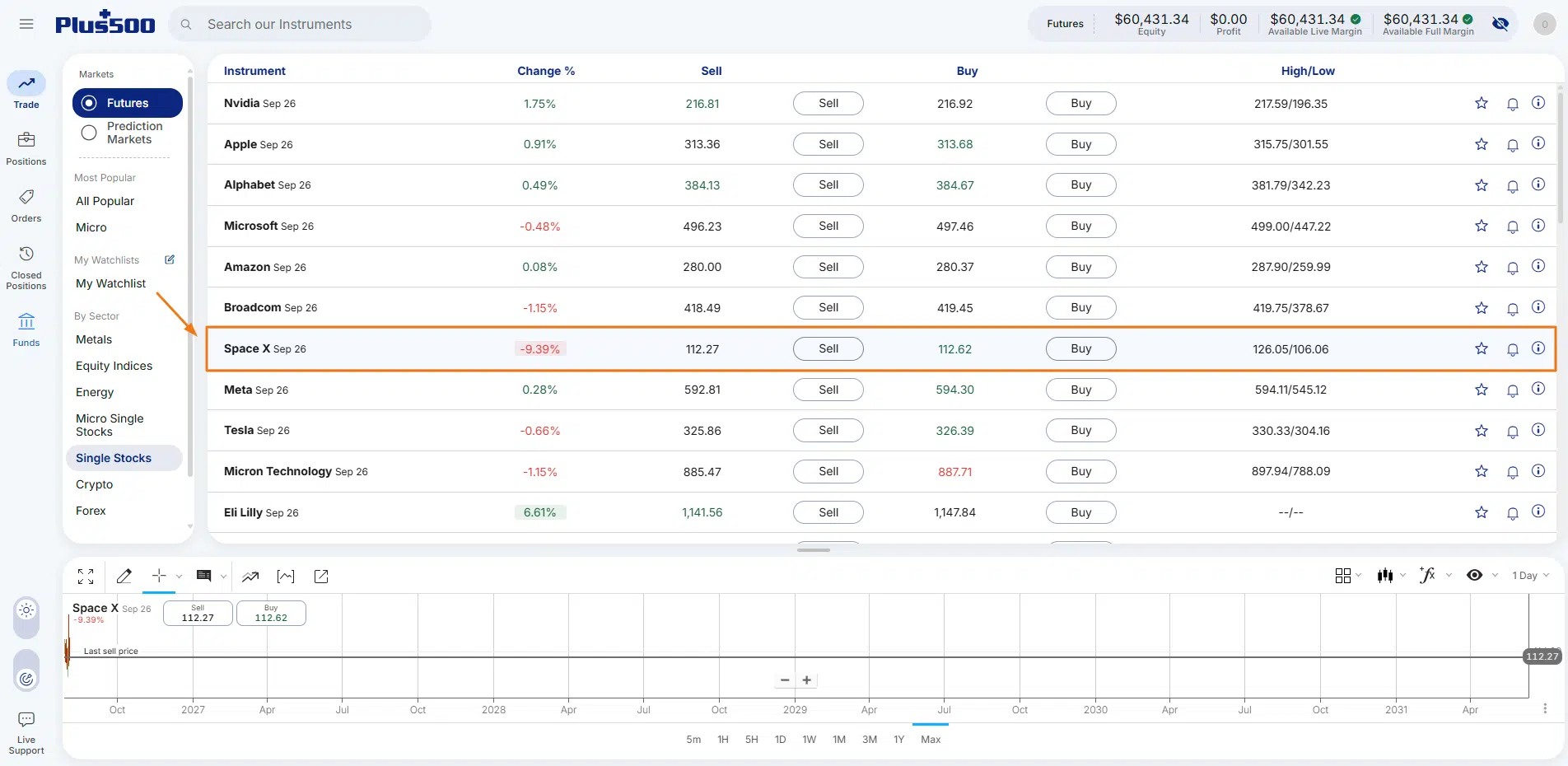
The launch lineup covers the stocks that dominate retail order flow: Nvidia, Tesla, Apple, Microsoft, Amazon, Alphabet, Meta, Micron and others. The headline inclusion is SpaceX, one of the most closely watched recent IPOs. With SpaceX shares in limited supply, its single stock future is one of the few practical ways for retail traders to get direct exposure to the company’s price.
Didn’t the US already try single stock futures?
Yes, and the history matters. Single stock futures first launched in the US in 2002, after the Commodity Futures Modernization Act of 2000 resolved a decades-long regulatory turf war between the SEC and CFTC. The product never gained traction: volumes stayed thin, spreads stayed wide, and OneChicago, the exchange that carried the product, shut down in 2020, leaving the US without any single stock futures market.
So why would it work this time? Three things have changed:
- Retail participation exploded. Futures trading among individual traders has grown dramatically, with CME reporting record equity futures volumes in 2026. Micro contracts made futures accessible to normal account sizes.
- The 24 hour trading race. Brokers are competing on overnight access to stocks. Futures already solve this natively: SSFs trade nearly around the clock on Globex.
- Hot IPOs with scarce shares. Companies like SpaceX list with limited float. A cash settled future does not depend on borrowing or owning shares, so it can offer clean exposure where the stock itself is hard to trade.
CME also has what OneChicago never did: massive existing liquidity in equity index futures, an established retail broker network, and cross-margining benefits within the same clearing house.
How single stock futures work in practice
Margin and leverage
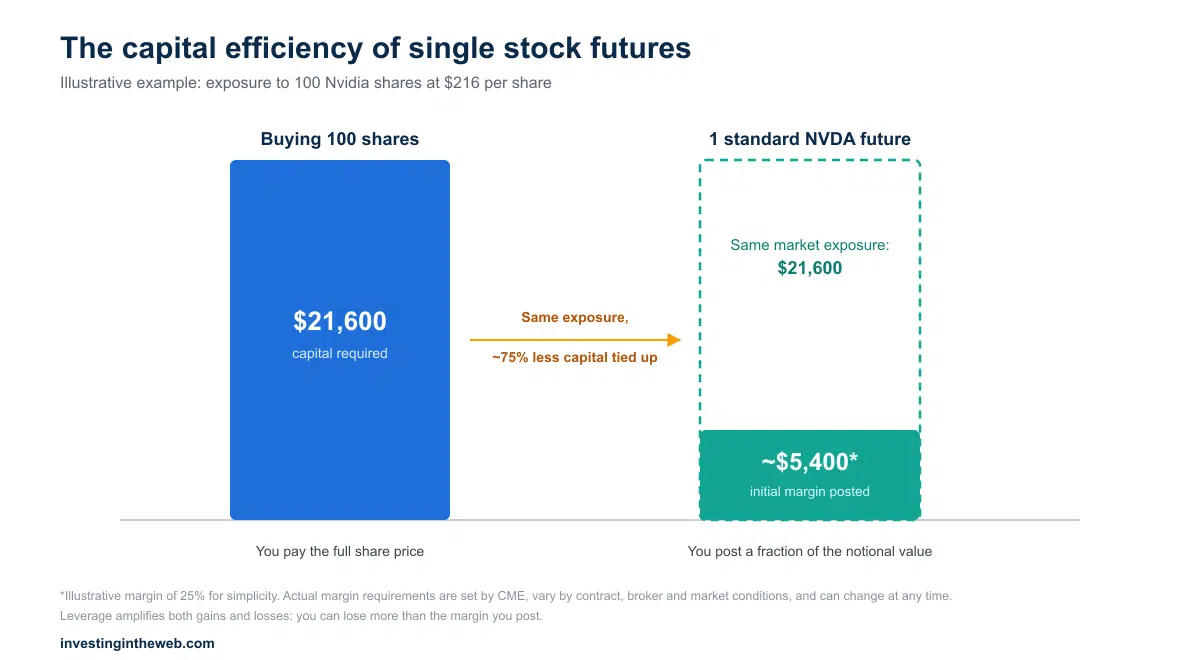
Instead of paying the full value of 100 shares upfront, you post an initial margin, a fraction of the contract’s notional value. This capital efficiency is the core appeal: you control the same exposure with far less cash. It cuts both ways, though. Leverage amplifies losses just as it amplifies gains, and your position is marked to market daily, meaning profits and losses flow through your account every day via variation margin.
Going short
Shorting a stock traditionally requires locating shares, paying borrowing fees, and accepting recall risk. With an SSF, going short is simply selling a contract. No locate, no borrow fee, no recall. For hard-to-borrow names, this is a meaningful structural advantage.
Dividends and corporate actions
Dividends are not paid to futures holders. Instead, expected dividends are priced into the futures price (the basis), and for special dividends the exchange adjusts the contract price so that neither side wins nor loses from the payment. Splits and mergers are handled by exchange adjustment rules designed to keep the contract tracking the stock faithfully.
Note: Plus500, the broker mentioned below, does not handle dividends or corporate actions and that the positions will be liquidated in such cases.
Expiration
Contracts have fixed expiration dates. At expiry, your position is settled in cash against the stock’s closing price. If you want to keep the exposure, you roll the position to the next contract month before expiration, just like index futures traders do.
Single stock futures vs stocks vs options
| Feature | Stocks | Options | Single stock futures |
| Ownership | Yes (shares, voting, dividends) | No | No |
| Leverage | Only via margin loans (interest charged) | Yes, non-linear | Yes, built in via margin |
| Time decay | None | Yes (theta) | None |
| Greeks to manage | None | Delta, gamma, theta, vega | None |
| Shorting | Requires borrow and fees | Via puts (premium cost) | Sell a contract, no borrow fee |
| Trading hours | Market hours plus limited extended sessions | Mostly market hours | ~23 hours/day, 5 days/week |
| Expiration | None | Yes | Yes (roll to maintain exposure) |
The short version: SSFs behave like the stock (linear, one-to-one directional exposure) but with the mechanics of futures (margin, expiration, near-24-hour access). Options give you asymmetric payoffs and defined-risk structures that futures cannot replicate, but at the cost of managing time decay and volatility. Many traders will use all three for different jobs.
The overnight trading advantage
This is where SSFs genuinely change the game for active traders. Roughly 80% of large earnings moves happen outside regular US market hours. Until now, a retail trader watching Nvidia report earnings at 4:20 p.m. ET had limited options: thin after-hours stock sessions with wide spreads, or index futures that dilute the single-name move.
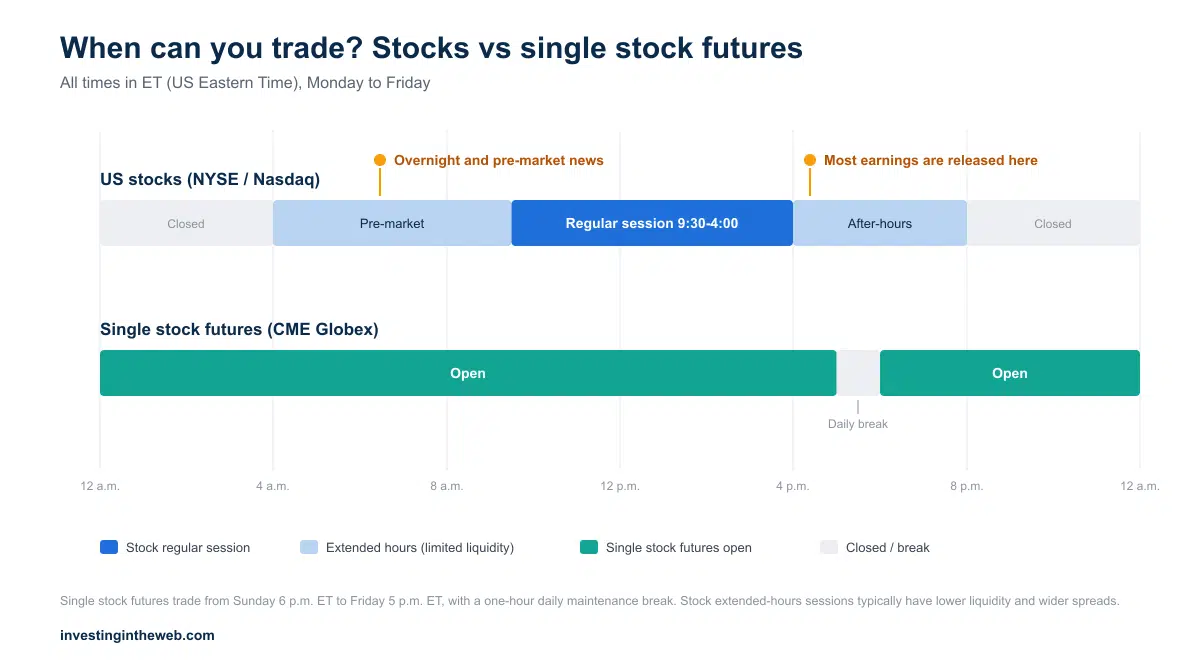
With single stock futures, you can:
- Trade earnings reactions in real time, at 5 p.m. or 5 a.m., with exchange-listed liquidity rather than a broker’s internal after-hours book.
- Position ahead of a pre-market move when overnight news breaks in Asia or Europe.
- Hedge a stock position overnight without selling the shares (and triggering a taxable event).
If this style of trading appeals to you, our comparison of the best futures platforms for day trading covers the tools that matter for fast, around-the-clock execution.
Where can you trade single stock futures?
You need an account with a futures broker (an FCM or introducing broker) that supports the new CME contracts. At launch, CME’s own list of participating brokers includes Plus500, NinjaTrader, Charles Schwab, Optimus Futures, Blue Line Futures and Edge Clear, and more retail platforms are expected to add the contracts in the coming months. You can also compare the wider field in our guide to the best futures trading platforms.
Our pick for getting started: Plus500 Futures
Plus500 US (Plus500US Financial Services LLC) is a CFTC-registered Futures Commission Merchant and NFA member, and one of the first brokers live with CME single stock futures from day one. Here is why we think it is one of the easiest ways to start trading SSFs:
- Low commissions, from $0.49 per contract, with no hidden fees
- Free real-time market data, which most futures brokers charge for
- Unlimited free demo account, so you can practice trading Nvidia or SpaceX futures with virtual money before risking a cent
- Simple, beginner-friendly platform on web and mobile, without the configuration overhead of professional futures front-ends
- Backed by Plus500, a London Stock Exchange-listed group (LSE: PLUS) serving over 33 million registered customers worldwide
Want the full picture first? Read our complete Plus500 Futures review.

Futures trading involves substantial risk of loss and is not suitable for every investor. You may lose more than your initial investment.
What are the risks?
Single stock futures are leveraged instruments, and single stocks are more volatile than indices. Before trading, understand that:
- You can lose more than your initial margin. Daily mark-to-market means losses are realized continuously, and a large adverse move can trigger margin calls or liquidation.
- Single-name risk is concentrated. An index future spreads risk across 500 companies; an SSF on Tesla is exposed to everything that can happen to one company overnight.
- Liquidity is still building. These are brand-new contracts. Spreads and depth should improve as more brokers and market makers connect, but early liquidity may be thinner than in established products, especially outside US hours.
- Contracts expire. Unlike shares, you cannot simply hold forever; maintaining long-term exposure requires rolling positions and paying attention to the futures basis.
If you are new to futures, start with Micro contracts and a demo account before committing real capital. Our guide to the best futures brokers for beginners is a good place to build the foundations first.
Frequently asked questions
When did CME single stock futures launch?
CME Group announced the product on February 10, 2026, confirmed the launch date on June 30, 2026, and the contracts went live on July 27, 2026.
How many stocks are available?
At launch, more than 50 top US stocks are covered through 55 standard-sized and 22 Micro-sized contracts, with CME indicating more names may be added based on demand.
Are single stock futures better than options?
Neither is universally better. SSFs offer simple, linear directional exposure with no time decay or Greeks. Options offer defined-risk and asymmetric strategies that futures cannot replicate. It depends on what you are trying to do.
Can I trade SpaceX with single stock futures?
Yes. SpaceX is among the listed names, making its SSF one of the few ways retail traders can get direct, exchange-listed exposure to SpaceX’s price without holding shares.
Can I trade single stock futures outside the US?
CME single stock futures require an account with a participating US futures broker, and access for non-US residents depends on each broker’s onboarding policies. If you are in Europe or elsewhere, you can compare internationally available alternatives in our guide to the best futures trading platforms, or read our review of the Plus500 CFD/Invest platform, which serves markets outside the US.
Do I receive dividends?
No. Expected dividends are reflected in the futures price, and special dividends are handled through exchange price adjustments, so holders are economically neutral to the payment.
What happens at expiration?
The contracts are cash settled. Your position is closed against the stock’s official closing price and the net difference is credited or debited to your account. No shares are delivered.