In July 2026, CME Group launched single stock futures (SSFs) on more than 50 top US companies, including Nvidia, Tesla, Apple and SpaceX, and a first wave of futures brokers made the contracts available from day one. SSFs let you go long or short on individual stocks with the capital efficiency of futures, nearly 23 hours a day, but they are leveraged products, which makes the choice of broker, its costs, platform and data fees, genuinely important.
Below we compare the best brokers currently offering CME single stock futures to US traders. Every broker on this list is registered with the Commodity Futures Trading Commission (CFTC) or introduces to a registered Futures Commission Merchant, and is a member of the National Futures Association (NFA).
For broader comparisons, see our guides to the best futures trading platforms and the best futures brokers for beginners.
Best brokers for single stock futures
- Plus500US: Best for beginners and low all-in costs
- Optimus Futures: Best for platform choice and personalized service
- NinjaTrader: Best platform and lowest commissions for active traders
- Charles Schwab: Best for SSFs inside a full brokerage account
Disclaimer: Futures trading involves substantial risk of loss.


Futures trading contains substantial risk of loss and is not for every investor.


Comparison of the best brokers for single stock futures


For a list of brokers we do not recommend, you can visit our full list of broker
Other resources
- Check our Youtube channel! You will find step-by-step guides of how to invest through different trading platforms, as well as other educational videos about trading and brokers.
- Explore our tools: Check our comparison tool, reviews, broker bonuses, broker interest rates, BrokerMatch, and others.
Broker reviews
Plus500US at a glance
Plus500US (Plus500US Financial Services LLC) is a Futures Commission Merchant registered with the CFTC, a member of the NFA (ID number 0001398) and a CME clearing member, and it was one of the first brokers live with single stock futures on launch day. You will find the contracts under the “Single Stocks” and “Micro Single Stocks” sectors of its WebTrader platform, covering names like Nvidia, Tesla, Apple, SpaceX and Eli Lilly.
What makes it stand out for someone starting with SSFs is the total cost of getting going: commissions start at $0.49 per Micro contract, real-time market data is free (most futures brokers charge monthly data subscriptions that can exceed your commission bill), the minimum deposit is just $10, and there are no inactivity, platform or routing fees.
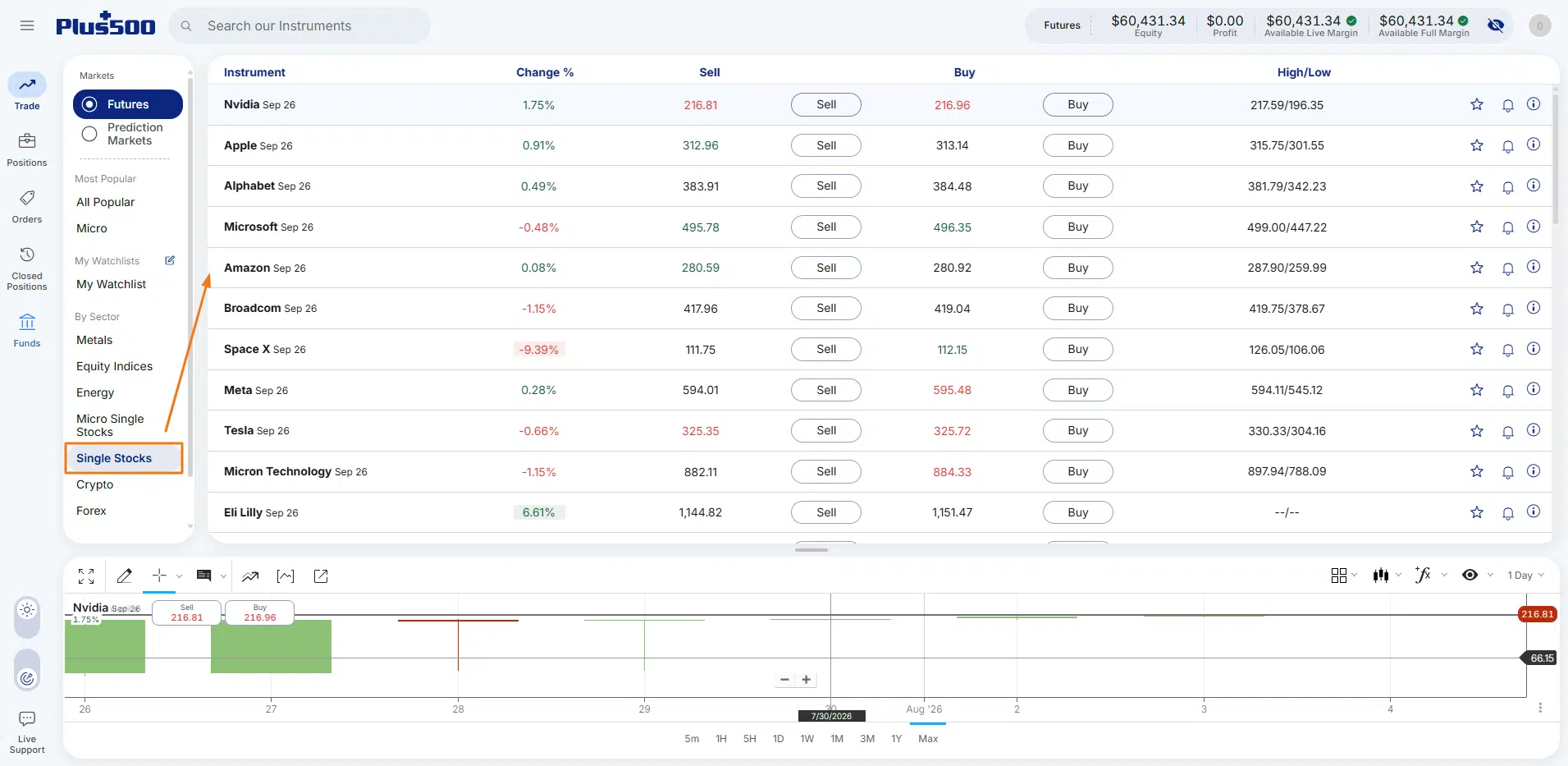
The unlimited demo account with $50,000 in virtual funds mirrors real pricing, including commissions, so you can practice trading Nvidia or SpaceX futures before risking a cent. The platform itself is deliberately simple: watchlists, alerts, basic technical analysis and three order types (Market, Limit, Stop) with attachable Take Profit and Stop Loss. Advanced traders may miss depth-of-market tools, but for directional SSF trading, especially around earnings, it covers what matters.
The parent group is listed on the London Stock Exchange (LSE: PLUS) and serves over 33 million registered customers worldwide. The main limitations: it is only available to US residents, and a $10 auto-liquidation fee applies per contract if you do not close a position before expiration.
Pros
- Low commissions (from $0.49 per Micro Futures contract and $0.01 per Prediction Markets contract)
- Single Stock Futures on major US companies
- Prediction Markets on politics, sports and economics alongside Futures
- No market data fees
- Minimum deposit of $10
- 24/7 Customer support
- Education articles and videos (Futures academy)
- Demo Account
Cons
- The funds you deposit are not protected by the Securities Investor Protection Corporation (SIPC)
- Auto-liquidation fee per contract of $10 (in case you do not close your contract prior to contract expiration)
- No Stocks, ETFs or Options trading (derivatives only)
- Only available in the US
Want to know more? Check our Plus500US review and visit Plus500’s website.
Futures trading involves substantial risk of loss and is not suitable for every investor. You may lose more than your initial investment.
Optimus Futures at a glance
Futures trading contains substantial risk of loss and is not for every investor.
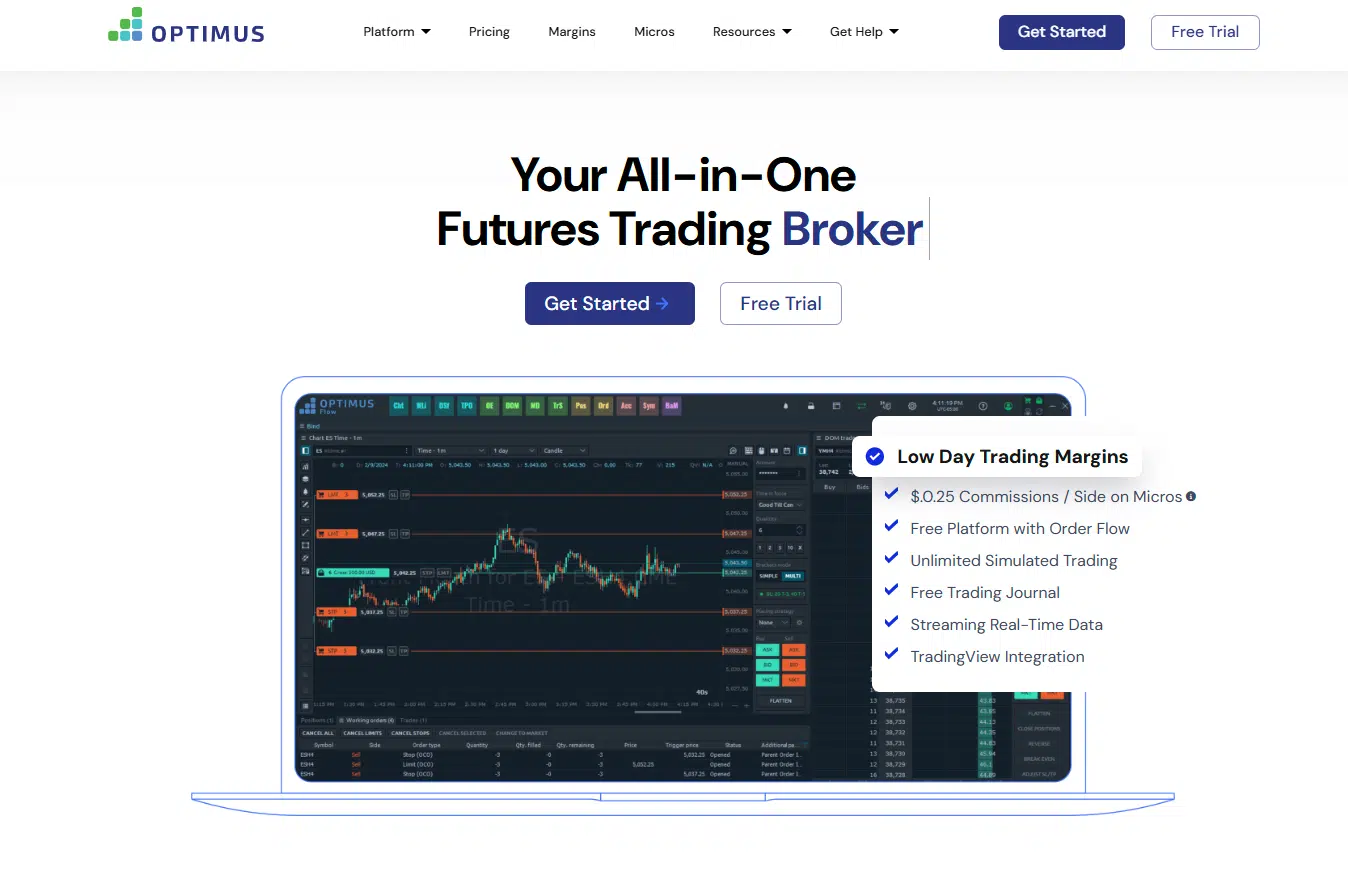
Optimus Futures is an NFA-registered Introducing Broker that routes to multiple CFTC-registered clearing firms and made CME single stock futures available to its clients from launch. Its defining strength is flexibility: instead of being locked into one front-end, you can trade SSFs through the proprietary Optimus Flow platform or pair your account with TradingView, Sierra Chart, MultiCharts and a long list of other professional platforms, choosing the tool that fits your workflow.
Commissions depend on the platform and clearing combination you choose and are generally competitive for a discount futures broker, with low day trading margins available on many contracts.
Where Optimus consistently earns praise is service: real futures specialists who answer the phone, help configure your platform and data setup, and guide you through contract specs and margin questions. That matters more than usual with a brand-new product like single stock futures, where margins, symbols and liquidity are still settling in the first months after launch.
For traders who want more control over their setup than an all-in-one app offers, without jumping straight to professional clearing relationships, Optimus sits in a sweet spot.
Pros
-
Wide choice of trading platforms and data feeds
-
Personalized support from futures specialists
-
Low day trading margins and competitive discount pricing
- Access to multiple clearing firms
Cons
-
Pricing varies by setup rather than one published rate
- Choice of platforms and clearing can overwhelm complete beginners
Want to know more? Check our Optimus Futures review and visit Optimus Futures’ website.
Futures trading involves substantial risk of loss and is not suitable for every investor. You may lose more than your initial investment.
NinjaTrader at a glance
NinjaTrader, now part of the Kraken group, made CME single stock futures available to eligible users on launch day and brings the most aggressive commission structure in the industry for high-volume traders. On the free plan, you pay $0.39 per Micro and $1.29 per standard contract per side; the $99/month plan drops that to $0.29/$0.99; and the one-time $1,499 Lifetime license unlocks $0.09 per Micro and $0.59 per standard contract, the lowest per-trade rates available for SSFs.
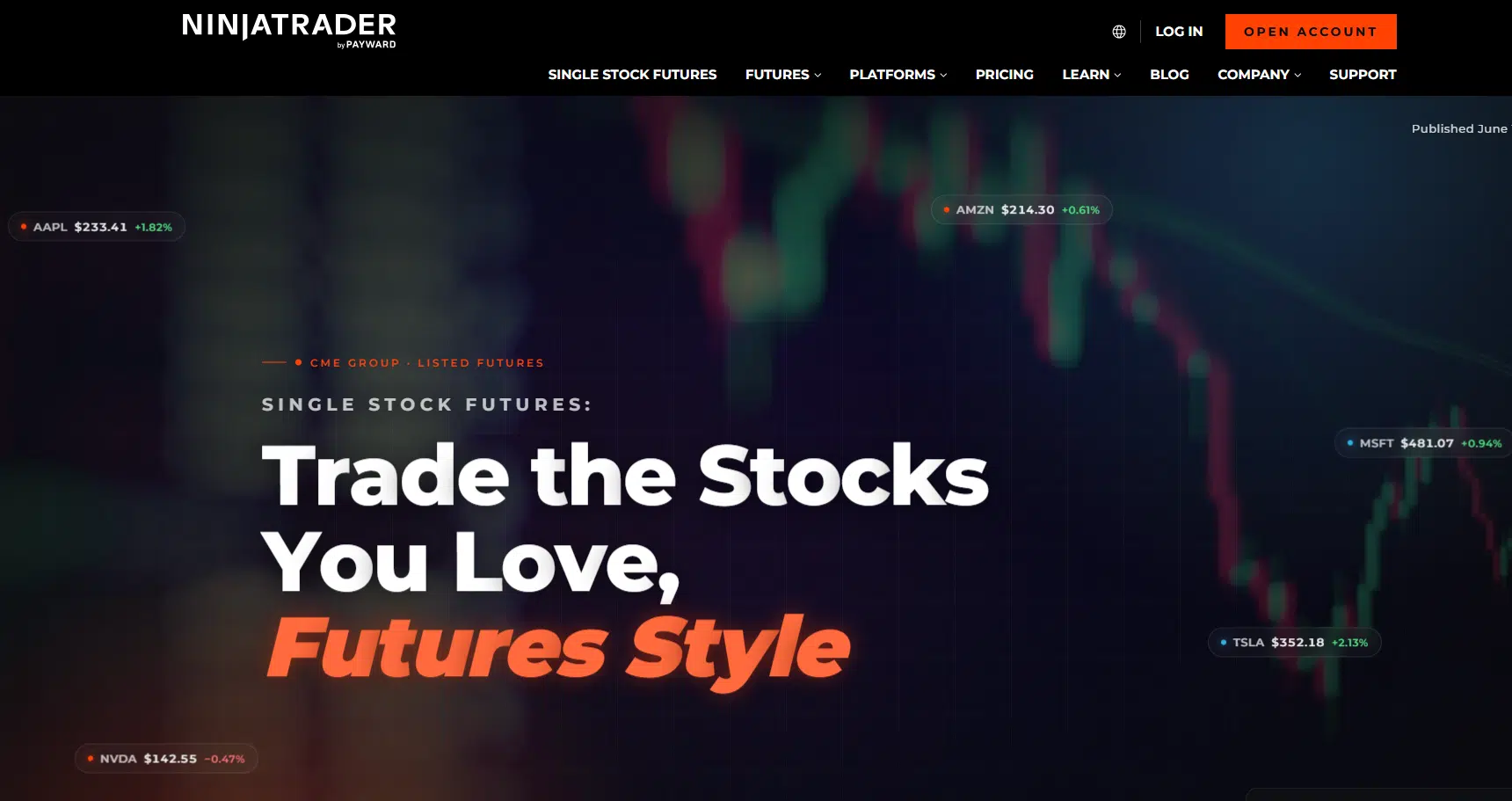
The platform is the real differentiator: the SuperDOM depth-of-market ladder for one-click order entry, advanced charting, order flow tools, automated strategy support and unlimited simulated trading, trusted by more than 800,000 traders. There is no minimum deposit and day trading margins are among the lowest available.
The trade-offs: market data requires paid subscriptions, a monthly inactivity fee applies if you stop trading, and the platform’s learning curve is steep for newcomers. For active traders who will amortize the license through volume, though, nothing on this list beats it on cost per trade.
Pros
-
Lowest commissions for volume traders (from $0.09 per Micro)
-
Professional-grade platform with SuperDOM and order flow tools
-
No minimum deposit and low day trading margins
- Unlimited free simulated trading
Cons
-
Paid market data subscriptions
-
Inactivity fee
- Steep learning curve for beginners
Futures accounts are cleared through NinjaTrader Clearing, LLC, a CFTC-registered FCM and NFA member.
Futures trading involves substantial risk of loss and is not suitable for every investor. You may lose more than your initial investment.
Charles Schwab at a glance
Charles Schwab is the only broker on this list where single stock futures sit alongside stocks, ETFs, options and retirement accounts under one roof. If you already invest with Schwab, adding futures approval to your account gives you SSF access through thinkorswim, one of the most complete retail trading platforms available, with the paperMoney simulator included for risk-free practice.
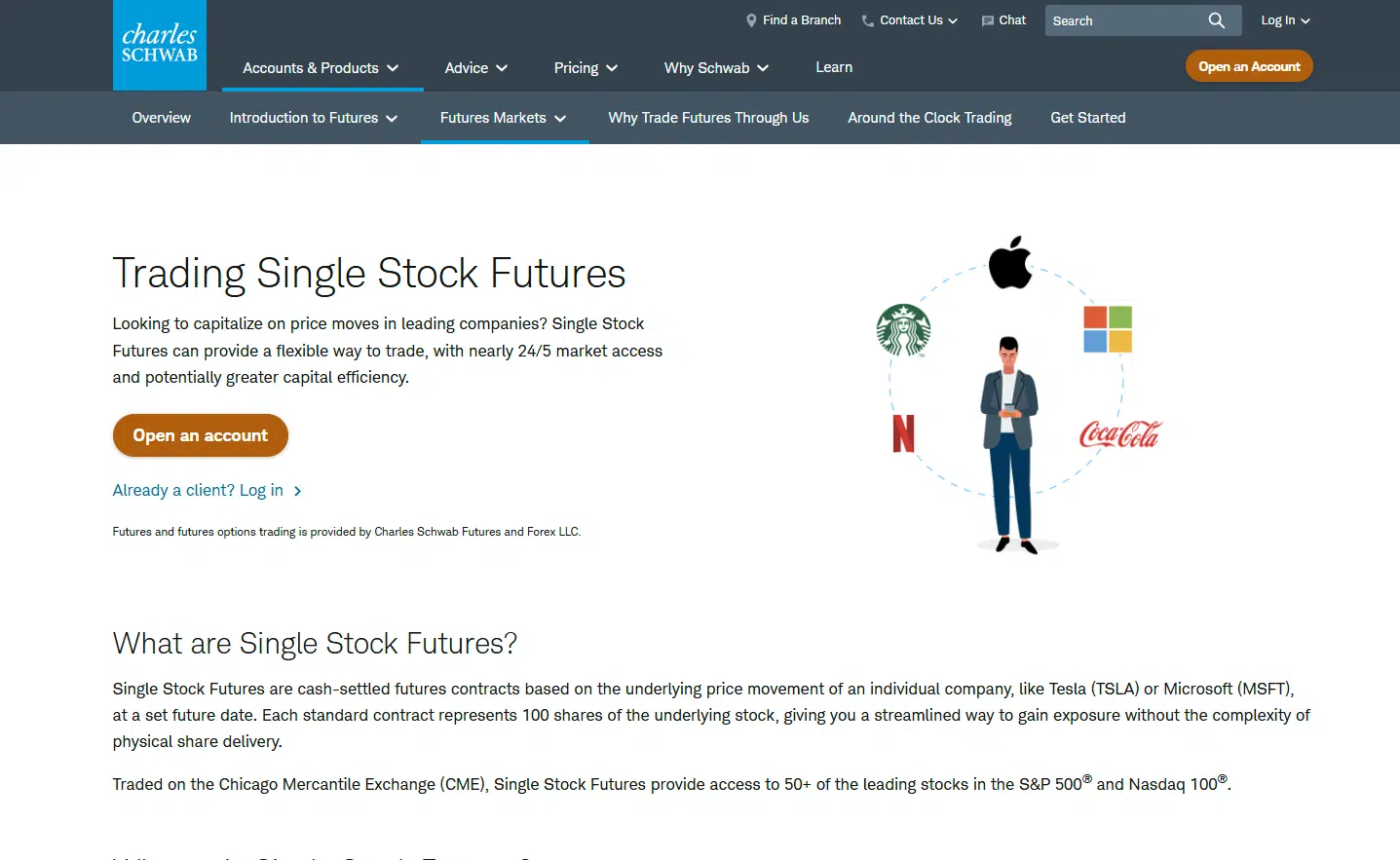
Futures commissions are $2.25 per contract per side, notably higher than the futures specialists on this list, but you get Schwab’s research, 24/7 support and the convenience of managing your actual stock portfolio and your futures hedges from the same place. That combination is genuinely useful for investors who want to hedge single-name risk around earnings without selling shares, one of the most practical use cases for the new contracts.
Note that futures trading requires a separate approval on top of a standard Schwab brokerage account, and futures balances are not covered by SIPC protection.
Pros
-
SSFs alongside stocks, ETFs and options in one account
-
Excellent thinkorswim platform with paperMoney simulator
-
Strong research and 24/7 support
- No minimum deposit
Cons
-
Higher commissions than futures specialists ($2.25 per side)
- Futures approval required on top of the brokerage account
Futures trading involves substantial risk of loss and is not suitable for every investor. You may lose more than your initial investment. Futures accounts are not protected by SIPC.
How we chose the best brokers for single stock futures
Our team has professional experience in finance and portfolio analysis, and we have reviewed well over 100 brokers and trading platforms since we started publishing comparisons. This ranking follows the same methodology we apply across the site.
First, availability and regulation: we started from CME Group’s official list of brokers supporting single stock futures at launch, and only considered firms registered with the CFTC and NFA, or introducing brokers clearing through registered FCMs. More brokers are expected to add SSFs in the coming months, and we will update this comparison as they do.
Second, total cost of trading: commissions, market data subscriptions, platform fees and non-trading charges (minimum deposits, inactivity and withdrawal fees), using each broker’s published pricing rather than headline claims. With futures, data fees in particular can quietly exceed commissions for occasional traders, so we weighted the all-in cost, not just the per-contract rate.
Third, platform quality for the product’s main use cases: directional trading and overnight earnings reactions. We assessed order types, charting, depth-of-market tools, mobile experience and demo accounts, and gave weight to support quality, which matters more than usual with a newly launched product where margins and contract specs are still settling.
Final thoughts
Plus500US leads as the most accessible way to start trading single stock futures, combining low commissions, free market data, a $10 minimum and a real-pricing demo. Optimus Futures is the pick for traders who want platform flexibility with hands-on support, while NinjaTrader offers the lowest per-trade costs for high-volume traders willing to invest in the platform and Charles Schwab suits investors who want SSFs as a hedging tool inside a full brokerage account.
Whichever you choose, make sure you understand how single stock futures work, including margin, cash settlement and expiration mechanics, and start with a demo account. For related comparisons, see our guides to the best futures trading platforms and the best futures platforms for day trading.
This article is for information purposes only and does not constitute investment advice or a recommendation. Futures trading involves leverage and carries a substantial risk of loss; you may lose more than your initial investment. Futures accounts are not protected by SIPC.