Investing in the S&P 500 is a popular strategy for those looking to gain exposure to a broad spectrum of the US stock market. It is widely regarded as a barometer of the US economy and a core holding in many investors’ portfolios.
Here’s a quick step-by-step on how to invest in the S&P 500 using eToro:
This article will guide you through the process of investing in the S&P 500 on eToro, covering which instruments to use, the fees involved and how to make your first investment (updated October 2026).
Pick an ETF tracking the S&P 500
You cannot buy the S&P 500 index directly. However, you can invest in it through an instrument that tracks it, such as an Exchange-Traded Fund (ETF).
The image below shows some of the S&P 500 ETFs available in eToro (to see all the S&P 500 ETFs available to Europeans, some of which may not be on eToro, go to justETF.com):

To help you filter all the available choices, we have selected these ETFs:
| Name | ISIN | Ticker* | Annual fee (TER) | Replication method | Use of income | Fund size (approx.) |
| iShares Core S&P 500 UCITS ETF (Acc) | IE00B5BMR087 | SXR8 | 0.07% | Physical | Accumulating | $159bn |
| State Street SPDR S&P 500 UCITS ETF (Dist) | IE00B6YX5C33 | SPY5 | 0.03% | Physical | Distributing | $44bn (whole fund) |
| State Street SPDR S&P 500 ETF Trust (USD) | US78462F1030 | SPY | 0.0945% | Physical (offered as a CFD on eToro in the EU) | Distributing | $815bn |
*Xetra tickers in EUR for the UCITS ETFs (the same funds trade under other tickers on other exchanges). Data as of 2 October 2026. Sources: iShares and State Street.
Please keep in mind that the same ETF can be traded in different exchanges and in different currencies. For example, the iShares Core S&P 500 UCITS ETF is traded on Xetra (“.DE”) and the London Stock Exchange (“.L”), among others. You can check that in the eToro trading platform:


As you can see, the line traded on “.DE” is quoted in EUR, whereas the one on “.L” is quoted in GBX (pence). If your eToro account is in EUR, the EUR line is usually the natural choice.
Place a buy order
Let’s say you have decided to invest in the iShares Core S&P 500 UCITS ETF (SXR8). The process is the same for the other ETFs.
- Search for the chosen ETF using the ticker symbol:

- Click “Trade”: choose the amount you wish to invest ($10 in our case). Make sure to use only “x1” leverage. With more leverage, you would be trading a derivative (a CFD), with higher risk and costs, and you would not own the underlying ETF.

- Click “Buy”: a pop-up stating “order filled” confirms that you are invested in the S&P 500.

eToro charges no commission on ETF trades (stocks cost $1 or $2 per trade, and other fees may apply) and has a modern, easy-to-use platform. You can trade on your computer or in eToro’s mobile app.
Note that some of the S&P 500 ETFs on eToro are US ETFs, which are not available to EU retail investors, so eToro offers them as CFDs (this is not the case with SXR8). Make sure you are buying the real ETF, since CFDs are different instruments, with other fees and no ownership of the asset.
Below is the example of VOO, which is offered as a CFD:

All the fees when buying an S&P 500 ETF on eToro
According to the eToro fees page, these are the charges to consider when buying an S&P 500 ETF:
- Commission: none on ETF trades. Stocks cost $1 or $2 per trade, depending on the exchange.
- Spread: eToro adds no markup to the market spread on ETFs.
- Currency conversion: may apply when you deposit, withdraw or trade in a different currency, and depends on your country, payment method and Club tier. Conversions on recurring investment deposits are free.
- Withdrawal fee: free from EUR, GBP and DKK accounts, $5 from the USD account.
- Inactivity fee: none.
On top of eToro’s charges, the ETF’s own annual fee (TER) is deducted inside the fund. For €1,000 invested in SXR8, that is about €0.70 a year, or €0.30 in SPY5.
What to look for in any ETF?
Not all ETFs are created equal. Different asset managers provide different ETFs tracking the same indices (like the S&P 500). The main differences are:
1. Fees (TER)
Asset managers like BlackRock (iShares) or Vanguard do not offer ETFs for free as they incur costs as well. Throughout the year, a small fee is subtracted from the fund’s assets. A lower fee means lower costs and, all else equal, higher returns for you. This overall cost is usually shown as the ongoing charges figure (OCF) or total expense ratio (TER).
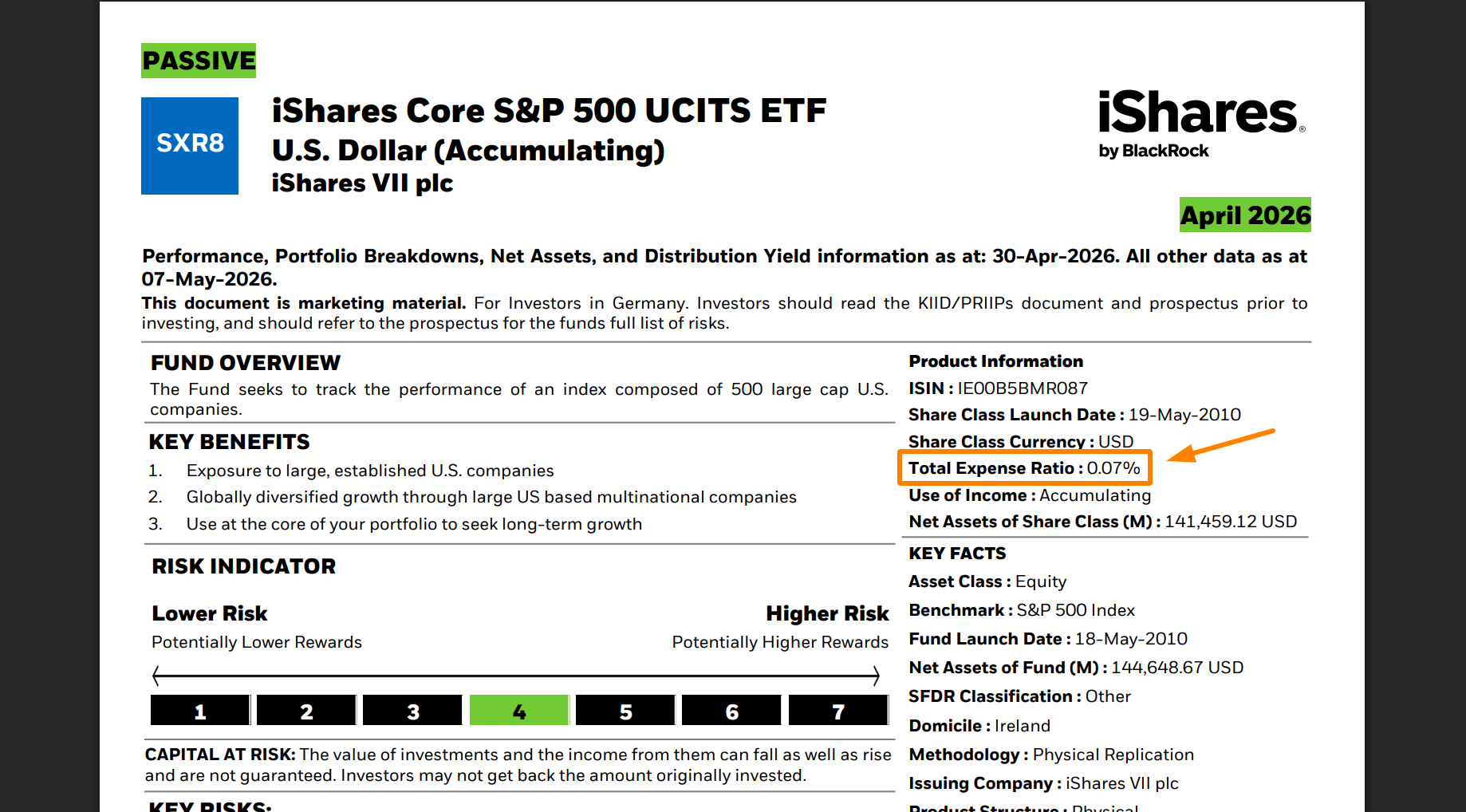
Using the iShares Core S&P 500 UCITS ETF (SXR8) as an example, you can check its TER of 0.07% in the factsheet:
2. Replication method
It can be done in two ways:
- Physical replication: the ETF buys the underlying assets in the index.
- Synthetic replication: the ETF uses derivatives (swaps) to replicate the performance of the index.
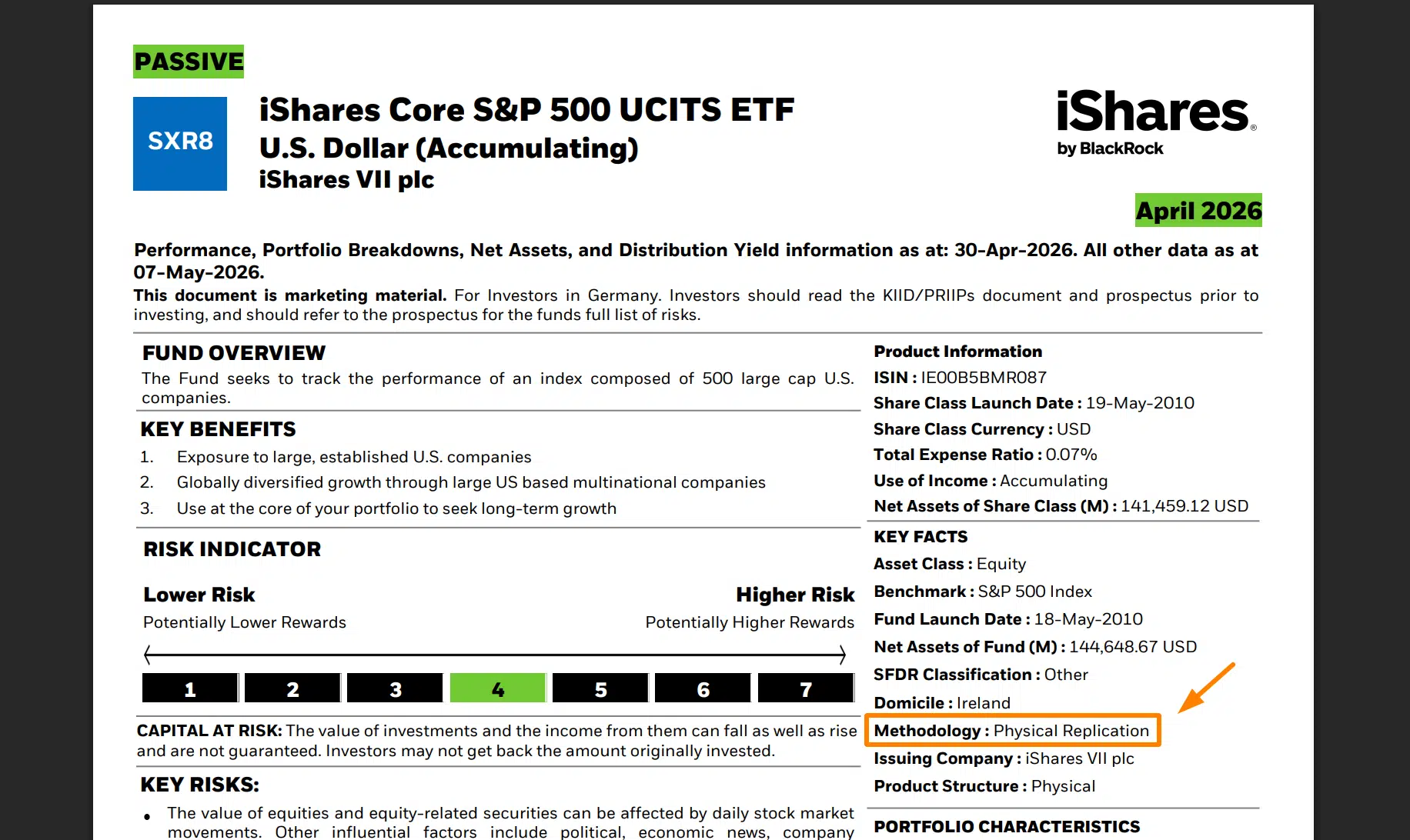
The companies in the S&P 500 are very liquid, so physical replication is straightforward and avoids the counterparty risk of derivatives. Using the same ETF, you can see its methodology as “Physical Replication”:
3. Use of income
ETFs also differ in what they do with dividends:
- Accumulating ETFs: the fund reinvests the dividends it receives, so its price grows faster than an identical distributing ETF. In some countries this is tax-efficient, as you do not declare dividends you never receive (others, such as Germany, tax a notional amount anyway).
- Distributing ETFs: the fund pays out dividends regularly (usually quarterly) to your brokerage account, and you declare them for tax.
Which one is better? It depends on your goals. If you plan to hold for 20 years without needing income, an accumulating ETF is usually simpler. If you want regular income, a distributing ETF is the better fit.
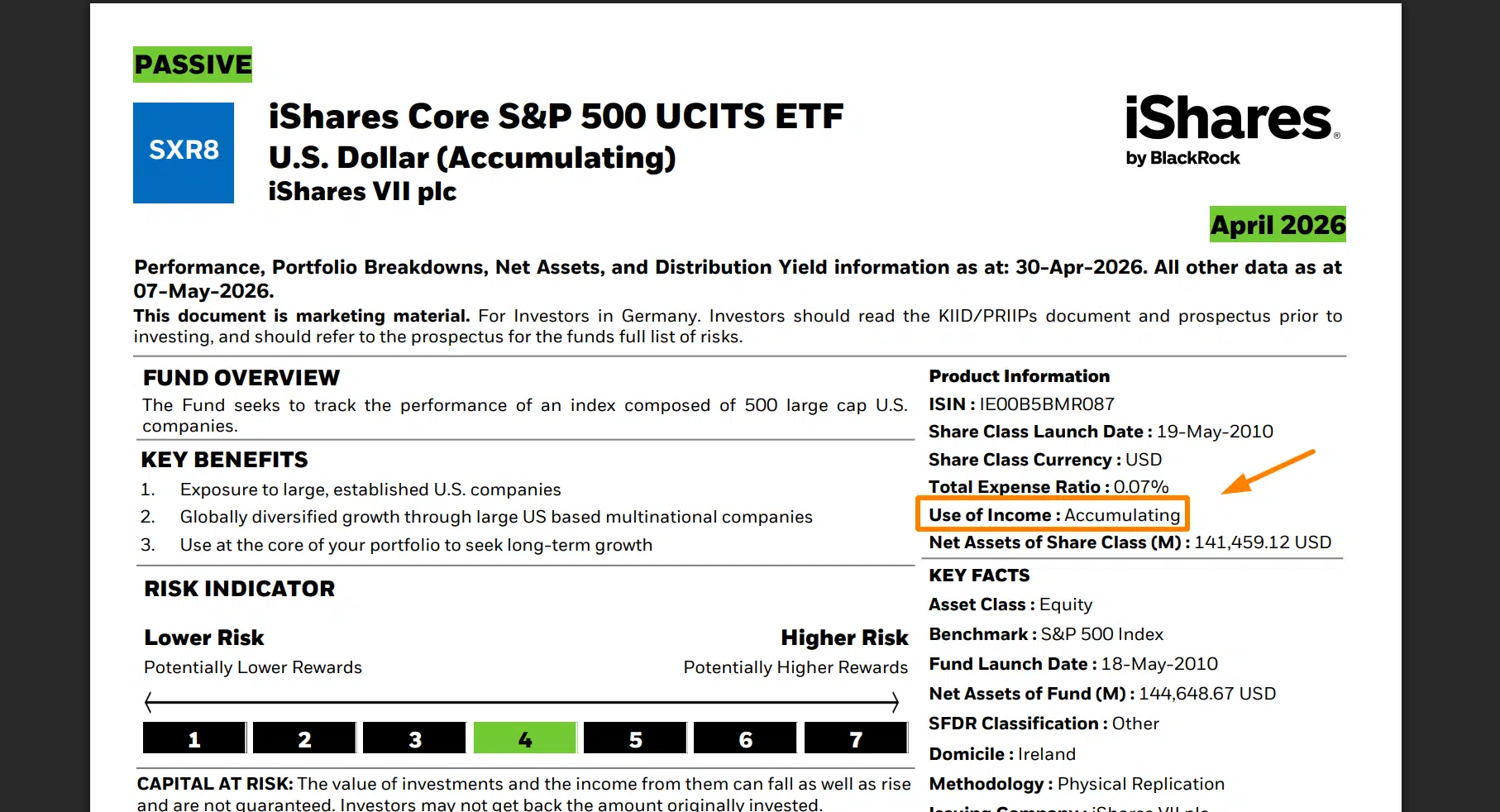
The SXR8 is “Accumulating”:
4. Size
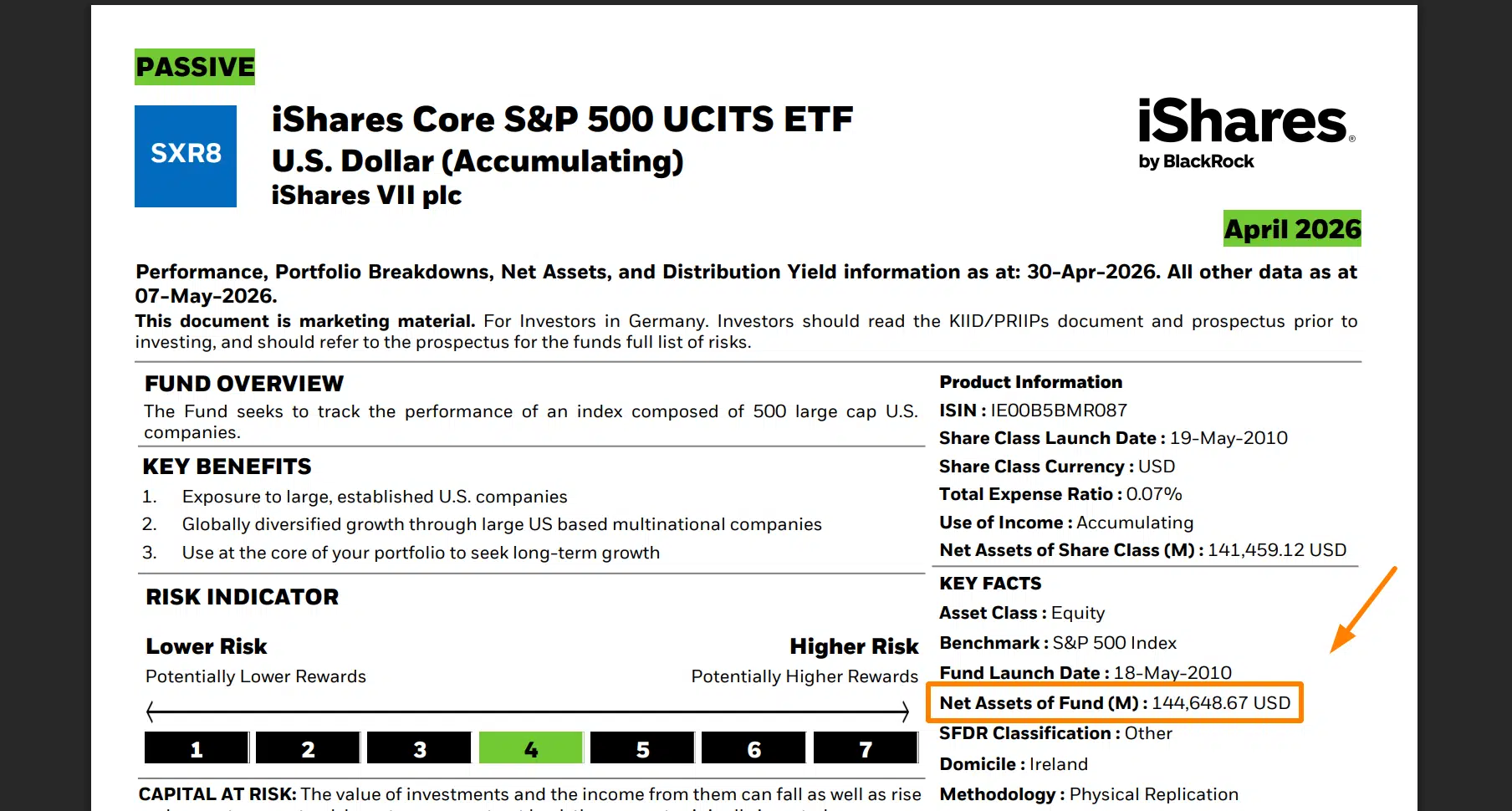
The overall fund size should also be taken into consideration. The size of an ETF can impact the likelihood of fund liquidation. Smaller funds generally run a higher risk of being liquidated than larger funds. In such a case, the fund will sell all its holdings, settle obligations and distribute the remainder to the fund holders.
SXR8 is part of the largest S&P 500 UCITS ETF, with net assets of about $159 billion on 2 October 2026:
5. Hedging
Some share classes use derivatives to hedge currency fluctuations. This adds a small cost but can protect you against large currency swings. The ETFs presented here are all unhedged, since currency movements tend to matter less over long holding periods.
Bottom line
To sum it up, here’s what you need to do:
-
Pick an ETF tracking the S&P 500: SXR8 stands out for its size and low fee, and SPY5 for its 0.03% TER if you prefer a distributing ETF.
-
Open an account and deposit money into eToro: complete the online account opening and verification, then fund your account.
-
Send a buy order for the ETF: search for the ticker, choose the amount, keep leverage at x1 and confirm the trade.
Make sure to do your own research to find the investing strategy that suits you.
You can also read more about eToro’s platform, its main stats and whether it is a safe platform to use or not.
You can also see how to invest in the S&P 500 with other providers, such as Revolut or XTB.
FAQs
What is the S&P500?
The S&P 500 is an index of around 500 large US companies, weighted by market value. The index includes large well known companies such as Apple, Amazon, and Microsoft.
What is an Exchange Traded Fund (ETF)?
An ETF is a publicly traded fund that holds assets like stocks. When you invest in an ETF, you indirectly buy a large portfolio of assets. In the case of an S&P 500 ETF that means it will track the performance of underlying holdings used in the index. So you get exposure to around 500 companies with a single investment.
Is it possible to invest directly in the S&P 500?
No. An index measures the performance of a theoretical portfolio, so you cannot buy it directly. You invest through a fund that tracks it, such as an ETF.
What are CFDs? Should I invest in S&P500 CFDs?
CFD stands for contract for difference. It lets traders speculate on price movements (up or down), often with leverage, without owning the asset. CFDs are complex and carry a high risk of losing money rapidly, so they are not suitable for most beginners or for long-term investing in the S&P 500.
Can Europeans invest in SPY or VOO?
Not as real ETFs. Retail investors in the EU generally cannot buy US-domiciled ETFs like SPY or VOO because of the PRIIPs (Packaged Retail and Insurance-based Investment Products) rules, which require a key information document that US issuers do not produce. On eToro, these ETFs are offered as CFDs instead. UCITS ETFs such as SXR8 or SPY5 are the alternatives.
Is now a good time to invest in the S&P 500 in Europe?
Nobody can reliably predict short-term market movements. Historically, the S&P 500 has risen over long periods, which is why many investors invest regularly rather than trying to time the market. Past performance does not guarantee future results.
Why should I invest in the S&P 500 index from Europe?
The S&P 500 gives you exposure to many of the world’s largest companies and has historically outperformed most European indices over long periods, although past performance does not guarantee future results. Many European investors combine it with global or European ETFs to avoid concentrating in one country.
Does eToro charge fees on ETFs?
eToro charges no commission and no extra spread on ETF trades. Currency conversion fees may apply if you trade in a different currency from your account, and withdrawals from the USD account cost $5. The ETF’s own annual fee (TER) is charged inside the fund.
Can I invest in the S&P 500 every month on eToro?
Yes. eToro offers recurring investments, and currency conversions on recurring investment deposits are free.