It is very difficult to keep track of the best offers on the market for high-yield savings accounts in Europe: new offers are hitting the market almost daily, and the current offers may frequently change the interest rates offered.
In this post, we will take a look at what is currently the best high-yield savings account across Europe. This will include not only banks but also e-Money Institutions and investment brokerages, which also lead the way in offering high yields to their customers.
Trading 212 is currently offering the highest fixed return on your cash in euros in Europe, where you can generate returns of 2.20%, or even 3.00% for BaFin-regulated users.
It’s not just about choosing the broker with the highest interest rate; it’s also crucial to consider how your funds are protected.
We believe the best combination of a high interest rate and protection is offered by Trade Republic at 3.00% (only for new users).
Best savings accounts in Europe
| Platform | Interest Rate |
| Trading 212 | 2.20% or 3.00%, depending on your country |
| Scalable Capital* | 2.50% |
| Trade Republic | 3.00% (offer only for new clients) |
| Mintos | Up to 2.00% |
| Lightyear | 1.90% |
| BUX** | Up to 1.75% |
| Wise | 1.72% |
| Interactive Brokers | IBRK Pro 1.451% |
Updated as of June 16th, 2026.
*Only available for residents in Austria, France, Germany, Italy, Spain and the UK.
**Only available for residents in the Netherlands, Belgium, France, Germany, Spain, Italy, Austria and Ireland.
Why not bookmark this page, so you can regularly come back and check on all the latest offers available to Europeans?
The prerequisite for our selection criteria is that the accounts selected are available for most European citizens. Depending on where you are resident, additional options may be available to you at equivalent or better rates.
The best European savings accounts explained
Trading 212
- Interest rate on offer: 2.20% on euro balances (or up to 3.00% in some countries, including for BaFin-regulated users).
- How often interest is paid: daily.
- Limitations: no cap on balances eligible to earn interest.
- Safety: uninvested cash is held within qualifying money market funds (e.g. BlackRock, Fidelity, Goldman Sachs) or as deposits at partner banks – in both cases, covered up to €100,000 per person under applicable deposit guarantee schemes (and money market funds carry their own underlying credit risk, which clients should be aware of).
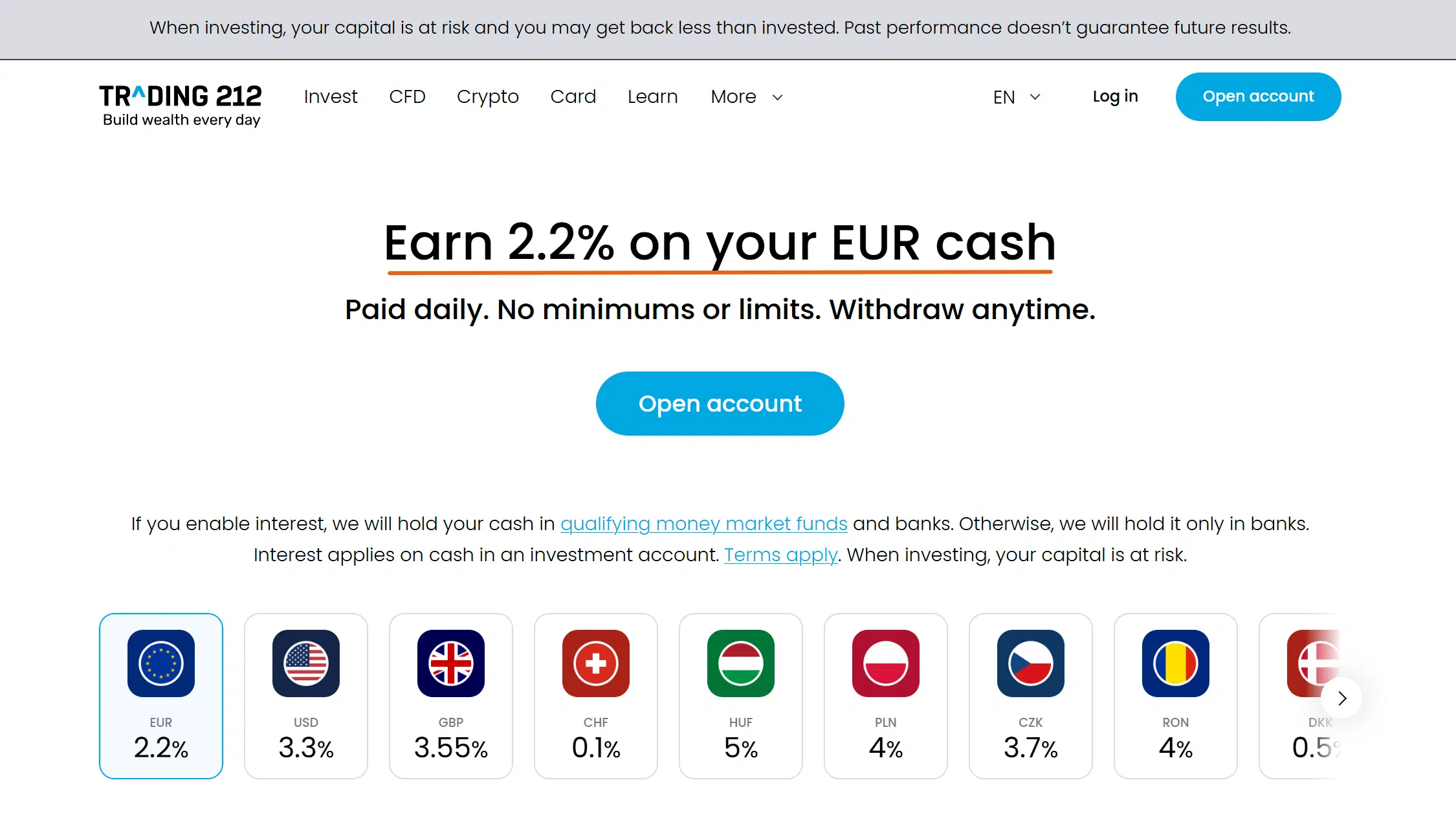
Founded in 2004 and with over 5 million funded accounts (€30+ billion in client assets), Trading 212 is a London-headquartered fintech with the mission of democratising investing through a simple mobile-first experience. The platform allows clients to invest in 13,000+ stocks and ETFs, plus CFDs on stocks, ETFs, indices, forex, and commodities. New users can claim a free fractional share worth up to €100 with the promo code IITW.
Trading 212 offers commission-free stocks and ETF trading (other fees may apply – see terms and conditions), fractional shares, Pies and AutoInvest for automated, portfolio-style investing, and a UK Stocks & Shares ISA and Cash ISA (both launched in 2024). The product range still lacks bonds and options, but Trading 212 expanded into crypto with the 212 Crypto launch in March 2026 under the EU’s MiCA framework.
Interested in knowing more about Trading 212? Read our Trading 212 review.
Risk disclaimer: When investing, your capital is at risk and you may get back less than invested. Past performance doesn’t guarantee future results.
Scalable Capital
- Interest rate on offer: 2.50% on Euro balances.
- How often interest is paid: Interest is paid monthly.
- Limitations: on unlimited cash in both FREE and PRIME+
- Safety: Not covered by a deposit guarantee scheme, but safeguarding is in place for customer funds
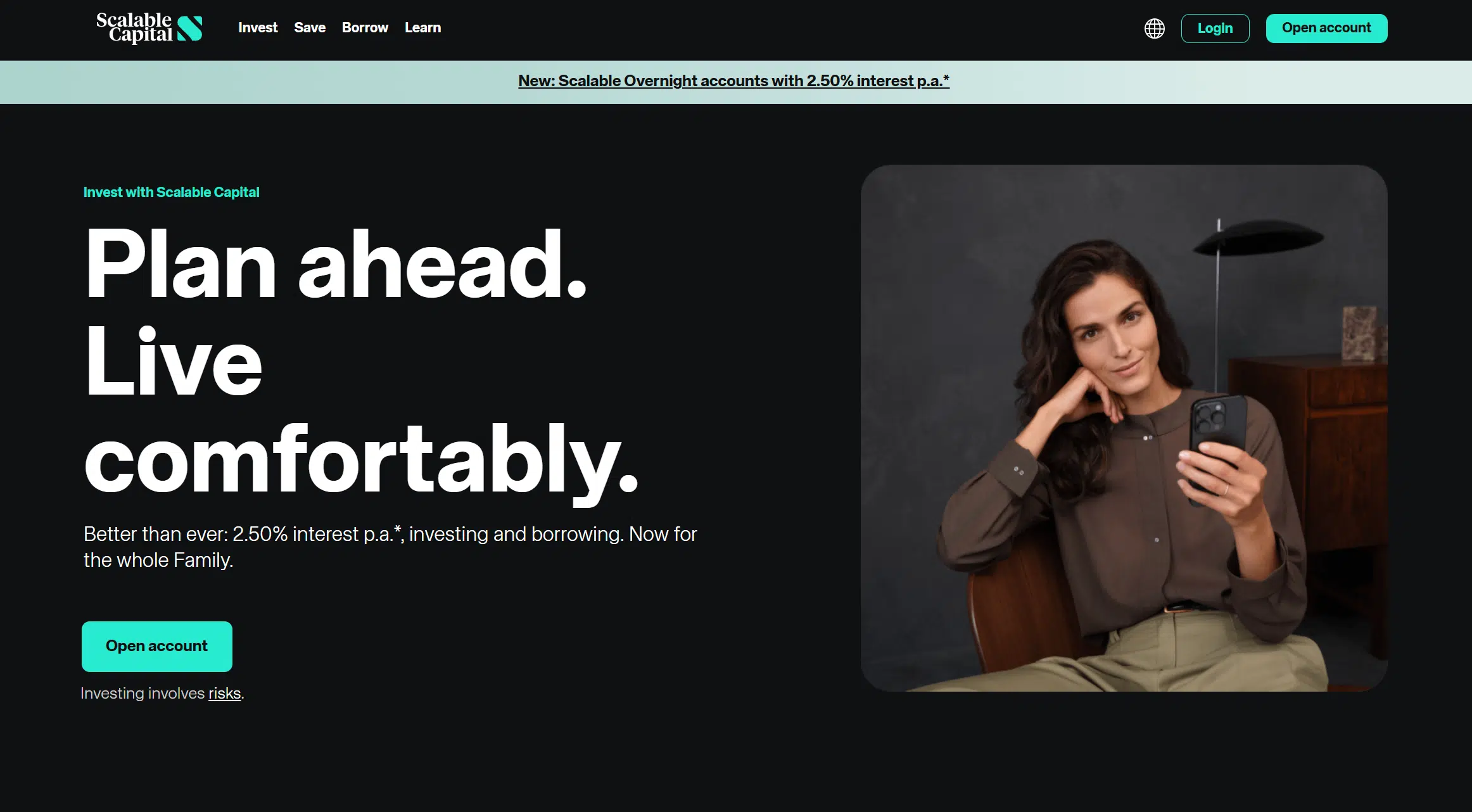
Scalable Capital, founded in 2014, is a Munich-based BaFin-regulated broker with over 1 million clients across Germany, Austria, Italy, Spain, the Netherlands, and France. The platform allows investors to independently trade stocks, ETFs, funds, cryptocurrencies, and derivatives.
Reading through Scalable Capital’s risk policies, there is no reference to Scalable itself being a member of a deposit guarantee scheme. The platform does note that some of the partner banks it uses to place your funds on deposit (in order to earn yield, which can then be passed back to you) are members of their respective national deposit guarantee schemes – but this protection is intermediated through the partner banks rather than directly via Scalable. In the event of a bank default, this offers limited protection to your funds, so it’s worth checking which partner banks hold your cash and what guarantees apply to each.
Trade Republic
- Interest rate on offer: 3.00% on Euro balances.
- How often interest is paid: Paid monthly.
- Limitations: No limit on balances that are eligible for earning interest in most countries (For instance, in Portugal, the payment is on balances up to €50,000)
- Safety: Your uninvested cash is held with either Solaris SE, Citibank Europe plc, Deutsche Bank AG, or J.P. Morgan SE, which are covered by a deposit guarantee scheme up to €100k.
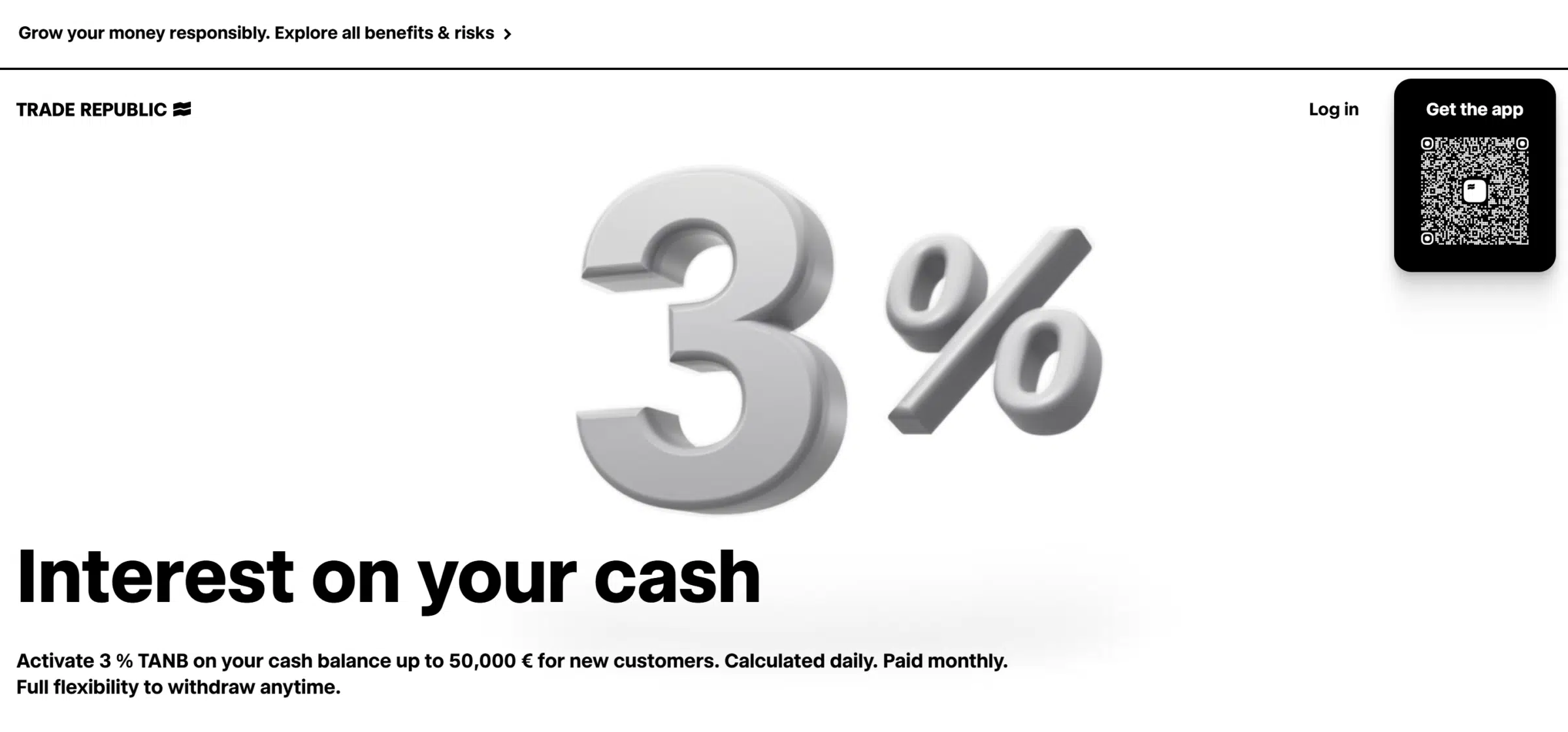
Founded in 2015 in Berlin, Trade Republic is one of Europe’s largest neobroker platforms, with over 10 million clients across 18 countries and more than €150 billion in assets under custody. The platform offers stocks, ETFs, cryptocurrencies, derivatives, and bonds, alongside a full banking suite (cash account, debit card, savings). Trade Republic holds a full banking licence and is supervised by both BaFin and the Deutsche Bundesbank.
Trade Republic remains one of the strongest brokers in Europe for combining low costs with depositor protection: your uninvested cash is held either directly with Trade Republic Bank GmbH or with partner banks (Solaris SE, Citibank Europe plc, Deutsche Bank AG, or J.P. Morgan SE) – in both cases, covered by a deposit guarantee scheme up to €100,000 per person per institution.
Interested in knowing more about Trade Republic? Read our Trade Republic review.
Mintos
- Interest rate on offer: Up 2.00% on Euro balances.
- How often interest is paid: Earned daily, but paid monthly.
- Limitations: No maximum amount.
- Safety: Not covered by a deposit guarantee scheme, but safeguarding is in place for customer funds.
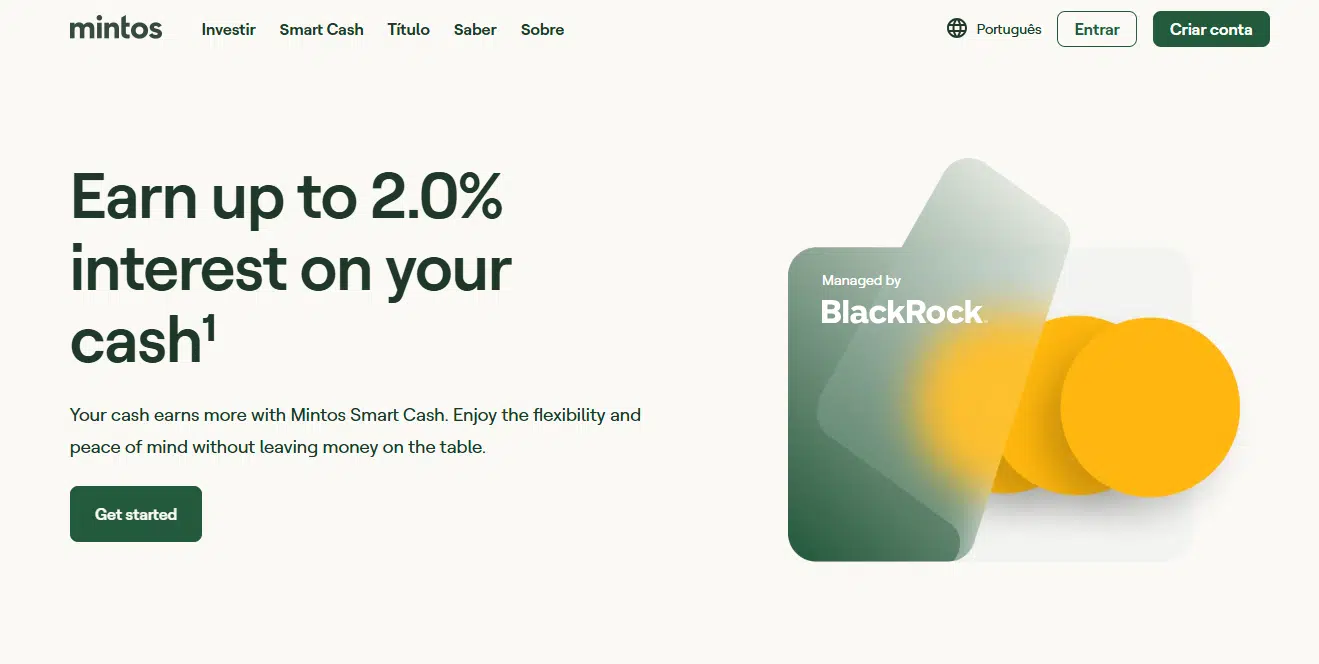
Mintos’s cash management feature is called Smart Cash. It lets you invest your money in a money market fund (MMF) – a fund holding low-risk, highly liquid instruments such as short-term government bonds and commercial paper. MMFs pay interest, but the value of your investment can fluctuate and capital is at risk (MMFs are not deposits and are not covered by the deposit guarantee scheme).
Mintos invests your Smart Cash balance in the BlackRock ICS Euro Liquidity Fund, authorised and regulated under the EU Money Market Fund Regulation (Regulation (EU) 2017/1131). Mintos Smart Cash uses the Premier Distributing share class of the fund (ISIN IE000GWTNRJ7), which maintains a stable net asset value of €1.00 per share.
As a side note, Mintos offers up to €350 when creating an account using the promo code “GO-INVESTWEB“.
Lightyear
- Interest rate on offer: 1.90% on Euro balances (As of june 2026).
- How often interest is paid: Interest is accrued daily and paid on the 1st of every month.
- Limitations: There are no restrictions or limits on the interest you can earn with Lightyear.
- Safety: Not covered by a deposit guarantee scheme, but safeguarding is in place for customer funds.

While funds held with Lightyear are not covered by a conventional deposit guarantee scheme, the firm is required to safeguard customer funds. Uninvested customer cash is held separately from Lightyear’s own business funds, with regulated EU credit institutions and in money market funds.
The primary institutions where Lightyear holds uninvested customer cash are ABN AMRO Bank (Netherlands) and AS LHV Bank (Estonia), alongside BlackRock money market funds rated AAA/mmf by Moody’s, S&P, and Fitch.
Co-founded by former Wise employees, Lightyear aims to be a platform that lets users invest globally without unnecessary barriers, with a transparent and consistent pricing structure. The platform offers stocks, ETFs, bonds, and multi-currency cash accounts (USD, EUR, GBP) – plus competitive interest on idle balances in those currencies.
Lightyear is now available across most of the EEA and UK, including Austria, Belgium, Cyprus, Estonia, Finland, France, Germany, Greece, Ireland, Italy, Latvia, Lithuania, Luxembourg, Malta, the Netherlands, Portugal, Slovakia, Slovenia, Spain, and the UK.
Lightyear also offers a free share worth up to €100 with our promo code INVESTINGINTHEWEB.
BUX
- Interest rate on offer: Up to 1.75% on Euro balances.
- How often interest is paid: Accrued daily and paid quarterly.
- Limitations: Only balances up to €25,000 will be eligible for interest.
- Safety: Your uninvested cash is held with ABN AMRO Clearing Bank, covered by a deposit guarantee scheme of up to €100k.
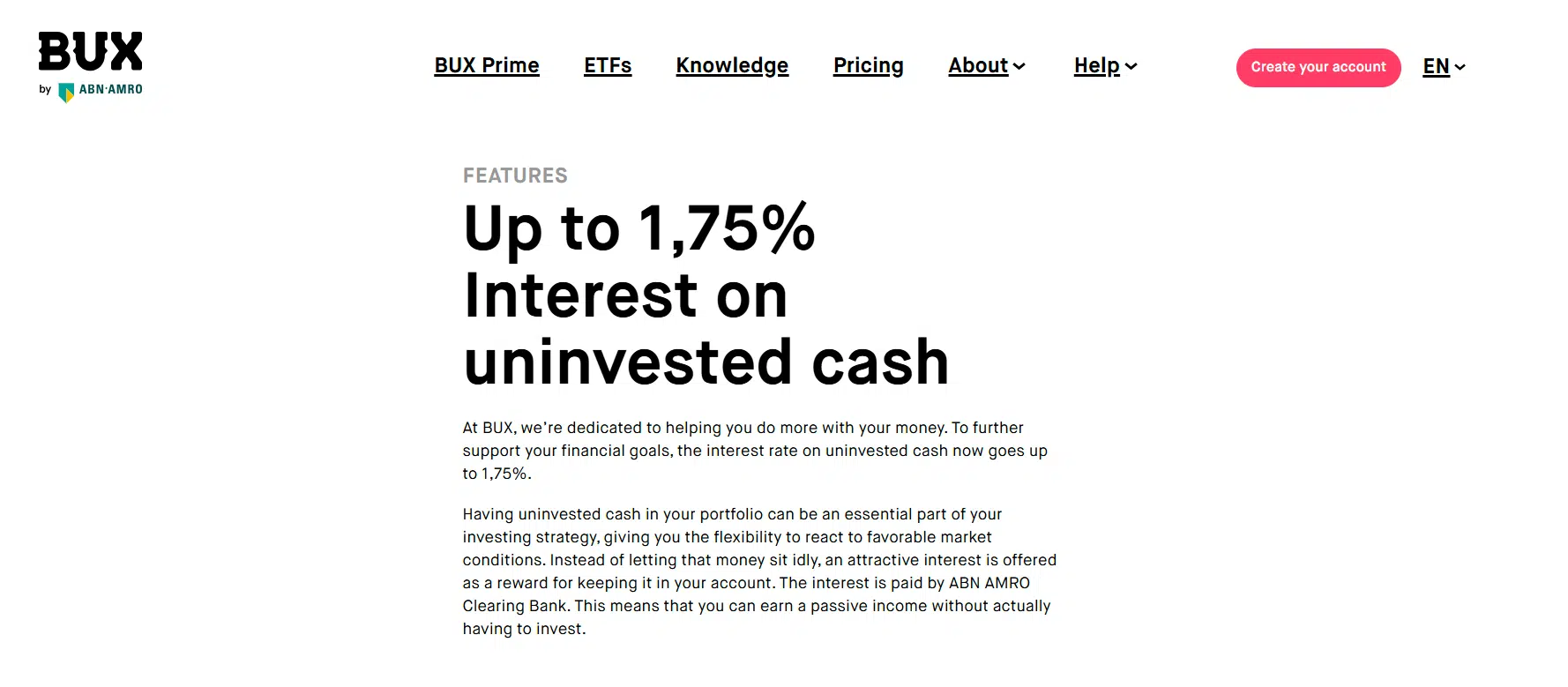
With over 700,000 users, BUX is a popular mobile-first investing app – particularly useful if you want to set up monthly savings plans to automate investing into stocks or ETFs. BUX was acquired by ABN AMRO in 2023, bringing the platform under one of the Netherlands’ largest banking groups.
BUX’s fees have crept upwards recently, including a monthly service fee of €2.99 on certain tiers – which can eat into your interest if your sole purpose for opening a BUX account is to earn yield on cash.
Your interest rate depends on your account tier:
- BUX Basic: 0%
- BUX Plus: 1.50% on balances up to €100,000; 0% above €100,000
- BUX Prime: 1.75% on balances up to €100,000; 1.65% above €100,000
All cash held at BUX is stored at ABN AMRO Clearing Bank and is protected up to €100,000 per person under the Dutch Central Bank’s Deposit Guarantee Scheme (DGS).
Check out our full BUX review.
Wise
- Interest rate on offer: 1.72% on Euro balances.
- How often interest is paid: the beginning of the following month.
- Limitations: There are no restrictions or limits on the interest you can earn with Wise.
- Safety: Not covered by a deposit guarantee scheme, but safeguarding is in place for customer funds. As Wise declares on its website: “We are not a bank, which means we don’t lend out our customers’ money to people or businesses. This also means our payment services aren’t subject to the Belgian Deposit Guarantee Scheme.”
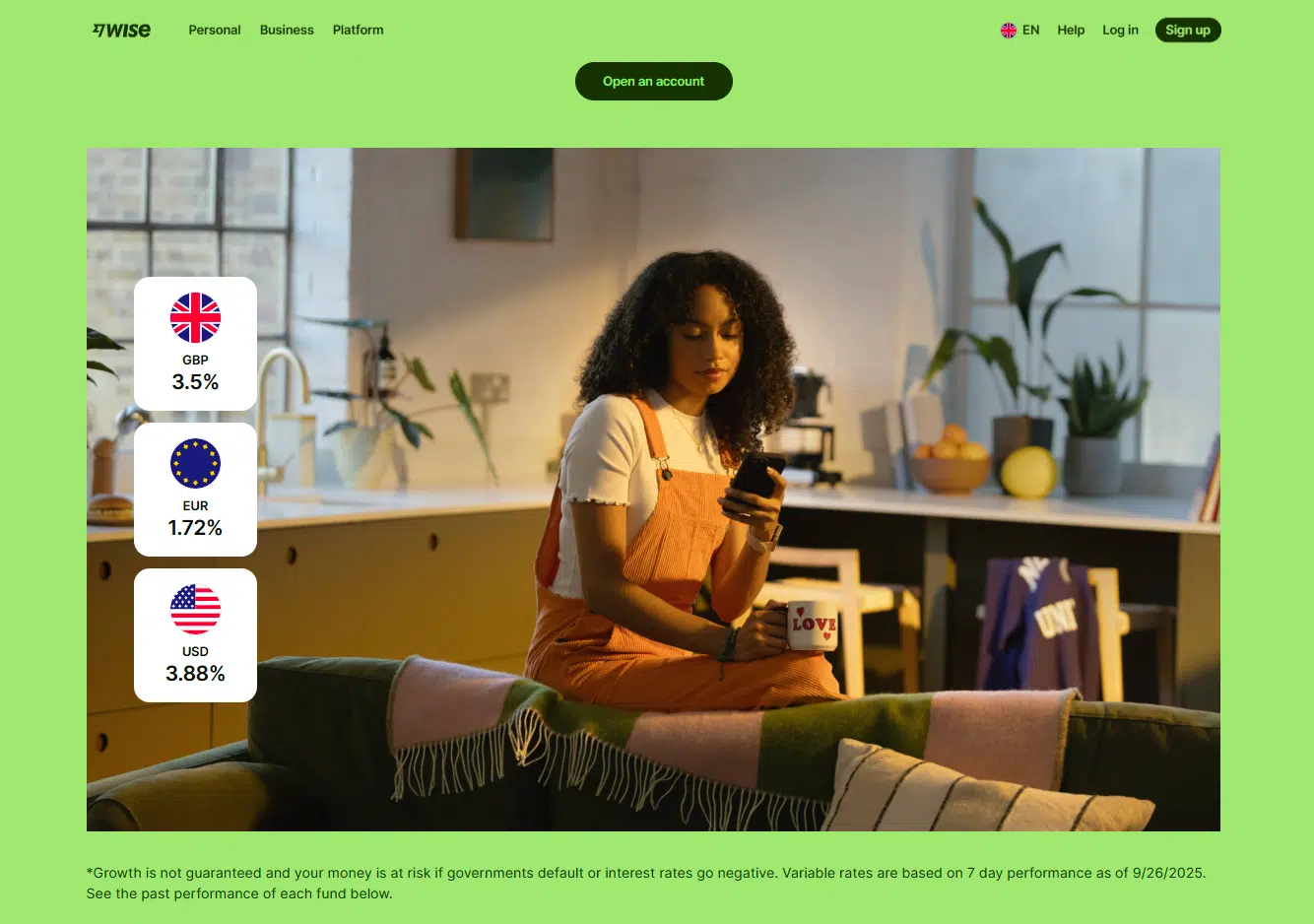
While Wise is not a bank, it does have meaningful safeguards in place for customer funds on European accounts. Wise segregates customer funds into a mix of cash held at leading commercial banks (such as JPMorgan Chase) and low-risk, highly liquid assets (money market funds with BlackRock and State Street).
These assets are held in segregated accounts, separate from Wise’s own operational funds. In addition to this safeguarding, each customer is eligible for protection under the Estonian Guarantee Fund (GF) up to a value of €20,000 on invested assets within the Wise Assets product.
Launched in 2011 (originally as TransferWise, rebranded to Wise in 2021), Wise is publicly listed on the London Stock Exchange (ticker: WISE) and is foremost an e-money business focused on reducing the cost of international money transfers for over 15 million customers globally.
Within the Wise Assets product, you can hold your funds as Cash, Stocks, or Interest. When you hold your money in Stocks, Wise selects an appropriate index fund and invests on your behalf.
If you switch your money to “Interest”, these funds are invested in government-backed short-term loans and bank deposits, with the interest earned passed back to you (less Wise’s fee).
Interactive Brokers
- Interest rate on offer: The maximum interest rates on offer: IBRK Pro 1.451% on Euro balances. It may change without prior notice.
- How often interest is paid: Accrued daily and paid monthly.
- Limitations: No interest paid on balances less than €10k.
- Safety: The level of protection you will receive for your money on deposit will vary from jurisdiction to jurisdiction.
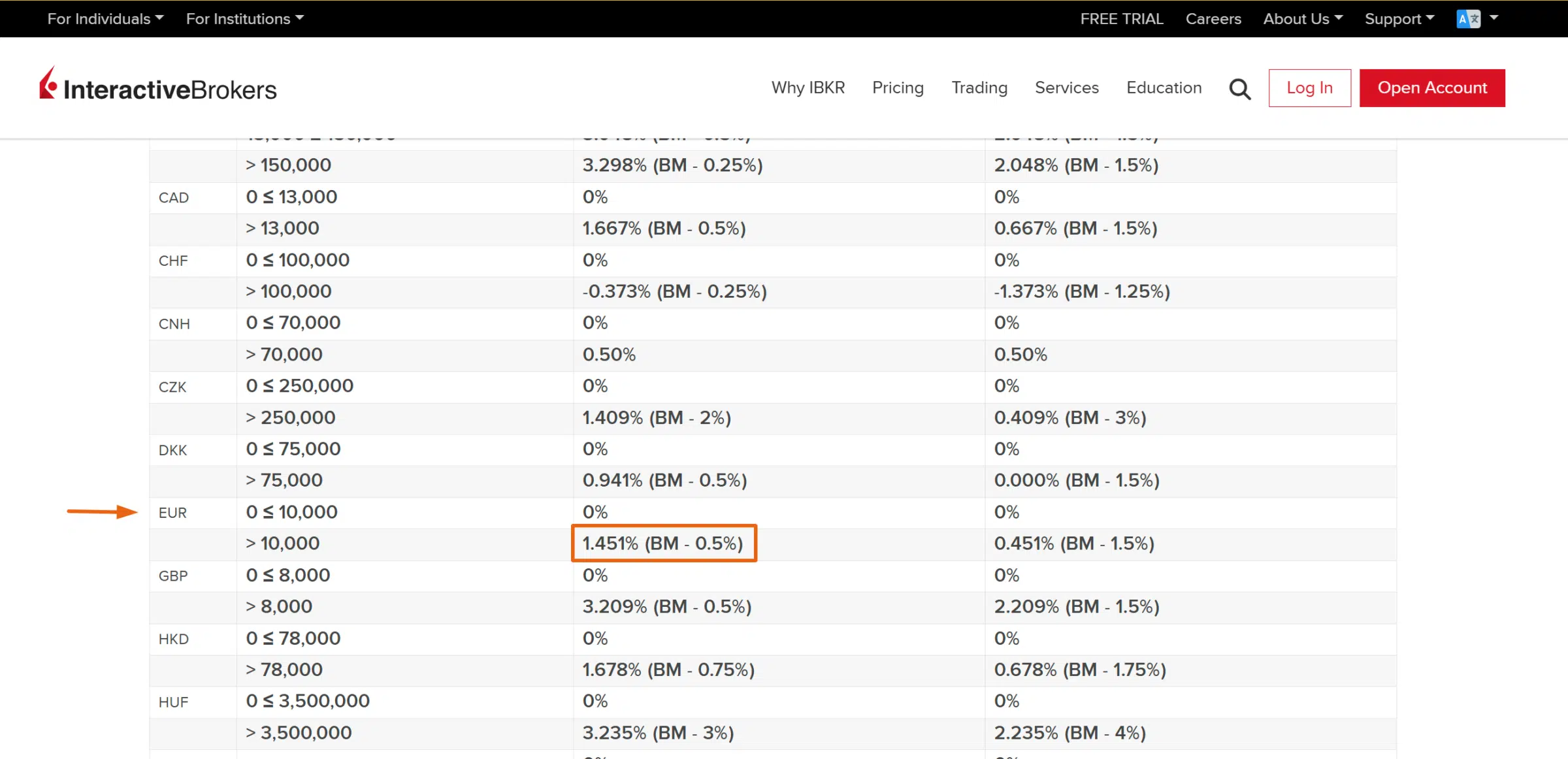
The level of protection you will receive on your cash deposited with Interactive Brokers will vary a lot from jurisdiction to jurisdiction, this is something we covered in detail in a separate article if you are interested in learning more about your protections with IBRK and we also have a full review IBRK’s services if you want to dig a little deeper.
Interactive Brokers is a renowned online brokerage firm that offers individuals and institutions a wide range of investment and trading services.
One of the key features that sets Interactive Brokers apart is its advanced trading platform. Known as Trader Workstation (TWS), this platform offers a comprehensive suite of tools and analytics to assist traders in executing their strategies effectively.
In terms of the IBKR interest rates offering, IBRK offers different interest rates on each currency, from USD to ZAR. The highest interest rate you can earn on a Euro Balance will depend on how much you have on deposit with Interactive Brokers, namely:
- Your total account value must exceed $100,000 (or equivalent in €);
- And your cash balance > $10,000 (or equivalent in €). So, only the amounts above will be paid.
For example, imagine you have €120,000 in your account. Around €40,000 is in cash, so you will only get paid interest on €30,000:
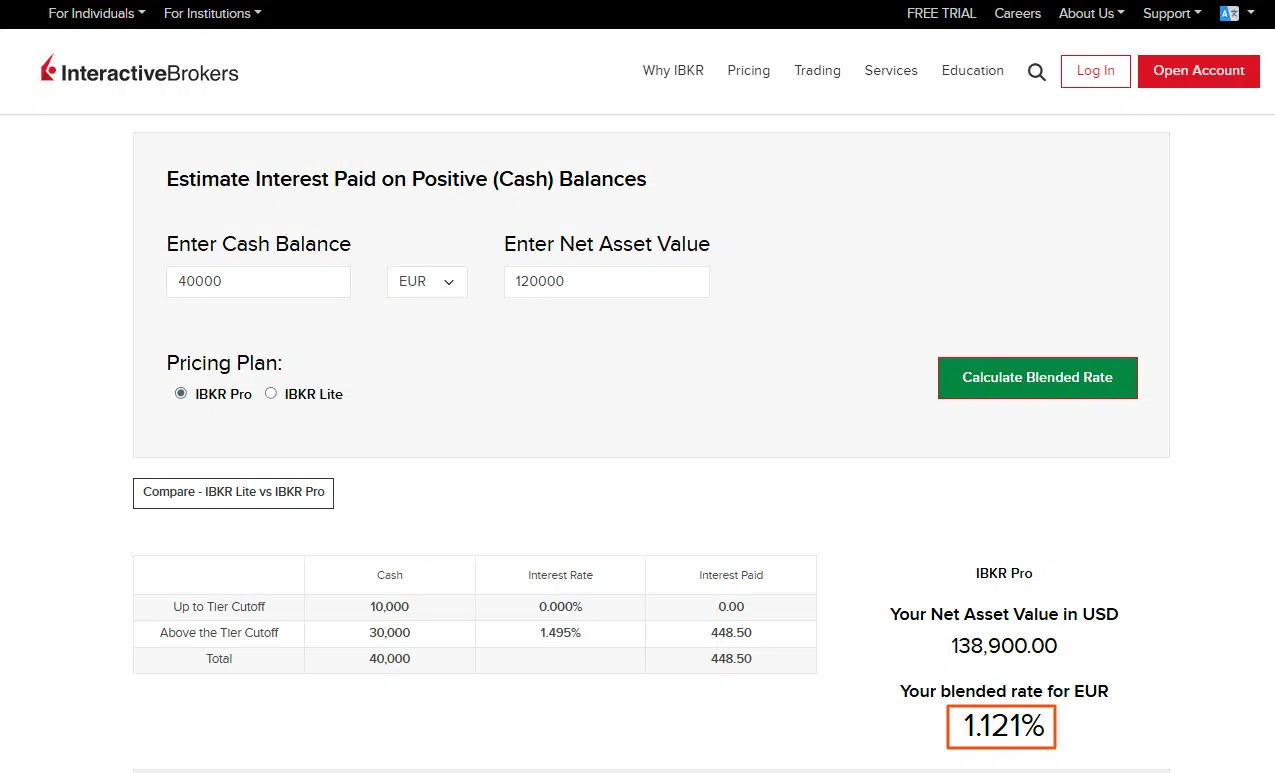
Accounts with a Net Asset Value (NAV) above USD 100,000 (or equivalent in EUR) are paid interest at the full rate for which they are eligible. Accounts with an NAV of less than USD 100,000 (or equivalent in EUR) receive interest at rates proportional to the size of the account.
This makes it more difficult to determine the interest rate you will receive. Still, Interactive brokers have a calculator you can use to try and estimate your interest earnings.
Fixed-term deposits (via Raisin)
So far, all the offers we’ve covered have primarily focused on accounts that let you withdraw your funds at any time. Generally speaking, you can earn higher interest rates on fixed-term deposit products, which banks typically offer in exchange for committing your cash for a set period.
The challenge is that interest rates have risen at very different paces across European countries, and you may be unlucky enough to live in a country with limited choice of fixed-term interest-bearing products compared to neighbouring markets.
Raisin helps solve this. Raisin is a savings marketplace that partners with banks across Europe to offer high-yield savings and fixed-term deposit products – all covered by their respective national deposit guarantee schemes. Many of these products are only accessible through the Raisin platform.
Raisin acts as a middleman: you create a Raisin account once, choose the deposit product you want (with the rate and term that suit you), transfer your funds, and Raisin handles the rest, including routing your deposit to the chosen partner bank.
While Raisin operates across most of Europe, the strongest fixed-term deposit options are currently available to residents of Germany, the Netherlands, Spain, Ireland, Austria, France, and the UK.
Discover the best savings account rates in various European countries
Check our Cash Interest Tool, where we filter the best banks and brokers offering the highest interest rates available in each country.
The tool is updated monthly to help you make an informed decision.
Can you open a savings account in another EU member state (as a non-resident)?
If you are a resident of an EU country, you are entitled to open a basic payment account in any EU member state – this gives you the ability to make deposits, withdraw funds, and receive and make payments, even at a bank in a different country from where you reside. The bank may ask for justification for opening such an account, but EU rules under the Payment Accounts Directive (PAD) generally require them to accept your application.
This entitlement does not extend to other account types – savings accounts, fixed-term deposits, investment accounts, or loans are not covered by the same cross-border opening rights.
This makes it harder to directly chase the highest interest rates across the EU as an individual depositor. Marketplace platforms like Raisin partially solve this by aggregating partner banks across multiple jurisdictions under a single account, letting you indirectly access higher-yielding products in other EU countries without needing to open an account at each bank yourself.
Are there any alternatives to savings accounts?
Yields on savings accounts have improved across Europe in recent years, but if the returns are still not meeting your needs, here are some alternatives worth researching:
- Certificates of Deposit (CDs) – fixed-term bank deposits with predetermined interest rates;
- Money market funds (MMFs) – low-risk pooled funds investing in short-term debt instruments;
- Government bonds and T-bills – sovereign-issued debt, generally the lowest-risk yielding option;
- Corporate bonds – debt issued by companies, with yields scaling to issuer credit risk;
- Peer-to-peer (P2P) lending – direct lending to borrowers via platforms like Mintos, Bondora, or PeerBerry;
- REITs (Real Estate Investment Trusts) – listed real estate exposure with regular distributions;
- Dividend-paying ETFs and stocks – equity income strategies with higher long-term return potential and higher volatility.
All of these alternatives carry varying degrees of risk and potential return. The key is to evaluate your risk appetite, investment horizon, and liquidity needs, and to diversify rather than relying on a single instrument. None of these are substitutes for a true emergency cash buffer – which should still sit in a savings account or money market fund for instant access.
Conclusion
The interest rate environment in Europe has shifted dramatically in recent years, and competition among providers – banks, neobrokers, e-money institutions, and savings marketplaces – has intensified.
Every individual has different financial goals across different time horizons, which makes choosing the right savings account a personal decision rather than a one-size-fits-all answer.
Some key considerations to weigh before making your decision:
- Liquidity: do you need quick access to your savings, or can you lock them up for a set period in exchange for a higher rate?
- Fees: are there any monthly account fees, withdrawal fees, or hidden charges that would eat into your yield?
- Protection: is a higher interest rate worth it if your funds are not protected by a deposit guarantee scheme – or only partially protected via underlying money market funds rather than direct bank deposits?
- Tax: don’t forget to calculate the tax on interest earned in your country of residence to get a clear view of the net yield you’ll keep (e.g. 19% Belka in Poland, 28% on interest in Portugal, 26% in Germany, etc.).
- Inflation: even strong nominal yields can be eroded by inflation – check your real (after-inflation, after-tax) return rather than just the headline rate.
Once you’ve thought through these factors, the right savings setup is often a combination rather than a single account: instant-access cash for emergencies, fixed-term deposits for medium-horizon goals, and higher-yielding investment alternatives for capital you genuinely don’t need access to for years.
FAQs
What is the taxation of interest-bearing accounts?
Capital gains and interest earned from savings accounts are subject to taxation in Europe. Here are the key points to consider:
- Capital Gains Tax: This is a tax on the profit earned from the sale of an investment, such as stocks or ETFs. The rate varies by country and your personal income level.
- Country-Specific Tax Rules: Each European country has its own tax regulations regarding interest-bearing accounts. It’s important to be aware of the specific rules in your home country to ensure compliance.
- Double Taxation: If you earn interest in a country different from your residence, you might be subject to taxes in both countries. Many countries have treaties to prevent double taxation, so check if such agreements exist between your home country and the country where your account is held.
- Home Country Taxation: Regardless of where your savings account is located, you are generally required to report and pay taxes on the interest earned to your home country’s tax authorities.
- Tax-Free Savings Accounts: Some countries offer tax-advantaged accounts where the interest earned is exempt from taxes, up to a certain limit. These accounts can be a beneficial option for maximizing your savings.
- Marginal Tax Rates: The rate at which your last euro of income is taxed. Understanding your marginal tax rate can help you estimate the tax you’ll owe on interest earned from your savings accounts.
- Profit Taxation: Beyond capital gains, any profits earned from investments within your savings account may also be subject to taxation based on your country’s laws.
- Investment Account Taxation: Different types of investment accounts may have varying tax treatments. For example, ISAs in the UK offer tax-free interest, while regular savings accounts do not.
What are the definition that I should know related to interest-bearing accounts?
Here are some important definitions:
- Compound Interest: The interest calculated on the initial principal and also on the accumulated interest from previous periods.
- Investment Duration: The length of time your money is invested or saved in an account. Longer durations typically offer higher interest rates.
- Locked Savings Accounts: These accounts require you to keep your funds deposited for a fixed period. In return, they often offer higher interest rates compared to flexible accounts.
- Flexible Term Savings Accounts: Unlike locked accounts, these allow you to deposit and withdraw funds without a fixed schedule, offering greater accessibility to your money while still earning interest.
- Vinculation of Money: Refers to the commitment of your funds to remain in a savings account for a specified period to earn interest, often seen in locked savings accounts.
- Accessibility to Your Money: The ease with which you can access your funds. Flexible term savings accounts typically offer higher accessibility compared to locked accounts.