


Investing in the S&P 500, one of the world’s best-known stock market indices, has long been a popular way to get exposure to US stocks.
If you are based in Singapore, you might be wondering how to access it and what the best approach is. This guide shows you, step by step, how to invest in the S&P 500 from Singapore: how to choose an S&P 500 ETF (including why the fund’s domicile matters for your taxes), how to pick a broker and how to place your order.
1. Pick an ETF tracking the S&P 500
The S&P 500 measures the performance of around 500 large US companies, such as NVIDIA, Apple, Microsoft and Amazon, across all sectors. Investing in it gives you exposure to a broad range of companies and can be the cornerstone of a diversified portfolio.
Buying each of these 500 companies separately would be costly and impractical. Exchange-traded funds (ETFs) solve this by giving you the whole index in a single investment.
Since the S&P 500 is so popular, many ETFs track it, listed on different exchanges. If you prefer to stay on the Singapore Exchange (SGX), the SPDR S&P 500 ETF Trust is listed there under the ticker S27 (it’s the same US-domiciled fund as SPY, traded in US dollars).
The table below shows some of the largest S&P 500 ETFs available to Singaporean investors. You can explore more options with the Morningstar ETF screener.
Biggest S&P 500 ETFs available in Singapore
| Name | ISIN | Ticker* | Annual fee (TER) | Domicile | Use of income | Total net assets |
| Vanguard S&P 500 ETF | US9229083632 | VOO | 0.03% | US | Distributing | $1 trillion+ |
| iShares Core S&P 500 ETF | US4642872000 | IVV | 0.03% | US | Distributing | $860bn+ |
| SPDR® S&P 500 ETF Trust | US78462F1030 | SPY | 0.0945% | US | Distributing | $785bn+ |
| iShares Core S&P 500 UCITS ETF | IE00B5BMR087 | CSPX | 0.07% | Ireland | Accumulating | $150bn+ |
| SPDR® Portfolio S&P 500 ETF | US78464A8541 | SPYM | 0.02% | US | Distributing | $145bn+ |
| Vanguard S&P 500 UCITS ETF (Acc) | IE00BFMXXD54 | VUAA | 0.07% | Ireland | Accumulating | $34bn+ |
*Each provider offers several ETFs tracking the S&P 500, listed on different exchanges. Net assets are approximate: US ETFs as of June 2026 (VOO, IVV and SPY) and May 2026 (SPYM), and Irish ETFs converted from justETF data (July 2026).
US or Irish domicile? This is one of the most important choices for Singaporean investors:
- Dividend tax: Singapore has no tax treaty with the US, so dividends from US-domiciled ETFs (such as VOO, IVV and SPY) are taxed at 30% at source. Irish-domiciled ETFs (such as CSPX and VUAA) benefit from the US-Ireland treaty and pay 15% on US dividends inside the fund, and Ireland doesn’t tax the dividends it pays to non-resident investors.
- US estate tax: non-US investors who hold US-situs assets, such as US-listed ETFs, worth more than $60,000 when they die may face US estate tax of up to 40%. Irish-domiciled ETFs are not US-situs assets, so they avoid this risk.
That’s why many long-term investors in Singapore prefer Irish-domiciled ETFs like CSPX or VUAA, even though their TER (0.07%) is higher than VOO’s or IVV’s (0.03%). Don’t worry if you’re unfamiliar with “use of income” and the other terms: we explain them later in this guide.
2. Choose a good ETF broker
After choosing an ETF, the next step is to find a reliable broker that lets you buy it. Not all brokers give access to the London Stock Exchange, where CSPX and VUAA are listed:
| Broker/ETF ticker | VOO | IVV | SPY | SPYM | CSPX | VUAA |
| Interactive Brokers | ✔ | ✔ | ✔ | ✔ | ✔ | ✔ |
| Saxo | ✔ | ✔ | ✔ | ✔ | ✔ | ✔ |
| Tiger Brokers | ✔ | ✔ | ✔ | ✔ | ✘ | ✘ |
| Moomoo | ✔ | ✔ | ✔ | ✔ | ✘ | ✘ |
Fees and access to different exchanges are also important when choosing a broker. Here is a summary for each one:
| Broker | US ETF fees | Min. deposit | London-listed ETFs (CSPX, VUAA) | Regulator in Singapore |
| Interactive Brokers | Tiered: $0.0005 to $0.0035 per share (plus exchange fees). Fixed: $0.005 per share, min. $1 | S$0 | ✔ | MAS |
| Saxo | 0.08% (Classic), 0.05% (Platinum) or 0.03% (VIP) of the trade value, min. $1 | S$0 | ✔ | MAS |
| Tiger Brokers | Commission of $0.005 per share (min. $0.99) plus a platform fee of $0.005 per share (min. $1) | S$0 | ✘ | MAS |
| Moomoo | $0 commission for eligible clients plus a $0.99 platform fee per order | S$0 | ✘ | MAS |
Fees in US dollars, checked on the brokers’ websites in September and October 2026. Exchange, settlement and regulatory fees, GST and currency conversion costs may apply on top. Saxo also charges a custody fee of 0.12% a year on US stocks and ETFs (0.06% for VIP), waived if you opt in to securities lending, according to its rates page.
CFDs are complex instruments and come with a high risk of losing money rapidly due to leverage. 62% of retail investor accounts lose money when trading CFDs with this provider. You should consider whether you understand how CFDs work and whether you can afford to take the high risk of losing your money.
3. Place a “buy order”
Once you have chosen a broker and funded your account, you are ready to place a buy order for your S&P 500 ETF. In this example, we use Interactive Brokers, but the steps are similar with any broker:
a) Search for the S&P 500 ETF you chose
Use the search function to find the ETF you selected, using its ticker (in our example, we searched for SPY):
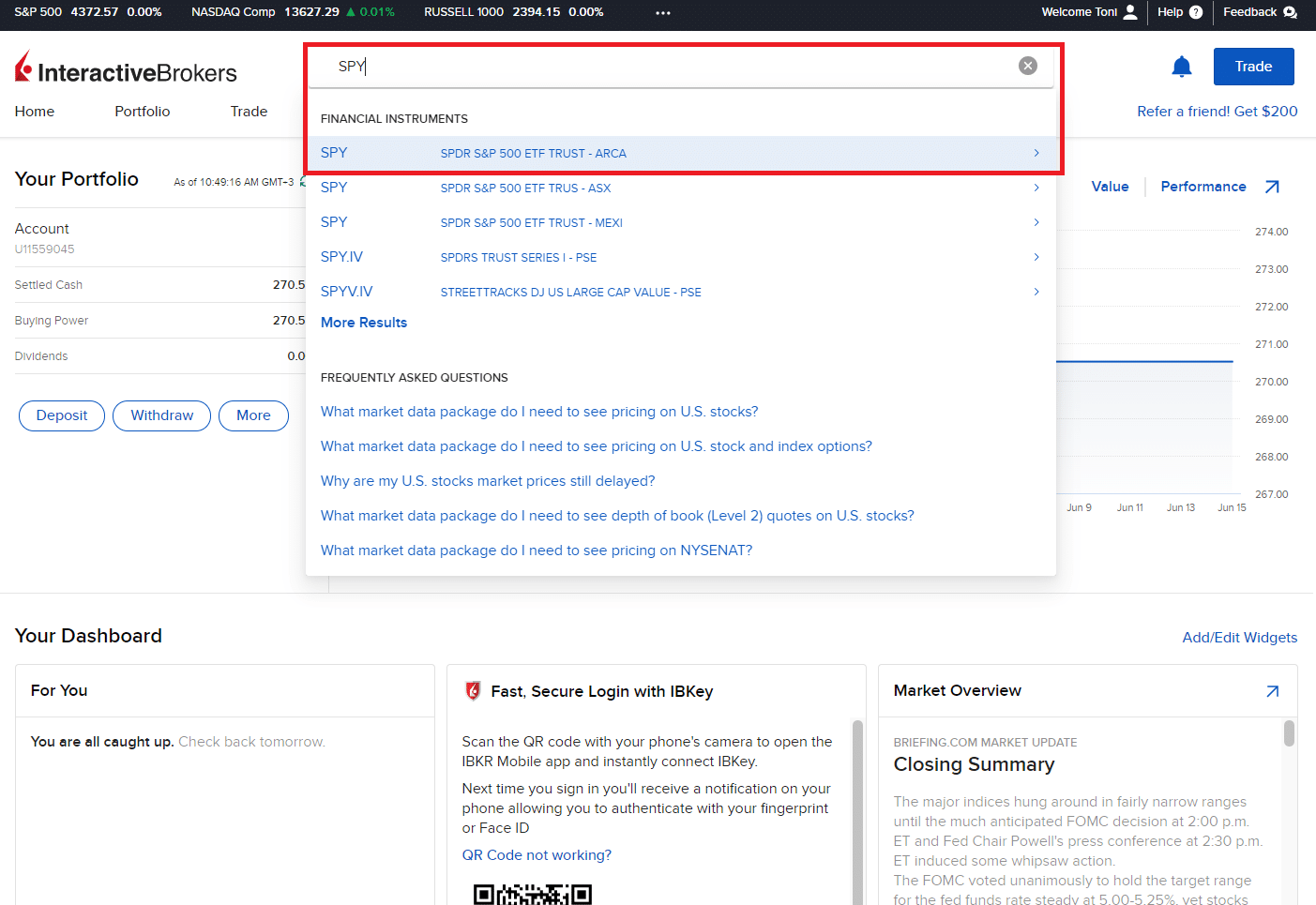
Some ETFs are listed on several exchanges and in different currencies, such as USD or GBP. Choose the listing in the same currency as your account cash to avoid currency conversion fees. For example, if you hold US dollars, pick the USD listing.
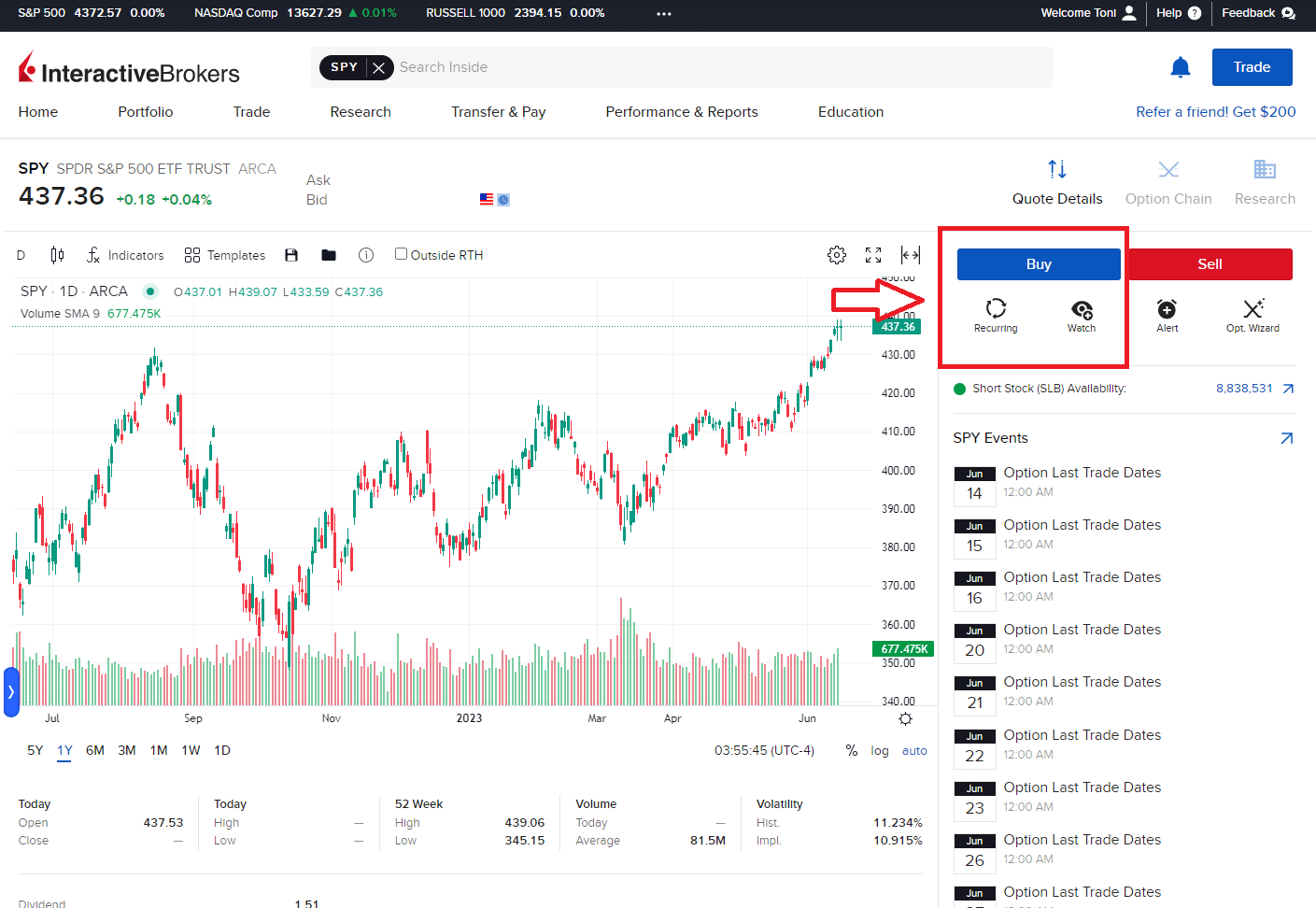
b) Click on “Buy”
The buy button is usually easy to find on the ETF’s page, next to the chart and key information.
c) Choose the order details
Now choose the order type and size:
- Limit order: the default on IBKR. You set the maximum price you’re willing to pay, and the order is only executed at that price or lower.
- Market order: executes the trade immediately at the current market price.
- Amount or units: the amount of money or the number of shares you want to buy.

d) Place the order
Finally, click “Submit Buy Order”. The broker then processes your order and executes it according to the parameters you set.
How to invest in the S&P 500 on different platforms
Below, you can find our guides for specific brokers, most of them with a step-by-step YouTube video:
What to look for in any ETF?
Not all ETFs are the same, so consider these factors before deciding:
1. Fees (TER)
Asset managers such as BlackRock (iShares), Vanguard and State Street (SPDR) charge a small annual fee, deducted directly from the fund’s assets. A lower fee means higher returns for you, all else being equal. This fee is usually called the expense ratio, ongoing charges figure (OCF) or total expense ratio (TER).
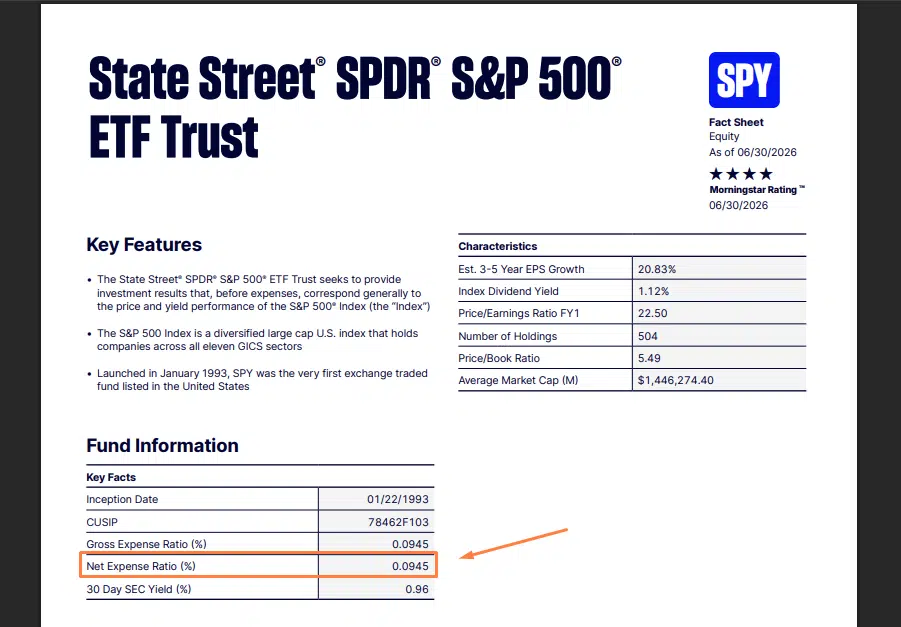
Taking the SPDR S&P 500 ETF Trust (SPY) as an example, you can see its net expense ratio of 0.0945% in the fund’s factsheet:
2. Replication method
ETFs can replicate their index in two ways:
- Physical replication: the fund buys the actual shares in the index.
- Synthetic replication: the fund uses derivatives, usually a swap with a bank, to deliver the index return.
Given how liquid the S&P 500 companies are, physical replication is the most common choice, as it avoids the counterparty risk of derivatives. All the ETFs in our table use physical replication.
The SPY factsheet doesn’t state the replication method explicitly, but SPY holds the shares of the index directly, which means physical replication. The FAQ on the State Street Global Advisors website confirms this:

3. Use of income
ETFs also differ in how they handle the dividends paid by the companies in the index:
- Accumulating ETFs reinvest the dividends inside the fund, which is reflected in a higher ETF price. You don’t pay any trading costs to reinvest them, since it’s done automatically.
- Distributing ETFs pay the dividends regularly into your brokerage account.
The right choice depends on your goals. If you plan to hold your investment for a long time and don’t need regular income, an accumulating ETF may be more suitable. If you want a regular income, a distributing ETF is the natural choice.
For Singaporean investors, taxes are an important part of this choice. Singapore doesn’t generally tax capital gains or foreign dividends received by individuals, but US-domiciled ETFs lose 30% of their dividends to US withholding tax, because Singapore has no tax treaty with the US. An Irish-domiciled accumulating ETF, such as CSPX or VUAA, pays 15% inside the fund and reinvests the rest. Tax rules can change and depend on your situation, so consider seeking advice from a tax adviser.
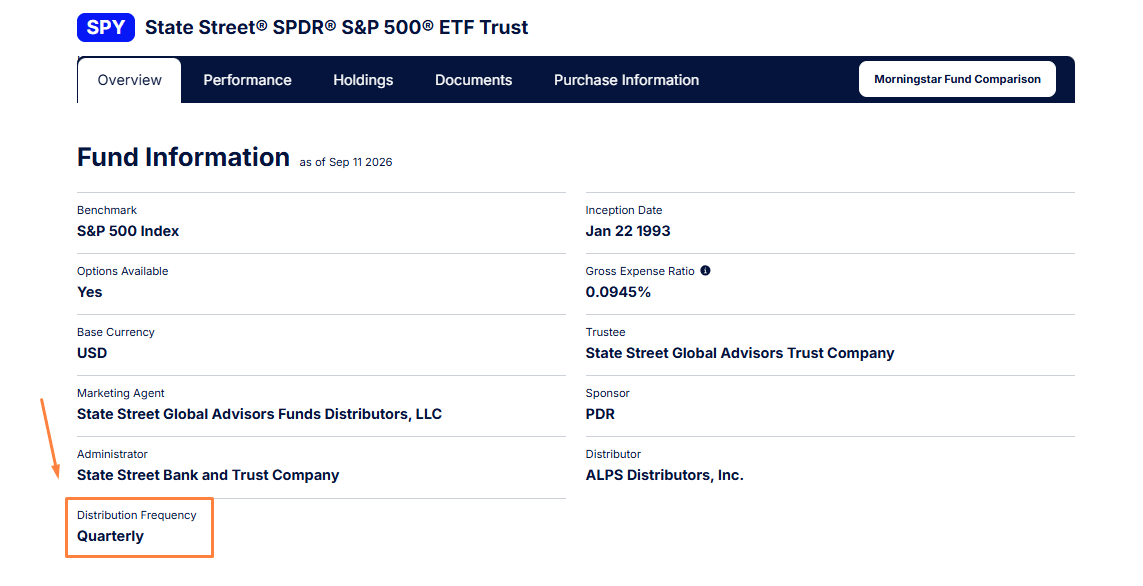
SPY is a distributing ETF:
4. Size
Consider the fund size when choosing an ETF. Larger funds generally carry a lower risk of being closed down. If a fund is liquidated, it sells its holdings, settles its obligations and pays the remainder to investors.
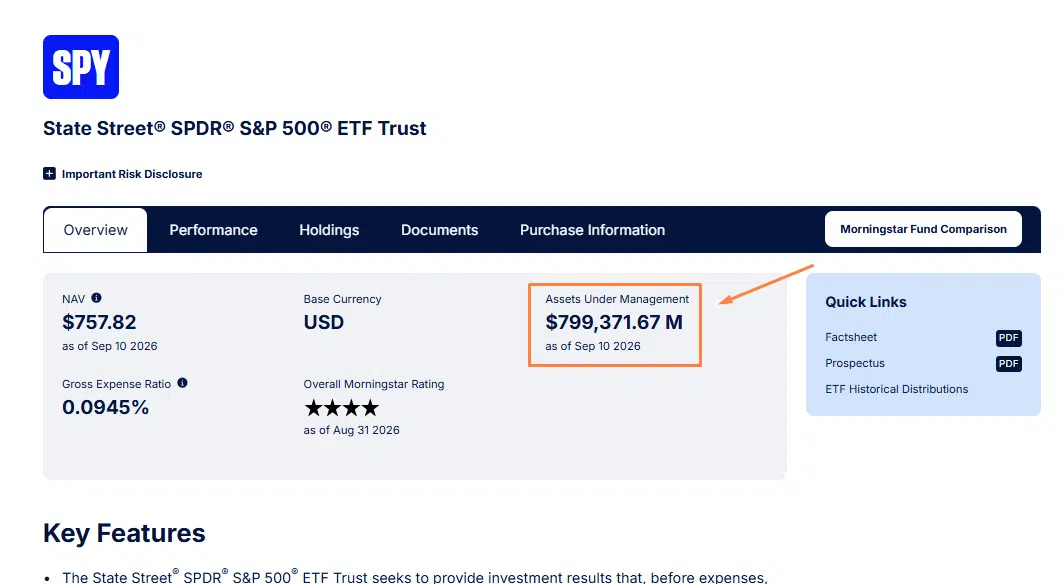
SPY has around $799 billion in net assets (September 2026). The factsheet shows the fund’s net assets:
5. Currency and hedging
All the ETFs above hold US stocks and are unhedged, so your returns in Singapore dollars also depend on the USD/SGD exchange rate. Some ETFs use derivatives to hedge currency movements, which reduces short-term swings but comes at an additional cost. You will also usually need to convert Singapore dollars to US dollars to buy these ETFs, so compare your broker’s currency conversion costs.
Bottom line
Investing in the S&P 500 from Singapore is a popular way to get exposure to the US stock market. Here’s a summary of the steps:
- Pick an ETF tracking the S&P 500: US-listed ETFs such as VOO, IVV and SPYM have the lowest fees, while Irish-domiciled ETFs such as CSPX and VUAA are usually more tax-efficient for Singaporean investors (15% instead of 30% on US dividends, and no US estate tax risk).
- Find a suitable broker: compare fees and check whether the broker gives access to the exchange where your ETF is listed. In this example, we used IBKR.
- Open an account and deposit money: go through the account opening process and fund your account.
- Send a buy order for the ETF you chose: just fill in the order details and submit it.
We hope this guide answered your questions. Remember to do your own research to find the best investment strategy for you.
Disclaimer: Investing involves risk and you may get back less than you invest. Past performance is not a reliable indicator of future results. This article is for information only and is not tax or investment advice.
FAQs
What is the S&P 500?
The S&P 500 is a stock market index that tracks the performance of around 500 of the largest companies listed in the US, weighted by market value.
Why would someone in Singapore want to invest in the S&P 500?
Investing in the S&P 500 gives Singaporean investors exposure to the largest US companies and their long-term growth, which complements a portfolio focused on Singapore and Asia.
Which brokers in Singapore offer access to S&P 500 ETFs?
Several brokers in Singapore offer access to S&P 500 ETFs, including Interactive Brokers, Saxo, Tiger Brokers and Moomoo. If you want Irish-domiciled ETFs like CSPX, choose a broker with access to the London Stock Exchange, such as Interactive Brokers or Saxo.
Should Singaporean investors buy US-listed or Irish-domiciled S&P 500 ETFs?
For long-term investors, Irish-domiciled ETFs such as CSPX or VUAA are often more tax-efficient: they pay 15% withholding tax on US dividends instead of 30%, and they don’t expose you to US estate tax. US-listed ETFs such as VOO and IVV have lower fees, so the right choice depends on your situation.
What is an Exchange Traded Fund (ETF)?
An exchange-traded fund (ETF) is an investment fund traded on a stock exchange, designed to track an index, commodity, sector or asset class. With an S&P 500 ETF, you get exposure to around 500 companies without buying each one separately, which is a simple and efficient way to diversify.
Is Robinhood available in Singapore?
Not yet. Robinhood Singapore received its capital markets services licence from the Monetary Authority of Singapore (MAS) on 1 July 2026, but as of October 2026 it hasn’t announced a launch date. In the meantime, check our Robinhood Singapore article for the latest news and alternatives.
What are CFDs? Should I invest in S&P500 CFDs?
Contracts for difference (CFDs) are derivatives that let you speculate on the price movements of an asset, such as the S&P 500, without owning it. They are complex, often leveraged products, and most retail CFD accounts lose money. To learn more, read our article CFDs vs shares: understand the differences and check our list of the best trading platforms in Singapore.



