Social trading platforms have become popular tools for both new and experienced retail investors. They let you automatically copy the strategies of successful traders, follow market sentiment, and learn from real-time portfolios – effectively crowdsourcing investment ideas.
The popularity of social trading has driven a substantial expansion in the platforms available, which is both good and challenging – more choice means better competition on fees and features, but also makes it harder to identify the genuinely strongest options.
To help you choose the right social trading broker, we compare the leading platforms – their features, fees, regulatory standing, and ideal use cases. Important context for European and UK readers: many social trading platforms primarily offer CFDs (Contracts for Difference) rather than ownership of real underlying assets, which carries distinct risks and tax implications. We’ll flag this throughout.
Best social trading apps and platforms for 2026
eToro | Social trading with $1 stock commissions and free ETF trading
Founded in 2007, eToro is the world’s leading social trading platform with over 40 million users globally. NASDAQ-listed (ETOR) since May 2025. It allows investors to trade real stocks ($1 commission per trade), real ETFs (commission-free), real cryptocurrencies (under MiCA), and CFDs on stocks, ETFs, commodities, forex, and indices. The CopyTrader feature lets you mirror the portfolios of top investors.
Disclaimer: eToro is a multi-asset investment platform. The value of your investments may go up or down. Your capital is at risk.
NAGA | Social trading on assets and CFDs
NAGA is a social trading and investing broker owned by CAPEX.com Group following the acquisition of The NAGA Group AG. It allows you to copy top investors’ trades or invest directly in global financial markets. You can trade worldwide stocks, ETFs, cryptocurrencies, futures, forex, and CFDs on indices and stocks via the Autocopy feature. Regulated by CySEC with EU passporting.
Disclaimer: CFDs are complex instruments and come with a high risk of losing money rapidly due to leverage. Around 75-80% of retail investor accounts lose money when trading CFDs with NAGA.
ZuluTrade | Social trading focused on forex
ZuluTrade is one of the largest social trading networks globally, specialising in forex copy trading. You can trade currency pairs, indices, commodities, and popular cryptocurrencies through Manual Trade or ZuluTrade Copy. Its filtering tools make it easy to find “Leaders” to copy based on risk profile, performance, market focus, and how much you can invest. Owned by Finvasia Group since 2022.
Trading 212 | Social investing through AutoInvest & Pies
An online broker offering real stocks, ETFs, crypto (under MiCA), and CFDs across various asset classes. Copy trading isn’t at the core of the offering, but the Pies & AutoInvest features let you build, share, and copy other investors’ diversified portfolios with automatic rebalancing and recurring contributions. Now serving over 5 million users.
How the best social trading apps compare
| Platform | eToro | NAGA | ZuluTrade | Trading 212 |
| Supported countries | Worldwide (with exceptions including Canada, Japan, restricted territories) | Most of Europe and selected international markets (not available in US, Canada, Japan, Belgium) | Worldwide (with some exceptions) | UK, EU/EEA, Switzerland |
| Regulators | FCA, CySEC, ASIC, ADGM FSRA, SEC/FINRA | CySEC, BaFin, MISA, FSC Mauritius | HCMC (Greece), Finvasia Group regulation in operating jurisdictions | FCA (UK), CySEC (Cyprus), BaFin (Germany), FSC (Bulgaria) |
| Social features | Copy trading, news feed, Popular Investor program, social media integration | Social investing network (NAGA Feed, NAGA Messenger, NAGA Pay integration) | Forums, comment sections, trader reviews, tips, and Q&A community | Social feed, Pies sharing, community discussions |
| Copy trading | Yes (CopyTrader and Smart Portfolios) | Yes (Autocopy) | Yes (ZuluTrade Copy) | Yes (Pie Copying and AutoInvest) |
| Users | 40 million+ | 1 million+ | 2 million+ | 5 million+ |
| Assets available to copy trade | Real stocks, real ETFs, real cryptocurrencies, CFDs (stocks, ETFs, commodities, forex, indices) | Forex, stocks, ETFs, cryptocurrencies, CFDs on stocks, indices, commodities | CFDs, forex, stocks, crypto, commodities, indices | Real stocks and real ETFs |
| Demo account | Yes ($100,000 virtual funds) | Yes | Yes | Yes |
| Broker service | Yes (direct broker) | Yes (direct broker) | No (connects to 3rd party brokers) | Yes (direct broker) |
| Minimum deposit | $50 (first deposit; $10 subsequent) | $250 | $50+ (depends on connected broker) | €/£1 |
Best social trading platforms reviewed
1# eToro

eToro at a glance
52% of retail CFD accounts lose money.
eToro was founded in 2007 and has become one of the most recognisable names in online investing. While the platform allows users to buy and sell a wide range of financial instruments, it is best known for its social trading and copy trading features. Today, eToro is one of the world’s leading social trading brokers, with over 35 million users worldwide.
Social trading is one of eToro’s main differentiators. Instead of investing in isolation, users can follow other investors, view their portfolios, read their market commentary, and interact with them through a social-style news feed. This makes the platform particularly appealing to beginners who want to learn from more experienced traders, as well as to investors who enjoy discussing investment ideas, market trends, and trading strategies with a wider community.
eToro’s CopyTrader feature allows users to automatically copy the trades of selected investors in real time. This means that when the copied trader opens, adjusts, or closes a position, the same action is replicated proportionally in the user’s own account. However, copy trading does not remove risk: past performance is not a guarantee of future returns, and users should always review a trader’s risk score, investment history, asset allocation, and trading style before copying them.
The platform offers a broad range of assets, including stocks, ETFs, cryptocurrencies, and CFDs on stocks, ETFs, commodities, forex, indices, and crypto. Some products may be suitable for beginners, while others — especially CFDs and cryptocurrencies — are higher-risk instruments that are generally more appropriate for experienced investors.
You can also open a demo account to practise investing and test copy trading strategies before using real money. Overall, eToro stands out as one of the best-known social trading apps, offering a combination of investing tools, community features, and copy trading functionality for different types of investors.
CFDs are complex instruments and come with a high risk of losing money rapidly due to leverage. 52% of retail investor accounts lose money when trading CFDs with this provider. You should consider whether you understand how CFDs work and whether you can afford to take the high risk of losing your money.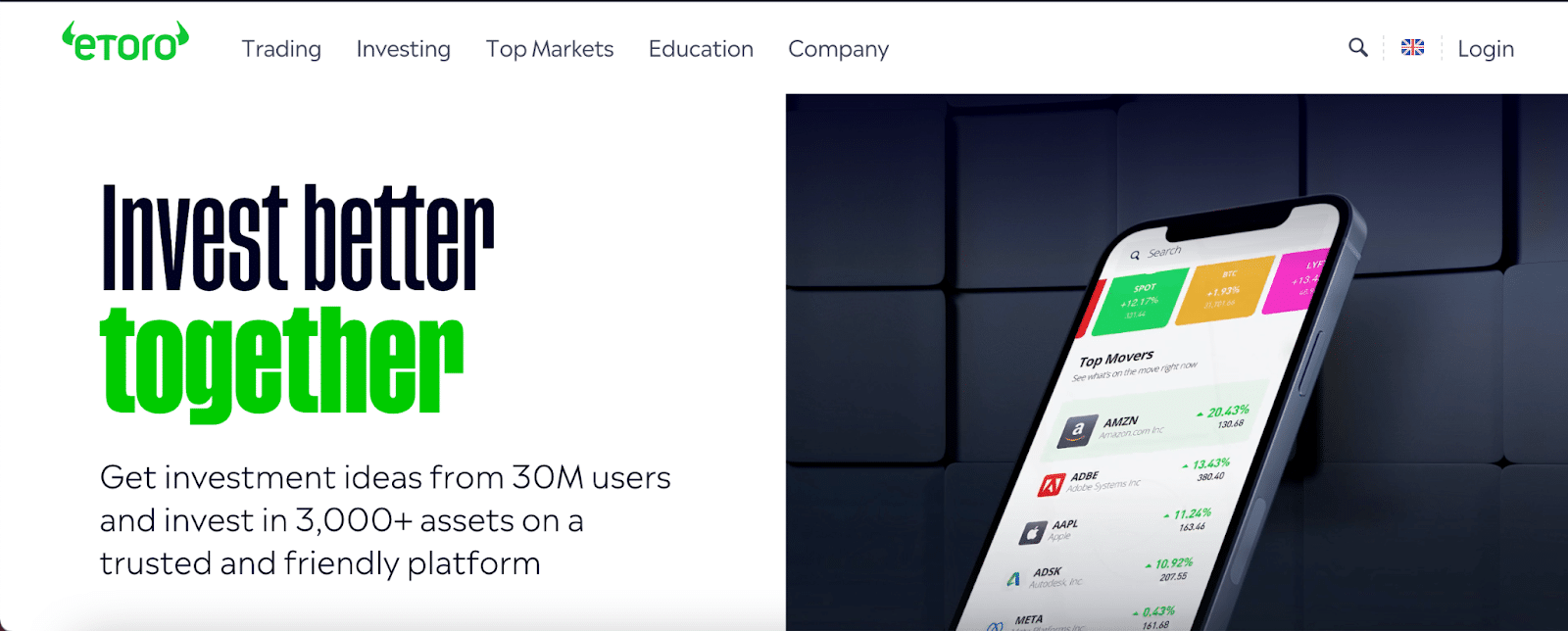
2# NAGA

NAGA at a glance
77.41% of retail CFD accounts lose money.
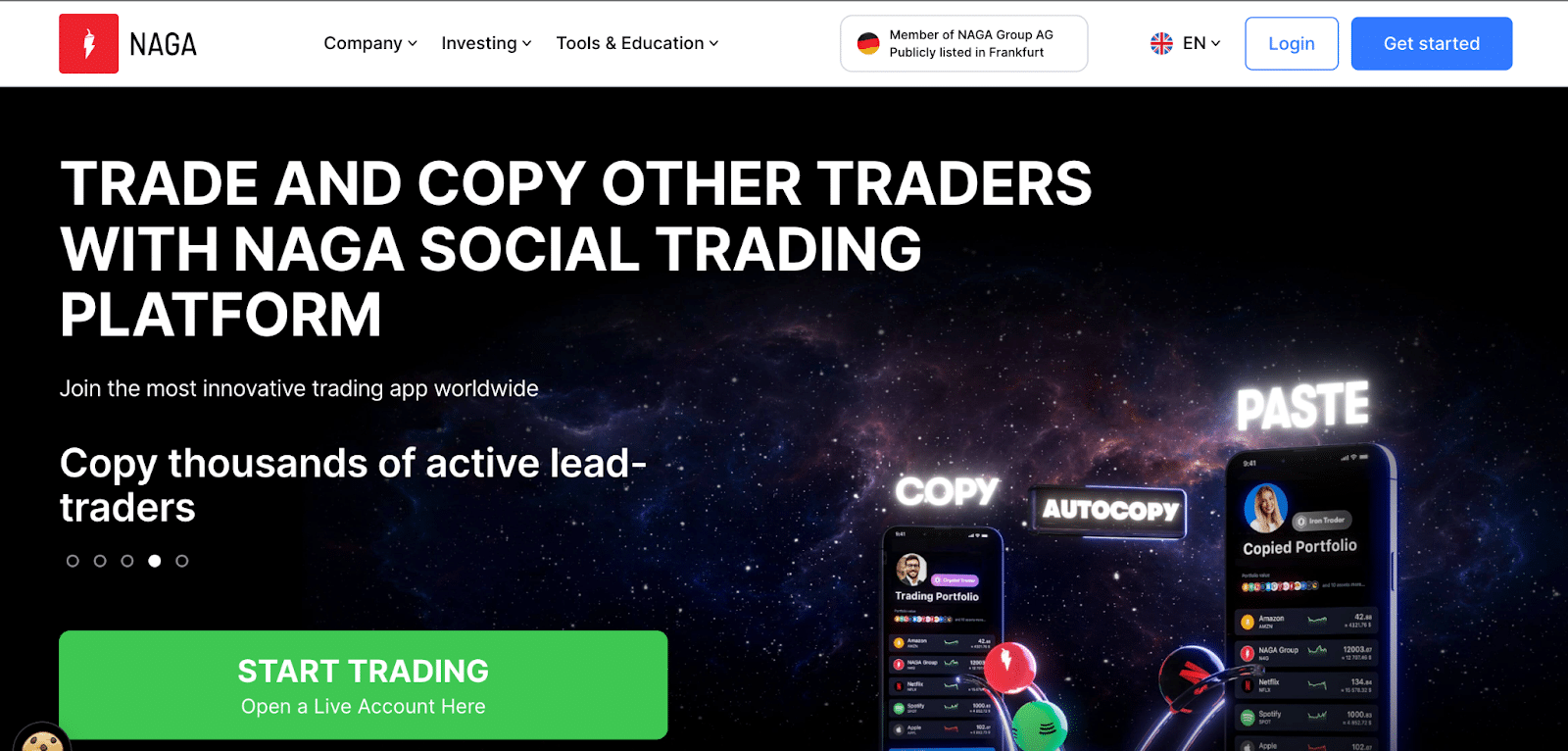
NAGA is part of The NAGA Group AG, a German fintech company founded in 2015 and publicly listed on the Frankfurt Stock Exchange. In 2024, NAGA completed its merger with CAPEX.com, creating a larger multi-asset trading group with users in more than 100 countries. As of the end of 2025, the platform reported over 2.5 million registered users and more than 180,000 funded clients globally.
For European clients, NAGA Markets Europe Ltd is authorised and regulated by the Cyprus Securities and Exchange Commission (CySEC) under licence no. 204/13. Depending on your country of residence, services may be provided by different NAGA Group entities, so it is important to check which entity applies to you before opening an account.
NAGA is best known for its social trading and copy trading features. Through NAGA Autocopy, users can follow lead traders, review their profiles and performance statistics, and automatically copy their trades in real time. You can set your own allocation, adjust copy trading settings, and stop copying a trader at any time. However, copy trading remains risky, and past performance is not a reliable indicator of future results.
The platform offers access to a wide range of assets, including real stocks and ETFs, as well as CFDs on stocks, forex, indices, commodities, ETFs, bonds, and cryptocurrencies. NAGA also provides social features such as a community feed, trader leaderboards, market discussions, and educational resources, including webinars, daily news, economic calendars, and learning materials.
If you want to try the platform first, NAGA offers a demo account with a $10,000 virtual balance, allowing you to practise trading, explore the platform, and test strategies before using real money. Overall, NAGA may appeal to investors looking for a social trading app with copy trading tools, a large trading community, and access to multiple asset classes.
Check out our full NAGA review to find out more.
3# ZuluTrade

ZuluTrade at a glance
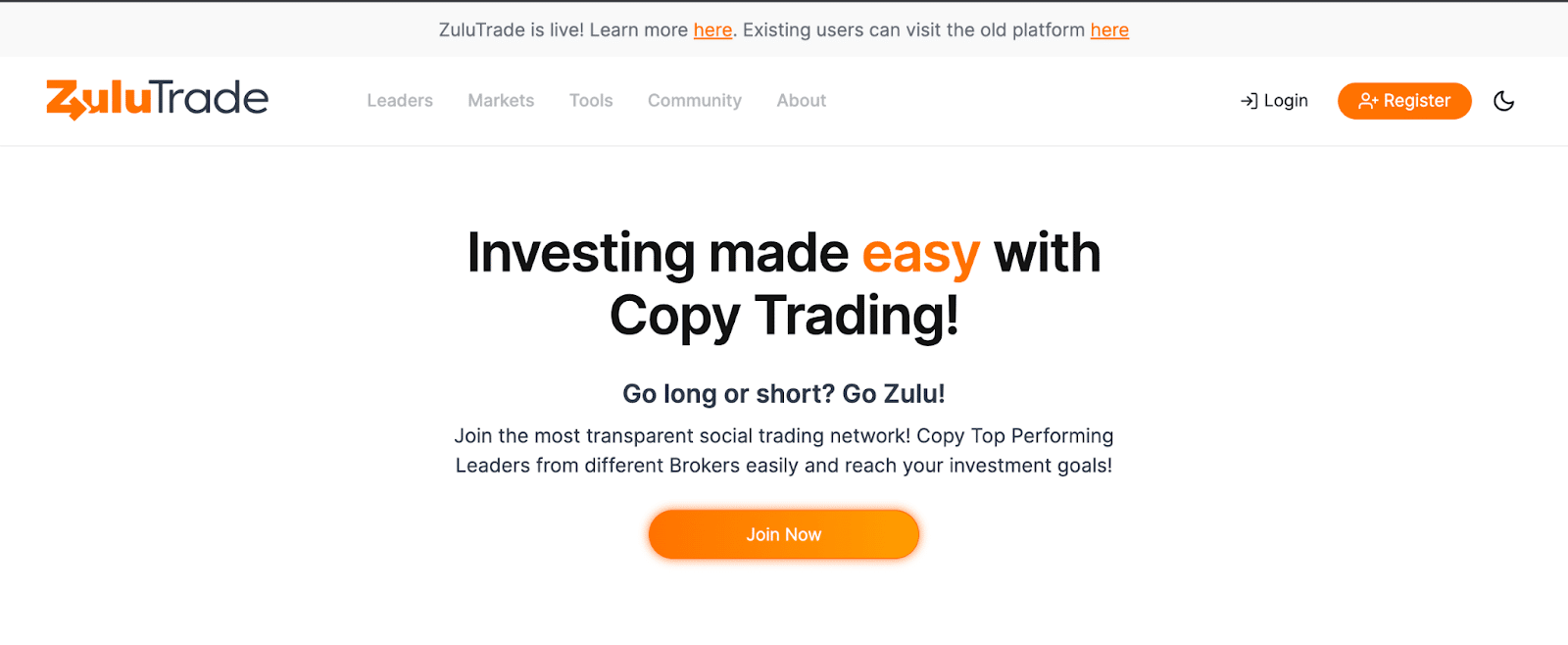
ZuluTrade was founded in 2007 and is one of the oldest and best-known copy trading platforms in the world. It is now part of the FINVASIA Group and operates as a broker-agnostic social trading platform, rather than as a traditional broker. This means users can connect a supported brokerage account to ZuluTrade and use its technology to follow, analyse, and copy other traders.
ZuluTrade is regulated in Greece by the Hellenic Capital Markets Commission (HCMC) under licence no. 2/540/17.2.2010. The platform serves users in more than 150 countries and supports different broker and platform connections, including integrated brokers as well as MT4, MT5, ActTrader, and X Open Hub connectivity.
The platform is centred around social and copy trading. Leaders share their trading strategies, while investors can browse profiles, review performance data, compare risk levels, and copy selected traders based on their own goals, capital, and risk appetite. ZuluTrade also provides more than 40 filters to help users find suitable Leaders, making it easier to compare strategies before deciding who to follow.
ZuluTrade states that 73% of its investors make a profit when copying top Leaders correctly, compared with a lower success rate for manual investors. However, this should be treated as platform-provided marketing data rather than a guarantee. Copy trading still involves risk, trading results can vary, and past performance is not a reliable indicator of future returns.
In terms of tools, ZuluTrade offers features such as ZuluGuard, risk scores, Backtest, Watchlist, trading simulations, calculators, and economic calendar tools. These can help users assess Leaders, test strategies, and manage risk more actively. The platform also includes social features, allowing investors to interact with Leaders and other users, ask questions, and learn from shared trading ideas.
ZuluTrade supports access to multiple asset classes through its partner brokers, including forex, commodities, indices, stocks, and cryptocurrencies. Overall, it may be a good option for investors looking for a dedicated social and copy trading platform with a long track record, broad broker connectivity, and useful tools for comparing and managing copied strategies.
4# Trading 212

Trading 212 at a glance
Capital at Risk. Sponsored Link. To get free fractional shares worth up to 100 EUR/GBP, you can open an account with Trading 212 through this link. Terms apply.
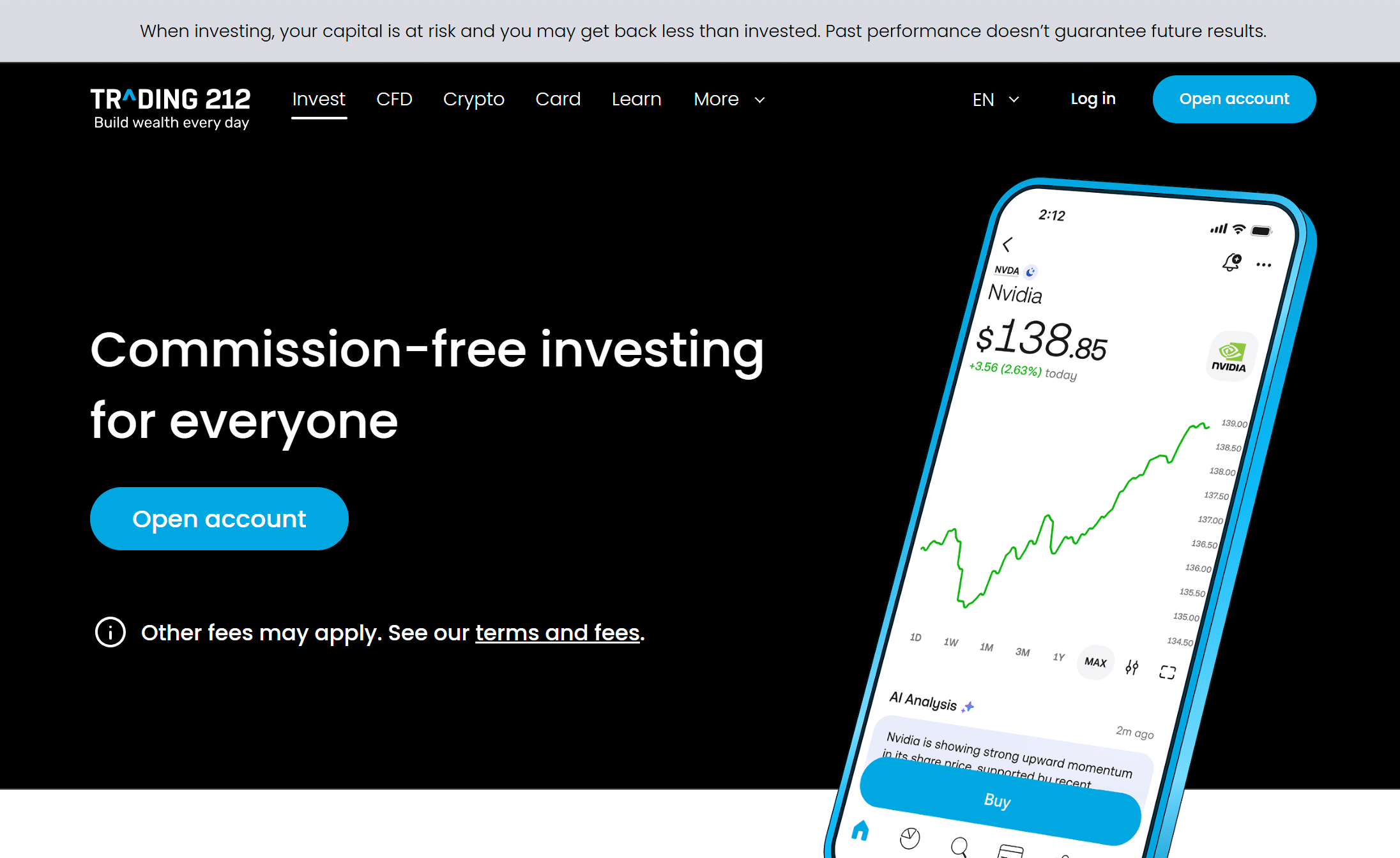
Trading 212 is a well-established investment platform founded in 2004. It is best known for commission-free investing in stocks and ETFs, fractional shares, AutoInvest, multi-currency accounts, and a simple mobile-first experience. While it is not a pure social trading broker like eToro or ZuluTrade, Trading 212 does include some social investing features through its Pies and Pie Library.
The main social element on Trading 212 is 212 Social, where users can discover, save, comment on, and copy shared Pies. A Pie is a portfolio made up of different stocks and ETFs, each with its own target allocation. Through the Pie Library, users can browse popular shared Pies, explore categories such as New, Top, and Saved, and copy a Pie into their own portfolio.
When you copy another user’s Pie, Trading 212 pre-fills the same holdings and allocations, but you still remain in control. You can adjust the Pie, add or remove holdings, rename it, and choose whether to invest manually or use AutoInvest. Copied Pies can also remain linked to the original Pie, meaning you may receive notifications when the original creator makes changes, such as adding or removing holdings or adjusting target weights. However, changes are not applied automatically: you can review the update and decide whether to accept or ignore it.
This makes Trading 212 more of a “social portfolio-sharing” platform than a full copy trading app. You are not automatically copying every trade made by another investor in real time. Instead, you can use shared Pies as inspiration, copy a portfolio structure, and then manage it yourself. Trading 212 also notes that Social Pies are created by members of the community and should not be treated as investment advice.
Trading 212 can still be a strong option for investors who want a low-cost, easy-to-use investing app with some social features. It offers access to thousands of stocks and ETFs, fractional investing, AutoInvest, a free demo account, and tools for building long-term portfolios. However, investors looking for advanced social trading, leaderboards, trader statistics, or automatic copy trading may prefer a dedicated social trading platform.
Eligible new users may also be able to get one free fractional share worth up to €100 by using the code IITW when signing up, subject to Trading 212’s promo code terms, eligibility rules, and campaign availability.
If you want to find out more, check out our full Trading 212 review. Or, learn more about Trading 212 AutoInvest and Pies here.
Important factors when choosing a social trading platform
Number of users and signal providers
Social and copy trading depend heavily on the size and quality of the community. A larger user base usually means more traders, strategies, and portfolios to analyse and potentially copy. It also increases your chances of finding investors whose risk profile, asset preferences, and trading style match your own. However, size alone is not enough: you should also look at the quality, transparency, and track record of the available signal providers.
Reliability and security
Before choosing a social trading platform, check whether it is regulated by reputable financial authorities and whether it offers investor protection. You should also consider where the company is based, how long it has been operating, whether it is publicly listed, and what users say about its reliability, withdrawals, customer support, and platform stability. Regulation does not eliminate investment risk, but it can provide an additional layer of protection.
Products and markets
Some social trading platforms focus mainly on forex and CFDs, while others offer a broader range of assets such as stocks, ETFs, commodities, indices, and cryptocurrencies. A wider product offering can provide more diversification opportunities, but the best choice will depend on your investment goals, experience, and risk tolerance. Beginners may prefer platforms with simple long-term investment options, while advanced traders may look for more complex products.
Copy trading features
Not all social trading platforms offer automatic copy trading. Some allow you to follow traders, read their posts, and view their signals, but still require you to place trades manually. Others let you automatically replicate another trader’s positions in real time. When comparing platforms, check whether you can control the amount invested, set risk limits, pause copying, close individual positions, or stop copying a trader at any time.
Social features
A good social trading platform should make it easy to interact with other traders and investors. Features such as comments, news feeds, public portfolios, trader profiles, community discussions, and market updates can help you understand why certain decisions are being made. This can be useful if you want to learn from others instead of simply copying trades without context.
Supported brokers
Some social trading platforms operate as brokers themselves, while others require you to connect an account from a third-party broker. Broker-agnostic platforms can offer more flexibility, but you should check which brokers are supported, what fees apply, and whether the broker is available in your country. The broker you use can affect spreads, execution quality, asset availability, and regulatory protection.
Trader data and transparency
The more information you have about a trader, the better. Look for platforms that provide detailed statistics such as historical performance, risk score, maximum drawdown, average holding time, number of copiers, assets traded, trading frequency, and portfolio allocation. Avoid copying traders based only on short-term returns. A trader with high recent performance may also be taking excessive risk.
Fees and currency conversion costs
Fees can have a significant impact on your returns, especially if you trade frequently or copy active traders. Social trading platforms may charge spreads, commissions, overnight fees, withdrawal fees, inactivity fees, or performance-related fees. Currency conversion costs are also important. Many platforms operate primarily in USD, so investors depositing in EUR, GBP, or another currency may pay conversion fees when funding the account or withdrawing money.
Risk management tools
Copy trading does not mean risk-free investing. A good platform should give you tools to manage your exposure, such as stop-loss settings, maximum allocation limits, copy-pause options, risk scores, and clear portfolio breakdowns. You should also avoid putting all your money into a single trader or strategy. Diversifying across different traders, assets, and investment styles can help reduce risk.
Ease of use and educational resources
Beginners should also consider how easy the platform is to use. A clear interface, demo account, educational articles, webinars, tutorials, and transparent explanations of copy trading mechanics can make a big difference. The best social trading platforms do not just let you copy others; they also help you understand what you are doing and the risks involved.
Pros and Cons of Social Trading
Pros
-
Sometimes better odds of making a trading profit
-
Benefit from the experience of successful traders
- Some platforms are cheap and easy to use
Cons
-
Lack of control
-
Can be complex to use
- Still risk losing money
Bottom line
Social trading platforms and apps have been around for many years, but they have become increasingly popular among retail investors who want to learn from others, share investment ideas, or copy more experienced traders. The best social trading app for you will depend on your goals, experience, risk tolerance, preferred assets, and whether you want full copy trading or simply access to community-driven investment ideas.
It is also important to understand the difference between a social trading broker and social trading software. Some platforms, such as eToro or NAGA, combine brokerage services with social and copy trading tools. Others, such as ZuluTrade, act more like a technology layer that connects to supported third-party brokers. This can affect fees, regulation, available assets, account protection, and the overall trading experience.
Before choosing a platform, compare the number of traders available to copy, the quality of performance data, risk management tools, fees, supported brokers, regulation, and available markets. Copy trading can be useful, especially for beginners who want to observe how other investors operate, but it does not remove risk. Past performance is never a guarantee of future returns, and you should only invest money you can afford to lose.
FAQs
What is copy trading?
This is when you copy or mirror the actions and positions of other traders. So, instead of researching your own moves, you mimic the trades of other investors (ideally successful and experienced traders).
‘Copy trading’ and ‘social trading’ tend to be used interchangeably. Social trading, however, can mean additional features like communities, forums, news feeds, and other ways to interact with like-minded investors or traders.
What is a social trading app or platform?
This is somewhere that facilitates copy trading and social investing. One important distinction is that not all social trading apps are brokerages. Some of these apps and platforms are just pieces of software or technology you need to integrate with a broker service to make trades.