eToro attracts a lot of attention, and understandably so. Founded in 2007, it built its name on social trading and has since grown into one of the largest retail investment platforms in the world.
Is eToro safe?
In short, yes, we consider eToro a safe broker, for the following reasons:
- Publicly listed company: eToro has been listed on Nasdaq (ticker: ETOR) since May 2025, meaning it files audited quarterly and annual results and is subject to SEC reporting requirements. That level of financial disclosure is not available for most privately held brokers;
- Regulatory oversight: eToro operates through entities regulated by top-tier authorities including CySEC (Cyprus), the FCA (UK), ASIC (Australia), and FINRA/SEC (US);
- Investor compensation schemes: clients under CySEC are covered up to €20,000 through the Investor Compensation Fund, while UK clients under the FCA are covered up to £85,000 by the FSCS. These schemes compensate in the event of firm insolvency and a shortfall in client funds;
- Private insurance: an additional insurance policy underwritten by Lloyd’s of London covers up to €1 million per eligible client, subject to an excess, with an overall policy limit of €25 million across all claimants;
- Asset segregation: client assets are held separately from eToro’s own funds, so in an insolvency scenario an appointed liquidator would manage the distribution of client assets.
An important caveat on the private insurance: because the overall limit is €25 million across all claimants, the €1 million per-client figure is a ceiling rather than a guarantee. In a large-scale failure affecting many clients, the pool would be shared. Treat the statutory compensation schemes as the primary protection and the insurance as a supplementary layer.
Note also that for both regulatory protection and private insurance cover, you must submit a claim promptly after the firm’s default or the loss becoming known, under the relevant scheme’s limitation rules. For losses connected to eToro (UK) Ltd, check the terms and follow any required procedure, including the excess of FSCS arrangement where applicable.
Security matters when assessing any broker, which is why we did our own due diligence before opening personal accounts with eToro.
One product note: eToro USA LLC does not offer CFDs – only real crypto assets are available to US clients.
Video summary
What is the eToro business model?
eToro’s model centres on attracting retail investors, often those entering financial markets for the first time. New users are typically guided toward the social investment network, where they can follow and copy the trades of other investors through the platform’s social trading features.
How eToro makes money
eToro generates most of its revenue through a market maker model, standard across much of the brokerage industry.
When you open a trade you see a bid price (what you receive when selling) and an ask price (what you pay when buying). The gap between the two is the spread, and the wider it is, the more eToro earns. Additional revenue comes from CFD spreads and overnight financing fees, currency conversion mark-ups, a $5 withdrawal fee, and a $10 monthly inactivity fee after 12 months without login.
Since August 2024, eToro has also charged a commission on real stock trades. The fee is $1 per trade on most exchanges and $2 per trade on the Australian, Hong Kong, Dubai, Abu Dhabi, and Tokyo exchanges, though the exact amount depends on your country of residence – UK residents currently pay no stock commission. The charge applies both when opening and closing a position, is calculated in USD regardless of the stock’s base currency, and sits separately from the market spread. ETFs remain commission-free regardless of transaction size or how the order is placed.
eToro financials
According to its full-year 2025 results, eToro delivered what CEO Yoni Assia described as a “milestone year”, having listed on Nasdaq (ticker: ETOR) in May 2025 and accelerated development of its global financial super-app.
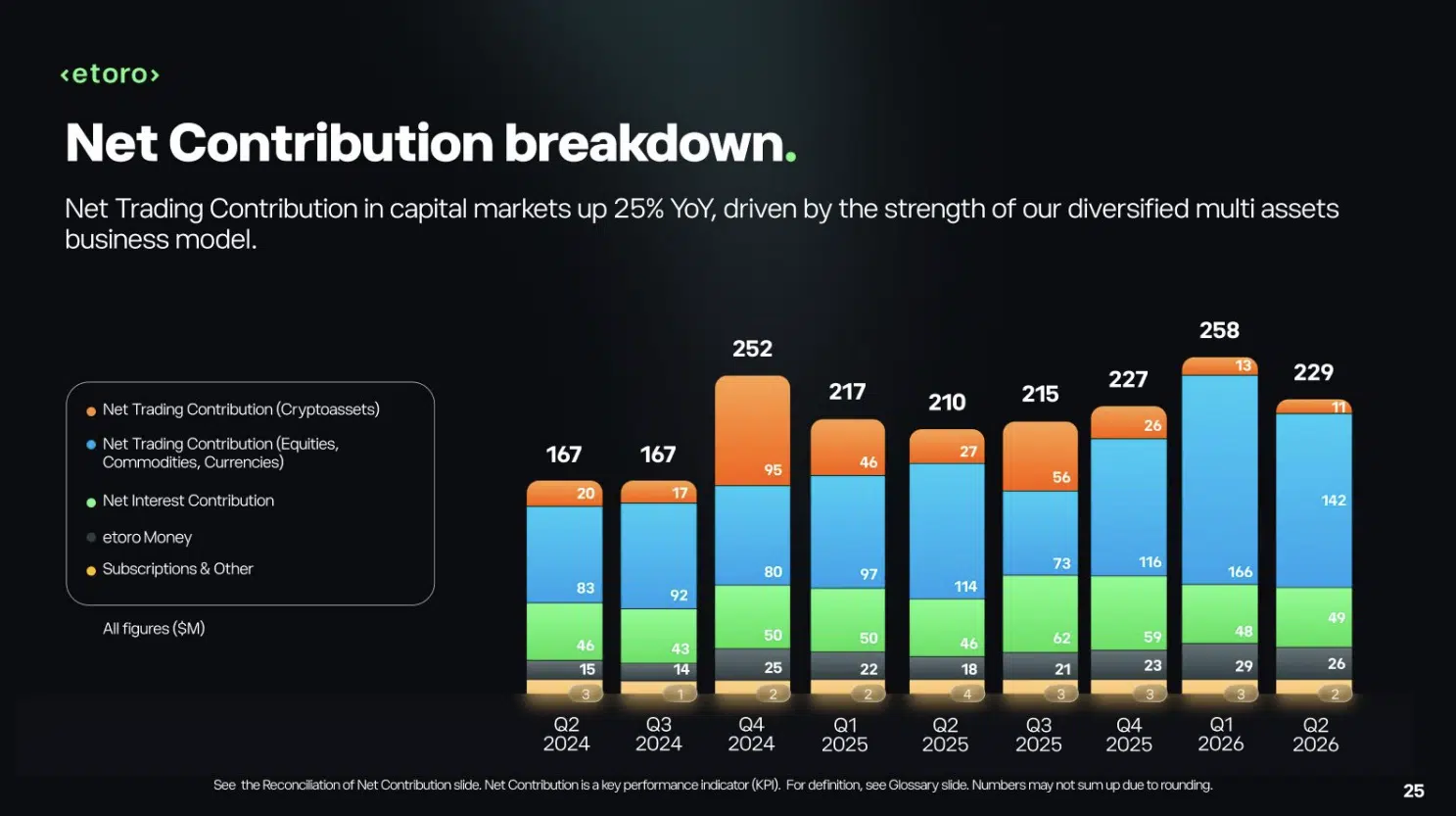
Total revenue for 2025 reached $13.84 billion, up 9% from $12.64 billion in 2024. Net Contribution – eToro’s preferred top-line metric, which strips out gross crypto pass-through and margin interest expense – hit a record $868 million, up 10% year-on-year from $788 million.
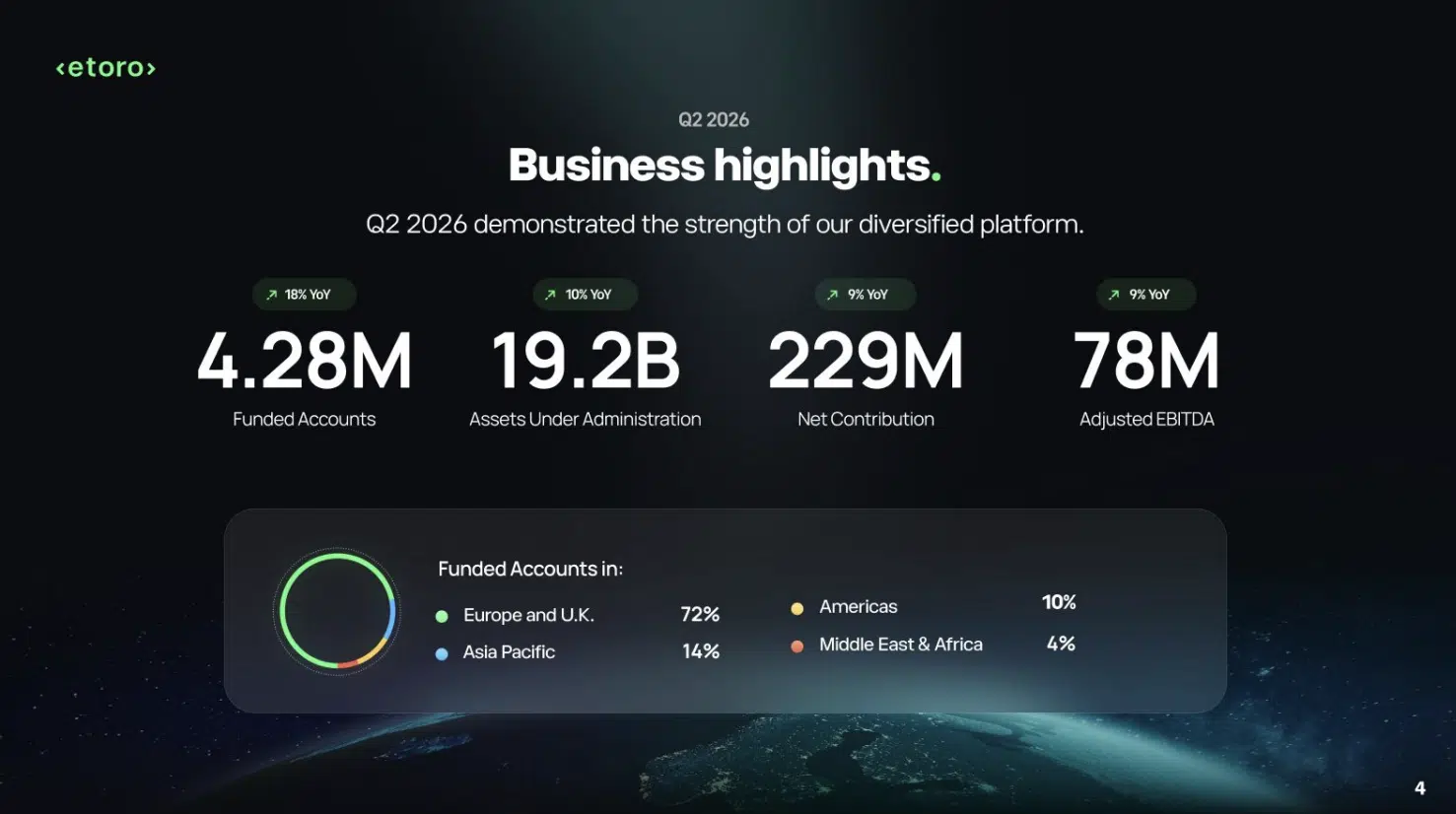
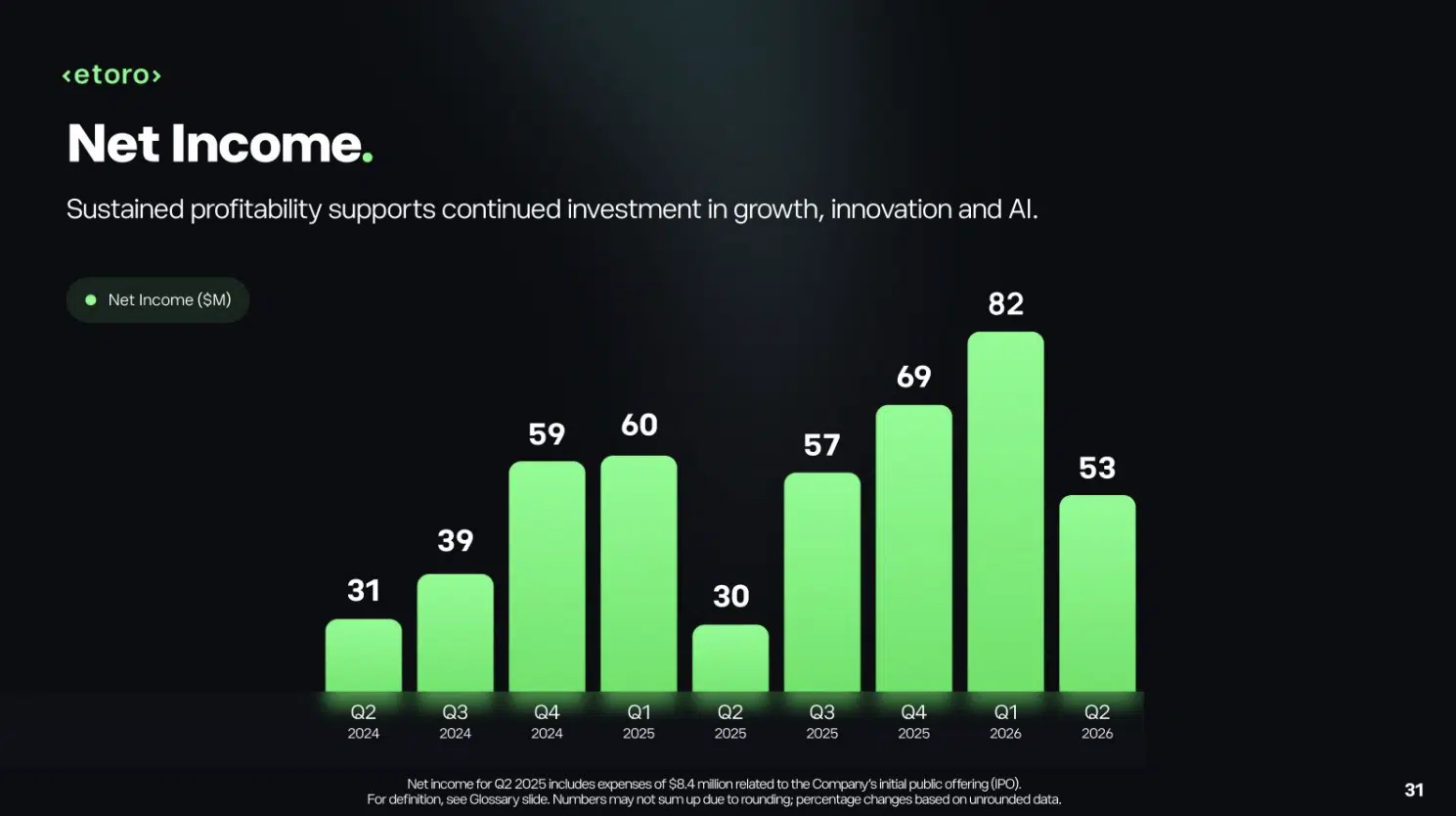
Profitability improved across the board. GAAP net income rose 12% to $216 million (from $192 million in 2024), and adjusted EBITDA increased 4% to $317 million (from $304 million), maintaining a healthy margin for a retail brokerage. eToro closed the year with $1.3 billion in cash and short-term investments, 3.81 million funded accounts (up 9%), and $18.5 billion in assets under administration (up 11%).
For an investor assessing safety, the relevant point is not the headline revenue figure but the balance sheet: a profitable, cash-generative business with $1.3 billion in liquid resources is considerably less likely to face the kind of solvency pressure that triggers compensation claims in the first place.
eToro risk management and governance
eToro applies structured controls around risk management. Client assets are held in segregated accounts separate from company funds, the firm does not lend out client crypto assets, and its financial statements are audited by EY, one of the four largest global auditing firms.
Since the Nasdaq listing, eToro is also subject to Sarbanes-Oxley internal control requirements and PCAOB audit oversight, which impose considerably more rigorous governance and reporting standards than apply to privately held brokers. For anyone assessing safety, that shift from private company to SEC-reporting issuer is arguably the single most meaningful development in eToro’s governance profile.
What if eToro goes bust?
a. Securities are held in a segregated account
Understanding eToro’s structure matters, and it works much like most other brokers. eToro acts as an intermediary that holds your ETFs, shares, and other financial products on your behalf rather than owning them itself.
Those securities sit in a segregated account with a custodian, separate from eToro’s own balance sheet. If the broker became insolvent, creditors could not claim client assets, because those assets belong to the clients rather than to the firm.
In practice, what would happen is a waiting period – potentially months, occasionally longer – while financial authorities establish what belongs to whom and arrange for assets to be transferred to another broker. Clients would receive their share of the segregated holdings, less any administrator costs incurred in handling and distributing the funds. If the process always worked cleanly, the compensation schemes would be little more than a formality.
b. Investor protection
Despite segregation and a currently profitable business, a broker can still fail for other reasons: fraud, administrative failure, or operational error. eToro sets out these risk factors in detail in its regulatory filings, which as a Nasdaq-listed company it is now required to publish and update quarterly.
That is where investor protection comes in. eToro operates through several entities, each supervised by a different regulator:
- eToro (Europe) Ltd: authorised and regulated by the Cyprus Securities and Exchange Commission (CySEC);
- eToro (UK) Ltd: authorised and regulated by the Financial Conduct Authority (FCA);
- eToro AUS Capital Limited: authorised and regulated by the Australian Securities and Investments Commission (ASIC);
- eToro (Seychelles) Ltd: registered with the Financial Services Authority Seychelles (FSAS);
- eToro USA LLC: registered with FinCEN as a Money Services Business, and a member of the Financial Industry Regulatory Authority (FINRA).
These are not equivalent. The Seychelles entity offers materially weaker protection than the CySEC, FCA, or ASIC-regulated entities, with no comparable investor compensation scheme. Knowing which entity holds your account matters more than knowing that eToro is “regulated” in general.
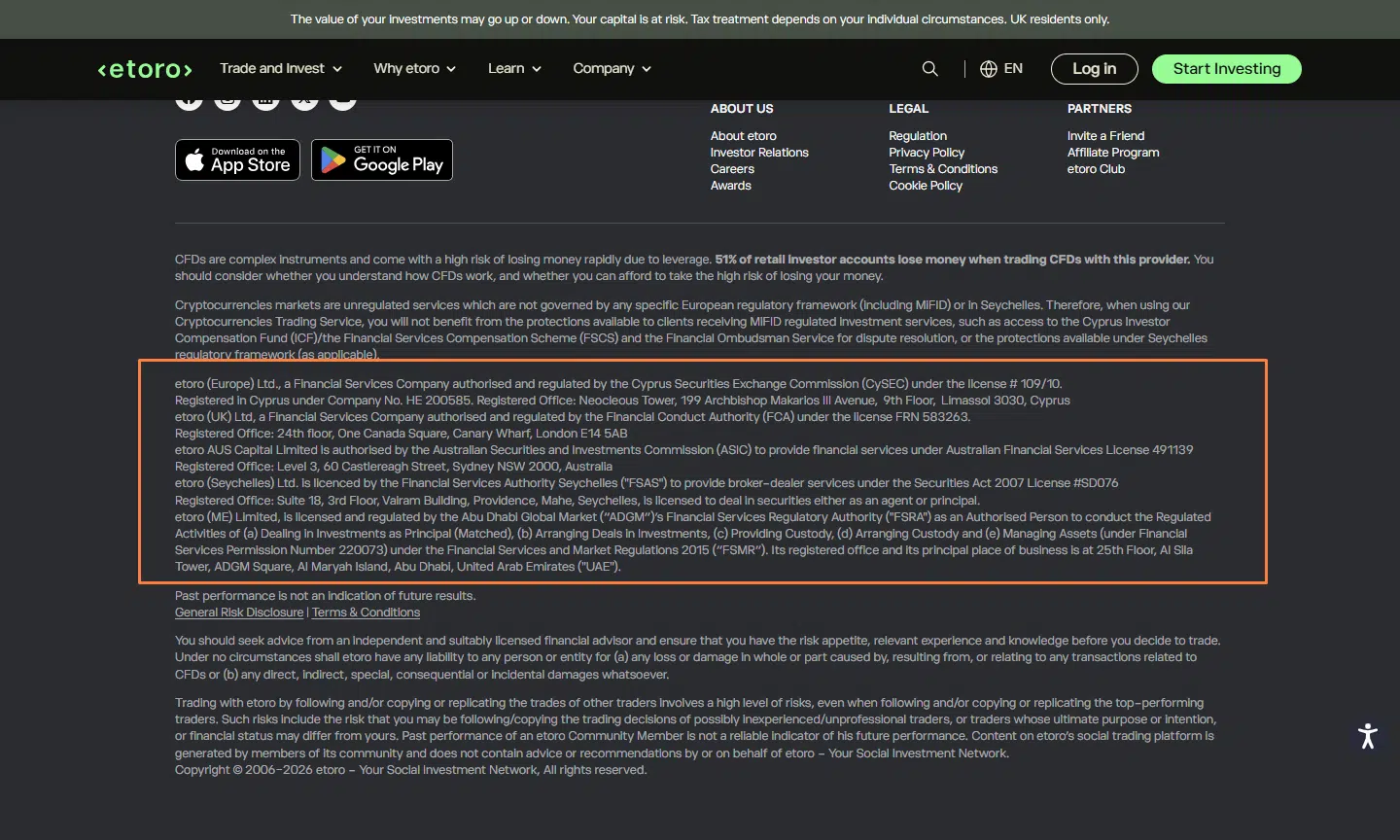
These three regulatory bodies are primarily compliance mechanisms to prosecute civil cases against companies that commit fraud, do not fully implement risk management tools, or engage in other irregular activities. However, they do not insure against any loss you might have due to these problems.
c. Investor compensation schemes
Alongside CySEC, FCA, and ASIC supervision, eToro’s entities participate in the following compensation schemes[1]:
- The Cyprus Investor Compensation Fund (ICF) provides coverage of up to €20,000 for clients of eToro (Europe) Ltd;
- The Financial Services Compensation Scheme (FSCS) compensates up to £85,000 for clients of eToro (UK) Ltd;
- For US clients, SIPC covers securities up to $500,000 (including a $250,000 cash sub-limit), while FDIC insurance covers cash held at partner banks up to $250,000.
An important reminder: if you hold cryptocurrencies, none of these protections apply. Crypto sits outside investor compensation schemes in every jurisdiction where eToro operates, so those holdings carry no safety net in an insolvency scenario.
It is also worth being clear about what these schemes cover. They protect against firm failure and a shortfall in client assets – they do not compensate you for investment losses. If your portfolio falls in value, that is not a claimable event under any of these schemes.
[1] ASIC does not operate a pre-defined compensation amount. More information here.
Am I signing up with the right eToro entity?
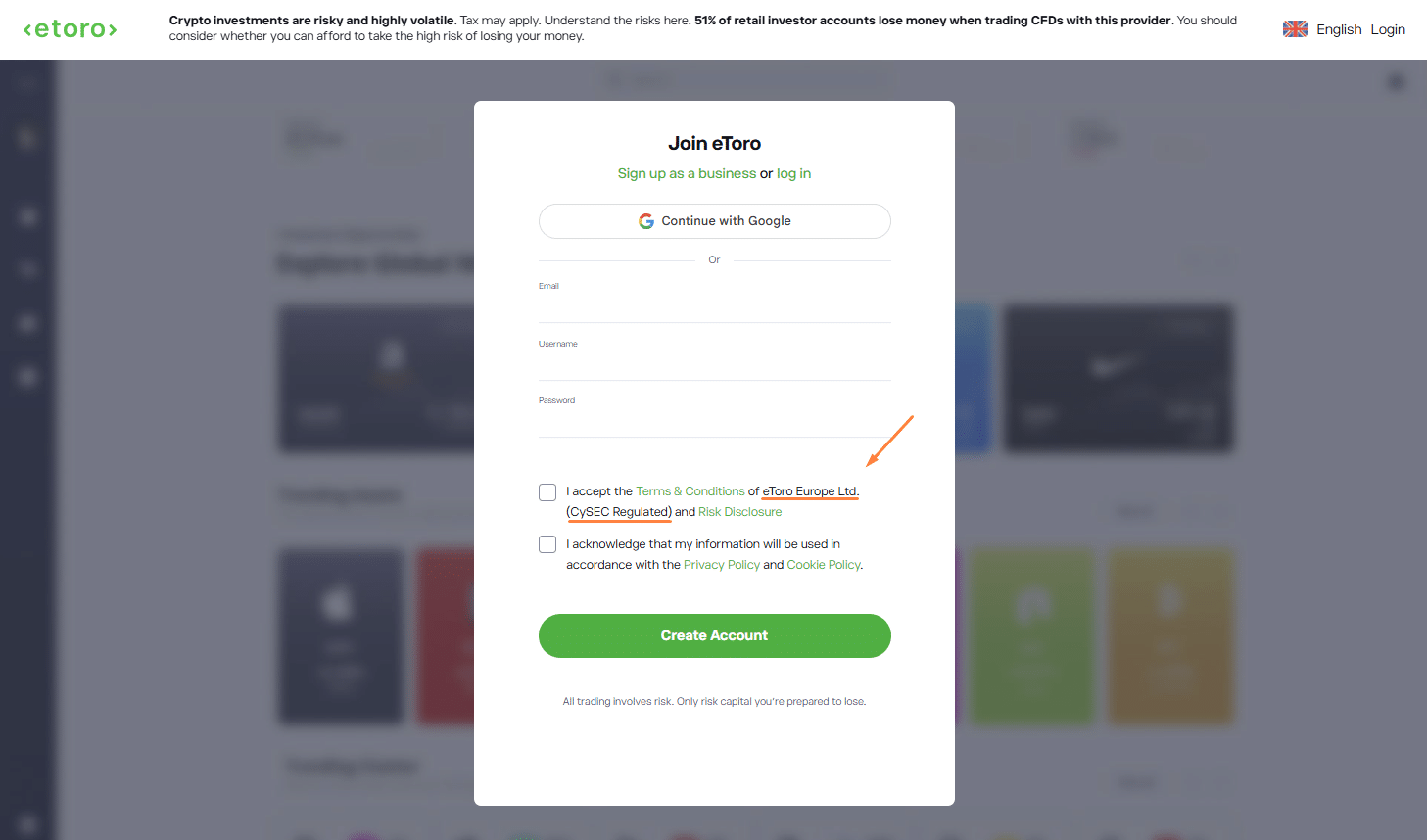
As a general rule, European investors (for example in Greece or Ireland) are onboarded under eToro (Europe) Ltd, UK investors under eToro (UK) Ltd, and Australian investors under eToro AUS Capital Limited. The entity is displayed during registration.
This is worth checking rather than assuming. The entity determines which regulator supervises your account, which compensation scheme covers you, and what protection limit applies – and as noted above, those limits vary considerably between entities.
What other protections are available?
Beyond the mandatory regulatory protections, eToro provides an additional layer of its own: eToro Insurance.
Underwritten by Lloyd’s of London, this covers up to €1 million or AUD 1 million depending on the region. Clients of eToro (Europe) Ltd and eToro AUS Capital Limited are automatically covered when they open an account, at no additional cost.
The insurance applies only to losses above the compensation scheme limit. For example, a European investor holding €30,000 would receive €20,000 from the Investor Compensation Fund and the remaining €10,000 from the insurance policy.
There is a significant caveat. The policy carries an overall maximum limit of €25 million in aggregate across all eligible claimants. In eToro’s own wording: “there is a chance you may not get all of your Losses back if the aggregate Losses of all Eligible Claimants exceed this maximum cap.”
That distinction matters. With over 3.8 million funded accounts, a €25 million aggregate cap would be exhausted quickly in any large-scale failure – it works out at under €7 per funded account if fully drawn. The €1 million headline figure protects an individual client in an isolated scenario, not all clients in a systemic one. Treat the statutory schemes as your real protection and the insurance as a useful supplement.
The insurance covers cash, CFD positions, and securities such as stocks and ETFs. As with the compensation schemes, cryptocurrencies are not covered.
Final thoughts
Online brokers have opened investing to anyone with a phone and an internet connection. That accessibility naturally invites questions about how safe these platforms actually are.
On the evidence, eToro compares well. It is regulated by multiple top-tier authorities, segregates client assets, is audited by EY, and since May 2025 has been a Nasdaq-listed company subject to SEC reporting, Sarbanes-Oxley internal controls, and PCAOB audit oversight. It closed 2025 profitable, with $1.3 billion in cash and short-term investments. That combination puts it in a stronger position than most retail brokers.
Three things to keep in perspective, though:
- Crypto has no protection. No compensation scheme and no insurance cover crypto holdings anywhere eToro operates;
- The €1 million insurance figure is a per-client ceiling, not a guarantee, given the €25 million aggregate cap;
- Check which entity holds your account. Protection varies considerably between the CySEC, FCA, ASIC, and Seychelles entities.
One practical tip: once you start investing, keep records of your holdings, trade confirmations, and monthly account statements. If you ever needed to file a claim, that documentation makes the process considerably faster.
Finally, remember that none of these protections cover investment losses. They exist for the unlikely event of firm failure, not for the far more common experience of a portfolio falling in value.
eToro is a multi-asset platform which offers both investing in stocks and cryptoassets, as well as trading CFDs.
CFDs are complex instruments and come with a high risk of losing money rapidly due to leverage. 52% of retail investor accounts lose money when trading CFDs with this provider. You should consider whether you understand how CFDs work and whether you can afford to take the high risk of losing your money.This communication is intended for information and educational purposes only and should not be considered investment advice or investment recommendation. Past performance is not an indication of future results.
Copy Trading does not amount to investment advice. The value of your investments may go up or down. Your capital is at risk.
Don’t invest unless you’re prepared to lose all the money you invest. This is a high-risk investment and you should not expect to be protected if something goes wrong. Take 2 mins to learn more at https://etoro.tw/44JRWLY
eToro USA LLC does not offer CFDs and makes no representation and assumes no liability as to the accuracy or completeness of the content of this publication, which has been prepared by our partner utilizing publicly available non-entity specific information about eToro.