eToro, the leading social trading platform, is available in Greece. The platform enables over 40 million users globally to trade a wide range of assets including stocks, ETFs, real cryptocurrencies, commodities, forex, indices, and CFDs. eToro offers low-commission stock trading ($1 per trade on most stocks) and commission-free real ETF trading, a sleek and intuitive platform, and the unique CopyTrader feature that lets you follow and replicate the strategies of other successful traders.
Major credibility milestone: eToro went public on NASDAQ (ticker: ETOR) in May 2025, adding the transparency and oversight that come with public market listing – useful context for Greek investors weighing platform reliability.
Greek investors can now open and fund their accounts in EUR directly, eliminating the FX conversion costs that previously applied to non-USD users. To invest in real stocks rather than CFDs, make sure you’re purchasing the underlying asset (CFDs are leveraged derivatives, not actual ownership – see our article on the differences between CFDs and real shares).
Want to know more about eToro in Greece, including fees, taxes, supported features, and how it compares to alternatives? We’ve got you covered – keep reading.
Is eToro legal in Greece?
Yes, eToro is fully legal and authorised to operate in Greece. Greece is not among eToro’s restricted countries, and Greek residents can open and use eToro accounts without restrictions.
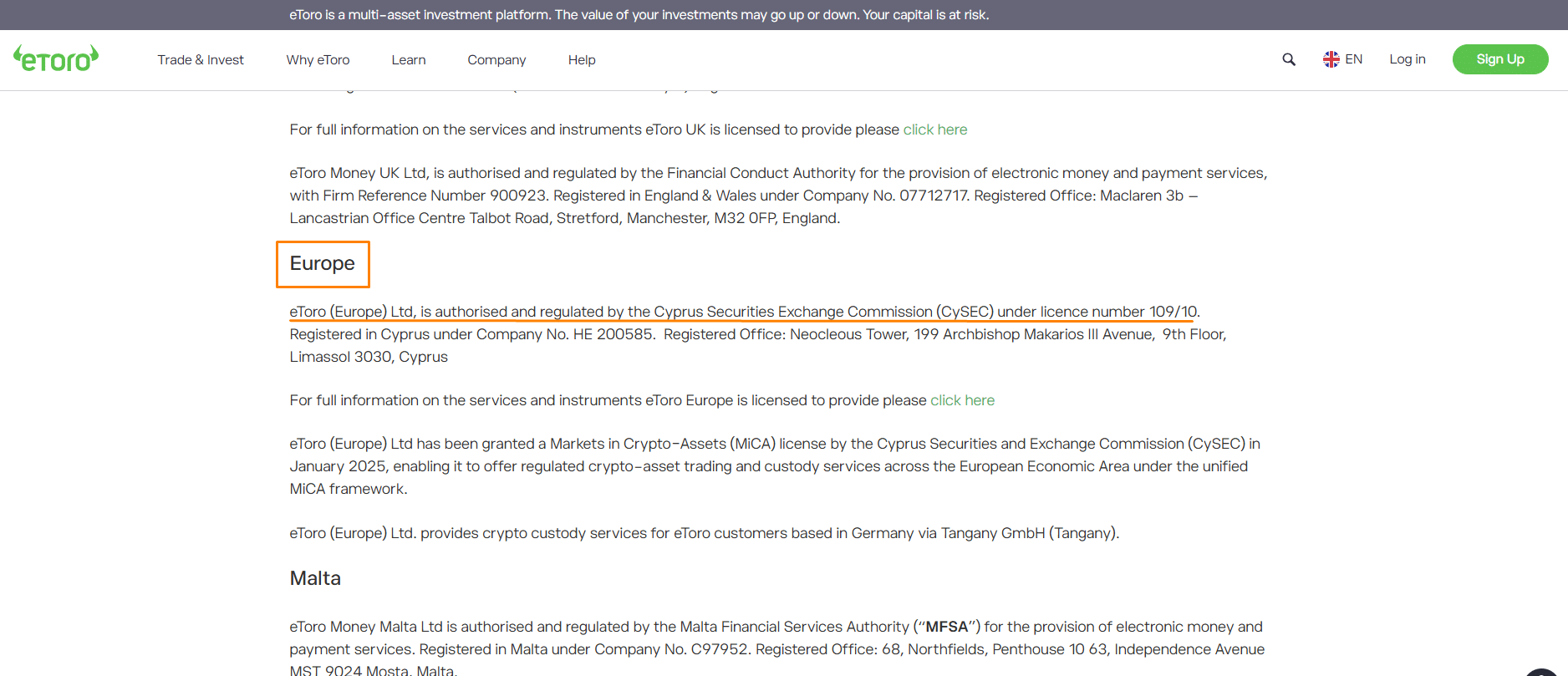
eToro operates in Greece through its EU-licensed entity, eToro (Europe) Ltd, which is regulated by the Cyprus Securities and Exchange Commission (CySEC) under licence number 109/10. This CySEC authorisation enables eToro to passport its services across the EU under the MiFID II single-market framework, including Greece. The Hellenic Capital Market Commission (Επιτροπή Κεφαλαιαγοράς, HCMC), Greece’s domestic financial regulator, recognises eToro’s EU passporting and permits the platform to operate in Greece without additional local restrictions.
For Greek investors, this means you benefit from the same EU-wide investor protections that apply to any CySEC-regulated broker, including coverage under the Cyprus Investor Compensation Fund (ICF) up to €20,000 in the unlikely event of broker insolvency.
eToro Greece highlights
| 👨⚖️ Legal in Greece | Yes (via eToro Europe Ltd, CySEC-regulated, EU passporting to Greece) |
| 💰 Stocks fees | $1 per trade on most stocks ($2 on AU/HK/Dubai/Abu Dhabi exchanges) |
| 💰 Real ETFs fees | $0 commission (other fees may apply) |
| 💰 CFDs fees | Variable spreads + overnight financing costs |
| 💰 Crypto fees | Spread-based pricing (typically ~1% per side) |
| 💰 Inactivity fee | $10/month after 12 months of inactivity |
| 💰 Withdrawal fee | $5 minimum, $30 minimum withdrawal amount |
| 💱 FX conversion fee | None for EUR accounts (now available); standard conversion fees apply otherwise |
| 💵 Minimum deposit | $50 (first deposit); $10 for subsequent deposits |
| 📍 Products offered | Real stocks, real ETFs, real cryptocurrencies, CFDs (stocks, ETFs, indices, commodities, forex, crypto), Smart Portfolios, CopyTrader |
| 🎮 Demo account | Yes – $100,000 in virtual funds |
| 📈 Listed | NASDAQ (ticker: ETOR) since May 2025 |
| 📜 Regulatory entities | FCA (UK), CySEC (Cyprus, EU passporting), ASIC (Australia), ADGM FSRA (UAE), SEC/FINRA (US) |
How safe is eToro?
This is typically the first question that comes to mind when choosing a broker – and rightly so. As investors ourselves, platform safety was our first concern too.
eToro offers three layers of safety for Greek investors:
- Segregated client assets: eToro operates as an intermediary in the financial system. When you buy a non-leveraged position in a stock or ETF, you acquire the actual financial asset, which is held in a segregated custodian account separate from eToro’s own balance sheet. This means if something went wrong with eToro itself, you would be able to transfer your securities to another broker – they aren’t part of eToro’s assets that creditors could claim. eToro’s primary custodian is Pershing LLC, a BNY Mellon subsidiary, providing institutional-grade custody.
- Investor compensation scheme (regulatory protection): as a Greek investor, your account is opened through eToro (Europe) Ltd, authorised and regulated by the Cyprus Securities and Exchange Commission (CySEC) under licence 109/10. As a CySEC-authorised firm, eToro must maintain membership of the Cyprus Investor Compensation Fund (ICF), which provides coverage of up to €20,000 per client per account in the event of broker insolvency. This is the same standard EU investor protection that applies to most EU-regulated brokers.
- Private insurance (additional layer): eToro has historically maintained a private insurance policy through Lloyd’s of London providing additional coverage above the regulatory minimum (with specific limits depending on the type of loss and client jurisdiction). Verify the current insurance terms and coverage limits directly with eToro before relying on this layer, as the specific policy terms have evolved over time.
- NASDAQ listing transparency: a fourth safety consideration worth mentioning – as a NASDAQ-listed public company (ETOR) since May 2025, eToro is now subject to ongoing SEC disclosure, audit, and corporate governance requirements. This adds meaningful financial transparency beyond standard broker regulation, with public quarterly earnings, audited financial statements, and analyst coverage.
If you need more details on eToro’s safety framework, check our analysis of eToro safety.
What financial instruments and features will I find?
eToro offers Greek investors access to a wide range of financial products:
- Real stocks: trade stocks from 20+ international exchanges, including New York Stock Exchange, NASDAQ, London Stock Exchange, Euronext (Paris, Amsterdam, Brussels, Lisbon), Frankfurt/Xetra, SIX Swiss Exchange, Borsa Italiana (Milan), BME (Madrid), Hong Kong Stock Exchange, ASX (Australia), and others. Note: eToro does not currently offer direct trading on the Athens Stock Exchange (ASE) – Greek investors looking for ASE-listed stocks need to use a Greek-domestic broker.
- Real ETFs: commission-free trading on a wide selection of ETFs from major providers including iShares, Vanguard, SPDR, Invesco, PIMCO, ARK, VanEck, WisdomTree, and others – covering broad equity indices, sector themes, bonds, commodities, and ESG strategies.
- Real cryptocurrencies: direct ownership of major cryptocurrencies (Bitcoin, Ethereum, and others) through eToro’s MiCA-regulated crypto offering – not just CFDs on crypto prices.
- Commodities: exposure to gold, silver, copper, platinum, palladium, oil, natural gas, and agricultural commodities (typically via CFDs).
- Forex: access to over 50 currency pairs, including major pairs (EUR/USD, GBP/USD, USD/JPY), minor pairs, and selected exotic pairs.
- CFDs: eToro offers CFDs on stocks, ETFs, indices, commodities, forex, and cryptocurrencies for leveraged trading. CFDs are complex instruments and carry significant risk – around 51% of retail accounts lose money trading CFDs at eToro (as required disclosure by EU regulators).
Beyond traditional trading, eToro’s distinctive features include:
- CopyTrader: automatically replicate the trades of other successful eToro investors in real time – you can copy up to 100 traders simultaneously, with proportional position sizing based on your allocation.
- Smart Portfolios: ready-made thematic investment portfolios curated around specific strategies (AI, renewable energy, dividend aristocrats, big tech, etc.) – essentially pre-built diversified baskets you can invest in with one click.
- eToro Academy: extensive educational content covering investing basics, technical analysis, options strategies, and more.

eToro’s fees
Like any broker, eToro generates revenue through a combination of trading commissions, spreads, and ancillary fees. Here’s the current fee structure for Greek investors:
- Stock trading: $1 commission per trade on most exchanges (US, UK, EU). Stocks listed on Australian, Hong Kong, Dubai, and Abu Dhabi exchanges incur a $2 commission per trade.
- Real ETFs: $0 commission, though other fees may apply (FX conversion if not in EUR account).
- Real cryptocurrencies: spread-based pricing (typically around 1% per side, varying by cryptocurrency).
- CFDs: variable spreads (priced into the bid-ask difference) plus overnight financing costs on leveraged positions held overnight. Spreads vary significantly by instrument, so check the eToro fees page for the products you plan to trade.
- FX conversion: no conversion fee for Greek investors using EUR-denominated accounts (now available). Standard conversion fees apply when trading assets in other currencies (e.g., USD-denominated stocks held in non-EUR accounts).
- Withdrawal fee: $5 per withdrawal, with a $30 minimum withdrawal amount.
- Inactivity fee: $10 per month after 12 months of inactivity (no logins). Easy to avoid by logging in periodically.
- No account opening or custody fees.
For Greek investors specifically, the recent EUR account availability is a meaningful improvement – it eliminates the FX conversion cost layer that previously applied when funding accounts from Greek euro bank accounts. For comprehensive fee details across specific instruments, always consult eToro’s official fees page before trading.
How to open an account?
To open an account, you need to go to eToro’s website, click on “Join now”, and provide the required information, as shown in the following image:

In the first check box (underlined in red), confirm in which subsidiary you are registering.
After this step, you need to verify your identity and address. Your proof of identity could be your ID or your passport. Meanwhile, your proof of residency could be your driving licence, a copy of a bank statement or a utility bill.
We suggest you submit all the remaining documents as soon as you open an account to prevent delays when withdrawing your money! We have witnessed no issues in taking money out of the platform, but it may take a more extended period if your account is not fully updated or verified.
Once everything is correctly set up, you’ll be able to deposit money to start trading with your real account on the eToro platform:
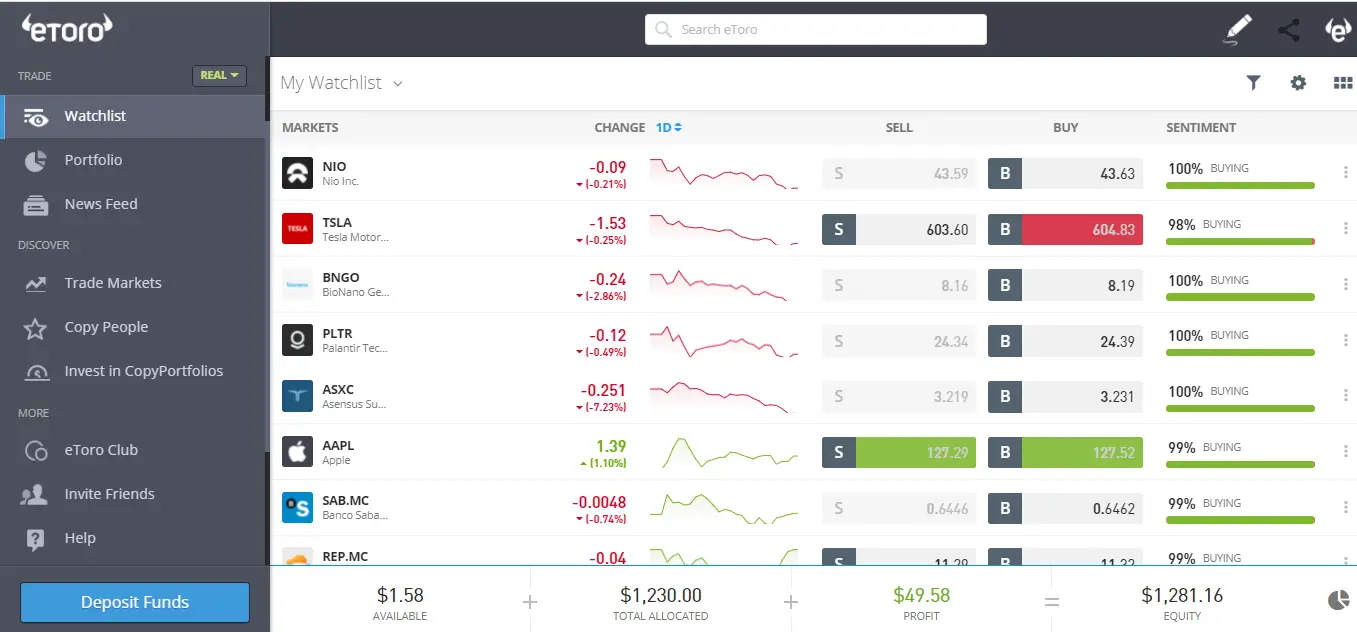
It is effortless to navigate through all the sidebars and the search function on the top. We are confident that you will find what you came looking for in less than a minute.
How to deposit and withdraw funds?
Before committing real money, remember you can use eToro’s demo account (with $100,000 in virtual funds) to practise and explore the platform first.
Deposits: from your eToro dashboard, click “Deposit Funds” to see the supported deposit methods. Greek investors can typically use:
- Credit/debit card (Visa, Mastercard) – instant deposit
- SEPA bank transfer – free for EUR transfers within the EU, typically 1-3 business days
- Skrill, Neteller, or other e-wallets – instant deposit
- Rapid Transfer – instant deposit through online banking
- Apple Pay / Google Pay – instant where available
The minimum first deposit for Greek investors is $50 (approximately €45-50 depending on EUR-USD rate), with subsequent deposits starting from $10. There are no eToro-side deposit fees.
Withdrawals: click “Withdraw Funds” on your dashboard. eToro typically requires withdrawals to use the same method as your deposit (this is standard anti-money-laundering practice across regulated brokers). Key facts:
- Minimum withdrawal: $30
- Withdrawal fee: $5 per withdrawal (fixed)
- Processing time: typically 1-3 business days for the withdrawal to be processed, plus your bank’s processing time on top
FX conversion – now much improved for Greek investors: previously, eToro applied currency conversion fees (typically 0.50%) on both deposits and withdrawals if you funded in EUR rather than USD, since the underlying account was USD-denominated. Now that eToro offers EUR-denominated accounts, Greek investors funding from EUR bank accounts can avoid these conversion costs entirely – a meaningful improvement. Conversion fees still apply when trading assets denominated in currencies other than your account base currency (e.g., USD-denominated US stocks held in a EUR account will incur conversion costs on trade execution).
For larger deposits where any remaining conversion costs add up, services like Wise can offer better FX rates than traditional bank transfers – though with EUR accounts now available at eToro, this matters less than it used to for Greek investors.
How to trade stocks or any other security?
The process for buying or selling stocks is straightforward, and is similar to other asset classes (ETFs or any security).
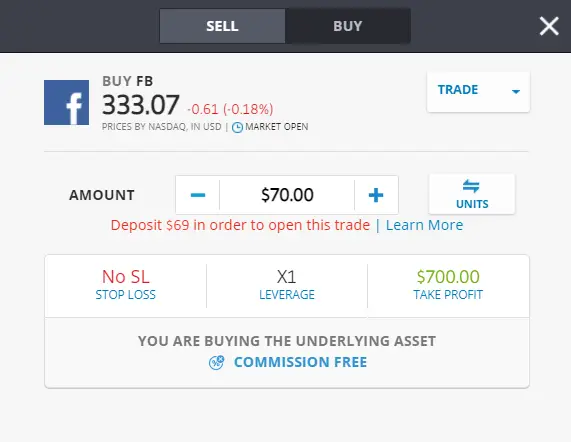
First, use the search bar to find the company you are looking for and then click on “Trade”, as shown in the image below:
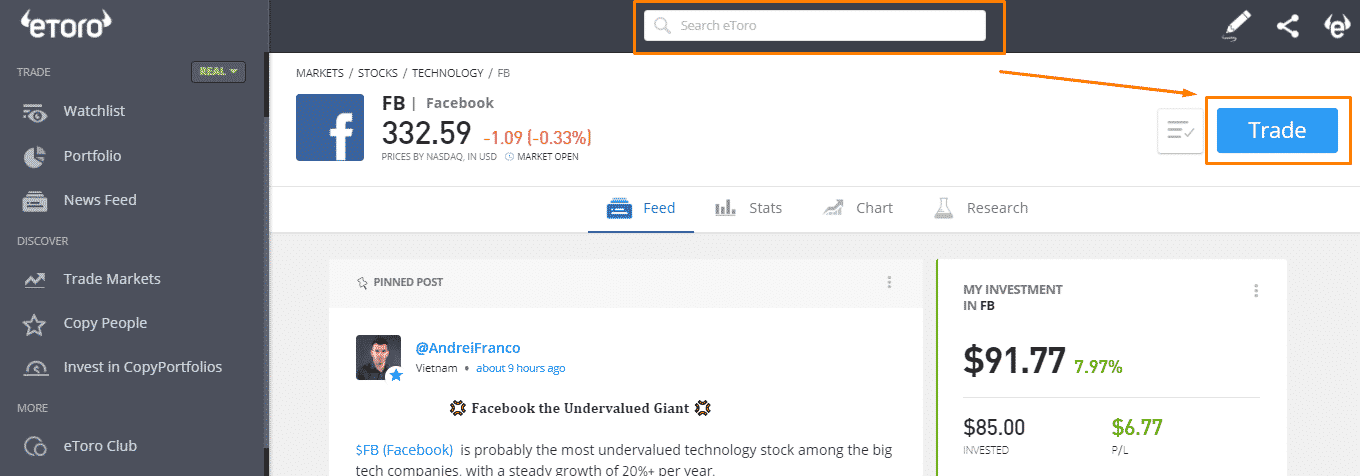
Second, a pop-up will appear where you can buy (or short) the stock. In this case, you are buying the underlying asset, and not a CFD. If you want to leverage your investment, you will need to change the “X1 LEVERAGE” to “X2” or to any other level of exposure that eToro allows.
Customer support
Our assessment of eToro’s customer support comes from direct experience contacting the team multiple times. Response times have improved noticeably over the past few years – particularly since the post-Covid period when many brokers faced unprecedented support volumes during the retail trading boom.
In our experience, response times currently average 1-3 business days for non-urgent queries, with most straightforward issues resolved on the first contact. Longer waits (5-7 days) are uncommon but can occur during high-volume periods (market volatility events, major product launches, etc.).
eToro offers several support channels:
- In-app live chat for account holders (faster response times than email)
- Help Centre / FAQ covering most common questions about deposits, withdrawals, trading, and account management
- Email support via the contact form on the eToro website
- Premium client services for eToro Club members (higher-balance tiers receive prioritised support and dedicated account managers)
Note that eToro’s customer support is primarily English-language, though the platform interface itself is available in Greek and many other European languages.
The bottom line
eToro is a solid option for Greek investors at all experience levels – beginners benefit from the intuitive interface, demo account, and educational content; intermediate investors appreciate the broad asset range and social investing features; and more sophisticated users can leverage CopyTrader, Smart Portfolios, and CFDs for advanced strategies.
Particularly meaningful improvements since eToro entered the Greek market:
- EUR account availability – eliminates the FX conversion costs that previously applied to Greek investors funding from EUR bank accounts.
- NASDAQ listing (ETOR, May 2025) – adds public-market transparency, SEC disclosure, and audited financial reporting to the safety story.
- Real cryptocurrency access – direct ownership of crypto under MiCA regulation, not just CFD exposure.
- Expanded regulatory footprint – now regulated by FCA, CySEC, ASIC, ADGM FSRA, and SEC/FINRA across multiple jurisdictions.
Important caveats for Greek investors:
- No Athens Stock Exchange access – if you want to invest in Greek-listed stocks (Hellenic Bank, OPAP, Public Power Corporation, etc.), you’ll need a Greek-domestic broker alongside eToro.
- Greek tax framework applies – capital gains and dividends from eToro investments are subject to Greek tax rules. As of recent legislation, Greek residents pay 15% on dividends and may be subject to capital gains tax depending on the specific instrument and holding pattern. eToro doesn’t withhold Greek tax at source – you handle your own reporting through your annual tax declaration to the AADE (Independent Authority for Public Revenue).
- CFDs carry significant risk – around 51% of retail accounts lose money trading CFDs at eToro. If you’re new to investing, focus on real stocks and ETFs rather than leveraged products.
For a complete overview of how eToro operates globally, read our eToro review.
CFDs are complex instruments and come with a high risk of losing money rapidly due to leverage. 52% of retail investor accounts lose money when trading CFDs with this provider. You should consider whether you understand how CFDs work and whether you can afford to take the high risk of losing your money.