This article guides you step by step through investing in the S&P 500 on XTB, from choosing the right ETF to placing your first order. XTB is a regulated broker, and you can learn more about its safety in our article on whether XTB is safe.
Video summary
Pick an ETF tracking the S&P 500
You can’t buy the S&P 500 index directly. However, you can invest in it through an instrument that replicates its performance, such as an exchange-traded fund (ETF).
The table below shows four of the largest S&P 500 ETFs that use physical replication and are available on XTB. All four replicate the index physically and are domiciled in Ireland. If you want to see all S&P 500 ETFs (some may not be available on XTB), check justETF.
| Name | Fund size (€ billion) | TER | Use of income | Ticker* | ISIN |
| iShares Core S&P 500 UCITS ETF | 134.4 | 0.07% | Accumulating | SXR8 | IE00B5BMR087 |
| Vanguard S&P 500 UCITS ETF (USD) Distributing | 45.8 | 0.07% | Distributing | VUSA | IE00B3XXRP09 |
| Vanguard S&P 500 UCITS ETF (USD) Accumulating | 31.1 | 0.07% | Accumulating | VUAA | IE00BFMXXD54 |
| iShares Core S&P 500 UCITS ETF USD (Dist) | 19.9 | 0.07% | Distributing | IUSA | IE0031442068 |
*Each ETF trades under different tickers on different exchanges. We chose the EUR-denominated tickers on XTB for simplicity. Source: justETF, fund sizes as of 14 September 2026.
We would consider any of these four ETFs for the following reasons:
- All have a total expense ratio (TER) of 0.07% a year, which is low. For example, €100 invested in any of them only costs you 7 cents a year.
- They use physical replication, meaning they buy the shares in the index. Synthetic ETFs use derivatives (swaps) instead, which adds counterparty risk, although it can sometimes lower costs.
- They are among the largest S&P 500 ETFs by fund size, which makes them very unlikely to be closed.
Out of these four, the iShares Core S&P 500 UCITS ETF (SXR8) and the Vanguard S&P 500 UCITS ETF (USD) Accumulating (VUAA) are accumulating ETFs, meaning that dividends are reinvested inside the fund. This can be useful for tax reasons in some countries, where dividends paid out to you are taxed.
Some newer S&P 500 ETFs have an even lower TER of 0.03% a year, such as the State Street SPDR S&P 500 UCITS ETF and the UBS Core S&P 500 UCITS ETF. If you want to compare more options, type “S&P 500” in the XTB search bar and scroll through the results:

Place a buy order
Let’s say you have decided to invest in the iShares Core S&P 500 UCITS ETF (SXR8). The process is the same for the other ETFs. In this example, we use XTB’s xStation desktop platform:
- Search for the chosen ETF using its ticker:

- Click “BUY”
A new window appears below the search bar, where you choose the number of shares you want to buy. We chose 1 share, but you could also buy 0.50 shares, for example, as XTB offers fractional shares:

- Click “CONFIRM”: all the order details will appear, including the costs (commission-free in this case):

And that’s it! You are now invested in the S&P 500.
If you prefer to invest a fixed amount regularly, XTB also offers Investment Plans, which let you build a portfolio of ETFs and invest automatically, with no extra fee for creating or managing the plan.
XTB ETF fees
XTB charges 0% commission on stocks and ETFs up to €100,000 of monthly turnover. What does monthly turnover mean? If, in a given month, you buy an ETF for €100 and then sell it for €100, your monthly turnover is €200.
Above the €100,000 limit, XTB charges a 0.2% commission (minimum €10) on the trade value.
If you invest in ETFs quoted in a currency other than your account currency, a 0.5% currency conversion fee applies. For example, SXR8 trades in EUR on XTB, so there is no conversion fee if you have a EUR account.
What to look for in an ETF
Not all ETFs are created equal. Different asset managers offer ETFs tracking the same index (like the S&P 500), and the main differences are:
1. Fees (TER)
Asset managers like BlackRock (iShares) or Vanguard charge a small annual fee, which is deducted from the fund’s assets throughout the year. A lower fee means lower costs and, all else being equal, higher returns for you. This fee is usually shown as the total expense ratio (TER) or ongoing charges figure (OCF).
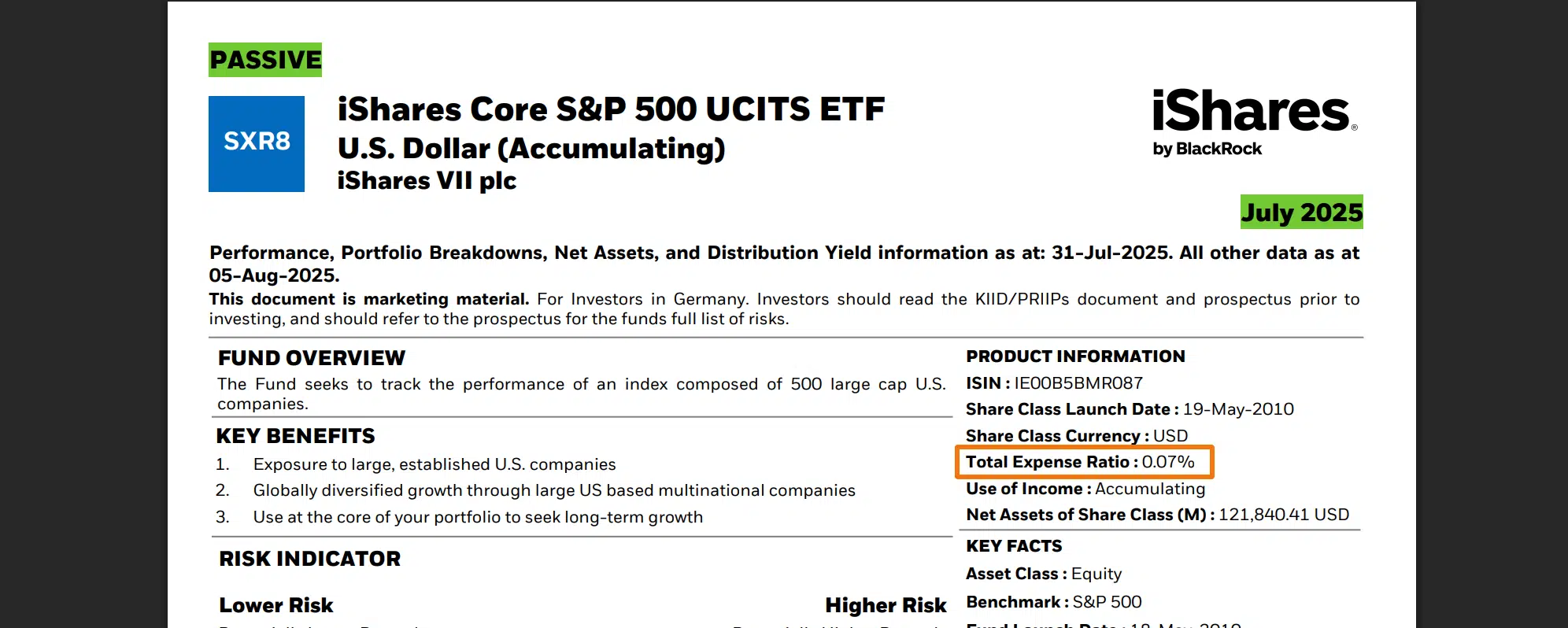
For the iShares Core S&P 500 UCITS ETF (SXR8), you can check its TER of 0.07% in the factsheet:
2. Replication method
An ETF can replicate its index in two ways:
- Physical replication means the ETF buys the assets included in the index.
- Synthetic replication means the ETF uses derivatives (swaps) to replicate the index’s performance.
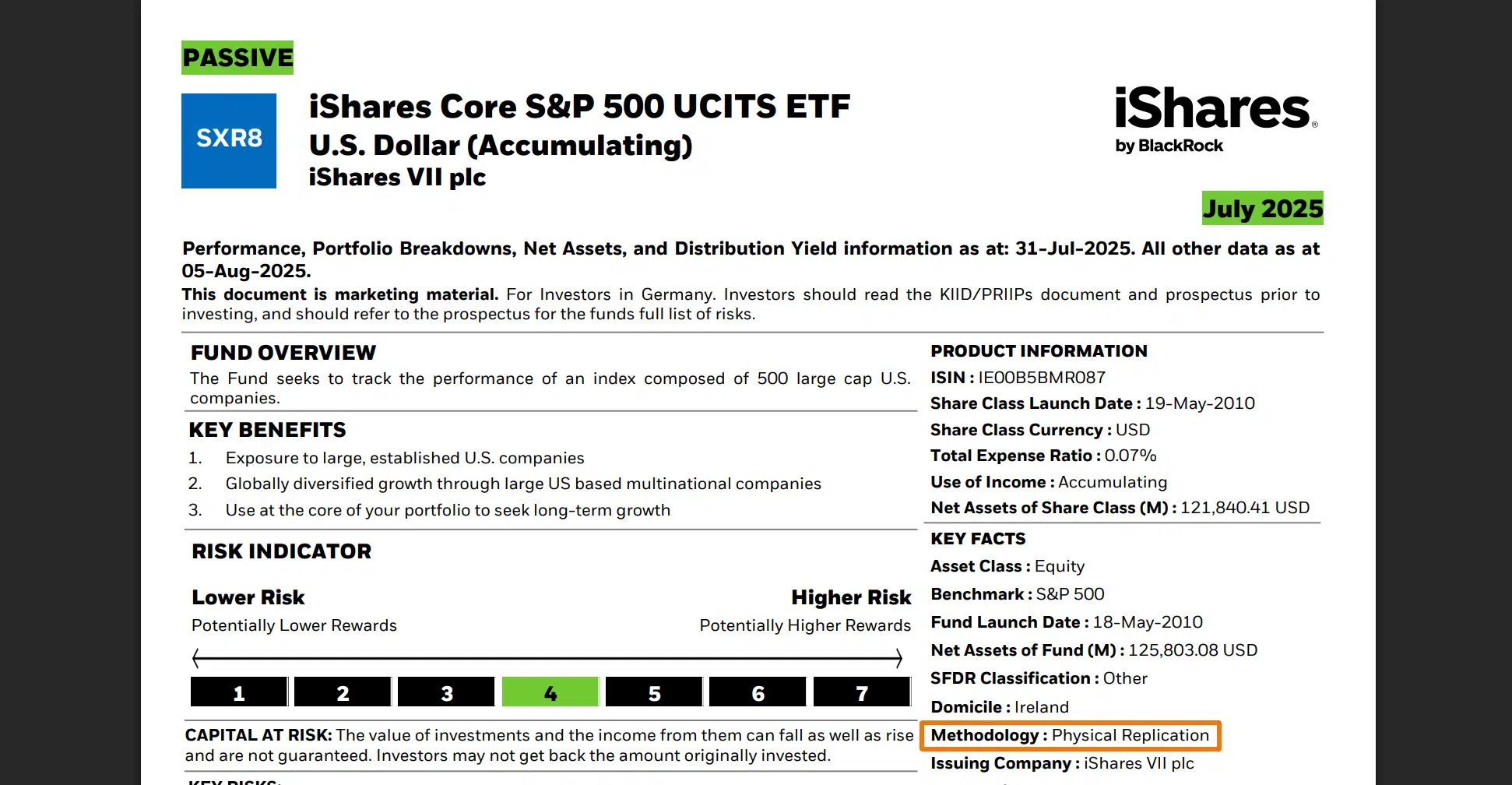
The companies in the S&P 500 are very liquid, so physical replication works well and avoids the counterparty risk of derivatives. The same ETF shows “Physical Replication” as its methodology:
3. Use of income
ETFs also differ in what they do with the dividends they receive:
- Accumulating ETFs reinvest the dividends inside the fund, so their price grows faster than that of an identical distributing ETF. In some countries, this is tax-efficient, because you don’t receive (and are not taxed on) the dividends each year.
- Distributing ETFs pay the dividends out to you regularly (usually quarterly), directly into your brokerage account. In most countries, you have to declare and pay tax on these dividends.
Which one is better? There is no single right answer, as it depends on your goals and your country’s tax rules. If you are investing for the long term and don’t need income, an accumulating ETF may suit you better. If you want regular income, a distributing ETF may be the better choice.
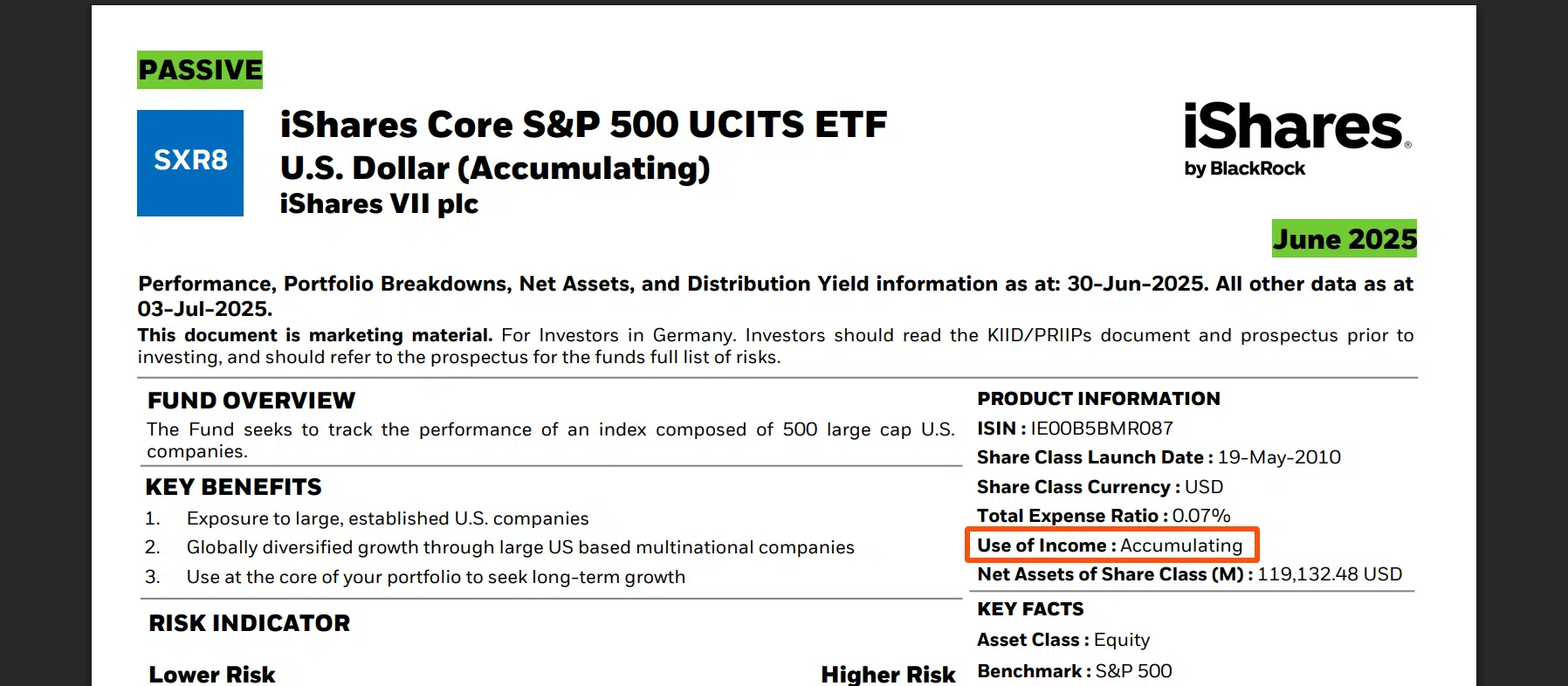
SXR8 is “Accumulating”:
4. Size
The fund size also matters. Smaller funds generally have a higher risk of being closed. If a fund is closed, it sells all its holdings, settles its obligations and pays the remaining value to its investors, which can create an unwanted taxable event.
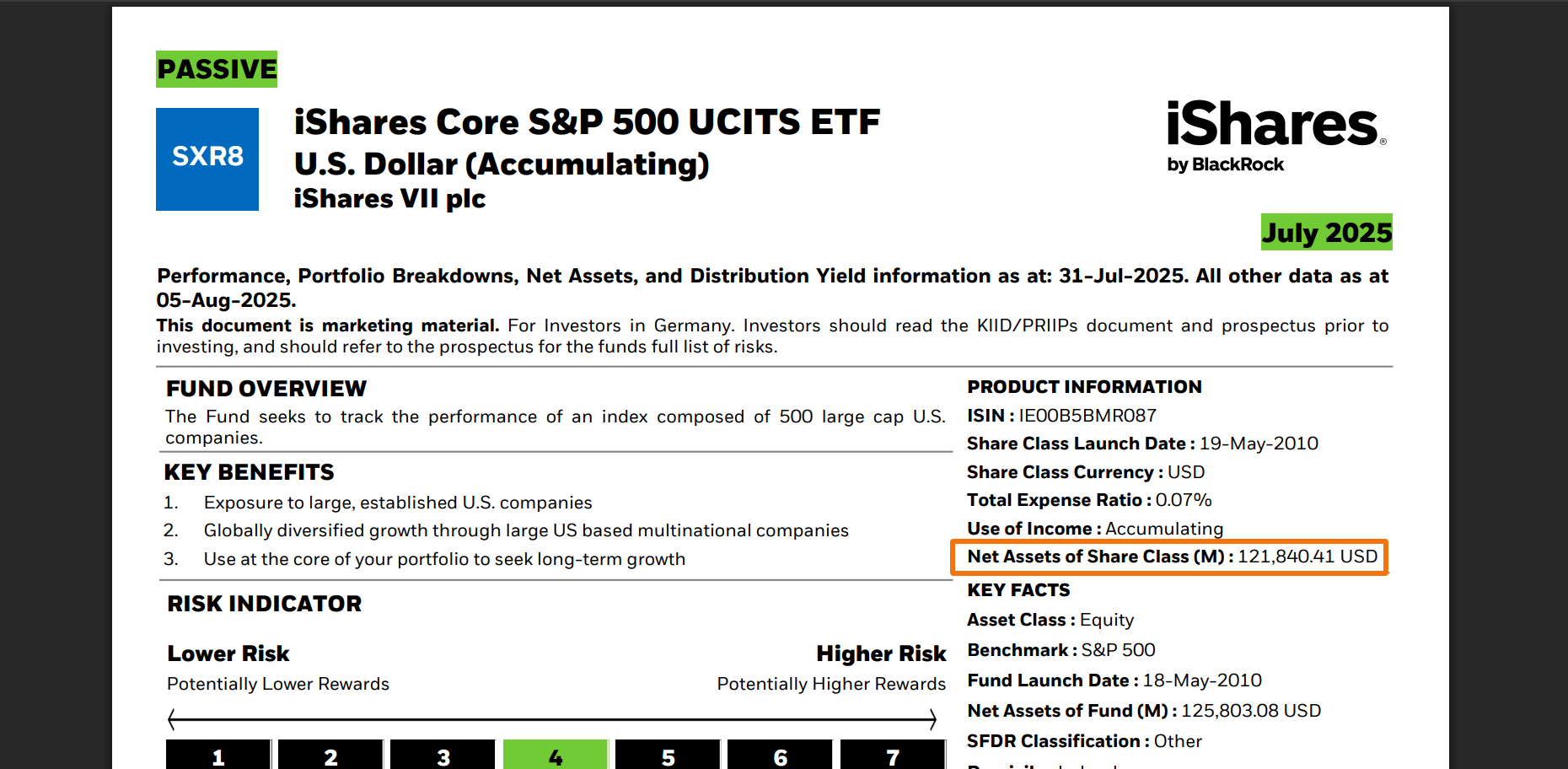
SXR8 is the largest S&P 500 UCITS ETF, with a fund size of over €134 billion (as of September 2026). You can check the current figure on the factsheet:
5. Currency hedging
Some ETFs use derivatives to protect against currency fluctuations, for example between the US dollar and the euro. This hedging has an extra cost, but it reduces the impact of currency swings on your returns. The four ETFs above are all unhedged, so their value in euros also depends on the EUR/USD exchange rate. Many long-term investors accept this currency risk to keep costs low.
Bottom line
To sum it up, here’s what you need to do:
- Pick an ETF tracking the S&P 500: compare fees, replication method, use of income and fund size.
- Open an account and deposit money into XTB: complete the account opening process and fund your account.
- Place a buy order for the chosen ETF: search for the ETF, enter the amount or number of shares and confirm your order.
We hope this guide answered your questions. Make sure to do your own research to find the investing strategy that suits you best.
FAQs
What is the S&P 500?
The S&P 500 is an index that tracks around 500 of the largest US companies, weighted by their free-float market capitalisation. It includes well-known companies such as Apple, Microsoft, Nvidia and Amazon.
What is an exchange-traded fund (ETF)?
An ETF is a fund traded on a stock exchange that holds assets such as stocks. When you buy an ETF, you indirectly invest in its whole portfolio. An S&P 500 ETF tracks the performance of the companies in the index, so you can invest in around 500 companies with a single purchase.
Is it possible to invest directly in the S&P 500?
No. An index measures the performance of a theoretical portfolio, so you can’t buy it directly. Instead, you can invest in a fund that tracks it, such as an ETF.
What are CFDs? Should I invest in S&P 500 CFDs?
CFD stands for contract for difference. CFDs let investors speculate on price movements (up or down), usually with leverage, without owning the underlying asset. They are complex, high-risk products and are not suitable for beginners. Learn more in our article on CFDs vs shares.
Can Europeans invest in SPY or VOO?
In most cases, no. Retail investors in the EU usually can’t buy US-domiciled ETFs such as SPY or VOO, because these funds don’t provide the key information document (KID) required under the PRIIPs rules. The Irish-domiciled ETFs in this article are UCITS alternatives available to European investors.
Is now a good time to invest in the S&P 500 from Europe?
No one can reliably predict short-term market movements. Historically, the S&P 500 has tended to rise over long periods, but past performance doesn’t guarantee future results, and there have been long periods of losses. Investing regularly over time can reduce the risk of investing everything at a bad moment.
Why should I invest in the S&P 500 from Europe?
Over the past decades, the S&P 500 has performed better than most European stock indices, and it gives you exposure to many of the world’s largest companies. However, past performance doesn’t guarantee future results, and investing only in the US concentrates your portfolio in one country and in the US dollar, so consider how it fits into a diversified portfolio.