


Safety is a top concern when choosing a broker, especially for beginners. XTB is a well-known European broker, and this article looks at whether it is a safe choice.
We cover how XTB protects client assets through asset segregation and investor compensation schemes, whether your cash has deposit protection, what its status as a publicly listed company means for you, and how it compares with Interactive Brokers, eToro and Trade Republic. The focus is on European investors, but we cover the other regions XTB serves too.
Highlights
- Is XTB safe? Yes, we believe XTB is a legitimate and safe broker for most investors. For brokers we don’t recommend, check our broker list and filter for “not approved”.
- Regulation: XTB is regulated by top-tier regulators, including the FCA in the UK, the KNF in Poland and CySEC in Cyprus.
- Investor compensation scheme: covers both cash and securities, but not every XTB client has one. It depends on which XTB entity you are served by.
- Deposit protection: XTB does not have a banking licence, so your cash is not covered by a deposit guarantee scheme, only by the investor compensation scheme.
- Asset segregation: XTB keeps client funds separate from its own money, so they are not treated as XTB’s assets if the company fails.
- Reputation: XTB was founded in 2002 and has been listed on the Warsaw Stock Exchange since 2016.
- Financials: XTB reported a net profit of PLN 643.8 million in 2025 and an estimated PLN 1.03 billion in the first half of 2026 alone, a record.
Regulators
XTB operates through several regulated entities, each supervised by a local regulator. Regulation is what makes client money protection enforceable: regulators require brokers to hold enough capital, keep client money separate and report on their operations, and they can fine or suspend firms that break the rules.
XTB’s main licences are:
- Poland: XTB S.A., regulated by the Polish Financial Supervision Authority (KNF). This is the parent company and serves most EU clients, including those in Portugal, Spain, Germany and France, through local branches.
- United Kingdom: XTB Limited, authorised by the Financial Conduct Authority (FCA, FRN 522157).
- Cyprus: XTB Limited, regulated by the Cyprus Securities and Exchange Commission (CySEC, licence 169/12).
- United Arab Emirates: XTB MENA Limited, regulated by the Dubai Financial Services Authority (DFSA) since 2021. In 2026, XTB also obtained Category 1 and 2 licences to offer full brokerage services in the wider UAE.
- South Africa: XTB Africa, licensed by the Financial Sector Conduct Authority (FSCA) since 2021.
- Chile: a securities agent licence from the Comisión para el Mercado Financiero (CMF) since March 2025.
- Other countries: XTB International Limited, regulated by the International Financial Services Commission (IFSC) in Belize, an offshore regulator with lighter requirements.
You can check the full list on XTB’s governance page.
Investor compensation scheme
An investor compensation scheme pays you back, up to a limit, if a broker goes bankrupt and cannot return your cash or securities. It is a last resort: it only comes into play if client assets are missing, for example because of fraud or a failure to segregate them properly.
This is the protection you get depending on the XTB entity that serves you:
| Client country | Protection | Regulator | XTB entity |
| United Kingdom | £85,000 (FSCS) | FCA | XTB Limited (UK) |
| Most EU countries (incl. Portugal, Spain, Germany, France) | €20,100 (Polish scheme) | KNF | XTB S.A. |
| Cyprus | €20,000 (ICF) | CySEC | XTB Limited (CY) |
| United Arab Emirates | None | DFSA | XTB MENA Limited |
| South Africa | None | FSCA | XTB Africa |
| Other countries | None | IFSC (Belize) | XTB International Limited |
The Polish scheme covers 100% of losses up to €3,000 and 90% above that, up to a maximum payout of €20,100. Check which entity your account is opened with in your client agreement.
Asset segregation
Asset segregation means keeping client money and securities separate from the broker’s own funds. It is the most important protection you have, because it means that if XTB went bankrupt and there was no fraud, your assets would be returned to you, rather than being used to pay XTB’s creditors. The compensation scheme above only matters if segregation fails.
XTB holds client money in segregated bank accounts, separate from its operating accounts, and cannot use it for its own expenses or investments. This is required by all its main regulators. The FCA, for example, requires UK brokers to hold client money in segregated client bank accounts.
For retail clients in the EU and UK, XTB also offers negative balance protection on CFDs, so you cannot lose more than the money in your account.
Deposit protection
XTB is an investment firm, not a bank. Cash in your XTB account, including cash earning interest, is not covered by a deposit guarantee scheme like the €100,000 bank deposit guarantee in the EU. It is protected by segregation and, where it applies, by the investor compensation scheme, which has a lower limit.
If you plan to keep a large cash balance at XTB, it is worth keeping that difference in mind.
XTB is a publicly traded company
XTB is listed on the Warsaw Stock Exchange, so it has to publish audited financial statements, report quarterly and disclose anything that could affect its shareholders. That means you can check its financial health yourself, which you can’t do with most privately owned brokers.
The numbers are solid. XTB reported a net profit of PLN 856.9 million in 2024 and PLN 643.8 million in 2025, and an estimated PLN 1.03 billion in the first half of 2026, the best half-year in its history. By mid-2026 it had almost 1.5 million active clients and PLN 50.3 billion in client assets, according to its financial reports.
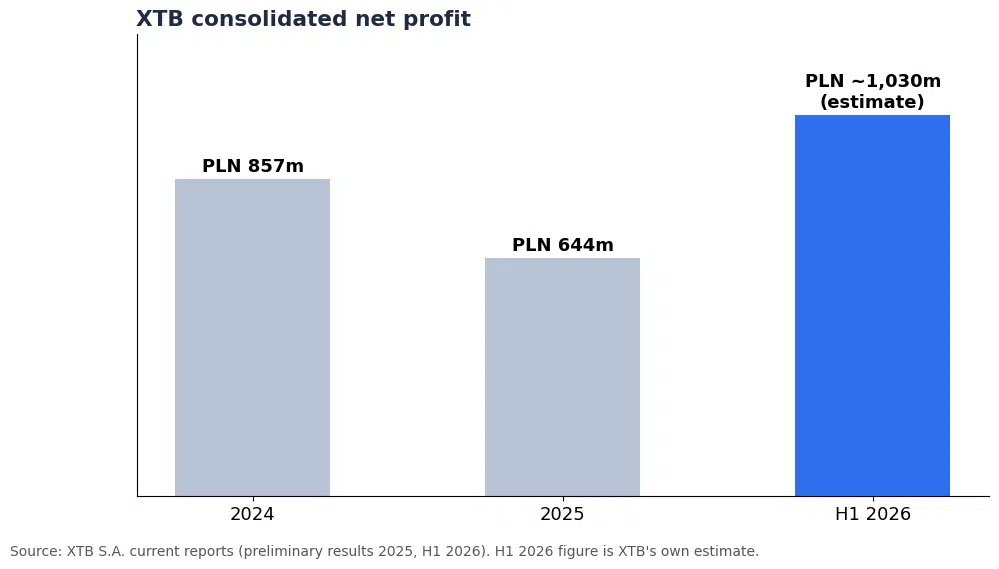
Source: XTB S.A. financial reports.
One point worth knowing: much of XTB’s recent profit came from CFD trading, and commodity CFDs alone accounted for 88.5% of trading revenue in the first quarter of 2026. That makes its earnings more volatile from year to year, although its capital position remains strong.
Being regulated also means being sanctioned when things go wrong. In 2026, XTB set aside PLN 20 million after the KNF issued a non-final decision to impose a financial penalty, and it was fined by the KNF in 2018. Supervisory fines like these are not unusual for large brokers, and they show the regulator is actively overseeing the company.
If you’re comfortable with what you’ve read, you can use our referral bonus on XTB to open an account.
How XTB compares with other brokers
Here’s how XTB’s protection compares with three brokers European investors often consider, for EU clients:
| Broker | Securities protection (EU) | Cash protection (EU) | Main EU regulator | Listed? |
| XTB | €20,100 (investor compensation) | €20,100 (investor compensation) | KNF (Poland) | Yes, Warsaw |
| Interactive Brokers | €20,000 (Irish ICCL) | €20,000 (Irish ICCL) | Central Bank of Ireland | Yes, NASDAQ |
| eToro | €20,000 (ICF) | €20,000 (ICF) | CySEC (Cyprus) | Yes, NASDAQ |
| Trade Republic | €20,000 (German EdW, 90% of losses) | €100,000 (German deposit guarantee) | BaFin (Germany) | No |
Limits apply per client and per institution. UK clients of all these brokers except Trade Republic are covered by the FSCS up to £85,000.
XTB’s protection is in line with Interactive Brokers and eToro. Trade Republic stands out on cash, because it holds a German banking licence and cash is covered as a bank deposit. On securities, all four offer similar protection, and in all cases segregation is the main safeguard.
Additional security tips
In practice, the real risks are operational problems, fraud and, if a broker does fail, how long it takes to get your assets back, which can be months or years. Two simple steps help:
- Use at least two brokers: not because you’re likely to lose your money, given the protections above, but so that all your assets are not frozen at once if one broker has a problem. Choose them deliberately. For example, Trading 212 holds client securities with Interactive Brokers as custodian, so having accounts only with those two gives you less diversification than it seems.
- Save a statement of your portfolio every month: a PDF export costs nothing and makes it much easier for administrators or regulators to identify your assets if something goes wrong.
Video summary
To learn more about broker safety, including real examples of broker bankruptcies, watch this video. It focuses on European brokers, but the principles apply everywhere:
Conclusion
Is XTB a safe broker? For European and UK investors, yes.
XTB uses the safeguards you should expect from a reputable broker: client funds are segregated, there are investor compensation schemes for EU and UK clients, and its finances are public and audited. Its protection is comparable to Interactive Brokers and eToro.
Two caveats are worth keeping in mind. Your cash is not covered by a bank deposit guarantee, and clients served by XTB’s entities outside the EU and UK have no compensation scheme at all, so the entity you open your account with matters.
No broker is completely risk-free, but XTB has multiple layers of protection that make it a reliable choice for beginners and experienced investors alike. For a full look at its fees and platform, read our XTB review.
Risk disclaimer: CFDs are complex instruments and come with a high risk of losing money rapidly due to leverage. You should consider whether you understand how CFDs work and whether you can afford to take the high risk of losing your money. When investing, your capital is at risk.



