This article will guide you through the process of investing in the S&P 500 on Trade Republic, covering the instruments to use and actually making your first investment.
Pick an ETF tracking the S&P 500
It is impossible to directly buy the S&P 500 index. However, you can invest in it through an instrument replicating every movement, like an Exchange-Traded Fund (ETF).
The table below shows four of the S&P 500 ETFs available in Trade Republic (in case you want to consult all the available S&P 500 ETFs available to Europeans – some may not be on Trade Republic – please go to justETF.com). We believe this list is enough for you to consider:
| Name | ISIN | Ticker* | Annual fee (TER) | Replication method | Use of income | Fund size (€ billion) |
| iShares Core S&P 500 UCITS ETF | IE00B5BMR087 | SXR8 | 0.07% | Physical | Accumulating | 81+ |
| Vanguard S&P 500 UCITS ETF | IE00B3XXRP09 | VUSA | 0.07% | Physical | Distributing | 30+ |
| Invesco S&P 500 UCITS ETF | IE00B3YCGJ38 | SPXS | 0.05% | Synthetic | Accumulating | 16+ |
| Xtrackers S&P 500 Swap UCITS ETF | IE0031442068 | IUSA | 0.07% | Physical | Distributing | 15+ |
*Each ETF has different tickers.
We would recommend one of the first two (iShares or Vanguard) for these reasons:
- Both present a total expense ratio (TER) of 0.07%, which is considered very low. Just to give an idea, €100 invested in any of those ETFs would only cost you 7 cents per annum;
- The replication method is “Physical,” meaning that you are investing in the underlying assets. When it is “synthetic”, it means that the ETF provider is using derivatives (exotic financial instruments) with inherent risks;
- These two are the biggest ETFs by asset under management (AUM), meaning that they are extremely unlikely to be closed down;
Still, if you want to explore more S&P 500 ETFs, go to the Trade Republic search bar and write “S&P 500”:

Place a “Buy Order”
So, let’s say you have decided to invest in iShares Core S&P 500 UCITS ETF (SXR8) – the process would be the same for the other ETFs.
- Search for the chosen ETF using the ticker symbol:

- Click “Review order”
Fill all the order details: the order type (market order by default), and the number of shares you want to buy:

- Click “Buy now”: All the details will appear (including the costs), and you are ready to trade by selecting “buy now”:

And that’s it! You are invested in the S&P 500!
S&P 500 ETF fees on Trade Republic
By purchasing an S&P 500 ETF, you will incur fees. According to the Trade Republic fees page, these would be the charges:
- External fee: You will only pay a €1 external fee;
And that’s it, nothing else! You can confirm the fees in our order below:

Payment for order flow: indirect fees
In its legal documents, Trade Republic reveals that it receives payments for forwarding its clients’ orders to trading systems or counterparties of the transactions.
These payments generally amount to up to 3 euros per order, but it can be a lot more.
What this means is that, in practice, you might not be receiving the best available price in the market, which can be seen as a hidden/indirect fee.
What to look for in any ETF?
Not all ETFs are created equal. Different asset managers provide different ETFs tracking the same indices (like the S&P 500). The main differences are:
1. Fees (TER)
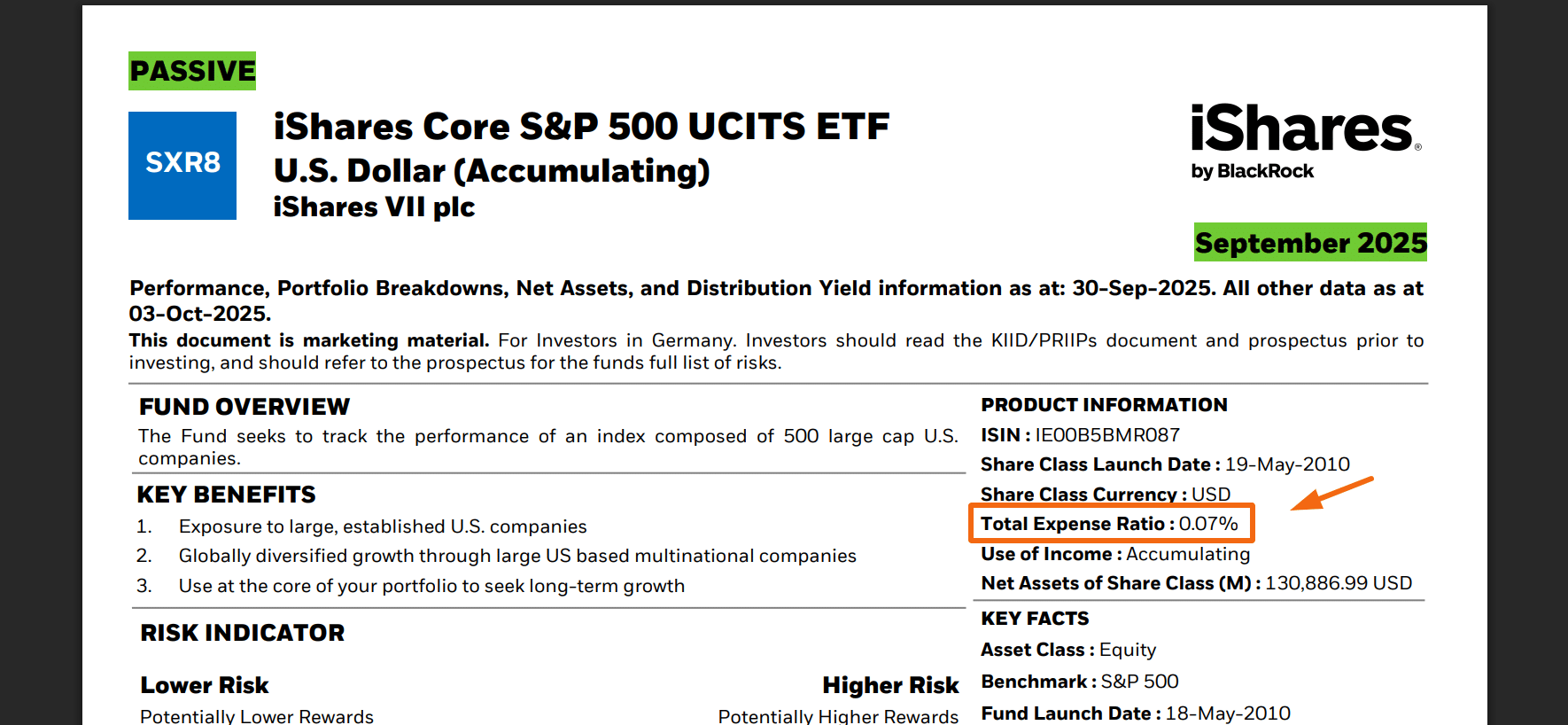
Asset managers like BlackRock (iShares) or Vanguard do not offer ETFs for free as they incur costs as well. Throughout the year, a small fee is subtracted from the fund’s assets. A lower fee will mean lower costs for you and, consequently, higher returns on our investments. Asset managers often list the overall cost of the fund. Ongoing charge (OCF) or total expense ratio (TER) are standard terms for this overall management fee.
Using the iShares Core S&P 500 UCITS ETF (SXR8) as an example, you can check its TER of 0.07% in the factsheet:
2. Replication method
It can be done in two ways:
- Physical replication ETFs means the ETF will try to buy the underlying assets laid out in the index.
- Synthetic replication ETFs means that the ETF uses financial derivatives to replicate the performance of the index.
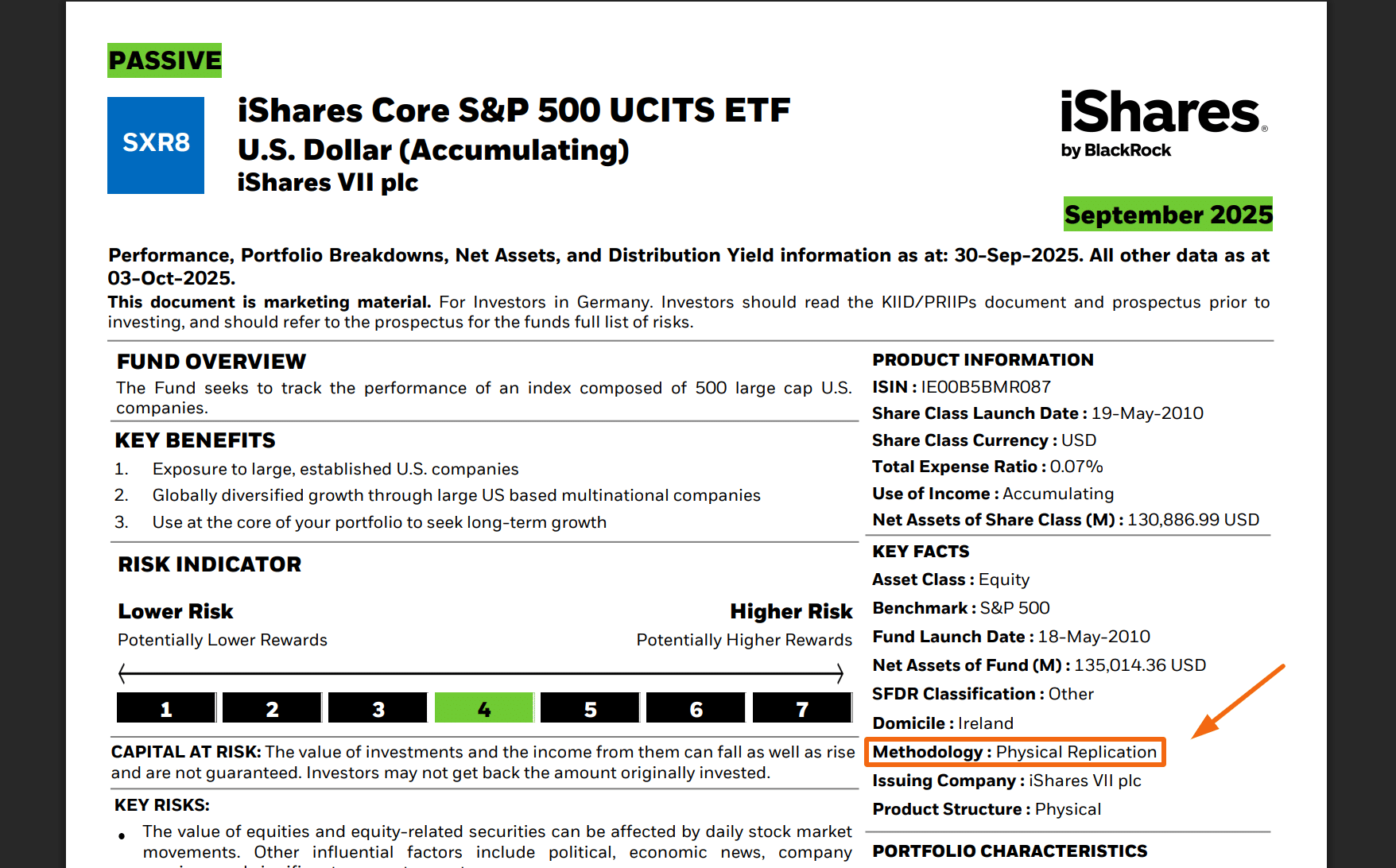
The underlying companies comprising the S&P 500 are very liquid, and thus physical replication is preferred as it does not incur any additional costs or risks related to derivatives. Using the same ETF, you can see its methodology as “Physical Replication”:
3. Use of Income
Apart from their product structure, the ETFs also distinguish between themselves in the following terms:
- Accumulating ETFs where the ETF reinvests the dividends it receives from the companies included in the index that decide to make that distribution. This will dictate a higher price for the ETF when compared to an identical distributing ETF, and, in some countries, it is tax advantageous because since the dividends are kept inside the ETF, you are not required to declare that amount;
- Distributing ETFs gives you on a regular basis (usually quarterly) the dividends that companies distribute. So, you will receive that amount directly in your brokerage account. Here, you will have to declare the dividends received.
Which one is better? There is no “correct” answer. It all comes down to your preferences. Do you plan to withdraw your investment in a 20-year time horizon? Maybe an accumulating ETF does a better job. Do you want to earn some regular income? Well, in that case, a distributing ETF will be the most appropriate choice.
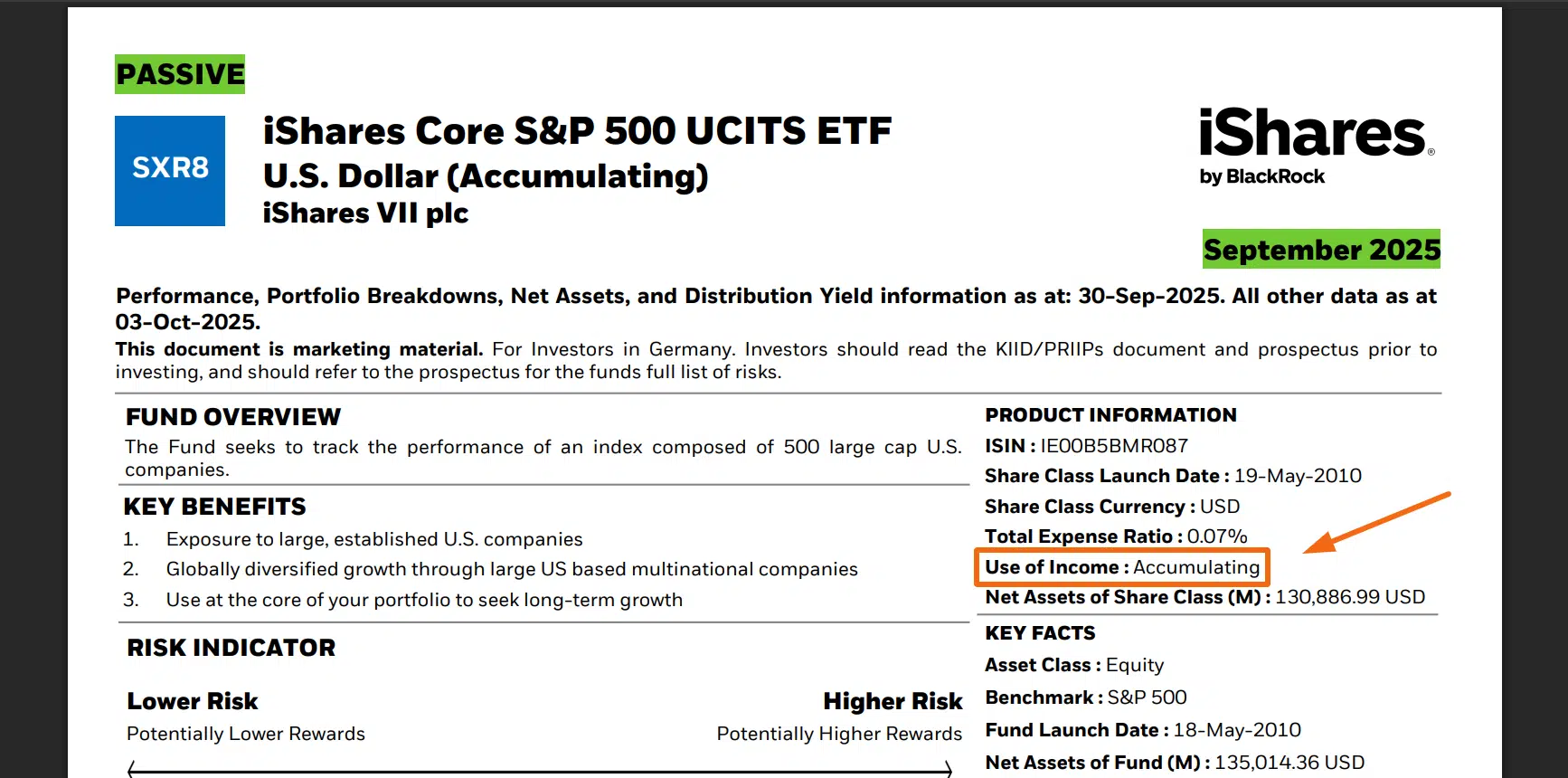
The SXR8 is “Accumulating”:
4. Size
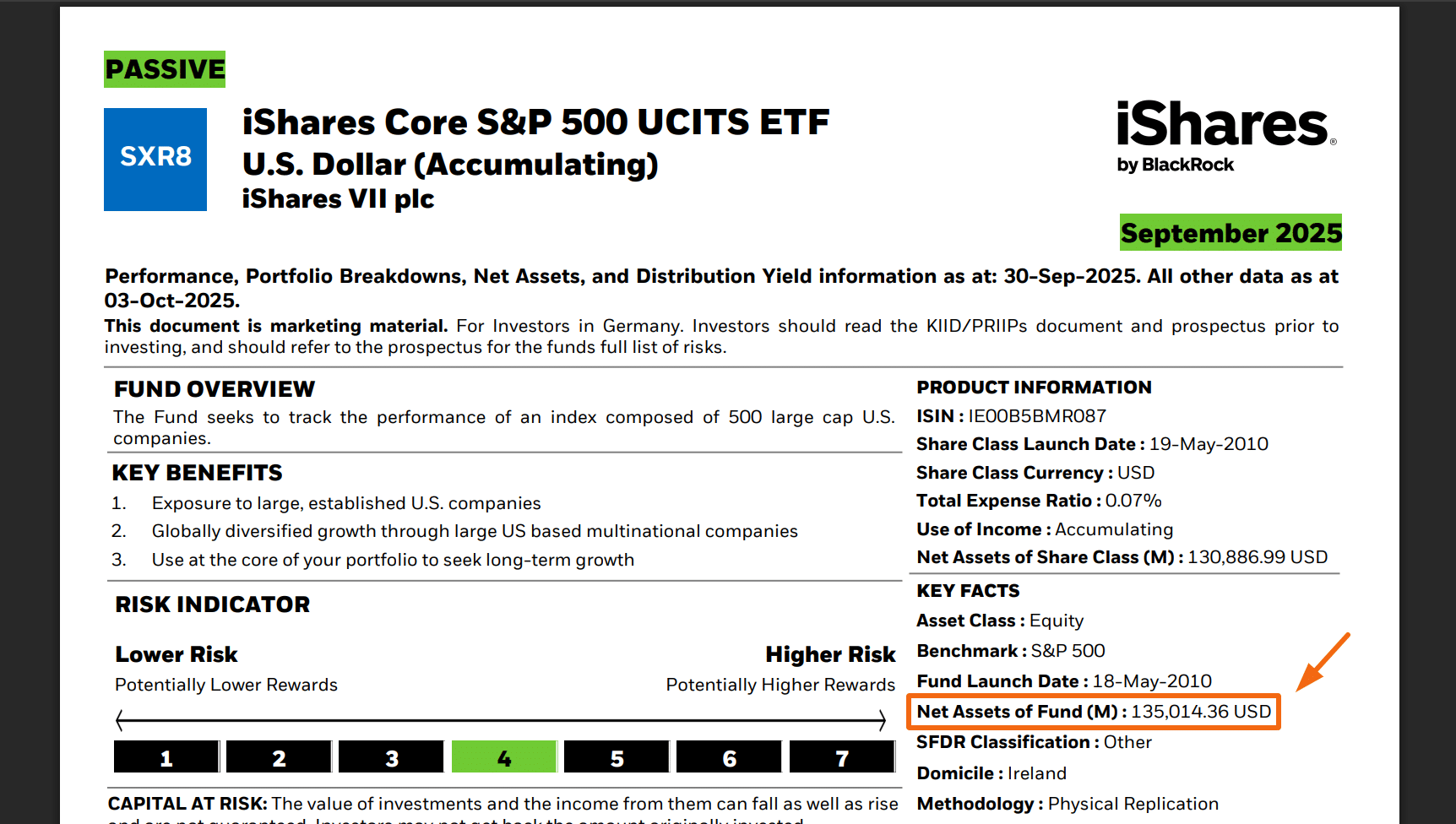
The overall fund size should also be taken into consideration. The size of an ETF can impact the likelihood of fund liquidation. Smaller funds generally run a higher risk of being liquidated than larger funds. In such a case, the fund will sell all its holdings, settle obligations and distribute the remainder to the fund holders.
The SXR8 has a net asset value of $130,886.99 million:
5. Hedging
ETFs can use financial derivatives to protect against currency fluctuations. This comes at an additional cost but might protect you against large currency swings. Our top 4 ETFs are all “unhedged” since we believe that over the long-term, currency fluctuations offset each other over time.
Bottom line
To sum it up, here’s what you need to do:
-
Pick an ETF tracking the S&P 500: Find an ETF tracking that index.
-
Open an account and deposit money into Trade Republic: After deciding which trading platform to use, you must go through the account opening process and deposit money.
-
Send a buy order for the picked ETF: That’s the easiest part (the process is intuitive)! After having your brokerage account and the name of the ETF that you want to buy, you just have to place a trade!
We hope that this post addressed some of your concerns. Make sure to do your own research to find out the best investing strategy for you!
Moreover, you might want to investigate whether Trade Republic is the platform that best suits your investments needs, as there many other trading platforms you can use. For example, you can invest in S&P500 on eToro , on DEGIRO or on Interactive Brokers.
FAQs
What is the S&P500?
The S&P 500 is an index tracking the leading 500 companies in the United States. It is calculated from the included companies’ share prices. The index includes large well known companies such as Apple, Amazon, and Microsoft.
What is an Exchange Traded Fund (ETF)?
An ETF is a publicly traded fund that holds assets like stocks. When you invest in an ETF, you indirectly buy a large portfolio of assets. In the case of an S&P 500 ETF that means it will track the performance of underlying holdings used in the index. That would mean you can easily gain exposure to over 500 different companies with just a single investment!
Is it possible to invest directly in the S&P 500?
No, an index is a measure of the performance of a theoretical portfolio, meaning that it is just a representation. It thus is impossible to directly buy an index.
What are CFDs? Should I invest in S&P500 CFDs?
CFD stands for contract for difference and allows investors to bet on price movements (either up or down), oftentimes with ample leverage. It is not recommended for novice investors to trade complex financial products. More about it here.
Can Europeans invest in SPY or VOO?
No, Europeans cannot buy SPY or VOO from Europe due to PRIIPS regulations. This article covers some alternatives available for EU investors.
Is now a good time to invest in the S&P 500 in Europe?
If anyone would know the future they would be rich. It is deemed impossible to predict short-term market movements, but history has shown that over a long time period, the stock market (or, more specifically, the S&P 500) tends to go up.
Why should I invest in the S&P 500 index from Europe?
The S&P 500 has historically performed significantly better than local indices in Europe. If an investor thinks this was to continue they should consider investing in the S&P 500 over local indices.