Investing in the S&P 500 is a popular strategy for those looking to gain exposure to a broad spectrum of the US stock market. The index is widely regarded as a barometer of the overall health of the US economy and is a staple in many investors’ portfolios.
This article guides you through investing in the S&P 500 on Lightyear, from choosing the right ETF to placing your first order.
Lightyear signup bonus: if you don’t have an account yet, check our Lightyear promo codes page to benefit from a signup bonus.
Disclaimer: Investing involves risk. See full T&Cs. Terms apply: lightyear.com/terms.
Video summary
Pick an ETF tracking the S&P 500
It is impossible to buy the S&P 500 index directly. However, you can invest in it through an instrument that replicates its performance, such as an exchange-traded fund (ETF).
The table below shows four of the largest S&P 500 ETFs available on Lightyear. If you want to see all the S&P 500 ETFs available to European investors (some may not be on Lightyear), check justETF.com, which lists 34 of them:
| Name | ISIN | Ticker* | TER | Replication | Income | Size (€ bn) |
| iShares Core S&P 500 UCITS ETF USD (Acc) | IE00B5BMR087 | SXR8 | 0.07% | Physical | Accumulating | 133 |
| Vanguard S&P 500 UCITS ETF (USD) Distributing | IE00B3XXRP09 | VUSA | 0.07% | Physical | Distributing | 45 |
| Vanguard S&P 500 UCITS ETF (USD) Accumulating | IE00BFMXXD54 | VUAA | 0.07% | Physical | Accumulating | 31 |
| iShares Core S&P 500 UCITS ETF USD (Dist) | IE0031442068 | IUSA | 0.07% | Physical | Distributing | 20 |
Fund size as of 10 September 2026 (source: justETF). *The same ETF has different tickers on different exchanges. We chose the tickers of the EUR-denominated listings on Lightyear for simplicity.
We would recommend SXR8 or VUAA, for these reasons:
- Both have a total expense ratio (TER) of 0.07% a year, which is very low: €100 invested costs you only 7 cents a year in fund fees;
- Their replication method is physical, meaning the ETF actually holds the shares of the companies in the index;
- They are accumulating, which means dividends are reinvested inside the ETF. Depending on the tax rules in your country, this can defer taxes until you sell;
- They are among the largest S&P 500 ETFs in Europe (over €130 billion for SXR8 and around €31 billion for VUAA), so they are extremely unlikely to be closed down.
Even cheaper S&P 500 ETFs exist, with TERs as low as 0.03% a year (for example, the State Street SPDR S&P 500 UCITS ETF or the UBS Core S&P 500 UCITS ETF). The difference is small, but if one of them is available on Lightyear, it is worth considering too.
To explore all the S&P 500 ETFs on Lightyear, type “S&P 500” in the search bar:

Keep in mind that the same ETF can be traded on different exchanges and in different currencies. For example, the Vanguard S&P 500 UCITS ETF (VUAA) trades on Euronext Amsterdam in euros and on the London Stock Exchange in US dollars, among others. Choosing the listing in your account’s currency helps you avoid currency conversion fees.

Place a “Buy” order
Let’s say you have decided to invest in the Vanguard S&P 500 UCITS ETF (VUAA). The process is the same for the other ETFs.
- Search for the ETF and select it using its ticker symbol:

- Choose the number of shares (one in our example) and click “Preview Buy”. Lightyear also lets you invest a set amount of money, buying fractional shares:

A new window shows the order summary: the order type (market buy order), the number of shares and the current price of the ETF. You can also see a “reserve amount”, an extra buffer set aside to cover possible price movements before the order is executed.
There is no commission, since Lightyear does not charge execution fees on ETFs (the fund’s own fees still apply).

- Order confirmation
Once you click “Confirm”, you will see your order confirmation:

And that’s it! You are invested in the S&P 500.
You can check your position in your personal dashboard:

All the fees when buying an S&P 500 ETF on Lightyear
Buying an S&P 500 ETF on Lightyear is cheap. These are the costs to keep in mind:
- Execution fee: none, as ETFs are commission-free on Lightyear;
- Currency conversion: 0.35% if you buy an ETF in a currency different from the one you deposited (for example, buying a USD listing with euros). Choosing a listing in your account’s currency avoids this fee;
- Fund fee (TER): charged by the ETF provider inside the fund, 0.07% a year for the four ETFs above.
You can see Lightyear’s execution fees on its pricing page:

Fees as of September 2026. Disclaimer: Investing involves risk. See full T&Cs. Terms apply: lightyear.com/terms.
What to look for in any ETF?
Not all ETFs are created equal. Different asset managers offer different ETFs tracking the same index (like the S&P 500). The main differences are:
1. Fees (TER)
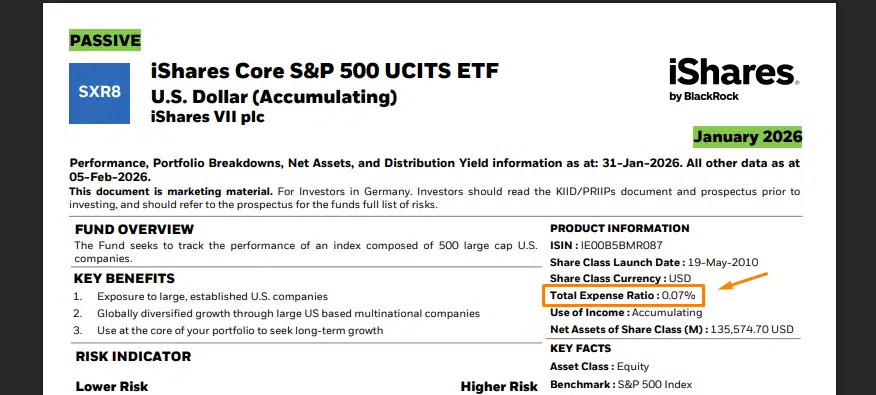
Asset managers like BlackRock (iShares) or Vanguard do not run ETFs for free. Throughout the year, a small fee is deducted from the fund’s assets. A lower fee means lower costs and, therefore, higher returns for you. This fee is usually shown as the ongoing charges figure (OCF) or total expense ratio (TER).
Using the iShares Core S&P 500 UCITS ETF (SXR8) as an example, you can find its TER of 0.07% in the factsheet:
2. Replication method
An ETF can replicate its index in two ways:
- Physical replication: the ETF buys the shares of the companies in the index;
- Synthetic replication: the ETF uses a swap agreement with a bank to receive the return of the index.
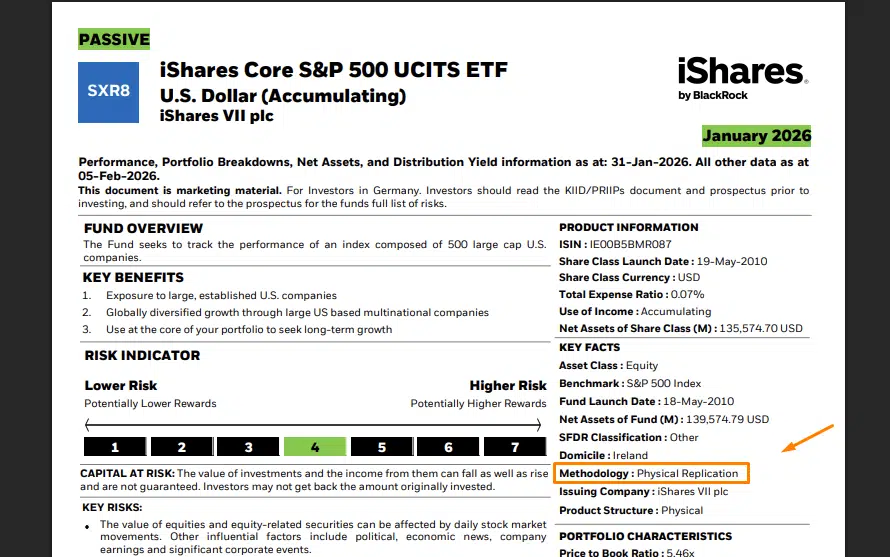
The companies in the S&P 500 are very liquid, so physical replication is simple and avoids the counterparty risk of derivatives. Synthetic S&P 500 ETFs can have a small tax advantage on US dividends, but they add that counterparty risk. The SXR8 factsheet shows its method as “Physical Replication”:
3. Use of income
ETFs also differ in what they do with the dividends they receive:
- Accumulating ETFs reinvest the dividends inside the fund. In many countries, this means you only pay tax when you sell, although the rules vary by country;
- Distributing ETFs pay the dividends out to you on a regular basis (usually quarterly), directly into your brokerage account, and you usually have to declare them as income.
Which one is better? There is no single right answer. If you plan to invest for 20 years without touching your money, an accumulating ETF may be more convenient. If you want a regular income, a distributing ETF is the more natural choice.
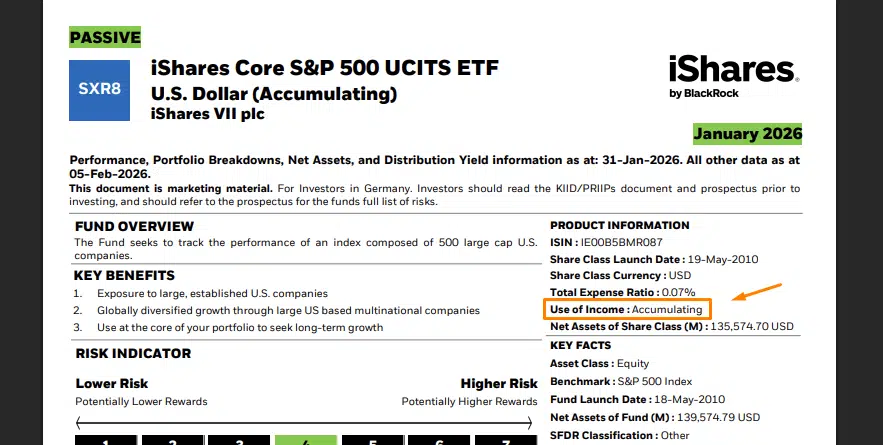
The SXR8 is “Accumulating”:
4. Size
The fund’s size also matters. Smaller funds are more likely to be closed down by their provider, in which case the fund sells its holdings and returns the proceeds to investors, which can create an unwanted tax event.
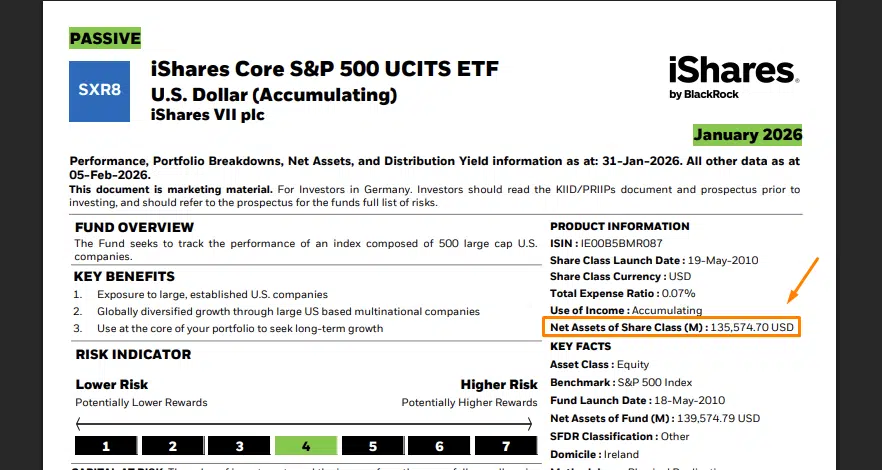
With over €130 billion in assets as of September 2026, according to justETF, SXR8 is the largest S&P 500 ETF in Europe:
5. Hedging
Some ETFs use derivatives to protect against currency movements, for example between the euro and the dollar. This comes at an extra cost. Our top four ETFs are all unhedged: over the long term, many investors accept currency swings rather than paying for hedging, but you should be aware that a stronger euro reduces your returns in euros.
Bottom line
To sum it up, here is what you need to do:
- Pick an ETF tracking the S&P 500: compare fees, replication method, use of income and size;
- Open an account and deposit money on Lightyear: go through the account opening process and fund your account;
- Place a buy order for the ETF you picked: the easiest part. Search for the ticker, choose the amount and confirm.
We hope this guide answered your questions. Make sure to do your own research to find the investing strategy that suits you best.
Disclaimer: Investing involves risk. See full T&Cs. Terms apply: lightyear.com/terms.
FAQs
What is the S&P 500?
The S&P 500 is an index that tracks 500 of the largest companies listed in the United States, weighted by their market value. It includes well-known companies such as NVIDIA, Apple, Microsoft and Amazon.
What is an exchange-traded fund (ETF)?
An ETF is a fund that trades on a stock exchange like a share and holds a basket of assets, such as stocks. When you buy an S&P 500 ETF, you get exposure to all the companies in the index with a single investment.
Is it possible to invest directly in the S&P 500?
No. An index is just a measure of the performance of a theoretical portfolio, so you cannot buy it directly. You can only invest in products that track it, such as ETFs or index funds.
What are CFDs? Should I invest in S&P 500 CFDs?
CFD stands for contract for difference. CFDs let you bet on price movements (up or down), often with leverage, and most retail investors who trade them lose money. They are not recommended for novice investors or long-term investing. You can learn more here.
Can Europeans invest in SPY or VOO?
Retail investors in the EU generally cannot buy US-domiciled ETFs such as SPY or VOO because of the PRIIPs rules, which require a key information document these funds do not provide. The UCITS ETFs in this article are the equivalent available to European investors.
Is now a good time to invest in the S&P 500?
Nobody can reliably predict short-term market movements. Historically, the S&P 500 has tended to rise over long periods, but it has also had large falls along the way. Investing regularly over time is a common way to avoid worrying about timing.
Why invest in the S&P 500 from Europe?
The S&P 500 has historically performed better than most European indices, and it gives you exposure to many of the world’s largest companies. Keep in mind that it is concentrated in the US and in large technology companies, so many investors combine it with, or prefer, a global index for broader diversification.