
Most day traders do not make money. In the largest studies of real trading records, 97% of day traders lost money or could expect to, and less than 1% were able to earn profits year after year. The few who make a living from it are a small minority.
This article brings together what the research says about how much day traders make, how many succeed, why most lose and what changed for US day traders in 2026. All figures come from peer-reviewed studies, academic working papers and official sources, which we link throughout.
How much do day traders make? The short answer
- Most lose money: 97% of the Brazilian day traders who kept trading for at least 300 days lost money, and in Taiwan 97% of day traders could expect to lose money.
- Few earn a living: only 1.1% of those Brazilian day traders earned more than the minimum wage, and only 0.5% earned more than the starting salary of a bank teller.
- Consistent winners are rare: in Taiwan, less than 1% of day traders earned reliable profits after fees from one year to the next.
- Salaries only apply to employees: job sites list pay for trading jobs at firms, but a retail day trader has no salary. Their income is their profit after costs and taxes, and it can be negative.
Key day trading statistics (2026)
The most quoted figures from the research, each with its source and year. Every study is linked in the sections below.
- 97% of Brazilians who day traded for more than 300 days lost money (Chague, De-Losso and Giovannetti, 2020).
- 71% of individual intraday traders in India's stock market lost money in 2022-23, rising to 80% among those who made more than 500 trades a year (SEBI, 2024).
- 97% of day traders in Taiwan were likely to lose money in future day trading (Barber, Lee, Liu, Odean and Zhang, 2020).
- 1,000 to 4,000 of about 450,000 Taiwanese day traders a year (0.2% to 0.9%) predictably earned positive returns after fees (Barber, Lee, Liu and Odean, 2014).
- 1.1% of Brazilians who day traded for more than 300 days earned more than the minimum wage (Chague, De-Losso and Giovannetti, 2020).
- 15% of Taiwanese day traders were still day trading three years after they started (Barber, Lee, Liu and Odean, 2018 working paper).
- 11.4% a year was the return of the US households that traded the most from 1991 to 1996, against 17.9% for the market (Barber and Odean, 2000).
- -4.7% was the average abnormal return over 20 days of the stocks Robinhood users bought most each day (Barber, Huang, Odean and Schwarz, 2022).
Day trading statistics at a glance
The table summarises the main studies of day trader performance. They cover different countries, markets and periods, but they reach the same conclusion: most day traders lose money after costs.
| Study | Lost money | Market and period | Traders studied |
| Chague, De-Losso and Giovannetti | 97% | Brazil, mini-index futures, started 2013-2015 | Everyone who day traded for 300+ days |
| SEBI (India's market regulator) | 71% | India, stocks, 2022-23 | Intraday clients of the 10 largest brokers |
| Barber, Lee, Liu and Odean | 97% (expected) | Taiwan, stocks, 1992-2006 | All day traders in the market |
| Jordan and Diltz | 64.2% | US, Nasdaq stocks, 1998-1999 | 324 clients of one broker |
| Garvey and Murphy | About 50% | US, stocks, 2000 | 1,386 clients of one broker |
Sources: the studies listed below. "Expected" means the share of Taiwanese day traders whose past results predicted losses.
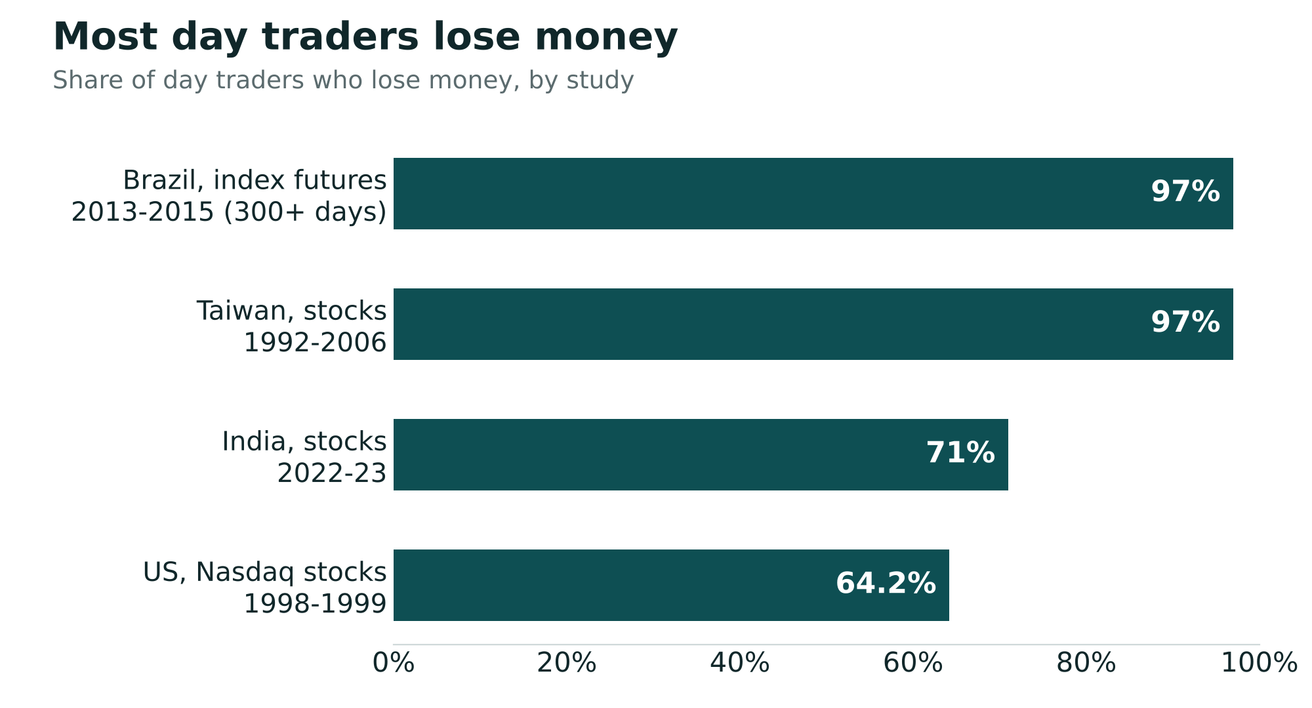
Chart by Investing in the Web. Data: Chague, De-Losso and Giovannetti (2020), Barber, Lee, Liu, Odean and Zhang (2020), SEBI (2024), Jordan and Diltz (2003).
What percentage of day traders make money?
Brazil: 97% lost money and 1.1% earned more than the minimum wage
The study "Day Trading for a Living?" by Fernando Chague, Rodrigo De-Losso and Bruno Giovannetti used data from Brazil's securities regulator on all 19,646 people who day traded mini-Ibovespa index futures for the first time between 2013 and 2015. Most stopped quickly: only 1,551 of them (7.9%) kept day trading for more than 300 days.
The longer people kept trading, the less likely they were to make money. 29.8% of those who day traded for a single day ended with a net profit, but only 3% of those who kept going for more than 300 days did, so 97% of them lost money. Only 1.1% of this group earned more than the Brazilian minimum wage and only 0.5% earned more than the starting salary of a bank teller. The authors found no evidence that people learn by day trading.
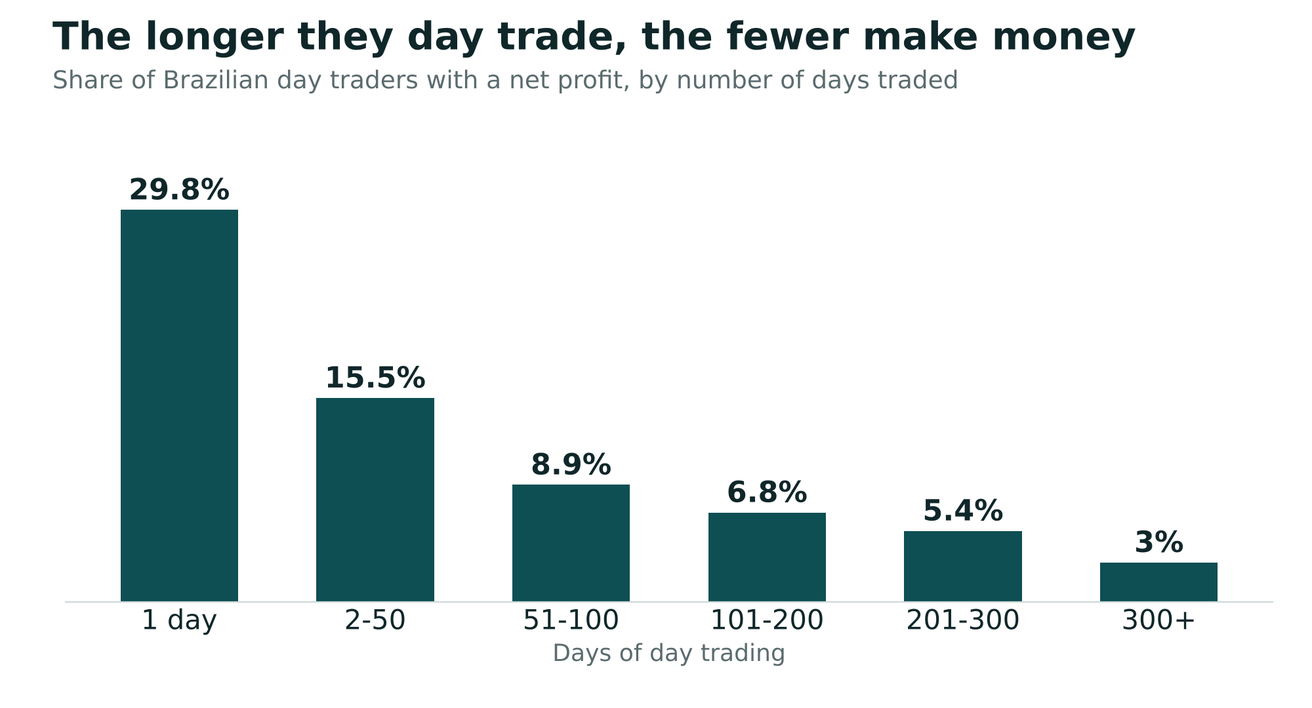
Chart by Investing in the Web. Data: Chague, De-Losso and Giovannetti (2020).
Taiwan: less than 1% of day traders are reliably profitable
Taiwan has the most complete data on day traders, because researchers had every trade on the Taiwan Stock Exchange from 1992 to 2006. In "The Cross-Section of Speculator Skill", published in the Journal of Financial Markets in 2014, Brad Barber, Yi-Tsung Lee, Yu-Jane Liu and Terrance Odean found that about 450,000 people day traded in an average year. Depending on the trading costs assumed, only 1,000 to 4,000 of them (0.2% to 0.9%) were able to predictably earn positive returns after fees.
In a later study, "Learning, Fast or Slow", published in The Review of Asset Pricing Studies in 2020, the same authors and Ke Zhang find that 97% of day traders are likely to lose money in future day trading and that traders with a history of losses generate 74% of all day trading volume. Day traders as a group lost money.
United States: about two in three day traders lost money
US data is older and comes from single brokers. Douglas Jordan and David Diltz studied 324 day traders from February 1998 to October 1999 in "The Profitability of Day Traders", published in the Financial Analysts Journal. 64.2% had a net loss after commissions, 25% lost at least $5,000 and only about 20% were more than marginally profitable. The average trader made a gross profit of more than $8,000, but commissions turned that into an average net loss of about $750.
A study of 1,386 clients of a US broker in 2000 by Ryan Garvey and Anthony Murphy, "The Profitability of Active Stock Traders", found a better result: about half were profitable after commissions. It covers a short period, so it says less about results over several years than the Brazilian and Taiwanese data.
India: 71% of intraday traders lost money in 2022-23
The most recent large dataset comes from India's market regulator. In its study of intraday trading by individuals in the equity cash segment, published in July 2024, SEBI looked at clients of the 10 largest brokers, who account for about 86% of individual clients. 71% of individual intraday traders lost money in the 2022-23 financial year, with an average loss of ₹5,371, while the 29% who made a profit earned ₹5,989 on average. The share of loss-makers rose to 80% among traders who made more than 500 trades a year and was 76% among traders under 30. Loss-makers also paid trading costs equal to 57% of their trading losses on top of those losses.
Frequent traders lose too, not only day traders
The same pattern shows up among ordinary investors who trade often. In "Trading Is Hazardous to Your Wealth", published in the Journal of Finance in 2000, Brad Barber and Terrance Odean studied 66,465 households at a large US discount broker from 1991 to 1996. The households that traded the most earned 11.4% a year, while the market returned 17.9%. The average household earned 16.4% and turned over 75% of its portfolio each year. The authors conclude that overconfidence can explain why people trade so much and earn so little.
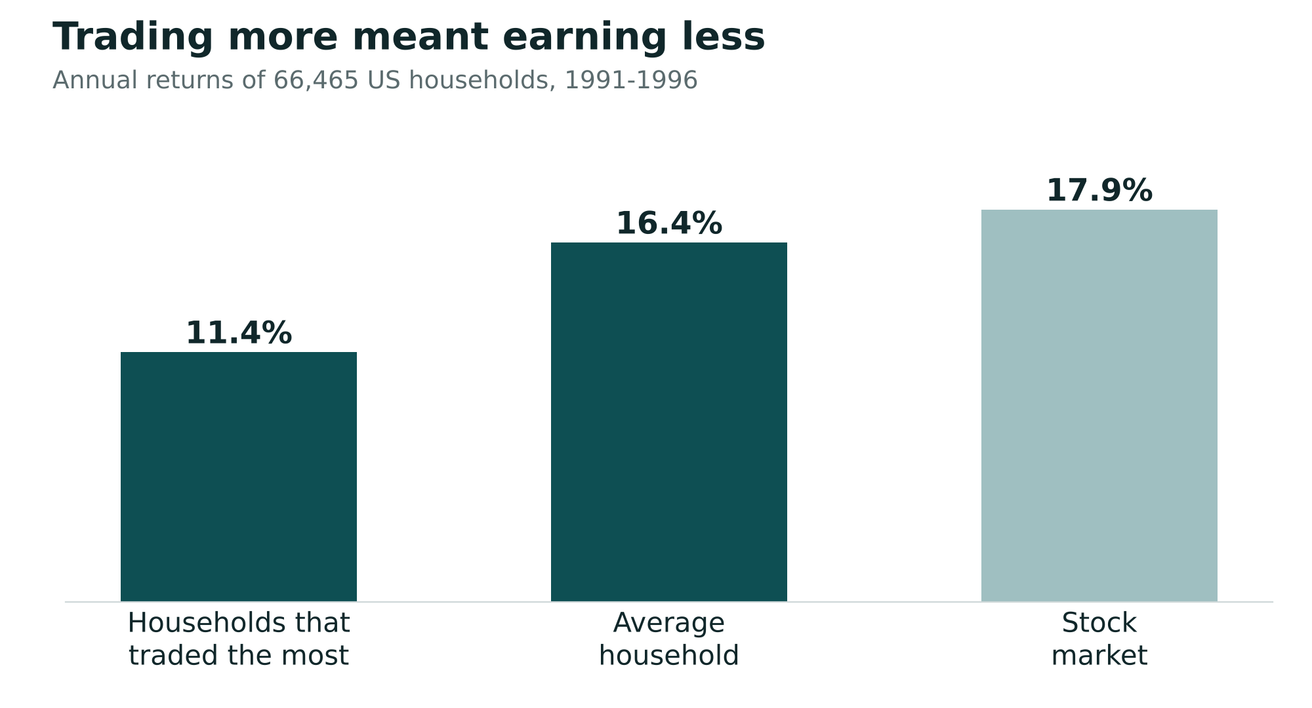
Chart by Investing in the Web. Data: Barber and Odean (2000).
In "Just How Much Do Individual Investors Lose by Trading?", published in The Review of Financial Studies in 2009, Barber, Lee, Liu and Odean looked at every trade on the Taiwan Stock Exchange from 1995 to 1999. Trading cost individual investors 3.8 percentage points of return a year, a loss equal to 2.2% of Taiwan's GDP. Virtually all of it came from aggressive orders, which are orders placed to trade straight away at the market price. Institutions, on the other side of many of these trades, gained 1.5 percentage points a year.
How much do successful day traders make?
Some day traders do make money, but the studies show how small that group is and how much risk it takes:
- Taiwan: the 500 best day traders of one year, about 0.1% of all day traders, went on to earn an average of 0.379% a day after fees in the following year. That is a strong result, but it applies to a few hundred people out of hundreds of thousands.
- Brazil: of the traders who lasted more than 300 days, 1 in 200 earned more than the starting salary of a bank teller. In the first version of the study, the best of them earned an average of $310 a day, with large swings from one day to the next.
- United States: in the Jordan and Diltz sample, the best trader made more than $197,000 and the worst lost more than $748,000.
Even a skilled trader needs a lot of capital to earn a full-time income. With a $25,000 account, making $50,000 a year means earning 200% a year after costs. A return that high usually comes with risks that can also wipe out the account.
Day trader salary vs trading your own money
When you search for a day trader salary, job sites show pay for people employed at trading firms. ZipRecruiter, for example, lists an average of $36.54 per hour for day trading jobs in the US as of 14 June 2026, with most jobs paying between $22.36 and $46.15 per hour. These figures come from job postings and include roles at banks and proprietary trading firms.
A retail day trader who trades their own money has no salary. Their income is what is left after trading costs, data and platform fees and taxes, and the studies above show that for most people this number is negative. That is why the average "day trader salary" says little about what a person trading from home can expect.
Why most day traders lose money
- Costs add up: in Taiwan, day traders lost 0.07% a day on average before costs, and costs more than tripled the loss to 0.239% a day. Commissions are $0 at most US brokers today, but spreads, fees on options and futures, data and platform subscriptions still apply.
- The other side is often a professional: retail day traders compete with market makers, high-frequency trading firms and institutions with better data and faster execution.
- Losers keep trading: in Taiwan, experienced day traders with a history of losses had a 95.3% probability of day trading again in the next 12 months, almost the same as profitable traders (96.4%).
- Most quit early: only 44% of Taiwanese day traders were still day trading after one year, 24% after two years and 15% after three years.
- Attention picks the stocks: in "All That Glitters", published in The Review of Financial Studies in 2008, Barber and Odean found that individual investors are net buyers of stocks in the news, stocks with unusually high trading volume and stocks with extreme one-day moves. A 2022 study of Robinhood users in the Journal of Finance found the same pattern on a modern app: the stocks Robinhood users bought most each day had average abnormal returns of -4.7% over the next 20 days.
- More skill does not mean more profit: investment strategist Michael Mauboussin calls this the paradox of skill. When everyone in a competition gets better, the gaps between them shrink and luck decides more of the results. Day traders compete with professional and high-frequency trading firms, so getting better is not enough to stand out.
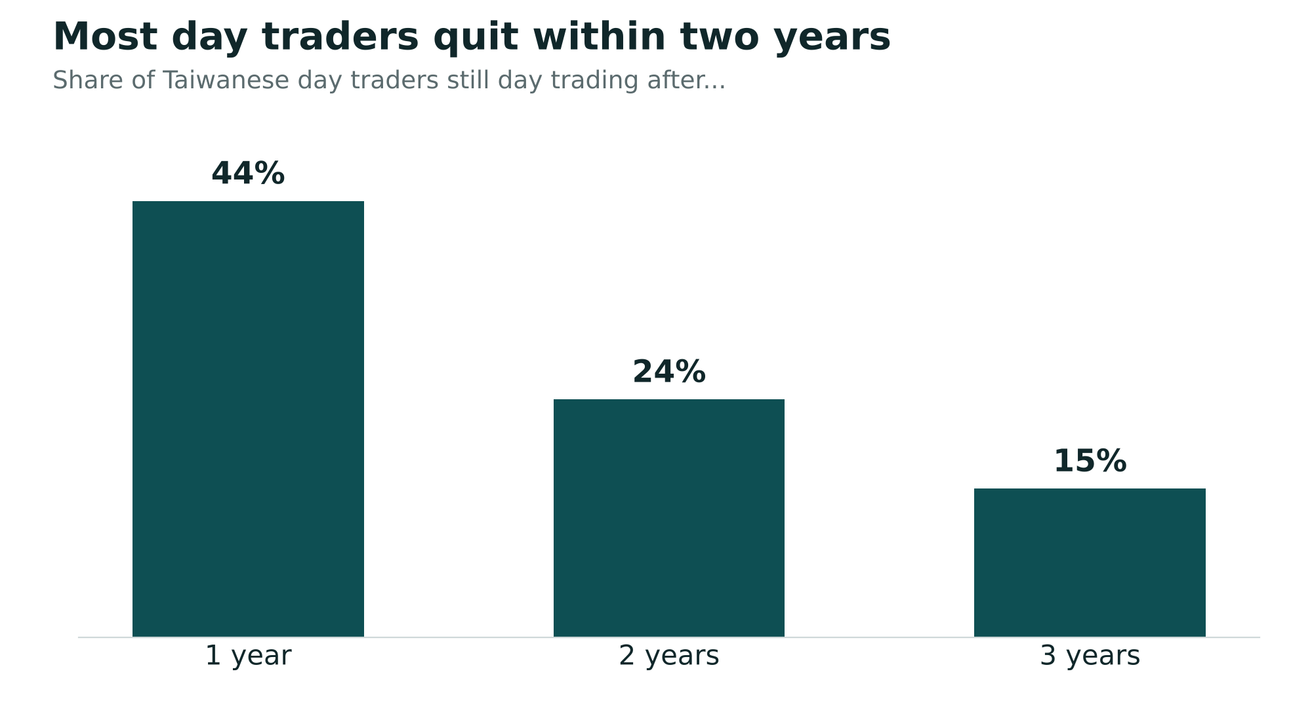
Chart by Investing in the Web. Data: Barber, Lee, Liu, Odean and Zhang, Learning, Fast or Slow (2018 working paper version), Taiwan Stock Exchange 1992-2006.
Why do people keep day trading?
If most day traders lose, why do so many start and keep going? The authors of Learning, Fast or Slow find that the data fit overconfidence and biased learning better than rational learning. Traders who lose are more likely to quit, but too slowly: many keep trading after a long run of losses, as if they expected their results to improve. Rational learning would mean trying day trading briefly, seeing the losses and stopping, which most of the traders in the data did not do.
What changed for US day traders in 2026
On 4 June 2026, FINRA's new intraday margin standards replaced the pattern day trader (PDT) rule, according to FINRA Regulatory Notice 26-10. The rule had required at least $25,000 in a margin account to make four or more day trades in five business days. Brokers now check during the day whether your account has enough equity for your open positions, instead of counting trades. Margin accounts still need at least $2,000 under the standard margin rules, and brokers have until 20 October 2027 to adopt the new standards.
The change makes it easier to start day trading with a small account, but it does not change the odds described above. We explain the new rules in our guide on how to avoid the PDT rule.
How day trading profits are taxed in the US
- Short-term capital gains: profits on positions held for one year or less are taxed at your ordinary income tax rate, according to IRS Topic 409. Almost all day trading gains fall into this group.
- Losses: if your capital losses are larger than your gains, you can deduct up to $3,000 a year ($1,500 if married filing separately) from other income and carry the rest forward.
- Wash sales: if you buy the same stock within 30 days before or after selling it at a loss, the loss is disallowed for now and added to the cost of the new shares. This happens often in day trading.
- Trader tax status: people who trade often enough to run a trading business can qualify as traders in securities. According to IRS Topic 429, they can make a section 475(f) mark-to-market election, which removes the $3,000 loss limit and the wash sale rule. The election has deadlines, so speak to a tax adviser before relying on it.
If you still want to day trade
- Start with a test: use a paper trading account or a small amount you can afford to lose, and keep doing it for several months.
- Track your results after costs: record every trade, including fees and taxes, and compare the result with simply holding an index fund.
- Keep costs low: choose a broker with low fees and fast execution. We compare the options in our guide to the best day trading platforms in the US.
- Keep investing separate: many people keep their long-term savings in a regular brokerage account or IRA and use only a small part of their money for trading.
- Own the winners through an index fund: a study of 64,000 global stocks from 1990 to 2020 by Hendrik Bessembinder and co-authors found that most stocks underperformed one-month US Treasury bills and that the top 2.4% of stocks accounted for all net wealth creation. An index fund holds those winners without you having to pick them.
Disclaimer: When investing, your capital is at risk and you may get back less than invested. Day trading carries a high risk of loss. The studies cited describe past results in specific markets and may not reflect your own results. This article is for information only and is not tax or investment advice.
FAQs
How much do day traders make a year?
Most retail day traders lose money. In Brazil, 97% of those who day traded for at least 300 days lost money and only 1.1% earned more than the minimum wage. Day traders employed by trading firms earn a salary, which ZipRecruiter put at an average of $36.54 per hour for day trading jobs in June 2026.
What percentage of day traders are successful?
Less than 1% in the largest study. In Taiwan, less than 1% of day traders earned reliable profits after fees from one year to the next, and the authors estimate that 97% could expect to lose money. In a US sample from 1998-1999, 64.2% lost money and about 20% were more than marginally profitable.
Can you make a living day trading?
It is possible but rare. The Brazilian study found that only 0.5% of persistent day traders earned more than the starting salary of a bank teller. To earn $50,000 a year from a $25,000 account, you would need a return of 200% a year after costs.
Why do most day traders lose money?
Trading costs, competition with professional traders and frequent trading. In Taiwan, costs more than tripled day traders' average daily loss, and traders with a history of losses kept trading almost as often as profitable ones.
Do you still need $25,000 to day trade in the US?
No. Since 4 June 2026, FINRA's intraday margin standards have replaced the pattern day trader rule and its $25,000 minimum. Margin accounts still need at least $2,000, and brokers have until 20 October 2027 to adopt the new rules, so check how your broker applies them.
How are day trading profits taxed?
Gains on positions held for one year or less are short-term capital gains, taxed at ordinary income rates. Capital losses can offset only $3,000 of other income a year unless you qualify as a trader and make a section 475(f) mark-to-market election.