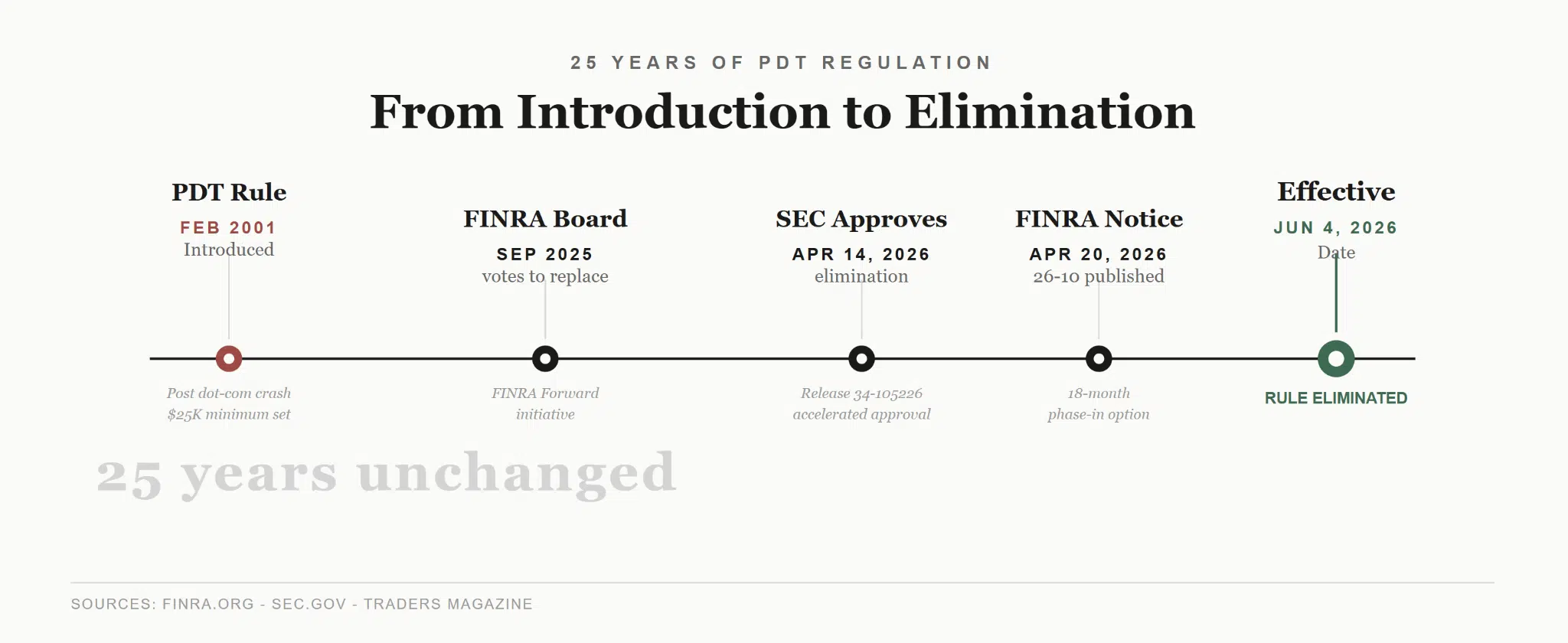
For 25 years, U.S. retail traders with less than $25,000 in their margin account lived under the Pattern Day Trader rule: a hard cap of three day trades per rolling five business days, enforced by FINRA Rule 4210. Cross that line and the account was flagged, then frozen.
That era ended on June 4, 2026, when FINRA’s new intraday margin standards took effect, eliminating the PDT designation and the $25,000 minimum equity requirement that came with it. The change was approved by the SEC on April 14, 2026 and formalized in FINRA Regulatory Notice 26-10 on April 20.
But “the rule is gone” doesn’t mean “every broker has switched.” Brokers have an 18-month implementation window (until October 20, 2027) to phase in the new framework. Many, like TradeZero America, implemented it on day one. Others moved a few days or weeks later, and some may still use the old rules.
Bonus: Use the TradeZero promo code IITW when signing up for a TradeZero account to activate your bonus.
In this guide we cover both halves of the practical question: how to keep day trading with a small account if your broker still applies the old rules, and which brokers have already implemented the new framework.
What the PDT rule was, and what replaced it
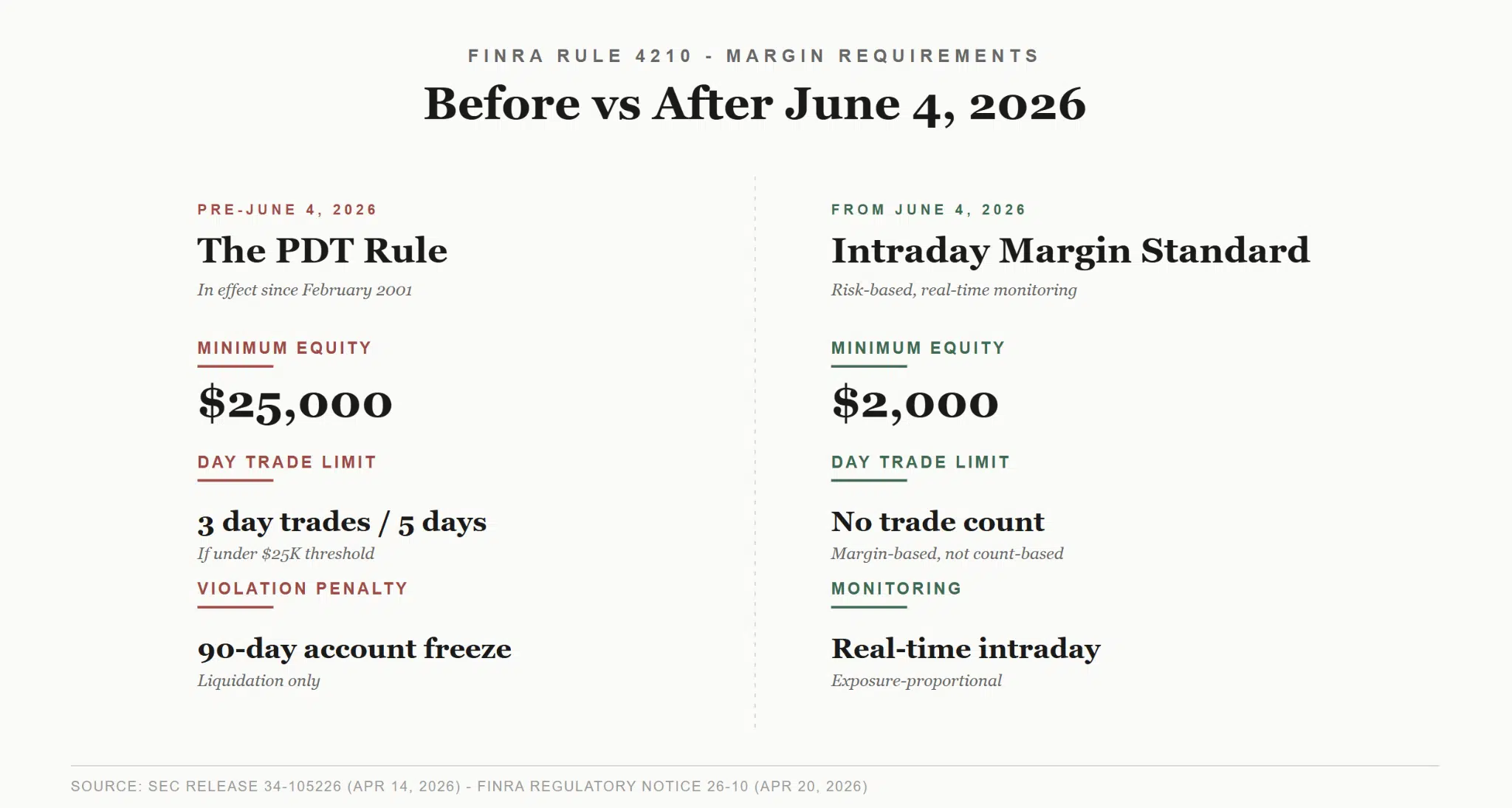
The Pattern Day Trader rule was a FINRA classification applied to any margin account holder who executed four or more day trades within a rolling five-business-day window. Once flagged, the trader had to maintain at least $25,000 in equity to continue day trading. Fall below that threshold, and the account was restricted to liquidating transactions only for 90 days.
It was introduced in 2001, in the aftermath of the dot-com bust, as a guardrail against retail traders blowing up small accounts during a period of high commissions and limited risk monitoring technology. It stood unchanged for 25 years.
What replaced it is a different philosophy. Under the amended Rule 4210, traders must maintain equity proportional to their actual intraday market exposure, rather than a fixed dollar minimum. In practice this means:
- The $25,000 minimum equity requirement is gone.
- The day trade count (four trades in five days) no longer triggers any designation.
- The minimum to day trade on margin drops to $2,000, the existing baseline for margin accounts.
- Brokers must work out each account’s intraday margin deficit, either in real time or with an end-of-day calculation.
- If you don’t cover an intraday margin deficit by the fifth business day and this becomes a pattern, the broker must apply a 90-day freeze on creating or increasing short positions or debit balances. Small deficits (below 5% of account equity or $1,000) don’t trigger the freeze.
- The new rules apply to margin accounts. Good faith (cash) accounts and portfolio margin accounts are excluded.
The PDT rule never applied to cash accounts, futures, forex or crypto, so those workarounds remain valid for traders whose broker hasn’t implemented the new framework yet.
Strategies if your broker still applies the PDT rule
Until your broker implements the new rules, the old workarounds still work. Once it does, some of these become unnecessary, but others remain relevant for traders who want to manage risk on small accounts. Here are the approaches that actually work, in order of practicality.
1. Use a cash account instead of margin
The PDT rule has always applied only to margin accounts. Cash accounts have never been subject to it.
The catch is settlement: under T+1 settlement (effective since May 2024), proceeds from a stock sale take one business day to settle. You can only reuse settled cash without triggering a good faith violation. In practice this means a cash account lets you make more day trades than a flagged margin account, but you’re capped by how fast your capital cycles.
For very active traders, this is still restrictive. For a trader doing one or two trades per day, a cash account effectively sidesteps the PDT rule entirely.
2. Switch to an offshore broker
Brokers regulated outside the U.S. are not bound by FINRA rules. TradeZero International (Bahamas), for example, has never enforced the PDT rule on its non-U.S. clients. Same for brokers regulated in jurisdictions outside FINRA’s reach.
This was the most popular workaround for U.S.-based active day traders over the last decade. Now that the rule is gone domestically, the appeal has shrunk, but offshore accounts still offer higher leverage and fewer restrictions for traders who want them.
3. Trade markets the PDT rule never covered
The PDT rule only applies to U.S. equities and equity options traded through FINRA member broker-dealers. It has never applied to:
- Futures markets (including micro futures like MES, MNQ)
- Forex
- Cryptocurrency (on non-FINRA platforms)
Micro futures in particular have become a common alternative for under-$25K traders looking for leveraged exposure to indices without PDT restrictions.
4. Use multiple brokerage accounts
Each margin account counts day trades independently. A trader with three day trades at Broker A and three at Broker B has six total trades without triggering PDT at either firm.
This is operationally clunky (capital is split, P&L tracking is harder) and becomes obsolete once your brokers implement the new rules. We mention it because some traders are still running this setup and may not realize they can now consolidate.
5. Just wait until your broker is ready
The single most consequential strategy in 2026 is knowing whether your broker has actually implemented the new framework. FINRA gave member firms an 18-month phase-in period, until October 20, 2027. Most large retail brokers switched in June or July 2026, but not all.
If your broker is still slow to implement, switching makes more sense than the old workarounds. Which brings us to the next section.
Brokers under the new rules: what to look for
There are three things to check before opening an account or trusting your current broker:
- Has the broker actually implemented the new framework? Help center pages and announcements are the clearest signal. Vague language (“we’re working on it”) usually means the broker is using the 18-month window.
- What is the new minimum equity to day trade on margin? Most are landing at $2,000, the existing margin baseline. Anything significantly higher is a warning sign.
- What does intraday margin enforcement actually look like? Some brokers will block trades before margin limits breach. Others will check at end of day. The first is friendlier to active traders.
Below we cover TradeZero America in detail because it was among the first to implement the change. We also note where other major brokers stand at the time of writing.
TradeZero America: implemented on day one
TradeZero America removed PDT restrictions on June 4, 2026, the first possible day under the new framework. Eligible margin accounts no longer need $25,000 in equity to day trade, and the three-round-trip limit is gone. Standard margin requirements still apply: buying power changes during the day, some securities carry higher requirements, and overnight positions must meet overnight margin.

That alone makes it a credible choice for active traders coming off PDT restrictions. TradeZero also paired the rule change with a promotion that ran from June 4 to September 4, 2026, cutting options contract fees by 50% and locate fees by 15%. That offer has now ended. Its standard options pricing is $0 commission plus a $0.42 contract fee per contract, with exchange, regulatory and clearing fees on top.
Thinking about opening an account at TradeZero? Check the signup bonuses available and don’t forget to use our promo code “IITW”.
Where TradeZero America fits best
| Trader profile | Fit |
|---|---|
| Active day trader with under $25K | Strong fit. PDT restrictions removed from day one, plus competitive fees. |
| Short sellers | Strong fit. Established short-borrow (locate) infrastructure for hard-to-borrow stocks. |
| Options-heavy strategies | Good fit. $0 commission and a $0.42 contract fee per options contract. |
| Passive long-term investor | Weak fit. The platform is built for active trading; cheaper alternatives exist for buy-and-hold. |
| Non-U.S. clients | Use TradeZero International (Bahamas) instead, which has its own rule set. |
What to know before opening an account
TradeZero America is a FINRA and SIPC member, registered with the SEC. SIPC coverage protects securities up to $500,000 (including $250,000 cash) in the event of broker insolvency.
The platform suite includes ZeroPro (desktop), ZeroFree (web), ZeroMobile, and TradingView integration. Pricing on equities depends on the platform and plan you choose, so check TradeZero’s fee schedule before you start.

Where other major brokers stand
This is where the main U.S. brokers stood at the time of writing, based on their own websites. We’ll update this section as brokers change their rules.
| Broker | Status | New framework since |
|---|---|---|
| TradeZero America | Implemented | June 4, 2026 |
| Robinhood | Implemented ($2,000 margin minimum) | June 4, 2026 |
| Webull | Implemented | June 4, 2026 |
| tastytrade | Implemented ($2,000 margin minimum) | June 4, 2026 |
| Charles Schwab | Implemented (day trade counting removed, then intraday margin buying power) | June 8 and July 13, 2026 |
| E*TRADE | Implemented ($2,000 margin minimum) | June 9, 2026 |
| Lightspeed | Committed to implement by June 4, 2026 | June 4, 2026 |
| Interactive Brokers | No implementation date published on its site at the time of writing | N/A |
Implementation status of the new FINRA intraday margin rules, from each broker’s website (checked October 2026).
- Charles Schwab: stopped counting day trades on June 8, 2026 and launched Intraday Margin Buying Power on July 13, 2026. With at least $2,000 in a margin account, you get a 25% intraday requirement (up to four times the buying power), but those positions must be closed by 8 p.m. ET.
- E*TRADE: implemented the new framework on June 9, 2026. Margin buying power now reflects real-time intraday margin excess, with a $2,000 minimum equity.
- Robinhood: removed day trade restrictions and existing PDT flags on June 4, 2026. A $2,000 minimum still applies to margin accounts.
- Webull: moved to the new rules on June 4, 2026, replacing day trade calls with intraday margin deficit calls.
- tastytrade: adopted the framework on June 4, 2026. A Reg T margin account needs $2,000 in marginable equity, and opening options trades are blocked if they would push options buying power below zero.
- Lightspeed: committed to implementing the new rule by June 4, 2026, with a minimum to day trade on margin as low as $2,000.
- Interactive Brokers: supported a real-time margining approach during the comment period. We couldn’t find a published implementation date on its website, so ask IBKR directly.
If your current broker isn’t on this list, contact their support directly and ask: “Have you implemented the new intraday margin framework, or are you using the 18-month phase-in period?” The answer tells you whether to wait or switch.
Final thoughts
The June 4, 2026 change was the most significant deregulation of U.S. retail day trading in 25 years. For traders with under $25,000, it removes a structural barrier that has shaped account sizing, capital allocation, and broker choice for an entire generation of retail participants.
The practical question isn’t whether the rule is gone (it is), but whether your broker has switched. The old workarounds (cash accounts, offshore brokers, futures, multiple accounts) still work where brokers haven’t, and remain useful for specific use cases. But for most U.S. active traders, the cleanest path forward is being with a broker that has already implemented the new framework.
TradeZero America was one of the brokers that implemented it on day one, and combines it with $0 commission options and established short-selling infrastructure.
FAQs
Is the PDT rule actually gone?
Yes. The SEC approved its elimination on April 14, 2026. FINRA published Regulatory Notice 26-10 on April 20, 2026 with an effective date of June 4, 2026. The pattern day trader designation and the $25,000 minimum equity requirement were removed from FINRA Rule 4210 on that date.
What replaces the PDT rule?
A new intraday margin framework. Instead of a fixed $25,000 floor and a day trade count, brokers monitor each account’s real-time market exposure throughout the day and require equity proportional to that exposure. The $2,000 minimum margin account balance still applies.
Has my broker implemented the new rules?
Most large U.S. retail brokers have. TradeZero America, Robinhood, Webull and tastytrade switched on June 4, 2026, Schwab on June 8 and E*TRADE on June 9. FINRA gave brokers until October 20, 2027 to implement the framework, so if your broker isn’t listed above, ask it directly.
Do I still need $25,000 to day trade?
Not at brokers that have implemented the new rules. The minimum to day trade on margin is now $2,000 (the existing margin account baseline). If your broker hasn’t rolled out the new framework yet, the old $25,000 threshold may still apply to your account.
Are cash accounts still a workaround?
Cash accounts were never subject to PDT and remain unaffected. They are still bound by T+1 settlement and good faith violation rules, which cap how often the same capital can be redeployed. For traders making more than a handful of trades per day, the new margin framework is more flexible than a cash account.
Will the change apply to options trading?
Yes. The PDT rule applied to both U.S. equities and equity options. Both are covered by the new intraday margin framework.
What about futures and crypto?
Neither was ever covered by the PDT rule. Futures and crypto traders see no change from this rule update.
Can my account still be restricted under the new rules?
Yes. If an intraday margin deficit isn’t covered by the fifth business day and this happens repeatedly, your broker must freeze the account for 90 days, preventing you from creating or increasing short positions or debit balances. Deficits below 5% of account equity or $1,000 don’t count. Brokers can also apply their own, stricter house rules.