
The best brokerage accounts in the US now charge $0 commission on online stock and ETF trades and have no minimum to open an account. The real differences are elsewhere: how much interest your uninvested cash earns, whether you get a match on IRA contributions, which investments you can buy and how good the platform is.
We compared 7 brokers available to US residents, using the information published on each broker's own website in November 2026. Here is the short answer:
- For most investors: Fidelity, for its range of investments, fractional shares from $1 and a core cash position that earned 3.60% in November 2026.
- For advanced and international investors: Interactive Brokers, for its low margin rates and access to markets in other countries.
- For cash and IRA bonuses: Public, Webull and Robinhood, which pay interest on cash and match IRA contributions.
Best brokerage accounts in 2026
Interactive Brokers
Best for advanced investors. $0 commission on IBKR Lite, stocks and ETFs in the US and other countries, fractional shares and interest of up to 3.38% on USD cash for accounts above $100,000.
Public
Best for earning on cash. 3.30% APY on cash with no fees, a 1% match on IRA contributions (4% with Public Reserve) and a 1% match on accounts you transfer in.
Webull
Best for active traders on a budget. $0 commission on stocks, ETFs and options, paper trading, and a 3.5% IRA match with Webull Premium ($3.99 a month).
Fidelity
Best for long-term investors. $0 commission, fractional shares from $1, Fidelity funds with no transaction fee and a core money market position that yielded 3.60% in November 2026.
Charles Schwab
Best for full service and branches. $0 commission online, the thinkorswim platform and a large mutual fund lineup, but 0.01% APY on uninvested cash.
Robinhood
Best for a simple app. $0 commission, 3.60% APY on cash and a 3% IRA match with Robinhood Gold ($5 a month).
Firstrade
Best for a low-cost basic account. $0 commission on stocks, ETFs, options and mutual funds, no inactivity fee and fractional shares from $5.
Brokerage accounts compared
All 7 brokers charge $0 commission on online US stock and ETF trades (Interactive Brokers on IBKR Lite) and have no account minimum. The table compares what still differs between them.


Sources: each broker's website, November 2026. Rates are variable. Fidelity: 7-day yield of the Fidelity Government Money Market Fund (SPAXX) as of 23 November 2026. Robinhood: APY for Gold members as of 17 September 2026. Interactive Brokers: no interest on the first $10,000.
How much does $10,000 of cash earn in a year?
Uninvested cash is where brokerage accounts differ most. The example below shows what $10,000 left in cash for a year would earn at the current rates, after the cost of any subscription needed to get that rate. It assumes the rate does not change.
| Broker | Rate | Interest in a year | Subscription | Net |
| Fidelity | 3.60% (SPAXX) | About $360 | $0 | About $360 |
| Public | 3.30% | About $330 | $0 | About $330 |
| Webull | 3.60% (Premium) | About $360 | $40 | About $320 |
| Robinhood | 3.60% (Gold) | About $360 | $60 | About $300 |
| Interactive Brokers | 3.38% above $10,000 | $0 | $0 | $0 |
| Charles Schwab | 0.01% | About $1 | $0 | About $1 |
Two details change the picture. Interactive Brokers pays nothing on the first $10,000 and pays the full rate only when your account is worth $100,000 or more, so it suits larger accounts. Fidelity's core position is a money market fund, not a bank deposit, so it is covered by SIPC as a security rather than by FDIC insurance. The cash programs of Public, Webull and Robinhood sweep your cash to partner banks, where it is FDIC insured up to several million dollars.
If you want a broker mainly to hold cash, see our guide to the best brokers for interest on uninvested USD cash.
1# Interactive Brokers

IB at a glance
Interactive Brokers gives access to stocks, ETFs, options, futures, bonds and funds in the US and on exchanges in other countries, all from one account. Fees for US residents:
- IBKR Lite: $0 commission on US-listed stocks and ETFs, available only to US residents.
- IBKR Pro: from $0.0035 per share on the Tiered plan, with a $0.35 minimum per order, for active traders who want direct order routing.
- Interest on cash (IBKR Pro): 3.38% on USD above the first $10,000 for accounts with a Net Asset Value of $100,000 or more. Smaller accounts earn a proportional rate, so an account worth $50,000 earns half.
- Fractional shares: available, so you can invest a set dollar amount in eligible stocks and ETFs.
It also has the lowest margin rates for larger balances: IBKR Pro charges 5.38% on the first $100,000 borrowed. The trade-off is Trader Workstation, a desktop platform built for active traders that takes time to learn. The IBKR Mobile app and the web platform are simpler. US clients hold their account with Interactive Brokers LLC, a FINRA member, and their securities are covered by SIPC up to $500,000, including $250,000 for cash.
Want to know more? Check our Interactive Brokers fees guide and whether Interactive Brokers is safe.

Interactive Brokers interest rates page. Screenshot from interactivebrokers.com, 24 November 2026.
2# Public

Public at a glance
Public offers stocks, ETFs, options, bonds and Treasuries, with Traditional and Roth IRAs, in an app and on the web. What stands out is what it pays you:
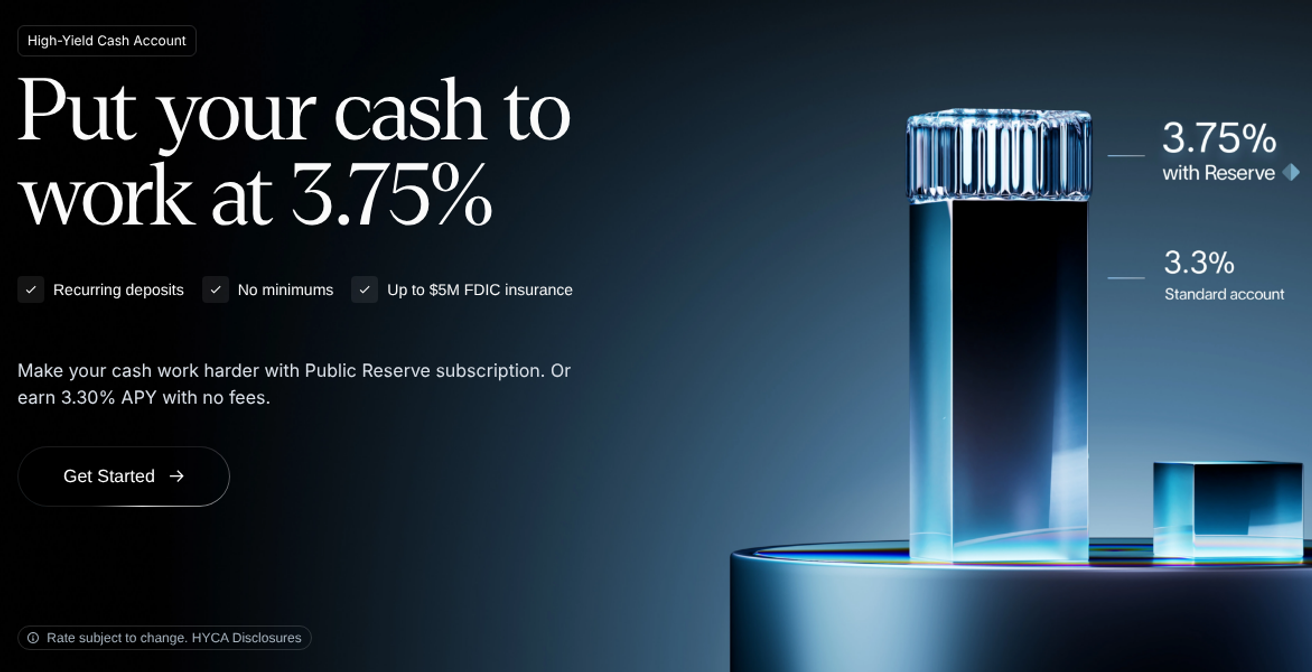
- High-Yield Cash Account: 3.30% APY with no fees, no minimum and no maximum, with FDIC insurance up to $5 million through partner banks.
- IRA match: 1% on contributions up to the annual IRS limit. The matched money must stay in the account for 5 years to avoid an early removal fee.
- Transfer match: since 14 September 2026, a 1% match on brokerage accounts, IRAs and 401(k)s you move to Public, with no cap, paid monthly over up to 5 years.
- Public Reserve: for $20 a month, 3.75% APY on cash and a 4% IRA match. On $10,000 of cash, the extra 0.45% earns about $45 a year, less than the $240 it costs, so Reserve only pays off for large IRA contributions or cash balances.
Public's brokerage accounts are held with Open to the Public Investing, a FINRA member, with Apex Clearing as the clearing firm. Securities are covered by SIPC up to $500,000, including $250,000 for cash. New customers can check the Public referral code before opening an account.
Public's High-Yield Cash Account page. Screenshot from public.com, 24 November 2026.
3# Webull

Webull at a glance
Webull charges no commission on US-listed stocks, ETFs and options and has no deposit minimum. It offers Traditional, Roth and Rollover IRAs, a desktop platform, a mobile app and paper trading with virtual money.
- Webull Premium: $3.99 a month or $40 a year. It raises the APY on uninvested cash in individual and joint cash accounts to up to 3.60%, cuts the margin rate and gives real-time Level 2 data.
- IRA match: 1% on new contributions, or 3.5% with Premium. IRA cash earns 0.10%, with or without Premium.
- FDIC coverage: cash in Cash Management is swept to partner banks with up to $5 million of FDIC coverage.
Webull Financial LLC is a FINRA member, and securities are covered by SIPC up to $500,000, including $250,000 for cash. Want to know more? Check our Webull fees guide.

Webull Premium page. Screenshot from webull.com, 24 November 2026.
4# Fidelity

Fidelity at a glance
Fidelity has no account fees and no minimum to open or keep a brokerage account, and it offers stocks, ETFs, options, mutual funds, bonds and CDs. Its main advantages:
- Fractional shares: Stocks by the Slice lets you buy US stocks and ETFs from $1.
- Cash: uninvested cash sits in a core position, such as the Fidelity Government Money Market Fund (SPAXX), whose 7-day yield was 3.60% on 23 November 2026. You earn it without subscribing to anything.
- Mutual funds: Fidelity funds cost nothing to buy or sell. Non-Fidelity funds in the No Transaction Fee program are free to buy, with a $49.95 fee if you sell within 60 days.
- Transfers: $0 to move assets out of your account.
Fidelity does not offer an IRA match, but its research, branches and phone support suit investors who want one firm for taxable accounts, IRAs and cash. Fidelity is a FINRA member, and securities are covered by SIPC up to $500,000, including $250,000 for cash. Want to know more? Check our Fidelity fees guide.
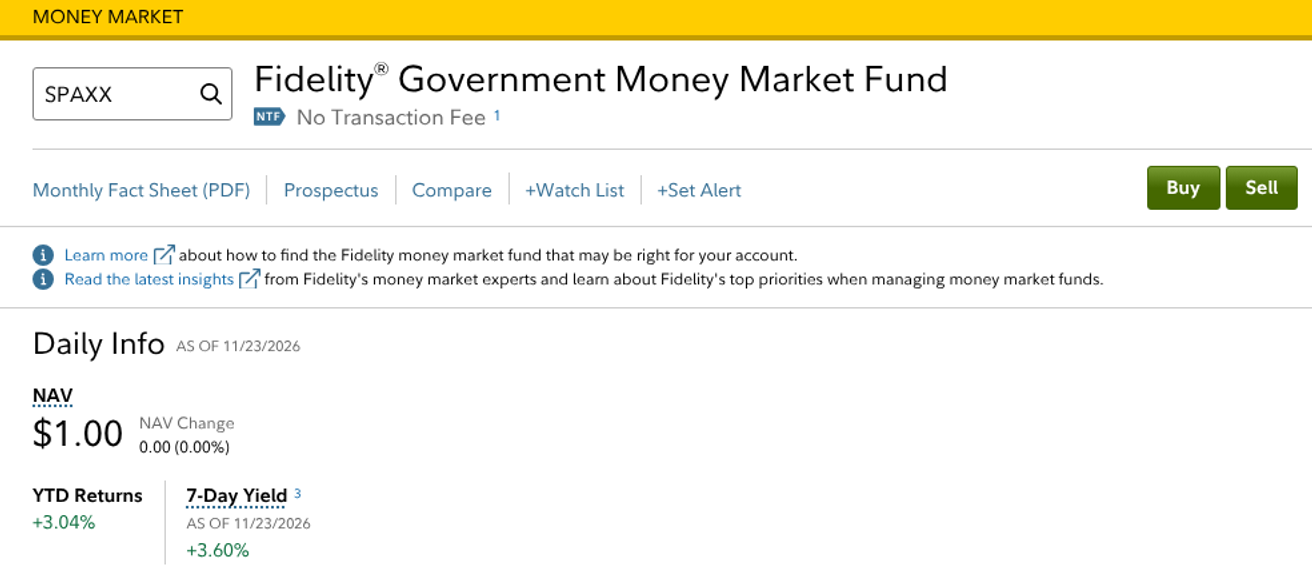
Fidelity Government Money Market Fund (SPAXX) page. Screenshot from fidelity.com, 24 November 2026.
5# Charles Schwab

Schwab at a glance
Charles Schwab combines $0 online trades with branches across the US, phone support and the thinkorswim platform for active traders.
- Fractional shares: Schwab Stock Slices lets you buy S&P 500 stocks from $5. Fractional ETFs are not available.
- Mutual funds: funds in the Mutual Fund OneSource program cost $0 online. Other funds cost up to $74.95 per online purchase.
- Broker-assisted trades: a $25 service charge per trade.
- Cash: uninvested cash in a brokerage account earns 0.01% APY, according to Schwab's cash investments page. To earn more, you need to buy a money market fund yourself.
Schwab suits investors who want branches and a large fund lineup and are willing to manage their cash. Charles Schwab & Co. is a FINRA member, and securities are covered by SIPC up to $500,000, including $250,000 for cash.
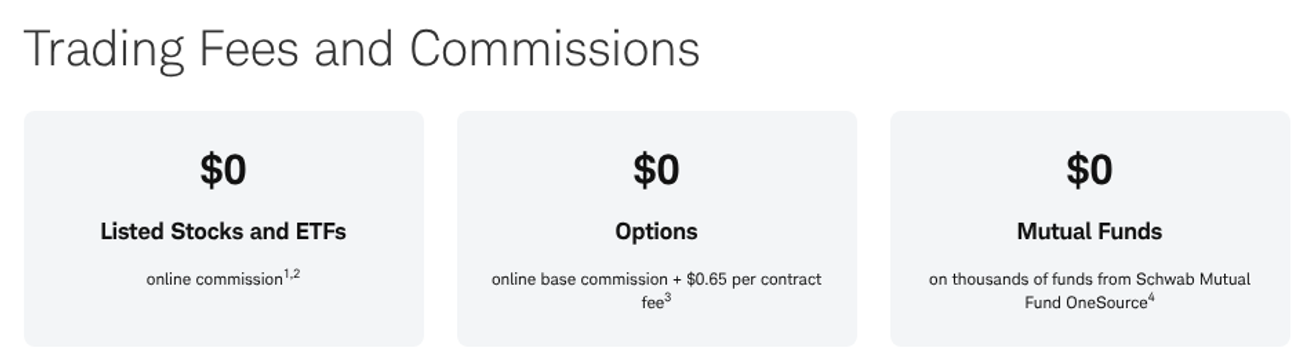
Charles Schwab commissions and fees page. Screenshot from schwab.com, 24 November 2026.
6# Robinhood

Robinhood at a glance
Robinhood has $0 commission trading in an app built for simplicity, with stocks, ETFs, options and crypto, plus Traditional and Roth IRAs. Most of its benefits come with Robinhood Gold, which costs $5 a month or $50 a year:
- Cash: 3.60% APY on eligible brokerage cash for Gold members (as of 17 September 2026), with FDIC insurance up to $2.5 million through partner banks. IRAs are not eligible.
- IRA match: 3% on contributions with Gold, or 1% without. The matched money must stay in the account for 5 years to avoid a removal fee.
- Margin: the first $1,000 is interest free with Gold.
Robinhood Financial is a FINRA member, and securities are covered by SIPC up to $500,000, including $250,000 for cash. See our guides to Robinhood fees and Robinhood fractional shares.
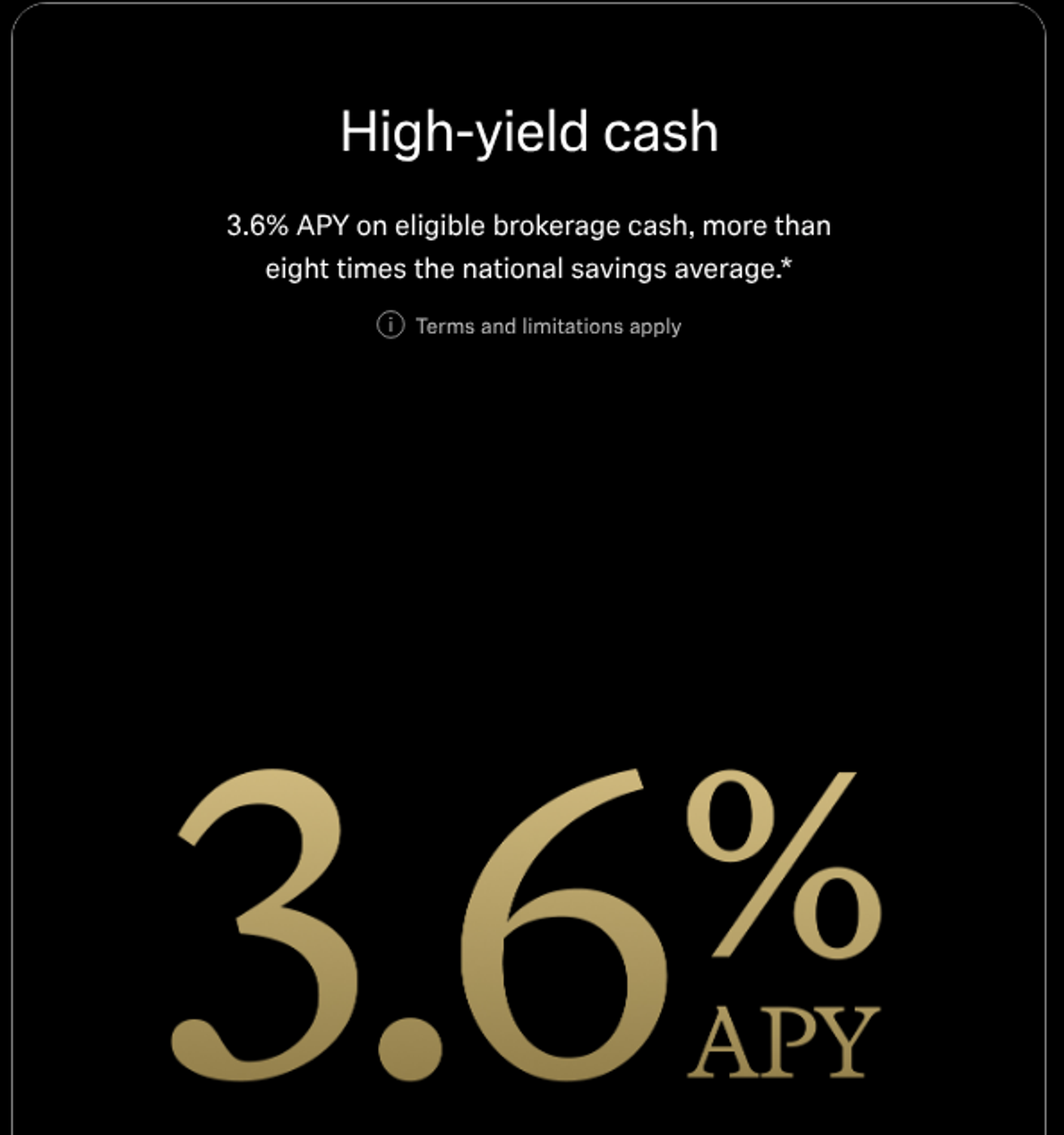
Robinhood Gold page. Screenshot from robinhood.com, 24 November 2026.
7# Firstrade

Firstrade at a glance
Firstrade is a US discount broker with $0 commission on stocks, ETFs, options and mutual funds, no account fees, no minimum and no inactivity fee.
- Fractional shares: more than 4,000 stocks and ETFs from $5, with dividend reinvestment.
- Cash: you can join the Apex FDIC-insured sweep program, but Firstrade does not publish the rate on its pricing pages.
- IRAs: available, but Firstrade does not offer an IRA match.
Firstrade Securities is a FINRA member, and securities are covered by SIPC up to $500,000, including $250,000 for cash.
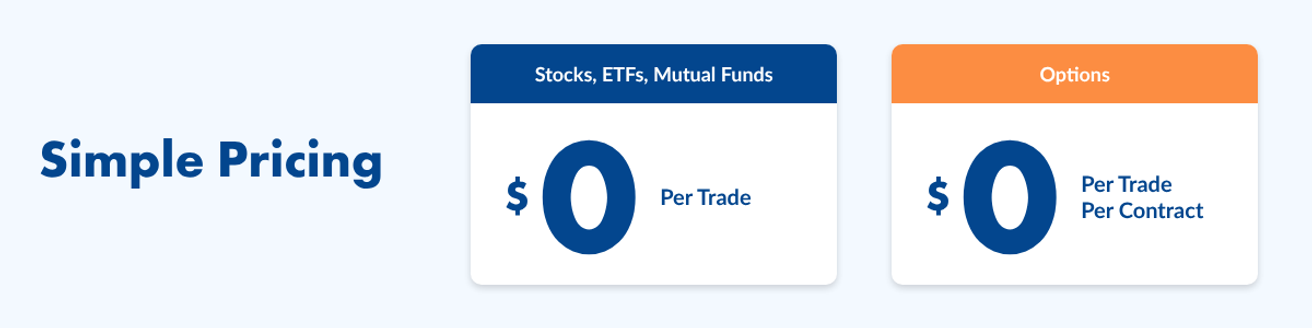
Firstrade pricing page. Screenshot from firstrade.com, 24 November 2026.
How to choose a brokerage account
- Interest on cash: if you keep cash in your account, the rate on it matters more than commissions, which are $0 almost everywhere. Check whether you need a subscription to get the advertised rate.
- IRA match: Public, Webull and Robinhood add 1% to your IRA contributions, and 3% to 4% with a paid plan. On a $7,500 contribution, the 2026 limit for people under 50, 3% is $225. Matches usually require you to keep the money in the account for 5 years.
- Investments: all 7 offer stocks, ETFs and options. Choose Fidelity or Schwab for a wide range of mutual funds, and Interactive Brokers for stocks and bonds outside the US.
- Fractional shares: useful for investing small amounts in expensive stocks. Schwab only offers them on S&P 500 stocks.
- Platform and support: Robinhood and Public are the simplest apps, while Interactive Brokers, Webull and Schwab's thinkorswim offer advanced charting. Fidelity and Schwab have branches.
- Transfer costs: if you plan to move your account later, check the outgoing transfer fee. Fidelity charges $0.
Types of brokerage accounts
Most brokers on this list offer the same main account types:
- Individual or joint taxable account: no contribution limit and you can withdraw at any time, but you pay tax on dividends, interest and capital gains each year.
- Traditional IRA: contributions may be tax deductible and the money grows tax-deferred until you withdraw it in retirement.
- Roth IRA: contributions are made after tax, and qualified withdrawals in retirement are tax free.
- Custodial account: an account you manage for a child until they reach adulthood.
If you are a beginner, a taxable account plus a Roth IRA at a broker with no minimum and fractional shares lets you start with small amounts. If you mainly trade, see our guides to the best day trading platforms and the best options trading platforms in the US.
Disclaimer: When investing, your capital is at risk and you may get back less than invested. Interest rates are variable and may have changed since we checked them. This article is for information only and is not tax or investment advice.
FAQs
What is the best brokerage account in the US?
For most long-term investors, Fidelity, for its $0 commissions, fractional shares from $1, wide range of funds and a core cash position that yielded 3.60% in November 2026 with no subscription. Interactive Brokers suits advanced investors with larger accounts, while Public, Webull and Robinhood offer interest on cash and IRA matches.
What is the best brokerage account for beginners?
A broker with no minimum, fractional shares and a simple app lets you start with small amounts. Fidelity, Public and Robinhood fit that description. Fidelity adds branches and phone support, while Public pays 3.30% APY on cash without a subscription.
Which brokerage account pays the most interest on cash?
Among the 7 brokers we compared, Public Reserve pays 3.75% APY and Fidelity's SPAXX core position, Webull Premium and Robinhood Gold pay around 3.60%. Public Reserve, Webull Premium and Robinhood Gold require a subscription, so on smaller balances Public's 3.30% with no fee or Fidelity's core position can leave you with more.
Which brokers offer an IRA match?
Public matches 1% of IRA contributions (4% with Public Reserve), Webull 1% (3.5% with Premium) and Robinhood 1% (3% with Gold). Interactive Brokers, Fidelity, Schwab and Firstrade do not offer an IRA match.
Is my money safe in a brokerage account?
All 7 brokers are FINRA members, and their customers' securities are covered by SIPC up to $500,000, including $250,000 for cash, if the broker fails. SIPC does not cover investment losses. Cash swept to partner banks is covered by FDIC insurance instead, up to the limit of each program.
How much money do you need to open a brokerage account?
None of the 7 brokers has a minimum to open an account. With fractional shares, you can start investing with $1 at Fidelity and $5 at Firstrade or Schwab.
Can you have more than one brokerage account?
Yes. Many investors keep a taxable account and an IRA, or use one broker for long-term investing and another for cash or trading. There is no limit on the number of brokerage accounts you can open.