
A full-service brokerage firm gives you a personal financial advisor who helps you invest, plan for retirement and manage taxes and estate questions, on top of buying and selling securities for you. The largest in the US are Merrill, Morgan Stanley, Edward Jones, Wells Fargo Advisors and Raymond James. That service costs much more than a discount broker: advisory fees start at about 1.40% a year and can reach 2%, or $3,500 to $5,000 a year on a $250,000 portfolio.
This guide explains what you get for that money, how full-service firms charge, how to check an advisor and when a cheaper option does the same job.
What is a full-service broker?
A full-service broker is a firm that combines a brokerage account with personal advice from a financial advisor. Besides placing trades, the advisor usually helps with:
- Investment advice: building and rebalancing a portfolio that fits your goals and risk.
- Financial planning: retirement income, college savings and cash flow.
- Tax and estate planning: usually with in-house specialists or with your own accountant and lawyer.
- Wider product range: managed portfolios, new bond issues, annuities, insurance and, for wealthier clients, lending and alternative investments.
A discount broker, by contrast, gives you an online account to trade on your own, usually with $0 commissions on US stocks and ETFs and no advice. Most large firms now offer both: Merrill has Merrill Edge, Wells Fargo has WellsTrade and Morgan Stanley owns E*TRADE.
Full-service vs discount brokers
| Full-service broker | Discount broker | |
| Advice | Personal advisor | None, or automated |
| Typical cost | 1.40% to 2% a year, or commissions per trade | $0 on US stocks and ETFs |
| Minimum | $0 to $25,000 for most accounts, more for private wealth | Usually $0 |
| Planning | Retirement, tax and estate | Online tools only |
| Suits | Complex finances, little time or interest | Investors who decide on their own |
Costs from the fee pages and Form ADV brochures of Edward Jones, Merrill and Morgan Stanley, November 2026.
How much do full-service brokers charge?
Full-service firms charge in one of two ways, and most let you choose:
- Advisory account: a yearly fee on the value of your assets, which covers the advice and the trades. Fund expenses come on top.
- Brokerage account: no yearly fee, but you pay commissions and sales charges each time you buy or sell.
Edward Jones publishes both. Its fee page shows advisory accounts starting at 1.40% a year (a 1.35% program fee plus a 0.05% platform fee, lower on larger balances), with a $25,000 minimum for Advisory Solutions. The commission-based Select Account has no minimum, but commissions and sales charges generally range from 0.75% to 5.75% of each purchase.
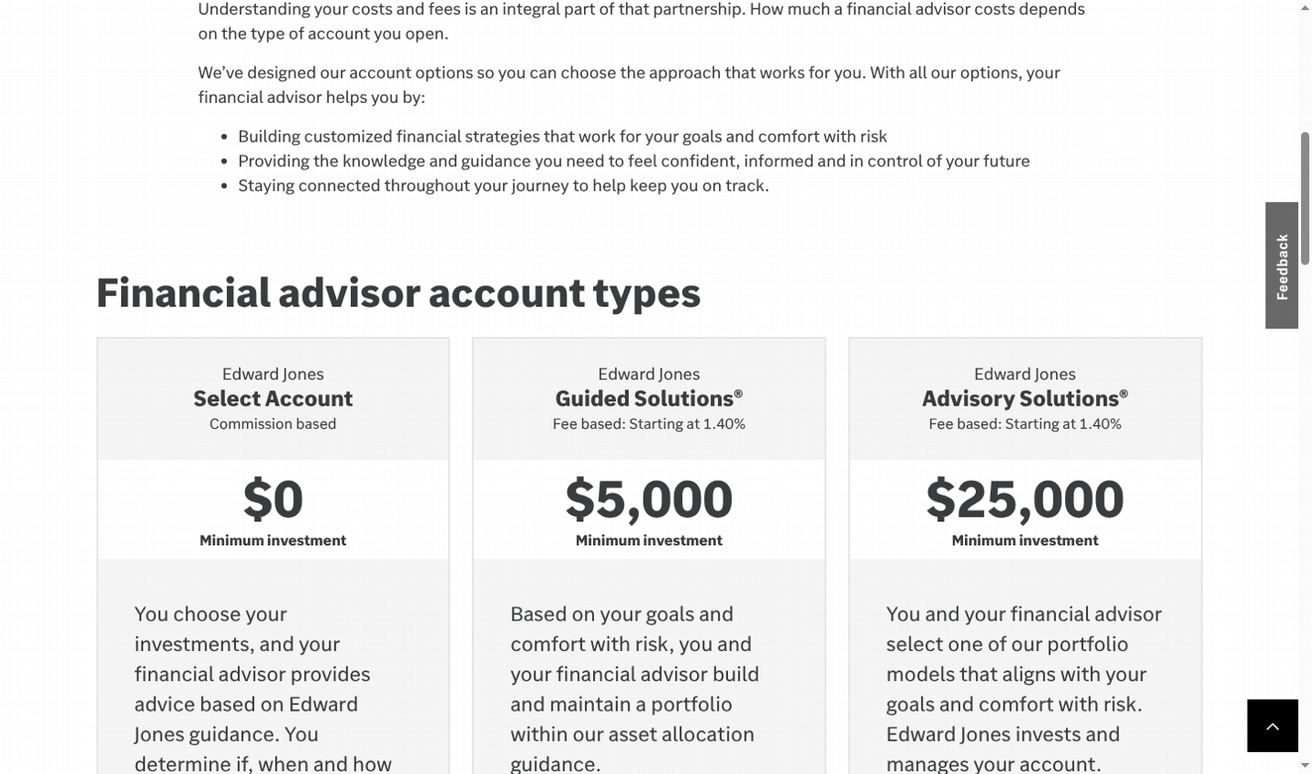
Edward Jones account types and fees
At the large wire houses the fee is negotiated with your advisor, up to a ceiling. Merrill caps its Investment Advisory Program fee at 1.75% a year and Morgan Stanley at 2.0%. Larger accounts usually negotiate less, so ask for the exact rate in writing before you sign.
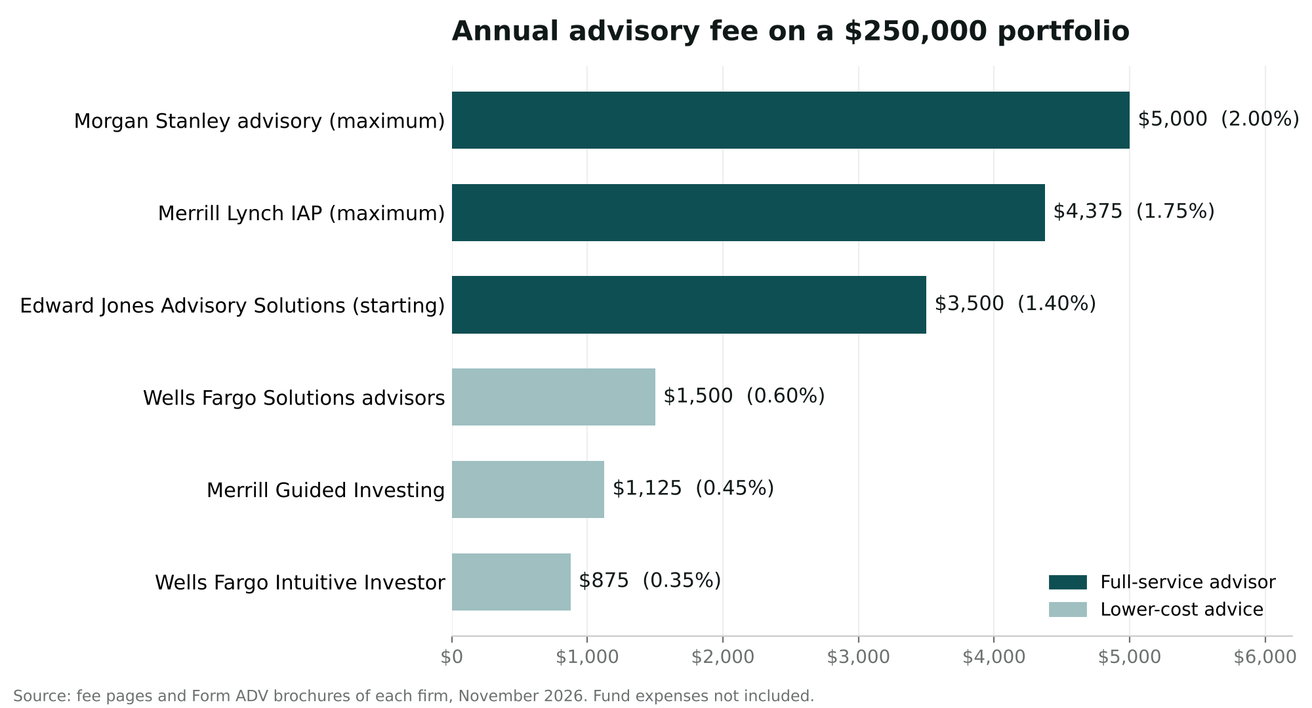
Advisory fees on $250,000. Source: fee pages and Form ADV brochures of each firm, November 2026
The fee is charged every year, whether your portfolio rises or falls. On $250,000, a 1.40% fee costs $3,500 a year and a 2% fee $5,000, before fund expenses. The same firms also sell cheaper advice: Wells Fargo charges 0.60% for its phone-based Solutions advisors and 0.35% for its Intuitive Investor robo-advisor, and Merrill charges 0.45% for Merrill Guided Investing.
The largest full-service brokerage firms
By number of financial advisors, the largest US full-service firm is Edward Jones, with more than 20,000 advisors in local branches. By client assets, Merrill and Morgan Stanley lead:
| Firm | Client assets | Advisors | Advisory fee |
| Merrill (Bank of America) | $4.2 trillion¹ | Not published | Up to 1.75% |
| Morgan Stanley | $3.16 trillion (fee-based)² | 16,000+² | Up to 2.0% |
| Edward Jones | $2.6 trillion³ | 20,000+³ | From 1.40% |
| Wells Fargo Advisors | $2.45 trillion⁴ | Not published | Negotiable (0.60% with Solutions advisors) |
| Raymond James | $1.94 trillion⁵ | About 8,900⁵ | Negotiable |
Sources: ¹ Bank of America 3Q26 earnings release, Merrill Wealth Management client balances, 30 September 2026. ² Morgan Stanley 3Q26 earnings release, Wealth Management fee-based client assets, 30 September 2026, and its careers page for the number of advisors. ³ Edward Jones, assets under care, 30 June 2026. ⁴ Wells Fargo, Wealth and Investment Management client assets, 3Q26. ⁵ Raymond James, total client assets, 30 September 2026. Firms measure client assets in different ways, so the figures show scale rather than an exact ranking.
Wells Fargo describes itself as the third-largest full-service provider of retail brokerage in the US. UBS also runs a large US wealth business, mostly for wealthy clients. For the global picture, including private banks, see our ranking of the largest wealth management firms.
Is a full-service broker worth it?
It can be, if you use what you pay for. A good advisor helps most when your finances are complex: a business to sell, stock options, an inheritance, retirement income from several accounts or an estate to plan. Advice can also stop you from selling in a market fall.
If you mainly need a portfolio of index funds that is rebalanced now and then, a 1.40% to 2% fee is hard to justify. It is charged on the whole balance every year, so it grows as your savings grow. Brokerage accounts carry a different risk: firms note in their own disclosures that the more you trade, the more they and the advisor earn, which creates an incentive to trade more.
How to check a full-service broker and advisor
- Look them up on FINRA BrokerCheck: it shows the firm’s and the advisor’s registrations, past employers and any complaints or disciplinary events.
- Read the Form CRS: every broker-dealer and adviser must give you this short relationship summary, with its services, fees and conflicts of interest.
- Ask if the account is advisory or brokerage: in an advisory account the firm acts as a fiduciary, while in a brokerage account it must act in your best interest when it makes a recommendation (Regulation Best Interest).
- Get every cost in writing: the advisory fee, platform fees, fund expenses and any commissions or sales charges.
Cheaper alternatives to a full-service broker
Robo-advisors: build and rebalance a portfolio of ETFs for about 0.25% to 0.45% a year, such as Wells Fargo Intuitive Investor at 0.35% and Merrill Guided Investing at 0.45%. See the largest robo-advisors for more options.
Hybrid advice: phone-based advisor teams cost less than a local advisor, such as Wells Fargo Solutions advisors at 0.60% with a $25,000 minimum. Schwab Wealth Advisory starts at 0.80%, with a $500,000 minimum.
Discount brokers: if you are happy to invest on your own, Interactive Brokers, Public and Webull charge $0 commission on US stocks and ETFs (IBKR on its Lite plan), with no yearly account fee. You can pair a discount broker with a fee-only planner who charges a flat fee for a one-off plan.
Bottom line
A full-service broker sells advice and planning, not just trades, and charges for it: from 1.40% a year at Edward Jones and up to 1.75% at Merrill and 2.0% at Morgan Stanley, or $3,500 to $5,000 a year on $250,000. It is worth considering when your finances are complex and you will use the planning. If you mainly need a diversified portfolio, a robo-advisor at 0.35% or a $0 commission broker does the same job for a fraction of the cost.
Disclaimer: When investing, your capital is at risk and you may get back less than invested. This article is for information only and is not investment advice. Fees are negotiable at many full-service firms and change over time, so check them in each firm’s Form CRS and fee schedule.
FAQs
What are full-service brokerage firms?
Firms that combine a brokerage account with a personal financial advisor who gives investment advice and helps with retirement, tax and estate planning. The largest in the US include Merrill, Morgan Stanley, Edward Jones, Wells Fargo Advisors and Raymond James.
How much do full-service brokers charge?
Advisory accounts usually cost between about 1.40% and 2% of your assets a year: Edward Jones starts at 1.40%, Merrill charges up to 1.75% and Morgan Stanley up to 2.0%. Commission-based accounts charge per trade instead, such as 0.75% to 5.75% at Edward Jones.
Which full-service broker is best?
The advisor matters more than the firm. Edward Jones ranked first for advised investor satisfaction in the J.D. Power 2026 U.S. Investor Satisfaction Study, while Merrill and Morgan Stanley offer the widest range of products for wealthier clients. Compare the fee you are offered and check the advisor on BrokerCheck.
Are full-service brokers worth it?
They can be for people with complex finances who use the planning. For a simple portfolio of index funds, a robo-advisor or a discount broker costs a fraction of the 1.40% to 2% yearly fee.
Is Charles Schwab a full-service broker?
Schwab is mainly a discount broker, with $0 online commissions on listed stocks and ETFs, but it also offers advice through Schwab Wealth Advisory, from 0.80% a year with a $500,000 minimum.