Hello, investor! Are you trying to decide between Freetrade and Trading 212 for your investment needs? This article will guide you through a detailed, side-by-side comparison to help you make the best choice.
In this analysis, we’ll explore how Freetrade and Trading 212 stack up against each other in key areas like features, fees, supported financial instruments and regulation. By the end, you’ll have a clear understanding of which broker aligns better with your investment strategy. All fees and features were checked in October 2026.
Below, you’ll find a comparison table and a breakdown of each platform’s pros and cons, highlighting the key differences. Let’s dive in!
Freetrade vs Trading 212
- Trading 212: best for investors who buy US or European stocks (0.15% FX fee), want interest on uninvested cash and a free ISA and SIPP. Commission-free trading (Other fees may apply. See terms and fees.)
- Freetrade: best for UK long-term investors who want a Junior ISA, mutual funds or gilts in the same app as their ISA and SIPP, with a free Basic plan and optional paid plans that cut the FX fee.
Comparison
| Category | Trading 212 | Freetrade |
| Demo account | Yes | No |
| Account minimum | €/$/£0 | £0 |
| Interest on uninvested cash (annually) | GBP: 3.55% USD: 3.30% EUR: 2.50% (no cap, variable) |
GBP: 1% (Basic, up to £1,000), 2.5% (Standard, up to £2,000), 3.5% (Plus, up to £3,000) |
| US, EU and UK stock fees | €/£0 | £0 |
| ETF fees | €/£0 | £0 |
| Currency conversion fee | 0.15% | 0.99% (Basic) 0.59% (Standard) 0.39% (Plus) |
| Monthly plan fee | £0 | £0 (Basic), £5.99 (Standard), £11.99 (Plus). Cheaper with annual billing |
| Regulators | FCA, CySEC, BaFin, ASIC | FCA |
| SIPP | Yes (free) | Yes (free) |
| ISA | Yes (Stocks and Shares ISA and Cash ISA) | Yes (Stocks and Shares ISA and Junior ISA, free) |
Checked on both brokers’ websites in October 2026. Interest rates are variable, may no longer be current and are subject to change. Trading 212: 0.15% FX fee applies when converting funds. Other fees may apply. See terms and fees.
Want to see a more in-depth comparison? Check the full comparison of Freetrade vs Trading 212 in our broker comparison tool.
About Trading 212
Trading 212 is a fintech company founded in 2004 and headquartered in London that aims to democratise the entire investment process through a simple web and mobile application.
The company has more than 5 million funded accounts and lets you invest in over 10,000 stocks and ETFs, as well as trade CFDs on forex, commodities, indices and cryptocurrencies. An interesting fact is that your shares are held in a pooled account at Interactive Brokers, commonly known as an omnibus account. For more information, you can visit the Trading 212 help centre.
Additionally, it offers an attractive interest rate on uninvested cash (3.55% on GBP, 3.30% on USD and 2.50% on EUR as of October 2026, variable), paid daily with no cap. For more details, you can explore how the Trading 212 interest on uninvested cash works.
You will find commission-free stocks and ETFs trading (Other fees may apply. See terms and fees.), fractional shares from £1, a multi-currency account with a debit card and an automatic investment system through Trading 212 AutoInvest. New users can also receive a free fractional share worth up to £/€100 by signing up with the Trading 212 promo code: IITW*.

On the downside, Trading 212 has some limitations in terms of available investment products, focusing mainly on stocks and ETFs. If you’re looking for other asset classes like bonds, mutual funds, options or futures, you might find the platform lacking.
For UK residents, Trading 212 offers a Stocks and Shares ISA and a Cash ISA with no platform fees and, since 2026, a SIPP with no account, custody or transfer fee. The SIPP holds shares and ETFs only and, for now, accepts personal contributions only (no employer contributions). There is still no Junior ISA.
Interested in learning more about Trading 212? Read our Trading 212 review.
*Sponsored link. To get free fractional shares worth up to 100 EUR/GBP, you can open an account with Trading 212 through this link. Terms apply.
Risk disclaimer: when investing, your capital is at risk and you may get back less than invested. Past performance doesn’t guarantee future results. Pies & AutoInvest is an execution-only service. Not investment advice or portfolio management. Automatic investing refers to executing scheduled deposits. You are responsible for all investment and rebalancing decisions. If you enable interest, Trading 212 will hold your cash in qualifying money market funds and banks. Otherwise, your cash will be held only in banks. Interest applies on cash in an investment account. Terms apply. Interest rates on uninvested cash are subject to change and may no longer be current. See the Trading 212 Terms & Fees page for the latest rates: https://www.trading212.com/en/terms/invest.
Trading 212 pros and cons
Pros
- Commission-free real stock, ETFs and crypto trading (other fees may apply. See terms and fees)
- AutoInvest & Pies feature (execution-only service, not financial advice)
- Fast and easy account opening process
- Demo account
- Top Tier Regulators
- Free fractional shares worth up to €100
- High interest on uninvested cash
Cons
- Limited product portfolio (no Options, Bonds, Mutual Funds or Futures)
- No relevant Fundamental tools
- 0.15% of Foreign exchange fees
About Freetrade
Freetrade is a UK-based fintech company founded in 2016 that focuses on simplifying the investment process through an easy-to-use mobile app and web platform. Since April 2025 it has been owned by IG Group, the FTSE 100 trading and investment group, while continuing to operate as a standalone brand.
The platform has more than 1.6 million users and passed £4 billion of assets under administration in April 2026. It offers more than 9,000 stocks, ETFs, funds and investment trusts across the UK, US and European markets, plus UK gilts and Treasury bills. Freetrade operates with an emphasis on transparency, and all shares are held in segregated custody accounts. For more details, you can visit the Freetrade help centre.
Freetrade’s free Basic plan includes the Stocks and Shares ISA, the Junior ISA and the SIPP with no platform fee. The paid Standard (£5.99 per month, or £4.99 billed annually) and Plus (£11.99 per month, or £9.99 billed annually) plans now mainly buy you a lower FX fee, more interest on cash and, on Plus, priority support. You will find commission-free trading for stocks and ETFs, as well as fractional US shares on every plan. New users can also receive a free share worth up to £100 by signing up with this Freetrade referral link.
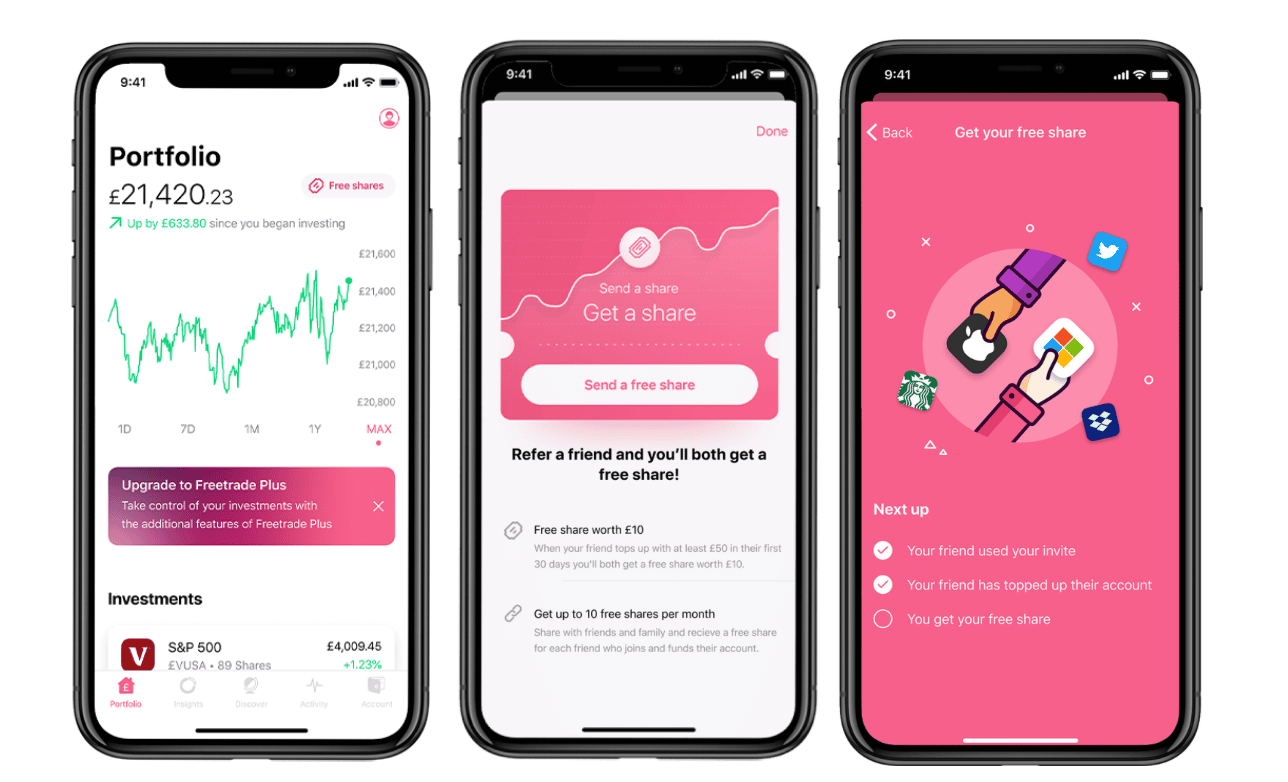
On the downside, Freetrade’s 0.99% FX fee on the free plan makes it expensive for anyone who mainly buys US or European shares: on that use case, Trading 212 is cheaper even if you pay for Plus, which still charges 0.39%. Freetrade also has no forex, CFDs or demo account (crypto exposure is limited to crypto ETNs), and no fractional shares on UK stocks.
If you invest in GBP-listed ETFs and UK shares, none of that matters, and the free Junior ISA, mutual funds and gilts are things Trading 212 does not offer.
Interested in learning more about Freetrade? Check out our Freetrade review, where we have conducted a full analysis of the platform.
Freetrade pros and cons
Pros
- Commission-free stocks and ETFs (other charges may apply)
- Free GIA, ISA, Junior ISA and SIPP on every plan
- No inactivity or account fees
- No minimum deposit
- Nice and user-friendly app
Cons
- No options, CFDs or direct crypto
- Limited research and education
- Graphs and portfolio tracking still need some development
- No phone support (in-app messages and email)
Fees and commissions
| Fee structure | Trading 212 | Freetrade |
| Stocks (US, EU and UK) | £/€0 | £0 |
| ETFs | £/€0 | £0 |
| Mutual funds | Not available | £0 (fund manager charges apply) |
| Cryptocurrencies (CFDs) | Spread only | Not available |
| Currency conversion fee | 0.15% | 0.99% (Basic) 0.59% (Standard) 0.39% (Plus) |
| CFD spreads | From 0.7 pips (forex) | Not applicable |
| Withdrawal fees | £/€0 | £0 |
| Inactivity fee | £/€0 | £0 |
| Monthly plan fee | £/€0 | £0 (Basic), £5.99 (Standard), £11.99 (Plus) |
| ISA fee | £0 | £0 (included on every plan) |
| SIPP fee | £0 | £0 (included on every plan) |
Checked in October 2026. Stamp duty of 0.5% applies to UK share purchases at both brokers. Trading 212: 0.15% FX fee applies when converting funds. Other fees may apply. See terms and fees.
Trading 212 offers a commission-free structure with the lowest FX fee of the two (0.15%), interest on all uninvested cash and a free ISA and SIPP, but it lacks investment products like bonds, mutual funds and options.
Freetrade, on the other hand, is tailored to UK long-term investors: the Basic plan is free and includes the ISA, Junior ISA and SIPP, but the 0.99% FX fee makes buying US or European shares expensive unless you pay for Standard or Plus. Worked example: investing £500 a month into a US stock costs £0.75 in FX at Trading 212 versus £4.95 at Freetrade Basic, about £50 a year more. Into a GBP-listed ETF such as VWRP, both are free.
Investment products
| Investment products | Trading 212 | Freetrade |
| Stocks | ✔ Available (real and CFDs) | ✔ Available (real only) |
| ETFs | ✔ Available (real and CFDs) | ✔ Available (real only) |
| Investment trusts and REITs | ✔ Available | ✔ Available (strong UK coverage) |
| Mutual funds | ✘ Not available | ✔ Available |
| Bonds | ✘ Not available | ✔ UK gilts and Treasury bills |
| Cryptocurrencies | ✔ CFDs only | ✔ Crypto ETNs only |
| Forex | ✔ 180+ currency pairs (CFDs only) | ✘ Not available |
| Commodities | ✔ CFDs only | ✘ Not available |
Trading 212 offers over 10,000 stocks and ETFs, making it a good fit for anyone who wants a broad international stock list. It also runs a separate CFD account, but it does not provide access to bonds, mutual funds or options.
Freetrade, on the other hand, focuses on long-term investing, offering over 9,000 real stocks, ETFs, funds and investment trusts, plus gilts and UK Treasury bills. It lacks forex, commodities and options, and its only crypto exposure is through crypto ETNs.
Account types
| Account types | Trading 212 | Freetrade |
| Invest account (GIA) | ✔ Available (commission-free trading) | ✔ Available (commission-free trading) |
| Stocks and Shares ISA | ✔ Available (no platform fees) | ✔ Available (free on every plan) |
| Cash ISA | ✔ Available | ✘ Not available |
| Junior ISA | ✘ Not available | ✔ Available (free) |
| SIPP | ✔ Available (free, shares and ETFs) | ✔ Available (free, includes funds) |
| CFD account | ✔ Available | ✘ Not available |
| Demo account | ✔ Available | ✘ Not available |
Both brokers now offer a free Stocks and Shares ISA and a free SIPP. Trading 212 adds a Cash ISA and a demo account that Freetrade lacks, while Freetrade is the only one of the two with a Junior ISA, and its SIPP can also hold mutual funds.
Safety
| Aspect | Trading 212 | Freetrade |
| Regulatory authorities | FCA (UK), CySEC and BaFin (EU), ASIC | FCA |
| Investor protection | Up to £85,000 (UK clients, FSCS) Up to €20,000 (EU clients) |
Up to £85,000 (FSCS) on investments. Cash held at partner banks covered up to £120,000 |
| Private insurance | Yes, additional insurance of up to €1 million (EU clients) | ✘ |
| Asset segregation | ✔ (omnibus account at Interactive Brokers) | ✔ |
| Negative balance protection | ✔ (CFD account) | Not applicable |
| Licences | Multiple jurisdictions | UK only |
| Listed on exchange | ✘ | Owned by IG Group (LSE: IGG, FTSE 100) |
Both Trading 212 and Freetrade are FCA-regulated and segregate client assets.
Trading 212 adds private insurance of up to €1 million for EU clients and includes negative balance protection for leveraged trading.
Freetrade, focusing on non-leveraged investments, doesn’t need these features. Since April 2025 it has the backing of IG Group, a London-listed company founded in 1974, which answers the question about the financial strength of a formerly loss-making start-up. Trading 212 is privately owned but profitable and has published audited accounts for years.
Trading platforms
| Feature | Trading 212 | Freetrade |
| Platforms | Web platform and mobile app | Mobile app and web platform |
| User experience | Extremely user-friendly | Beginner-friendly, intuitive |
| Tools and indicators | Basic, but adequate | Basic market data and in-app research (analyst ratings, financials) |
| Charting | Basic to intermediate | Basic, no advanced charting tools |
| Extras | Pies and AutoInvest, share lending, 24/5 trading, multi-currency card | Extended-hours US trading, ready-made portfolios, community forum |
Customer support
Trading 212
Trading 212 provides support through email and 24/7 in-app live chat, plus a comprehensive help centre, available in multiple languages.
Freetrade
Freetrade offers support via email and in-app chat, with priority support for Plus members. There is no phone support, but users can access a detailed help centre. Responses are typically provided within one to two business days on the free plan.
Freetrade vs Trading 212: final verdict
Trading 212
Best overall: lowest FX fee, interest on cash and a free ISA and SIPPFreetrade
Best for UK investors who want a free Junior ISA, mutual funds and gilts alongside their ISA and SIPP
Choosing between Freetrade and Trading 212 can be challenging. Here’s a breakdown to help you decide:
Do you buy US or European stocks, want to earn interest on every pound of uninvested cash and prefer a platform with no monthly fees at all? If so, Trading 212 is your best bet. Its 0.15% FX fee is a fraction of Freetrade’s, its ISA and SIPP are free, and it also gives you a Cash ISA and a demo account.
Or are you a UK long-term investor who wants a Junior ISA for your children, mainly holds UK shares and GBP-listed ETFs, and values mutual funds and gilts? If so, Freetrade is the right choice. All of that is free on the Basic plan, and the paid plans only matter if you trade a lot in foreign currencies.
Many UK investors simply use both: Trading 212 for US and European shares and cash, Freetrade for the Junior ISA and funds.
And remember, if you decide to go with Trading 212, you can benefit from a free fractional share worth up to £/€100 by signing up with the Trading 212 promo code IITW. On the other hand, if Freetrade aligns better with your investment goals, you can also receive a free share worth up to £100 by signing up with this Freetrade referral link.
Want to learn more about other brokers? Check out our in-depth broker reviews, comparison table and BrokerMatch tool to find the best option for you!
Other comparisons
Disclaimer: crypto-assets are high-risk and volatile. You could lose your invested capital, and these assets are not covered by protection schemes. Make sure you understand the risks before investing and whether you can afford to lose your money. Past performance doesn’t guarantee future results. CFDs are complex instruments and come with a high risk of losing money rapidly due to leverage. Most retail investor accounts lose money when trading CFDs with Trading 212.